

 Trade W

Most investors have a fantasy in the back of their mind about taking $5,000 and somehow turning it into $1,000,000. It plays out like this: a late-night scroll through success stories online, Instagram reels showing traders flexing in Lamborghinis, and that one friend's cousin who "made it big." The logic works: the markets move, people get wealthy, so why not you?
The answer is much more complicated than that. Yes, it is likely possible to turn $5,000 into $1 million, but it's more than simply luck or an aggressive "go for it" strategy. It requires understanding what money actually grows, the best tools to use, withstanding the ridiculously small amount of risk, and, to be honest, whether your true risk tolerance can handle the ride.
In this article, we break through the fantasy and show you the potentially mediocre reality. We will discuss the concept of exponential growth, show you the math behind compounding, talk about leverage and recognize it cuts two ways, and ultimately provide you with a roadmap for wealth building based on any starting capital. Moreover, we will discuss all of the limitations that prevent this from happening for most people and why that is a good thing.
The Power of Exponential Growth: Understanding Compounding
Let’s begin by examining the numbers, because figures don't lie.
Compounding is easy to grasp but amazing in its effect—take an amount of money, that money earns return, the return earns return; repeat this long enough, and growth starts to feel like magic. Einstein referred to compounding as the eighth wonder of the world, which sounds correct.
Specifically, if you invested $5,000 and earned 10% a year, you end year one with $5,500. But in year two, 10% is now 10% of the 5,500, not the original 5,000. So you have gained $550 to arrive at $6,050. If I had a graph chart, you can start to see the increase getting exponential with time.
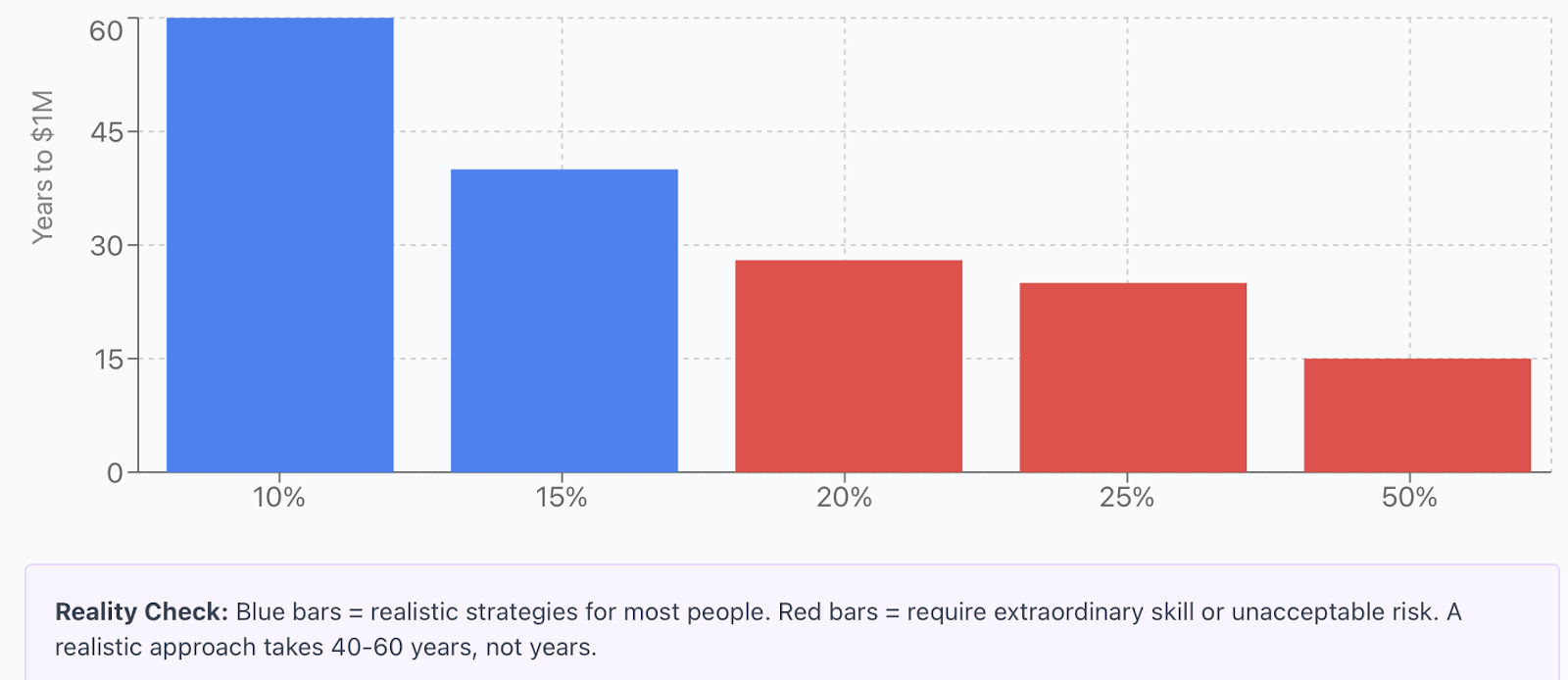
If we plug in a 10% return, after 35 years, your investment will be approximately $50,000. After 60 years, you will be at $1.3 million. Now if you could get a higher rate of return, say 25% per year, the time scales change pretty dramatically. With that return rate, you could get to $1 million in about 25 years. And hypothetically, if you could get a 50% rate of return, you could arrive at $1 million in about 15 years.
The trade-off? Those expected higher returns come with far higher uncertainty. A 10% return is reasonable for a broadly diversified stock portfolio. A 25% annual return nearly always requires active trading or leverage. And 50%? That is strictly in the realm of professional traders, hedge funds, or people willing to risk catastrophic loss.
Warren Buffett is the quintessential example. His long-term returns averaged just around 20% annually over decades. This is spectacular skill and just decades of compounding. He didn't invest once and wait for it to multiply, he invested everything and compounded and compounded, and stayed in the game long enough for the time to take flight. His original investments in insurance, manufacturing, and strategic acquisitions started compounding off one another and the results just kept getting better.
For the beginner investor, here is the tough pill to swallow: It is more about the time than the return. If you burn out or lose it all during that time, a steady 10% over 50 years will outperform explosive 30% over 10 years. Early investments trump right returns because compounded returns are patient and tireless.
Leverage and High Returns: Accelerating Wealth Through Borrowed Power
If compounding is the tortoise strategy, leverage is the hare. And as the fable tells you, the hare often experiences a spectacular crash.
Leverage is nothing more than borrowed money to boost your investment. You can use CFDs (Contracts for Difference), margin accounts, futures contracts, etc. The allure is easy to understand: you still have your $5,000, pay a broker to lend you $10,000 (for $15,000 total) and if your position goes up 10%, you've made $1,500 instead of $500! You've tripled your profit without tripling your capital requirements.
But lose, and you've also tripled your loss. That 10% gain is on borrowed money you need to repay. If the position goes down 10%, you've lost $1,500 of your $5,000 position. You're down 30%. If you get bad luck and the position goes down 20%, your entire $5,000 is gone and you still owe the broker their $10,000.
Leverage is most dangerous because it combines three elements: speed, confidence, and vulnerability. Losses happen quickly. You feel like you know what you're doing after your first winner, so you increase your size; and then a bad market call wipes out multiple months of profit in a couple of days.
Hedge funds utilize leverage because they have risk management teams, account sizes capable of absorbing losses, and rules in place to reduce position sizes at their discretion. There are also times when a hedge fund goes belly up, even when a professional manager is in charge. For retail traders, leverage is worse. Evidence suggests that retail traders who trade with high leverage will be worse off than retail traders who do not trade with leverage.
The successful high-leverage traders are not the traders you hear about on Twitter. They are disciplined traders who have money management rules so strong that they seem paranoid. They position size so small that they can take huge losses and still survive. They have somewhat of a religious belief in the use of stop-losses.
They also understand that they will lose the majority of the trades they take. Edge does not come from risk, it comes from having more winning trades than losing trades over time, where the trader takes accounts that allow the trader to be successful over thousands of trades, rather than betting the farm on one trade.
This is how leverage works, hedge funds that use leverage may be able to increase the speed of wealth growth, but that also will help increase the speed of wealth decay. They take risk with a system proven and await success of boredom to get to their final goals. For most people, leverage is a fast ride to devastation!
The Limits of Reality: Why $5,000 Rarely Becomes $1 Million Overnight
Now, let's examine the factors that truly prevent average investors from building modest amounts into substantial wealth.
The first is volatility. Market movements are anything but smooth. The equity market can swing up and down on a daily basis. In 2020, the markets fell 30% in a matter of weeks. There is a good chance that your account, if started with $5,000, could fall to $3,500 in March, then recover by December. If you panic-sold when the market had bottomed, you would have captured that loss. Even if you held the account, the emotional decisions that come from watching your money evaporate can be powerful.
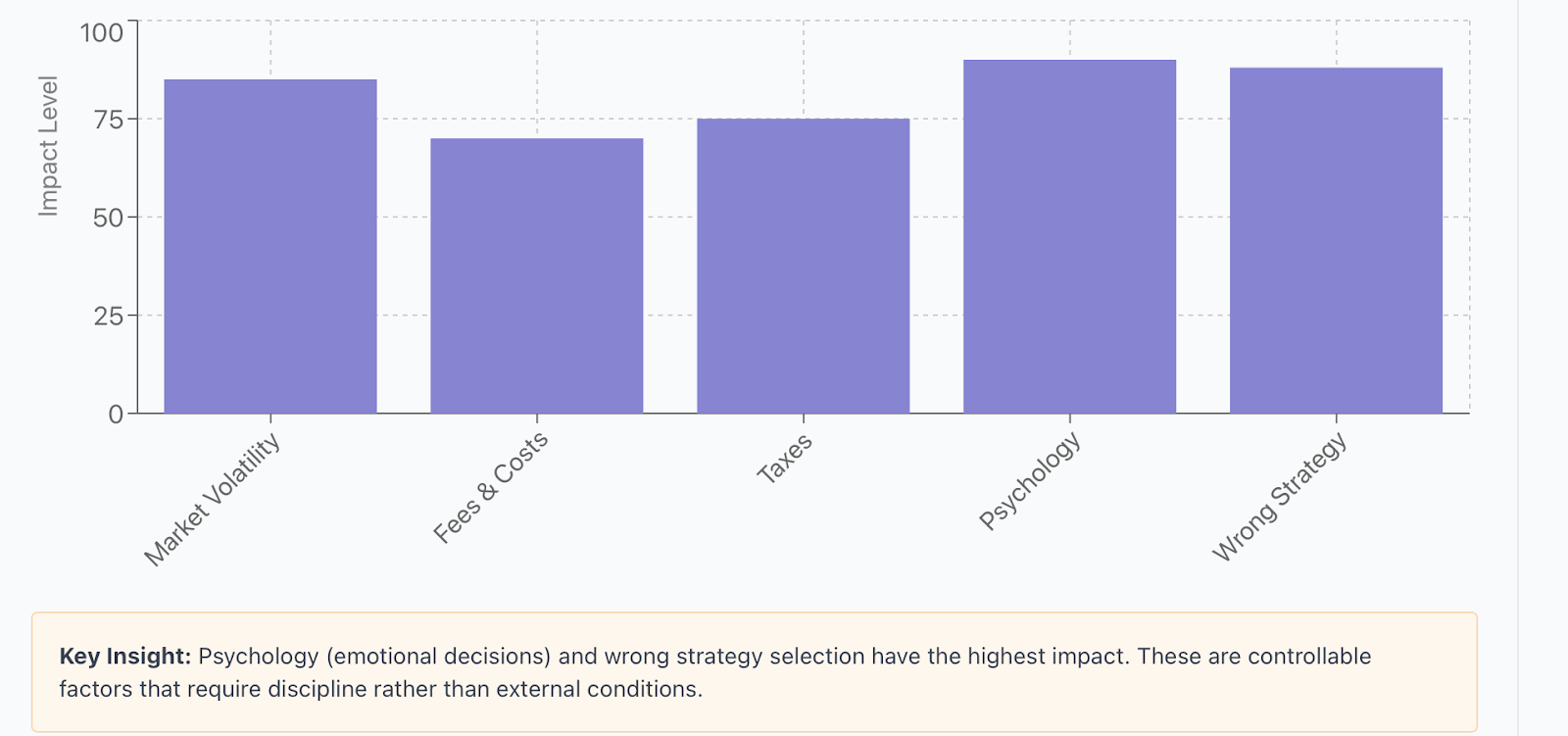
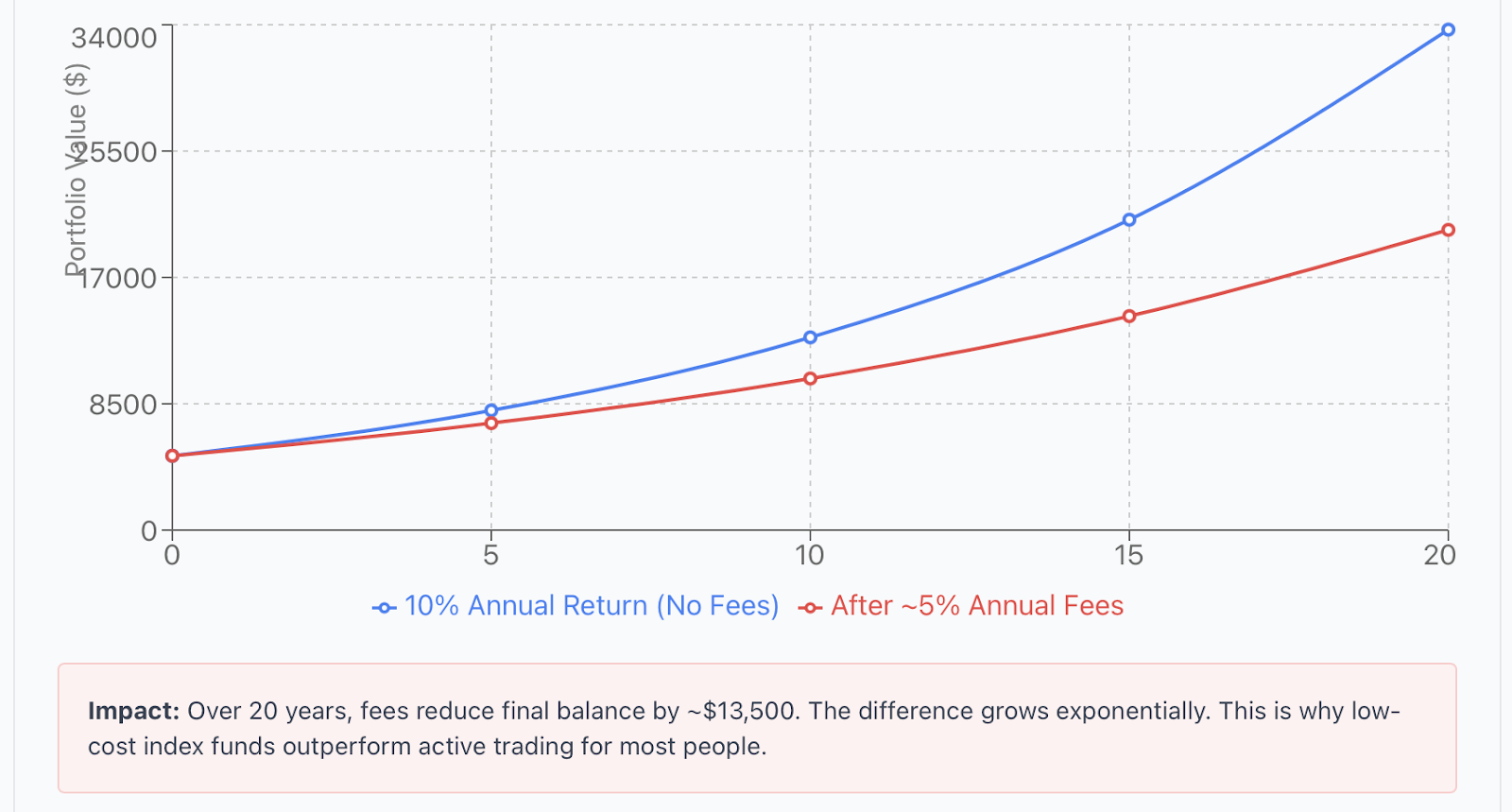
The second is fees and costs. Brokers charge commissions. Trading platforms charge spreads. If you are trading on margin or leverage, you have to pay interest on borrowed money. If you were trading on a short time frame, the costs add up and compound against you. A trader, for example, trading 50 trades a year, at $10 a trade, is wasting $500 each year on the commissions alone. A trader, after 20 years of trading a small amount of capital to start ($5,000) is looking at $10,000 in opportunity cost from the beginning from fees alone. That’s opportunity cost you can never get back!
Taxes are another factor that can act as a silent destroyer. If you are in a taxable account, actively trading, short-term capital gains are taxed at your ordinary income rates and can be over 30%. So, if you make $10,000 in profit, $3,000 goes to the government. You now need to generate an additional $3,000 just to be back to even. That’s one reason long-term holding usually experiences better performance than active trading, as the returns may be lesser than short-term strategies.
Don't forget psychology. The average investor overestimates their ability to pick a winner, rushes into trends, holds losers way too long, and sells winners way too early. They also become overconfident about the next trade following a couple of wins, which leads them to make unwise decisions. Multiple studies have shown that the average investor greatly underperforms the market as a result of trading emotionally.
Another common trading limitation is wrong strategy selection. A beginner reads one success story about day trading, and they immediately jump into it without knowing the odds of making money. The data is harsh over 90% of day traders lose money. It’s not that the strategy doesn’t work, it’s that most people don’t have the discipline, emotional control, or finely tuned systems to implement it week in and week out.
The uncomfortable truth is that it is technically feasible for a sum of $5,000 to turn into $1 million in a small number of years, but it is statistically improbable. It occurs, but usually it is due to either extraordinary talent, ludicrous luck or risking something you should never want to risk. The more realistic route is slower, but much more dependable.
Low-Risk vs. High-Risk Strategies: Finding Your Balance
Investment options vary in terms of risk and return potential. It depends largely on your timeline and risk threshold. And how you feel looking at your money do different things.
If you have a conservative approach, you are affordably investing for slow and predictable growth over the timeline you defined. In this approach, you are comfortable buying index funds that track the broader market, holding those funds for years, and reinvesting dividends.
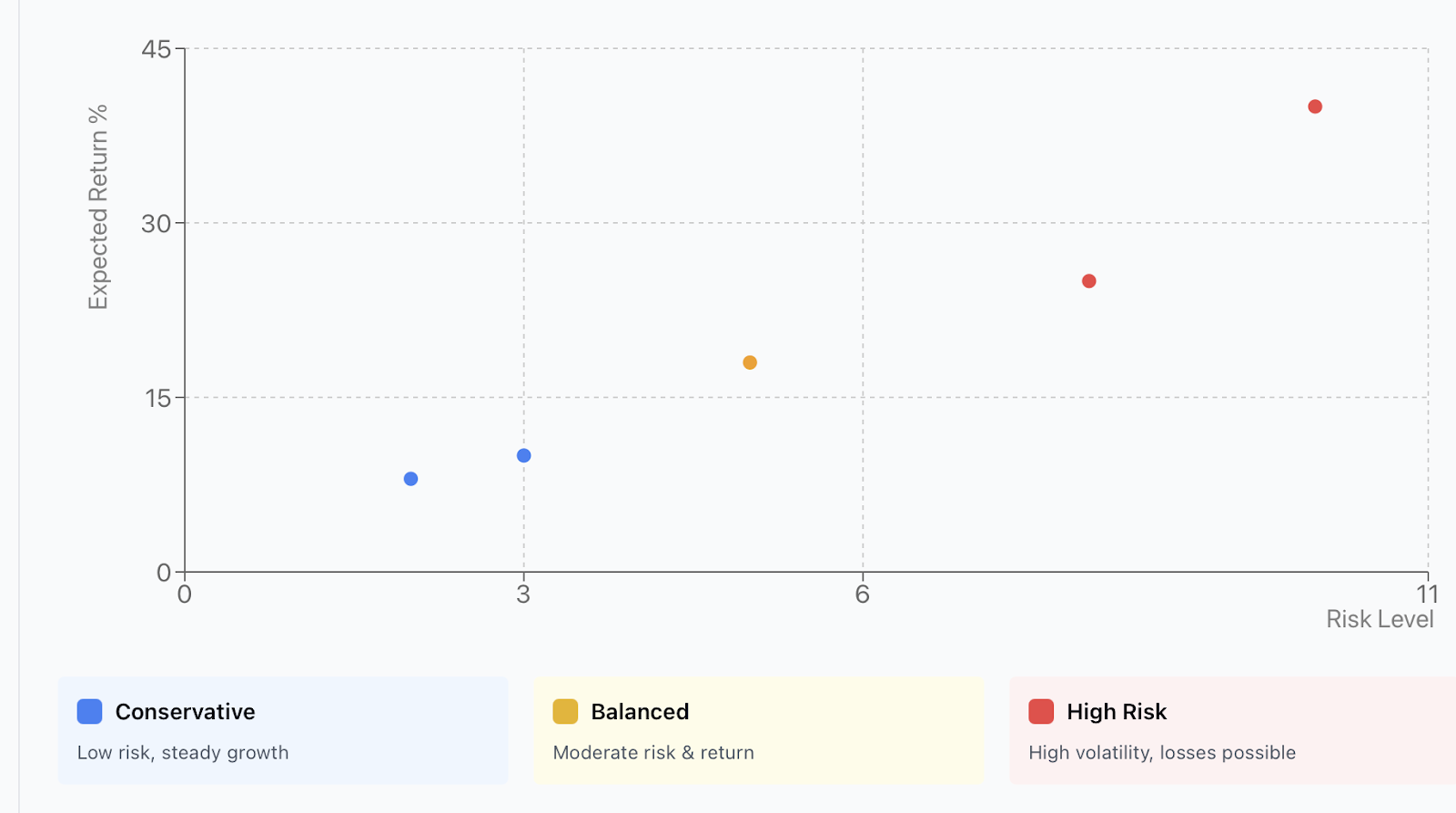
You may also buy some individual stocks, but you are diversified across sectors and geographies. You are realisitic and expect a return of 7-10 % annually on your investments and you sleep well each night! After holding $5000 in an S&P 500 index fund for 30 years, you can expect to hold between 50,000-100,000, depending on the performance of the market over that period. True wealth creation with little worry.
The best part is that conservative investing is simple and free of emotion. You do not check your portfolio on a daily basis. You do not panic in the market crashes. You understand they are short-lived, and you stay the course. This is a strategy many financial advisers recommend to those with jobs and no desire to develop the types of trading skills you're reading about.
Dramatic investing approaches aim to beat the market because investment is deemed an active decision. In this case, you might initiate mixed portfolio trades, whether they be CFDs, forex, or individual stocks. You may leverage your accounts for the sake of increased buying power.
You are strategically positioning yourself, based on economic trends, and reacting to the news. You may expect a return on your money in the range of 20-50% annually, and you may often come up big one year and get hammered the next. In this approach, the windfall is higher, and so is the risk of losing it all.
Aggressive strategies involve learning the necessary skills, which takes years to develop. You have to understand market mechanics, risk management, technical, and fundamental analysis. You also need to develop emotional discipline and the capability of accepting large and frequent losses. You also need systems that will be successful in various market conditions. The majority of people have no idea how much work this requires.
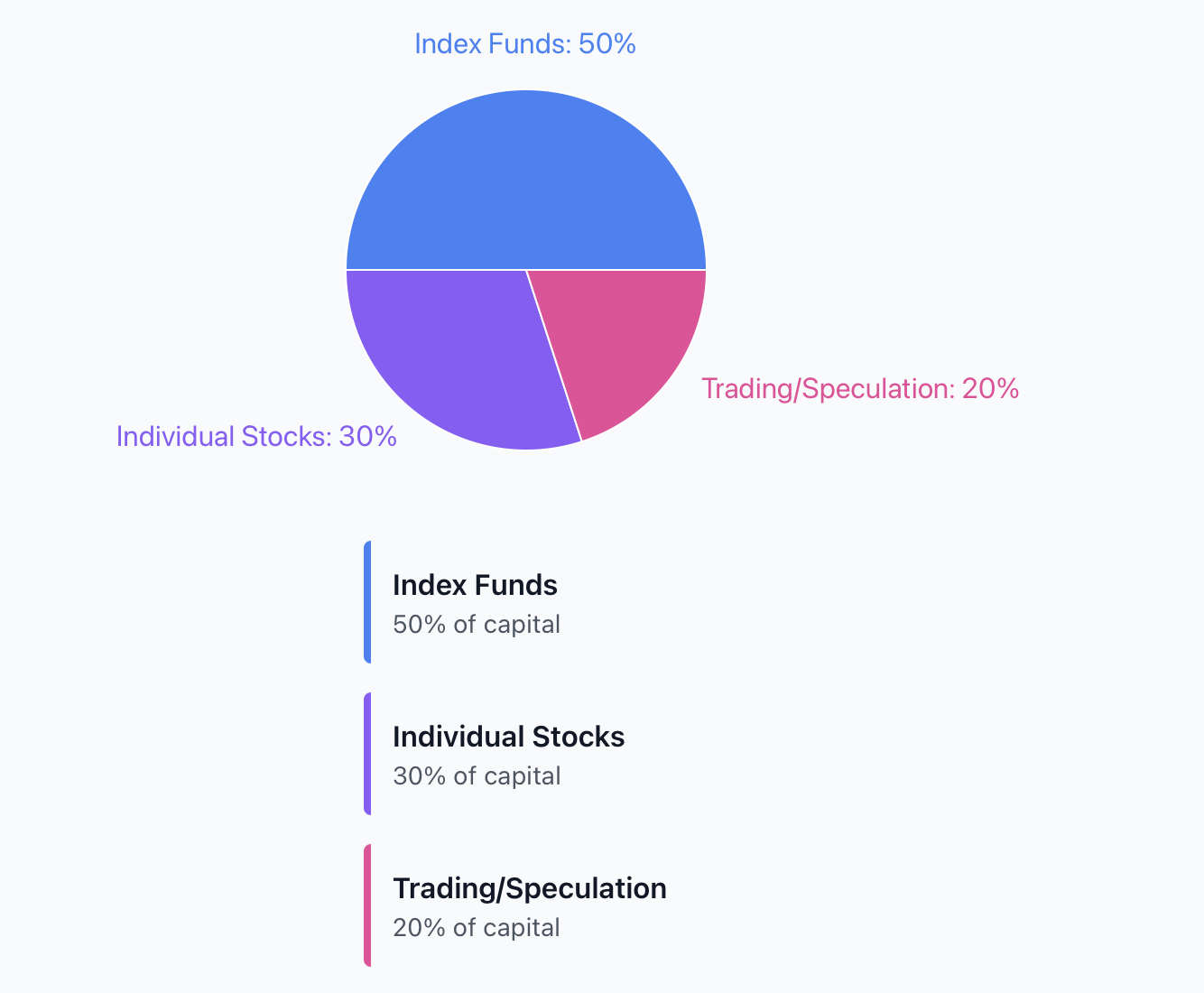
There is also a realistic alternative. While many people trade in a more aggressive manner, they use conventional long-term positions and a smaller percentage of capital for trading. For instance, you put 70% of your capital into diversified index funds or blue-chip stocks.
Then you trade 30% of your capital in a more active manner possibly with the use of leverage or speculation. This way, your core wealth can grow at a steady rate, and you can still scratch your itch for higher returns without risking all of your capital.
The most important principle to remember is that your strategy must conform to your risk tolerance for volatility and risk of loss. A person who takes a conservative approach and starts with $5,000 will build their wealth slowly but surely.
Conversely, a more aggressive trader with the same $5,000 could either triple it over a period of one year or lose it dangerously fast within a one month or less time. Neither approach is objectively superior, and each one is appropriate in its own way for a particular individual.
Practical Guide: A Step-by-Step Approach to Building Wealth
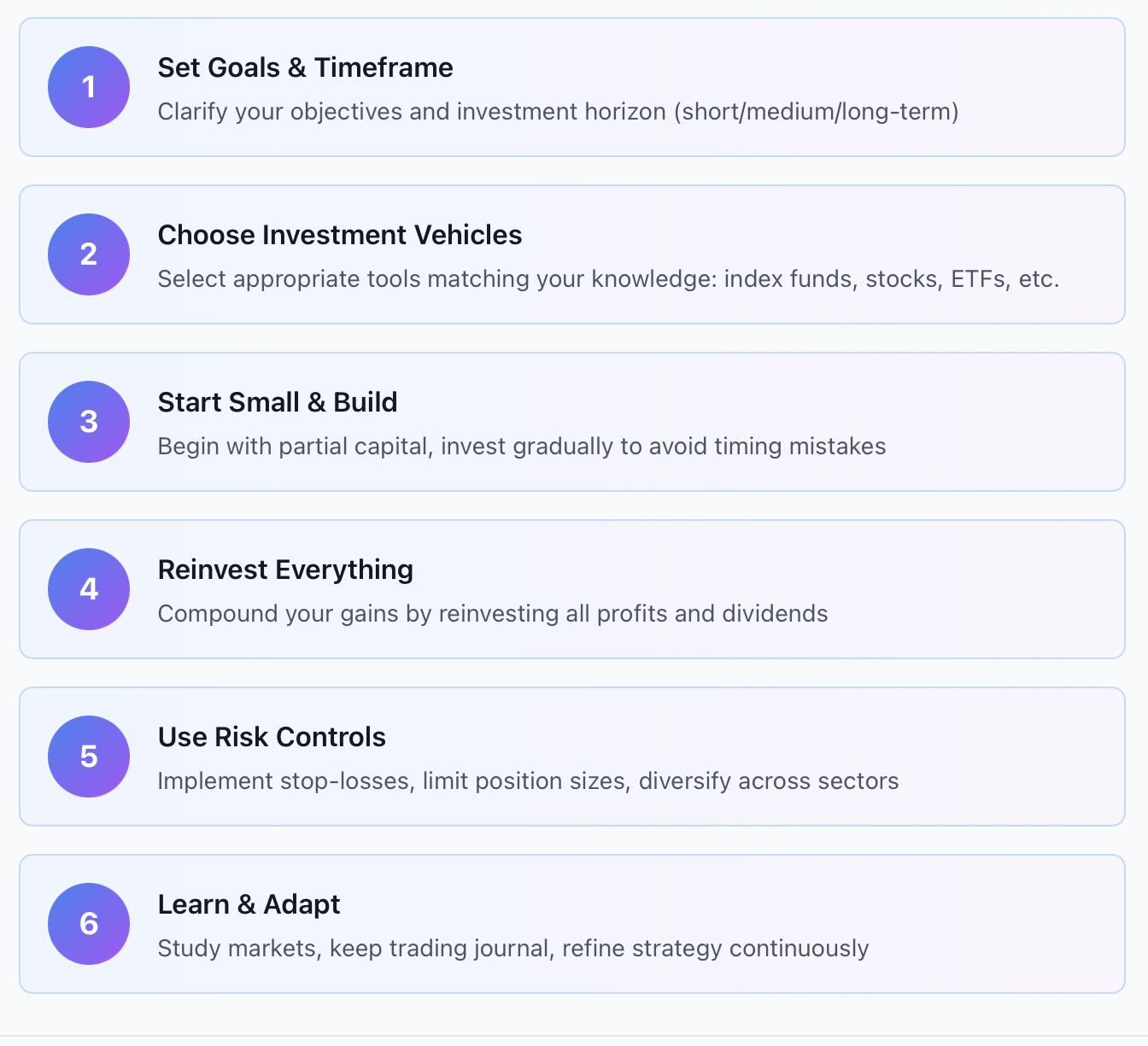
Step 1: Decide on your goals and timeframe.
You want to have a clear idea to what you're working towards and how long of a time it will take. Is your goal to accumulate retirement savings by investing for 30 years? Are you looking to generate some income over the next 1 year?
Are you trying to learn how to trade? Your answer will dictate your entire planned strategy. If you need the use of the money within five years, leveraging or taking speculative positions would be irresponsible. If you are investing for your retirement, or investing for the long term, slightly aggressive positions would likely be an acceptable strategy.
Be honest with yourself on your time frame. If you are going to be sick if there is a downturn or a drop in the market, then don't pretend that you can handle volatility in a shorter time horizon.
Step 2: What investment vehicles, or type of investments will you select?
Which vehicles will you ultimately select? Stock market index funds would be the simplest and therefore least skillful investment to apply. Individual stocks can be more engaging, however you will still need to conduct analysis before trading these assets. ETFs are index funds where you can get diversification and keep things simple. Trading CFDs (Contracts for Difference) allows you to trade with leverage, but also presents more risk to your investment.
Forex trading involves currency pairs, and the market is open 24 hours a day. Cryptocurrency is still speculative, and generally even more volatile than other investment types. Each type of investment will have differing learning curves, will require different amounts of your time, and will involve differently risk in dollars.
Begin, with investment vehicle, that matches your current knowledge and skill set. As a starting point, beginners are best suited to index funds, established ETFs, or large-cap stock. Once you become more knowledgeable and skilled, it would be acceptable to expand into investments that have more intricacies.
Step 3: Increase Your Stake Gradually
Don’t go all-in on Day 1. Start with smaller positions on Day 1. If you have $5,000; start with $1,000 - $2,000 to put in the opening position. Continue to add several weeks later. There are really several great reasons for this. You will learn as you go, you will not buy at market tops, and you will stay in the game because you only get small gains at a time and then a couple forces discipline and eliminates emotion when the time comes into play.
Step 4: Reinvest Everything
This is where the compounding starts to happen. Every profit, every dividend, every gain is put back in the portfolio. You will not take profits to buy coffee or a weekend getaway - this is now working capital. Compounding takes time and patience, while reinvesting. Do not skip this step and then be flipping money on returning an amount of money instead of using it to multiply.
Step 5: Use Strong Risk Controls
For each position, use stop-loss orders. If your trade is down 5% - 10% - exit the trade. Keep position size limited so you do not destroy your portfolio on a single trade. If you are using a multiplier (leverage) use tight stops. And diversify in many assets and sectors so one or two moves don’t wreck your entire portfolio.
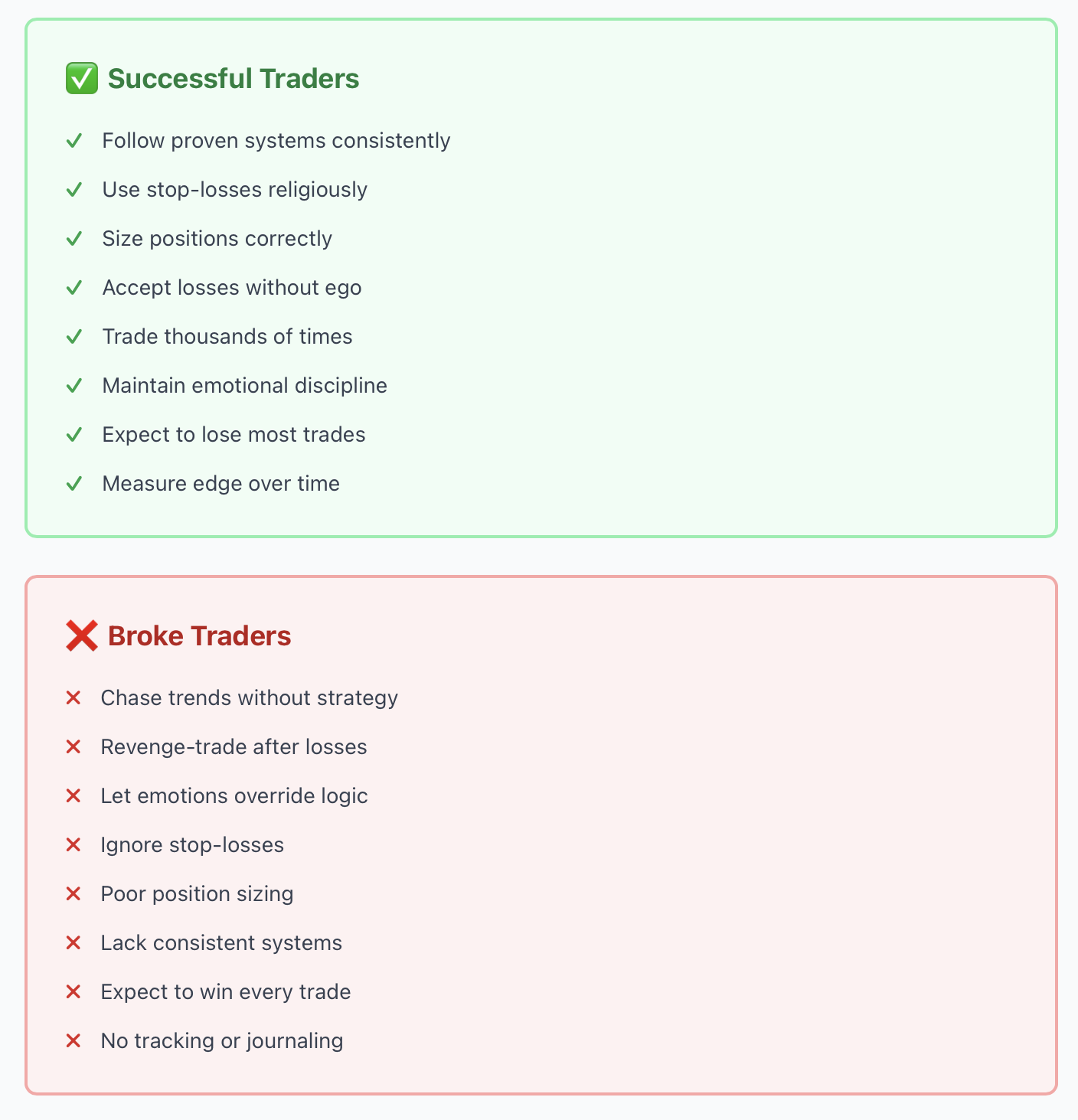
Risk controls are where you learn to separate the successful traders from the broke traders. They are not exciting, boring stuff will save your life in these markets.
Step 6: Learn and Adapt
Markets are dynamic. Your strategies need to be dynamic as well. Take the time to learn technical analysis, fundamental analysis, market cycles, and psychology. Read case studies. Keep track of your trades in a journal. Discover what works and does not work. The best traders are perpetual students.
FAQ: Myths and Truths About Explosive Investment Growth
Can you really turn $5,000 into $1 million fast?
Possibly. However, "fast" is doing a lot of work. If you mean in months, not a chance. The math doesn't add up, unless you are okay risking total loss each month while generating 50%+ monthly returns. If you mean in years, sure, it can happen with leverage and skill, but statistically very improbable. Most people who try will completely lose their starting capital. If you mean in decades, then without question yes. Compounding absolutely works, but it is done, and quantified, over decades, closer to 20-40 years of normal returns.
Is leverage trading (or margin trading) appropriate for everyone?
No way. Leverage is used by experienced traders with proven systems and the emotional discipline to withstand it. For many people, pursuing leverage is just a tactic to lose more than what capital was originally invested. If you haven't traded profitably in a normal market environment and with normal leverage for at least two years, you should probably consider not engaging in leveraged trades.
How long does compounding take for the dollar amount to be noticeable?
Nothing happens fast, at first. In your first year, using your example of $5000, your balance would be around $5500 after the first year. Wow yawn. By year ten, it will be noticeable. By year 30, it will be life changing. The power of compounding works over decades, not years.
What distinguish the successful trader from a broke trader?
It is not intelligence, but it is discipline. Successful traders follow systems, employ stop-losses, size their trades correctly, and accept losses without ego. Broke traders are trend chasers, revenge-trade after losses, and allow their emotions to override their plan, they rarely follow a well-thought-out trading plan or system.
Take Action: Start Your Smart Investment Journey on Tradewill
There is such a gap between knowing what investing is and actually doing it. Most people know that they should invest early, compounding works, and then think "someday" to start because it feels too complicated.
Tradewill breaks that wall down. Get a platform created for the cautious and new investor, an experienced trader, or somewhere in between.
If you want to build more wealth through index funds or invest in CFD trading with ways to managed-risks, there is something in the app you can use. The interface is clean, the spreads are competitive, and the customer support actually supports you in the development of your trading instead of moving transactions.
Don't wait for the "right time" or enough knowledge. Begin today with what you have, and learn as you trade. Then, give time what time is probably best at - operating. You will be grateful for starting today rather than planning on starting tomorrow.
Open your account on Tradewill, and let compounding do the magic with whatever capital you put into the game.
Disclaimer: The content of the blog does not represent any position of Trade W, does not serve as any trading-related decision advice, and does not endorse any third-party.