

 Trade W

Technology has changed by way of artificial intelligence so much to the extent that they have revolutionized how we invest money in our markets. The influx of AI-oriented stocks have created major conversation among investors, however, understanding how AI stocks work at a basic level can be quite daunting. This guide will provide comprehensive documentation of all facets of investing related to AI stocks from how it profits its companies; as well as, what you need to know in order to identify the next potential opportunity within AI stocks.
What Are AI Stocks and Why Should You Care?
AI stocks are investments in companies that research, create, or sell AI-based products or services. Companies that operate within the AI industry have created unique ways to apply AI toward developing and providing additional value. For example, several AI-related companies create chips to support the development of AI-based systems, provide an online platform to provide AI services, and develop software programs that use AI to solve everyday problems.
AI companies differ from traditional technology companies for three reasons. First, AI companies tend to rapidly grow in size, ability, and presence when compared to many traditional technology companies. AI companies can develop and release a product and establish themselves as market leaders within a few months, while many traditional companies will take years to achieve that level of success. Second, AI company stocks are often much more volatile than those of traditional technology companies.
A company can report positive quarterly earnings but this can cause an extreme price fluctuation in the stock between positive and negative earnings. The volatility of AI stocks can be affected by new product releases and quarterly earnings announcements. Third, technology ownership and skills play an important role in determining the success of an AI stock. While a company may be the biggest supplier of AI products today, it could lose market share to a company that creates better algorithms or utilizes higher-performance hardware in the future.
There are several different methods used by software and service companies (similarly hardware manufacturers) to generate profit, as indicated by the ability of software/service companies to create a large, sustainable profit margin since they are able to resell their products (or services) many times over to thousands of users with little added cost; the investment that hardware manufacturers (e.g. chipmakers) make to build their products (chips) can be significant, but the growing demand for AI-enabled computers provides a way for such companies to generate a substantial amount of revenue. Some companies are "blended" by combining both product sales with the creation of service revenues through the development of cloud technology.
Nvidia serves as an example of this blending; Nvidia sells GPUs (graphics processing units, chips) but also creates revenue from their AI cloud solutions and software tools. Microsoft also utilizes the blended approach, but their focus is on the integration of AI into services hosted by Microsoft Azure and in their productivity suite of software products. Palantir is a company that specializes in the analysis of data collected through artificial intelligence and helps organizations utilize the enormous volumes of data collected by their businesses to derive useful information about their operations.
You should consider that while traditional technology companies have historically experienced slow steady growth over time, artificial intelligence based technology companies have the potential to disrupt and transform entire industries within very short time frames (quarters). This rapid change presents both opportunity and risk to these investors; therefore, careful evaluation and analysis must occur prior to considering the investment in a technology company utilizing AI technology.
How AI Companies Actually Make Money
The understanding of the income sources of an AI organization provides a great amount of insight into the viability and future growth capacity of an AI organization. Now we can examine the four largest categories of revenue generation for these companies.
First is SaaS/cloud-based AI platforms: SaaS/cloud-based AI platforms generate revenue via a high-margin source, charging customers a subscription fee to access their AI tools (either as a stand-alone product or an analytics platform) or their AI computing resources. After the initial development cost of building the software solution, the costs of servicing additional customers are very low. A case in point is Microsoft's Azure AI service; customers pay a small monthly fee to utilize Azure’s host of AI capabilities without going through the expense of developing their own computers.
Second is Hardware sales that range from AI-specific chips to robotics equipment. Nvidia continues to be a leader in this segment, selling the GPUs required to train and deploy AI solutions. Unlike the high margin earned on software, the margin earned on hardware is lower due to the associated costs of the manufacturing, shipping, and supporting of a product sold on a per unit basis. However, as demand for AI computing continues to increase, the demand for these types of products grows substantially.
The last categories of revenue generation for AI companies fall under the broad category of Data Analytics and Consulting Services, which are a hybrid of technology and expertise. Rather than merely selling a software product to their customers, companies like Palantir are able to provide a solution that helps their clients implement AI into their business process. This generates consistent and predictable revenue and fosters long-term customer loyalty. Nonetheless it is a slower growing revenue stream than pure-play software
While it may come as a shock, advertising and platform sales are large revenue sources for many companies, including Google. They use AI algorithms to determine the best sources for their paid ads based on users' previous searches and browsing behaviors.
Social media sites like Facebook, Twitter, etc. also use AI to recommend posts, photos, videos, etc. to help keep users engaged and encourage user actions. Companies use AI to indirectly monetize it by creating a more pleasant experience for the user.
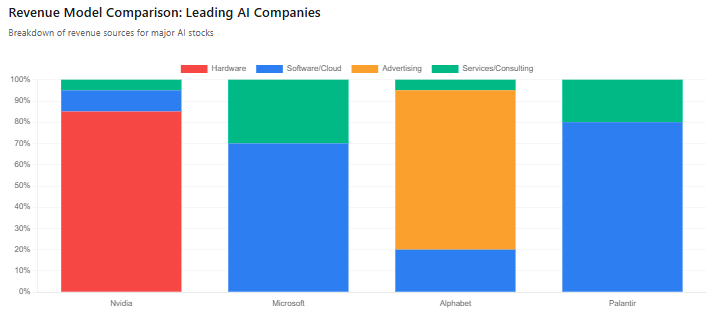
The breakdown of revenues can provide insight into the business strategies of these companies. Most of Nvidia's revenue originates from hardware sales, but as they move into software services, their margins will be greater on those products. Most of the revenue generated by Alphabet is through advertising (again through the use of AI) and now they are developing Google Cloud into a major cloud services company. Palantir focuses primarily on software and services, concentrating on government and large enterprise clients who pay premium prices for its services.
Typically, the best companies in AI are those that incorporate multiple streams of revenue. A company that solely relies on hardware sales is at risk of commoditization. Companies that depend entirely on service revenues may be limited in their ability to scale their product offerings. Companies with multiple revenue sources will have a more stable base and will continue to grow.
Gross Margins: The Real Profitability Story
Gross margin indicates how much money a business holds after paying for the direct costs associated with the inventory sold. Gross margins differ tremendously by business model within AI stocks, and being aware of these differences is important when assessing profitability over time.
For software and cloud services, gross margins are 70-90%. Once a product is created, adding more customers incurs nearly no additional costs as it was already developed. Microsoft's AI cloud services illustrate this perfectly, essentially all new Azure subscriptions represent pure profit to Microsoft as the original investment in developing Azure Cloud Services was spread out over millions of users.
On the other hand, gross margins for hardware businesses are thinner, usually between 40%-65%. Nvidia manufactures top-of-the-line graphics processing units but each chip has significant costs related to material costs, manufacturing, and testing. As demand for Nvidia chips increases, the costs associated with making those chips will continue to increase as well. However, because of Nvidia's superior technology and ability to charge a premium for their products, Nvidia has consistently achieved the highest margins in the hardware industry.
Service-centric businesses fit in between these two camps, typically falling in the 50%-75% range. Palantir provides clients both software products and consulting services; therefore, when they add a new client, the company must assign personnel to that account to support that client. This results in greater margins than traditional consulting firms, but less than pure software companies, because to successfully scale a service-oriented business, additional specialized personnel must be added.
Margins are better indicators of a company's financial health than revenue alone. For instance, a company that makes $1 billion in revenue at 30% margins keeps $300 million to cover expenses and profits; while a company that only has $500 million in revenue, but has 80% margin, keeps $400 million of that revenue to fund its operations. The company with $500 million in revenue actually generates more gross profit than the company with $1B in revenue, so therefore is able to invest in growth, research and returns to shareholders.
Monitor the trend of margins over time. An increasing margin indicates the company is scaling efficiently, automating processes, or gaining pricing power due to either the supply chain or the competition. Conversely, decreasing margins may indicate the company is facing increased competition, increasing cost of goods sold and lower margin products moving into the market. Microsoft's margins for their Azure Cloud platform are increasing as the platform increases in use.
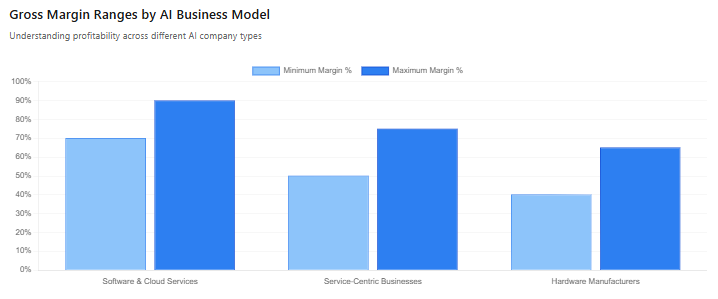
Nvidia's chip margins are erratic with the cycles of the chip market; however, their margins are trending upward due to a higher demand for their AI-based chip products. As a red flag, watch for a company that is growing in revenue, but is experiencing decreasing margins. The evidence may indicate that the company is trading off profitability for market share (it may be a smart move, or an indicator of a problem). Context is critical; young companies that are investing heavily in acquiring new customers may have a momentary decrease in margins. Conversely, established companies whose margins are compressing are likely to be facing very strong competitive pressure.
What Actually Drives AI Stock Growth
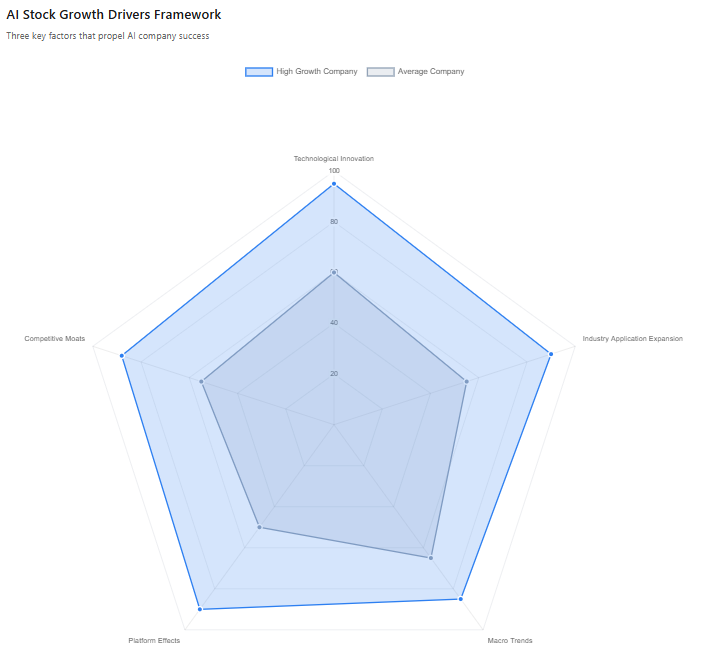
Three driving forces propel the growth of AI in the stock market, and companies that utilize all three effectively see the greatest success.
Technological innovation: Technological innovation is the first and foremost driver of AI stock growth. Companies that push the envelope create new markets for their products/services and command a higher price than others. Nvidia's graphics processing units (GPUs) improved the graphics in many computer games; however, the company was able to leverage its technology by creating a new market (i.e., training algorithms for AI) and thus an entirely new area of demand. Numerous breakthroughs in the areas of model efficiency, chip design, and algorithm performance could lead to dramatic changes for companies. However, continuous innovation (i.e., not one great product) will determine how successful companies are. Look for companies that consistently invest 15 to 20% of their total revenue into research and development and file patent applications and publish articles in academic journals.
The expansion of industry applications of AI drives revenue: Companies in the healthcare industry utilize AI to discover new drugs and diagnose diseases. Banks use AI to identify fraudulent transactions and develop trading algorithms that lead to better investment returns. Retail companies utilize AI to optimize inventory levels and provide personalized recommendations to customers. In addition, all kinds of industries (e.g., autonomous vehicles, manufacturing robots, and smart cities) are powered by AI.
Companies that effectively transition from one industry to many industries can achieve exponential growth. Microsoft began using AI with their productivity software; however, they expanded their product offering with Azure to include industries such as healthcare, financial services, and manufacturing.
Macro trends: Macro trends are creating tailwinds and headwinds on an industry-wide basis independent of the performance of individual companies. The migration to the cloud speeds up the use of artificial intelligence (AI) because many organizations can now use a cloud provider's infrastructure to deploy AI applications instead of having to create their own.
The effect of being the primary platform for an industry means that as developers utilize these platforms (Nvidia's CUDA, Microsoft Windows Azure, etc.), the businesses underlying those platforms will create success for both themselves and their communities. Digital Transformation is a key driving force behind most companies adopting AI; those who don't adapt will risk becoming obsolete compared to their competition. These Macro Trends benefit the entire industry; however, the market leaders will capture the most substantial portions of any benefits available.
Explosive Growth occurs when the convergence of all three occurs. Nvidia's GPU innovations created an onramp to training large language models when enterprises started investing heavily in AI infrastructure, resulting in unprecedented growth in both revenue and stock prices.
Identifying Potential Growth Opportunities is to analyze companies that are solving real-world issues in expanding markets while creating defensible competitive advantages. An excellent AI model will not succeed if the market isn't willing to pay for it. Entrants into an enormous market will not create a sustainable advantage if there are easy means for their competitors to copy them. The Success Stories will be those who can create a unique technological advantage, deliver substantial customer value, and create barriers to entry.
Investment Strategies That Actually Work
When investing in AI, a successful investment strategy will match your investment goals, your tolerance of risk, and your time horizon.
When investing in AI, it is most intelligent to have a long-term holding strategy for the leading AI companies that have already demonstrated that they can build and maintain their companies' business models over time. Microsoft, Alphabet, and Nvidia have shown that they can execute, innovate and maintain a stable position in the market. Volatility is insignificant if you are betting on long-term multi-year trends. Holding onto the long-term volatility of AI stocks is the only way to capture the true value of growth and mitigate unnecessary trading costs and tax implications.
Diversifying your investments allows you to reduce your overall portfolio risk while allowing you to maintain the potential for upside potential. The worst thing you could do as an investor in AI is to put all your eggs in one basket (also known as concentrated investments) or invest only in one type of AI business. Instead, consider a diversified portfolio that includes multiple types of companies; for example, Nvidia is a hardware play, while Microsoft is a software leader and Palantir is a niche provider. By mixing large-cap stability with smaller-cap companies with higher growth prospects, you can limit your exposure to any one segment of the market and still benefit from participating in the companies and/or segments that provide the highest returns on your investment
Being up-to-date on current trends helps prevent you from investing in companies without a sound fundamental business plan. For example, although growth is an important measure, profitable growth is much more important to your long-term success. Look for positive margin trends and consistent growth in revenue. Be certain that your revenue growth is justified by your customer acquisition cost relative to your customer lifetime value. Use technology trends to find compelling investment opportunities and then use financial fundamentals to validate your investment.
The highlights of risk management, when investing, include: Be mindful not to invest more than you are willing to lose on any one stock. Establish limits on the size of your position—for example, 5-10% of your entire portfolio, per stock for large-cap stocks and less on smaller-cap stocks. Place stop-losses carefully and with caution since stocks can gap-down due to earnings announcements which would render them ineffective. Monitor your investments on at least a quarterly basis but don’t allow yourself to be too emotional about your investments for short-term events.
Buying and Selling: You should always seek to buy stocks of good companies experiencing some type of temporary set-back. Examples are bad quarters, weakened broader market conditions, negative publicity that does not change the long-term fundamentals of the company. You should sell your stock when your thesis for owning that stock is broken—e.g., the CEO leaves, a competitor gains more market share, or the company’s financial metrics deteriorate. If your investment in the stock is based on the growth of that company, you should not sell the stock simply because it has gone up in price.
Small companies engaged in artificial intelligence can offer greater reward potential but have a greater risk of failure. They can experience explosive growth or go out of business overnight. If you are investing in smaller companies, it is important to determine how much money to invest in them and monitor them closely. Invest in larger, established companies for greater stability of returns and less risk of loss so that they may serve as the core holdings of your portfolio.
Top AI Stocks Worth Watching in 2025
The artificial intelligence (AI) industry is made up of many different types of companies and has a huge opportunity for growth.
Hardware and Infrastructure Leaders
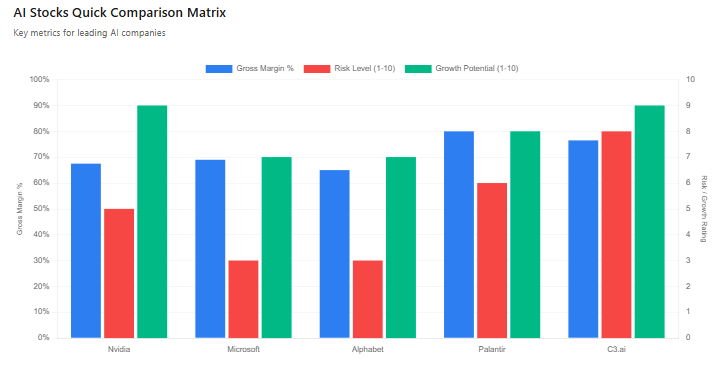
Nvidia (NVDA), the leading manufacturer of AI chips, produces the graphics processing unit (GPU) chips that are used in training large language models and powering many of the AI applications that are being run today. The majority of Nvidia's revenue is generated from the sales of its hardware, but it is also generating more and more of its revenue from cloud-based and software-based services. The company's gross profit margins continue to be about 65%-70% (very high for a hardware manufacturer). Nvidia's biggest growth drivers include demand for AI training infrastructure and gaming GPUs and the rapid expansion of the data center space. Nvidia also faces a risk of increased competition, especially from companies like AMD and from customers who are beginning to build their own chips.
Software and Platform Companies
Microsoft (MSFT) has integrated AI capabilities into every aspect of its business, including its Azure cloud services, Office software, GitHub Copilot and Enterprise Solutions. Microsoft generates 68%-70% of its revenue from software and software services, which continue to produce very high margins because of the robust sales of AI-based tools, continued expansion of Azure infrastructure and increased productivity that continues to allow Microsoft to command a premium price for its products. The company's diversified product mix provides Microsoft with significant stability; however, increasing regulatory scrutiny and rampant competition from both Amazon and Google continue to create challenges for Microsoft.
Google, with its advertising and online search business, maximizes revenue through its machine-learning capabilities in conjunction with providing digital marketing solutions, such as through cloud computing. Google also develops new artificial-intelligence technologies like DeepMind, which despite providing competing monetization opportunities for the company's current revenue stream, the search-advertising division remains the best chance for the company to monetize artificial intelligence. Additionally, through the Chrome browser, Android operating system, and YouTube video service, Google has gained tremendous amounts of data to use for training machine-learning algorithms and also for distributing that content to end users.
Data Analytics & Enterprise AI
Palantir Technologies develops and delivers software-based data-analysis solutions to help organizations understand complex sets of information in a meaningful way, using machine learning technology. Its customers include government organizations that pay for contracts, as well as commercial organizations that purchase software products and/or services from Palantir, with Palantir's model generating around 80% gross margins. In order to maintain strong revenue growth, Palantir must continue expanding its commercial market and build and sustain its government relationships. Due to Palantir's business model, which relies heavily on software sales, it has a very strong gross margin and continues to grow. However, because Palantir derives a significant portion of its revenue from government organizations, the high concentration of revenue results in revenue volatility for Palantir.
C3.ai develops artificial intelligence based on machine learning technologies to provide predictive maintenance, fraud detection, supply chain optimization, and more. C3.ai's revenue model is purely software-based, and the company's gross margins are 75-78%, thus supporting the development of artificial intelligence across multiple industries with massive market potential. The company will face competition from established players as well as specialized machine-learning vendors for their artificial intelligence services, and therefore, in order to be successful, the company will need to prove the return on investment for its services compared to alternatives.
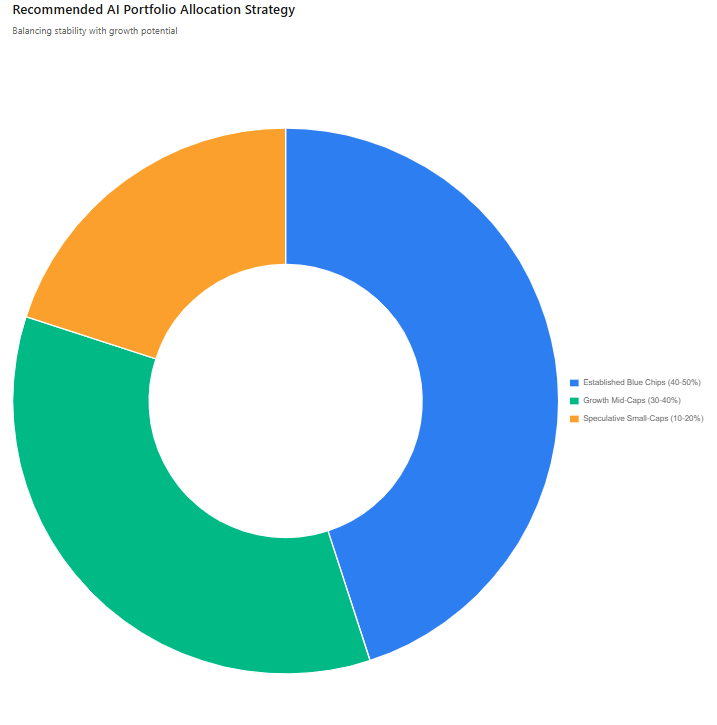
When considering how to allocate investments:
A typical core portfolio would contain approximately 40-50% of established blue chip stocks (e.g. Microsoft, Alphabet, & Nvidia) to provide stability and maintain a steady rate of growth (known as "compound interest"). An additional 30-40% may consist of established mid-cap stocks such as Palantir that show strong potential for profitability. The final allocation of 10-20% will allow for smaller, more risky, speculative type investments. Adjust allocations depending on individual risk tolerance and conviction.
Reading the Signs: Earnings Reports and Market News
AIs Trade wildly with news and earnings. Knowing what to focus on allows you to distinguish between the signal and the noise.
Here are some Key Earnings metrics:
-
Revenue Growth and Guidance
-
Gross Margin Trend (Stable, Improving, or Deteriorating)
-
Operating Cash Flow (The Actual Cash Generated versus Accounting Profits)
-
Customer Acquisition and Retention Numbers
-
Forward Guidance and Management Commentary
When a company beats its Revenue Estimates and has Margin Compression, it is likely a warning sign. If the company misses its revenue slightly but has Margin Expansion, they may be managing for profitability. Therefore, context is more important than the individual metrics.
The following are types of news that drive stock price movements:
-
Product launches or Large Updates (i.e., releasing a new GPU Generation)
-
Major customer wins or contract announcements
-
Partnership Deals with Other Tech Giants
-
Regulatory Changes impacting AI Development or Deployment
-
Competitive Threat or technological breakthrough
-
Senior Management Changes
Nvidia's Stock price tends to move dramatically whenever they announce new GPUs as each generation has greater performance gains and pricing power. Microsoft's Contract Wins through Azure represent a strong indication that Enterprise AI will grow. Palantir's Government Contracts provide predictable revenue visibility for the future.
Short-term versus long-term investment strategies: For both day and swing traders, price fluctuations due to news will often average 10-20% on the day of earnings or announcements. Day traders use these movements to try to generate a profit, while longer-term investors will generally focus on whether or not that news has changed their view of the company’s underlying fundamentals. If a business segment has a temporary slowdown in growth, but overall growth is still strong, then it’s less of a concern for a long-term investor. A product delay may provide an opportunity to buy, rather than sell, for long-term investors.
Use of news to improve decision making: Stay up to date on news, but evaluate all news in the context of your own investment strategy. Will the news change your reasons for owning that stock? For example, if you purchased Nvidia to capitalize on AI infrastructure growth, then quarterly variations in gaming revenue are irrelevant to you. Conversely, if you are holding Palantir stock because of anticipated government contracts, then a major win in that sector strengthens your investment thesis. As a timeframe manager, the important factor is how to use news to enhance your decision-making abilities and not allow news to dictate your investment strategy.
The Future of AI Investing
A number of factors will have an impact on how AI stock markets perform during the next several years and will create investment opportunities for those who know how to effectively invest in AI.
The public is very aware of Large Language Models and Generative AI, but we are still at the very beginning stages of understanding how they will affect society. The computational requirements needed to train and run these models require substantial amounts of infrastructure. Consequently, companies that manufacture chips, provide cloud services, develop tools, etc. will be the ones who benefit from the demand created by this infrastructure regardless of which model(s) ultimately prevail(s). Open AI's success has had a positive impact on Microsoft, Nvidia, Cloud Providers, and others.
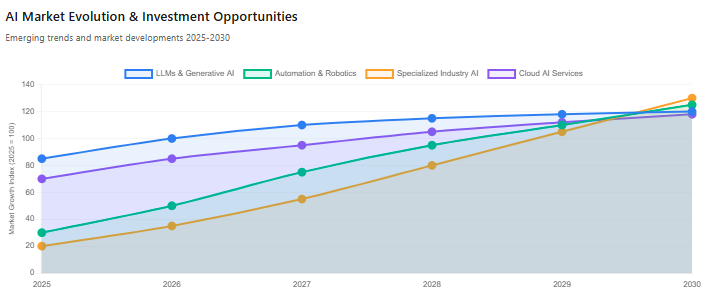
The upcoming wave of AI applications will include automation and robotics. AI robotics are being utilized more and more in manufacturing, warehouses, and logistics. Developing specially designed hardware, control systems, and providing necessary integration services for these applications will require new skill sets. As the rate of adoption for this type of automation increases, the companies that provide the needed software AI for these types of operational automations will likely enjoy rapid growth as they fill a growing market demand.
Specialized AI applications that can be applied to specific industries will create new opportunities for companies involved in the healthcare, financial services, legal services, etc. sectors. While generic AI tools are useful to companies, they do not have nearly the value of specialized solutions that are trained using data and workflows specific to a particular industry. Look for companies developing defensible positions within specific industries rather than trying to be all things to all people.
AI cloud services are being developed primarily around three major cloud providers; Microsoft, Amazon, and Google. The included advantageous Ecosystem and Infrastructure integrated into these current platforms will provide companies with no way to leverage these capabilities, therefore increasing switch costs in perpetuity, which means companies will be stuck with the company they choose to partner with initially. As a result of this high level of investment by the companies building applications for the AI platforms and training employees on each company’s services, there is a high probability of repeat revenue.
The size of the market for AI is projected to reach several trillion dollars over the next ten years. However, each company will not receive the same level of success. There will be winners and losers. The winners will combine superior technology with strong execution in their go-to-market strategies and competitive advantages they can defend. We believe there will be many AI stocks that will do very well, and there will also be many stocks that will not do as well as anticipated due to increased competition and the expectations versus reality not aligning.
To that end, investment implications are to focus on stocks that have clear and sustainable growth and profits. Avoid investing in stocks based only on hype; generally the companies that receive the most media attention are not always the most viable investments. Also keep an eye on leaders who are continuing to expand their competitive advantages and monitor any potential disruptive entrants who may use a superior business model.
Ready to start your AI investing journey? Visit tradewill.com to explore our comprehensive AI stocks list, access real-time analysis, and build your portfolio with confidence. Open your account today and turn insights into action.
Disclaimer: The content of the blog does not represent any position of Trade W, does not serve as any trading-related decision advice, and does not endorse any third-party.