

 Trade W
Introduction to Algorithmic Trading: Why It Matters in Forex, Stocks & Indices
Algorithmic trading refers to the use of computer programs to automatically execute trades in financial markets. For an analogy, think about how a vending machine gives you your refreshing drink after you insert your favorite coin. The vending machine is simply following typical programmed instructions and does not require any input from a human each time. The same with trading; the programs can buy or sell, for example, an asset like the EUR/USD currency pair or futures of the S&P 500 with a defined strategy.
What is appealing about algorithmic trading is the speed with which it can execute trades, and the precision with which you can create the algorithm's model. A human trader might take a few seconds, or even more, to analyze a chart and place an order. However, once the algorithm is executed, it can scan multiple markets, identify an opportunity, and execute the order in a matter of milliseconds. That speed in fast-moving markets when prices can change drastically in seconds becomes an advantage.
However, algorithmic trading also allows a trader to execute complex strategies that would be almost impossible to execute manually. For example, monitoring a dozen currency pairs, determining their relative correlation and executing one or more hedged positions in each market would be too much for a human to manage. For an algorithm, it is business as usual.
This complete guide will provide everything you need to know about algo trading. We will explore its interesting history, examine key concepts and strategies, consider the impact of AI in this space, discuss important risk management, review regulation, examine psychology, look at real-world examples, and consider innovation to come.
This guide offers lots of valuable information to get you started with algo trading no matter where you are? Whether you are totally new to trading or experienced but want to automate your strategy, you will probably leave with something valuable from this article.
The Evolution of Algorithmic Trading: From Manual to High-Frequency Systems
The development of algorithmic trading took off in the 1980s as exchanges introduced program trading to the market. These early systems typically employed relatively straightforward algorithms that executed simple rules, such as instructing a buyer to buy a stock if the price fell below a certain threshold. The algorithms of that time resembled mechanical toys that followed simple instructions, unlike today's sophisticated algorithmic trading systems.
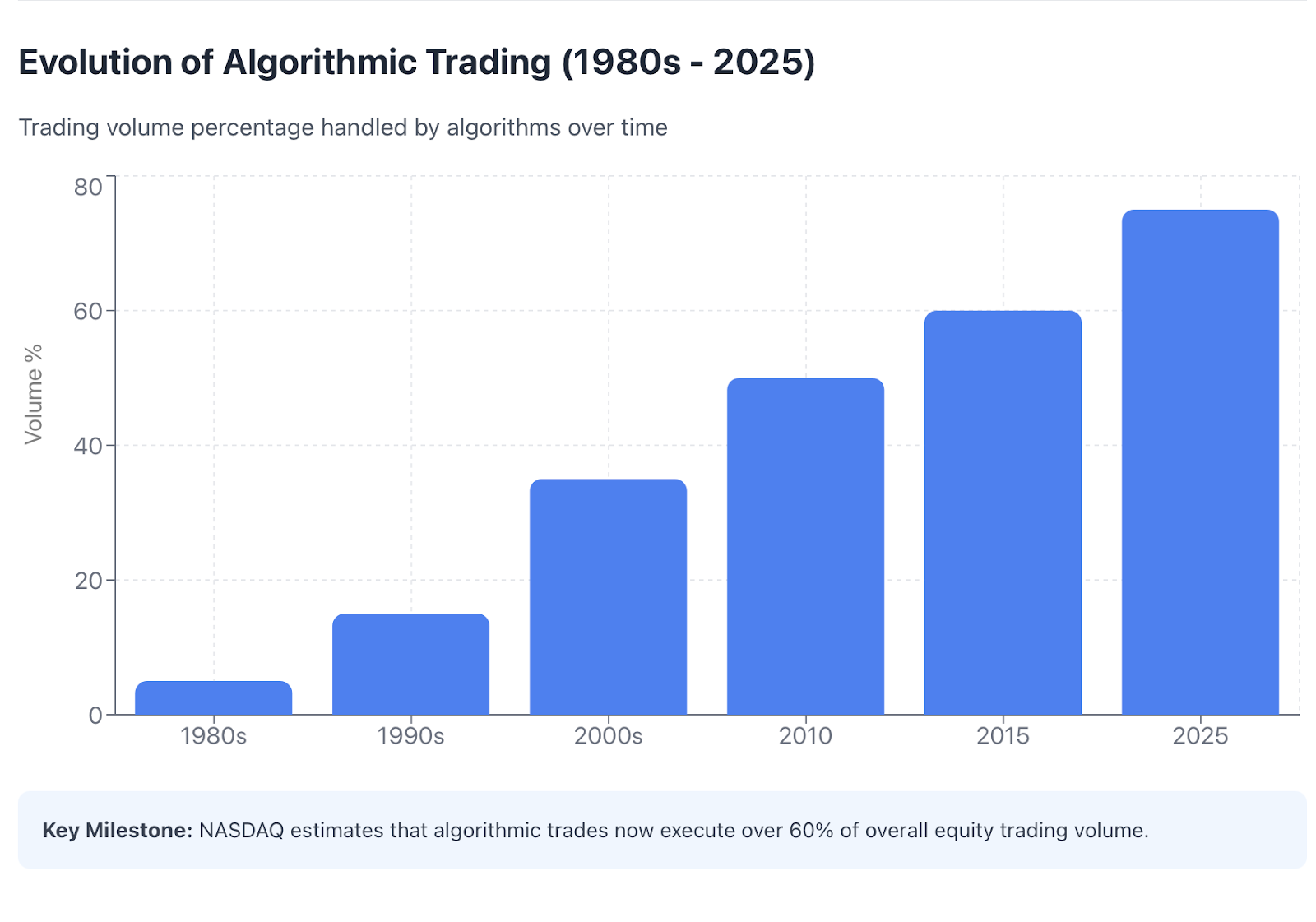
The real transformation began in the late 1990s and it rapidly accelerated following the 2008 financial crisis. Major exchanges like the NYSE and NASDAQ updated their infrastructure to accept and allow trades to be executed in microseconds. High frequency trading became a major phenomenon, with trading firms specializing in this type of trading and using super fast computers and advanced algorithms to make money being a few fractions of a price change, over and over.
The Flash Crash of May 6, 2010, became a landmark event in algorithmic trading history. Within minutes it caused the Dow Jones Industrial Average to plummet nearly 1,000 points, before moving back the other direction just as fast. This event signified the power of an algorithmic system being utilized in the equity market, but it also highlighted the potential risk involved with algorithmic systems. The investigating bodies discovered automated trading programs amplified volatility in the market as this type of trading resulted in mass selling, which momentarily destabilized everyone's market positions.
The environment of algorithmic trading today is markedly different than it was when it started. From humble beginnings as simple automated order execution mechanisms, it has grown into a complex ecosystem where algorithms are responsible for the majority of volume in major markets. NASDAQ estimates that algorithmic trades execute over 60% of overall equity trading volume. The systems are so sophisticated that they can predict movements, adapt to different circumstances, and learn from prior mistakes using machine learning.
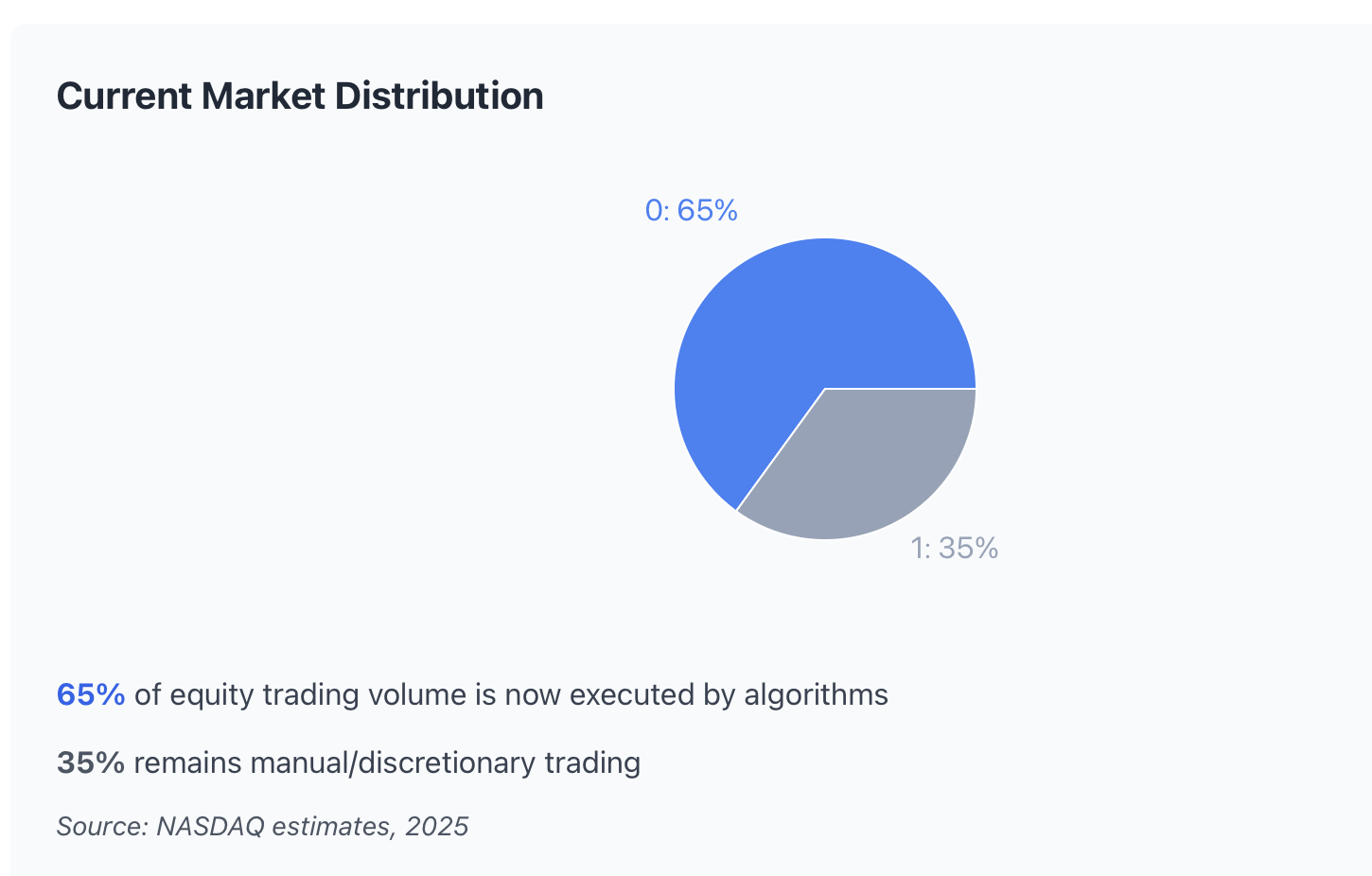
It's important to understand how and why this has occurred; these developments not only signal a change in how trades are executed. They have fundamentally changed market structure, liquidity, and price discovery mechanisms. The development of this awareness enables traders to identify more successful strategies in today's algorithm-based markets.
Core Concepts of Algorithmic Trading: What Every Trader Should Know
The essence of algorithmic trading consists of three components: a signal generator, strategy execution, and risk management. It is akin to a simple alarm clock, where you have conditions set (e.g., wake me at 7 AM on weekdays), and the system executes your command based on predefined conditions. In trading, algorithms track market conditions and execute trades based on criteria established by your trading strategy.
Signal generation is a key part of this model. It involves reviewing available market data for potential trades. The algorithm looks for price changes, volume, technical indicators, or news feeds to discover whether conditions will trigger a trade according to the trading strategy. A basic example of the signal could involve an algorithm producing a buy signal if the 50-day moving average of a currency pair crosses the 200-day moving average. This is one of the most basic applications of a trend-following indicator.
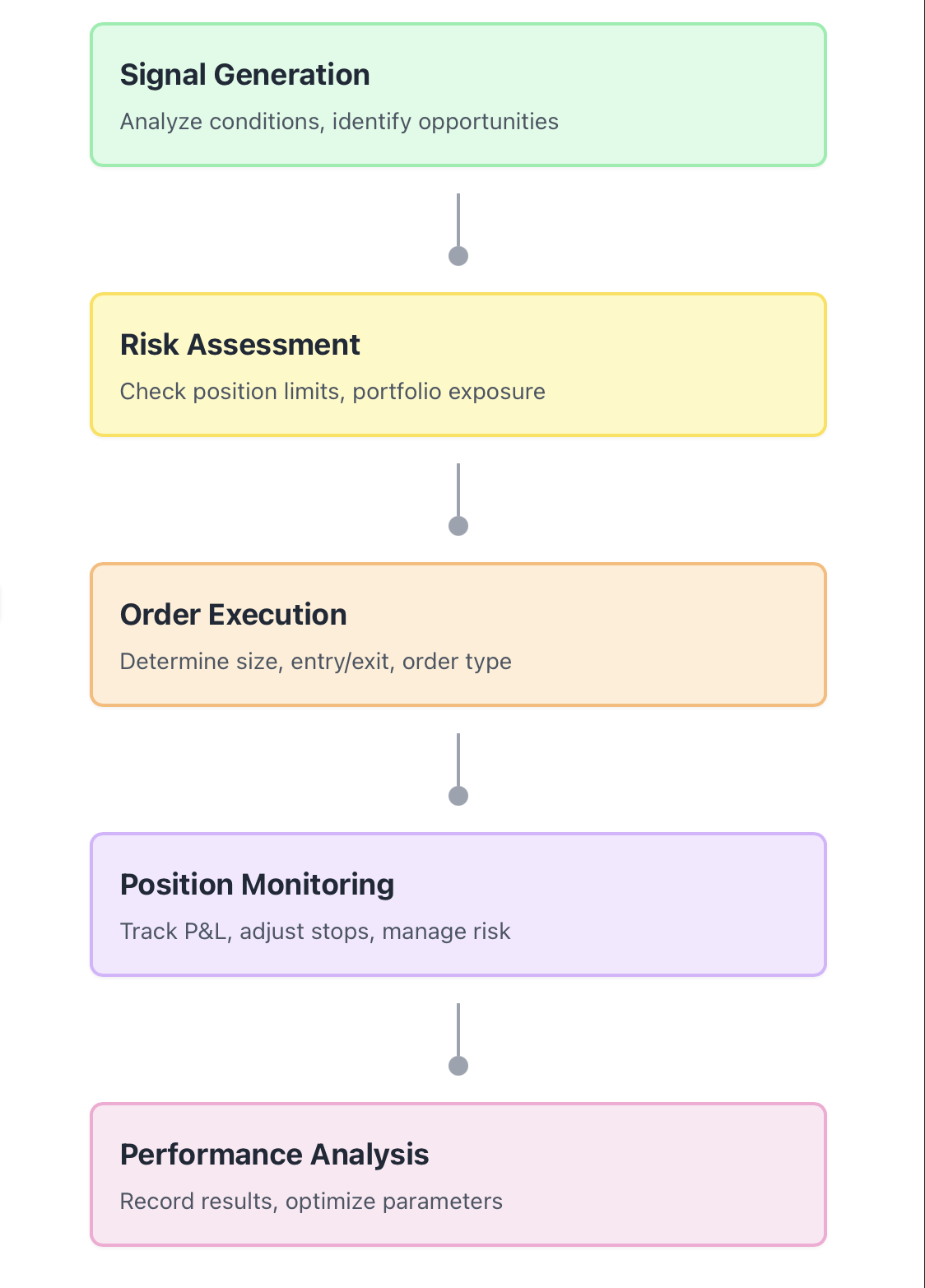
The execution of the trade takes the signals and executes it in the market. It determines position size, entry point, exit point, and what order types to use. Professional quantitative hedge funds even develop sophisticated execution algorithms that can take larger orders, such as a purchase of a stock, and execute them in smaller sizes so as not to adversely impact the market price. Instead of purchasing 10,000 shares at once and pushing the price up, the algorithms could split the orders over several hours to minimize market impact and slippage.
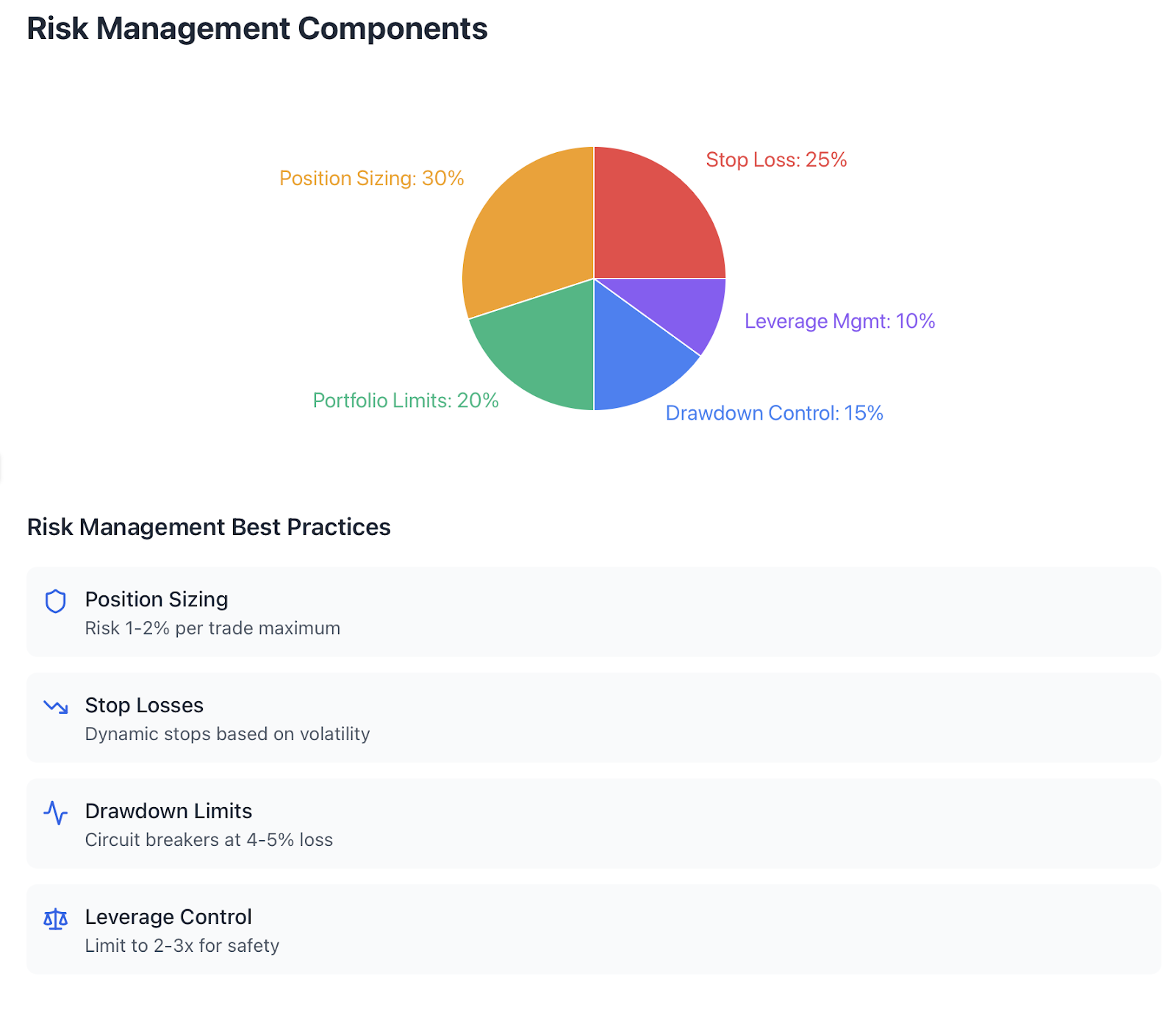
Risk management is what safeguards capital. Any algorithmic system must include mechanisms for loss limitation and profitable-positions protection. This includes: setting stop-loss levels; defining the maximum size of any position; establishing portfolio-wide risk limits. Without such risk management controls, even the most soundly profitable strategy has the potential to severely erode capital in an unanticipated event in the marketplace.
There are several different approaches to algorithmic trading. High-frequency trading takes advantage of tiny price discrepancies in microsecond timeframes. Quantitative trading looks for statistical patterns using mathematical models. Automated trading systems automate and execute longer-term strategies without manual interaction. Each approach is facilitated with different technology infrastructure, different amounts of required capital, and different risk management mechanisms.
Successful algorithmic trading mostly resides in learning how to harness all three elements — signal generation, meaningful execution, and risk management. A great signal generating system is worthless without efficient execution (with limited slippage). Perfect and efficient execution means nothing without a risk management plan. Learning how to use these processes together is how algorithmic trading evolves from a black box into a digestible control system.
Top Algorithmic Trading Strategies: How Professionals and Beginners Can Profit
Algorithmic trading strategies are available in a wide variety, each meant to capitalize on different conditions in the market environment. Complementary and useful to traders is an understanding of these types of trading strategies, so they can find one that fits with their goals, risk profile, and view of the market.
Trend-following strategies, meanwhile, are among the most basic and popular. These strategies identify and capitalize on trends based on price movement in one direction, while ignoring directional change in value. Think of it like a video game, where you automatically follow the movement pattern of the enemy. In an algorithmic trading context, a trend-following algorithm will decide to buy EUR/USD after a decisive break above resistance, and hold the position as long as the trend is upward. Trend-following strategies work really well during strong, directional moves, but can lead to losses during choppy, sideways markets.
Mean reversion strategies are defined by their opposite assumption. They assume that if an asset price has moved outside its average price after a significant directional move, the price will then return back toward its average price. When a stock or currency pair price moves significantly away from its historical average or mean, mean-reverting algorithms bet that the next move will be back to normal.
Think of it as a rubber band that has been pulled and must soon snap back toward the average. Let's say the S&P 500 market index fell by 3% and that movement could not be justified by either fundamental or transactional response, the mean-reverting algorithm would purchase the index, anticipating a bounce.
Arbitrage strategies try to take advantage of price differences across various markets or instruments. One type of arbitrage is statistical arbitrage, which is frequently used by professional funds, and consists of searching for pairs of securities that historically have moved together.
When their prices diverge, the algorithm buys the undervalued instrument, and sells the overvalued instrument simultaneously, profiting from the pair when they revert. One common example is trading the relationship between an ETF and its underlying basket of stocks. When there is a temporary imbalance, arbitrage algorithms can step in and make money quickly before the correction occurs within the market.
In terms of market-making strategies, market makers provide liquidity by continuously quoting both buy and sell prices. These algorithms earn profits on the bid-ask spreads while managing their inventory. Market making is necessary for the market to function properly, as it allows traders to make small trades without significantly impacting prices. Professional market-making firms employ sophisticated algorithms to continually update quotes based on market conditions, however, inventory position, and volatility.
High-frequency strategies function on extremely small timeframes where positions are often held for seconds or less. These strategies seek to profit on small price inefficiencies, order flow patterns, and microstructure friction. High-frequency trading requires the use of substantial technology investments, often time utilizing co-location services within close proximity to the exchange servers, and is still considered to be highly profitable for specialized firms.
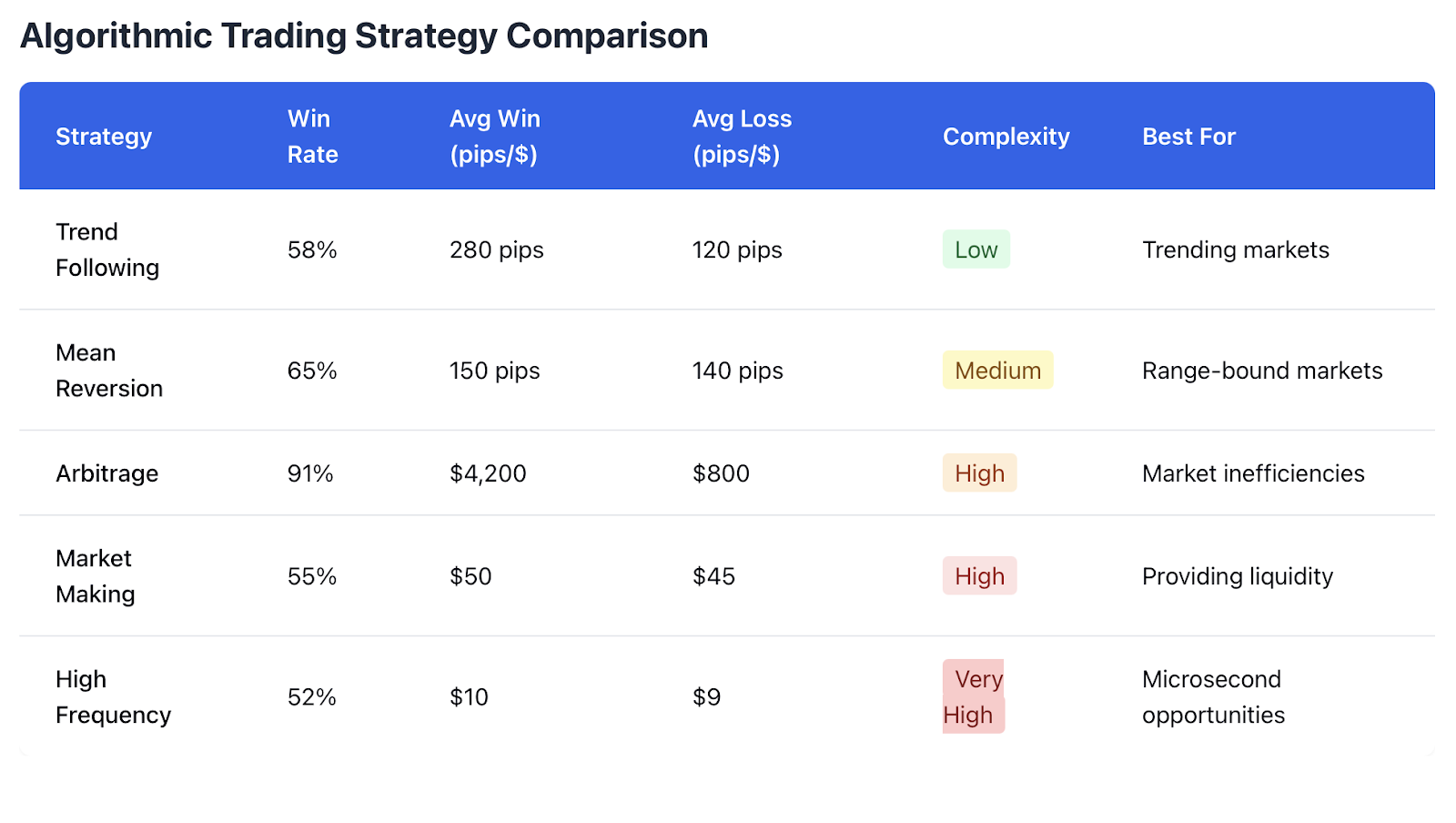
The selection of a strategy is influenced by a range of factors, such as capital availability, technology infrastructure, risk appetite, and market conditions. Trend-following may work extremely well in trending markets, but is likely to fare poorly if the market is trending in a range-bound fashion. Mean reversion performs well in stable markets but could be damaging in times of strong trends. The most successful algorithmic traders often implement several strategies in order to achieve a diversified portfolio with strategies designed to perform in various market environments.
Optimizing Algorithmic Strategies with AI and Machine Learning
Crafting a profitable algorithmic trading strategy is only the first step. The next step is to optimize, in order to maximize performance and minimize risk. Optimization requires a robust set of testing methodologies and will ultimately require continuous testing of the strategy. This is similar to how players of video games practice over and over to become better players and optimize their gameplay.
Backtesting is the cornerstone of optimizing your strategy. Backtesting essentially means running your strategy with historical market data to obtain an idea on how your strategy would have performed in the past. Because past performance is not an indication of future returns, backtesting is beneficial at detecting obvious flaws and gives you statistical evidence in terms of the potential of the strategy. Professional traders backtest their strategies under many different market conditions including bull markets, bear markets, a high volatility environment, or low volatility.
Parameter optimization involves finessing the variables in your trading strategy. For instance, suppose you have a moving average crossover strategy; you must set the length of the moving averages. Do you use 10/20 periods or 50/200? Parameter optimization will create thousands of combinations and test them to determine unique sets of parameters that resulted in the best risk-adjusted return -historically-. Traders must account for over-optimization or curve fitting; this would mean that a strategy performs terribly in live-market conditions shortly after performing exceptionally well when optimizing the strategy against historical data.
Monte Carlo simulations give us an additional layer of robustness testing. Monte Carlo simulations would take historical returns and shuffle them randomly to create thousands of different scenarios that will allow our traders to see a possible range of outcomes. This highlights how many times a strategy may lead to destructive drawdowns and whether or not the risk is worth the reward.
Artificial intelligence and machine learning are increasingly changing the way that traders can optimize their strategies. Traditional algorithms simply would operate on a set of fixed rules, and machine learning systems adapt and get better over time. Reinforcement learning is particularly powerful in this area. Reinforcement learning systems learn "optimal" trading behaviors via trial and error, similar to how human beings learn from experience. An example would be a reinforcement learning system that is trading EUR/USD creates discoveries of small specific patterns that no human programmer would have ever considered to be programmed.
Neural networks can also identify complex non-linear relationships in market data that would escape other traditional statistical approaches. The system will use all relevant information regardless of the characteristics of that information. This could be price pattern information or volume information, it could be sentiment or macroeconomic factors and will provide actionable trading signals. In fact, some hedge funds have developed deep learning systems that will disseminate their knowledge in real time of the dynamics of the market.
Finding the right trade-off between complexity and robustness is the key for successful optimization. Models that are too complex may capture noise rather than true patterns, which often translates to marginal performance in a live environment. Ultimately, the most successful optimized strategies are derived from well thought out theory fused with the details from the data. They're complex enough to identify meaningful patterns, and simple enough to weather the inevitable changes in the market.
Risk Management in Algorithmic Trading: Protecting Your Capital
Any trading strategy, even the most successful one, will ultimately fail without disciplined risk management. The history of algorithmic trading is littered with funds that had amazing performance before ultimately blowing up because of poor risk management controls. Every algorithm should aim to protect capital above every objective.
Dynamic stop losses serve as a trading strategy's first line of defense. Dynamic stops adapt to volatility conditions, while fixed stop losses stay fixed irrespective of market or instrument volatility. Fixed stops might range comfortably around entry during low volatility markets, while during periods of volatility, stops might be placed further from entry until the instrument stabilizes in price. This is akin to a videogame character who automatically exits dangerous situations before health reaches zero. Stop losses do not protect your health, but they serve a similar role with your trading capital.
Position sizing informs how much risk to take in relation to each trade. Professional algorithms rarely risk more than 1-2 percent of account capital in any one position to protect from a string of losses obliterating the account. The Kelly Criterion, a mathematical formula applied by quantitative traders, calculates the optimal position size based on the win rate and, ideally, risk to reward ratio depending on the trading philosophy. Properly sized positions allow an algorithmic strategy to survive all the inevitable losing streaks it will encounter while maximizing possible growth over time.
Portfolio risk management examines exposure across a number of strategies and instruments. For example, an algorithm trading S&P 500 may also be managing exposure in other related markets such as individual tech stocks or international equity indices. Excessive correlation in positions means you can incur extremely large losses when markets move against you. True risk is reduced by diversifying non-correlated strategies.
In the world of algorithmic trading there are different issues to deal with involving slippage and execution delays. Slippage occurs when the executed price is different from your anticipated price. This usually occurs when there is a fast moving market or not enough liquidity to fill your order. High frequency algorithms are at risk since a microsecond delay can eliminate your profit. Professional systems run slippage estimates as one part of their backtesting, and also adjust the parameters of their strategy as well.
Maximum drawdown limits are circuit breakers. These rules will automatically stop trades if losses exceed a certain amount set by the trader. If a strategy suffers atypical losses, it may be trading in a market condition outside of its intended design. Stopping the trading will also limit smaller losses from turning catastrophic. Professional funds generally have daily and monthly drawdown limits.
With leverage, gains can be magnified to a greater degree as opposed to trading solely the cash account. Enabling leverage can give your account a boost in positive return, but while in a drawdown phase it can accelerate account destruction versus a cash account. Conservative algorithmic traders utilize limited leverage depending on their setup methodology but generally limit leverage to 2x or 3x margin to avoid margin calls even in large adverse moves.
It is important to understand that risk management will never completely mitigate losses but will allow someone to perform optimally while incurring losses versus a cash account. Losses will occur. Risk management ensures losses are manageable and sustains trading against winning strategies. An asymmetric win vs loss average strategy, based on trade stats and management, will increase your probability for longer term positive net returns.
Global Regulation & Compliance: Staying Legal in Algorithmic Trading
Algorithmic trading is subjected to a detailed range of regulations intended to preserve market integrity and protect investors. It is important to understand regulation not only to avoid a fine; it is also critical to develop sustainable trading operations that can adjust to an ever-changing regulatory environment.
In the United States, the SEC (Securities and Exchange Commission) regulates algorithmic trading in the equity markets, and those regulations require firms to establish adequate risk management systems, such as pre-trade risk management controls to block perceived erroneous orders from reaching the market. Think of regulation as analogous to rules against cheating in school. This type of regulation is designed to maintain an even playing field for all participants.
There was regulatory tightening following the May 2010 Flash Crash, during which the SEC implemented circuit breakers to pause trading due to price movements that were too fast. There are market-wide circuit breakers that will halt all trading when the S&P 500 index drops 7%, 13%, or 20% during the day. There are also individual stock halts when individual stock price move a certain percentage in a period of 5 minutes on bids, offers, or transaction prices. Circuit breakers are imposed so that algorithmic trading can't supercharge the market participants into mass panic.
The Markets in Financial Instruments Directive in Europe governs algorithmic trading throughout the EU. MiFID II, which came into force in 2018, placed strict requirements on algorithmic traders. These requirements include the need to test algorithms in advance of live trading, the need to be able to monitor algorithms in real-time, and the need to keep detailed records of algorithms in terms of performance and any changes.
Firms are required to demonstrate that algorithmic and automated trading systems they deploy will not contribute to market disturbances, and if they do so, firms should have arrangements in place to ensure their systems have adequate capacity and resilience.
High-frequency trading, or HFT, is under close scrutiny, especially because of practices like “quote stuffing,” where algorithms rapidly generate orders in the market and cancel them before execution. Regulators note that such practices are concerning because they can manipulate prices or slow down competing algorithms. Regulators have also brought a series of high-profile enforcement actions, resulting in significant financial penalties. An example is a recent high-frequency trading firm that paid $14 million to settle SEC enforcement action connected to allegedly misleading trading practices.
Under market manipulation rules, it is prohibited for algorithms to engage in trading practices such as spoofing or layering. Spoofing is to place orders in the market with the intention to cancel the orders before execution—to create deceptive impressions of supply or demand. Regulators are using advanced surveillance systems to identify such patterns in the market. There have been a number of cases of convicted spoofing traders that have received not just administrative fines, but also criminal penalties such as imprisonment.
Every jurisdiction and trade will have its own registration criteria but many algorithmic trading firms will have to register as broker-dealers or investment advisers because they are not trading solely for their own account. Others rely on some of the exemptions that are allowed for proprietary traders, which have specific registration criteria, as well. Understanding where your activities fit in the registration categories is important to staying compliant.
Compliance is more than simply adhering to a rule or standard. It entails monitoring audits, the establishment of sufficient cybersecurity measures, and having a disaster recovery preparedness plan. Regulators do expect algorithmic trading firms to conduct audits of their systems consistently and to enhance controls as needed.
The regulatory environment continues to change with advancing technology. Keeping compliant means constantly monitoring the rules and changing accordingly. The potential consequences of non-compliance can be grave (e.g. a ban of activities for trading, a civil monetary penalty, a suspension or expulsion of a firm, or damage to reputation, thus never being able to attract clients or counter-parties).
Trader Psychology in Algorithmic Trading: How Human Behavior Impacts Bots
While algorithmic trading may seem mechanical, human psychology plays an important (albeit not algorithmic important) role. Understanding these psychological processes can help in terms of strategy design and predicting market behavior.
The sentiment of a market will move away from price valuations that algorithms have to manage. The two dominant emotions in trading are fear and greed; they will create predictable patterns. During times of panic, for example, fear causes traders to sell with little rational reasoning, which sends prices much lower than reasonable valuations. During times of euphoria, greed takes over as prices push upward in an unrealistic manner. Algorithms that are programmed to exploit these psychological forces (emotional extremes) can provide a profit through irrationality.
Think of bidding in an auction - bidders will become overly competitive, and convince themselves to pay much more than an item's worth. Markets behave similarly, herding behavior contributes to extreme levels of trader involvement. Many traders will pile into a trade based on popularity, and algorithms can execute pre-determined trades based on new momentum. Once the herd shifts direction, mean reversion will enterprising traders to profit on corrections.
High-frequency trading has an impact on the psychology of the human trader, and retail traders often express that they feel they are trading against machines with an unfair advantage. This notion is not completely unfounded. The algorithms used in high-frequency trading can recognize when large orders are about to come into the market and will trade in front of that order, a process known as front-running.
In a scenario where a large buy order comes into the market, the high-frequency trading system may acquire shares immediately, then sell the shares milliseconds later at a price that is a tick higher. While front-running is a controversial practice, this process is typically legal given the regulatory environment enforced today.
The implications of front-running reach both the supply and demand side of liquidity and subsequently impact market psychology, either positively or negatively. High-frequency trading firms often provide liquidity under normal market conditions (i.e., outside of an event or stress); however, in times of stress, these same firms will remove the liquidity back to the supply or the demand side (i.e., during normal liquidity and market conditions, a retail trader may see tight bid ask spreads, yet the market may exhibit extreme spreads if liquidity is not available).
This is the same phenomenon that contributed to the Flash Crash; this is where the liquidity that existed prior to the Flash Crash evaporated as algorithms all withdrew at the same time.
Another aspect of psychological impact is that overconfidence manifests in algorithmic trading in the same way it does in manual trading. When developers conduct backtesting of a trading strategy, they may develop confidence after observing positive results, and disregard the difference between back-testing and real trading.
This overconfidence leads to inadequate risk management and position sizing for the new strategies when deployed in live environments. Ultimately, if trading is poor or negative once systems go live, traders may have to make difficult decisions about the fidelity of the system, if they want to monitor the system, or intervene with a manual trade.
The psychological challenge of an emotional override to the algorithm tends to be encountered during periods of losses. When one day after day, sees an algorithm that is losing money; emotional resolve is tested. It is often the case that traders will abandon a profitable strategy because it is experiencing a drawdown; only to replay their decision later the strategy continues to make profits, after stopping. On the other side of the spectrum are a small number of traders who will continue to endure losses at the expense of their ego that they can't or won't change their strategy.
To better understand the psychology of rigged trades, is to also make advancements in algorithm design. For example, the designed strategy can include indicators of sentiment that measure fear and greed in the market or the algorithmic assessing of news will determine in regards to market moves that are appropriate or otherwise an emotional response. For example, heuristic patterns behavior modifying machine learning is at work in recognizing when the market finds itself in an irrational move that is about to correct itself.
A meeting of psychology applied to the interaction with algorithmic businesses creates both opportunities and risk. For example, algorithmic processes that have the ability to accurately assess and then profit from the emotional mistakes after being able to identify a microeconomics pattern of trade, have a substantial edge. By the same token, an algorithm index that ignores psychology and demoted the factors of human behavior in trading economics is likely on the wrong side of the emotional behavior markets.
Real-World Algorithmic Trading Case Studies
Theories can be revolutionary, but they only come to life when they are applied to actual markets. Let us now analyze two separate case studies, and see them unfold in detail, to see how algorithmic trading strategies perform within a real-world context.
EUR/USD Trend-Following Strategy
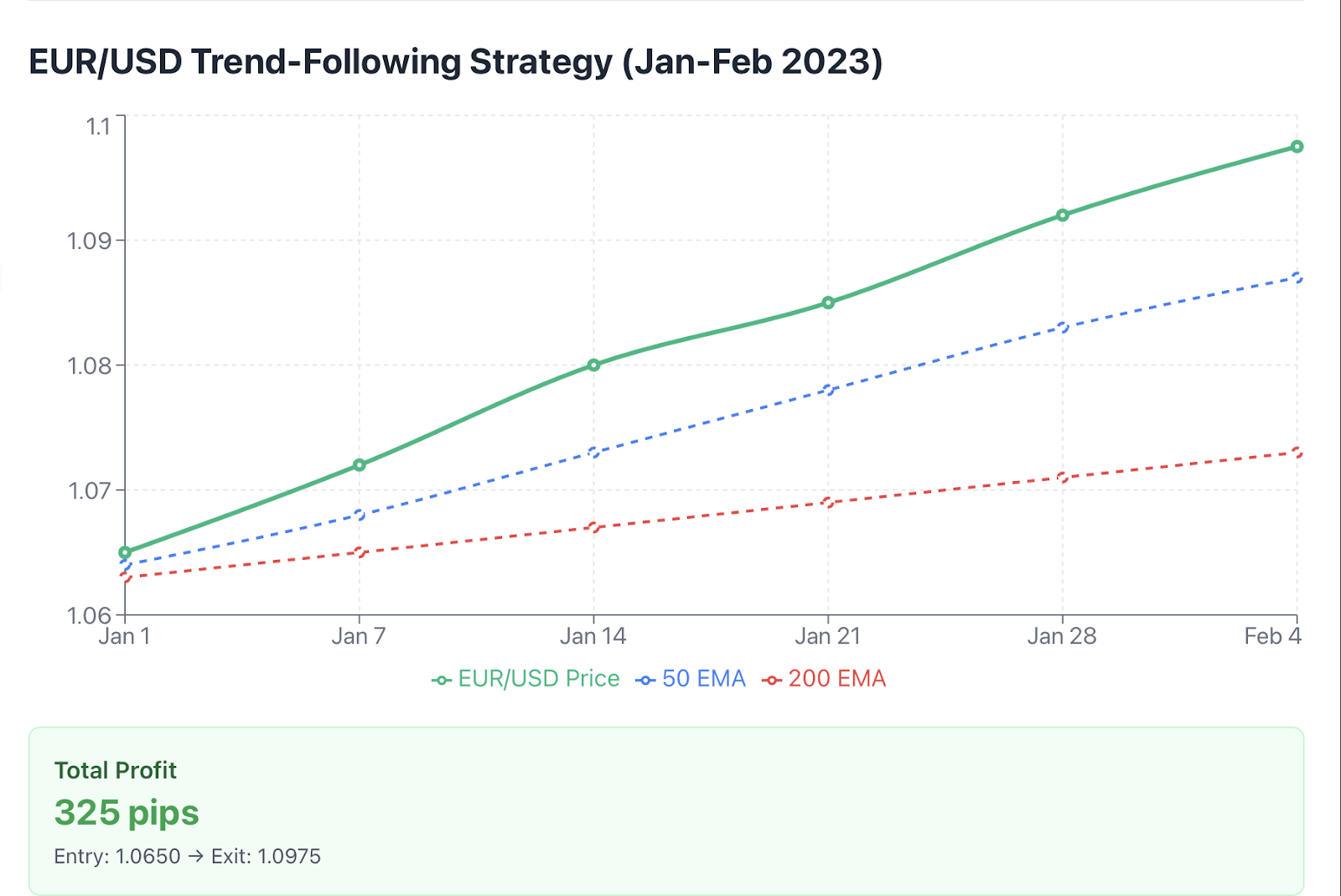
This strategy utilizes a combination of moving averages and momentum indicators to identify and trade trends in the most liquid currency pair in the world. The algorithm will track the 50-period, and the 200-period exponential moving averages on 4-hour charts. When the faster 50 EMA crosses above the slower 200 EMA, the algorithm will identify a buy. When the 50 EMA crosses below the 200 EMA it identifies a sell.
In early 2023, the EUR/USD market entered a strong and sustained uptrend as the European Central Bank continued to raise interest rates, while the Federal Reserve would signal pause interest rates The algorithm generated the buy signal at 1.0650 when the moving averages crossed back in January. It remained in its position as EUR/USD price rallied toward 1.1000 over the following weeks.
Based on the modeled trading strategy, a dynamic stop-loss was established at 1.5 times the Average True Range under the entry price. This gave the trade plenty of room to operate with normal volatility while providing a level of protection in the event of a trend reversal. The take-profit target was designed at 2.5 times risk to target an acceptable risk/reward ratio for the strategy. When EUR/USD moved to the 1.0975 price point, the algorithm had captured nearly 325 pips of profit.
However, the strategy was not without faults. During range-bound price activities in mid-2023, the algorithm generated several false signals by getting into trades that then quickly reversed. These false signals crossed several trades with a total loss of about 150 pips. Overall, the strategy remained profitable since it produced winning trades that captured larger moves than the losing trades gave back. The algorithm produced a win rate of 58% over the course of a six-month back-test period.
The average win was 280 pips and the average loss was 120 pips. The maximum drawdown for the entire six-month period was just 4.2% of account equity during a glow period in August 2023. This demonstrates that moderate win ratios can still be profitable with risk/reward ratios constructed properly.
S&P 500 Index Arbitrage Strategy
The sophisticated strategy takes advantage of temporary mispricing between S&P 500 index futures and the underlying basket of stocks. In regular situations, prices of the futures will closely follow the theoretical fair value determined in relation to the basket of component stocks plus carrying costs. Therefore, the existence of a pricing discrepancy creates an arbitrage opportunity.
The algorithm constantly checks the spread, or mispricing, between the futures price and its fair value. When the futures price at which you can buy futures contracts exceeds its fair value by enough to cover transaction costs, the algorithm sells futures contracts, while simultaneously buying the stocks in the calculated proportions. Once the spread normalizes, the algorithm unwinds both positions for a profit.
There was a significant opportunity for the algorithm in October of 2023, which was a very volatile month. For a brief moment, the S&P 500 futures traded at a 0.35% premium to fair value because there were many buy orders being filled in the futures market. The algorithm executed the trade immediately by selling 10 contracts of the futures and buying the underlying basket of stocks.
In around 15 minutes, as the market makers brought the pricing of futures back into equilibrium, the futures price premium narrowed to just 0.05%. The algorithm unwound the positions for a profit of around 0.30% after costs, which based on nominal exposure of $2 million, resulted in a profit of $6,000 for the trade that lasted less than 1 hour.
The risk management aspect of this trading approach is also quite stringent since the legs of your trade offset one another. The main risks arise when there is a delay in trade execution, as one leg of the trade is executed and the other could not execute because it slipped, or instances in rare extreme dislocations, where the normal relative relation ceases to exist.
Over the course of three months, the algorithm arranged 47 trades with a 91% win ratio. Each winning trade averaged a gain of $4,200 and the losing trades averaged a loss of $800, for a profit of over $178,000. This, however, came with a significant capital base required for execution in a low latency environment.
These case studies reflect the key principles of successful algorithmic trading: consistent strategy with entry and exit rules, systemic risk management, and realistic expectations around win ratio and profitability potential. Also clear: there are indeed strategies that will maintain consistency through various market conditions, variations of your supervisory capital base and as it relates to your trader which should remain constant across varying conditions.
Future Trends and Innovations in Algorithmic Trading
Algorithmic trading is quickly maturing due to new advances in technology and market structure. When a trader can recognize these trends in the markets, they can adapt to them accordingly and look for opportunities before they become fully adopted in the market.
Cloud-based trading platforms have democratized access to technology needed to develop robust algorithmic trading strategies. In the past, building and deploying algorithmic trading strategies had a large capital requirement upfront for servers, data feeds and co-locations services. Cloud-based trading platforms host this technology en-mass and allow a trader to access institutional quality technology for a modest monthly fee.
These cloud-based trading platforms allow the development of ecosystems in which trading strategies can be shared or codified and traders can publish their algorithmic strategies for the use of other traders. Some of the marketplaces allow the developers of algorithmic strategies to receive income from the users of their algorithm. This builds together a community in which developers can innovate rapidly and traders are able to diversify trading by running multiple strategies created by different experts.
Further, blockchain technology and decentralized finance is creating entirely new opportunities for algorithmic trading. Decentralized exchanges do not work with central authority and instead scopes peer-to-peer trades using smart contracts. Algorithmic traders are developing trading bots that are automatically providing liquidity for decentralized exchanges as well as arbitraging prices between centralized exchanges and decentralized exchanges in addition to being able to exploit decentralized finance strategies such as yield farming and liquidity mining.
Blockchain's data transparency provides insights into trading behavior that have never been possible before as each transaction is recorded on-chain, allowing algorithms to follow wallet transfers, track whale activity, and forecast price changes based on on-chain indicators. This is a significant development when comparing it to traditional finance where much of the trading activity is obscured.
There is a growing appetite for environmental, social and governance focused algorithmic strategies. Investment algorithms evaluate sustainably sounded investments within an ESG framework while still optimizing for financial returns. Machine learning systems review sustainability reports, collect carbon emissions data, and analyze metrics for social impact to identify companies that are likely to be a top performer once ESG is front and center in an investor's consideration.
Although quantum computing is still nascent, it may eventually transform algorithmic trading by enhancing decision-making in situations that require solving optimization challenges that classical computers cannot solve in a reasonable amount of time. Taken together, portfolio optimization across thousands of unique securities, millions of iterations using Monte Carlo simulations, and completing complex option pricing models could vastly outperform classical computers on quantum computing systems. As early adopters achieve expertise in quantum algorithms, there is potential for outsized advantages.
The field of natural language processing (NLP) is progressing, enabling algorithms to discover trading signals in unstructured data. Now, modern NLP systems are processing transcripts of earnings calls, financial news, social media sentiment, and regulatory filings looking for upcoming market impact before it is entirely priced in. In fact, some hedge funds have developed armies of algorithms that continuously monitor text data, searching for information which traders may not have noticed.
Expect regulators to step up enforcement as algorithmic trading continues to gain prevalence. Regulators are building even more sophisticated surveillance capabilities to identify market manipulation and uphold fair markets. Traders can expect heightened reporting standards, mandatory test-based systems, and possibly limitations on particular high-frequency trading strategies.
Themes in trading will potentially continue to emerge relative to traditional and cryptocurrency markets. With institutions lifting their hands to adopt bitcoin and other digital assets, algorithms that trade both traditional and cryptocurrency markets will be able to identify difficult-to-find arbitrage and correlation opportunities. For instance, cross-market strategies may be able to capitalize on relationships relative to the price of bitcoin and the price of gold or stocks priced on blockchain with cryptocurrency.
It will also be easier to have personalized algorithmic trading strategies. Instead of having a generic strategy, traders will develop AI systems that learn risk tolerances, market perspectives, and adapted trading styles, creating personalized algorithms. These will streamline automatically, gaining their strengths and weaknesses based on institutional feedback, while adjusting to market forces.
The future of algorithmic trading may lead to a more sophisticated, more widely accessible, and more highly regulated form of trading. Traders who are aware of changes in technology and alter their strategies may have the best chance of prospering in the evolving landscape.
Conclusion
Algorithmic trading signifies a significant change in the operational dynamics of financial markets. Algorithmic strategies have progressed from basic automatic order placement to more paramount systems that now represent the bulk of trading activity across all asset classes. The possibilities from these systems are intriguing; algorithmic trading can trade faster than humans, potentially execute complex multi-market strategies, and maintain disciplined risk controls in a way that individuals cannot.
Through this guide we have covered the basics of algorithmic trading. We have traced algorithmic trading through earlier versions of program trading and into modern high-frequency trading systems. We have broken down the fundamentals every trader should understand, as well as analyzed well-known trading strategies including trend-following and arbitrage strategies. We have also discussed how AI and machine learning are improving strategies, why risk management is essential to long-term survival, and the landscape of regulation surrounding algorithmic trading.
The studies of psychology confirm that even in automatic trading - people can still have an effect on the market. Markets are ultimately driven by people, and algorithmic systems that trade based on understanding patterns of human behavior will have an advantage over pure technical systems. Examples from the market support that successful algorithmic trading is a marriage of good theory, good execution, and realistic expectations.
As we look to the future, new advancements in cloud computing, blockchain, AI and quantum computing, which all promise to make algorithmic trading even more accessible and powerful. The democratization of these technology platforms will allow traders to implement strategies that were once only used by institutional traders.
Algorithmic trading is not dependent on you being a program master or investing millions of dollars into infrastructure. It fundamentally is about understanding the essential principles, starting with established strategies, creating sound risk management protocols and continuously learning from successes and failures. The traders that will be able to capitalize are those that are able to blend technology with market knowledge while achieving discipline in execution.
Ready to start your algorithmic trading journey? Tradewill provides the real-time charting tools, market data, and execution capabilities you need to bring your trading strategies to life. Begin exploring the possibilities today and discover how algorithmic trading can transform your approach to financial markets.
Disclaimer: The content of the blog does not represent any position of Trade W, does not serve as any trading-related decision advice, and does not endorse any third-party.