

 Trade W

Regarding ARMOUR Residential REIT (ARR), if you find this company while searching for high-yielding dividend payer stocks, you are not the only one! The attractive double-digit yields on this stock's dividends certainly grab your attention when you look at the stock price, and the fact that the company pays dividends monthly makes them more appealing.
However, in the excitement of potential dividend payments, many do not notice that ARR's dividend history has been marked by significant volatility, dividend reductions, and a steady decline in the stock price, which could eliminate those high-yielding dividends quicker than you can utter “passive income.”
We will now look into the business model of ARMOUR Resident REIT, how the company has been paying its dividends throughout the last decade, along with some of the reasons why investors should avoid pursuing high-yielding dividend-paying stocks without taking the time to understand what they are doing.
What Is ARR? Understanding ARMOUR Residential REIT
Founded in 2008, ARMOUR Residential REIT (ARR) is a different type of real estate company. Rather than owning physical buildings (e.g., apartments or shopping centres), ARR is a mortgage real estate investment trust (mREIT). They invest in mortgage-backed securities (MBS) – mostly, agency MBS that are guaranteed by the government (e.g., Fannie Mae and Freddie Mac), rather than investing directly in real estate.
Here's how it works: ARR borrows from banks and other financial institutions at short-term rates (think cheap debt). They take the cash they have borrowed and purchase long-term mortgage securities that pay higher yields. The profit from this strategy comes from the difference (or "spread") between the cost of borrowing and the interest earnings on the securities purchased.
In the simplest form, this is how it works. However, the use of leverage is significant. ARR typically borrows $8-$10 for every $1 of equity. ARR can print money when borrowing costs are stable, and high spreads exist between what they pay for money and what they receive from the securities. On the other hand, when interest rates are volatile or tight spreads exist, ARR's business model is adversely impacted.
To illustrate this more clearly, think of borrowing $10,000 at 2% interest and using that money to purchase bonds with a yield of 4%. You would pocket the 2% difference between the two rates. Now, consider this scenario: interest rates rise rapidly; your borrowing costs increase at the same time, and the value of your current bonds decreases because of the higher rates on newly issued bonds. This illustrates the ARR business model.
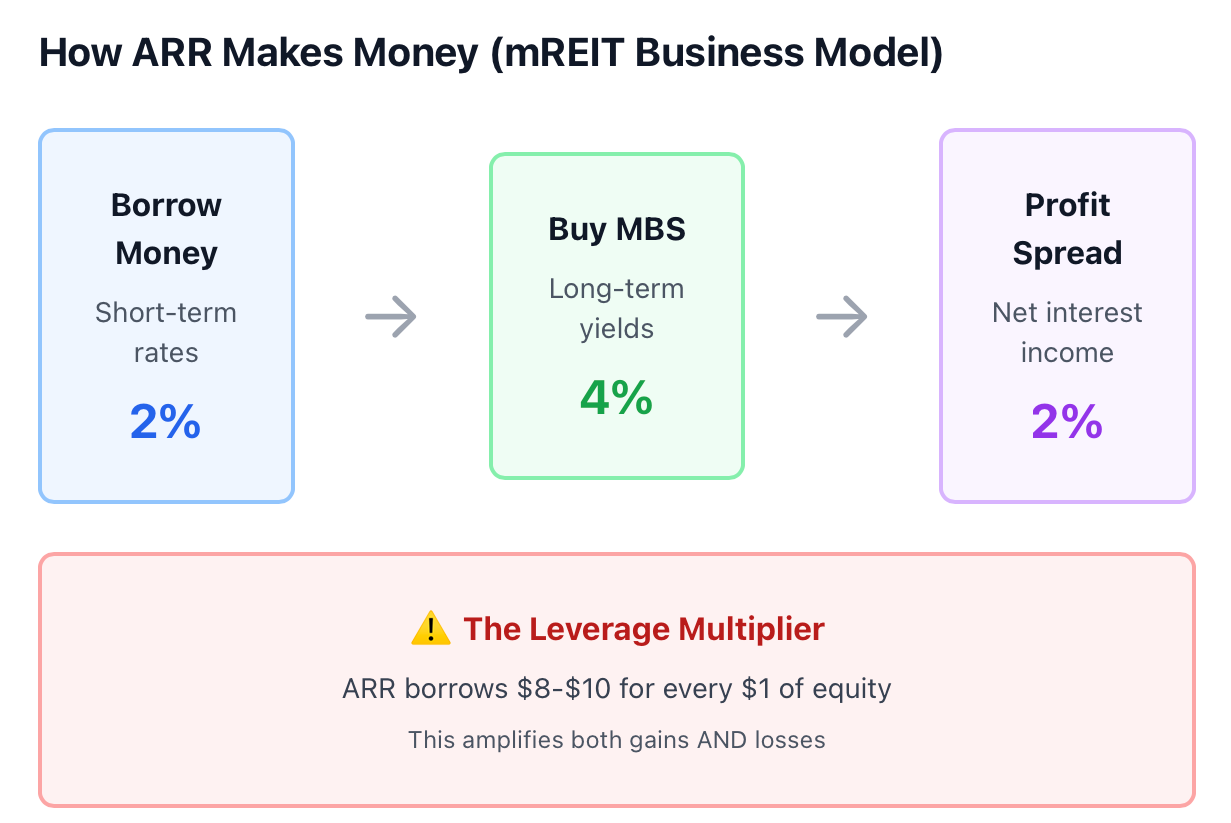
The most important aspect of the ARR model is: depending upon how they make their money is that it does not involve investing in real estate; it involves trading interest rates. This is the reason why the dividend history of ARR is very volatile.
ARR's 10-Year Dividend History: High Yields, Higher Volatility
Each month, ARR will pay you a cash dividend. This is an incredible feeling to see cash go into your bank account every 30 days, isn't it? Yet, if we dissect the actual cash amounts of that dividend, they really paint a different picture than that positive psychological view.
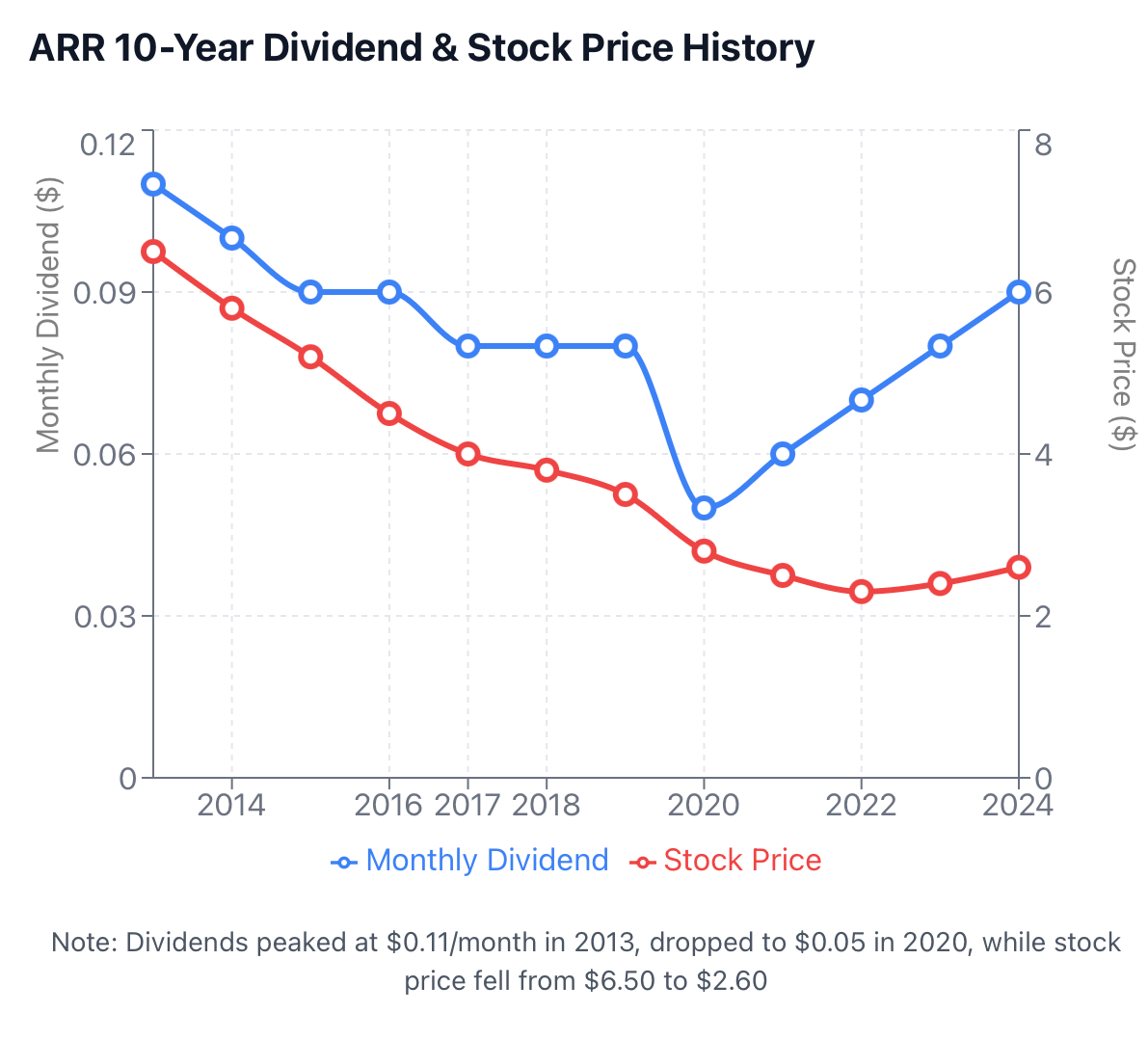
For example, in the last decade, ARR has had its dividend cut on numerous occasions. For instance, in 2013, the monthly dividend paid was approximately $0.11 per share. Fast forward to 2020, and it had fallen to approximately $0.08 per share. When the pandemic hit, that dividend fell further to approximately $0.05 per share. Fast forward again to 2024, and while the dividend is higher than it was previously, it still has not recovered to where it was historically.
Based on the history of ARR, we can see the pattern that ARR typically increases the dividend amount in a good interest rate environment, only to drop it when the environment turns bad. Therefore, when dividends are raised, you will see that reflected in the yield, which can sometimes be 15%+ when compared to current payouts.
This is where new investors make a mistake: they see the 15% yield and think that yield will always be there. It may not. The yield you see reflects the current dividend paid divided by the current stock price. Next month, that dividend could drop, for example, by 20%, and all of a sudden, you have a "high yield" investment bleeding you dry.
The ARR dividend history does not provide a guarantee. It shows you the history of the dividends paid under certain market conditions. Those conditions will change.
Dividend vs Total Return: The Missing Half of the Story
The total return is the basis upon which the ARR pitch models all of the flaws of return on investment by looking only at the dividends received. Total return is derived from price appreciation (or depreciation) and dividends.
The total return on ARR will always be less than that of an S&P 500 index fund because while it offers a high rate of dividend yield, it has also experienced a long-term decline in price since it reached approximately $6-7 per share in 2013 to below $3 per share in 2020 and now is hovering around $2-3 per share (as of late 2024).
This means that if you had purchased ARR shares at the $6 price in 2013 and collected all the dividends, you would still be in the red because your dividends did not cover the price drop of more than 50%.
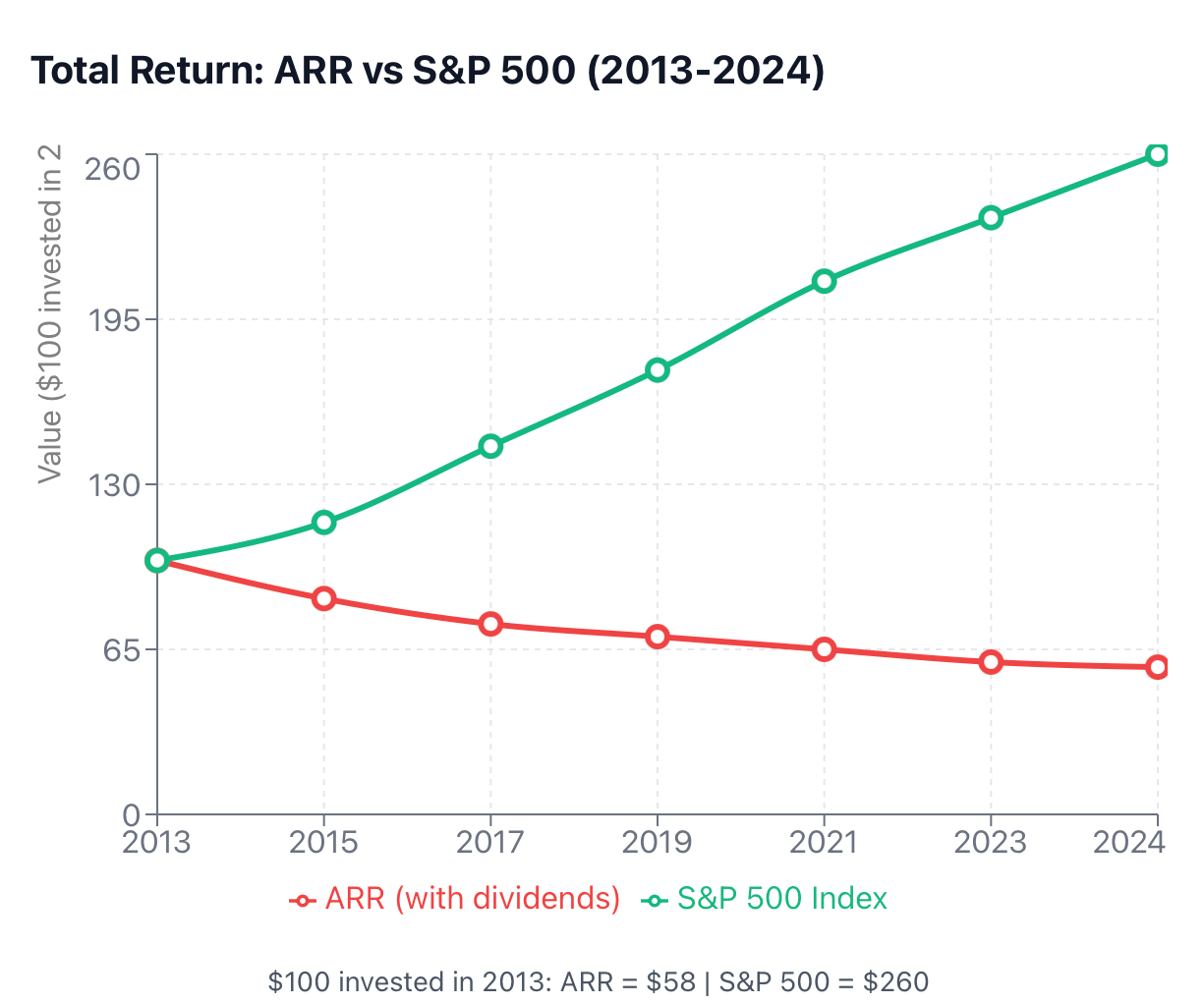
This is a classic example of capital return versus cash-flowing cash payment schemes. While cash-flow returns may seem advantageous to the absolute cash-flow returns you receive, if your account balance continues to decline every month, you are not profiting; rather, you are merely receiving back your own money through the monthly cash payment (this continues until your capital has reached zero).
When you compare ARR to purchasing and holding the S&P 500 index fund during the same period, you will see that while the dividends from the S&P 500 index fund are lower, the capital appreciation has allowed for a better overall return than the ARR example due to the continued appreciation of the overall market.
The moral would thus be that the total return from dividend-producing securities is simply one piece of the overall puzzle. If your security experiences a price drop significant enough to negate the dividend yield, then the dividend yield will not help to counteract the loss on your investment.
Can ARR Keep Paying Its Dividends? What to Watch
To invest in ARR (or any mREIT), you must keep an eye on how sustainable its dividend is. To track this, there are five primary indicators:
Core Earnings: This is what the company actually made as profit after deducting interest income, all expenses related to running the business and any costs associated with hedging. If a company has reported core earnings per share below the dividend, it means that the dividend payout is not sustainable. ARR has a history of cutting dividends when core earnings have decreased as well.
Book Value: This value indicates the net asset value of the holdings that the company owns. Decreasing book values indicate that the company is shrinking, creating pressure on future dividends.
Leverage Ratio: The level of leverage that you employ can increase or decrease your gains or losses. If ARR's debt-to-equity ratio exceeds a 9:1 ratio, it means that you need to be cautious. In addition, if rates were to increase, the amount of leverage that a company has may cause forced sales of assets and dividend cuts.
Net Interest Spread: The difference in the amount of money that a company pays to borrow money and the amount of money that it earns from MBS investments. When the net interest spread narrows like during periods of Fed rate increases, a company's profitability will suffer significantly.
Hedging Costs: To insulate itself from interest rate fluctuations, ARR employs interest rate swaps and other derivative instruments. In periods of higher volatility, the cost of hedging will increase, resulting in a loss of income and profit share.
Before any major dividend cut from ARR, at least two of the five indicators listed above were in a red letter state. You can monitor your holdings of ARR by reviewing quarterly financial statements. Do not wait for announcements regarding imminent dividend cuts.
Why ARR's Dividends Are So Volatile
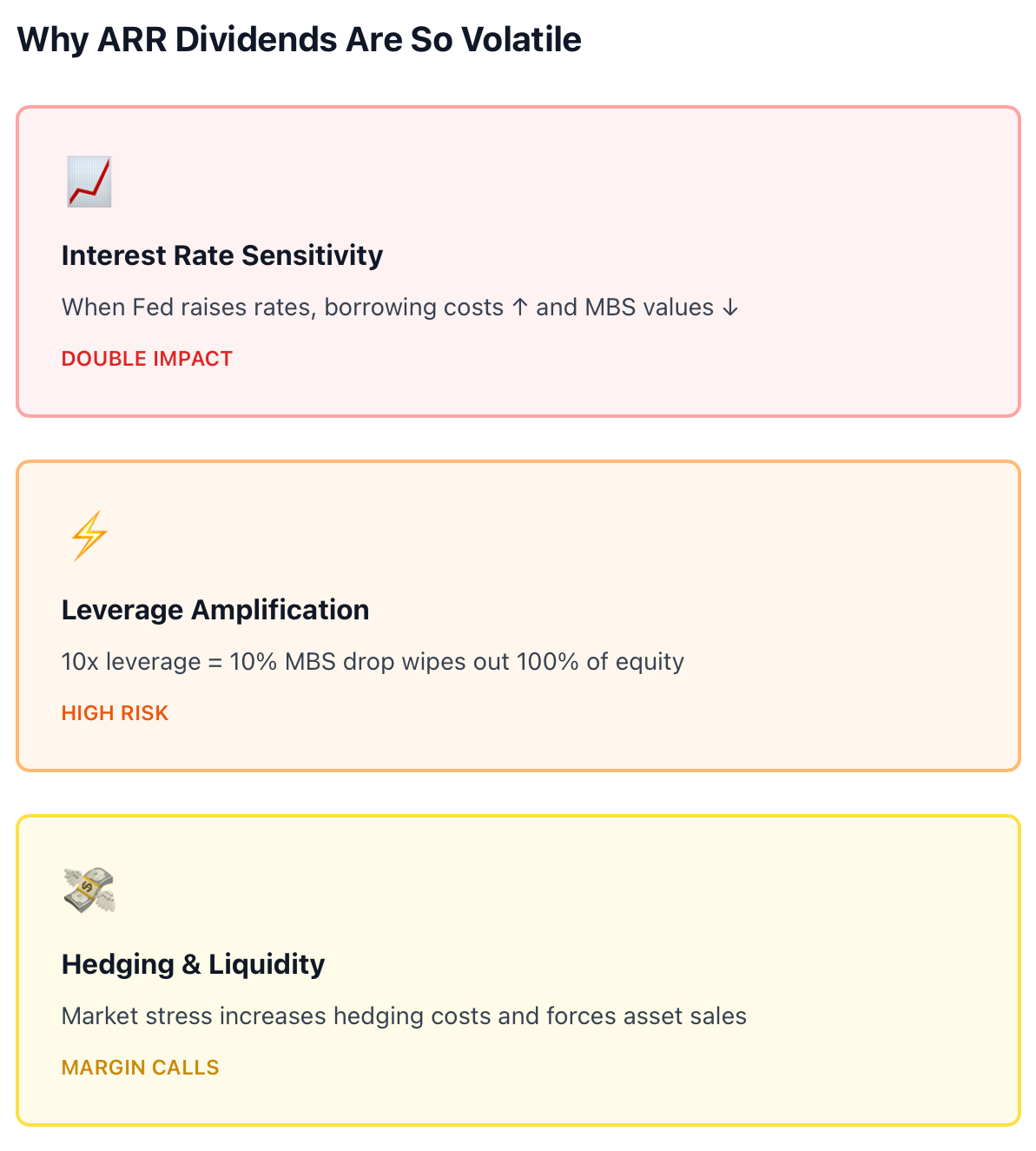
The instability of dividends paid by ARR is not the result of poor management, but rather due to the structure of the business. Here are several reasons why:
Interest Rate Sensitivity: mREITs are sensitive to changes in interest rates, both up or down. If the Fed were to quickly raise interest rates as happened from late 2022 through 2023, ARR's costs to borrow would increase dramatically, while the value of their current holdings (MBS) would begin to fall significantly. This results in a double-whammy effect on the net assets of ARR and most likely will lead to dividend cuts.
Leverage Amplification: That 8 to 10 times leverage we discussed is not a one-sided equation; a decline in MBS values of 10% when using a 10 times multiple of $1 billion will effectively create a total equity loss of $800 million to $1 billion, which is why ARR's book values are highly volatile.
Hedging Costs and Liquidity Risk: When there is market stress, the cost to hedge increases significantly. In March 2020, due to the volatility in the market, ARR faced margin calls and was forced to sell assets at a loss, which caused a major reduction in the dividends that ARR paid.
To put this in layman's terms, imagine that ARR is like a business that borrows money to operate during a storm. When the storm is over, the revenue from profits will be excellent; however, when there is a storm, the priority of that business is to survive, and therefore, dividends will be cut so that they can survive.
This is not just an issue for ARR but is an industry issue for mREITs, as high dividends are accompanied by higher structural risk.
Common Misconceptions About ARR Dividends
1. Myth: Higher yield = better investment. Truth: Higher yield can also mean higher risk; high yield means the market is factoring in a high probability of dividend cuts into the price of the investment (the higher yield).
2. Myth: Monthly dividends equal stable income. Truth: Just because a company pays monthly dividends doesn't mean that it pays a consistent amount each month. American Capital has decreased its monthly payments several times.
3. Myth: REITs (Revenue + Interest = Rent) are safer than stocks. Truth: mREITs (mortgage REITs) are leveraged interest rate "plays," and therefore they have significantly more risk than most equities (stocks).
4. Myth: Dividend cuts rarely happen. Truth: American Capital has cut dividends on multiple occasions in the last 10 years; cutting dividends is part of their strategy.
5. Myth: Holding a stock for a long time guarantees a stock's recovery. Truth: The stock price of American Capital has not returned to its pre-2015 level, and time cannot solve structural problems.
The above myths prevent new investors from purchasing American Capital at the right time. Don't let attractive headline yields prevent you from doing proper due diligence.
Should You Hold ARR? The Allocation Question
You should only consider ARR if you're not planning to allocate more than 5% of your total investments to it, thus treating it as a satellite investment rather than a core investment.
Many experienced mREIT investors will often allocate 0% - 5% to their overall portfolio because of the lack of risk/reward justification for any larger amounts. The yield from dividends may look exceptional when compared to traditional sources of investment income, but the reality of their volatility is very real and has been seen in the last couple of years.
If you're thinking of investing in ARR, remember the hot sauce analogy. Hot sauce adds flavour to a chicken dish or any other meal, but too much hot sauce would ruin that meal.
Therefore, your core portfolio should consist of an even mix of stocks, bonds, and real estate with no concentrated positions; whereas ARR should only be used as a speculative addition to your overall portfolio.
For new mREIT investors, if you're asking yourself if you should invest in ARR, then you probably shouldn't. The mechanics of ARR are not simple, and there is a relatively high level of risk involved with investing in mREITs, as well as very unpredictable dividends.
Key Takeaways: What ARR's Dividend History Teaches Us
Yields can attract attention, but the most important thing is your total return. ARR's dividends may have provided you with a cash flow, but not cover the decline in the price of shares.
What really matters is whether a dividend can be sustained or not. Core earnings, book value and leverage ratios are all more important indicators.
The main thing with mREITs is that they are traded on interest rates as opposed to generating passive cash flow. If you do not understand interest rate risk, you should not buy mREITs.
Monthly dividend payments may create the illusion of cash flow. Just because you receive a payment every month does not mean you are making a profit.
In order to avoid the disaster of large losses due to high-risk investments, investors need to maintain discipline in how they allocate their portfolios. High-risk dividend-paying stocks should only occupy a small portion of your portfolio allocation.
ARR's record of paying dividends is an example of why yields by themselves are not sufficient to evaluate the appropriateness of an investment. Monthly dividends appear attractive until you factor in the significant depletion of the share price along with ongoing dividend cuts.
Want to Trade ARR Without the Long-Term Risk?
For those who are more interested in ARR's volatility than in its dividend yield, there are ways to profit from price movements without buying the stock for the long term. Traders use contracts for difference (CFDs) and options to speculate on price movements resulting from events such as dividend announcements, Federal Reserve meetings, and interest rate changes, all while avoiding investing capital into a declining asset. Find out more about volatility trading strategies and how experienced traders trade high-dividend stocks at Tradewill.com.
Disclaimer: The content of the blog does not represent any position of Trade W, does not serve as any trading-related decision advice, and does not endorse any third-party.