

 Trade W
Introduction
In the ever-changing world of Forex trading, traders have come to rely on derivatives, including options, to manage risk, speculate on market moves, and take advantage of volatile markets. One of the foundational concepts in Forex trading that every trader must be aware of is ATM or "At the Money" – the primary basis of understanding option pricing and for option strategy and risk management.
ATM means that an option's strike price is equal or very close to the current market price of the underlying currency pair. ATM is the cornerstone of option valuation and strategy in the Forex markets. It is important to understand ATM because it is the point where time value is at the highest point and where the Greeks (the mathematical sensitivities affecting the options pricing) have the most impact.
This complete guide will hopefully fill the gap in knowledge for those traders who are at the beginning or intermediate stage of their trading careers, in an easy to understand format, with illustrative examples, and apply their newly acquired knowledge of ATM in the Forex trading environment.
Because you might be a high school student learning about financial markets, or a full-time professional who wants to improve your strategy, the next several pages should provide you with the basic necessary knowledge to consider, identify, analyze, and use ATM concepts.
To help visualize an ATM option, consider the analogy of "an ATM is like a movie ticket you may buy, has the price that matches the cash in your pocket, where you created no value at that moment, but you've converted cash into potential".
To give this a somewhat of a professional context, when EUR/USD is trading at 1.1000, and you are holding an option with the strike price of 1.1000, you are holding an ATM option, which has the maximum time value and maximum strategic flexibility built into it.
Understanding ATM - At the Money
ATM (At the Money), occurs when the strike price of an option equals or closely approximates to the current market price of the underlying currency pairs. This position is important in options trading, representing a transitional point in which intrinsic value is equal to zero, but time value is at the maximum.
To understand ATM, we have to understand ATM in relation to ITM (In the Money) and OTM (Out of the Money) as well:
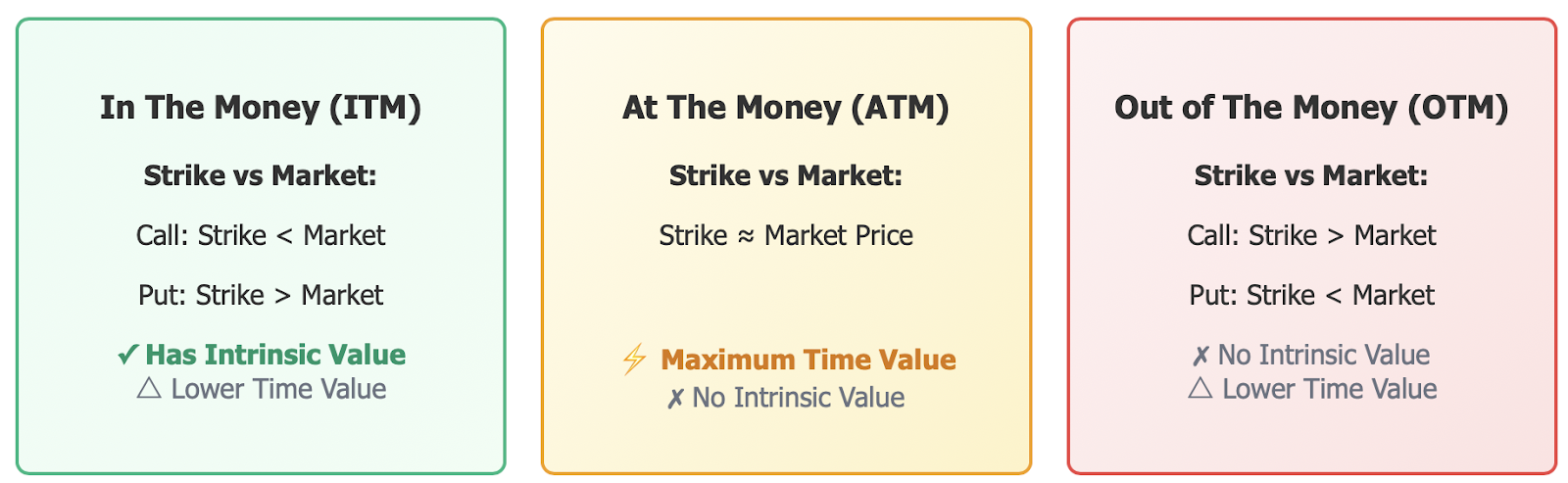
In the Money (ITM): For call options, ITM occurs when the market price is higher than the strike price. For put options, ITM occurs when the strike price is higher than the market price. ITM options contain intrinsic value.
At the Money (ATM): the strike price is exactly or nearly equal to the current market price. ATM options have no intrinsic value but have maximum time value, which also makes them very sensitive to changes in volatility and time decay.
Out of the Money (OTM): OTM exists with call options when the strike price is higher than the current market price. OTM exists with put options when the market price is higher than the strike price. OTM options have no intrinsic value and relatively less time value compared to ATM options.
This difference is important with respect to pricing dynamics. ATM options generally have higher premiums than OTM options. This is due to the probability difference that ATM options have of finishing in the money and the maximum time value that ATM options possess. The premium also reflects the market expectations concerning future changes to the underlying volatility as well as the expectations regarding possible future price movements.
Consider a professional example: If the current EUR/USD exchange rate is 1.1000, then an option with a strike price of 1.1000 would be ATM. You do not have either a profit or a loss – you are not at or out of the money, but at the money, with nothing but time value and speculative value. For the beginning trader think about it this way.
Imagine you just bought a few amusement park tokens where the ground price of those tokens matched exactly the cash in your hand - you are at equilibrium - maximum potential gain or loss.
ATM options are the "value balance point" of options. They are not a profit or loss marker; they are simply a meaning point to gauge an option against the current price of the underlying. This balance point will be the basis to move into more complex options strategies and risk management.
Significances of ATM in Forex Trading
ATM Options provide immense significance in Forex trading because of their unique characteristics, their strategic application in volatility trading, smooth money management, and market sentiment.
Given that there is inherent structural relationship between ATM options and volatility, the sensitivity of ATM options in relation to implied volatility is critical to their significance. Specifically, ATM options have the highest levels of sensitivity to changes in implied volatility, and also the largest associated volatility as a relation to their premium.
With this volatility relationship, ATM options provide the best instruments for trading volatility. When markets envisage increased volatility, ATM option premiums substantially increase as the market grapples with uncertainty and a higher probability of substantial price movement. Contrastingly, during low volatility periods, ATM premiums compress to show the market's complacency.
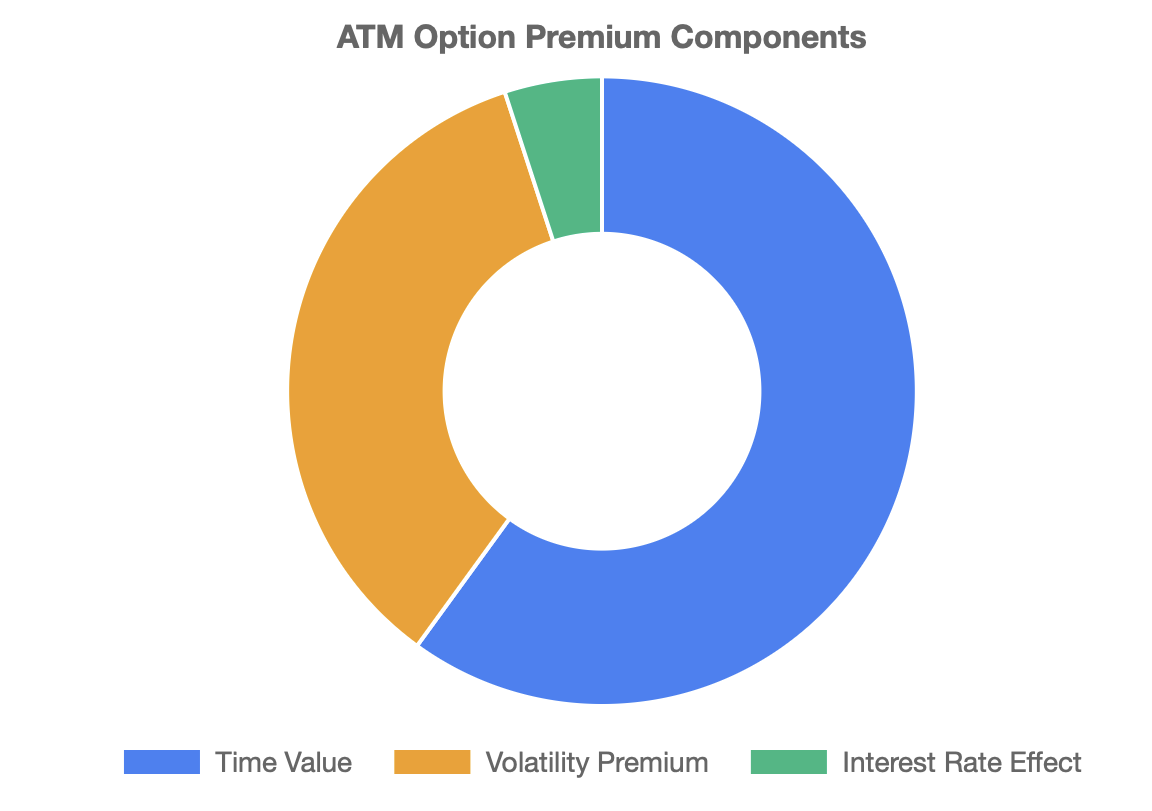
At- the-money (ATM) options have the most time value which is a direct indicator of marketplace beliefs about future price direction and volatility. The time value represents the premium a trader must pay for future potential by the end of the time frame. The time value will erode over time and this time decay creates opportunity and volatility based on the trader's trading style.
Institutional traders like a hedge fund or a bank might rely on ATM options to help hedge their risk. The ATM option is balanced in its amount of risk and best used to help hedge an existing position without a lot of capital. For example, a bank has a large amount of trade exposure to the EUR/USD and buys ATM options to protect against losers due to currency movements, but still allow an upside trade position to gain.
For beginner traders, being familiar with ATM helps prevent misunderstandings about options and profitability. Many beginner traders think they will be able to realize a profit as soon as they make an option purchase.
In fact, an ATM option is only going to earn a profit if the underlying instrument achieves favorable volatility or direction for the option to gain profitability against the premium paid. This could help students develop a better idea of their expectations moving forward and formulate strategies for their trading approach linked to market activity as well.
Real-world example: Prior to a European Central Bank announcement, EUR/USD ATM option premiums tend to experience an unsolicited bump as traders position themselves around expected volatility.This bump in premiums is an expression of market uncertainty.
It's an opportunity for volatility traders. For the newer traders, think of an exam where you sit exactly at the borderline - anything could happen; you have perfectly equal chances at failing or passing.
ATM options are valuable protective and reactive states to market sentiment and market expectations. Accounts with higher ATM premiums generally have higher market uncertainty and expected volatility.
Conversely, accounts with lower ATM premiums demonstrate market confidence and expected stability. ATM options are valuable risk-revealing tools to identify expected market conditions and to position yourself accordingly.
How Traders Use ATM in Practice
ATM options have equally important roles in practical applications of trading. They can serve a number of account applications, speculation, hedging, and a game of volatility. Appreciating the applications will better prepare anyone to take advantage of ATM aspects no matter what the conditions are.
In one option pricing model, notably the Black-Scholes pricing model, ATM options possess the most optionality to changes in volatility. Because of this, ATM strikes represent the most robust candidates for traders seeking to capitalize on market expansions or contractions of volatility.
Keep in mind that the fair value estimation of ATM options is contingent on the market assumption of the implied volatility, which may present a trade opportunity when market pricing deviates from theoretical pricing.
Professional example: Often, prior to Non-Farm Payroll releases, traders will buy EUR/USD ATM straddles in anticipation of some volatility spikes. They know that it makes no difference in which direction the data points.
As long as the price movement exceeds the premium they have paid, they will make a profit. For novice traders, think of an ATM option somewhat like a scratch ticket; you don't know what the outcome will be until you scratch the ticket - you have paid money for a potential outcome, but you need it to be a good outcome to profit.
Risk management considerations are a huge part of utilizing an ATM options strategy. Although ATM options have fairly neutral exposure, there is no guarantee that ATM options will provide profits. The utilization of ATM options requires accurate assessments of volatility, timing, and market conditions. Novice traders must understand that ATM options need favorable volatility or directional movement in order to overcome time decay and become profitable.
ATM & Greeks
Understanding ATM options in relation to the Greeks - Delta, Gamma, Theta, Vega and Rho - is useful in understanding how options behave and how we can manage risk. ATM options show unique characteristics when examining all Greeks, which is why understanding ATM options is important in understanding options sensitivities.
Delta is a measure of the degree of price sensitivity to changes in the price of the underlying asset. Moreover, Delta of ATM call options is on the order of approximately 0.5, and the Delta of ATM put options is on the order of approximately -0.5. On average, move about half as much as the underlying asset when the underlying price changes which maintains a balanced exposure to the underlying asset without excessive leverage.
For this reason, ATM options, relatively, are less risky than other contracts and suitable for taking short-term directional exposure to the underlying price movement.
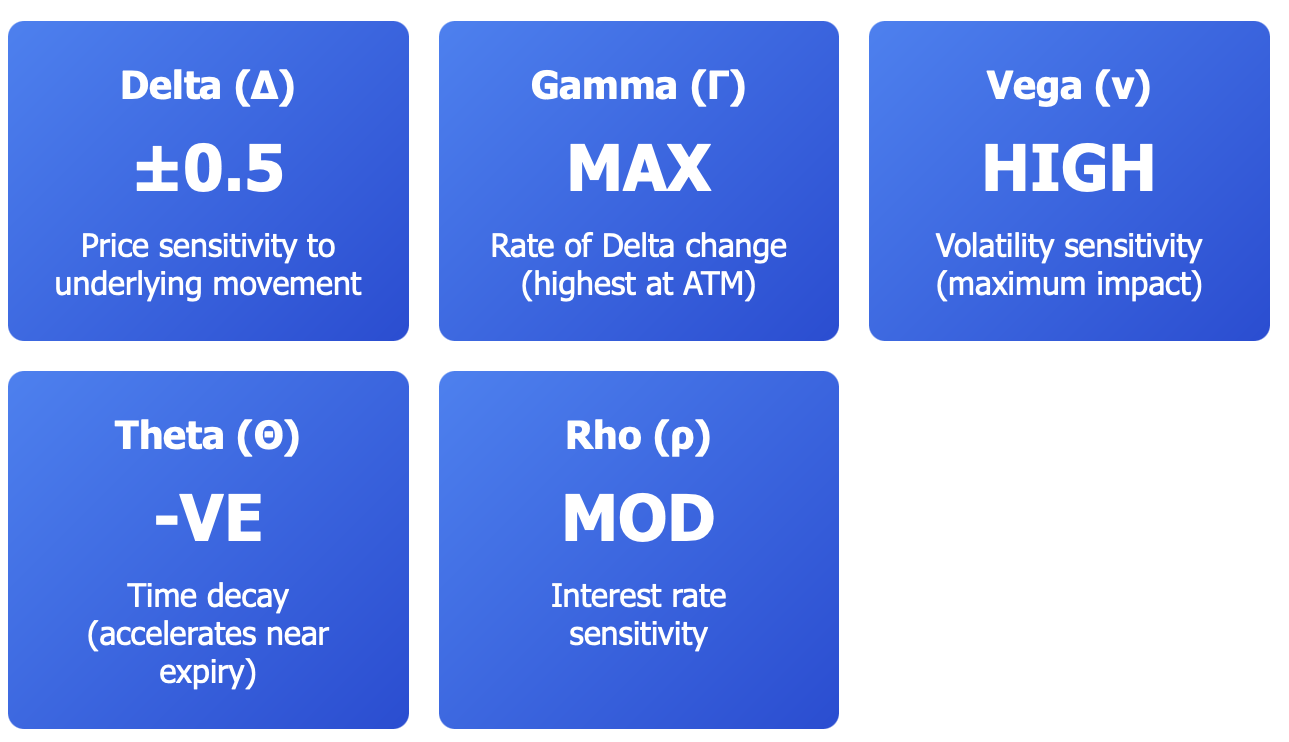
Gamma, which looks at the rate of change of Delta and is greatest at ATM, indicates that the ATM call/put options have the highest rate of change of Delta for small price movements on the underlying. In other words, high Gamma means that as the underlying price moves rapidly the ATM option's Delta will change quickly to have rapidly accelerating losses or gains based on the movement of the underlying asset.
As a result, ATM call and put options have a propulsive characteristic, which increases the risk and return asymmetrically with Delta, particularly for any type of movement.
Vega, the sensitivity to the change in implied volatility, is at its highest for ATM options, meaning that ATM options are very responsive to implied volatility changes. Moreover, ATM options generally have the highest Vega values which means that the ATM option's price will fluctuate dramatically, positive or negative, with changes in the implied vol values.
As such, ATM options can be a very powerful form of implied volatility trading, however, if the implied volatility contracts unexpectedly without the underlying price moving, significant losses will be realized.
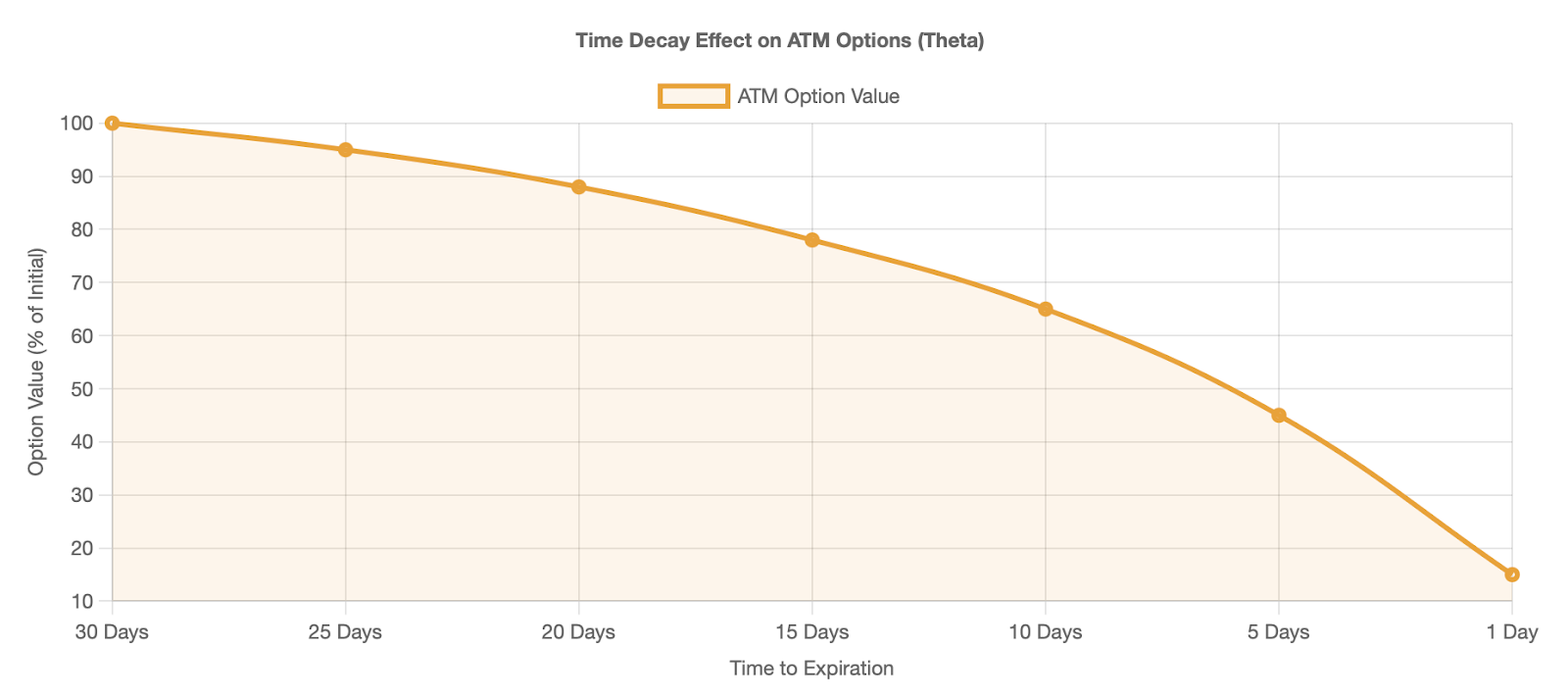
Theta, or time decay, plays a major role for ATM options since ATM options are losing value during the time value as the option gets closer to the expiration. These options lose value progressively as expiration nears but at an accelerated pace in the last weeks. Because of this, this can create problems for a buyer, because an ATM position buyer must overcome time decay through a combination of positive price movement or an increase in volatility.
Rho, or interest rate sensitivity, does not typically have as much effect on the ATM options as it is typically not a consideration for short-term objectives for Forex options but may have a degree of relevance for longer-term ATM positions, especially during periods of high interest rates.
Professional example: An EUR/USD ATM option with aggressive gamma may have a delta that goes from 0.5 to 0.7 with even a small favorable price movement driving the profit to accelerate rapidly in the ATM position, but an unfavorable movement will result in a similar acceleration downward.
For a visual, think of a scale that is evenly balanced, whereby even a small amount of pressure can yield a major leaning motion on the other side. Small changes can yield major outcomes.
Knowing these Greeks allows professional traders to manage risk and strategize at a high and sophisticated level.
The Greeks are the lifeblood of ATM options and, while effective and significant for many market conditions in different types of trading activities, they can alter dramatically and should be managed as effectively as possible in a real-time basis regularly.
ATM Strategy Uses
ATM options provide many unique and complex trading strategies specifically oriented towards market conditions and risk-reward preferences, and understanding these uses will allow traders to capture ATM characteristics across a multitude of scenarios.
ATM straddles are a very popular volatility strategy that involves the simultaneous purchase of an ATM call option and an ATM put option on the same underlying, with the same expiration, and the same strike price as the ATM call and put will be almost the same strike price.
An ATM straddle will have a large price movement, either up or down, south of the combined premium cost of both the call and the put during a fundamental economic announcement and/or during broader market conditions that will await volatility expansion.
A straddle can only be profitable after the price has moved greater than what is spent on premium for the call and put because of these characteristics.
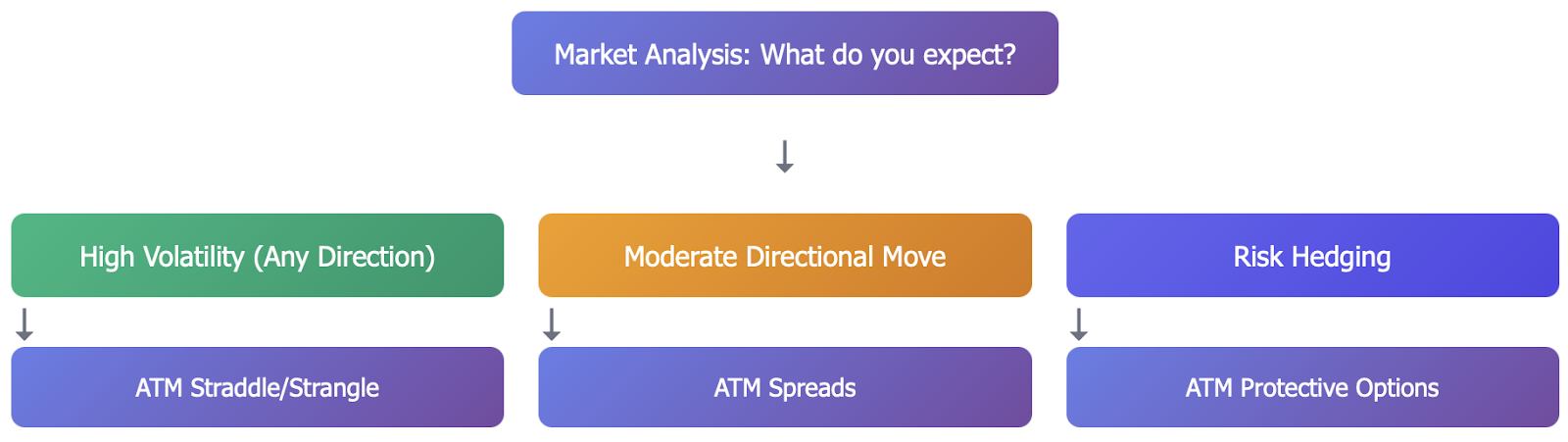
ATM strangles will alter the straddle idea by assuming 0.5-.10 of OTM on both the call and put options to ensure a low premium cost, but a larger price movement must occur for profitability. A strangle is more cost-effective than straddles for trading volatility but has the same upside potential for any major price movement.
Spread trading that utilizes ATM options includes bull call spreads and bear put spreads simply combining ATM options with OTM options to create defined risk and reward profiles. Spread trading costs less in premiums than simply buying the option even though it limits maximum profit potential. ATM spreads are effective in spreading out risk and reward potential for traders hoping for moderate directional moves.
Hedging strategies can take advantage of the balanced nature of ATM options to effectively hedge an existing position. Portfolio managers use ATM options to hedge currency risk with exposure to upside potential depending on the direction of the move. The ATM option provides "insurance" that hedges against the downside, while the position has the potential for an allowable upside.
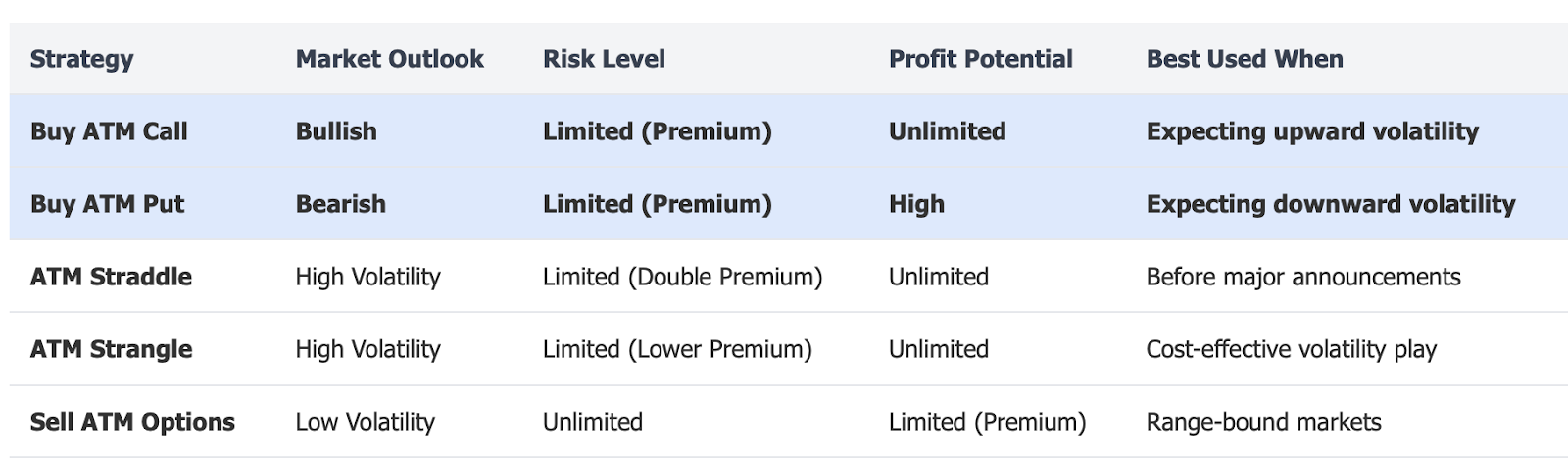
When comparing buying and selling ATM strategies, the overall outcome is compared with different risk profiles. When buying ATM options, you are limited loss exposure with potentially unlimited upside. This is useful for either expecting volatility or directional, movement play. When you sell ATM options and take the positive premium, you expose yourself to potentially unlimited loss and need to manage risk and margin accordingly.
Professional example: Often ahead of Federal Reserve or other important announcements, traders will implement straddles on USD pairs as ATM options with the expectation of significant volatility regardless of the direction of the policy.
The straddle will be profitable if the underlying movement exceeds the premium paid and this captures value resulting from the volatility expansion. To simplify or consider the beginner's mind, you want to consider the lottery where you are selecting the "middle number". Now you have set yourself up for maximum flexibility with the smallest amount of initial risk.
Another time-based approach using ATM options is a calendar spread. You sell a short-term ATM option and buy a longer-term ATM option at the same strike. You benefit from the time decay of the short position accelerating while still having longer-term ATM exposure. This strategy is most effective when you expect the underlying to consolidate before it eventually moves with volatility.
Hedging strategies can take advantage of the balanced nature of ATM options to effectively hedge an existing position. Portfolio managers use ATM options to hedge currency risk with exposure to upside potential depending on the direction of the move. The ATM option provides "insurance" that hedges against the downside, while the position has the potential for an allowable upside.
When comparing buying and selling ATM strategies, the overall outcome is compared with different risk profiles. When buying ATM options, you are limited loss exposure with potentially unlimited upside. This is useful for either expecting volatility or directional, movement play. When you sell ATM options and take the positive premium, you expose yourself to potentially unlimited loss and need to manage risk and margin accordingly.
Professional example: Often ahead of Federal Reserve or other important announcements, traders will implement straddles on USD pairs as ATM options with the expectation of significant volatility regardless of the direction of the policy. The straddle will be profitable if the underlying movement exceeds the premium paid and this captures value resulting from the volatility expansion.
To simplify or consider the beginner's mind, you want to consider the lottery where you are selecting the "middle number". Now you have set yourself up for maximum flexibility with the smallest amount of initial risk.
Another time-based approach using ATM options is a calendar spread. You sell a short-term ATM option and buy a longer-term ATM option at the same strike. You benefit from the time decay of the short position accelerating while still having longer-term ATM exposure. This strategy is most effective when you expect the underlying to consolidate before it eventually moves with volatility.
Iron condors using ATM options produce range-bound trading strategies, which are good for lower volatility expectations. These types of option strategies are complex arbitrage strategies that utilize multiple position options to take advantage of sideways price action while controlling risk with a limited defined profit and loss parameters.
ATM & Market Volatility
Understanding the relationship between ATM options and market volatility is perhaps the most important consideration in options trading because it will drive pricing, strategy selection, and risk management decisions. ATM options' very unique sensitivity to volatility makes them vital with understanding and trading the market.
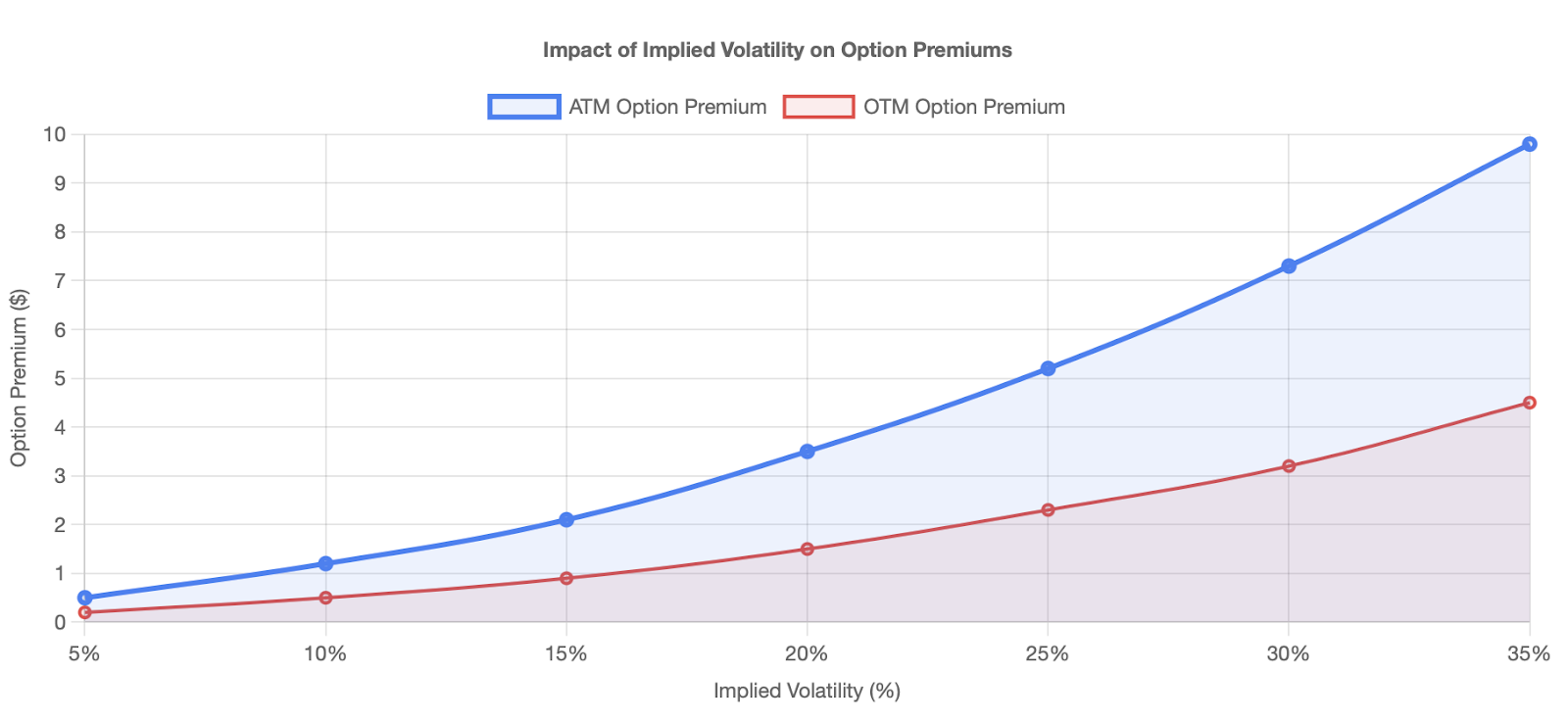
ATM options' total premium is affected by implied volatility more than any other moneyness category of option. When markets are expecting volatility we will see ATM premiums expand exponentially because prices are neither stable, predictable, or in other words, there are increased probabilities of larger price movements.
This sensitivity to ATM volatility presents opportunity for volatility traders when the trader believes that the current level of implied volatility is either too high or low in representative of future realized volatility.
The volatility smile or skew is the phenomenon that illustrates the fact that implied volatility varies based on strike and time to expiration. ATM options usually occupy the middle or nearly the middle of the volatility smile which helps the trader understand the level of baseline implied volatility expectation for any ATM options. Using this level of understanding about the ATM options assists the trader to identify possible relative value opportunities throughout the option chain.
Iron condors using ATM options produce range-bound trading strategies, which are good for lower volatility expectations. These types of option strategies are complex arbitrage strategies that utilize multiple position options to take advantage of sideways price action while controlling risk with a limited defined profit and loss parameters.
ATM & Market Volatility
Understanding the relationship between ATM options and market volatility is perhaps the most important consideration in options trading because it will drive pricing, strategy selection, and risk management decisions. ATM options' very unique sensitivity to volatility makes them vital with understanding and trading the market.
ATM options' total premium is affected by implied volatility more than any other moneyness category of option. When markets are expecting volatility we will see ATM premiums expand exponentially because prices are neither stable, predictable, or in other words, there are increased probabilities of larger price movements.
This sensitivity to ATM volatility presents an opportunity for volatility traders when the trader believes that the current level of implied volatility is either too high or low in representative of future realized volatility.
The volatility smile or skew is the phenomenon that illustrates the fact that implied volatility varies based on strike and time to expiration. ATM options usually occupy the middle or nearly the middle of the volatility smile which helps the trader understand the level of baseline implied volatility expectation for any ATM options. Using this level of understanding about the ATM options assists the trader to identify possible relative value opportunities throughout the option chain.
The fluctuation of ATM premium levels during periods of high versus low volatility creates unique trading conditions; higher volatility will have higher ATM premiums resulting in option positioning as more expensive but with the chance of profit based on the large amount of distance the options could move.
Conversely, low volatility will have less ATM premiums which will result in options being packed inside the money but will need to make a larger movement, if they are to ever entice traders to pursue potential profitable positioning.
The historical patterns of volatility provide the reference point upon which traders evaluate ATM premium levels. Traders evaluate how much the current implied volatility is relative to historical (realized) volatility as a way to form general conclusions about whether ATM options are overpriced or underpriced. This a launching point for mean reverting volatility strategies and gleaning valuations.
A professional example would be ATM EUR/USD option premiums during major market crises; ATM option premiums are expansive at peak uncertainty and will only get larger. This scenario creates a decision framework for professional traders if the premiums were justified based on realized risks or if premiums reached a point of panic creating attractive potential selling opportunities. The only analysis needed in such a situation becomes, discerning the level of uncertainty that is relative to historical volatility patterns.
For beginners, think about how the difficulty of exams impacts the value of getting a passing grade. And when exams become harder, a passing grade becomes more valuable. This process is very much like "demand" for ATM options, and the exam question becomes finding out if the current "difficulty level" justifies the premiums being pursued.
Volatility clustering is where periods of high volatility are followed by more periods of high volatility that influence ATM option strategies and patterns in volatility. Traders who recognize these patterns can time their entries and exits to make trades in accordance with volatility cycles rather than against it.
Mean reversion in volatility suggests that there is an opportunity to take a contrarian ATM approach. Traders will place positions when implied volatility reaches an extreme, expecting a reversion to the historical mean. They will either sell ATM options when they appear priced at a premium, or buy them when they are selling for less than their historical mean.
ATM & Risk Management
ATM options act as sophisticated risk management options, with characteristics that make it much easier for hedging existing positions, managing portfolio risk, and addressing exposure around different market conditions. The key to successfully using ATM options is understanding their hedging and risk management abilities, as well as their limitations.
ATM options provide effective hedging for an existing currency position due to their risk-reward profile. Deep ITM options involve high premiums that are difficult to achieve due to the costs and risks. Options that are OTM do not provide adequate hedging and exposure.
ATM options provide for reasonable protection for risk, while leaving open the upside potential. This makes ATM options appealing to portfolio managers who wish to hedge, without eliminating their potential for profit.
The risk exposure relationship with ATM positions contributes to dynamic hedging needs. As the underlying prices move, the Delta of ATM options changes quickly due to high Gamma, requiring adjustments to the ATM position to maintain desired hedge ratios. To manage the continuing evolving risk related to ATM options, traders are required to continually monitor and rebalance their ATM positions.
The issue of portfolio correlation is also relevant to the extent ATM options are used for risk management. In order to manage risk, an accurate understanding of the extent to which ATM options behave in a correlated manner with existing risk exposure needs to be understood.
Since ATM options are not static hedging instruments, time decay associated with ATM option positions is always an issue, regardless of the time frame of the hedging strategy. ATM options will lose value over time, meaning time costs must be considered each time a ATM option position is opened. Long hedging strategies are expected to require a rich rolling strategy in order to effectively manage the time decay.
A common example is a multinational corporation with a sizable exposure to EUR. To hedge the possibility of adverse EUR currency downward movements, the company might purchase ATM EUR/USD put options. In this example, the corporation has financial protection against downside risk while retaining the ability to take advantage of any favorable EUR upward movements through indirect exposure.
Cost must be paid for this protection (through premiums), and ongoing premium payments and management of position sizes would be needed to manage its put options ATM position.
The risk exposure relationship with ATM positions contributes to dynamic hedging needs.
As the underlying prices move, the Delta of ATM options changes quickly due to high Gamma, requiring adjustments to the ATM position to maintain desired hedge ratios. To manage the continuing evolving risk related to ATM options, traders are required to continually monitor and rebalance their ATM positions.
The issue of portfolio correlation is also relevant to the extent ATM options are used for risk management. In order to manage risk, an accurate understanding of the extent to which ATM options behave in a correlated manner with existing risk exposure needs to be understood.
Since ATM options are not static hedging instruments, time decay associated with ATM option positions is always an issue, regardless of the time frame of the hedging strategy.
ATM options will lose value over time, meaning time costs must be considered each time a ATM option position is opened. Long hedging strategies are expected to require a rich rolling strategy in order to effectively manage the time decay.
A common example is a multinational corporation with a sizable exposure to EUR. To hedge the possibility of adverse EUR currency downward movements, the company might purchase ATM EUR/USD put options. In this example, the corporation has financial protection against downside risk while retaining the ability to take advantage of any favorable EUR upward movements through indirect exposure.
Cost must be paid for this protection (through premiums), and ongoing premium payments and management of position sizes would be needed to manage its put options ATM position.
To better illustrate this for the novice trader, carrying an umbrella offers an intriguing analogy. you have paid for some protection against the rain (bad price movement), and your only restriction to enjoy the sunshine (good price movement) is the umbrella itself! It costs you money to carry an umbrella, but it is a better option to avoid getting soaked.
Stress testing ATM hedging strategies across market conditions will help to highlight weaknesses and optimize hedge ratios. Good risk management requires an understanding of ATM options in normal market conditions, volatile market conditions, and extreme events.
Position sizing factors are important parts of ATM risk management implementations. The risk of too much ATM options creates its own risk and less return on any portfolio. Too little ATM options creates insufficient protection so the task is to find the right combination testing the bounds of risk tolerance, costs, and protection.
Historical case studies
Studying historical executions of ATM options in historical financial market environments is valuable in understanding the effectiveness and limitations in using ATM options. These case studies demonstrate how the ATM features come together under different market pressures to add value in insights for planning one future strategy.
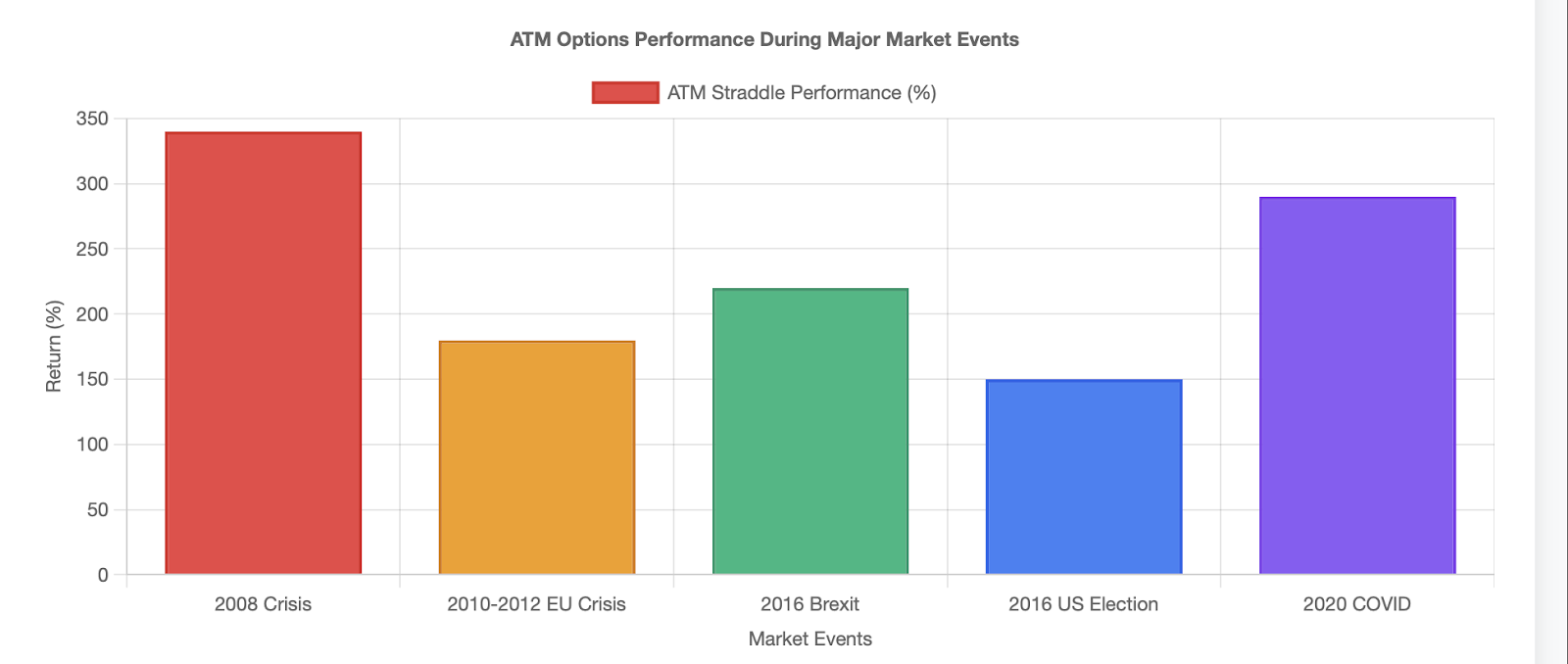
The financial crisis of 2008 created some extreme volatility conditions that showed the importance ATM options provided for both risk management and speculation. During the most uncertain times, the ATM implied volatilities reached historical highs as dealers attempted to protect themselves from the ever-changing conditions of the marketplace. Those that purchased ATM straddles prior to the onset of the financial crisis captured an enormous profit, as the realized volatility of the underlying demonstrated even higher levels than implied volatility.
The European sovereign debt crisis period from 2010 to 2012, demonstrated the need for ATM options in hedging currency exposure. The EUR/USD ATM option provided great protection against the institutions with Euro exposure as the political uncertainty created volatility in the currencies for as long as the uncertainty lasted. The crisis demonstrated that ATM options represent the right properties for hedging during uncertain directional periods.
The Brexit referendum and subsequent negotiations provided the perfect volatility trading conditions for GBP pairs. The binary nature of the referendum outcome and ongoing negotiations made directional predictions difficult while fostering significant expectations of volatility. These conditions ultimately led to a significant profit from ATM straddles on GBP/USD during the peak periods of uncertainty with the protection of ATM straddles during periods of calm.
In the last presidential election in the US (2016), political uncertainty lifted EUR/USD ATM option premiums to high levels; traders using ATM strangles prior to the election capitalized on the ensuing volatility, while traders selling high premiums in the wake of the initial spikes, benefitted from volatility mean reversion.
As an example for novices, think about how students adjust their preparation strategies in response to significant policy changes in examination. Right after the uncertainty, all students desire flexible preparation (like an ATM option), while demand for that high premium option will eventually drop after the policies are clear.
Fully evolving central bank communication has also impacted the effectiveness of ATM options models over the years. As the market evolved and central banks became more transparent and predictable, ATM event based options strategies became less effective, warranting the need for new patterns of communication and changes in market structure as to when we assessed an event in relation to its discretion.
Again, the historical examples do show that although ATM options could be valuable tools for a multitude of market environments, they only work based on an accurate recognition of market dynamics, followed by correct timing, and with a realistic understanding of the limitations of that strategy.
Conclusion
All ATM (at the Money) options are the building blocks to Forex trading as identified by the balance point between the strike price and the price of the underlying market. The article has reviewed the definition of ATM options, how ATM is differentiated between ITM, OTM options, and the importance of their pricing structure as time value is maximized, and intrinsic value is zero.
ATM options can be utilized in Forex trading from many different perspectives which reinforces their importance. They are maximum sensitive to implied volatility which gives them unique properties to volatility trading.
They have balanced risk/reward for portfolio managers and institutional traders and will effectively hedge their exposure, thus if ATM options were ineffective, the entire Forex options market would cease to exist. Their relationship with the Greeks (maximum Gamma, and very high Vega sensitivity) enables traders to measure unique opportunities and risks.
Strategic usages of ATM options can take many forms, from intent to take advantage of volatility (to capture implied volatility) through the use of straddles and strangles to taking directional exposure via spreads and hedging usages. The decision to either purchase or sell ATM options affords very different risk exposures appropriate for different trading conditions and objectives. Understanding the ATM option usages allows better development and execution of strategies.
There is no underestimating the relationship between ATM options and market volatility. These expense are macroeconomic indicators of market uncertainty, with premiums increasing the more volatile it is and decreasing the more stable it is going forward. The fact that ATM options have this sensitivity to volatility provide both trade opportunities and risks to manage.
Historical case studies of established market events provide practical applications of ATM options, while identifying their limitations. With examples from the 2008 crisis to Brexit uncertainty, "real-world" applications demonstrate the effectiveness in moving from a theoretical concept to trading, and to create portfolio insurance.
For traders in every cohort, ATM fundamentals are an essential part of foundational knowledge needed to trade options successfully. Regardless of whether it is a new trader learning market terminology, or an experienced trader fine tuning advanced risk management strategies to be more effective, important inclusions are ATM characteristics, applications, and limitations that allow market participants to make informed and astute decisions about risk management.
The most important insight about ATM trading is that they are not profit generators, but rather a complex, leveraged instrument for trade ideas.
ATM options are very sensitive to volatility in time and negligible experience in directional trading. Their efficacy ultimately is based on whether you can assess volatility accurately, time correctly, and have proper and honest optimism about market behaviour. It is encouraging that as the markets continue to evolve,
ATMs will most likely be used as a relevant tool to respond to changing market conditions and implement effective risk management processes.
Ready to put ATM strategies into practice? Start trading smarter with Tradewill.com – your
trusted partner in Forex options and risk management.
Disclaimer: The content of the blog does not represent any position of Trade W, does not serve as any trading-related decision advice, and does not endorse any third-party.