

 Trade W

The majority of people look to the price of gold to decide whether to invest or not; however, the greatest aspect of gold is found at its centre: the nucleus contains 79 protons arranged in such a way that this particular element has an atomic number unlike any other element on the periodic table. Knowing this atomic number of 79 provides the basis for why gold has always been valuable and continues to be so as of 2026.
When you consider gold at an atomic level, you will view it as an asset differently from how you do now. When inflation begins to rise, the value of currencies declines, or the stock market goes into a panic mode, gold will always have value because of the atomic structure of the metal: it is chemically inactive, it is physically resistant, and it is no other element that is rarer on Earth. To say these are marketing statements is incorrect; they are scientific facts.
The remainder of this article outlines the science behind the atomic number 79, the unique strength of gold's placement on the periodic table, the cosmic origin of gold creates scarcity, and the overall relevance these factors have on traders and investors attempting to navigate markets in 2026.
What Is the Atomic Number of Gold? The Science Behind the Atomic No of Gold (79)
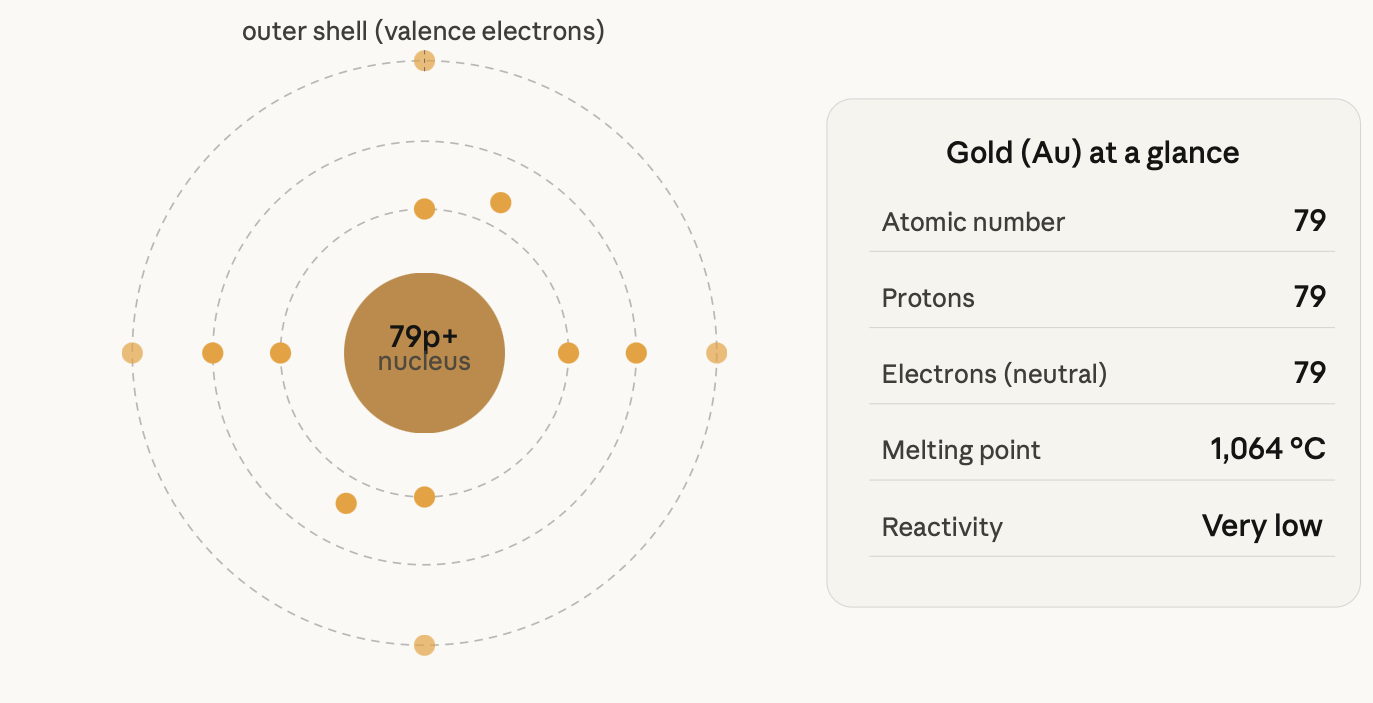
Each of the chemical elements within the periodic table has a distinct atomic number. The atomic number of an element corresponds directly to the number of protons contained in that element's nucleus; therefore, the atomic number for each chemical element governs all of the characteristics of that element. For example, gold has an atomic number of 79; consequently, every gold atom contains 79 protons and 79 electrons orbiting the nucleus when the atom is in its neutrally charged state.
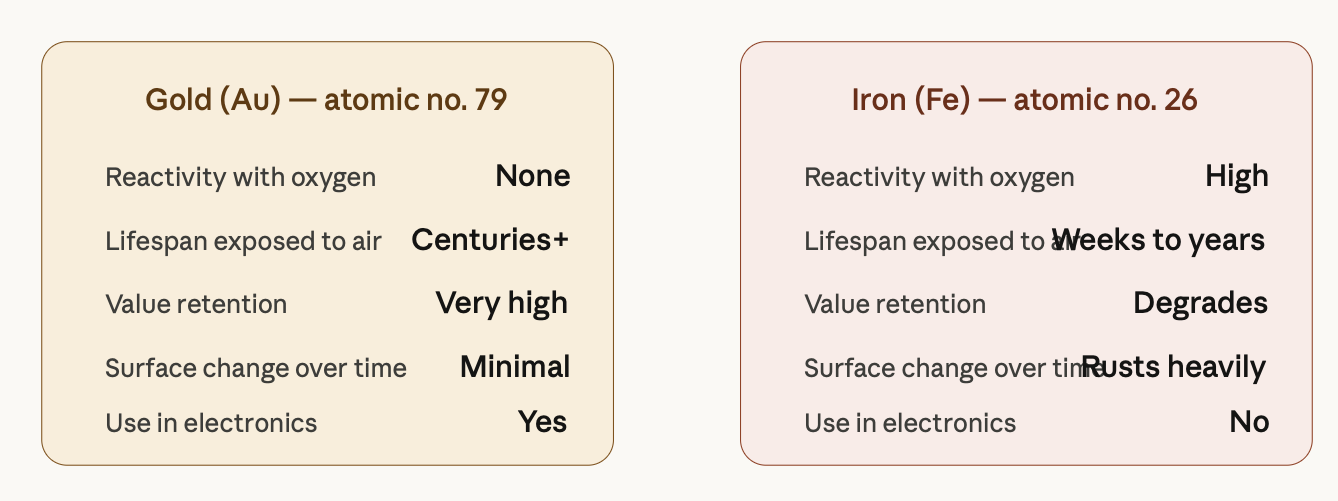
The arrangement of these protons and electrons is such that gold has full, symmetrical occupancy of its electron shells, making the outer-shell electrons of gold far less likely to react chemically with other substances than other metals. As a result, iron nails left outdoors typically exhibit surface rust after a few weeks due to the outer-shell electrons of iron readily bonding with oxygen.
In contrast, every sample of gold left outside for hundreds of years would still appear identical to other samples of gold because the outer-shell electron shielding of gold is too stable and progressed to be able to form chemical bonds with either oxygen, water, or most acids.
This stability and lack of chemical reactivity are the primary reasons why professionals use gold to coat circuit board contacts and aerospace connectors. In doing so, the metal-circuit connections create a reliable signal to and from the circuit over time. The same lack of chemical reactivity is the primary reason why investors can be assured that the gold coins held by their grandparents will retain the same amount of gold as originally produced.
Gold vs Iron:
The Cosmic Origin of Gold: Scarcity Built Into the Universe
The creation of gold doesn't occur in normal stars. Only supernovas and the collision of two neutron stars, which are among the most violent events known to occur in the universe, create the right conditions for the heavy element formations needed to produce gold and platinum. This is an extremely energy-intensive and infrequent process, so that in mass terms, there is only about 0.004 grams of gold located in every million grams of Earth's crust or ore.
There's no question about the value of gold being very rare; however, it does not appear that this will change in the future on a global scale. We're adding about 3000 to 3500 tonnes of gold to the supply of gold each year through mining, while all of the accumulated gold on the surface amounts to only approximately 212,000 tonnes. Therefore, we can only grow the total supply of gold at less than 2% each year, which is almost completely not feasible to double, no matter how much demand increases.
In contrast, you can double the supply of currency from fiat money with just one central bank decision. You cannot double the total amount of gold that exists on Earth. This asymmetry is what many investors view as providing a hedge against the inflation of fiat currencies denominated in currency due to inflation in that value of currency.
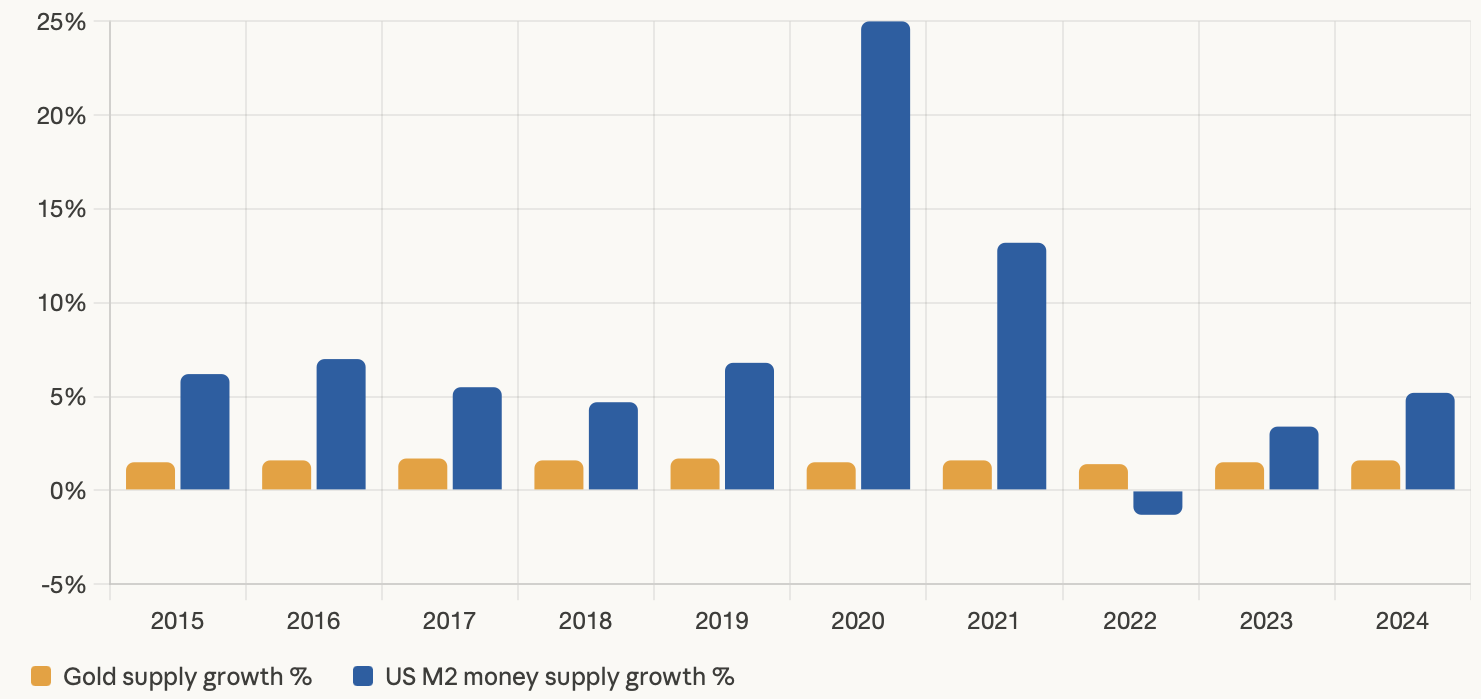
The 2020 spike in money supply is exactly why gold surged to record highs in that period. When dollars multiply rapidly, each one buys less. Gold's supply barely moved.
Why Atomic Number 79 Makes Gold Uniquely Valuable: Comparing Platinum (78) and Mercury (80)
Platinum and gold both have the same atomic number of 78 and therefore share many characteristics, though platinum is less abundant than gold and more stable chemically. They are each valuable metals, and both display similar characteristics in their atomic structure.
However, mercury, which has an atomic number of 80, is somewhat similar, but unlike both platinum and gold, it is also very special because it is the only metal that remains liquid at room temperature.
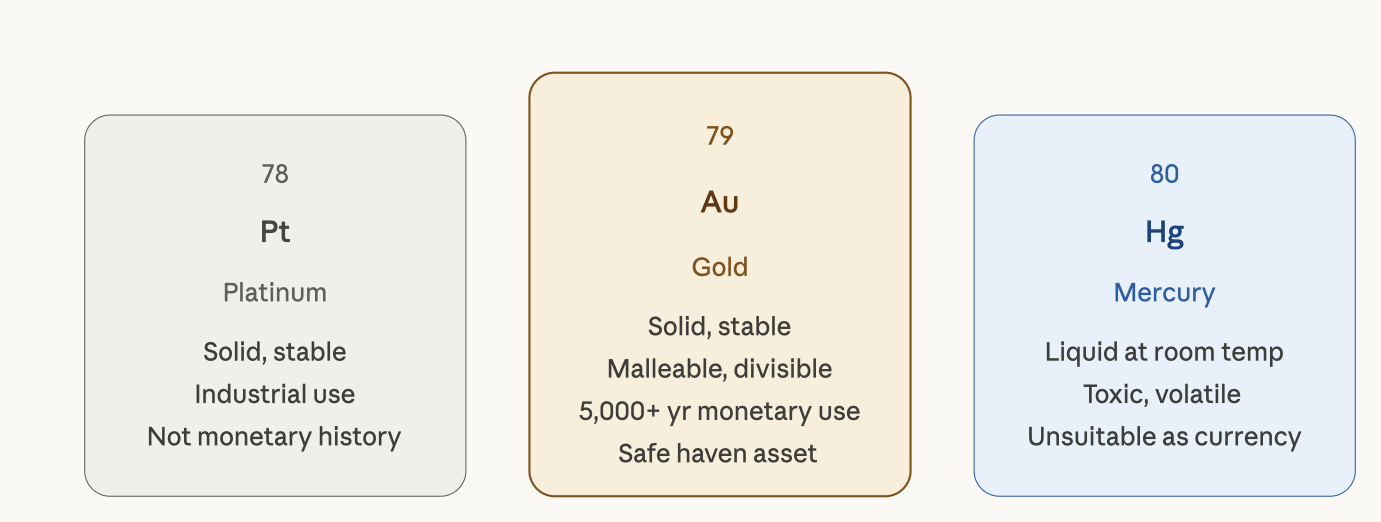
The yellow metal strikes a rare balance of being both solid and easily manipulated at normal temperatures, unlike the element mercury. The yellow metal is also sourced much more readily than platinum and hence has been the most widely used monetary metal throughout history.
You can cast the yellow metal into coins, bars, or wire without needing any specialised industrial equipment, and you can split the yellow metal into small pieces without losing any material, as gold does not rust or decay over time, unlike most other metals, after thousands of years of being handled by human beings.
From ancient Egypt to the Roman Empire to the Bretton Woods currency agreement, they all independently sought the yellow metal as a true measure of value, and this is not a coincidence, but a reflection of the fact that gold has an atomic number of 79.
From Atoms to Assets: Gold vs Bitcoin Scarcity
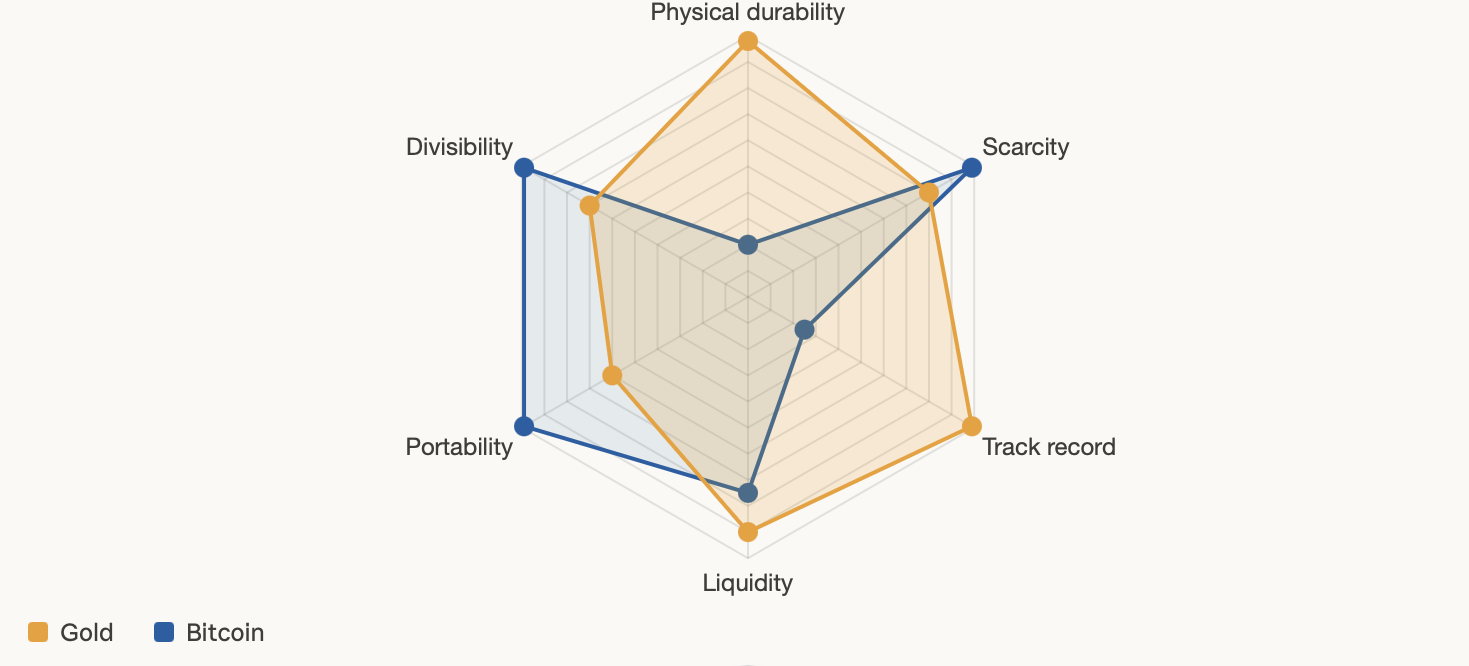
Bitcoin's maximum supply of 21 million is a product of its programming; its hard ceiling is built into the protocol. On the other hand, gold's scarcity is determined by the rules of nuclear physics. Both assets have finite quantities and, therefore, attract investors who seek to hedge against inflationary pressures.
However, gold has a much more extensive history than that of Bitcoin and has experienced many hostile events, such as wars, empires collapsing, and major economic disruptions over the past five thousand years. Bitcoin has not even been around for twenty years yet.
For a diversified trader, these two assets serve different purposes within a portfolio. Gold is often referred to as ballast because it stabilises overall performance. Conversely, Bitcoin represents a high-conviction position with much more volatility than other asset classes.
Therefore, understanding how both asset classes function requires understanding scarcity; in gold's case, it begins by understanding atomic number 79.
Gold as a Safe Haven Asset in 2026: Inflation, Risk, and Volatility
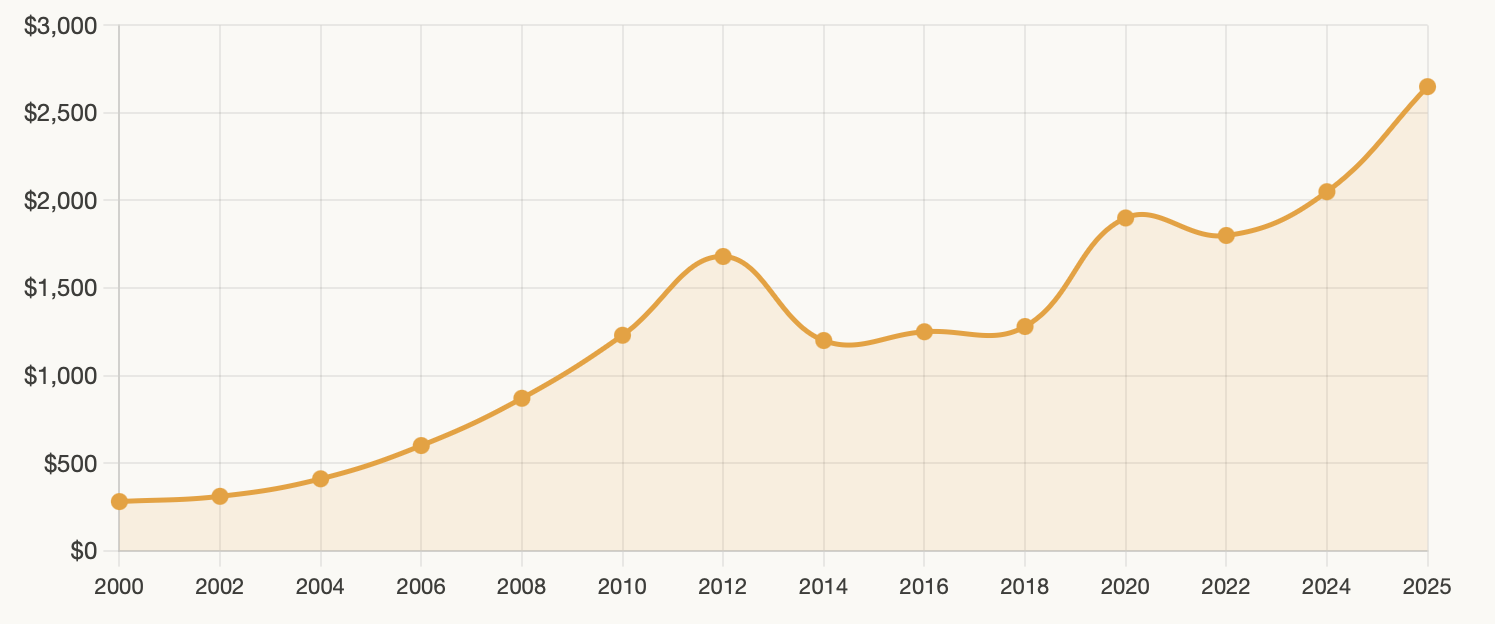
When the 2008 financial crisis occurred, the 2020 pandemic caused a sharp drop in the stock market and the 2022 inflation rise; there was a major influx of capital into gold. This was driven by consumer sentiment and a change in behaviour related to economic uncertainty. When there is uncertainty present in the economy, investors will seek out investments that are not reliant on another party's promise to pay, and gold fits that description well.
From a practical standpoint, most managers recommend that in a diversified portfolio, investors should maintain 5-15% of their overall investment in gold assets as a hedge against inflation, rather than as an investment for growth. Gold has been seen to have an inverse correlation with real interest rates.
When interest rates decline or become negative when inflation-adjusted, the price of gold typically increases. The same is true of gold prices when central banks increase their money supply. The price of gold tends to hold or increase during the times when the stock market is at its lowest point.
Gold provides additional opportunities to trade via contracts for difference (CFDs). The price of gold typically responds to announcements made by the Federal Reserve, geopolitical developments, U.S. dollar strength, as well as purchases made by central banks, all of which can provide a variety of trading opportunities in gold without having to physically deliver the metal itself.
Global Gold Reserves: Who Holds the Most
The countries with the largest official gold reserves are the ones that understand what atomic number 79 represents in a reserve asset.
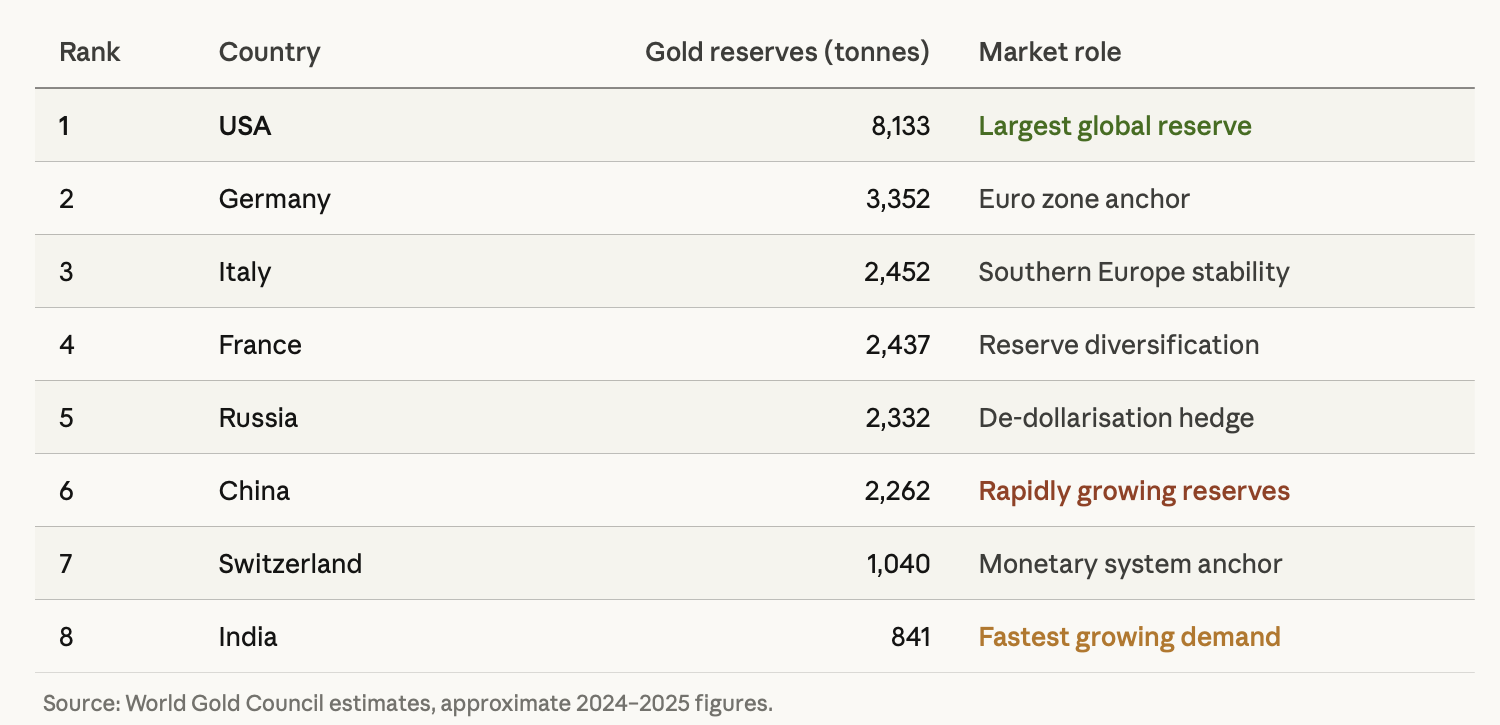
In 2022 and 2023, the central banks accrued the most gold since the early 1970s, accumulating more than 1,000 tons per year at that point. The four countries with the most aggressive purchases (China, India, Poland, and Turkey) have been reducing their reliance on dollar-denominated reserves. The purpose of purchasing gold is that it will not exist based on its price; it exists based on the fact that gold is atomic number of 79.
The atomic number of gold is not just a piece of trivia from a chemistry class. It is the primary reason that the important financial characteristics of gold exist at all. When you have 79 protons, with an electron configuration that is stable enough to prevent gold from corroding for thousands of years, you end up with an element that can survive the test of time as a store of value no other physical property can live up to.
When you factor in the cosmos' rarity of gold's formation, the extremely low annual amount of new gold that is created, and gold's 5,000-year history as money, you have a situation where the science and the economics of gold are in alignment.
As we enter 2026, the fundamentals are still the same. Central banks are still accumulating gold at an unprecedented rate. Inflation risk has not gone away, interest rates are both volatile and at record lows, and the amount of central bank is continuing to expand at a rate that will never correlate to the amount at which gold is produced.
Whether you are a long-term investor trying to build a strong portfolio or a trader actively looking for tactical entry points into gold CFDs, the atomic number of gold provides the foundation of understanding why every legitimate financial strategy should incorporate gold.
FAQ
What is the atomic no of gold? Gold's atomic number is 79, meaning every gold atom contains exactly 79 protons in its nucleus.
Why is gold's atomic number 79 important? The 79-proton configuration gives gold its uniquely stable electron shell, making it chemically inert, corrosion-resistant, and physically durable across centuries.
Does gold's atomic structure affect its price? Indirectly, yes. The atomic structure is the reason gold doesn't corrode, which is why it has maintained value as a monetary metal for millennia, directly influencing its demand and price.
Why is gold considered a safe-haven asset? Because it's chemically stable, physically scarce, not tied to any government promise, and has retained value across every financial crisis in recorded history.
Is gold rarer than other metals? Yes. Gold's cosmic formation requires supernova-level energy events, making it rarer than most elements in Earth's crust at roughly 0.004 parts per million.
How does gold compare to Bitcoin? Both are scarce assets used as inflation hedges. Gold's scarcity is physical and atomic. Bitcoin is algorithmic. Gold has a 5,000-year track record. Bitcoin is under two decades old.
Can gold lose its value? Gold can drop in price over shorter timeframes, but it has never gone to zero and has consistently held purchasing power over long periods, unlike currencies or bonds.
Is gold suitable for CFD trading? Yes. Gold CFDs allow traders to speculate on price movements without holding physical metal, with leverage, tight spreads, and the ability to trade both long and short positions.
How does inflation impact gold prices? When inflation rises and real interest rates fall, gold typically appreciates because the opportunity cost of holding a non-yielding asset like gold decreases while currency purchasing power erodes.
Ready to trade the most chemically stable asset on the periodic table? Explore gold CFDs on Tradewill and execute your gold trading strategy with tight spreads, real-time pricing, and institutional-grade execution built for traders who understand what they're buying.
Disclaimer: The content of the blog does not represent any position of Trade W, does not serve as any trading-related decision advice, and does not endorse any third-party.