

 Trade W
What Is an Atomic Swap? The Complete Guide for Crypto Traders
Isn't it interesting how we have created an entire crypto trading world surrounding the theme of decentralization however; the majority of people use centralized trading platforms to trade and swap out their coins? This is a huge contradiction.
Atomic swaps allow direct trading between different Blockchain networks. Instead of a third party (such as a centralised trading platform) taking a fee from both sides, atomic swaps eliminate this process completely. An atomic swap would allow a true Peer-to-Peer cryptocurrency Trade.
Let's say you have two friends, Sarah and Mike. Sarah owns some game coins from World A and Mike owns some game coins from World B; they want to exchange these coins, but there is no game shop closer to them that can facilitate this exchange.
Instead of using a centralised party or intermediary (who may charge transaction fees), Sarah and Mike create their own set of rules regarding how to trade their coins. They both place their game coins inside an enclosed "locked" box which only allows opening when both agree to complete the trade.
If Sarah decides to back out or not take the trade, Mike still receives back his original coins. No risk or cheating would take place in either direction; therefore, both sides receive their original coins back. This is the concept of an atomic swap within cryptocurrency and Blockchain technology.
Here's how atom swaps work: If you own a Bitcoin (BTC) but want a Litecoin (LTC), in the past, you would sell your BTC to buy LTC through an online exchange, such as Binance or Coinbase. This normally would involve the online exchange holding your BTC for you, charging you a trade fee, and trusting the exchange with your assets. However, with atomic swaps, you directly connect with a person who wants to trade their LTC for your BTC and perform the atomic swap automatically via the blockchain, without needing to trust or use an online exchange to facilitate the trade.
Looking at the comparison between the two options below will show you just how different they are:
-
Accounts are required to create along with KYC verification
-
Trading fees charged (typically from 0.1% to 0.5% for each transaction)
-
Custodial control is held over your funds
-
Exchange has potential for hacks and downtime
-
Trades are executed using the exchange's internal system of operation
Atomic Swaps:
-
No accounts are required
-
Low network fees
-
You maintain custody of your assets at all times
-
There isn't a single point of failure
-
Orders are executed asynchronously on the blockchain
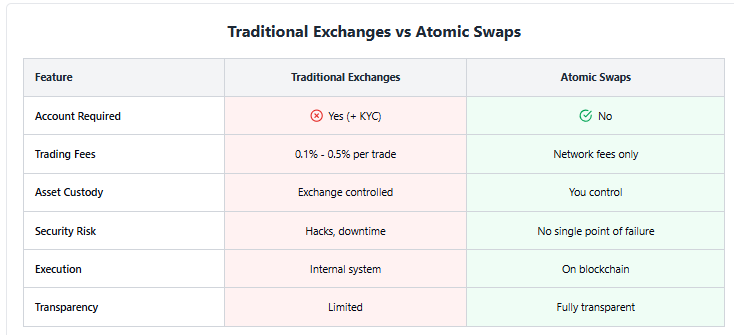
Additionally, the speed and security differences between the two options are important considerations. While centralized exchanges can freeze accounts due to unknown circumstances, can get hacked, or even be regulated (as in the case of Mount Gox), these types of risks do not exist with atomic swaps.
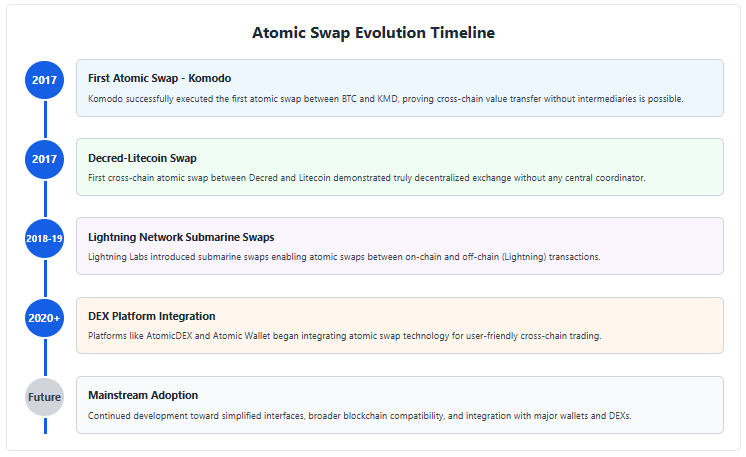
The first atomic swap was conducted in 2017 when Komodo made a working example of exchanging BTC for KMD. This was an important moment because it demonstrated that it is possible for two different blockchains to transfer value to each other without any intermediaries. Following this success, numerous other projects such as the Lightning Network began exploring ways to use atomic swaps to facilitate interoperability between cryptocurrencies.
The value proposition of these types of exchanges is straightforward yet powerful. They allow users to trade coins and tokens in an entirely automated manner, eliminating the need to trust a centralized third party to manage the transaction on their behalf. Instead, users can rely on trust in the underlying mathematics and computer code governing these transactions, which is generally much more reliable than human oversight.
How Atomic Swaps Work: HTLC & Smart Contracts Explained
Now let's take a look behind the curtain to understand the technical side of things. The technology behind this magic is called HTLC – or Hash Time Locked Contract.
HTLCs combine the two steps of a lock when sending to ensure honesty from both participants.
Hash Locks are essentially a "password" created through cryptography. A user selects secret data, makes a unique hash from their secret data, and then provides the hash to the second user. The second user will need the user's secret data in order to submit their side of the transaction.
Time Locks act as "countdowns" for the transaction to be successfully completed by both parties. If for any reason the swap does not happen, then the transaction will reverse itself after the specified time limit, enabling both parties to recover their original funds.
The method by which Friend B locks their merchandise away until Friend A claims it, is similar to how HTLC works under atomic swaps.
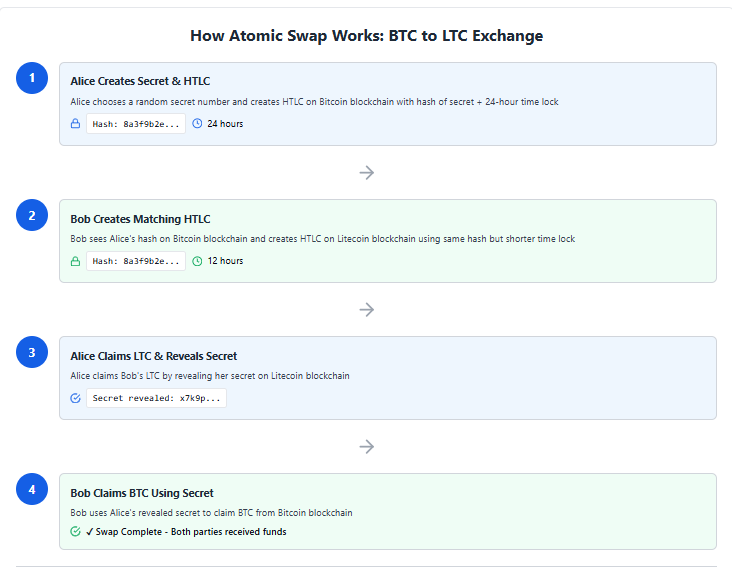
For example with a BTC to LTC transaction, this is how the atomic swap would occur:
1. Alice is in possession of BTC. She will choose a random number as her secret.
2. Alice will create an HTLC on the BTC chain (Bitcoin) by locking her BTC with the hash of the secret number and a 24-hour time lock.
3. Bob notices the hash on the BTC blockchain, therefore Bob can create a second HTLC on the LTC blockchain (Litecoin) by locking his LTC using the same hash that Alice created, however the time lock will be shorter (e.g., 12 hours).
4. Once Alice creates the HTLC on the BTC chain, Bob can claim Alice's BTC by revealing his secret to the LTC blockchain.
5. Additionally, when Bob reveals his secret number to Alice, Bob will also be able to use that information to successfully claim Alice's BTC.
6. If Alice fails to disclose her secret number, both time locks will expire, and the coins will revert to their previous owners.
Atomicity is a key feature of this technology. In this context, 'atomic' highlights the all-or-nothing aspect of a transaction; if you perform an atomic swap, either everything is completed successfully or nothing is completed--and there is no situation in between where only one party has received funds while the other has not.
Atomic swaps are made possible by smart contracts that automatically execute when specific conditions are met. They are resistant to tampering and do not depend on anyone to facilitate the switch.
When implemented, smart contracts will operate according to the code that was deployed without fail in 100% of cases.
An example of this occurred in 2017 when Decred and Litecoin created a cross-chain atomic swap. The entire process occurred on both blockchains, and no central party participated in the coordination of the two blockchains.
Because of this, atomic swaps can be characterised as truly trustless transactions. In an atomic swap, your trust does not go to Bob potentially sending LTC after you send him BTC; rather, it lies in the belief that the mathematics ensures that either both transactions go through or neither goes through.
Real-World Use Cases of Atomic Swaps
There are many different applications for this technology. Knowing how it works is not enough; seeing it in real life is when it becomes really exciting.
One of the more obvious uses for this technology is in cross-chain exchanges of cryptocurrency (i.e. exchanging bitcoin for litecoin, ethereum for bitcoin, monero for zcash, etc.). Any pair(s) of coins that both blockchains have all of the necessary smart contract capabilities to allow for such exchanges are valid candidates for this type of exchange.
The reason this is important to the industry is that the crypto ecosystem is fragmented by thousands of different tokens and chains, and historically would require centralized exchanges or centralized bridge solutions to move value from one token or chain to the other. Atomic swaps will help to eliminate this fragmentation.
Additionally, DEXs are beginning to adopt the use of atomic swap technology as well. Platforms like Uniswap and PancakeSwap (to name a couple) could become true cross-chain platforms with the use of atomic swaps. Currently, DEXs trade only within the parent ecosystems on which they were created.
Uniswap trades only on the ethereum token ecosystem, while PancakeSwap trades on the Binance Smart Chain ecosystem. With the advent of atomic swaps, a user may be able to swap, say, their bitcoin for an ethereum token without wrapping their bitcoin or having to bridge.
To use a video game analogy to illustrate my point - if two players wanted to trade in-game items from different consoles, then those players would have to find an online 'middle man' who supports both consoles and then pay for that service. However, if they were able to use Atomic Swaps, they would trade directly between their respective consoles without needing to pay a 'middle man.'
The Komodo Team has been at the forefront of developing an atomic swap implementation. The team has demonstrated that they can perform direct cross-blockchain swapping of coins through the AtomicDEX platform, reducing the cryptocurrency trading community's dependency on centralized exchanges.
Atomic swaps have also proven to be beneficial to businesses that want to accept payments across different blockchain platforms, as there are now many different blockchain platforms being used within supply chains and/or within the same industry.
For example, company A might be operating on Hyperledger, but company B might be using Ethereum and company C might be using a private blockchain. Companies will be able to perform cross-blockchain payments directly through the use of Atomic Swaps, eliminating the need to convert their respective cryptocurrencies into fiat currency and back again using a centralized exchange.
Enabling businesses to perform atomic swaps will increase liquidity for digital assets across the entire cryptocurrency ecosystem; instead of liquid assets being locked into specific platforms or centralized exchanges, they will be able to move freely throughout the ecosystem.
This has also been the subject of experimentation for the Lightning Network. Lightning Labs created a method called submarine swap, which is a type of atomic swap that enables the exchange of currency between an on-chain (blockchain) and off-chain (off-chain) version of Bitcoin or other cryptocurrencies through Lightning channels. This is still in the initial stages of development; however, it represents a major opportunity for making cryptocurrency payment solutions easier and more scalable than they are today.
When we speak about atomic swaps, it is essential to realise that we are still very much in the beginning stages of their acceptance by cryptocurrency users. While the technology is sound, it is still evolving into a user-friendly format, which is analogous to simply clicking 'trade' at Coinbase, but that will likely rapidly evolve as further development occurs with wallets and exchanges creating better interfaces for this technology.
Benefits & Limitations of Atomic Swaps
Let's face facts. No tech is flawless, atomic swaps represent the same reality. Although they are beneficial and advantageous there are also requirements and constraints involved that you need to be cognizant of before engaging with them.
Benefits include:
Trustless exchange: You're not putting your trust in a third party with your money, even for a short period of time. Given the recent history of Exchange hacks (i.e FTX), this is significant; you always have control of your keys and crypto.
Cross-Chain liquidity will receive an increase in liquidity due to the lack of barriers preventing the flow of value across both. This helps in making the crypto market greatly improved overall.
Lower transaction prices result from Atomic Swaps compared to centralized exchanges which normally charge two to three times more than the transaction fees that are associated with Atomic Swaps. That could equate to hundreds or thousands of dollars in savings when the transaction is larger.
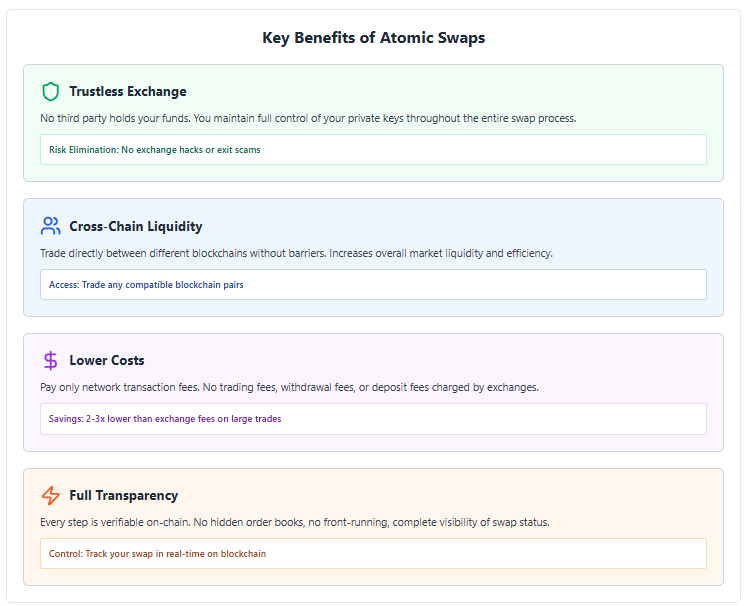
You don't need to put any faith in anyone or any (hidden) order books, nor is the possibility of front-running by an exchange included. Every aspect of the swap is fully on-chain; thus, you can check for yourself where your swap is at every point along the way.
It's essentially two friends swapping collectibles with one another, while also saving the shop markup and without the need to trust any shop owners, as it's entirely peer-to-peer and they verify the condition of their respective collectibles before they make any trades.
The Limitations:
Although there are many advantages to atomic swaps, they do not yet provide an easy-to-prepare solution for most average users. The complexity of technology behind them is considerable, requiring the understanding of HTLC (hashed time-lock contract) contracts as well as time-lock management and having both parties on chains that are compatible with HTLC. Most crypto currency users today do not have the level of technical knowledge to meet these requirements.
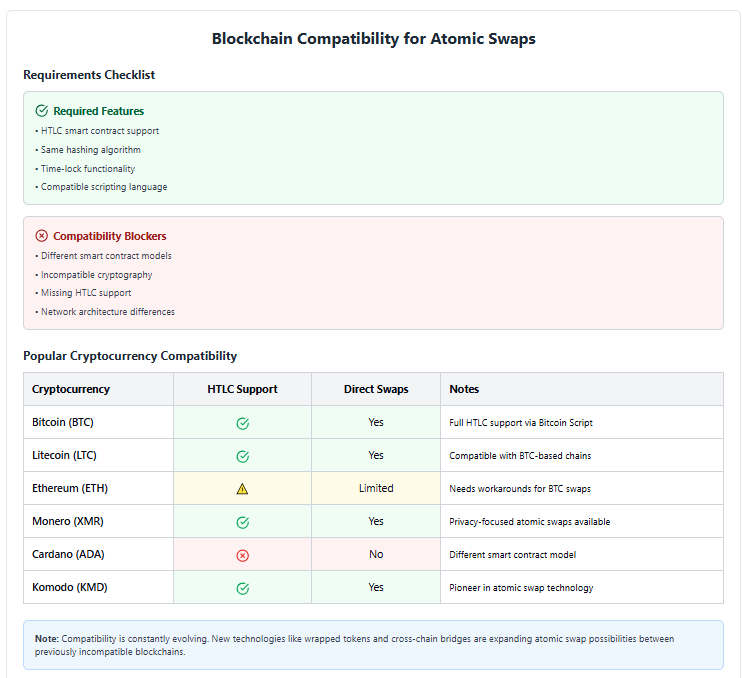
The ability of a given block chain to support atomic swaps is also limited; therefore, not all coins will be able to take advantage of this new technology. For example, it is not possible for a user to swap Bitcoin and Cardano directly because they do not have the same smart contract functionality.
There are many other important aspects of atomic swaps including transaction speed. In order for an atomic swap to be completed there must be at least two transactions made on-chain. Each of these transactions must also have received block confirmation before being processed as secure. For example, if Bitcoin were to be extremely congested then it could take several hours to complete a swap, in comparison to using a centralized exchange which offers immediate trades.
The overall condition of both networks is another factor in the success or failure of an atomic swap. If a large number of fees are incurred due to increased activity on either side of the swap, then the final cost of the swaps will likely exceed the anticipated cost. Additionally, if one block chain is significantly slower than the other, the time-lock created may expire before both parties can finish their transactions.
To keep it real, most people will find centralized exchanges a lot easier than doing an atomic swap. To utilize a centralized exchange (such as Coinbase) in short, you simply sign up, deposit funds, trade, and withdraw your funds. Atomic swaps require a bit of technical knowledge and also the added responsibility of being solely in control of your own funds.
Sadly, there have also been many cases of failed atomic swaps. Often, this happens when the time lock expires due to an increase in congestion on the blockchain that causes delays in the required confirmations. On other occasions, users have misconfigured their HTLC contract (Hash Timed Locked Contract) and lost their access to their funds (temporarily). However, these instances are infrequent.
Understanding these limitations can help you successfully execute atomic swaps. Currently, they will not replace Coinbase on the horizon but, in certain use cases (specifically, for larger trades where fees may affect the outcome) and have the added advantage of being private transactions, atomic swaps will be a very powerful technology.
How to Execute Atomic Swaps: A Beginner-Friendly Guide
Do you want to learn how to use an "atomic swap" (a type of trade) with cryptocurrencies? Follow my instructions to do it.
How do I know if my wallet supports atomic swaps?
Not every wallet supports atomic swaps yet, but there are already a number of great wallets on the market that allow atomic swaps. Komodo has developed an easy-to-use application called AtomicDEX, which has built-in support for atomic swaps.
Atomic Wallet is a wallet that will let you do cross-chain swaps for some specific pairs of coins. As the technology behind atomic swaps develops further, there will be more platforms that will also have support for atomic swaps.
Be sure to check the "trading pairs" available on the platform you want to use to make sure that both cryptocurrencies you plan to trade are available.
A step-by-step guide to atomic swap trading.
-
Identify Your Trading Pair - You must choose the two cryptocurrencies you wish to switch. For example, if you are going to exchange Bitcoin for Litecoin, you need to ensure both types of currency are supported on the exchange you desire to use.
-
Initiate The Atomic Swap - Enter the amount of each coin that you want to swap on the respective platform. The exchange will provide you with the current exchange rate and any associated network fees charged. Verify that all aspects of the swap are correct as atomic swaps are final.
-
Create the HTLC Contract: The process begins when your wallet creates an HTLC contract on your behalf. You don't need to worry about how the software creates the contract or what kind of cryptography it is using, you will just need to ensure that the locking period of your HTLC contract is long enough, generally a minimum of 24-48 hours.
-
Wait for Counterparty: Once you have created your contract, you will then wait until the other party has created their HTLC contract using your hash. There are two ways to do this: either your platform will automatically match you with another user, or you will find and contact another user directly.
-
Exchange Hash Values: After both parties have created the HTLC contracts, both users will need to exchange the hashes that they created. This process will take place automatically through the platform, and both parties will be able to verify that the other party has created an HTLC contract using the same hash as themselves in the blockchain.
-
Complete the Swap: After the hash values are exchanged, both parties will reveal their secrets to the other party in order to claim the funds from the other party's HTLC contract. After both payments have been made, the transaction has been completed and both parties will have completed the swap.
Let us examine the friend analogy one more time. Two friends have to exchange some things with each other through a pair of secure boxes. Friend A places their item into a secure box containing a lock with a password on it and a timer that counts down from one minute, then sends the box to Friend B.
Friend B does the same with their item. Once Friend A enters the correct password into the box they received from Friend B to unlock it, the same password becomes available for Friend B to unlock the box they received from Friend A. If neither friend unlocks their respective boxes by entering the correct password before the timer expires, both boxes will return to the respective owners of the boxes. This is the complete process described in brief.
Key Considerations:
It is essential to check that you are using a compatible blockchain for your Atomic Swap.; there is no guarantee that every blockchain can use Atomic Swap with one another. For example, Bitcoin and Ethereum cannot be used for direct swapping as they have two different Smart Contract Languages, so there are workarounds to enable it.
Before proceeding with your Atomic Swap, verify that you have the correct Hash, and Time Lock settings in place. While the majority of "Atomic Swap" swear by doing this automatically, it is advisable to ensure that they did this properly; otherwise, an incorrectly configured Time Lock could result in your original crypto not being transferred.
Be aware of the risks involved in performing an Atomic Swap. If there is an unexpected spike in Network Fees or congestion on one of the blockchains, the transaction will time out; you will receive your original funds back but you will still incur Network Fees.
When you first attempt an Atomic Swap, only use a small amount of Crypto. Do not attempt to perform an Atomic Swap with a value of $10,000 on your first attempt; perform a small Test Transaction beforehand to see how the process works.
Classic Atomic Swap Examples & Beginner Analogies
Sometimes theoretical knowledge will not provide enough understanding. Let's use examples and compare this to something familiar that can aid in your understanding.
The first example is the Komodo project, demonstrating their BTC-KMD atomic swap in 2017.
The BTC-KMD Swap was one of the first public atomic swaps in existence. Here is how it worked:
The Swap between the two platforms utilized their blockchains independently. The team generated a HTTL on the Bitcoin Blockchain, locking up the BTC and securing it with a hash-lock; they generated an HTLC contract on the Komodo Blockchain that uses the same hash but had a different expiration (set to a shorter timeframe).
When the secret was revealed so the user could claim their KMD, that same secret was also disclosed on the Bitcoin Blockchain to allow the counter-party to claim their BTC.
Thus both transactions finished within a few minutes and to confirm this was successful, both blockchains could verify this event. In doing so, this proved that cryptocurrency could exist as decentralized and untethered to any centralized entity.
Lightning Network Cross-Chain Payments
With the introduction of Cross-Chain Lightning (CCL), Lightning Labs has expanded the capabilities of atomic swaps to include payment transactions rather than just traditional on-chain trade interactions. CCL enables you to take BTC and send it via CCL to an individual who has a wallet that can accept it in LTC format.
CCL transactions occur almost instantly, have very low costs associated with them, and are completely trustless because they utilize secure routing methods rather than relying on a third party.
Lightning Labs has proven this technology by executing atomic swaps between various types of cryptocurrencies, proving that atomic swap technology is valid across both blockchain networks (on-chain) and payment channels (off-chain). Therefore, CCL opens the door to utilising cryptocurrency as a form of payment for everyday goods and services.
Beginner Analogy: The Envelope Trade
Here's my favorite way to explain atomic swaps to complete beginners:
Two friends want to exchange collectible cards, but they live a long distance apart, and neither of them really trusts the other. As a result, they choose to send their cards in special envelopes with locking mechanisms for safety.
Friend A sends an envelope that contains their card and is secured with a combination lock to Friend B. However, the envelope also has a timer attached to it. It will automatically return to Friend A if it hasn't been opened within 24 hours.
Once Friend B receives the envelope, they will not be able to open it because they do not have the combination. Instead, Friend B puts their card into a different envelope (also timed, but with a maximum of 12 hours) and sends it back to Friend A.
Now that Friend A has received Friend B's envelope, they have access to both combinations. Friend A opens Friend B's envelope using the combination they have and retrieves Friend B's card. Friend B will have seen that Friend A entered the combination (recorded) and can use it to open their own envelope from Friend A.
Both friends will now have received their cards without cheating. If Friend A never enters a combination, both envelopes will automatically return to their original owners before 24 hours pass.
Game Coin Analogy:
An example of a trading between two different online games would be if you had rare armor in Game A and your buddy had a rare mount from Game B, but you couldn’t trade them because they are both from different online worlds.
With atomic swap technology embedded into both of these games, you would create an agreement where you reserve your armor and your friend would create an agreement to reserve their mount, and only once both parties confirm the deal by entering a special code do the items exchange ownership. If either party does not enter the provided code prior to the deadline, ownership of both items would revert back to their original owners.
This is similar to how atomic swaps between the various cryptocurrencies work.
The above analogy is used throughout the examples provided to highlight the fact that both atomic swaps and cross-chain item trading are based on the same principles of cryptographic security and a countdown clock/timer; therefore, the underlying mechanism for both processes is the same regardless if cryptocurrencies or game items are being exchanged.
Why Every Crypto Trader Should Understand Atomic Swaps
Crypto is set to build the future of finance; however, many people use it as if it were still in 2010 - centralised exchanges, KYC processes, custodial wallets - basically, we have returned to the traditional financial systems' problems in what purports to be a decentralised environment. Atomic swaps are what crypto was always meant to be; a true P2P exchange, with no third-party mediation and you simply have two people and some very clever cryptography to ensure neither party loses out.
Is it a good idea to immediately switch to atomic swaps for all of your trades? Not necessarily; by no means are they the answer to every problem as the technology is still maturing and there are advantages to using a centralized exchange for convenience. However, if and when you understand how atomic swaps work, you will have more choices.
When exchanges go down (and they do), when fees increase (and they will), and when privacy is of concern (and it should be), at least you will know that another option is available. Atomic swaps are one of the best examples of how decentralisation can empower beginner crypto users and continue to empower professional traders through DeFi strategies; they will become a more important tool as DeFi evolves, as cross-chain liquidity becomes a more pressing need.
Increased Interoperability in the Cryptocurrency Ecosystem
We're witnessing an increasing number of developments in the Cryptocurrency Ecosystem with many of the existing players (many of which consider themselves 'Bitcoin maximalists' or 'Ethereum enthusiasts') beginning to comprehend that Blockchain Tribalism serves no-one.
Interoperability is the ability of different blockchain networks to interact with one another, and Atomic Swaps represent one method for creating interoperability between these networks.
Atomic Swaps allow you to trade Cryptocurrencies without the need for a third party or intermediary. You can utilize Atomic Swaps to trade perfectly and reliably all of the assets you hold on your Cryptocurrency Exchange account.
By understanding how Atomic Swaps work, both new and experienced Traders should better understand what the future holds for Cryptocurrency Trading when you remove Middlemen from the equation and are able to trust the Code (the Smart Contract) rather than institutions.
If you want to learn more about Cryptocurrency Trading Strategies, or how to use Blockchain Technology to your advantage, you may want to try Demo Trading on Tradewill.com to learn how to use the above concepts without risk. Understanding the method of doing Decentralized Trading will help you become a more successful and knowledgeable Trader as you expand your career in today's ever-changing Cryptocurrency Industry.
Disclaimer: The content of the blog does not represent any position of Trade W, does not serve as any trading-related decision advice, and does not endorse any third-party.