
 Trade W
Why Currency Trading in India Is Exploding in 2026
Every day, the global foreign exchange market processes approximately $7.5 trillion in trading volume, making it the largest and most liquid financial market in the world. Until recently, however, this was a market that most retail traders could only read about rather than actively participate in. In India, that situation is changing rapidly, at a pace that has surprised even many experienced market participants.
Retail participation in trading has grown at a rate that would have seemed unimaginable just five years ago. This growth has been driven by several factors, including widespread smartphone adoption, the ubiquity of India's UPI payment ecosystem, and the increasing role of the U.S. dollar in the Indian economy through imports, remittances, and IT exports. As a result, millions of people who may never have previously considered trading currencies are now paying attention to foreign exchange markets and observing how the value of the Indian rupee moves relative to the U.S. dollar, particularly following major announcements from the U.S. Federal Reserve.
When the rupee weakens against the dollar, the effects extend far beyond those purchasing goods from overseas. Anyone making payments denominated in U.S. dollars, including subscriptions, software services, educational expenses, or international transactions, can be affected by changes in the exchange rate. Consequently, many retail traders and consumers in India have developed a greater interest in understanding how central banks use tools such as quantitative easing and monetary policy to influence currency markets. What was once viewed as a topic relevant only to institutional investors has become increasingly important to everyday market participants as well.
There are several common myths about forex trading that often confuse new investors. For example, many people believe that forex trading is completely illegal in India or that it operates in the same way as cryptocurrency markets. Neither of these assumptions is accurate. Currency trading in India is regulated within a structured legal framework, and before considering any broker, platform, or currency pair, it is important to understand how that framework operates.
In India, retail traders primarily access the currency markets through exchange-traded currency derivatives listed on the National Stock Exchange (NSE) and other regulated exchanges rather than through the broader global spot forex market. Recent volatility in the USD/INR exchange rate, driven by interventions from the Reserve Bank of India (RBI) and changes in U.S. monetary policy, has created significant trading opportunities for market participants. Before selecting a trading platform, however, traders should clearly understand the regulatory limits governing which instruments can be traded, how they can be traded, and which types of currency transactions are not permitted within the Indian regulatory environment.
What Is Currency Trading? A Beginner's Guide to Forex and Currency Pairs
Forex trading involves buying one currency while simultaneously selling another. Because currencies are always exchanged relative to one another, they are quoted and traded in pairs. The first currency in a pair is known as the base currency, while the second is known as the quote currency. For example, if the USD/INR exchange rate is quoted at 83.50, it means that one U.S. dollar is equivalent to 83.50 Indian rupees. A trader's profit or loss is determined by changes in the exchange rate between the two currencies.
Spot foreign exchange (FX) is the largest financial market in the world and operates primarily through over-the-counter (OTC) transactions between banks, financial institutions, and other market participants at live market prices. Currency futures, by contrast, are standardized contracts that are bought and sold on regulated exchanges such as the National Stock Exchange (NSE), allowing retail traders in India to participate in the currency markets within a regulated framework.
Through offshore brokers, traders may also gain access to international currency pairs and forex-related contracts. However, because these products are generally not regulated under Indian law, they do not carry the same legal protections or regulatory oversight as instruments traded on Indian exchanges. The implications of this distinction will be discussed in greater detail later in the article.
The primary currency contracts available to Indian traders on the NSE include USD/INR, EUR/INR, and GBP/INR. Traders who access international forex markets through brokers may also encounter major global currency pairs such as USD/JPY and EUR/USD. Regardless of the market being traded, transaction costs remain an important consideration. One of the most significant costs is the bid-ask spread, which represents the difference between the price at which a currency pair can be bought and the price at which it can be sold.
It is helpful to understand how floating exchange rates function. Most of the world's major currencies, such as the euro and the U.S. dollar, operate under a floating exchange rate system, where their values are determined primarily by market forces of supply and demand. The Indian rupee, however, operates under a managed float system. While its value is largely determined by market activity, the Reserve Bank of India (RBI) may intervene periodically to reduce excessive volatility and maintain orderly market conditions. Despite these interventions, the rupee is not fixed to any specific exchange rate.
The extent and frequency of RBI intervention can have a significant impact on the movement of the USD/INR exchange rate and may cause its behavior to differ from that of freely floating currency pairs such as EUR/USD. Understanding these dynamics is particularly important for traders entering the Indian currency market for the first time, as domestic monetary policy and central bank actions can influence price movements in ways that differ from those observed in other major forex markets.
Is Forex Trading Legal in India? RBI and SEBI Rules Explained
This is one of the most common questions that creates confusion for beginner traders. The answer is yes, forex trading is permitted in India, but only when conducted within a specific and well-defined regulatory framework. Trading currencies outside of this framework can expose traders to legal and regulatory risks, and many retail forex traders unknowingly operate beyond these permitted boundaries.
Two primary regulatory authorities oversee currency trading activities in India. The first is the Reserve Bank of India (RBI), which establishes the policy framework governing foreign exchange transactions under the Foreign Exchange Management Act (FEMA). The second is the Securities and Exchange Board of India (SEBI), which regulates the securities and derivatives markets, including exchange-traded currency derivatives. Together, these regulatory bodies define the legal framework within which Indian currency traders can participate in the market.
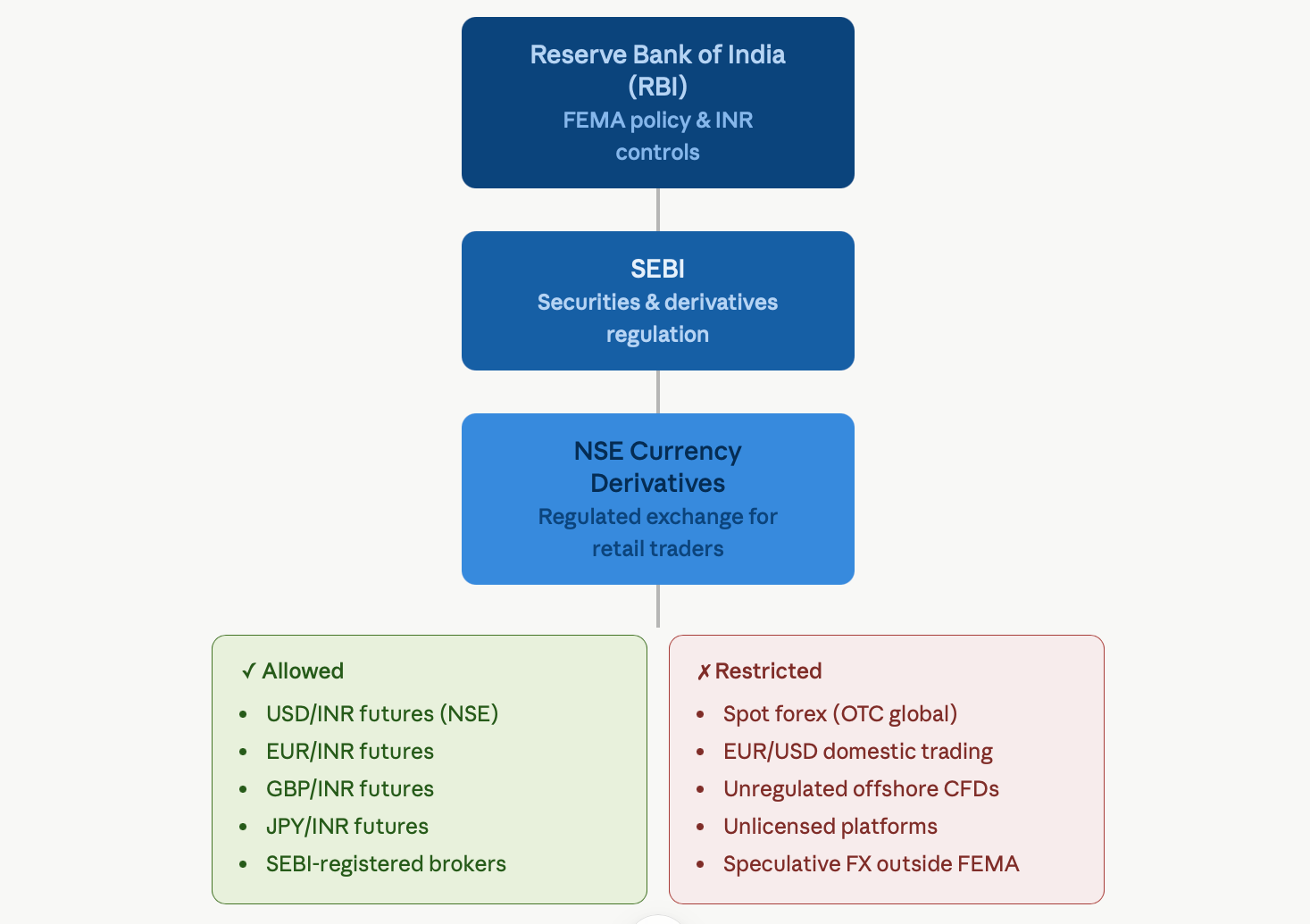
Indian traders have the option of trading INR-based currency pairs through brokers registered with SEBI. These include USD/INR, EUR/INR, GBP/INR, and JPY/INR futures contracts. All of these instruments are exchange-traded, regulated, and subject to transparent pricing and institutional oversight.
Domestic traders generally cannot legally speculate on non-INR currency pairs through Indian bank accounts or participate directly in foreign exchange markets outside the framework permitted by Indian regulations without the appropriate authorization. Many offshore trading platforms continue to operate in a regulatory grey area, potentially exposing traders to legal and compliance risks, tax complications, and limited avenues for dispute resolution or fund recovery in the event of a problem.
From a taxation perspective, income generated from currency trading in India is typically classified as either speculative income or business income, depending on factors such as trading frequency, trading volume, and the trader's intent. Regardless of the classification, trading income must be properly disclosed and reported in the trader's Income Tax Return (ITR). Failure to comply with tax reporting requirements can create significant legal and financial complications that cannot be offset by trading profits.
For most Indian retail traders, the most prudent approach is to begin with regulated, exchange-traded currency derivatives through a SEBI-registered broker on recognized exchanges such as the National Stock Exchange (NSE). The purpose of regulation is not to restrict participation in financial markets, but rather to facilitate participation within a transparent and regulated environment that helps protect all market participants.
Best Broker for Currency Trading in India (2026 Platform Comparison)
When selecting a broker in India, it is essential to choose one that aligns with your trading style and risk tolerance. Rather than making a decision based on advertising or promotional claims, traders should focus on three core factors: regulatory compliance, cost efficiency, and execution quality. These considerations are far more important to long-term trading success than any marketing message.
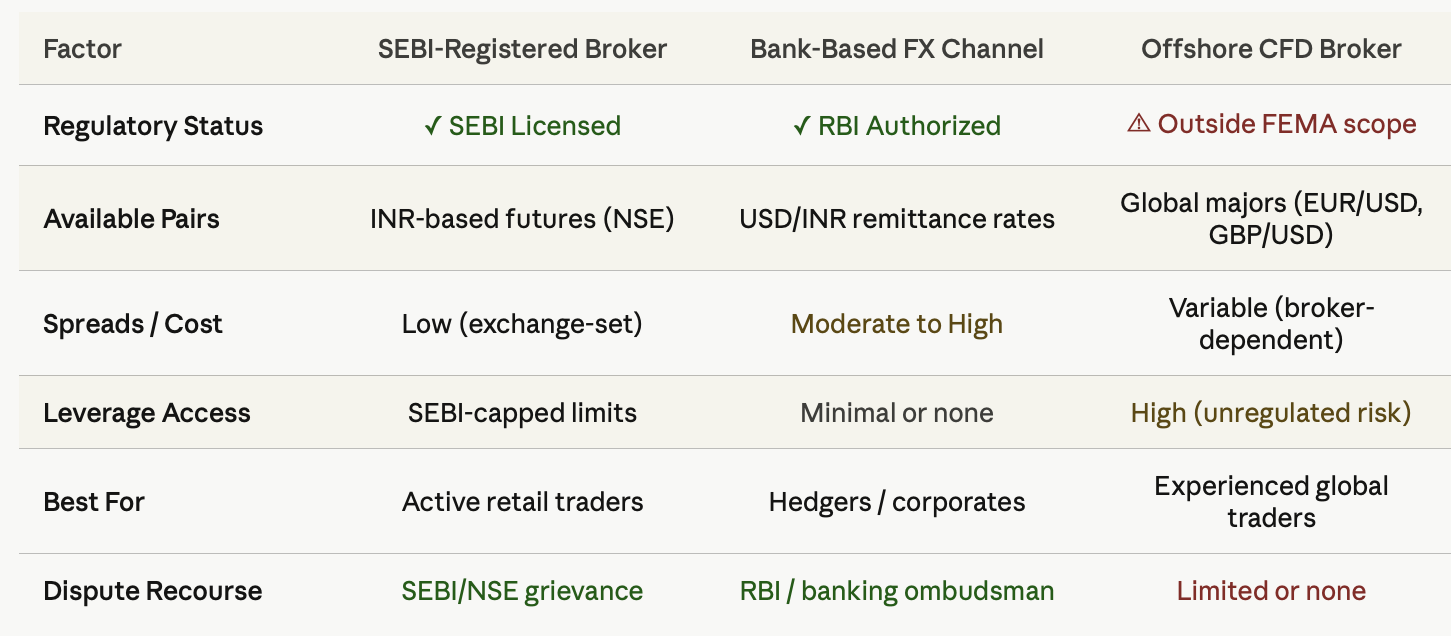
When evaluating a SEBI-regulated broker for trading currency derivatives, the factors that will most directly affect profitability include the competitiveness of spreads, the speed and consistency of trade execution, and the reliability of the trading platform during periods of elevated market volatility. A broker can turn a potentially profitable trade into a losing one if spreads widen significantly during major market events, such as Reserve Bank of India (RBI) monetary policy announcements or U.S. employment reports, even when the market itself has not moved materially against the trader's position.
The broker selection process is also an appropriate time to examine the role of currency trading signals and learn how to distinguish legitimate sources of market analysis from misleading marketing claims. Many traders become confused by the inconsistent way forex signals are promoted across the industry. Understanding how signals are generated, evaluated, and marketed can help traders avoid unrealistic expectations and make more informed decisions when selecting both a broker and a trading strategy.
For novice traders, regulatory compliance and access to educational resources should be the highest priorities when entering the world of trading. Active traders who focus on short-term market opportunities, on the other hand, often place greater emphasis on leverage, execution speed, and market depth. Scalpers trading USD/INR require a platform capable of delivering sub-second order execution and consistently tight spreads. Swing traders seeking to profit from price movements over several days or weeks may place greater importance on intuitive interfaces, research tools, and analytical resources than on marginal differences in execution speed.
The type of trading platform a trader uses can also play an important role in the overall trading experience. Mobile applications may be ideal for traders who monitor positions throughout the day and require flexibility while away from their desks. Professional desktop or web-based trading terminals, however, often provide more advanced charting capabilities, technical analysis tools, and customization features that support sophisticated trading strategies.
Rather than asking, "What is the most popular broker?", traders should ask a more practical question: "Does this broker provide the instruments, execution quality, platform features, regulatory protection, and overall trading environment that align with my specific trading style and objectives?" The answer to that question is far more important than a broker's popularity or marketing presence.
How Currency Trading Works: Margin, Leverage, Spreads, and Execution
Understanding how trading works from a mechanical and structural standpoint is an essential prerequisite before placing any trades. A solid understanding of these fundamentals can significantly influence your ability to develop trading skills and manage risk effectively from the outset.
In every forex trade, you are required to post margin, which serves as collateral for the position you wish to control. For example, if you deposit ₹10,000 as margin and your broker provides 10:1 leverage, you can control a position worth ₹100,000. Leverage magnifies both gains and losses. A 1% favorable movement in the value of the position would generate a 10% return on your margin, while a 1% adverse movement would result in a 10% loss on your margin.
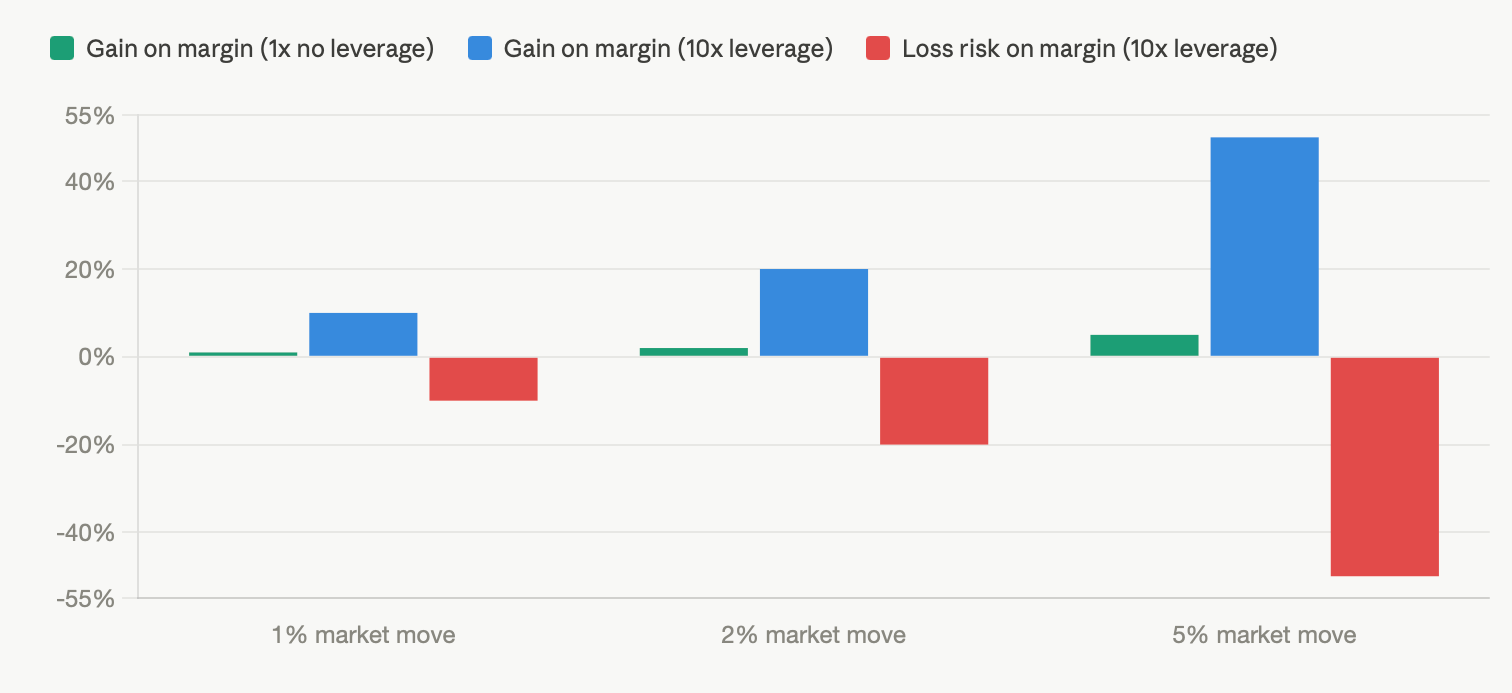
Because leverage amplifies outcomes in both directions, understanding margin requirements and risk management is one of the most important skills a new trader can develop. Protecting your trading capital should be a higher priority than maximizing returns during the early stages of your trading journey. By learning how margin and leverage work before increasing position sizes, traders can build a stronger foundation for long-term portfolio management and avoid many of the mistakes that commonly lead to significant losses.
One of the primary costs associated with forex trading is the spread, which is the difference between the price at which you can buy an asset and the price at which you can sell it. Because the spread is incurred on every trade, it often represents a significant portion of the total transaction cost associated with entering and exiting positions. In addition to spreads, some brokers charge commissions, particularly on accounts that offer very tight spreads. While certain platforms market themselves as commission-free, traders should always evaluate the total trading cost rather than focusing on any single fee component.
To trade forex effectively, it is important to understand how different order types work and when to use them appropriately. A market order is executed at the best available price when the order reaches the market. A limit order allows you to specify the price at which you are willing to enter a trade, helping you maintain greater control over execution. A stop-loss order is designed to automatically close a position if the market moves against you by a predetermined amount, thereby limiting potential losses.
Among these order types, the stop-loss order is arguably the most important risk-management tool available to retail traders. By defining an acceptable level of risk before entering a trade, traders can protect their capital, reduce the impact of emotional decision-making, and maintain greater consistency in their overall trading approach.
Best Currency Pairs to Trade in India
Not all currency pairs are equally suitable for Indian traders to trade on a regular basis. Differences in liquidity, transaction costs, volatility, and market behavior can be substantial enough to produce very different trading outcomes, even when the same strategy is applied across multiple currency pairs.
From both a regulatory and macroeconomic perspective, USD/INR is the most important currency pair for Indian traders. The behavior of USD/INR is influenced by factors such as interventions by the Reserve Bank of India (RBI), India's oil import requirements, capital flows, and monetary policy decisions by the U.S. Federal Reserve. Because USD/INR is actively traded on the National Stock Exchange (NSE), its price movements often reflect developments in both the Indian and U.S. economies, and it may exhibit recurring patterns around major economic announcements.
Among globally traded currency pairs, EUR/USD is widely regarded as the most liquid. Its high liquidity generally results in lower spread costs than most other forex pairs, making it attractive to many traders. Instruments that provide access to EUR/USD also tend to respond well to technical analysis because of the large number of market participants trading the pair.
For traders seeking greater volatility, GBP/USD typically offers larger average daily price movements and tends to be more sensitive to economic developments in the United Kingdom, shifts in global market sentiment, and changes in risk appetite.
For most beginners, starting with USD/INR can be a practical way to build an understanding of currency market behavior within a familiar regulatory environment. As traders gain experience and expand into additional currency pairs, it becomes increasingly important to understand currency correlations. Holding multiple highly correlated currency positions can unintentionally increase exposure to the same underlying market risks, resulting in a larger concentration of risk than the trader may initially realize.
Starting correctly is far more important than starting quickly. Traders who rush into live markets without adequate preparation generally perform worse than those who take the time to build a solid foundation of knowledge and gain experience through demo trading before risking real capital.
The transition from demo trading to live trading is often where psychology becomes the most important factor in a trader's performance. While demo accounts are valuable learning tools, they cannot fully replicate the emotional pressures associated with risking real money. As a result, many traders who perform well in a simulated environment struggle to achieve similar results once they begin trading live. Emotions such as fear, greed, impatience, and hesitation can influence decision-making in ways that are difficult to anticipate until real capital is at risk.
Traders who prefer not to rely heavily on technical indicators may benefit from studying price action trading methods. Price action analysis encourages traders to develop their ability to observe market behavior directly from price movements and chart structure without overcomplicating the decision-making process with excessive indicators. This approach can help build a stronger understanding of market dynamics and improve chart-reading skills over time.
Once a trader has established a solid foundation in risk management, market analysis, and trading psychology, they may choose to explore more active approaches, including higher-volume trading strategies and structured forex day trading methods that are better suited to experienced market participants.
How to Start Currency Trading in India Step-by-Step (2026 Beginner Guide)
Taking the first step toward becoming a successful trader is important, but taking that step correctly is far more important than taking it quickly. Many traders rush into live trading before spending sufficient time developing a solid foundation of knowledge and practical skills. As a result, they often perform worse than those who take a more measured approach and invest the necessary time in building a strong understanding of how markets operate.
The transition from demo trading to live trading is often where psychology becomes one of the most important factors in a trader's success. Traders who perform well on demo accounts frequently find it difficult to achieve the same results in a live environment because demo trading cannot fully replicate the emotional pressures associated with risking real money. Without actual capital at stake, emotions such as fear, greed, hesitation, and overconfidence are far less pronounced, making the move to live trading a significant adjustment for many traders.
Traders who wish to use price action as a primary method of understanding market behavior can benefit greatly from adopting a price action-based approach during their development. This methodology helps traders build the observational skills necessary to interpret charts directly through price movement and market structure, without relying on excessive indicators or unnecessarily complex analysis.
Once traders have developed a solid foundation and demonstrated consistent results, they may choose to explore higher-frequency trading approaches. However, these strategies are generally most effective after a trader has established discipline, risk-management skills, and a repeatable trading process through regular market participation, whether during active daytime trading sessions or through structured forex trading strategies that operate across global market hours.
Risks of Currency Trading Every Indian Trader Must Understand
There are numerous risks associated with forex trading, and many of them can cause significant damage to traders who enter the market without fully understanding what they are doing. The primary reason most retail traders lose money is not because the market is rigged or because a strategy is inherently flawed. More often, losses occur because traders make mistakes with position sizing, allowing leverage to transform normal market fluctuations into account-damaging losses.
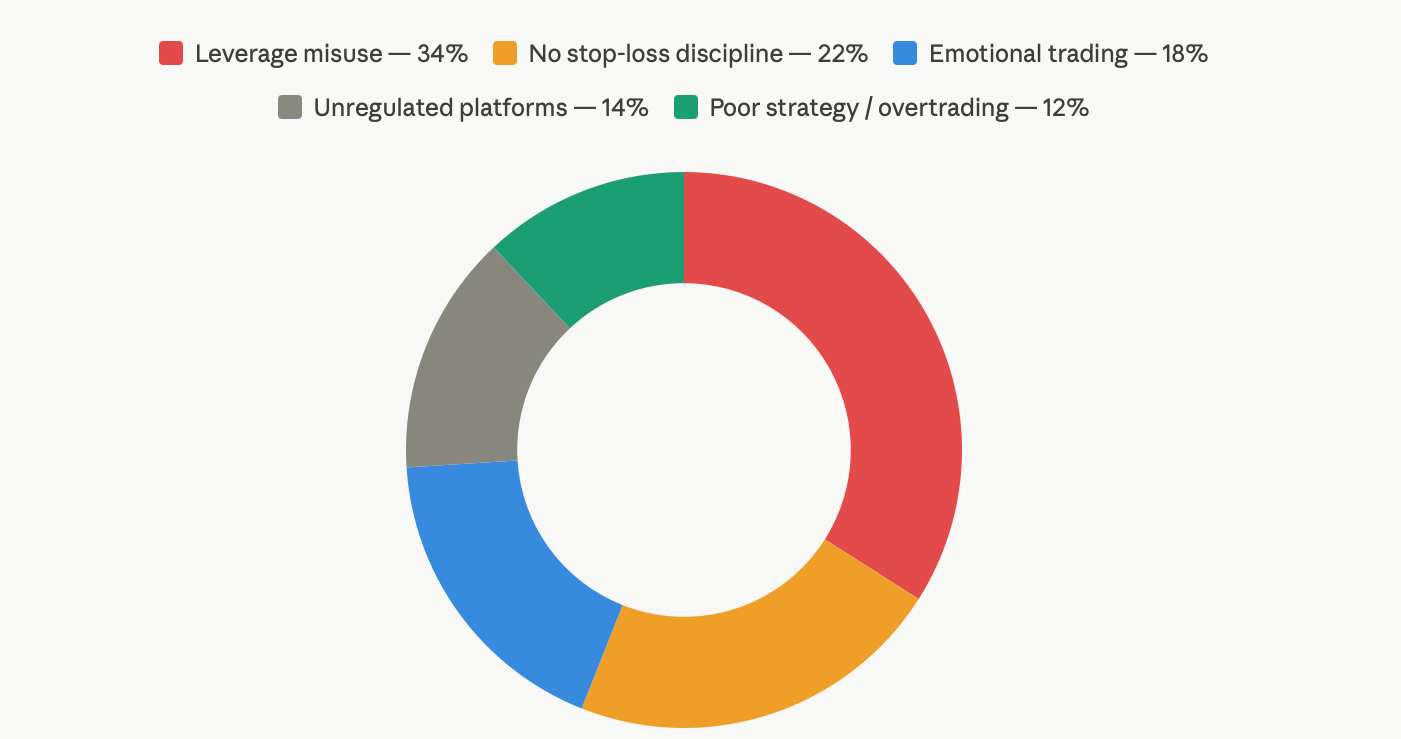
Leverage risk is at the top of the list of forex trading risks for good reason. A trader holding a highly leveraged position during a major economic announcement, such as an employment report, can lose a substantial portion of their account within minutes. In many cases, the problem is not simply being wrong about the market direction but rather taking a position size that is too large relative to the size of the trading account.
The second major risk is market volatility. Significant events, such as the United Kingdom's decision to leave the European Union (Brexit), demonstrate how rapidly markets can move during periods of uncertainty. Similarly, movements in the Indian rupee can be heavily influenced by monetary policy decisions made by the Reserve Bank of India (RBI). During major policy announcements, volatility often increases and spreads may widen considerably, making trade execution more difficult and increasing overall trading costs.
Liquidity risk is another important consideration. For example, traders attempting to trade GBP/INR during off-peak market hours may encounter thinner market liquidity, wider spreads, and slower execution. These conditions can make it more difficult to enter and exit positions efficiently and may negatively affect profitability.
There is also the risk associated with using unregistered offshore brokers or trading platforms. Traders who choose to use such providers may face additional risks related to fund security, dispute resolution, and regulatory protection. If an offshore broker experiences financial difficulties or fails to process withdrawal requests, recovering funds may be significantly more challenging than when dealing with a broker operating under a recognised Trading regulatory framework.
Understanding these risks before trading is essential. Effective risk management, appropriate position sizing, careful broker selection, and a thorough understanding of market conditions are often far more important to long-term success than finding the next trading strategy or market opportunity.
The Safe Way to Start Currency Trading in India (2026 Beginner Roadmap)
In India, currency trading is a rapidly expanding and fully regulated financial activity. The sheer size of the worldwide foreign exchange market presents real opportunities for informed retail participants, while the expanding financial infrastructure in India means doing so has never been easier. The true barrier is not access; it is the quality of education received prior to that access.
Traders who develop sustainable profits in currency markets do so by first educating themselves about the regulatory environment and selecting a broker that operates within that environment; learning how to execute orders and understand the costs of spreads and margins before placing trades with their own funds; and constructing habits around position sizing that preserve capital by withstanding extended losing periods.
Currency trading in India is legally permitted through Exchange-Traded Derivatives on the National Stock Exchange. The Securities and Exchange Board of India has established real investor protection for its members that unregulated offshore platforms simply cannot provide. Therefore, working within this established framework is not a limitation; rather, it is the safest basis for developing a trading career.
Your next step is to learn first; then demo trade; then place small live trades; and then scale your account only if your trading performance justifies it. Following this sequence works; there are no shortcuts.
Start your currency trading journey on a platform built for structured learning, not just rapid execution. Tradewill's education-first trading ecosystem gives you the tools, broker clarity, and market insights to trade INR pairs and global forex with confidence from day one.
Disclaimer: The content of the blog does not represent any position of Trade W, does not serve as any trading-related decision advice, and does not endorse any third-party.