
 Trade W
Options trading has evolved from being primarily the domain of large institutional investors, such as hedge funds and professional trading firms to becoming a popular activity among millions of retail investors. Daily options trading volume in the United States has more than doubled over the past five years, driven largely by the growth of commission-free trading platforms, mobile-first access through smartphones, and a new generation of investors seeking greater leverage and flexibility than traditional stock ownership can provide.
Choosing a broker is one of the most important decisions an options trader will make, as it directly affects the overall trading experience. Broker selection influences everything from the speed and efficiency of executing an AAPL call option to the quality of the analytical tools available for evaluating and trading an options chain shortly after the market opens. This guide will walk you through the key concepts you need to understand, including how call and put options work, as well as the essential factors that distinguish an exceptional options broker from an average one.
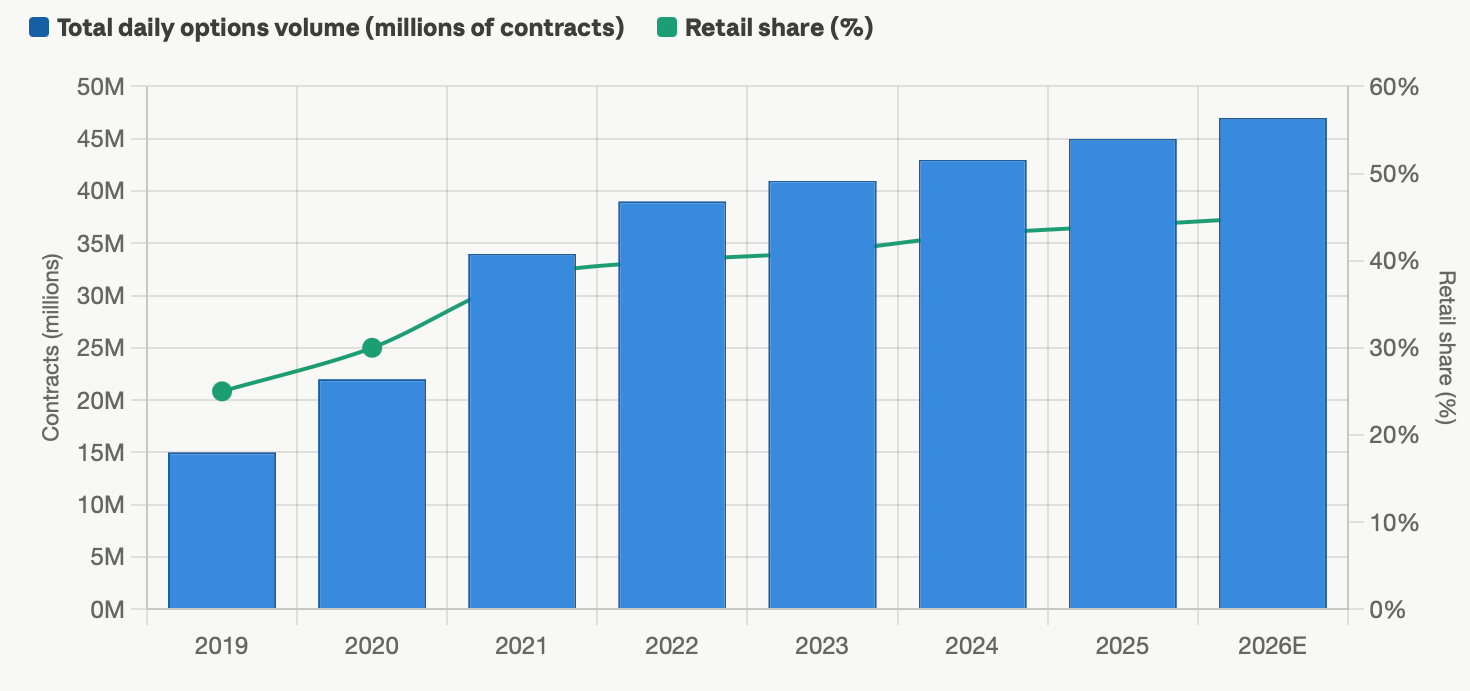
Retail investor participation in the options market has increased significantly, rising from approximately 25% of total trading volume in 2019 to more than 44% in recent years, with little indication that this trend is slowing. Account-opening processes that once required extensive paperwork and lengthy approval periods can now often be completed in a single session, enabling many traders to open a brokerage account and place their first options trade within 24 hours of receiving approval from their broker.
What Are Options? Call and Put Options Explained
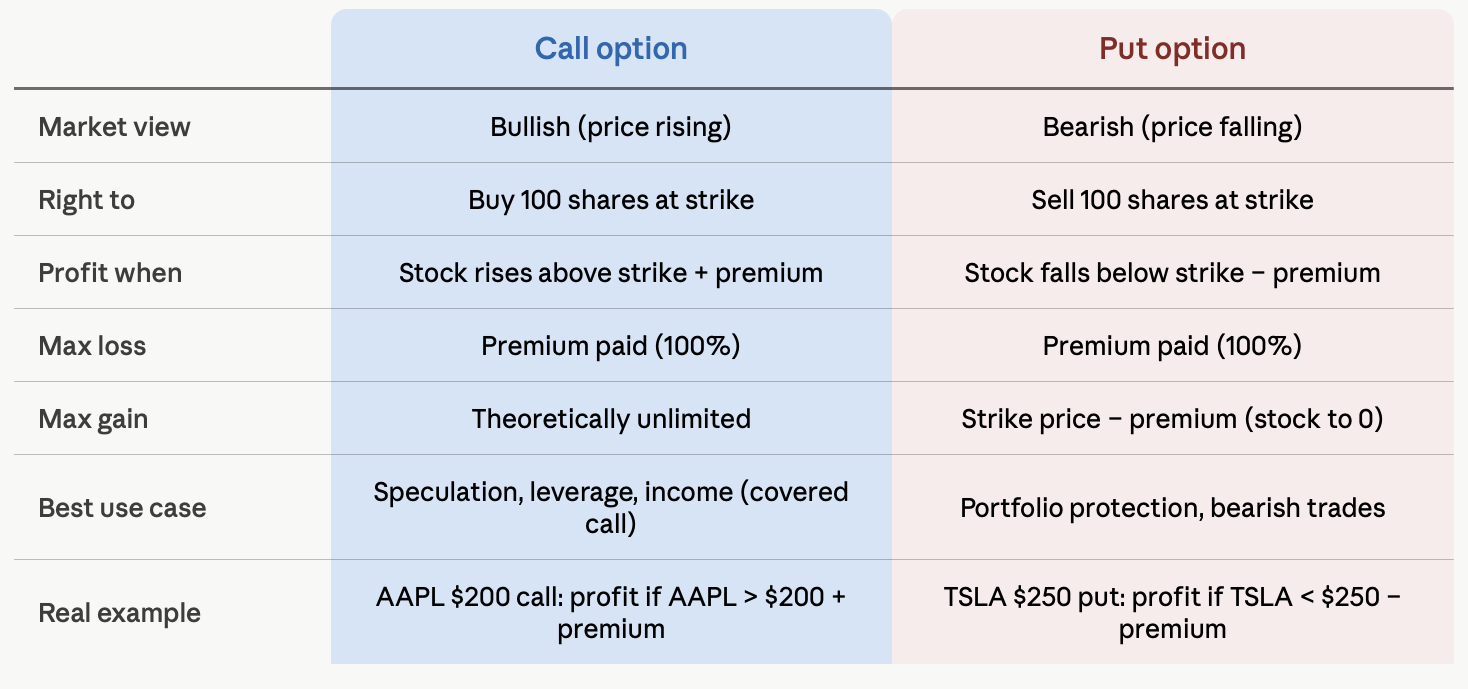
Before comparing brokerage firms, every trader should develop a solid understanding of the financial instruments they intend to trade. Options are contracts that give traders the right but not the obligation to buy or sell an underlying asset at a predetermined price, known as the strike price, before a specified expiration date. Unlike purchasing shares of stock, which provides ownership in a company, buying an option grants the holder certain contractual rights without requiring ownership of the underlying asset.
A call option gives the holder the right to purchase 100 shares of the underlying asset at the strike price. For example, if a trader purchases an AAPL call option with a strike price of $200 and the price of AAPL rises to $225 before expiration, the trader may choose to exercise the option and buy the shares at $200. The shares could then be sold in the open market at $225, resulting in a profit of $25 per share, excluding the cost of the option and any applicable fees. Call options are generally used when traders expect the price of the underlying asset to increase and want to benefit from a bullish market outlook.
Before placing an options trade, it is important to understand not only how call options work but also the factors that influence their value, including time to expiration, implied volatility, and the relationship between the strike price and the market price of the underlying asset.
A put option gives the holder the right to sell shares of an underlying asset at a predetermined price, known as the strike price, before the option expires. For example, if you purchase a put option on TSLA with a strike price of $250 and the stock price falls to $210, the put option becomes "in the money" because it gives you the right to sell shares at $250 while the market price is only $210. Put options are commonly used by traders and investors who wish to profit from a decline in the price of an asset or hedge an existing portfolio against potential losses.
Options are generally classified into three categories based on the relationship between the strike price and the current market price of the underlying asset:
-
In-the-money (ITM) options have intrinsic value because the market price of the underlying asset has moved beyond the strike price in a way that benefits the option holder.
-
At-the-money (ATM) options have a strike price that is equal to, or very close to, the current market price of the underlying asset. Because small price movements can significantly affect their value, these options are often highly sensitive to changes in the underlying asset's price.
-
Out-of-the-money (OTM) options have no intrinsic value at the present time. Their value is derived entirely from the possibility that the underlying asset's price may move beyond the strike price before the option expires.
Understanding these classifications is essential because they influence an option's pricing, risk profile, and potential profitability.
How Options Really Work: Premiums, Strike Prices, and Volatility
Every option has a price, known as the premium. This premium consists of two components: intrinsic value and extrinsic value. Intrinsic value represents the amount by which an option is currently in the money, based on the relationship between the market price of the underlying asset and the option's strike price. Extrinsic value, often referred to as time value, reflects factors such as the amount of time remaining until expiration and the level of implied volatility associated with the option contract.
Another important concept for options traders is theta, commonly known as time decay. Theta measures the rate at which an option loses value as it approaches expiration. As time passes, an option's extrinsic value gradually declines, even if the price of the underlying asset remains unchanged. This effect accelerates as expiration draws closer.
As a result, buyers of short-dated, out-of-the-money (OTM) options face a significant challenge because they are not only relying on the underlying asset to move in the desired direction but are also working against the effects of time decay. For this reason, repeatedly purchasing large quantities of inexpensive weekly OTM options can be a high-risk strategy, as the probability of losing the entire premium paid is often substantial if the anticipated price movement does not occur within a relatively short period.
Implied volatility represents the market's expectation of future price movement in an underlying asset and is a major factor in determining how much of an option's premium consists of extrinsic value. When earnings announcements approach or a significant macroeconomic event appears on the calendar, implied volatility tends to increase, causing option premiums to become more expensive. Once the event has passed, implied volatility typically declines, a phenomenon traders refer to as an IV crush. As a result, even if the underlying asset moves exactly as you predicted, you may still lose money because the elevated implied volatility that inflated the option's premium has dissipated. This can be one of the most frustrating experiences for new traders, being correct about the direction of the market but still losing money because they purchased options when implied volatility was unusually high.
When reviewing an options chain, it is also important to pay attention to open interest (the total number of outstanding contracts at a given strike price) and the bid-ask spread (the difference between the price buyers are willing to pay and sellers are willing to accept). If you trade options with low liquidity and wide bid-ask spreads, you may begin the trade at an immediate disadvantage, as the spread can significantly increase your transaction costs from the moment your order is filled.
To gain a broader understanding of how these concepts apply across different asset classes, a guide to foreign exchange derivatives, including futures, options, and CFDs, can provide valuable insight into how these same principles affect currency and commodity markets.
Best Broker for Trading Options in 2026: Compare Fees, Features, and Execution
When evaluating brokers, there are many different features that can affect how money is made or lost through options trading. Execution quality represents the most important feature that active traders should compare across platforms when looking for a new broker. If you are an active trader, better price execution on fast-moving options can add hundreds of dollars to your bottom line every month. While the spread from the midpoint to the ask may be insignificant on a single trade, it can become a much larger issue after executing dozens or hundreds of individual trades throughout the year.
In addition to execution quality, contract fees are a feature that still exists on almost all options trading platforms, even though there is no longer an associated stock commission. For example, while a $0.65 per-contract fee may seem low on a single contract, if you are executing a 10-leg strategy with 20 contracts per leg ($130 total in fees), it can easily start to erode your profits.
Another key differentiator across options trading platforms is the analytics tools they provide. The best analytics platforms offer probability-of-profit calculators, implied volatility rank charts, earnings-date overlays on the options chain, and risk/reward visualizers that update in real time before you initiate any trades.
One of the biggest differences between options trading platforms is the quality of their analytics tools. Leading platforms typically offer features such as profit probability calculators, implied volatility ranking charts, earnings date markers integrated into the options chain, and risk/reward visualizers that update in real time.
For traders who actively monitor and manage positions throughout market hours, the ability to execute trades from a mobile device without being tied to a desktop computer is extremely important. A well-designed mobile platform can provide flexibility and responsiveness when market conditions change rapidly.
The level of options approval granted by a broker determines which strategies you are permitted to trade. Most brokers use a tiered approval system consisting of four levels. Level 1 generally includes basic strategies such as covered calls and cash-secured puts, while Level 4 typically permits more advanced strategies, including naked calls and naked puts.
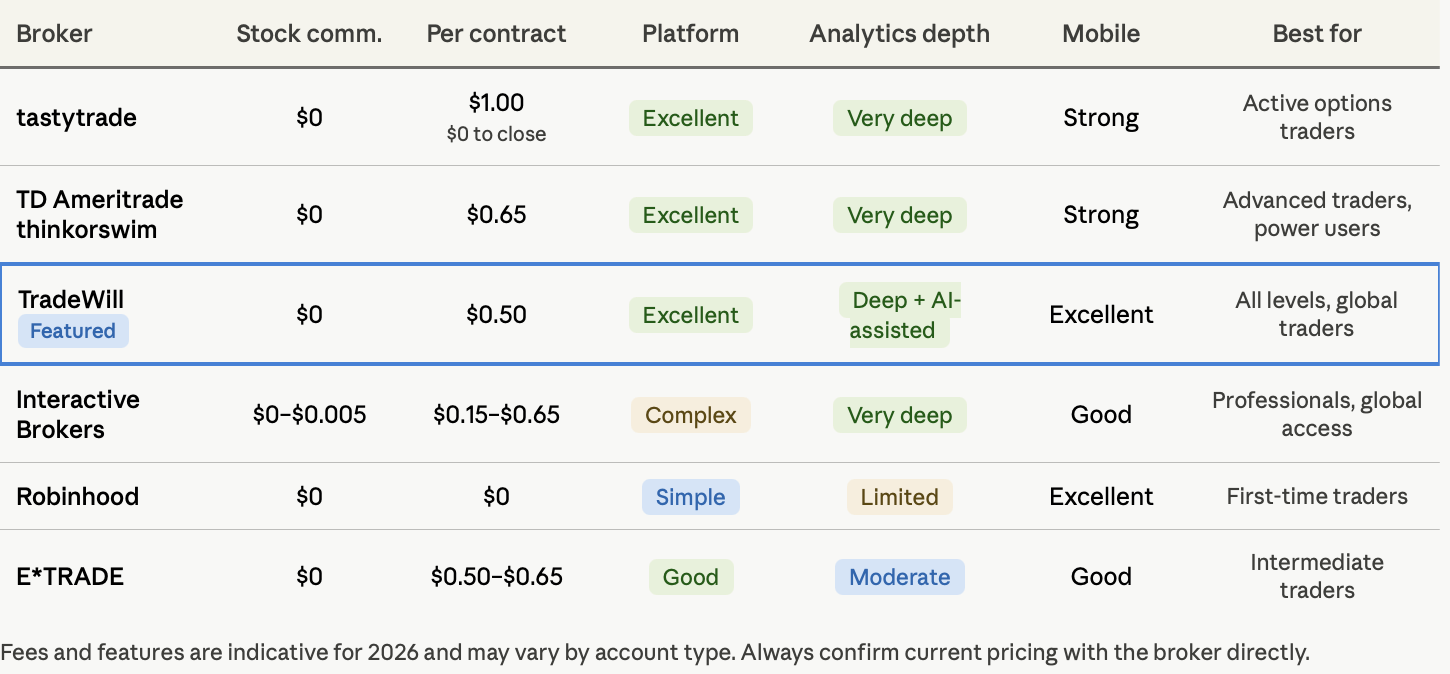
A broker's pricing structure should not be the sole factor in your decision-making process. Although a broker may advertise zero commissions, that does not necessarily make it the best choice for your trading needs. Poor execution quality, limited analytical tools, and inadequate support for advanced options strategies can ultimately cost far more than paying a modest commission, such as $0.65 per contract, to a broker that provides institutional-quality execution, research, and trading tools.
The Most Popular Options Trading Strategies for Income, Growth, and Protection
There is a large range of options strategies available, from single-leg trades to complex multi-leg strategies (also known as “legs”). Each strategy has its own set of ideal market conditions. This guide will focus specifically on options strategies that may prove effective in volatile markets.
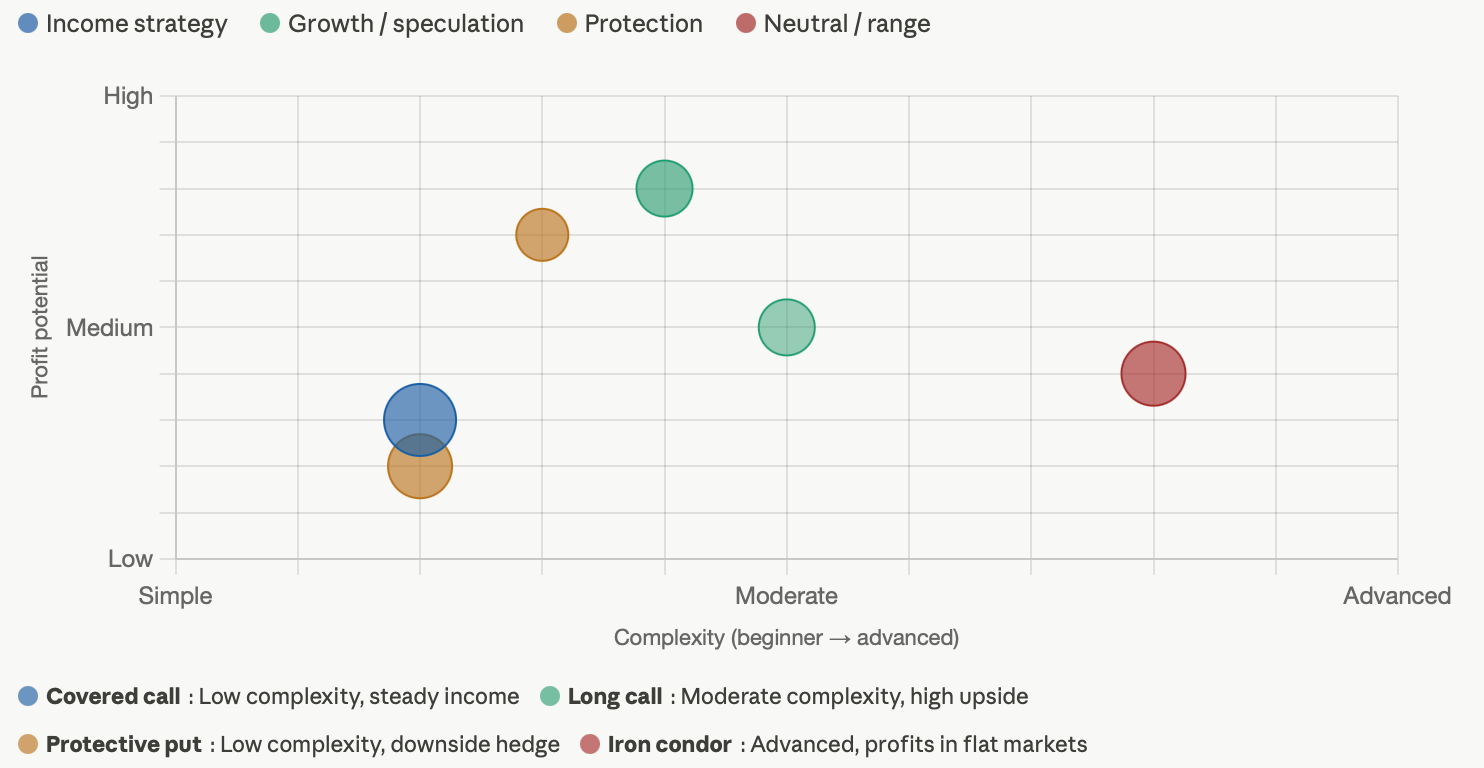
The dominant options strategy for generating income is the use of covered call options. The investor holds a position of at least 100 shares in the underlying stock and sells a call option against that position. In return for providing the buyer with the right to purchase the stock at the strike price, the seller receives the premium in cash immediately but also trades away the ability to capture any profits should the stock price rise above the strike price. Covered calls are well suited to long-term equity investors who do not expect significant stock price movements but are looking to generate yield from existing holdings that they intend to maintain.
Options can also be used as a form of insurance for an investment portfolio. In this case, buying protective put options on shares an investor already owns can partially offset losses should the stock experience a sharp decline, because the value of the put option will rise as the value of the stock falls. Investors commonly utilize protective puts as protection against macroeconomic shocks, particularly during events such as FOMC meetings, when interest-rate expectations may change quickly.
If you are new to options trading, you can often trade defined-risk vertical spreads without obtaining the highest level of options approval. A vertical spread involves buying one option and selling another option with the same expiration date but a different strike price. This structure establishes both a maximum potential profit and a maximum potential loss at the time the trade is entered, allowing traders to define their risk in advance.
An Iron Condor combines two vertical spreads into a single options strategy. The objective is to profit when the underlying security remains within a specified price range through expiration. Iron Condors generally perform best in low-volatility environments when there is no strong expectation of a significant directional move in the underlying asset. A comprehensive Iron Condor guide can provide detailed information on how to construct, manage, adjust, and exit the position effectively.
The Biggest Risks Every Options Trader Must Understand
Options have the same mechanical characteristics for generating gains as they do for generating losses, including the risk of being wrong on direction, but they also carry risks beyond simply making an incorrect directional call.
For every buyer of an option, there is a risk of losing the entire premium paid if the option expires worthless, which is completely different from holding shares, where a company would generally have to go bankrupt before the investor loses everything.
Leverage risk also amplifies the consequences, both positive and negative of a correct or incorrect trade. Using one contract to control 100 shares may seem highly efficient until the market moves against you. At the same point where leverage can multiply your gains, it can equally multiply your losses.
Even directionally correct traders are tripped up more often than many people realise by volatility risk and implied volatility (IV) crush. Paying high premiums for options purchased when IV is near annual highs can result in a rapid collapse in IV once the anticipated price move occurs. As a result, the trader may end up holding an option that has little or no remaining value by expiration despite correctly predicting the direction of the underlying asset.
Many inexperienced option sellers are surprised by the risks associated with assignment. For example, if you sell a call option and the underlying asset's price rises above the strike price, you may be assigned and required to deliver shares at that price. If you do not already own the shares, you could be forced into a short position. For this reason, it is important to understand your broker's margin requirements and assignment procedures before engaging in option-selling strategies, as broker intervention may occur if account requirements are not maintained.
Even well-structured options trades can be affected by sudden and extreme market dislocations. Unexpected events can create substantial losses, particularly when volatility increases rapidly or liquidity deteriorates. Studying how experienced traders navigated major black swan events can provide valuable insight into risk management, position sizing, and portfolio construction during periods of extraordinary market stress.
10 Costly Mistakes Beginners Make in Options Trading
The most common mistake made when options accounts experience losses is not a variety of different errors, but rather the same error occurring repeatedly across all types of accounts, various instruments, and all kinds of market conditions.
Without a trading plan and a clear understanding of your profit target, maximum acceptable loss, and the conditions that will trigger you to exit a trade, you are at risk of making all types of mistakes when trading options. Without a trading plan, you are also less likely to actively manage your options positions. Unlike stocks, the value of an option decreases every day regardless of what the underlying security is doing.
Buying low-priced out-of-the-money options may appear to be a way to create maximum leverage with a minimal investment; however, the low price reflects the market's assessment of the probability of success, and most out-of-the-money options ultimately lose their entire value.
Overleveraging your account by allocating the majority of its value to one or two high-risk options trades can result in significant losses from a single losing trade. Position-sizing requirements for options trading are generally more stringent than those for stock trading.
If you do not sell a losing position prior to its expiration date, you will not have the opportunity to recover any of the option's remaining time value. Experienced options traders usually close out their trades before expiration unless there is a specific tactical reason to continue holding the position until the expiration date.
Excessive trading is one of the most effective ways to lose your trading account. More trades do not create better results and the friction from spreads and contract fees adds up with each unnecessary trade. A better way to create a more selective trading approach versus reacting to every short-term move would be to use tools such as RSI based signal generators to help identify whether stocks are overbought or oversold.
When an investor trades earnings as if there are no expected moves for the security at the time, they are usually very disappointed. The reason is that the options market assigns a price range of anticipated movement around the time of earnings. Thus, the anticipated movement can create multiple scenarios and there are usually a lot of traders buying call and put options at the time of earnings. If the actual movement is within the anticipated range, both call and put option traders lose money even though they bought options in opposite directions.
As retail traders have become more aware of the impact that algorithmic trading systems interact with the options market, the amount of trading done by algorithmic strategies continues to increase. The quant trading masterclass gives additional insight into how algorithmic systems behave at different price levels.
Final Verdict: How to Choose the Best Options Broker and Build a Sustainable Trading Plan
A good broker will fit the way you actually trade, so choose one with an accessible educational program and a straightforward options chain interface rather than one with professional-grade analytics that you won’t use until later. If you intend to place 50+ contracts per day using multi-leg strategies, then your primary decision criteria will likely be execution quality, platform speed, and per-contract fees.
Before committing real money, remember to set up a paper trading account so you can gain experience before putting your strategies and position management skills into practice without risk. Most brokers provide simulated trading accounts that allow you to develop your execution skills, test strategies, manage positions, and plan exits without any financial exposure.
Develop your knowledge in a logical progression. Start with covered calls and protective puts, then move on to spreads. Do not attempt complex multi-leg strategies until you are comfortable executing single-leg trades in a consistent and mechanical manner. Months or years of disciplined execution will generally produce far better outcomes than making high-risk bets during your first few weeks of trading.
Understanding risk prior to chasing return is the key to growing your options trading business sustainably. Obtain accurate information about which tools will be best suited for your trading style, prior to entering into your first trade with an option. Finally, recognize and understand the mechanics of both time and volatility as opposed to fighting against them.
TradeWill gives you institutional-grade options analytics, tight execution across global markets, and real-time insights built for traders who want to understand every position they hold, not just hope it works. Start trading with TradeWill today.
Disclaimer: The content of the blog does not represent any position of Trade W, does not serve as any trading-related decision advice, and does not endorse any third-party.