
 Trade W

The way retail investors participate in financial markets has changed dramatically over the past five years, and copy trading sits at the center of that shift. What started as a niche feature on a handful of social trading platforms has grown into a structured fintech ecosystem, giving first-time investors a way to place their capital behind experienced traders without needing to master charting, technical analysis, or order execution themselves. That said, copy trading is not a passive income machine, and understanding its mechanics, its real risks, and its genuine potential is the difference between using it intelligently and losing money because of misplaced expectations.
This guide covers everything from how copy trading actually works under the hood, to the best platforms available in 2026, to the portfolio strategies that give beginners a fighting chance at consistent results.
What Is Copy Trading and Why Is It Growing So Fast in 2026?
The Copy Trading System imitates automatically the trades performed by a chosen signal provider into your account in real-time, either proportionally or in fixed lot size. For example, if a trader you're copying opens a long position on EUR/USD, your account will place the exact same order almost immediately. Likewise, when that trader closes their position, yours will close too.
The growth from manual trading to automated social ecosystems has been slow, but has begun to take off over the last couple of years. In the early days of currency trading, traders would share their signals via Telegram groups or e-mail newsletters, requiring their followers to make every trade manually. Recently, those methods have transitioned to using signal platforms, where traders can quickly execute trades through a single click. These platforms now also include a completely automated copy trading system, where only the initial decision of which trader to copy will have a human element. If you're interested in learning more about signal-based trading and how it differs from copy trading, our guide on forex trading signals for new traders explains how to evaluate trading signals and the potential risk involved in each trading signal.
Copy trading's major growth drivers in 2026 consist of three key elements. First, mobile-first investing habits are leading the majority of new retail investors to access trading through mobile applications rather than traditional desktop platforms. Second, continued demand for passive income strategies is attracting both existing traders and a growing segment of new investors who prefer not to spend time actively managing trades. Third, the ongoing democratization of financial markets has enabled trading platforms to reduce barriers to entry for individuals who wish to participate.
With respect to the first two factors, copy trading addresses both needs effectively and has therefore contributed significantly to the overall growth of the global copy trading market, which has recorded a compound annual growth rate (CAGR) of more than 7% since 2020.
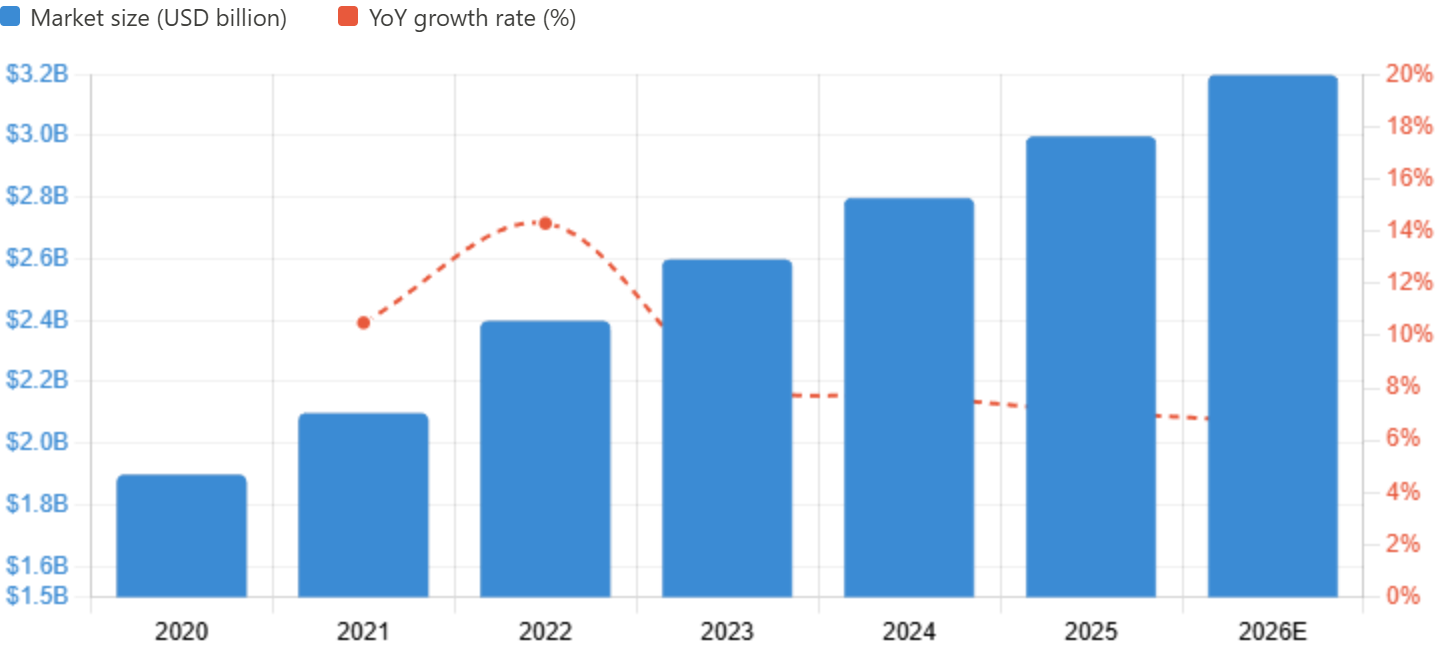
Copy trading is not the same as two different types of investment strategies, although people often confuse them. Robo-advisors (like Betterment or Wealthfront) allocate funds using algorithms to manage and adjust their portfolio, but the underlying strategy doesn’t have individual human traders that can be evaluated. Traditional investing is an investment strategy where the investor makes his or her own decisions. Whereas copy trading has an individual trader who has a documented track record of his or her performance, and you have the choice of how much to invest and when to stop duplicating that investor. If you are trying to determine if copy trading may fit into your broader investment strategy that is passive then beginner's guide to passive investing would be a good resource to accompany this.
How Copy Trading Actually Works: The Engine Behind the System
Understanding how copy trading works is essential for managing your expectations regarding HotTrade's performance, costs, and risks. The copy-trading process begins when a signal provider opens a trade in their own account. Once the trade is executed, the HotTrade system responds in real time and sends instructions to replicate that trade across all follower accounts subscribed to the provider at that moment. Your broker then opens a corresponding position in your account based on the amount of capital you have allocated to copy that trader.
To illustrate this in practice, suppose the trader opens a 2-lot position on the EUR/USD pair at 1.0850, and you have allocated $500 to copy that trader using proportional allocation. If the trader has $10,000 in their account and you have $500 allocated in yours, your account would open a position equal to approximately 5% of the trader's position, or 0.1 lots. As a result, gains and losses are generally reflected proportionally across both accounts, meaning performance is measured by percentage returns rather than by matching the trader's exact dollar gains or losses.
Currently, there are two principal copy-trading models in use across multiple platforms. Proportional copy allocation enables position sizing to scale automatically based on account capital, making risk management more straightforward and, for most users, representing the preferred copy-trading option. Fixed-lot copy allocation, by contrast, establishes a predetermined lot size for each trade regardless of account size. This approach provides greater manual control but requires more oversight to ensure that trades executed by the signal provider remain appropriate for your account balance and risk tolerance.
For traders interested in understanding how algorithmic systems execute similar replication logic, it is highly recommended to review our in-depth examination of algorithmic trading strategies . Doing so can provide valuable insight into how automated trade replication systems operate and manage position allocation.
There are three important execution issues that should be considered. The first is latency between the trader's execution and your own execution. This creates a time gap that can widen during periods of high market volatility. The second is slippage, which represents the difference between the expected execution price and the actual execution price received. Higher levels of slippage are common during major news events, when prices can move rapidly in either direction. Third, liquidity constraints can affect trade replication. In thinly traded instruments or during off-market hours, large trades executed by a signal provider may not be replicated efficiently or accurately across follower accounts.
When evaluating a trader's performance on a copy-trading platform, you will commonly encounter the following key metrics: ROI (Return on Investment) over a specified period, win rate (the percentage of trades closed at a profit), maximum drawdown (the largest decline in account equity from its highest point to its lowest point), and a risk score assigned by the platform's ranking algorithm. None of these four metrics provides a complete picture of performance on its own; however, when considered together, they help compensate for one another's limitations and offer a more accurate assessment of a trader's overall consistency and risk profile.
Best Copy Trading Platforms and Apps in 2026: Full Comparison
Understanding how to choose the best copy-trading platform as a beginner starts with recognizing that your requirements are fundamentally different from those of someone managing a diversified copy-trading portfolio worth $50,000. The following platforms have been assessed based on five key factors: transparency of trader data, execution quality, depth of the trader marketplace, fee structure, and regulatory standing.
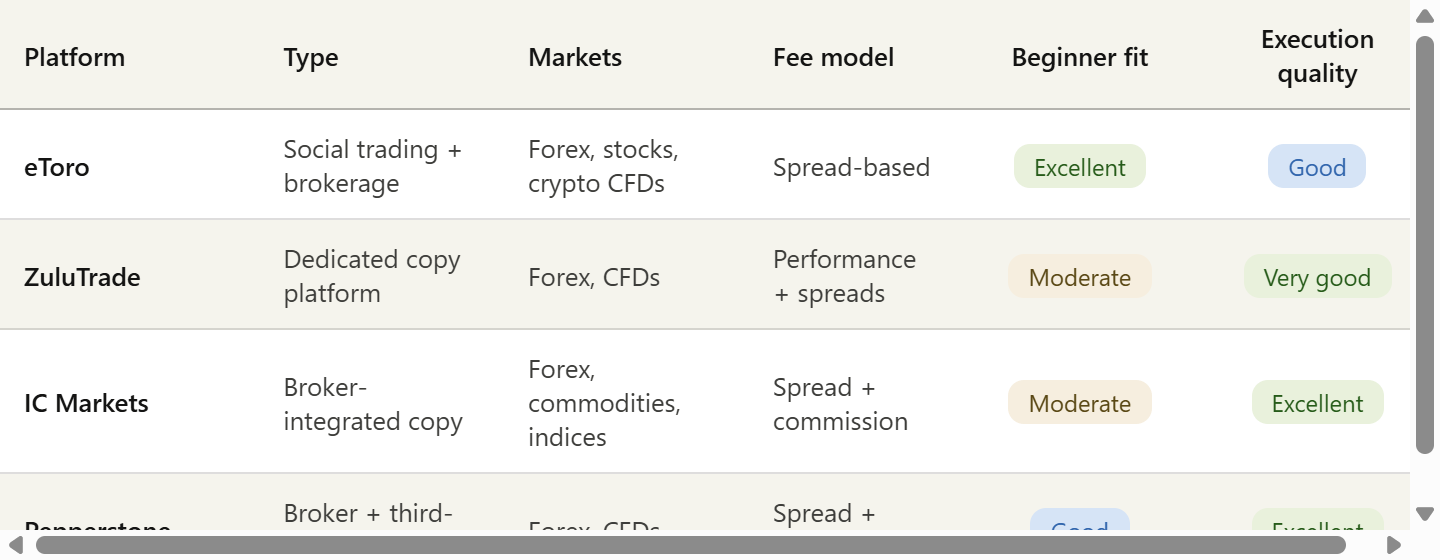
eToro is currently one of the most popular and widely used social trading platforms in the world, largely due to its user-friendly design and mobile-first experience, as well as the transparency provided through its Popular Investor program. Traders who qualify for the program have access to a public performance dashboard that allows prospective followers to review key performance metrics, including monthly returns, drawdown history, and the assets they trade most frequently. One potential drawback of eToro's CopyTrader system is that its execution environment may not offer the same depth as a typical raw-spread broker. For example, spreads on eToro can be wider than those available through traditional raw-spread or direct market access brokers. This is particularly relevant when copying traders who employ high-frequency trading strategies, as spread-related costs can accumulate rapidly.
ZuluTrade is an excellent platform for users who want a high degree of control over trader selection. Its ranking system is more sophisticated than many alternatives, incorporating risk-adjusted performance metrics rather than focusing solely on return percentages. However, the platform's interface can be challenging for beginners, particularly those unfamiliar with concepts such as drawdowns and risk management. Despite this learning curve, one of ZuluTrade's greatest strengths is its extensive marketplace, which features a large and diverse selection of verified signal providers from a wide range of brokerages.
Both IC Markets and Pepperstone offer broker-integrated copy-trading solutions. The copy-trading functionality on both platforms is connected directly to their institutional-grade execution infrastructure. As a result, the benefits of raw spreads, fast execution speeds, and a reduced likelihood of slippage are generally maintained even during periods of heightened market volatility. Both brokers are well suited to traders who are familiar with MT4 and MT5, as well as those interested in integrating third-party copy-trading services such as Myfxbook AutoTrade. While beginners may find the setup process more complex than that of eToro, the quality of execution can justify the additional effort, particularly for traders with larger account balances.
There is no single "best" broker for every trader. The right choice depends on several factors, including the amount of capital you intend to invest, the markets you wish to trade, your risk tolerance, and the amount of time you are willing to dedicate to researching signal providers before allocating your capital.
Choosing the Right Platform for Your Trading Style
The decision framework for selecting a copy trading platform starts not with the platform's features, but with an honest assessment of your own investor profile.
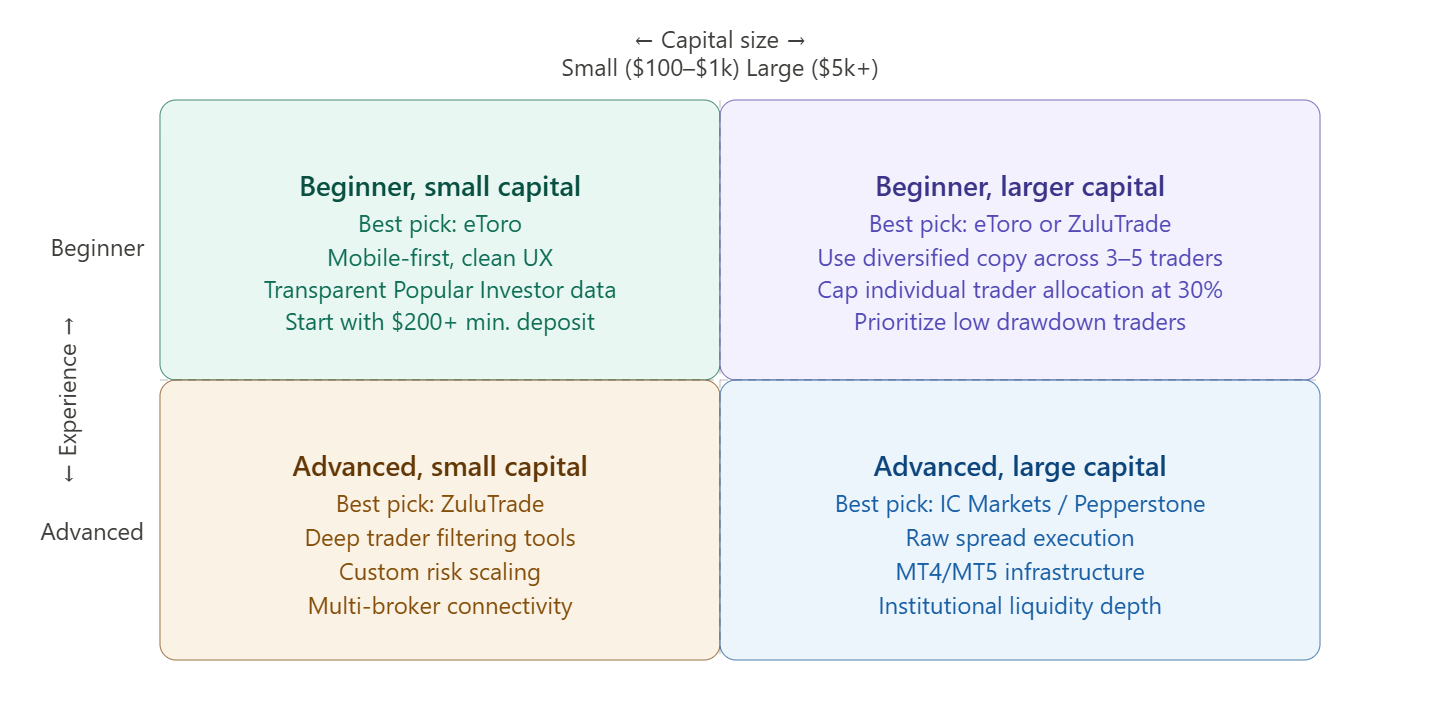
There are three key metrics that should be weighted most heavily when evaluating individual traders to copy. Maximum drawdown indicates the worst loss a trader has experienced while managing follower capital. If a trader’s maximum drawdown exceeds 30%, you should exercise significant caution before deciding to follow that trader. Additionally, consistency in monthly returns is generally more important than occasional periods of exceptional performance. For example, a trader who generates a steady 3% monthly return over 12 months is often a more attractive allocation than one who earns 18% in March but loses 15% in April. Inconsistent monthly returns can have a direct impact on risk management and position sizing for copy traders.
One of the fundamental principles of copy trading is diversification. By allocating your entire copy-trading balance to a single trader, regardless of how impressive their track record may be, you expose your portfolio to that trader’s worst possible period of performance. Therefore, spreading your capital across three to five traders with different trading styles, such as a trend-following forex trader, a crypto momentum trader, and a low-frequency stock CFD trader, can significantly reduce correlation risk. You may also benefit from reviewing our guide on using currency-pair correlations to hedge risk, as many of the same principles used to manage currency correlation can be applied when constructing and managing a diversified portfolio of traders.
Copy Trading Risks That Most Beginners Overlook
A common mistake made by novice copy traders is using a trader’s annual return on investment over the previous 12 months to forecast future performance. However, past performance provides no guarantee of future results, whether positive or negative. For example, while company revenue trends may offer some insight into future earnings potential, trading performance is influenced by factors that can change significantly over time. These include: shifts in market structure, changes in volatility conditions, and evolving trends in the currency pairs or assets that generated the historical performance being evaluated. As a result, traders should avoid relying solely on historical returns when assessing a trader’s future potential and should instead consider a broader range of risk and performance metrics.
More than any other factor, the risk of drawdown amplification will come as a surprise to copycat traders. If you are replicating a trader who uses a high level of leverage (such as 10:1) and the broker replicates that level of leverage in your account, the actual drawdown that you see in your account may be significantly greater than what the trader experienced. This may occur because of the way in which the broker or trading platform being used by the trader is set up, as well as the level of leverage you are using when copying that trader. Examine the leverage settings of the trader you want to copy in relation to the leverage maximum for your trading account.
Total costs associated with spread widening due to major economic releases, news spikes, and other liquidity gaps should also be considered. Spreads can expand from two to five times their average during these types of market events causing trades taken by copycat traders to be filled at much poorer prices than what was executed by the trader they are trying to copy, thus lowering the total profit attributable to the copycat trader for both losing/loser trades.
Emotional switching; the practice of changing traders based on short-term performance fluctuations, can quietly contribute to losses in copy-trading accounts. For example, a follower may stop copying a trader after experiencing two weeks of drawdown and switch to another trader, only to see the original trader subsequently recover and return to profitability. In this scenario, the follower locks in losses from the first trader while forfeiting the opportunity to participate in the recovery.
If you have conducted thorough due diligence before selecting a trader, a temporary drawdown that remains within the trader’s historical maximum drawdown range is not, by itself, a sufficient reason to stop copying that trader. Our day trading strategies for 2026 guide discusses the psychology of managing drawdowns from the perspective of a discretionary trader, and many of the same behavioral principles apply equally to copy trading.
Portfolio Strategies for Beginner Copy Traders
Building a well-structured copy-trading portfolio involves more than simply selecting the traders or investors with the highest returns. It also requires careful allocation of capital to ensure that your investments are not overly concentrated in a single trader, strategy, or asset class.
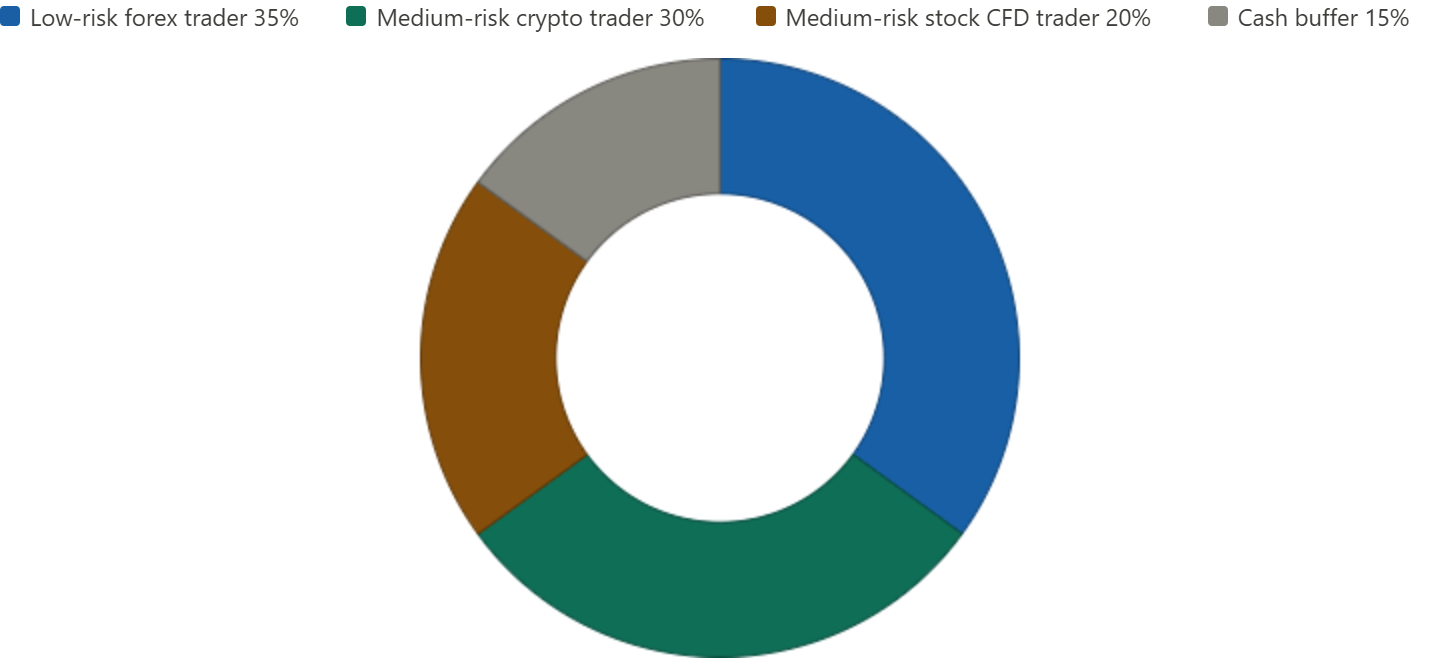
Looking at the portfolio below, several important principles have been applied to create a balanced allocation across multiple assets and traders. The forex allocation, representing 35% of the overall portfolio, is assigned to a trader with a long-term track record and a history of relatively consistent performance, including drawdowns that have remained within a predictable range.
Allocating 30% of the portfolio to cryptocurrency provides additional growth potential. However, due to the asset class's inherently higher volatility, the allocation is capped at 30% to help manage overall portfolio risk.
Stock CFDs contribute further diversification by providing exposure to a different market and trading style, helping to reduce reliance on the performance of any single asset class or strategy.
The portfolio also maintains a 15% cash allocation. This reserve can be used for periodic rebalancing and allows investors to add capital to underweighted positions without needing to withdraw and redeposit funds.
For most new investors, quarterly rebalancing provides a reasonable schedule for maintaining target allocations within an investment portfolio.
While annual rebalancing may allow portfolio imbalances to grow too large, excessively frequent rebalancing can reinforce the emotional decision-making patterns discussed earlier.
Conducting portfolio reviews every 30 days, without necessarily making adjustments, offers a practical compromise between these two approaches.
Demo accounts are an excellent way to evaluate a trader's performance before committing real capital. Following a trader in a demo environment for at least four to six weeks allows you to observe how their strategy performs under varying market conditions. Although demo accounts do not perfectly replicate real-world execution, they can provide valuable insight into a trader's risk profile, historical drawdown behavior, and the effectiveness of the copy-trading mechanism.
They also provide an opportunity to assess whether your personal tolerance for risk aligns with the level of drawdown you may experience when following that trader.
In addition to evaluating ETFs, stocks, and crypto as investment vehicles, it is equally important to consider these asset classes when assessing traders. Doing so can help you identify traders whose strategies best complement your overall investment plan and portfolio objectives.
How to Start Copy Trading in 2026: Step-by-Step
When it comes to getting started with copy trading, the process is relatively straightforward, assuming you have already selected your preferred platform. For most regulated platforms, the time required to go from account registration to actively copying trades is typically no more than 48 hours.
First, choose a platform based on the decision framework outlined above and complete the registration process. On regulated platforms, you will be required to verify your identity and complete a basic suitability assessment before being permitted to trade. Next, fund your account using one of the platform's supported payment methods, keeping in mind that each platform has its own minimum deposit requirement. Depending on the broker or platform, this minimum typically ranges from $50 to $500.
Once your account has been funded, access the trader marketplace. You can filter traders using criteria such as a maximum drawdown of 25% or less, a minimum trading history of six months, a risk rating of 6 or lower on a 10-point scale, and experience trading both forex and non-forex assets. After selecting the traders you wish to follow, allocate capital among them and establish an account-level stop-loss threshold.
From that point forward, ongoing management requirements are relatively modest. Monitor overall account performance on a weekly basis, review each trader's drawdown activity monthly, and rebalance your allocations if any trader's behavior or risk profile deviates significantly from their historical patterns.
If you want to learn more about strategic thinking for your own forex-focused Trader before using one of their strategies, our complete guide to Forex Day Trading will provide a great starting point for assessing the actual strategies that these Traders have implemented. Our pairs Trading Strategy Guide will cover the type of strategies used by some of the more advanced signal Providers on ZuluTrade if you are looking for a market neutral approach.
Final Verdict: Is Copy Trading Worth It in 2026?
Copy trading is a legitimate financial tool that provides a straightforward way to participate in global markets, often with lower barriers to entry than many traditional investment approaches. However, copy trading is not a substitute for understanding what you are investing in or why you are investing in it. Successful investors use copy trading as one component of a broader investment strategy rather than relying on it as a passive source of income that requires no attention or decision-making.
New investors are generally advised to use established and reputable social trading platforms, such as eToro, and to risk only capital they can afford to lose. They should also diversify their funds across three or more traders with different risk profiles, monitor performance regularly, and focus on monthly results rather than reacting emotionally to short-term market fluctuations. More experienced traders who understand leverage, risk management, and trade execution may benefit from broker-integrated copy-trading solutions, such as those offered by IC Markets and Pepperstone, which can provide advantages in execution quality and technical performance.
Maintaining realistic expectations is equally important. Well-managed copy-trading portfolios typically target annualized returns in the range of 8% to 15% while maintaining diversified allocations and relatively conservative drawdown limits, often around 10% or less. If someone claims that copy trading can consistently generate returns of 50% per month without the possibility of substantial losses, they are promoting an extremely high-risk proposition rather than a sustainable investment strategy.
Financial markets are expected to be more accessible than ever in 2026, and copy trading will likely remain one of the most straightforward ways for individuals to gain market exposure, provided they approach it with realistic expectations, proper risk management, and a clear understanding of the risks involved.
Ready to put your copy trading knowledge into action? TradeWill gives you the market intelligence, strategy breakdowns, and platform analysis you need to build a copy portfolio that's grounded in real risk management, not marketing promises. Explore the full TradeWill research library and start making more informed decisions today.
Disclaimer: The content of the blog does not represent any position of Trade W, does not serve as any trading-related decision advice, and does not endorse any third-party.