

 Trade W
Scalping has a lot of different pros and cons to be considered; in the fastmoving Forex marketplace, few strategies get as much hype as scalping does. Scalping is a completely different approach to a trade compared to long term investing or swing trading. Scalping requires speed, and quickness of execution as it’s all about performing the number of trades made over a very short time frame (hours minutes or even potential seconds) to generate tiny profits that are gained from tiny market fluctuations.
For a lot of traders, scalping is attractive because it allows you to take many trades in one session and realize using compounding much fast than a long-term strategy. In this fastnatured scalping session, traders are usually "engaging", as the trader is always plugged into the market, they are not waiting days or weeks for results all outcomes are usually either gained through a trade or lost within minutes.
However, scalpers need to aware of the negative aspects of scalping such as needing to be very focused, need to able to make quick decisions, and lastly being able to make decisions in a very faced paced environment with the pressure of buying and selling very regularly up to dozens of trades a day; even but a fraction of a delay in action can be lose of a winning trade.
By the time you finish reading this guide, you will understand how to choose the right currency pairs for scalping, how to utilize successful trading methods, and how to safeguard your capital while trading fast.
Scalping Fundamentals
Before we can examine which currency pairs are suitable for scalping, we should first review fundamental information on scalping. Remember, scalping is a style of trading that incorporates much more than quick trades; it encompasses a fast-paced discipline that employs speed and accuracy combined with psychology; we will examine each component one step at a time.
1. Scalping Versus Other Trading Types
Generally, Forex traders can be categorized into three types:
Swing Traders Refers to these trader types as "swing traders"; they typically hold their trade for many days or weeks (taking advantage of big move opportunities that can be several hundred pips).
Day Traders Referring to these trader types as "day traders": they typically open and close in a single day (holding trades based on hourly setups).
Scalpers They can take dozens of trades in a matter of minutes or seconds and are typically looking to take very small profits on each trade (between 5–15 pips).
The primary difference is targeting and timeframe. If the swing trader decides to wait a week for 300 pips; the scalper capture 10 pips in less than a minute, but repeat 30 or 40 times in a single session.
2. Appropriate Markets for scalping
Scalping is effective in markets that are:
Highly liquid markets - those where large orders can be placed easily and rapidly (EUR/USD, USD/JPY)
Low-spread markets - to minimize trading costs being lost from frequent gains.
Moderately volatile markets - enough to create price movement and opportunities, yet not so volatile to add slippage, reducing your profit.
It is for these reasons why most scalping strategies focus on major currency pairs, they provide that ideal mixture of liquidity, volatility, and cheap trading costs.
3. Timeframes scalping
Scalpers use ultra-short time frames such as:
1 minute charts (M1) - ideal for scalping high-frequency strategies.
5 minute charts (M5) - for slightly less aggressive scalping.
Some traders will use 15 minute charts to provide context and perspective to their trades but enter trades only on M1 or M5 charts depending on trading frequency. The smaller the timeframe, the quicker the trader will have to act.
4. The Psychological Aspect of Scalping
Scalping requires advanced mental acuity, just as it does trading skills. Scalpers are required to:
-
Concentrate intensely for prolonged periods.
-
Make quick decisions without emotions, in high-pressure environments.
-
Forbear the desire to "chase" the market after a trade has been missed.
Experienced traders will still struggle with the psychological hurdles of scalping. A brief delay, or worse, revenge trading, will turn a winning day into a losing one.
5. Scalping versus High-Frequency Trading
Scalping and high-frequency trading (HFT), which are used by hedge funds, and banks with high-frequency algorithms are somewhat similar. The difference is that scalpers are executing trades manually (or semi-automatically with indicators) while HFTs are fully executing trades using automated systems to capitalize on opportunities that last a matter of microseconds. Traders employ volume, liquidity and execution regardless.
III. Guidelines for Picking Scalping Currency Pairs
Selecting the proper currency pairs to scalp is the entryway into profitable trades. Not every pair is made equally; some offer speed, liquidity, and small spreads while others will cost you profits through slippage and other high costs. We will go over the primary considerations any scalper should take into account.
1. Liquidity
When you're looking for liquidity, you're looking for how easy it is to buy or sell a currency pair without impacting the price too much. Scalpers do not want to use a currency pair that does not have high liquidity. The more liquid a currency pair is, the faster your orders will be filled at the price you want.
Ideal Choices: EUR/USD, USD/JPY, GBP/USD
Why it Matters: High liquidity will reduce slippage (getting filled at an original price but for a worse price).
2. Very Low Spreads
Because scalping uses a lot of trades in one session, even a small spread can take away from profits. So, the smaller the spread is, the smaller the cost to get in and out.
-
Majors (EUR/USD, USD/JPY): 0.1-0.5 pip spreads with good brokers.
-
Exotics (USD/TRY, USD/ZAR): 5-10 pips which rules them out for scalping.
Tip: Always check what your broker's spread is in peak trading hours (London & New York) for the best conditions.
3. Moderate Volatility
Volatility can bring opportunity, but too much can be problematic. Scalpers need consistent price movement - enough to get their small profits not so much that the trades get stopped out.
-
Best Pairs: EUR/USD, GBP/USD - these pairs have consistent movement and volatility.
-
Worse Pairs: GBP/JPY (also known as the "Dragon") has crazy moves, that can quickly put a dent into scalpers' account!
4. Trading Sessions
Not every hour has the same value. Scalping works best when the market is at its most active. Here are the key hours:
-
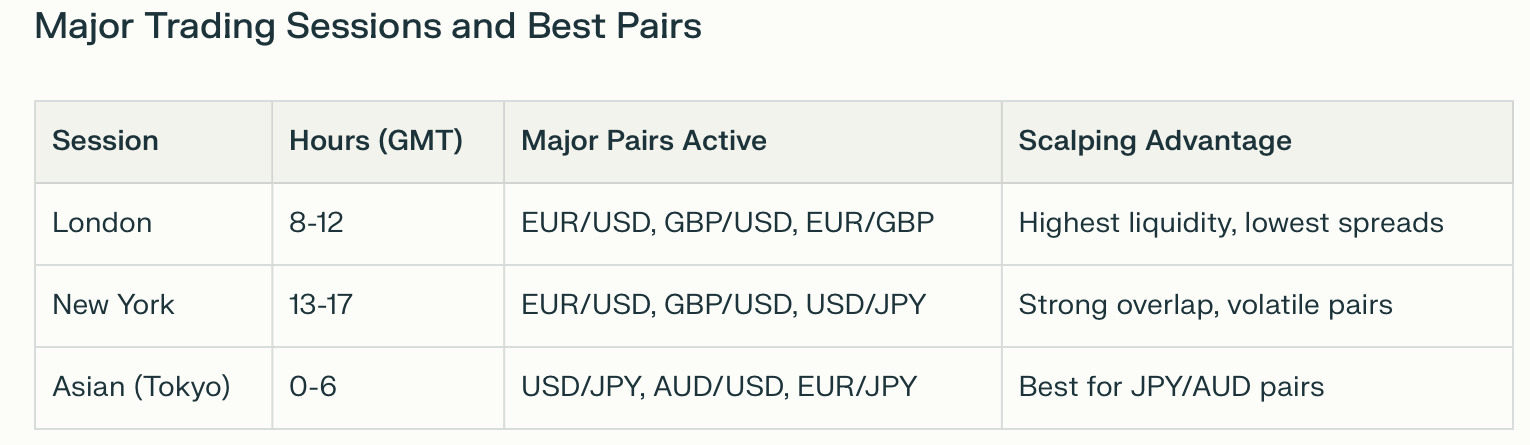
London Session (8 AM - 12 PM GMT): This is when liquidity is at its highest, especially for EUR/USD and GBP/USD.
-
New York Session (1 PM - 5 PM GMT): Plenty of overlap with London; most USD pairs are moving.
-
Asian Session (12 AM - 6 AM GMT): This is usually the lowest volatility period and best suited for USD/JPY or AUD/USD.
Rule of Thumb: Trade only when at least two major financial centers are open.
5. Impact of Economic News
When it comes to economic news, scalpers need to exercise caution during high impact economic news releases. Let’s look at a couple of the more well-known events, such as the U.S. Non Farm Payroll (NFP) report or decisions by central banks on interest rates, both of which can see spreads lifting to many pips wide enough to wipe a scalper out in seconds.
Pro Tip: If you are scalping, do not go anywhere near a major announcement unless your plan is solely to trade the news itself with a solid, established strategy.

IV. Best Currency Pairs for Scalping
Now that we have discussed how to select pairs for scalping, let’s get to the best currency pairs for scalping. Scalpers want majors and some select cross pairs, as these provide the liquidity, spreads, and volatility needed to help them make quick trades, many trades.
1. Major Pairs
a) EUR/USD
-
Liquidity: The highest liquidity in the Forex market.
-
Spread: Among the lowest spreads (0.1–0.3 pips with ECN brokers).
-
Volatility: Moderately volatile, good for scalping as it does not jettison.
Best Session: London and New York overlap.
Why It’s Good: Holds up as the number one scalping option for traders around the world with price action that is reliable, moves that are easy to predict in the short-term, and enormous trading volume.
b) USD/JPY
-
Liquidity: Very high liquidity, especially in the Asian and U.S. session.
-
Spread: Very low (0.2–0.5 pips).
-
Volatility: Mostly steady with occasional spikes, ideal for scalping momentum.
Best Session: Tokyo and New York.
Why it’s Good: Has drawn out movements, goes to clear technical levels, and is consistent with strong reactions to economic data.
GBP/USD or British Pound / US Dollar
-
Liquidity: High, but less than EUR/USD.
-
Spread: A little higher (0.5-1.0 pips).
-
Volatility: More volatility compared to EUR/USD, which means more opportunities but increased risk.
Best Session: London open.
Why It’s Good: Perfect for advanced scalpers who can deal with quick swings.
d) AUD/USD
-
Liquidity: Strong, especially during Asia hours.
-
Spread: Small to medium (0.3–0.8 pips).
-
Volatility: Consistent for the most part, with bursts during commodity-related news.
Best Session: Sydney and Tokyo.
Why It’s Good: Good for traders in the Asia hours, as it moves well with commodity trends.
2. Cross Pairs
a) EUR/GBP
-
Liquidity – High
-
Spread – Fairly low (0.5–1.0 pips)
-
Volatility – Generally lower than GBP/USD, more consistent price behavior
Best Session – London
Why is it good? Smooth price movement with less wildness than GBP/USD, good for patient scalpers.
b) EUR/JPY
-
Liquidity – Good
-
Spread – Fair (0.5–1.0 pips)
-
Volatility – Higher than EUR/USD, works well for momentum scalping
Best Session – London-Tokyo overlap
Why is it good? Great for traders who like volatility but don't like the loss of consistency that comes with trading GBP/JPY.
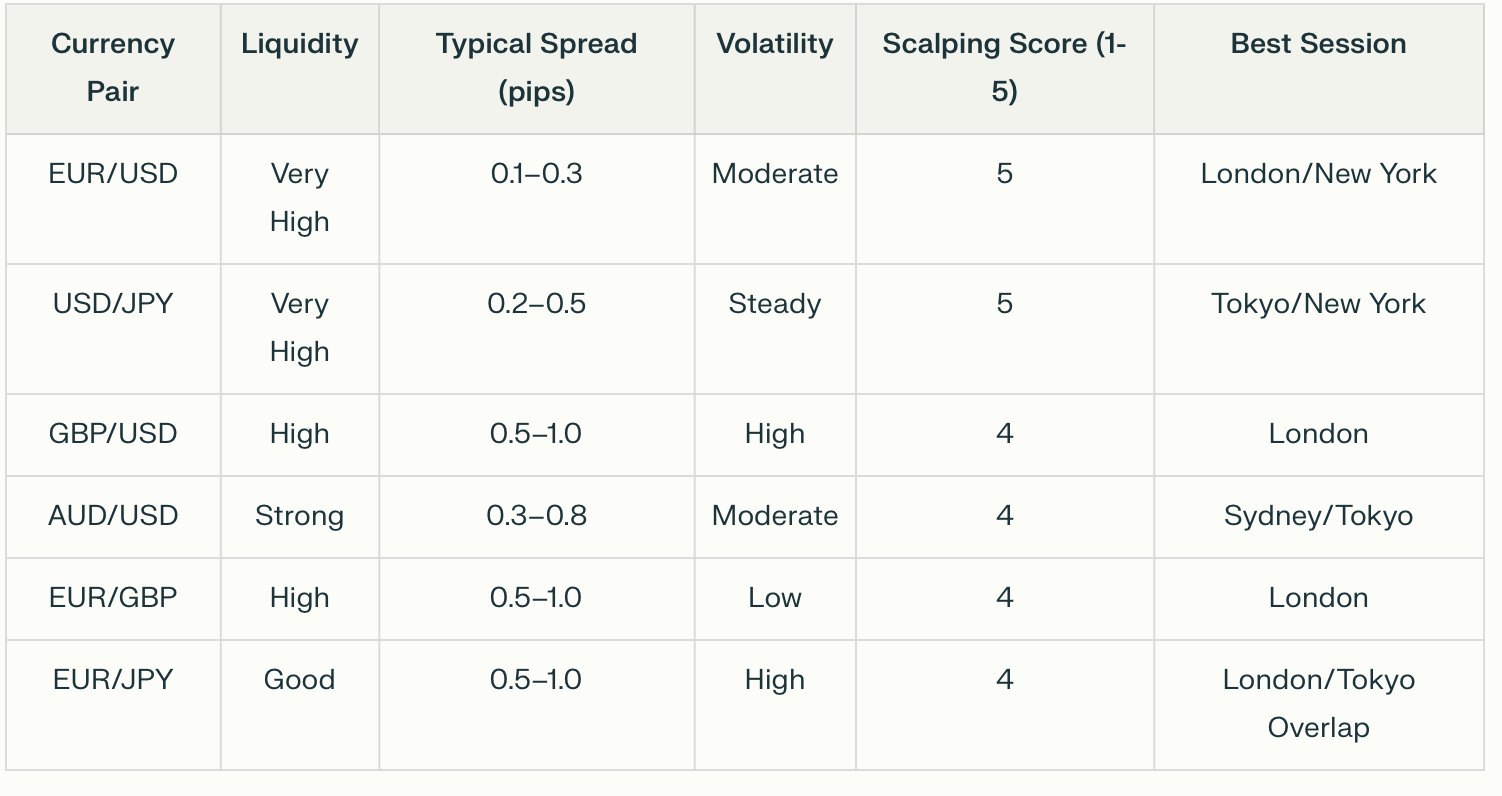
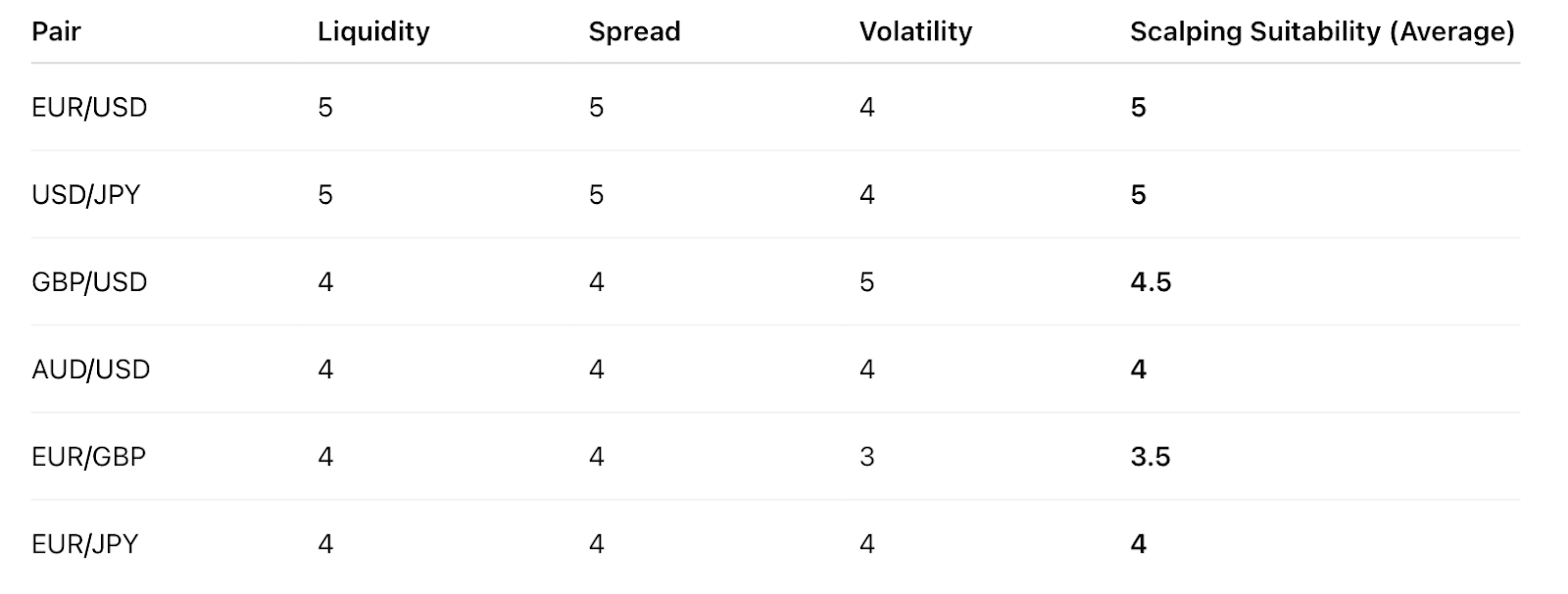
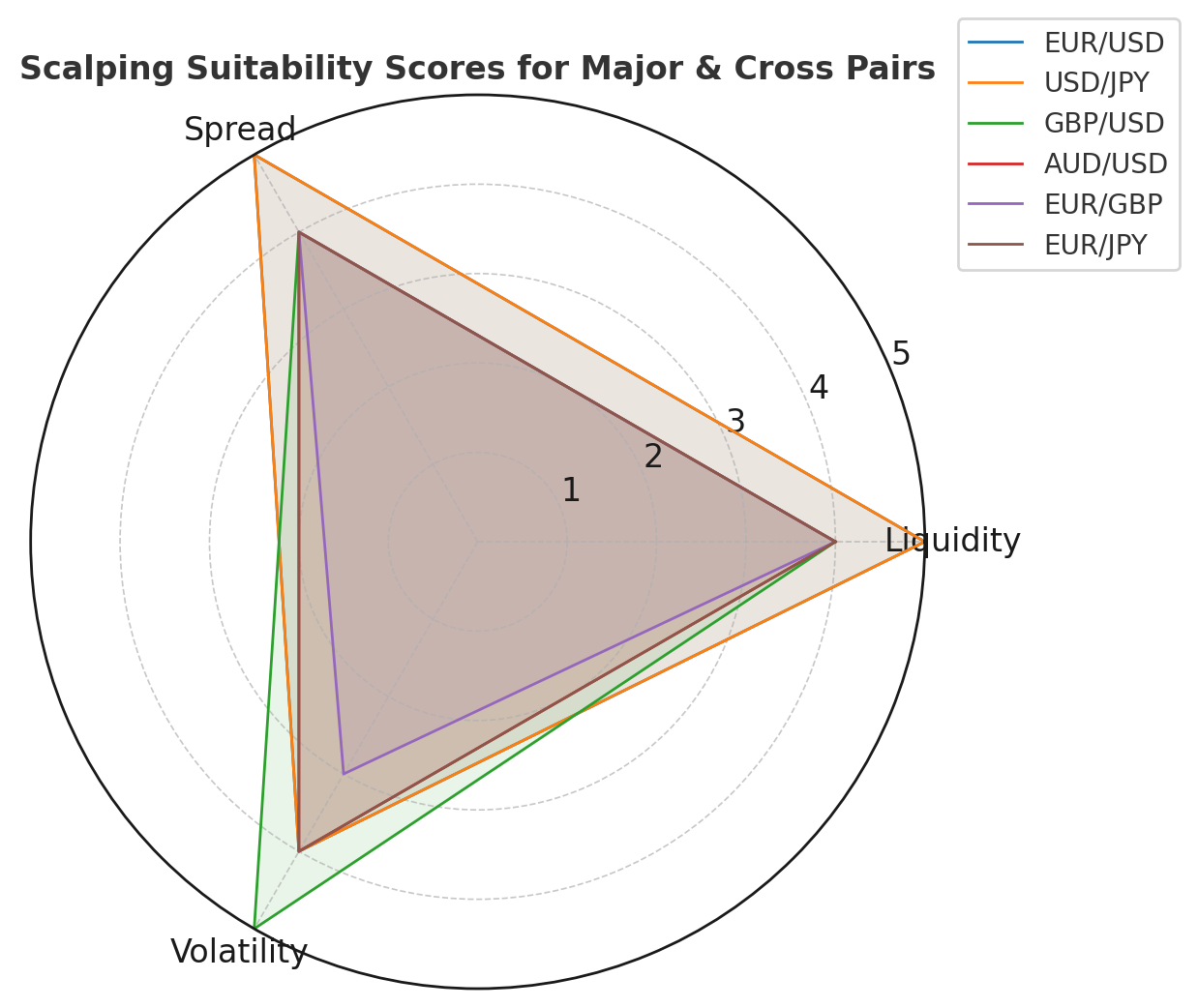
3. Scalping Suitability Scoring
Below is a suggested scoring framework (1 = Poor, 5 = Excellent) to evaluate each pair:
V. Technical Analysis for Scalping
While scalping may be quick, it is not random. Therefore, successful scalpers are reliant on technical analysis tools to identify entry and exit signals with accuracy. These trades can last in a minute or seconds, so every signal is crucial. Let's explain clearly some of the strategies you can use when scalping.
1. Moving Averages (MA)
-
Moving averages smooth out price action and help scalpers spot short-term trends.
-
Exponential Moving Averages (EMA): React faster than simple moving averages, which makes them preferable for scalping.
-
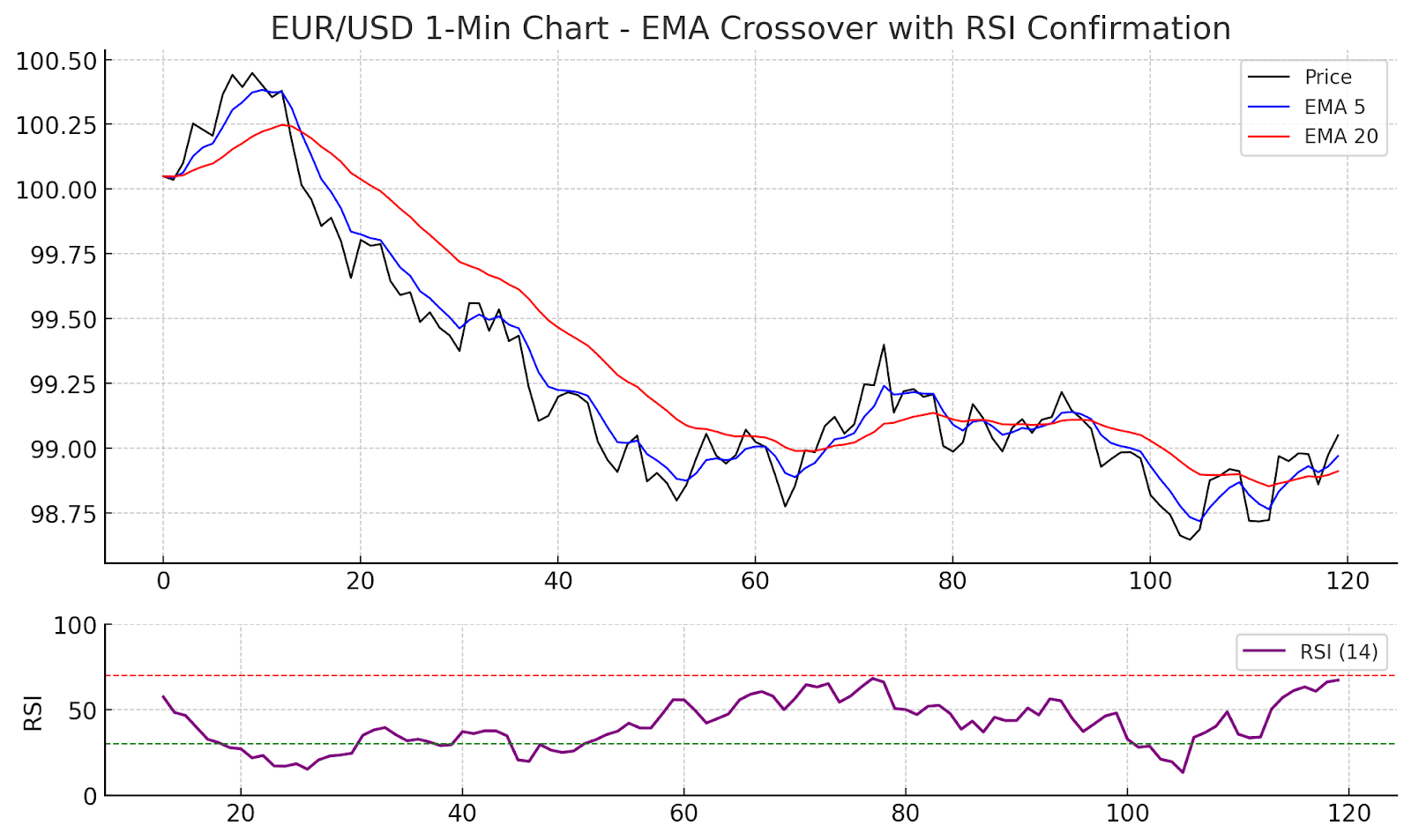
Most Used Setup: EMA 5 and EMA 20 crossovers
-
Buy signal: EMA 5 crosses over EMA 20.
-
Sell signal: EMA 5 crosses under EMA 20.
2. Bollinger Bands
-
Bollinger Bands reflect volatility and elucidate where price is overbought/oversold.
-
Use for Scalping
-
Buy when price is near the lower Bollinger band in an uptrend.
-
Sell when price is near the upper Bollinger band in a downtrend.
-
Works best in range-bound markets where prices oscillate for sharp direction movements quickly.
3. Relative Strength Index (RSI)
The RSI is especially useful in gauging momentum and identifying overbought and oversold conditions
Scalping trade setup:
• Overbought > 70 = short (sell signal in forex)
• Oversold < 30 = long (buy signal in forex)
• Use in conjunction with moving averages for extra confirmation.
4. MACD (Moving Average Convergence Divergence)
MACD indicates where momentum changes. When scalping:
-
If the MACD line crosses the signal line this means you may want to look out for a potential reversal.
-
Works well in confirming trades from 1-5 minute charts.
5. Support & Resistance Levels
Even in fast-moving markets price still respects key levels. As a scalper you might:
-
Take long positions near intraday support.
-
Take short positions nay intraday resistance.
-
Use tight stop-loss orders just above or below these levels.
6. Candlestick Patterns
There are some candlestick patterns that are especially useful for scalpers due to their frequency appearing in smaller timeframes:
Pin Bar (Hammer or Shooting Star): This indicates a quick reversal.
Engulfing Pattern: This indicates a momentum shift.
Doji: Market indecision which tends to be followed by sharp movement.
7. Multi-Timeframe Analysis
Although scalpers may review a 1-minute chart, confirmation from the 5-minute or 15-minute chart is essential.
For instance, a bullish crossover on the 1-minute chart is more credible if the 15-minute direction is also up.
VI. Risk & Money Management
Scalping can be a fast way to make profits, it also has arguably one of the highest risks of trading. Scalpers have the potential to make dozens of trades in one session, therefore, even a small mistake or poor risk management can end any profits or worse, an entire account.
This is why risk and money management cannot be overlooked; it is the very structure/scaffold for sustainable scalping.
1. Stop-Loss Plan
Every scalping trade must have a designated stop-loss. If a stop-loss is not set a small move against you can quickly lead to a large loss.
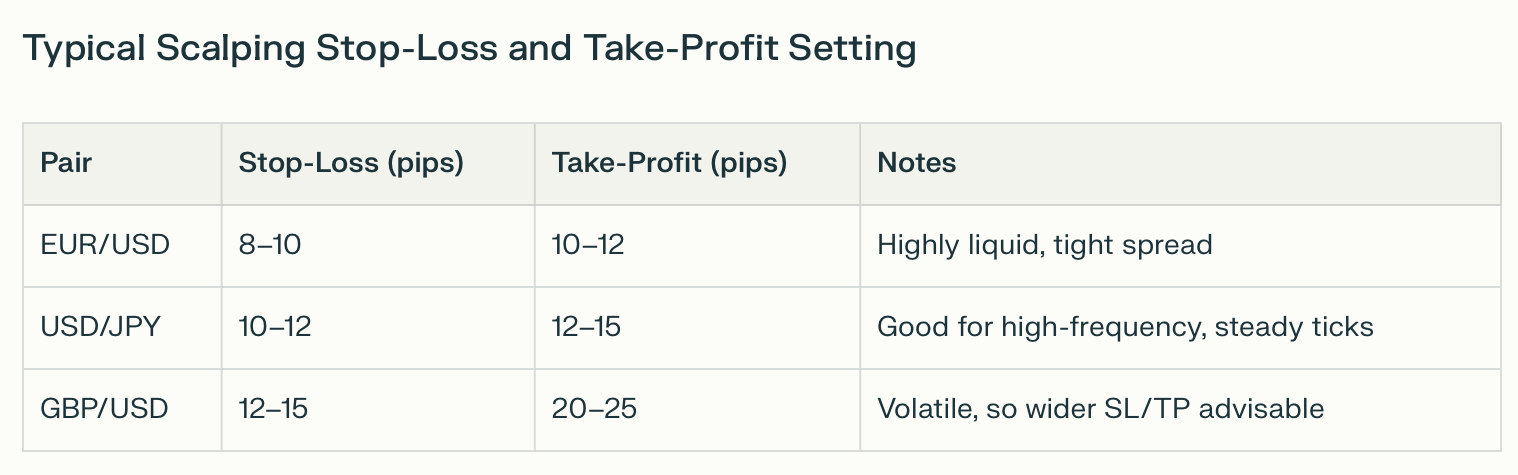
Fixed Pip Stop-Loss: Many scalpers use a tight stop-loss of 5–10 pips (20 pips questionable).
ATR-Based Stop-Loss: Some traders calculate stop-losses based on Average True Range (ATR) and adjust for existing volatility.
For Example, if the EUR/USD moves an average of 10 pips per minute, a scalper may set stop-loss at 1.5x ATR (Average True Range) = 15 pips.
2. Position Sizing
Control Risk via Position Sizing and not just Stop Loss. As a general rule, you should never risk more than 1 – 2% of the account on each trade.
If your account size = $10,000, the maximum risk per trade = $100 - $200.
With a stop loss of 10 pips, you will need to determine your position size to ensure each pip is worth $10 - $20.
With this type of position sizing, even losing several trades in a row will not wipe out your account.
3. Slippage & Spread Cost
Scalping is about entering and exiting at high frequency. Two hidden enemies you will have to contend with are:
Slippage: This is when your order gets filled at a price much worse than expected during periods of volatility.
Spread Cost: Every trade has a spread cost so if you do 50 trades during the day at a spread of 1 pip, that is 50 lost pips just in cost of each trade.
Tip: Keep your trades to the major pairs with lower spreads and trade during liquider time periods to lessen slippage.
4. Trading Psychology
Risk management is not just mathematics, it is a mental challenge as well. The emotional pressure of scalping can be great. Mental errors will wreck a successful strategy that required considerable discipline to put together.
-
Avoid Revenge Trading: Don’t double your position size to ‘make back’ lost profits after a loss.
-
Limit Trading Hours: Scalping for 10 hours straight leads to fatigue, which causes you to make mistakes.
-
Be Consistent: If you have a plan stick with it, don’t chase moves.
VII. Practical Examples of Scalping
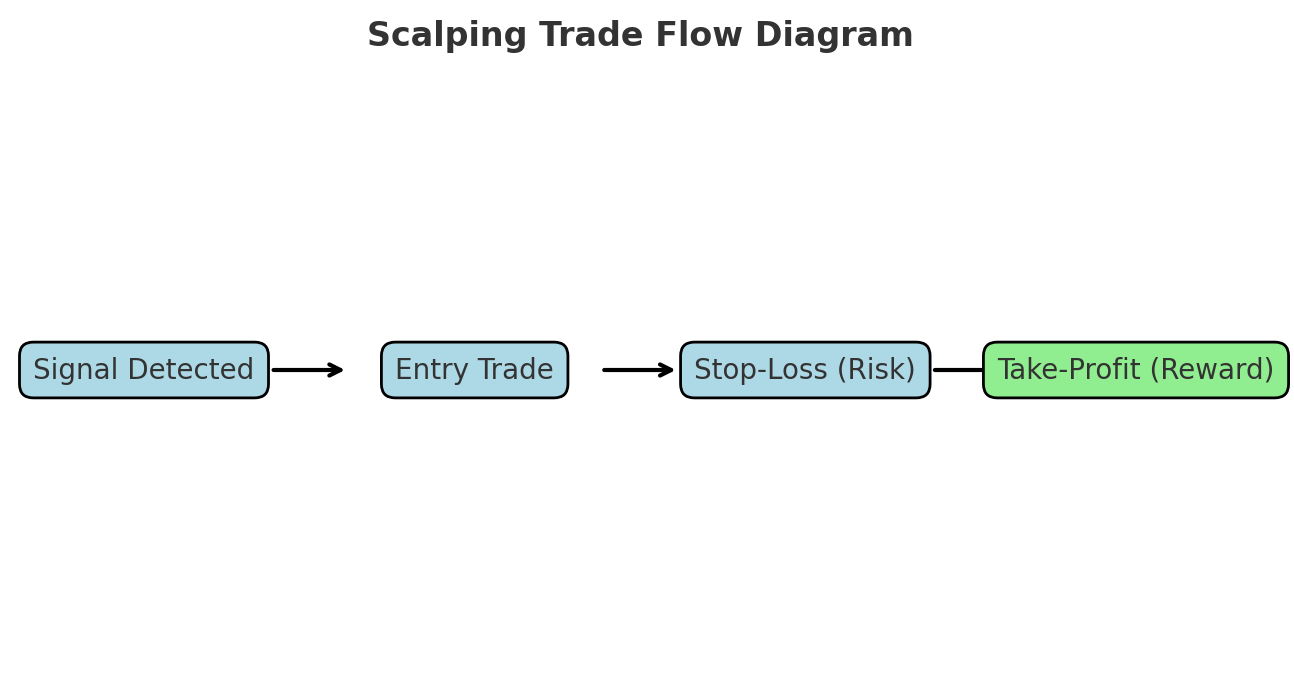
Learning the theory is very important, but we learn best as traders when we see actual scalping workflows in live time. In this section, we will provide examples of how traders can apply scalping workflows step by step. We will examine three different workflows that utilize some major pairs in different market conditions.
Case 1: EUR/USD 1-Minute Scalping Chart – London Session
The EUR/USD is the most liquid pair in Forex and is a good pair for scalpers to trade.
Workflow:
-
Market: London session (high liquidity, tight spreads).
-
Indicators: EMA 5/20 crossover + RSI confirmation.
-
Entry: When EMA 5 crosses above EMA 20, RSI is signaling > 40 but < 70.
-
Stop-Loss: 8 pips.
-
Take-Profit: 10 - 12 pips.
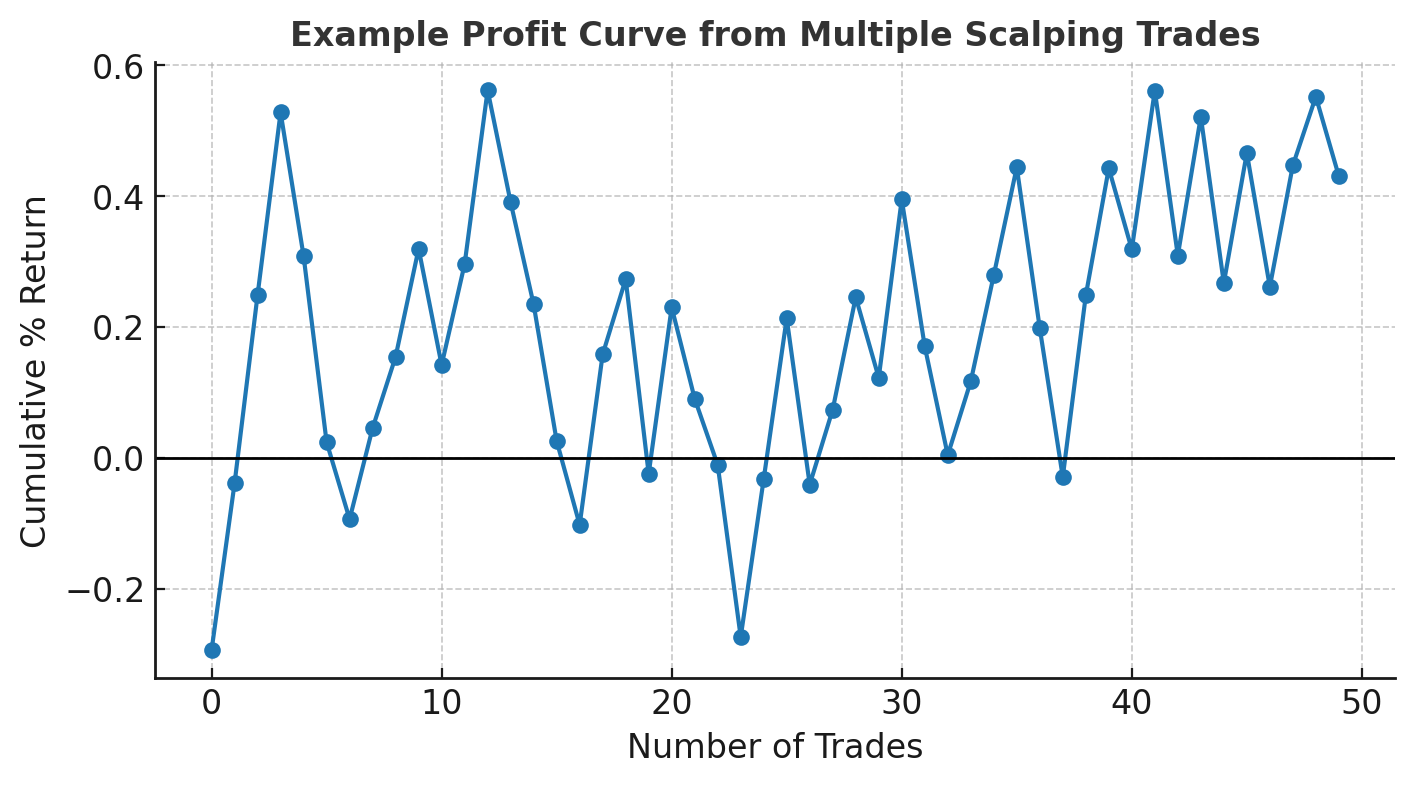
Result: After trading for a total 3 hours after entering this strategy, the trader completed a total of 50 trades. Out of the 50 trades, the trader had 20 of those trades as losses. The trader generated a net gain of +1.5% account growth due to risk-reward ratio.
Case 2: USD/JPY Scalping in High Volatility
The USD/JPY is influenced by U.S. economic news and has some of the fastest scaling opportunities.
-
Workflow:
-
Market: New York session, after the economic news release (Non-Farm Payroll).
-
Indicators: Bollinger Bands for volatility + candlestick reversal signals.
-
Entry: Short trade at upper band touching price with bearish engulfing candle.
-
Stop-Loss: 12 pips.
-
Take-Profit: 15 pips.
Result: 6 trades in 1 hour, 4 profitable. The volatility provides larger pip targets, but the spread may widen around news releases, which requires careful execution.
Case 3: GBP/USD Combining technical analysis and trading on news announcements
GBP/USD typically has more volatility than EUR/USD so it is considered to have higher risk and reward.
Workflow:
-
Market: overlapping London and New York sessions.
-
Indicators: EMA crossover with RSI and economic news (Bank of England announcement).
-
Entry: Long trade at price breaking the resistance after confirming bullish news.
-
Stop-Loss: 15 pips.
-
Take-Profit: 20-25 pips.
Result: The total number of trades is fewer (10-15) but the average was higher profit per move. The risk is larger, so very strict money management is essential.
VIII. Conclusion & Suggestions
Forex trading has a reputation for being run-of-the-mill, but scalping has the potential to be one of the most disciplined and dynamic styles of trading available. Scalping is a style of trading that relies on short-term, high-frequency order entry to net small movements in price and typically creates forms of consistent profit. Over the last several chapters, we explored the fundamentals of scalping that need to consumed and mastered by each and every scalper:
Currency Pair Selection: Almost more than anything, the liquidity and the spread are the two biggest concerns for the scalper. The most used currency pairs (and top choices) remain the EUR/USD, USD/JPY, and GBP/USD; despite the fact that there are countless combinations of currencies to trade.
Technical Analysis: Scalping is all about precision. Leading indicators such as EMA crossover signals, RSI signals, Bollinger Bands signals, and candlestick chart patterns mostly deliver practical signals and signals to enter and exit the trade.
Risk & Money Management: Success is not found from avoiding losses, but rather limiting them and combining wins. Limiting loss requires the stop losses to be positioned properly, size your position small, and discipline to not blow up the account.
Recommendations for Traders:
-
Begin with demo accounts: before putting real money at risk, you need practice! Scalping is trade heavy and takes practice.
-
Trade during major sessions (London & New York) where you will have ample liquidity.
-
Focus on a few good pairs: don't get distracted by losing pairs and chase exotic currencies.
-
Keep a trading journal to follow your entries, exits, and emotion-fueled decisions.
-
Risk management is your first priority, profit targets are secondary.
At the end of the day, scalping is not about achieving a "perfect trade," it is about executing a strategy effectively and consistently with discipline and patience. It is a journey that starts with preparation and practice, while focusing on preserving your capital.
If you want to expand your knowledge of scalping and practice in live demo environments, check out Tradewill.com for strategy guides, tutorials, and tools and products for scalpers.
Disclaimer: The content of the blog does not represent any position of Trade W, does not serve as any trading-related decision advice, and does not endorse any third-party.