
 Trade W

The Short Answer: What Makes a Forex Broker the Best in Dubai?
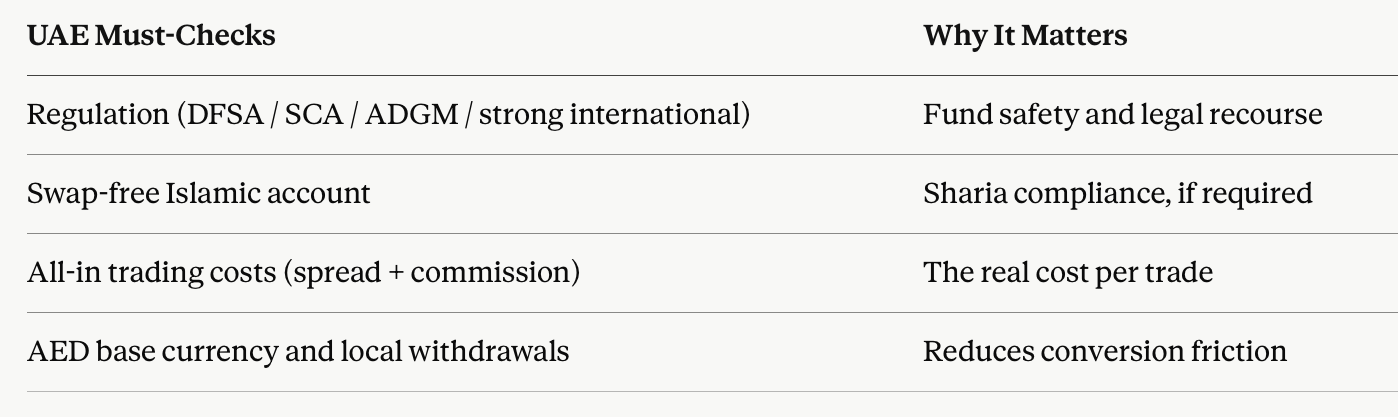
To choose the best forex broker in Dubai, you should first verify that the broker is properly regulated under the applicable UAE regulatory framework, whether through the DFSA, the SCA, the ADGM, or a reputable international regulatory authority. You should also evaluate the broker's trading costs, the availability of a swap-free Islamic account if required, and the reliability of its deposit and withdrawal methods. The best forex broker ultimately depends on your individual trading goals and preferences. Before depositing any funds, verify that the broker appears on the relevant regulator's official register, such as the Dubai Financial Services Authority (DFSA), and test the broker's platform using a demo account to ensure it meets your needs.
Before making your final decision, verify the broker's regulatory status through the appropriate official register, confirm that a swap-free Islamic account is available if you require one, and review all costs associated with using that account. You should also compare the broker's overall trading fees, spreads, commissions, and account conditions before testing the trading platform through a demo account. Although regulation helps reduce many of the risks associated with forex trading, it does not eliminate them. Most retail traders lose money when trading leveraged forex products, so it is important to understand these risks before making any trading decisions.
Why Choosing a Forex Broker in Dubai Is a Different Decision
When looking for an FX broker, you should generally compare the broker's spreads, trading platform, and minimum deposit requirements. When choosing an FX broker in Dubai or the UAE, you should also consider factors such as local regulatory licensing, the availability of a Sharia-compliant Islamic account, AED base currency support, and Arabic-speaking customer service. These are important considerations that are not always included in generic international broker comparisons.
The UAE is one of the world's leading retail FX markets, with Dubai serving as the centre of a financial ecosystem that combines Islamic finance principles with advanced international trading infrastructure. A broker that meets the needs of a trader in London or Sydney may not necessarily meet the requirements of a UAE resident if it lacks certain features that are important in the local market. As a result, international broker rankings may not always address the specific needs of traders in the UAE.
Before comparing brokers, it is advisable to identify your essential requirements. For example, if you are a Muslim, a swap-free Islamic account may be a minimum requirement. If you prefer to maintain your account and deposits in the local currency, AED base currency support may also be essential. Developing a solid understanding of how central banks influence currency prices and what drives the forex market will also help you evaluate a broker's terms and conditions more effectively, rather than relying solely on its marketing materials.
Is Forex Trading Legal in Dubai? Who Regulates Brokers Here?
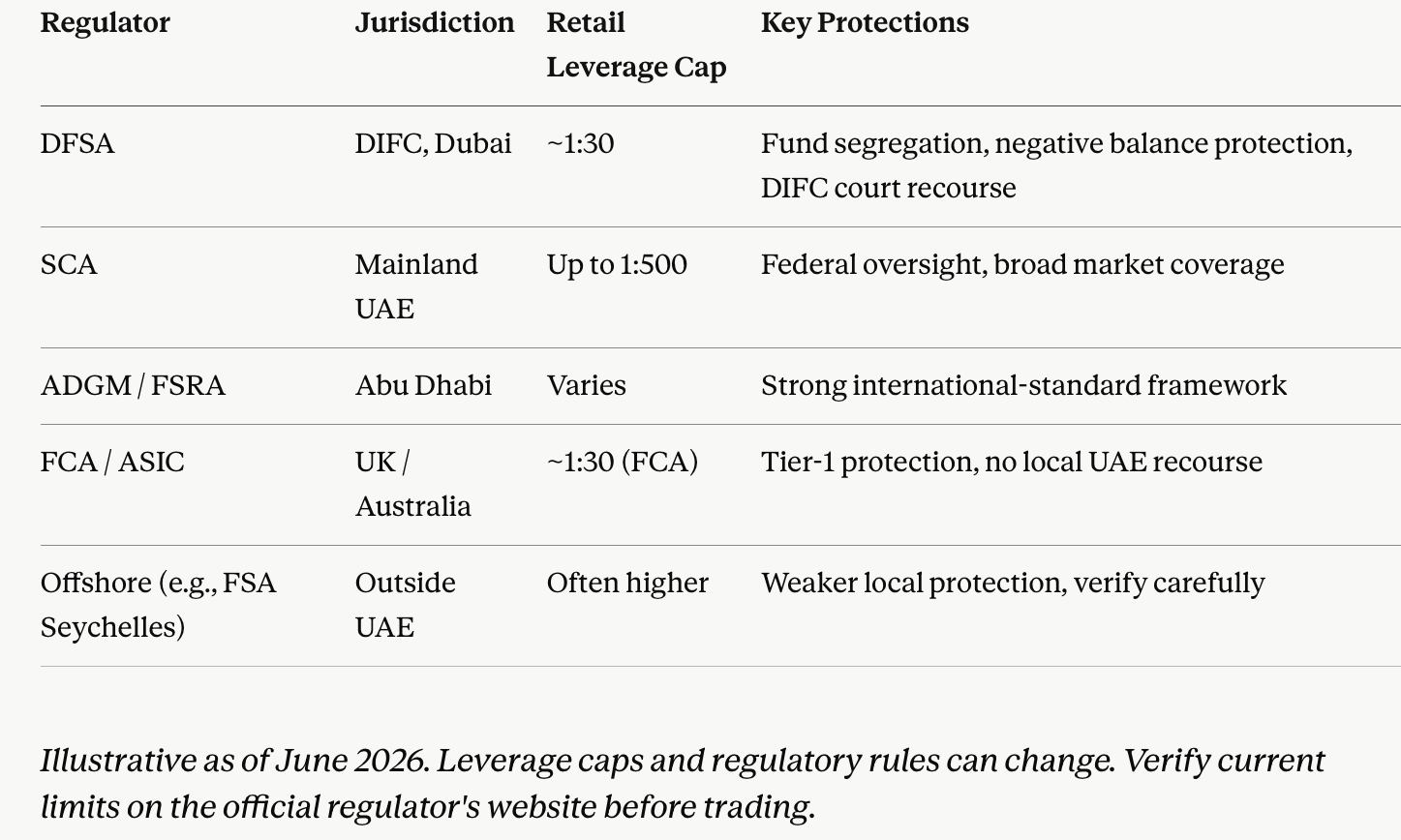
In the United Arab Emirates (UAE), including major cities such as Dubai, foreign exchange (forex) trading is legal and recognized as a legitimate financial activity. The country has established multiple regulatory authorities that oversee different types of brokers based on their place of registration and regulatory jurisdiction. The three primary regulatory authorities that traders in the UAE should be familiar with are the Dubai Financial Services Authority (DFSA), the Securities and Commodities Authority (SCA), and the Abu Dhabi Global Market (ADGM).
The DFSA is responsible for regulating financial services firms operating within the Dubai International Financial Centre (DIFC), one of the world's leading financial centers. As a tier-one regulator, the DFSA maintains regulatory standards comparable to those of the UK's Financial Conduct Authority (FCA) and the Australian Securities and Investments Commission (ASIC). Brokers regulated by the DFSA must comply with strict capital requirements, maintain segregated client accounts, and provide negative balance protection. Under the DFSA framework, retail leverage is generally limited to approximately 1:30. Traders using DFSA-regulated brokers also have access to the DIFC court system for resolving eligible disputes. For many traders, this strong regulatory framework justifies the lower leverage limits imposed on retail accounts.
The SCA is the national regulator responsible for brokers operating in the UAE mainland. Depending on the broker and the applicable regulatory framework, retail traders may have access to leverage of up to 1:500, providing greater flexibility in how leverage is used. However, traders should fully understand that leverage magnifies both profits and losses before using higher leverage levels offered by SCA-regulated brokers. Knowing how interest rate differentials feed into carry costs and overnight positions is particularly relevant when you're operating at high leverage across multiple pairs.
The Abu Dhabi Global Market (ADGM), supervised by the Financial Services Regulatory Authority (FSRA), is the third major financial regulatory framework in the UAE. It operates within the Abu Dhabi Global Market and maintains regulatory standards that are broadly comparable to those of the Dubai Financial Services Authority (DFSA).
Beyond these three major local regulators, many traders in the UAE also use internationally regulated brokers that are licensed by authorities such as the UK's Financial Conduct Authority (FCA) or the Australian Securities and Investments Commission (ASIC). These brokers provide a high level of investor protection even though they are not licensed by one of the UAE's three primary regulators. However, clients of these brokers do not have access to the Dubai International Financial Centre (DIFC) legal framework for resolving disputes.
In addition to these regulators, some offshore brokers licensed by smaller regulatory authorities, such as the Seychelles Financial Services Authority (FSA Seychelles), also accept clients from the UAE. While these brokers may offer higher leverage, they generally do not provide the same level of regulatory oversight or local investor protection as brokers regulated within the UAE. For this reason, traders should conduct thorough due diligence before depositing funds with any offshore broker.
It is important to note that UAE residents are not legally required to use a DFSA-regulated broker when opening a forex trading account. Many traders in the UAE successfully use brokers regulated by the FCA or ASIC. The primary difference lies in the available legal and regulatory protections if a dispute arises. Clients of DFSA-regulated brokers have access to established dispute resolution mechanisms within the UAE, whereas clients of offshore brokers are generally limited to the legal and regulatory processes of the broker's home jurisdiction.
How to Verify a Broker's Regulation in the UAE
Forex brokers must comply with regulatory requirements before conducting business. However, some brokers exaggerate their regulatory credentials, while others are clone firms that impersonate legitimate brokerages. Spending just five minutes verifying a broker's regulatory status is one of the most important steps a trader can take before funding an account, yet it remains one of the most common mistakes that traders overlook.
1. Locate the broker's stated regulator and license number.
This information is usually found in the website footer or on a dedicated legal or regulatory information page.
2. Open the public register for the relevant regulator.
-
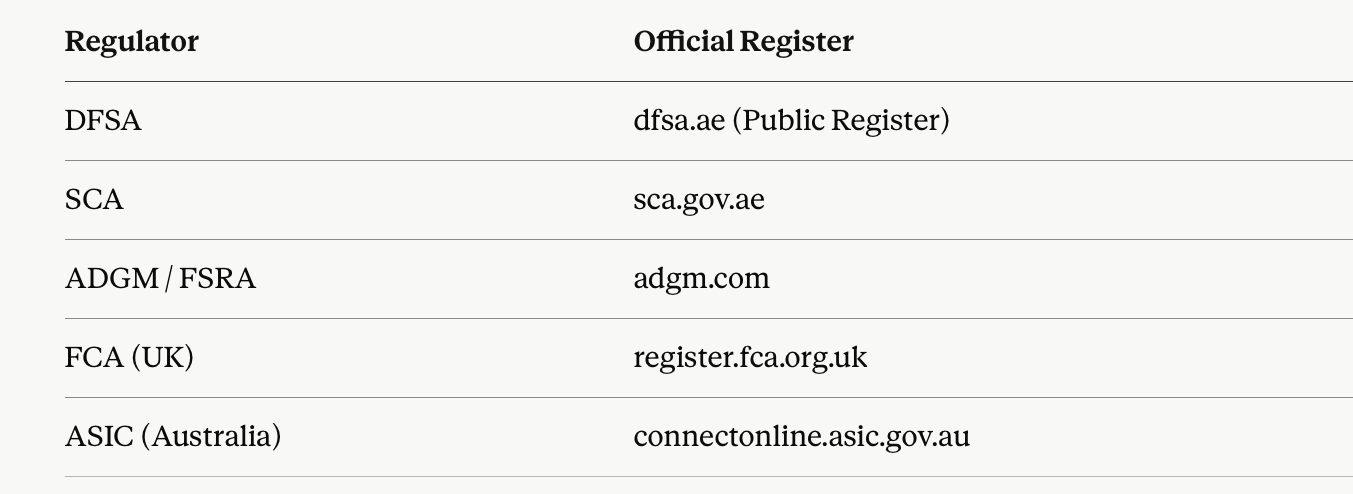
DFSA Public Register: dfsa.ae
-
SCA Register: sca.gov.ae
-
ADGM Register: adgm.com
3. Search by the broker's name or license number.
Confirm that the broker is registered with the regulator it claims to be licensed by. Verify the legal entity name, license number, and official website domain.
4. Determine which legal entity will hold your trading account.
Many brokers operate both an onshore regulated entity, such as a DFSA-regulated company, and one or more offshore entities. Depending on how your account is opened, you may become a client of either entity.
5. Check for regulatory warnings or enforcement actions.
Visit the regulator's website to determine whether any public warnings, disciplinary actions, or enforcement notices have been issued against the broker. This information is typically available under sections such as Public Notifications or Disciplinary Actions.
A common mistake traders make is assuming that the regulatory logo displayed on a broker's website automatically applies to the entity holding their trading account and client funds. In many cases, brokers operate multiple legal entities, and the tier-one regulatory license displayed on the website may belong to a different entity than the one with which your account is actually opened. For this reason, completing Step 4 by verifying the specific legal entity that will hold your account is just as important as confirming the broker's registration through the regulator's public register.
Islamic (Swap-Free) Forex Accounts in the UAE — What You Need to Know
Many traders in the Emirate of Abu Dhabi require a swap-free Islamic forex account. Under Islamic finance principles, earning or paying interest, known as Riba, is prohibited. This is why standard forex trading accounts apply overnight swap charges to positions held beyond one trading day, while swap-free Islamic accounts do not include these interest-based charges.
To understand how swaps work, consider that when a trader holds a position overnight in a standard account, the broker either charges or credits the account based on the interest rate differential between the two currencies in the pair. Understanding how floating exchange rates and interest rate dynamics feed into these calculations and why Sharia-compliant accounts are structured to avoid them.
Instead of applying overnight swap charges, brokers often impose a fixed administrative fee on positions held beyond a specified period in swap-free Islamic accounts. This allows the broker to charge for maintaining the position without applying interest. Whether a particular fee structure is considered Sharia-compliant depends on how the fee is structured, whether the broker has received approval from a recognized Sharia board, and how qualified Islamic scholars interpret the agreement between the broker and the client. Before treating any account as fully halal, it is advisable to consult a qualified Islamic scholar or another appropriately qualified religious authority.
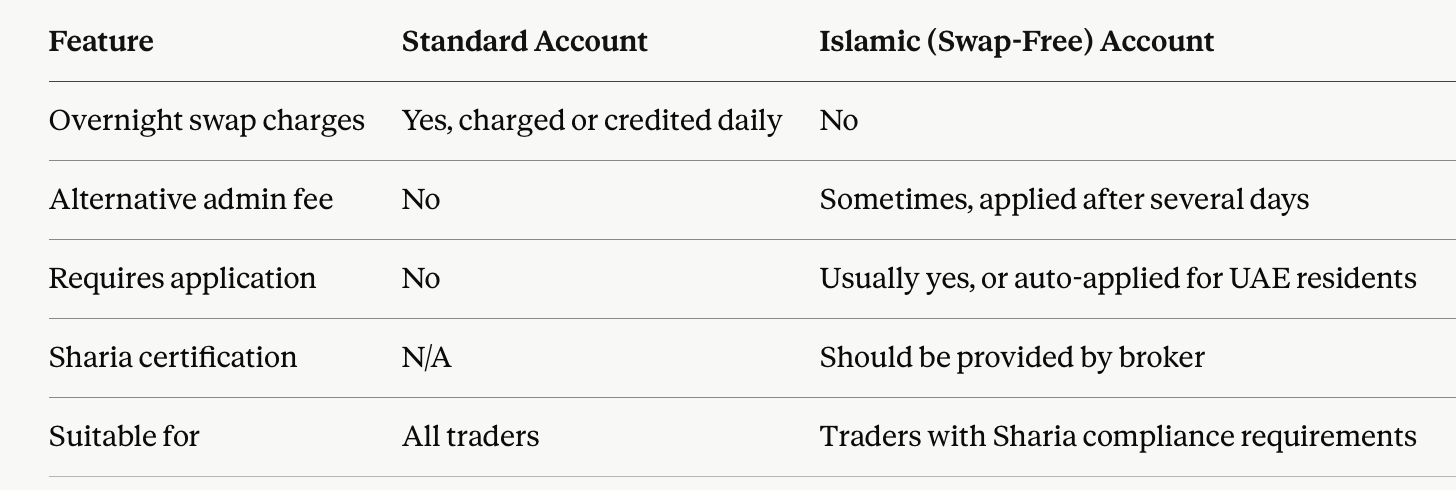
Most large brokers offer a swap-free account option, although the eligibility requirements and fee structures vary. Depending on the broker, the arrangement may include a flat administrative fee for positions held beyond a specified number of days, such as after the third day, or a no-fee Islamic account for clients who meet the broker's eligibility criteria. Before opening a swap-free account, it is advisable to request the complete terms and conditions in writing, including a copy of any Sharia compliance certificate issued by an independent and recognized Sharia supervisory board rather than relying solely on the broker's internal declaration.
What to Compare When Choosing a Forex Broker in Dubai
After confirming that your forex broker is properly regulated and offers a swap-free Islamic account if required, the next step is to evaluate the broker's trading conditions and execution infrastructure.
Overall Cost of Trading
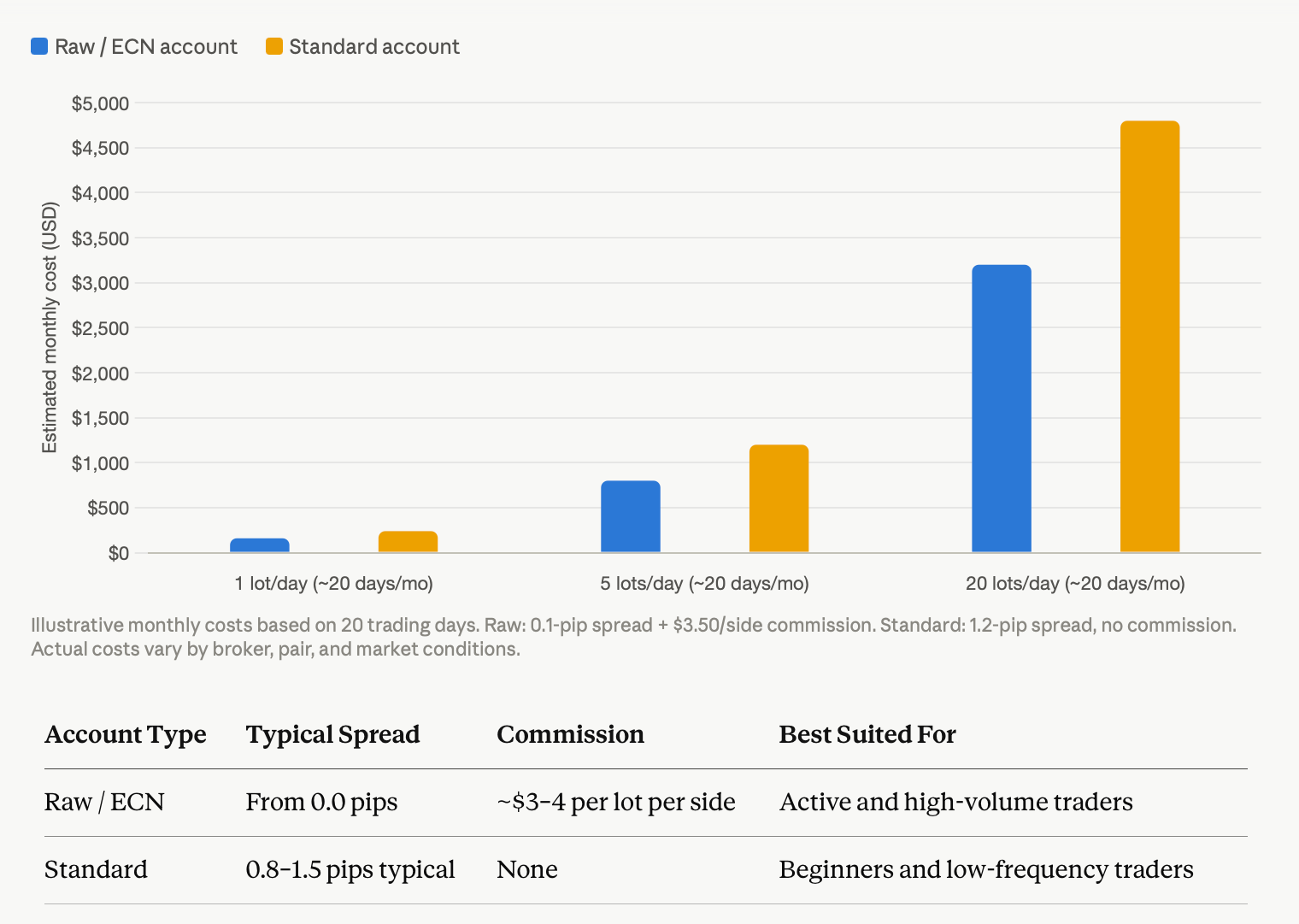
A common source of confusion for retail forex traders is the relationship between spreads and commissions. Raw, or ECN, accounts typically offer very tight spreads, sometimes as low as 0.0 pips, but charge a commission for each lot traded. Standard accounts, on the other hand, usually have wider spreads but do not charge a separate commission. Neither account type is inherently better. What matters is the total cost of trading based on the volume and frequency of your trades, rather than the advertised spread alone.
For example, if a Raw account charges a commission of $3.50 per side for a one-lot EUR/USD trade and has a spread of 0.1 pips, the approximate round-trip trading cost would be about $8. A Standard account with a spread of 1.2 pips on the same trade would have an approximate round-trip cost of $12. Although the difference may appear small for an individual trade, these costs can accumulate significantly over time, particularly for active traders. Before choosing an account type, it is important to understand how spreads and commissions combine to determine your actual trading costs.
Quality of the Platform and Execution
MetaTrader 4 remains the most widely used retail forex trading platform because of its extensive support for Expert Advisors and automated trading strategies. MetaTrader 5 expands on these features by offering additional order types and access to a broader range of asset classes. Proprietary trading platforms vary considerably in quality, although the best platforms typically offer TradingView chart integration, reliable mobile applications, and fast order execution.
For many inexperienced forex traders, execution quality is more important than they realize. During periods of high market volatility, such as major economic news releases, poor execution can result in slippage, causing trades to be filled at less favorable prices. As a result, the benefit of a tight spread can quickly disappear. If a broker claims to execute orders in less than 100 milliseconds, verify this claim by testing the platform on a demo account during live market conditions before committing real funds.
Base Currency in AED and Fund Withdrawals
If your trading account is denominated in AED, you can avoid currency conversion fees when depositing or withdrawing funds between your UAE bank account and your broker. By comparison, if your trading account is denominated in USD or EUR, each deposit and withdrawal may involve currency conversion charges, which can accumulate over time.
Another important factor when choosing a broker is the reliability of its withdrawal process. Before depositing a significant amount of capital, consider making a small deposit and then requesting a small withdrawal. This allows you to evaluate the broker's withdrawal procedures and customer support before committing larger amounts of money.
Leverage and Risk
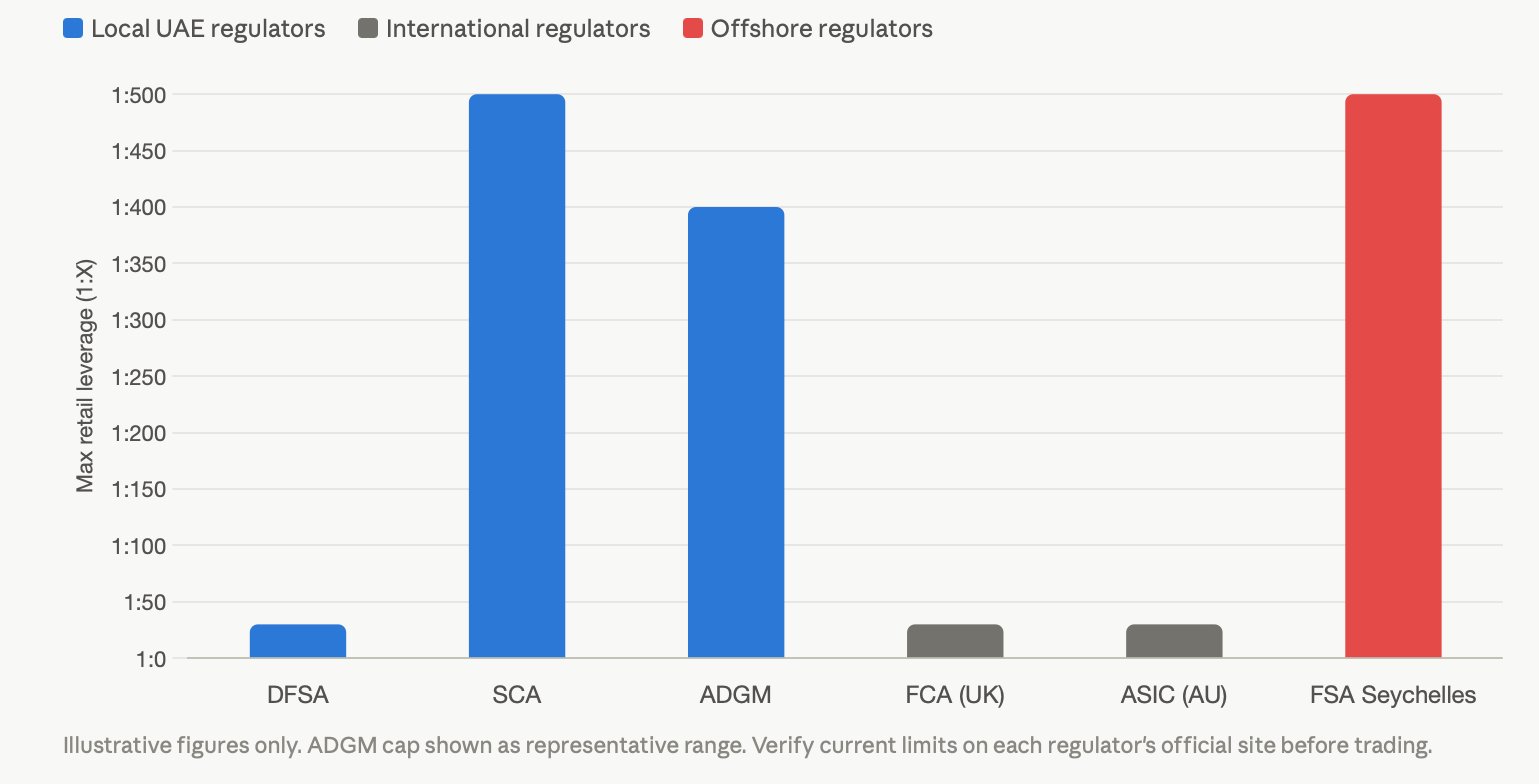
As illustrated in the chart, different regulatory authorities impose different maximum leverage limits for retail traders. The DFSA generally limits retail leverage to approximately 1:30, while the UAE SCA permits leverage of up to 1:500. Some offshore brokers may offer leverage exceeding 1:500.
Although leverage increases the potential for larger profits, it also magnifies potential losses by the same proportion. Before selecting a leverage level, take the time to understand how leverage affects your positions during periods of market volatility and how it aligns with your risk tolerance and account size. Your choice of leverage should be based on your personal risk management strategy rather than simply selecting the highest level available.
How Tradewill Fits for UAE Traders
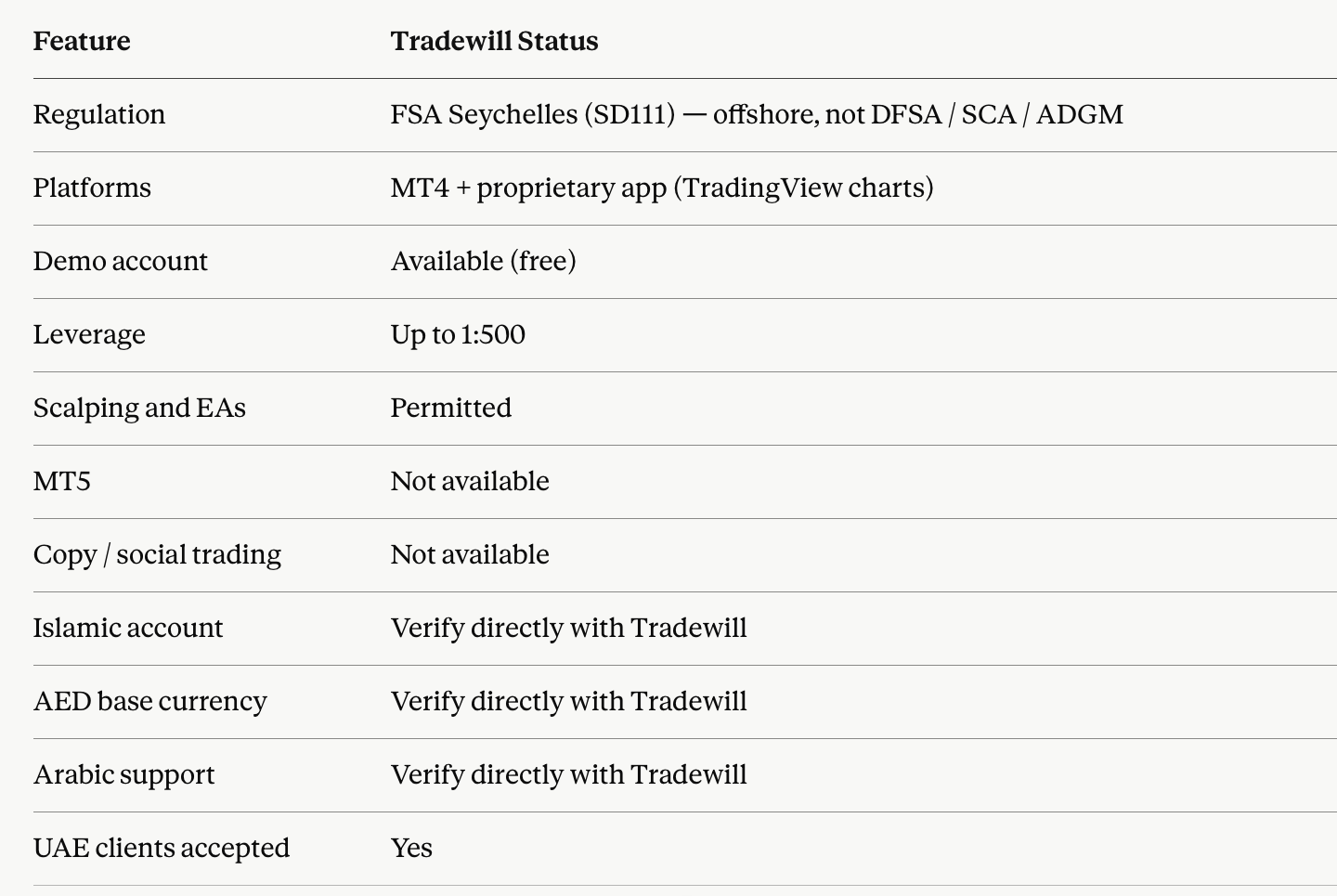
Tradewill allows users to trade forex, gold, and Contracts for Difference (CFDs) through the MetaTrader 4 trading platform. The broker also offers a proprietary trading application with charting powered by TradingView. Tradewill provides a free demo account for new traders, a minimum deposit of $100 for live accounts, leverage of up to 1:500, and permits both scalping strategies and the use of Expert Advisors without restrictions. Individuals who reside in jurisdictions where Tradewill accepts clients may be eligible to open an account, provided they are not located in a restricted country or territory.
For traders in the UAE, the primary consideration is Tradewill's regulatory status. The broker is regulated by the Seychelles Financial Services Authority (FSA) under License Number SD111. However, Tradewill is not regulated by the Dubai Financial Services Authority (DFSA), the Securities and Commodities Authority (SCA), or the Financial Services Regulatory Authority (FSRA) of the Abu Dhabi Global Market (ADGM). Traders who place a high value on local regulatory oversight should take this into account, as the legal protections and dispute resolution processes available through UAE regulators differ from those provided by an offshore regulator.
Before opening an account, traders should also confirm whether Tradewill offers swap-free Islamic accounts, AED as a base account currency, and Arabic-language customer support. These features are important for many traders in the UAE. As with any broker, it is advisable to verify the current account features, trading conditions, and eligibility requirements before opening an account.
If you are a trader who prefers a low minimum deposit, an EA-friendly MT4 platform, and a mobile app integrated with TradingView, Tradewill may be worth considering. The practical first step with any broker is to open a free demo account and use it during live market hours to evaluate the trading conditions and account features that apply to you before depositing any funds. You can also use the demo account to explore different forex trading styles, determine which account type best suits your trading approach, and assess the conditions under which you plan to trade.
Your evaluation should be based on real market conditions rather than simulated performance expectations. For this reason, it is recommended that you open a Tradewill demo account, place trades during live market sessions, and evaluate the broker's actual spreads, execution quality, and platform performance to determine whether they are suitable for your trading strategy.
Frequently Asked Questions
Is forex trading legal in Dubai?
Yes, forex trading is fully legal in the UAE, including Dubai. Brokers are regulated locally by the DFSA in the DIFC, the SCA on the mainland, or the ADGM, and many UAE residents also trade through strongly regulated international brokers. Always verify a broker's licence on the official register before depositing funds.
Which forex broker is best in Dubai?
There's no single answer that fits every trader. The best forex broker in Dubai is one that's properly regulated under the DFSA, SCA, ADGM, or a strong international authority, offers a swap-free Islamic account if you need one, carries low all-in trading costs, and supports reliable AED-denominated transactions. Verify, demo, and then decide.
Are DFSA-regulated brokers safer?
DFSA-regulated brokers operate under a Tier-1 framework requiring strict capital adequacy, client fund segregation, and negative balance protection, with DIFC court recourse available for disputes. That generally makes them among the stronger choices for UAE traders, though the retail leverage cap sits at approximately 1:30.
Is forex halal?
Forex can be considered halal when traded through a properly certified swap-free Islamic account that removes overnight interest, but scholarly opinions differ and the specifics of each account's terms matter considerably. Whether a particular account qualifies depends on its formal Sharia board certification. Consult a qualified Islamic scholar and review the broker's documentation directly. This is not religious advice.
Do I need a DFSA-regulated broker to trade forex in the UAE?
No, DFSA licensing isn't legally required for UAE residents. Many traders here use ASIC- or FCA-regulated international brokers without issue. The practical difference is that DFSA licensing provides the strongest local legal recourse through DIFC courts, which matters if a dispute arises. Confirm which entity will actually hold your account before you fund it.
How do I verify a broker's regulation?
Find the regulator and licence number on the broker's website, then search the relevant official register: dfsa.ae for DFSA brokers, sca.gov.ae for SCA-licensed firms, or adgm.com for ADGM entities. Confirm the company name, number, and registered website match exactly, and check which specific legal entity will hold your account.
What leverage can I use as a UAE trader?
Leverage depends on the regulator. DFSA-regulated brokers cap retail leverage at approximately 1:30. SCA-licensed brokers can offer up to 1:500. Offshore brokers sometimes offer more. Higher leverage amplifies losses as readily as it amplifies gains, so choosing based on your risk tolerance rather than the maximum available number is the more sustainable approach.
What should I compare when choosing a broker in Dubai?
Prioritise local or strong international regulation, swap-free Islamic account availability and its exact fee terms, all-in trading cost for your typical volume, AED base currency, Arabic customer support if needed, withdrawal reliability via UAE banks, platform quality and execution, and the ability to test everything on a demo before funding any live account.
Conclusion: Choosing Your Forex Broker in Dubai
A good forex broker for a trader in Dubai is one that meets specific regulatory, Sharia, and cost requirements, not one with the largest marketing budget or the highest advertised leverage. Begin by verifying that the broker is properly regulated and confirming its license through the regulator's official public register. Once this has been verified, you can better understand the legal protections and dispute resolution options available if a problem arises. If you require an Islamic trading account, carefully review the swap-free account terms and the total trading costs for the trading volume you expect to execute. Finally, confirm that the broker supports AED deposits, offers convenient withdrawal methods, and provides a trading platform that meets your practical requirements before funding your account.
The evaluation process consists of four steps: verify the broker's license, review the Islamic account terms if applicable, compare the total cost of trading, and use a demo account to evaluate the broker's performance under live market conditions. A demo account is one of the most effective ways to assess a broker's execution quality, platform stability, and trading conditions before risking real money. While testing a broker through a demo account, you can also practice reading price action and managing positions, giving you a better understanding of whether the broker's execution quality matches its advertised claims.
Tradewill's MT4 platform and proprietary TradingView-powered application provide a practical environment for traders who want to evaluate execution quality before opening a live account. Opening a free demo account, testing spreads during live market conditions, and evaluating execution quality can help you determine whether the platform is suitable for your trading strategy before committing real capital.
Tradewill's MT4 platform and TradingView-powered app are built for traders who want to see real conditions before they commit. Open a free demo, stress-test the spreads through a live session, and let the execution quality make the case.
Disclaimer: The content of the blog does not represent any position of Trade W, does not serve as any trading-related decision advice, and does not endorse any third-party.