
 Trade W

What Is a Low Spread Forex Broker?
Low spread Forex brokers can provide traders with cost savings by offering low or 0 pip spreads on various types of raw and ECN accounts. In addition, these brokers charge low commissions per lot for trading on these accounts. When searching for the cheapest low spread Forex brokers, it is important to focus on minimising the total all-in cost of your trades, not just the headline published spread for your account type, as even a 0 pip spread still involves a commission paid each time you trade a lot.
The true measure of which Forex broker is the cheapest depends on the all-in cost rather than the advertised spread alone. Raw and ECN accounts may offer a published minimum spread of 0 pips, but they include commissions charged per lot traded. Standard accounts typically have wider spreads but do not charge a separate commission.
For traders who execute a high number of frequent trades, a raw account will often be cheaper when comparing the full extent of all fees and costs incurred. Factors such as execution quality, average slippage, regulatory status, and consistency of spreads across both average and individual trading sessions are also necessary to evaluate whether a broker is suitable before depositing funds.
Factors to consider when selecting a low spread Forex broker:
-
Compare your overall cost; do not rely solely on the published average spread, and do not depend on minimum spreads such as 0 pips when assessing real trading conditions, as there is often a significant difference between minimum and average spreads during trading sessions.
-
Review execution speed and expected slippage; verify ECN and STP routing through the broker’s execution policies; independently confirm the broker’s regulatory status directly through the relevant regulatory authority, as it may not always reflect the broker’s actual current status.
-
Review non-trading fees such as swaps, withdrawal fees, and inactivity fees; ensure you are using the correct account type for your trading frequency and strategy.
-
Confirm the spreads you receive on a demo account before depositing funds with a broker.
"Low Spread" Sounds Cheap, But Here's What You Actually Pay
All Forex Market brokers claim tight spreads and can prove it by providing screenshots from peak London liquidity hours in the best conditions possible. Unfortunately, these screenshots will not include information regarding the average spread built throughout a regular trading session, the add-on commissions that double the actual cost to trade on a raw account, or any slip you would incur from executing an order during fast volatility.
Use the spread as an example of a toll paid each time we enter or exit a position. Spread is the difference between the buy price a broker will give you for a currency and the sell price he will accept to buy that same currency back. For an active trader, even minor differences in spread produce a compound effect, resulting in much higher annual costs. For instance, a trader trading 50 standard contracts a month on the EUR/USD with an average spread saving of just 0.5 pips could save approximately $250, which they would otherwise have spent if they traded with a wider spread broker, for example $3,000 per year by making one small change.
However, the above-mentioned calculations would only be valid if the commission rate of the broker with the narrower-than-average spreads did not negate any of these savings; therein lies the problem with so much of the information used to compare spread brokers. For example, a broker that charges $10 for a round-turn lot with 0.0 pip spreads could be more expensive in real terms than another broker that charges $4.50 and has an average spread of 0.5 pips. This guide provides a thorough analysis of all costs associated with your trade so that your comparison provides you with a valuable metric.
Forex Spreads Explained in Plain English: Fixed, Variable, and Raw
For a trader, knowing how much money will be involved with entering and exiting trades can be important. This information is also referred to as the bid-ask spread and measures the difference between the broker's buying and selling price of each currency pair. There are three common types of bid-ask spreads depending on your individual account format and your broker's brokerage model. They are market makers, automated online execution systems, as well as retail customer accounts.
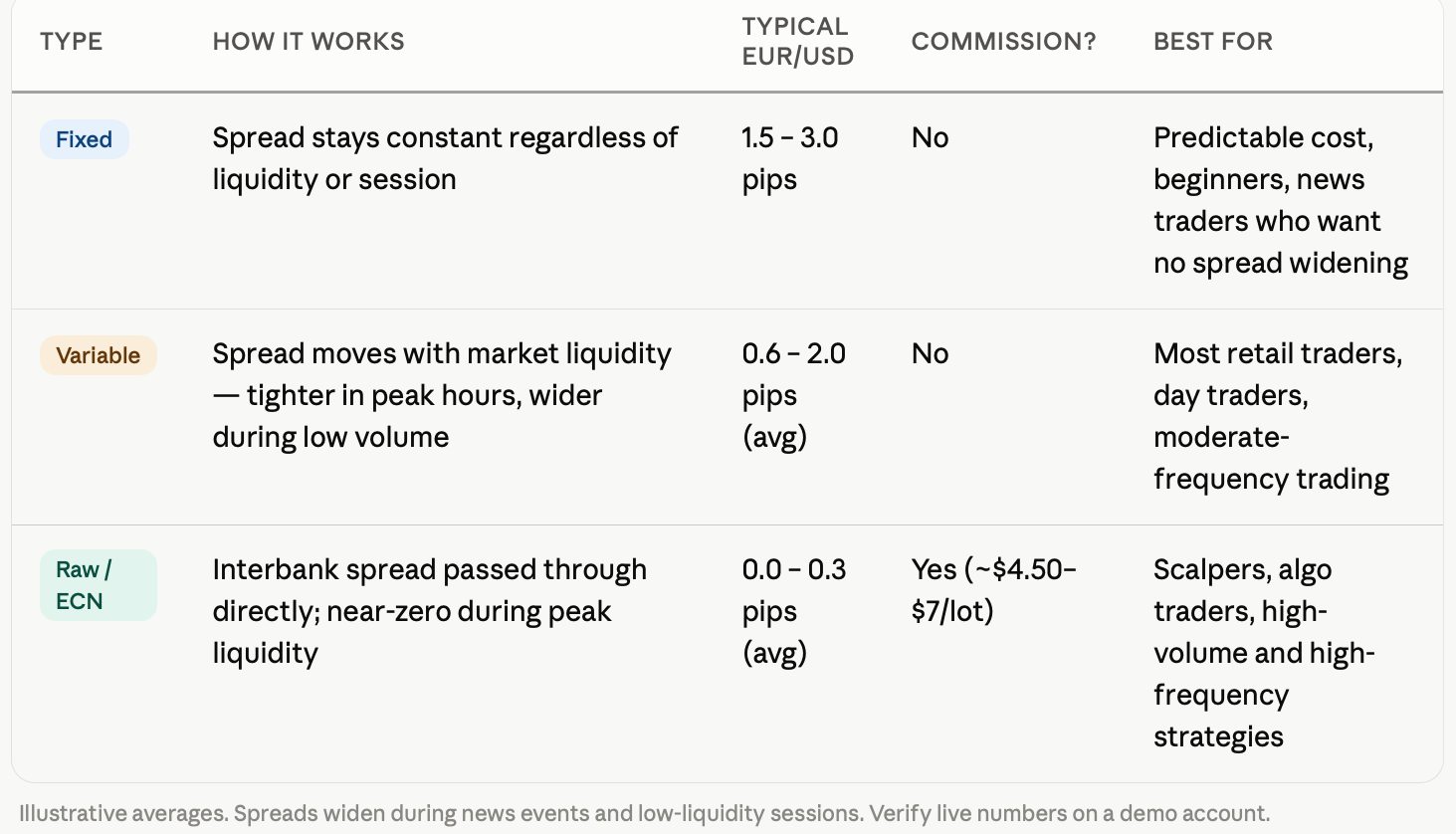
EUR/USD spreads are typically around $10 per standard lot for 1.0 pips. Therefore, a 0.3 pip spread will cost you $3 when you enter a position with 1 standard lot because of the large spread in scalping. When your target price is only 5 pips away from the entry point, you have already lost 20% of your target price ($10) before commissions or slippage come into play. If you would like to know how to calculate pip values, decimal pricing, and how they relate to actual trading results, the Complete Guide to Forex Pips/Pipettes and Decimal Pricing will give you the total calculation framework for both.
Competitive EUR/USD spreads should be under 1.0 on a standard account and below 0.3 on a raw or ECN account during the London-New York overlap after the New York close. Exotic currency pair spreads are much larger due to lower liquidity; spreads can often be found between 5 and 20 on raw accounts.
The Real Cost of Trading:
Just like most brokers compare themselves to other brokers by using the traditional method of looking at their cost of trading using the spread plus commission, this is still better than looking at just the spread. However, there is one other cost that very few people consider, and this is where a broker can actually differentiate themselves from others, not by appearance. So, what is that additional cost?
To arrive at a complete true-cost calculation when you're trading, you need to add together the following: spread, commission, slippage, and non-trading fees.
Slippage is the difference between your expected fill price when you place your order and the actual price at which your order gets filled. Depending on how fast the markets move and how quickly a broker is able to execute an order due to slower infrastructure, you can have a difference of anywhere from 1/10 of a pip to 5/10 of a pip per trade and sometimes even more around major economic news releases. This could become a significant yearly cost if you trade a large number of times in the course of each month and is an expense that will not show up on any broker spread calculation unless you have purposely measured this cost over many live or demo trading periods.
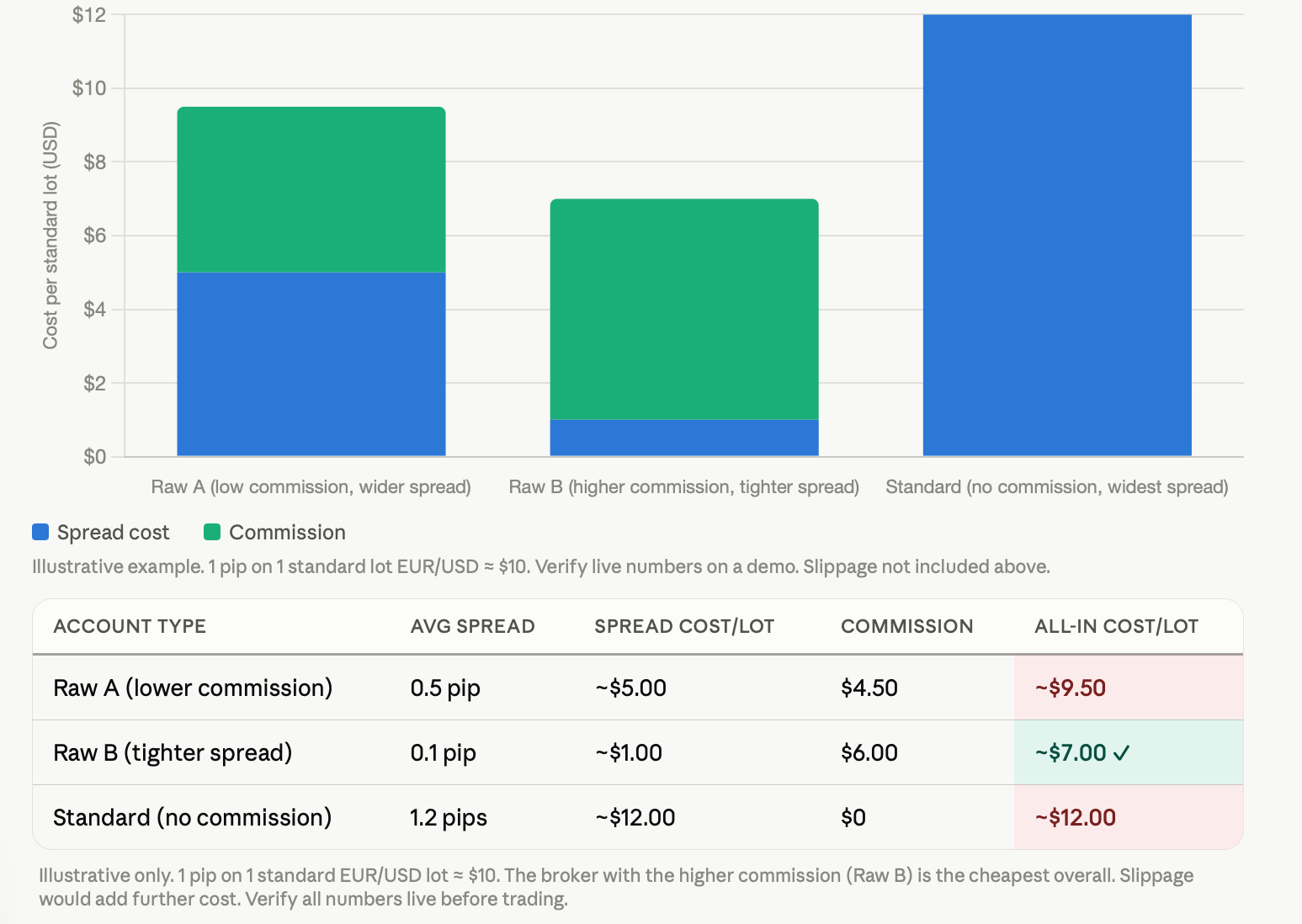
The above cost matrix shows you why using a comparison of brokers by commission alone will lead you to the wrong broker. Raw account A has a lower commission of $4.50, but the average spread for raw account A is 0.5 pips wider than that of raw account B, making the all-in cost $9.50 per lot for raw account A, while the all-in cost for raw account B would be $7.00 per lot. Therefore, although raw account B charges a higher commission, based on the volume of trades you will actually be able to trade more cheaply using raw account B than with raw account A.
You must also consider all other non-trading fees, such as overnight swap rates, withdrawal fees, currency conversion markups, and inactivity fees, before you have all the information you need to get to an accurate price per lot for a broker. Even if every other number looks competitive for a broker, if a broker charges you a $5 monthly withdrawal fee, that will actually increase your real cost of doing business with that broker. As a trader that carries positions overnight, understanding how swap cost and carry mechanics work is critical to getting the accurate cost per lot for a broker.
Raw/ECN vs Standard Accounts: Which One Is Actually Cheaper for You?
The type of account you choose is just as important as the name of the broker. The same platform could be costly or genuinely cost-effective depending on what kind of account you open and how often you execute trades.
Raw or ECN account types route your order to external liquidity providers, typically large banks and institutional trading desks, with very little spread markup. You would see a spread that is very close to the raw interbank rate, typically 0.0 pips to 0.3 pips on major pairs, with a per-lot commission of approximately $4.50 to $7 round turn on competitive ECN brokers.
Standard account structures will offer costs differently; there is no separate commission, however the broker will add a spread markup of 0.8 to 1.5 pips over the raw rate and retain that markup as revenue. For a trader that executes one or two positions every week this may be a simpler solution and may be sufficient. For anyone executing trades every day or utilising automated strategies, that markup adds up to a significant amount on an annual basis.
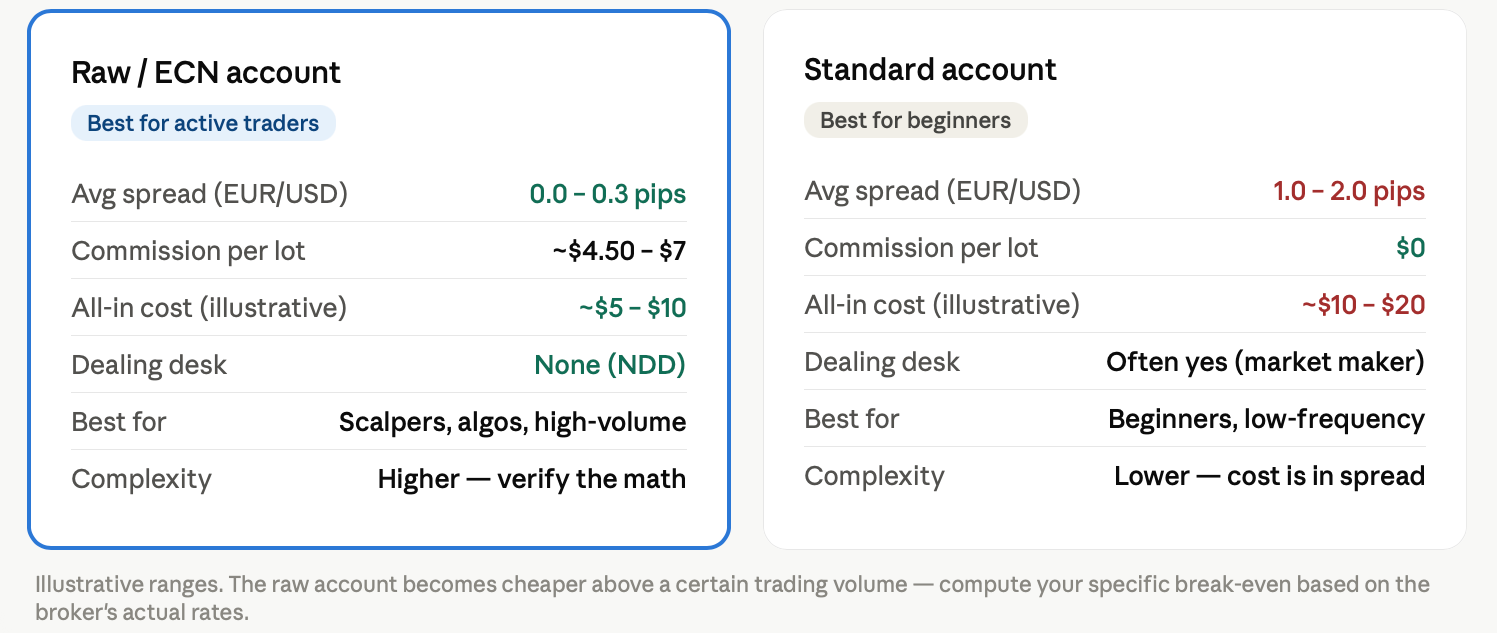
The simple calculation for breakeven is that if you pay a $6 commission and your average raw spread is 0.1 pips ($1), the total cost for one lot would equal $7. When comparing that against the standard ECN account with a 1.2 pip spread (or $12) and no commission (or zero commissions), the result shows that the raw account is $5 cheaper, and the difference grows further as you increase lot size.
In a real ECN/NDD broker environment, they will not take the other side of your trade and therefore must route all of your transactions to external providers of liquidity, such as banks. This is very different from a market maker broker, who can set their own price and create a potential conflict of interest with their customer that does not exist when you are using an ECN broker that is executing through external liquidity.
It is also important to verify the ECN or raw designation of the account by checking the execution policy in each broker's legal documents rather than relying only on the product description page.
How to Spot a Genuinely Low-Cost Broker Without Getting Fooled by "0.0 Pips" Marketing
The phrase "zero pips" used in advertising is similar to airline $9 fares. When we say there is a zero pip spread for a currency pair, but there is a limited scope for how often this can actually be achieved during a full trading day with adequate liquidity, we need to compare it with real-time spreads.
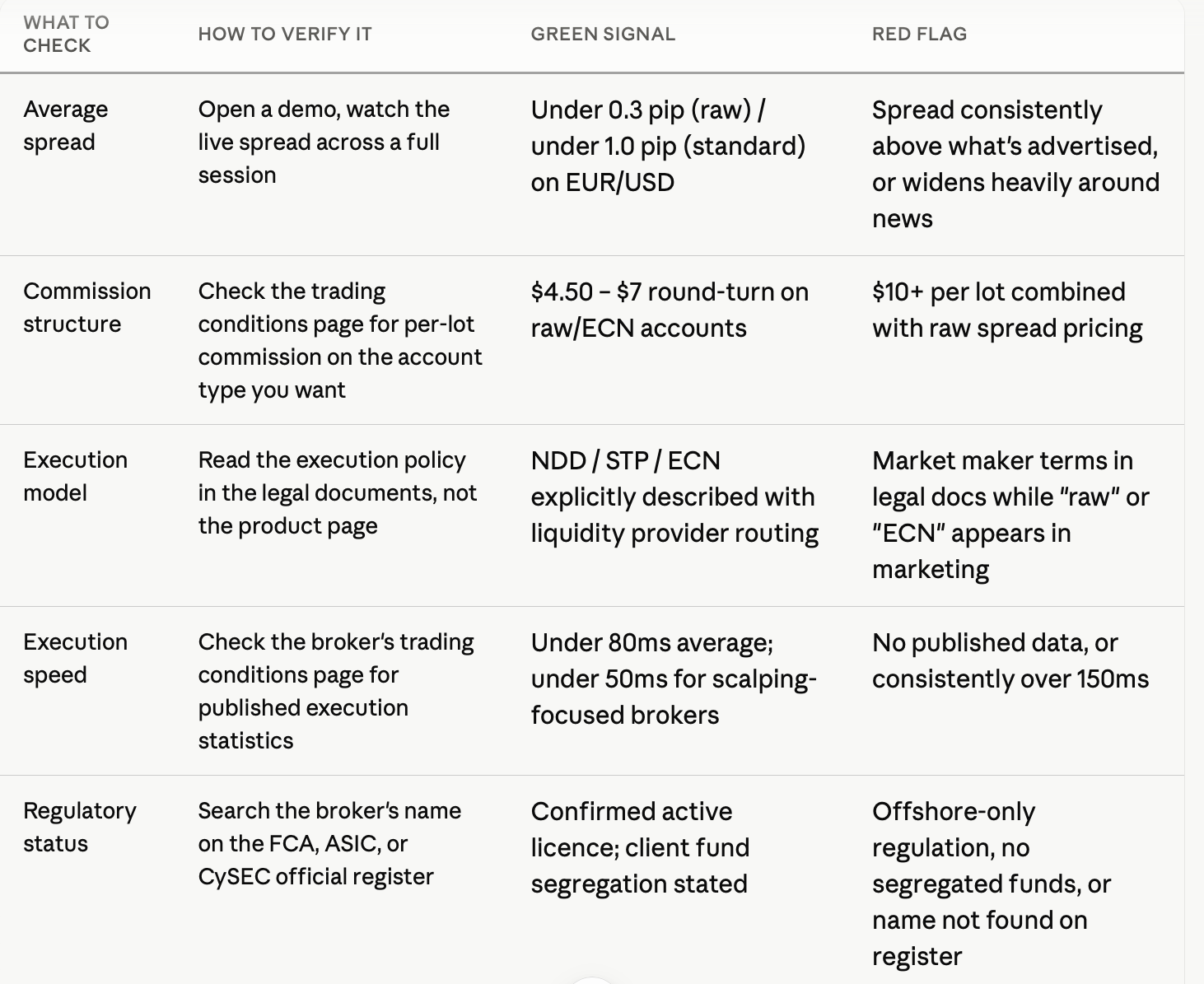
To verify the average spreads of a broker that you are considering, perform the following steps to check the broker's operational conditions.
Track
Observe the average spreads on a live demo account through your current trading session. Create a live demo account at any broker you are seriously considering during your trading session and observe their live spread on the pair you are trading for an extended period, ideally through the London and New York sessions and during some news events. You should also do this during the London and New York overlap, which typically has the tightest spreads for most pairs.
Execution policy
You want to understand what you can expect from the broker by reviewing their execution policy section of the site. The execution policy should provide clear disclosure relating to their use of external liquidity providers and explain whether they use a dealing desk.
If the website of a broker states they are an ECN or NDD, but their execution policy document states they are a market maker, the marketing material on the website is not a reliable statement regarding how your order is executed.
Estimate slippage
Most tier-1 ECN brokers will execute an order in less than 80 milliseconds, while the majority of competitive brokers will execute an order in approximately 50 milliseconds or less. For scalpers, differences in execution of more than 20 milliseconds during rapid trading scenarios can affect accuracy.
Request average slippage data from an existing broker if they do not have those statistics published on their website. Many brokers' trading conditions describe average slippage rates.
Check regulation
Before dealing with a broker that you are seriously considering, verify the registration of the regulator from the appropriate source. The following links will provide you with accurate information regarding valid FCA, ASIC, or CySEC brokers.
Do not rely on the broker's marketing information and claims of being regulated; use the information from the official regulatory sources.

The Forex Bid-Ask Spread Guide will walk you through each of the key features that are important to understanding bid-ask spreads, as well as how they are affected by various market conditions and order types, before you begin to look at live numbers from multiple brokers.
Who Low Spreads Help Most: Scalpers, Algo Traders, and High-Volume Strategies
While not all traders will receive the same level of benefit from the tightest spread possible, identifying this difference upfront helps new traders avoid optimising the incorrect variable while still developing their core foundation for trading.
Scalpers are the type of traders that feel the impact of the spread immediately. With your profit target being only 5 to 10 pips per trade, a 1.0 pip spread is consuming 10 to 20% of your target, and that is before you add in commission and slippage. If you were to trade with a 0.2 pip raw spread with an actual ECN broker with sub-50ms executions, you would have fundamentally changed the economics of your trading strategy, which is why scalpers should always treat their broker's cost structure as a direct performance decision, rather than just an administrative decision.
Algorithm and high-frequency traders have the same spread effects, but to a greater extent. If your automated trading system executes (for example, 200 trades at $10 each) but achieves an average of 0.04 pips more per trade from a lower cost of your broker, you would experience an additional 80 pips (for example, $800) every month. Additionally, back-testing is only as accurate as your cost assumptions; therefore, your back-testing results will be misleading. For example, if you enter an unrealistic value into your back-testing model instead of using actual average spread data, then you will be misled before making your first trade live. This information can also be found in the algorithmic trading strategies guide, explaining how execution cost inputs play into accurate performance projection for automated trading systems.
While day traders have an average target range of 20 to 50 pips, they are still very much impacted by the spread, but typically not as much as scalpers. For position and swing traders, who generally target between 50 and 200 pips, they are impacted by the spread; however, a 1-pip difference in cost will have less of an impact relative to the size of their profit objective than with scalpers. In fact, for those types of traders, platform reliability, charting quality, customer service, and regulatory standing will outweigh an additional 0.2 pips in cost per trade when comparing brokers.
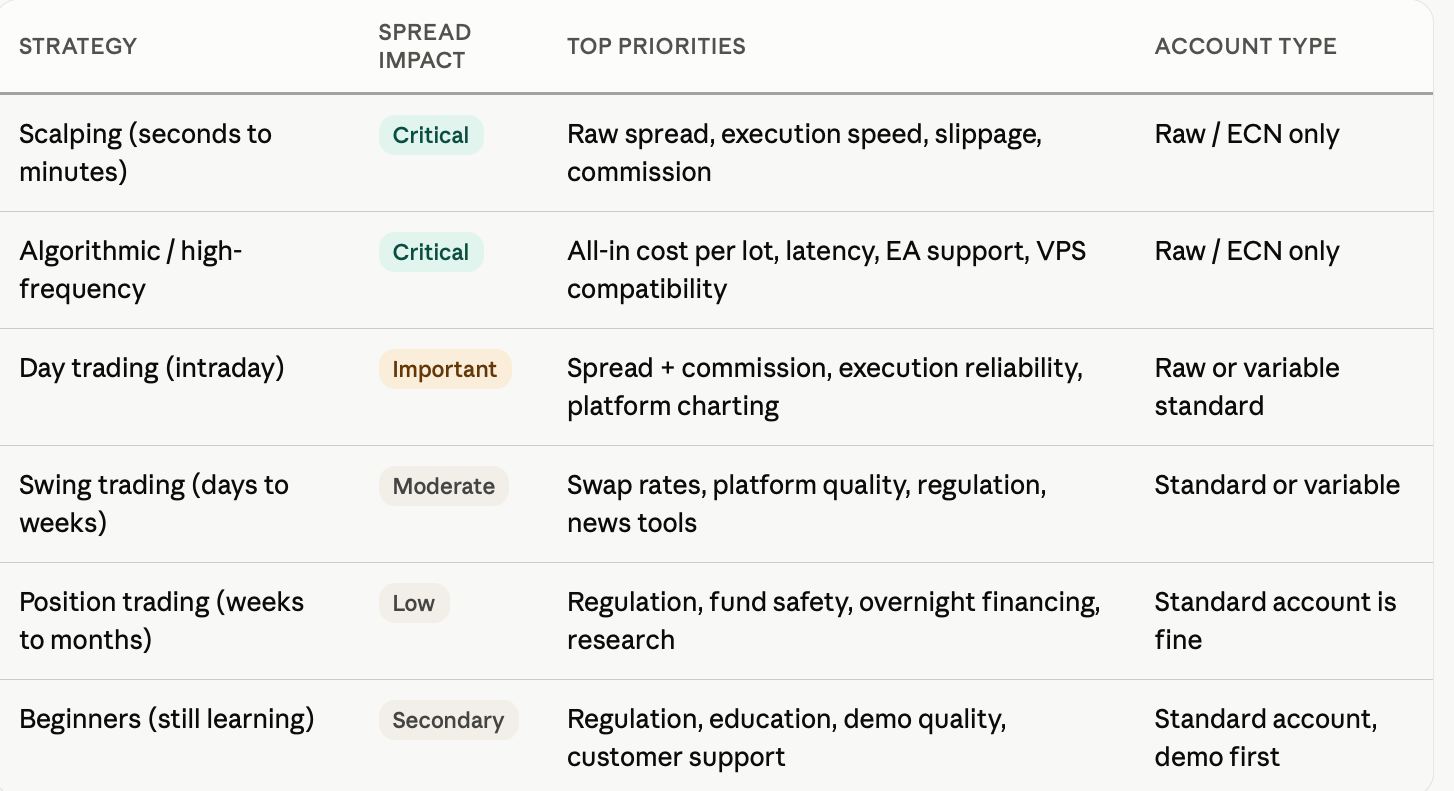
New traders that are just starting to learn how to read charts, control risk, and create consistent executions for themselves are not helping their own case by worrying only about the absolute tightest spreads with an inconvenient or less regulated broker. For more details on the relationship between trading costs and short-term strategy decisions when trading, please refer to the step-by-step day trading guide for 2026 for additional information regarding scheduling costs into your strategy at various timeframes.
Where Tradewill Fits If You Want Tight Spreads and Fast Execution
The Tradewill trading platform offers trading in Forex, Gold, CFDs via the MT4 terminal and through their proprietary trading application which has built-in TradingView charts. This combination is geared towards supporting both manual traders and traders who execute algorithmic strategies on an automated basis. There is no MT5 support; there are no copy trading or social trading features. Tradewill will provide leverage up to 1:500, is allowing scalper trades, and using expert advisors on MT4 is fully allowed.
Tradewill account types have varying levels of cost associated with them on an account and on a per-lot basis. The account types with very low spreads (from 0.0 pips) and in some cases $0 (i.e. their Pro accounts) should generate very low overall trading costs. That should be the case in theory, but as you investigate further you will find out that certain account types appear to charge on a per-lot level, and some account types are charging on a per-lot level more than the raw ECN benchmarks used across the entire industry of $4.50 to $7.00 round-trip. Therefore, those accounts with 0.0 pips spreads do not provide the lowest all-in cost when compared to other brokers whose business models revolve around dedicated ECNs; but only when you perform your calculations and compare your specific methodology.
Tradewill has additional items worth mentioning. They have a free demo using live market conditions and an execution speed reported to be around 0.04 seconds, full support for scalping and algorithmic-based strategies, and a low initial deposit requirement which allows very small traders to get started. Tradewill is based in Seychelles; it is regulated by the Seychelles Financial Services Authority (FSA), which is an offshore regulator; and that does make a difference in terms of the amount of protection your funds have and the manner in which disputes can be resolved. Tradewill does not accept customers from the USA, Canada, Israel, or Iran.
The best thing you can do to verify any broker's cost-effectiveness or value of service is to open a free demo account, then measure the actual live average spread and commission for one trading session. Then compare that with any averages that you have established for other brokers or retail accounts. You can therefore establish the brokerage cost and value of service through those comparisons.
Frequently Asked Questions
What is a low spread forex broker?
A low spread forex broker offers tight bid-ask spreads, typically from 0.0 pips on raw or ECN accounts with a per-lot commission, or under 1.0 pip on standard accounts without a separate commission. What makes a broker genuinely "low spread" is the all-in cost (spread plus commission) rather than the headline number, because the two are inseparable once you account for how raw account pricing actually works.
Do low spread brokers charge commissions?
On raw or ECN accounts, almost always yes. A zero-spread or 0.0-pip account generates broker revenue through a per-lot commission rather than a spread markup, with commission rates typically ranging from $4.50 to $7 round-turn on competitive ECN accounts. The spread may sit near zero while your total transaction cost per lot is still $7 to $10, which is why running the full calculation before comparing is the only approach that tells you something accurate.
What is the difference between a raw spread account and a standard account?
A raw or ECN account shows spreads close to the interbank rate (often 0.0 to 0.3 pips on EUR/USD) and charges a separate per-lot commission, while a standard account has wider spreads (typically 1.0 to 2.0 pips) with no commission. For traders executing frequently, the raw account almost always costs less overall, but the exact crossover depends on your volume and the specific rates at the broker you're evaluating.
Are ECN brokers better for active traders?
For scalpers, algo traders, and anyone running multiple lots per day, genuine ECN brokers typically offer lower all-in costs because they pass through raw interbank spreads and charge a transparent per-lot commission rather than a spread markup. The important qualifier is "genuine" — the ECN label is used loosely in the industry, and verifying actual NDD routing through the execution policy is more reliable than the account name.
How does slippage affect the real cost of trading?
Slippage is the difference between the price you expected and the price your order filled at, and it adds a real per-trade cost on top of the spread and commission that doesn't appear in most broker comparison tables. Even a tight spread is partially offset by poor execution, because slow broker infrastructure can consistently fill orders 0.2 to 0.5 pips away from the expected price during fast-moving markets, effectively raising your true cost above what the spread-plus-commission figure suggests.
When are forex spreads at their tightest?
Spreads are consistently tightest during the London session and especially during the London-New York overlap (roughly 13:00 to 17:00 GMT), when trading volume peaks across the major currency pairs. They widen during the Asian session, at the weekly open and close, and around major economic events including non-farm payrolls, CPI releases, and central bank rate decisions, which is why testing average spreads across a full session matters more than checking at a single optimal moment.
Is a zero-spread account actually free to trade?
A zero-spread or 0.0-pip account is not free. The broker's revenue model replaces the spread markup with a per-lot commission, and the commission can produce a total cost that's similar to or higher than a spread-only account depending on your volume and the specific pair you trade. Running the all-in calculation (spread cost plus commission per lot) under your actual trading conditions for both account structures is the only way to determine which is genuinely cheaper for you.
Can I verify a broker's spreads before depositing?
Yes, and you should always do this before committing funds. Open a free demo account and watch the live spread on your preferred pair across a complete trading session during your typical hours. Demo spreads can occasionally be marginally tighter than live conditions, so confirming with a small live deposit before scaling up is worthwhile once the demo comparison looks favourable.
How do I verify that a broker is a genuine ECN?
Read the execution policy in the broker's legal documentation rather than relying on the marketing page or the account name. A genuine ECN or NDD broker will explicitly describe routing orders to external liquidity providers with no dealing desk involvement in those documents. If the legal terms describe a market maker model while the product page uses "ECN" or "raw" language, you're looking at a marketing label rather than an accurate description of how your orders are processed.
Are low spread brokers safe to use?
The spread a broker offers doesn't determine how safe it is, but the regulatory framework it operates under does. Prioritise brokers regulated by recognised Tier-1 authorities (FCA, ASIC, CySEC) that require client fund segregation, negative balance protection, and transparent dispute resolution. Always verify the licence on the official regulatory register before depositing, and don't let a tight headline substitute for a legitimate safety check.
The Bottom Line: What the Genuinely Cheapest Broker Actually Looks Like
The all-in cost per trade (lot) over a period of time will give you the best indication of whether or not your broker has competitive costs (low cost). The all-in cost per trade includes the bid-ask spread (average), brokerage commission, and slippage, a measure of the difference between the price you enter the market and the price your order executes.
The advertised bid-ask spread is the start of your shortlist and should not be the only factor when making a decision. The shortest path is to find brokers who are regulated and support your strategy, to open free demo accounts with two or three of those brokers, and to measure the current average bid-ask spread on your top tradable Forex pair. Add broker commissions to the bid-ask spread to arrive at your total cost per trade. Also account for withdrawal fees or inactivity fees, and then choose the lowest total all-in cost broker from your demo trading activities based on average bid-ask spreads calculated during the entire trading day that you trade normally.
For example, most retail traders lose money. The lower your trading costs, the better your odds, statistically, of eventually making a profit; however, you cannot guarantee profits based solely on lower trading costs. This article should not be construed as financial advice, and all spreads and commission amounts listed in this article are for example purposes only. Please contact your broker for their real-time bid-ask spreads and complete commissions before placing a trade or opening an account with that broker.
Open a free Tradewill demo and measure your actual all-in cost on the pairs you trade, spread, commission, and execution speed together, before you deposit anything.
Disclaimer: The content of the blog does not represent any position of Trade W, does not serve as any trading-related decision advice, and does not endorse any third-party.