

 Trade W
If you’re among those who’ve been following the dominant tech behemoths over the last several years, you’re likely familiar with the term “Magnificent 7.” This includes Apple, Microsoft, Alphabet, Amazon, Meta, Nvidia, and Tesla. These companies have propped up the S&P 500 index over the last several years, and here we are in 2026 looking for answers to the same question: how do I invest in all 7 at once?
Well, various ETFs represent this idea of investing in all 7 companies, but which one is right for you? This article will take a closer look at some of the popular Magnificent 7 ETFs, their hidden costs, and whether you should be going all in on technology as an investment.
MAGS vs. FNGS vs. QQQM: Which ETF Actually Fits Your Portfolio?
If you want to gain exposure to the "Magnificent 7," you have three options: MAGS, FNGS, and QQQM. Each of these investments offers different ways of investing in technology companies, and understanding the differences will prevent you from making a regrettable, costly decision.
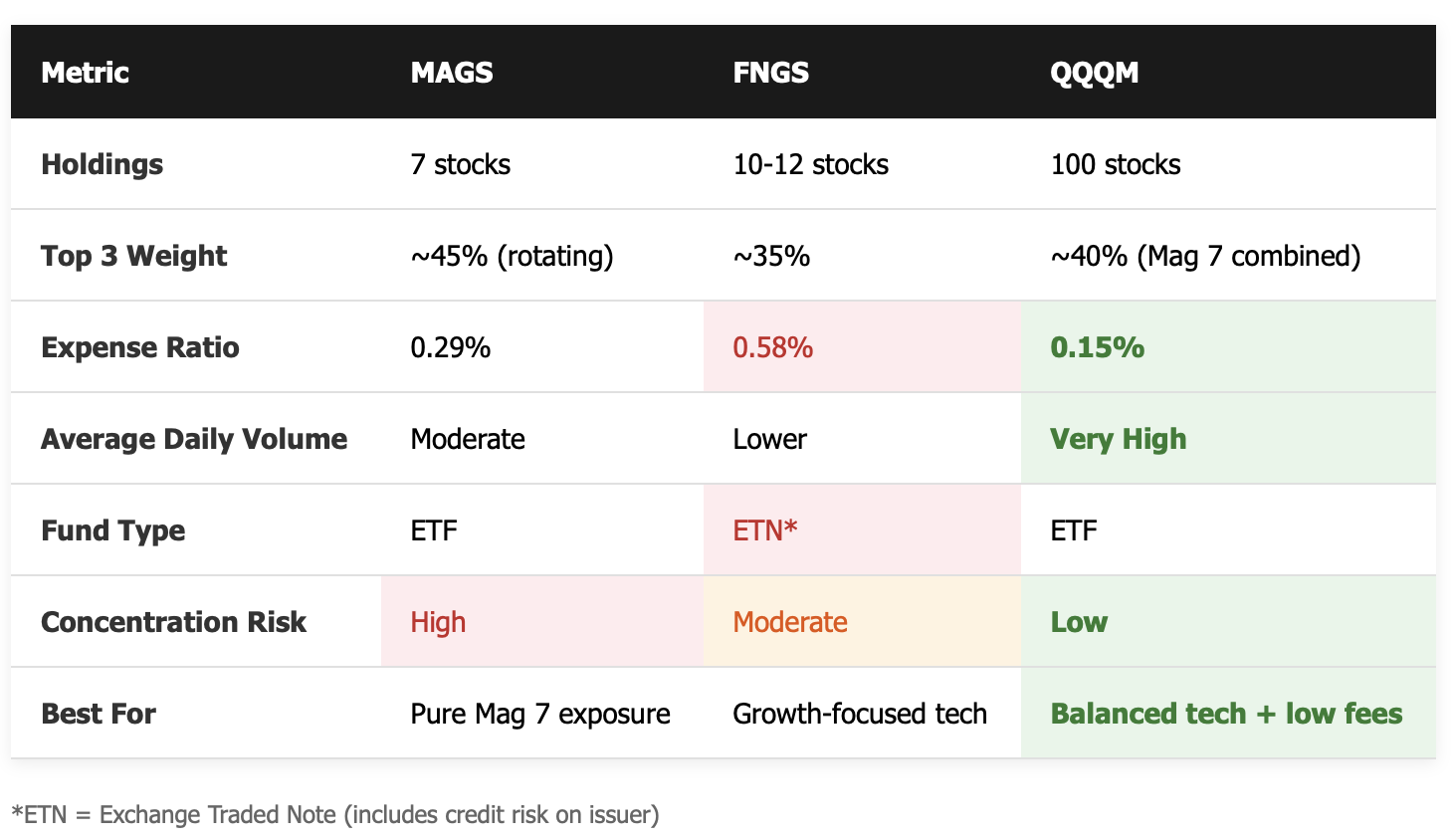
The MAGS ETF (Roundhill Magnificent Seven ETF) is very straightforward as it consists solely of investments in the seven companies mentioned earlier, with equitable weightings. You get a direct and precise approach to investing in seven mega technology companies. The MAGS ETF has an expense ratio of 0.29% - not the cheapest, but reasonable given the concentration of the company’s investments.
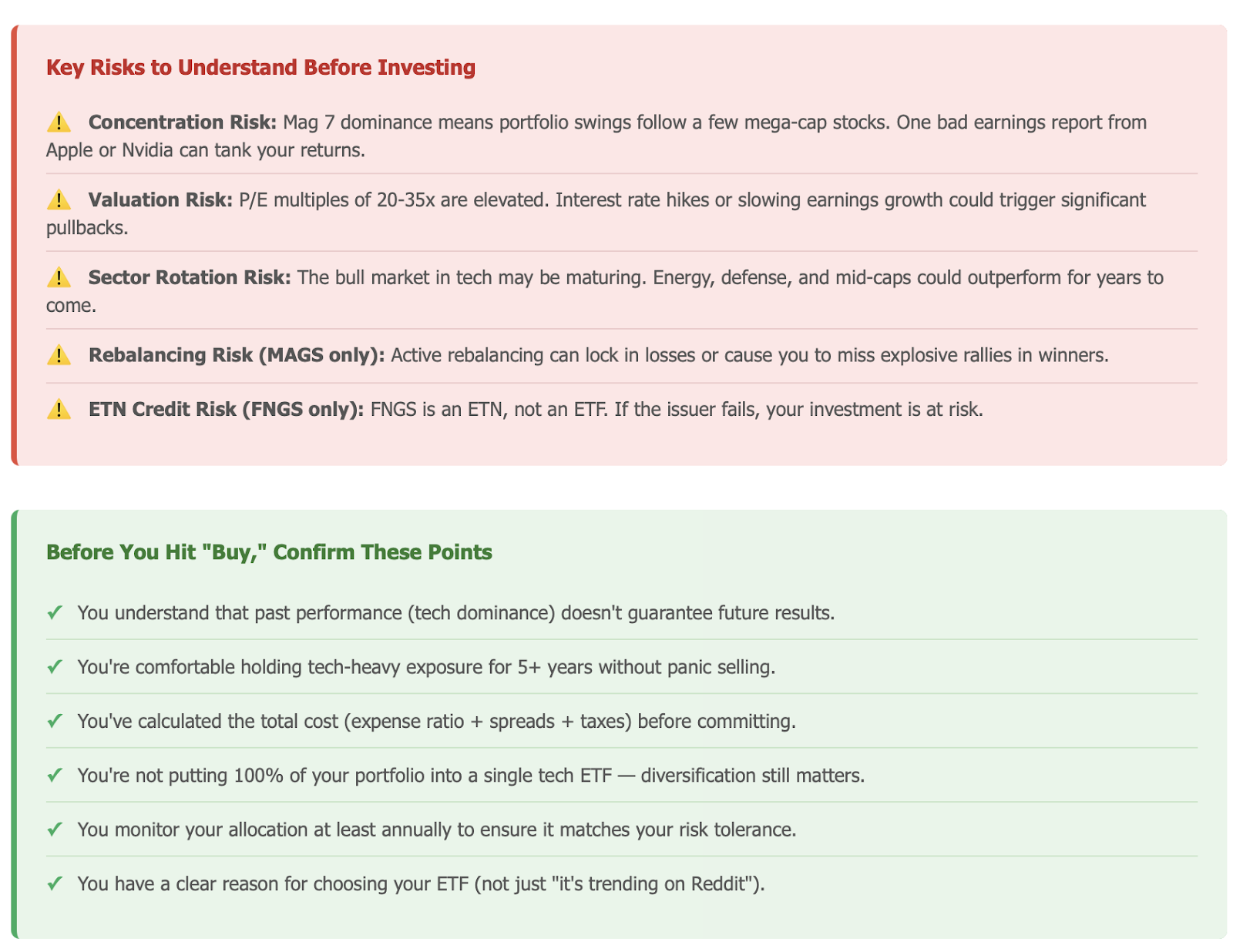
FNGS ETF (MicroSectors FANG+ ETN) is less focused than MAGS as it offers exposure to the FANG+ index, which has more than just the four FANG stocks included. The addition of other companies such as Netflix, Broadcom, and Snowflake increases the total number of equity holdings from seven to approximately 10 to 12, thus lowering risk, yet still maintaining a heavy emphasis on technology. The expense ratio for this ETF is approximately 0.58%, which is higher than MAGS, but it is considered an ETN (Exchange Traded Note), thus you take credit risk on the issuer.
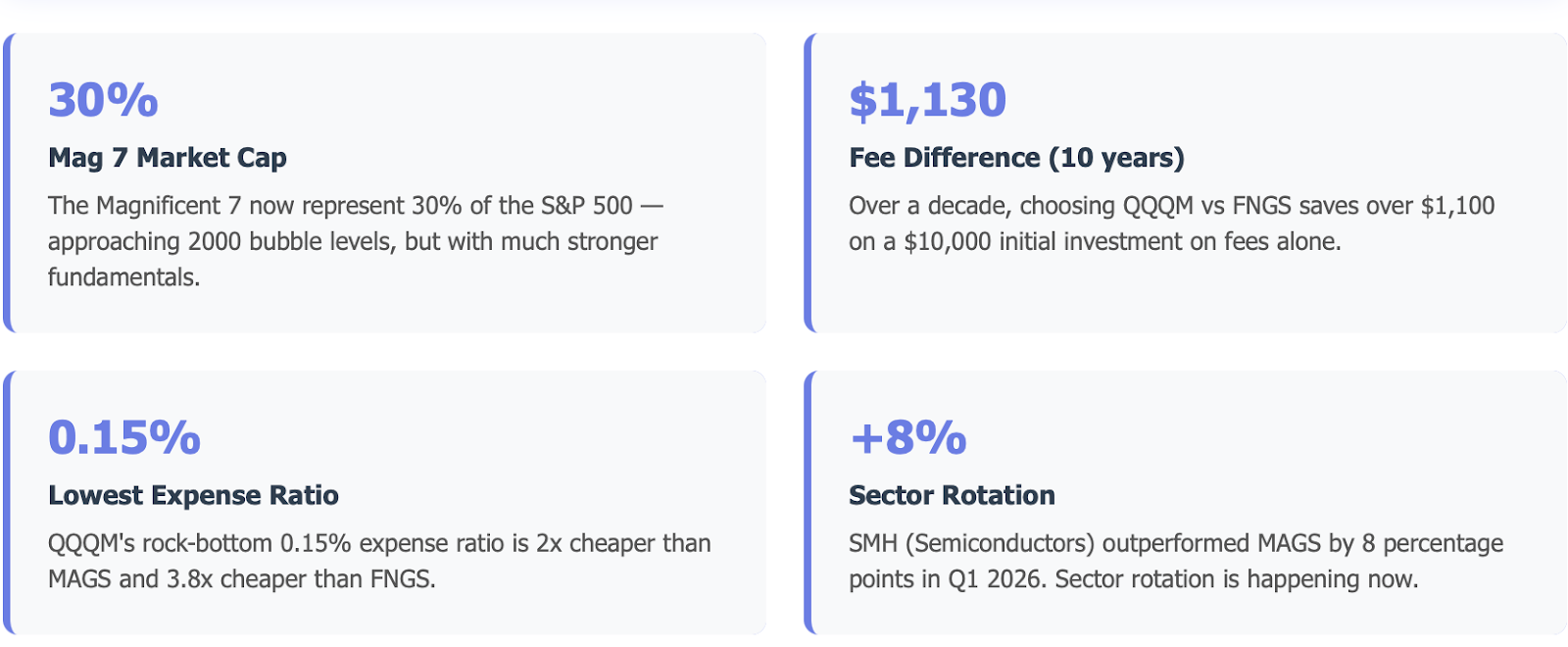
QQQM (Invesco NASDAQ 100 ETF) offers the most diversified portfolio of the three options discussed here. QQQM tracks the entire NASDAQ 100 and includes 100 different companies in comparison to 7 companies or 10-12 companies with MAGS or FNGS, respectively. The Magnificent 7 still make up a significant part of the top holdings within QQQM, but they are a smaller portion of the overall portfolio. The main advantage of investing in QQQM over MAGS or FNGS is the low expense ratio of 0.15%, making it the least expensive long-term investment.
Here's how they stack up:
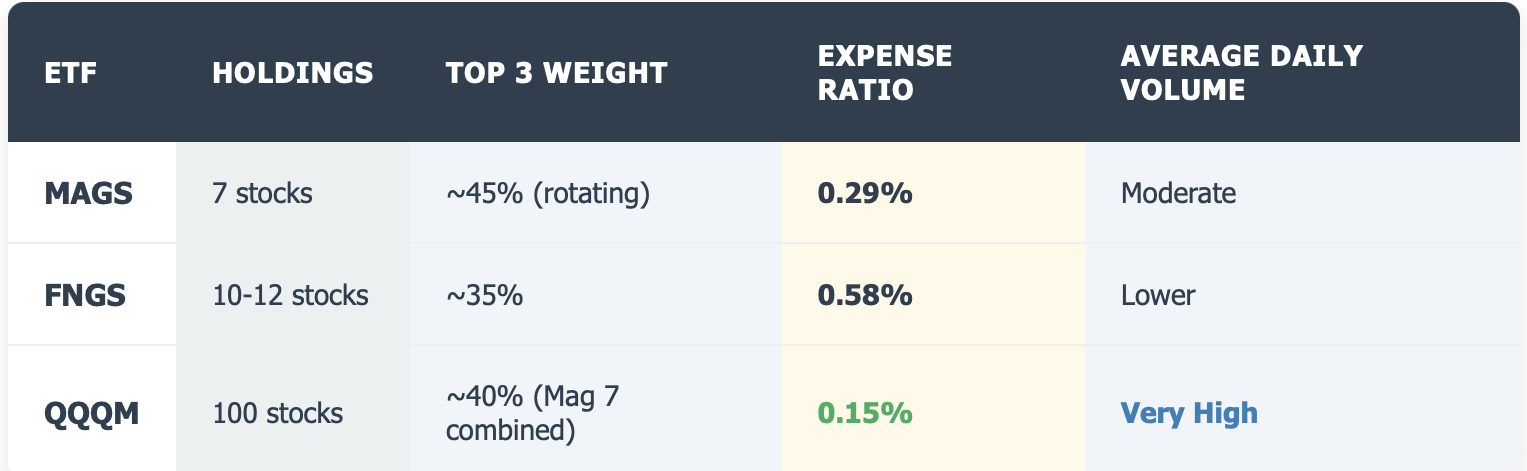
Ultimately, your investment priorities will determine which ETF is the best fit for you. MAGS is a good option if you want to gain pure exposure to the seven largest US companies and think those companies will continue to outperform. On the other hand, if you want a little bit more in terms of diversification but still stay technology-focused, then FNGS would suffice. That said, if you're concerned about concentration risk and keeping fees low, then QQQM would probably be your best option.
One of the things that stood out to me in 2025 was how MAGS was adjusting its weights. MAGS has been adjusting the weights of Nvidia and Tesla following changes in their earnings results and current valuations. For example, Nvidia had a great Q4 2024 earnings report and was temporarily increased before being re-weighted downward again.
As for Tesla, due to its recent declining sales numbers, MAGS has been decreasing the weight of Tesla since early 2026. That being said, this active rebalancing occurs with both the benefits of rebalancing as well as the risks associated with it. When investing in MAGS, you aren't simply buying and holding seven companies; you're also relying on the judgment of the fund management companies to make sound investment weighting decisions.
Why MAGS Keeps Tinkering with Nvidia and Tesla
The primary purpose of an Exchange Traded Fund (ETF) is that it should remain uncomplicated, right? However, this fund (MAGS) does not only purchase (or have) an equal amount of each of the seven stocks and let them run. Instead, the ETF is rebalanced quarterly, with Nvidia and Tesla having been the two companies that have stood out the most in terms of being rebalanced in the ETF during the course of 2026.
To start, let's discuss Nvidia. This stock rocketed up after exceeding earnings expectations in late 2024 and early 2025 due to unprecedented demand for AI-based chips. The increase in demand resulted in an increase in the company's stock price, which subsequently increased its percentage weight in the ETF. However, one of the goals of MAGS is to maintain a relatively balanced weight across all 7 stocks in the fund.
Consequently, the ETF will reduce the allocation of any one stock that has a weight that is disproportionate to that of the other stocks, and redistribute those shares among the remaining 6 stocks within the ETF portfolio. As an example, in the first quarter of 2026, Nvidia's allocation was reduced from approximately 18% back to approximately 14%.
Now let's look at Tesla. Unlike Nvidia, Tesla is facing competition from other companies in the electric vehicle (EV) sector, and its delivery numbers have also disappointed, resulting in underperformance vs. most of its peers. As a result of this, during the same rebalancing period of Q1 2026, Tesla's percentage weight was reduced from approximately 14% to about 11%.
Similar to the case with Nvidia, Tesla's stock was not sold by the ETF Management Team because it is not a good company, as it is still one of the Magnificent Seven companies, but the ETF's rebalancing process reduces the amount of exposure to stocks that underperform while increasing the amount of exposure to those stocks that outperform.
The interesting thing about this scenario is that MAGS has a momentum component to it, unlike a traditional passive index fund. The ETF is in a constant state of selling when a stock is priced high by lowering its allocation of stock that is performing well, and purchasing when a stock is priced low (by increasing its allocation of stock that is not performing well). While this may be a smart approach to managing risk, it may potentially also cause ETF investors to miss out on long-term growth rallies in the event that one company's stock price increases dramatically.
In conclusion, don't become alarmed when you see MAGS rebalance weightings in the stocks. This is the reason MAGS exists; the ETF's investment objective is to maintain a relatively consistent weighting of the seven Magnificent Seven Companies, as opposed to attempting to maximise your returns on just one of the seven companies in MAGS, i.e., investing in only Nvidia or Tesla would be better suited if you bought the respective stock outright.
The Hidden Costs That'll Eat Your Returns
The expense ratio is one factor that influences what it costs to own an ETF; it is not the only one. Actual costs associated with owning an ETF also include the trading spread, how long you hold onto your shares and what the tax impact will be.
An expense ratio is typically the easiest item for investors to understand. For example, QQQM has a 0.15% expense ratio, MAGS has 0.29%, and FNGS has 0.58%. While the differences may appear small at first, they compound quickly.
Let’s assume you invest $10,000 in any of these three ETFs and achieve 10% returns each year for 10 years. Below are the ten-year fee totals.
-
For QQQM: $400,
-
For MAGS: $770,
-
For FNGS: $1,530.
Thus, the difference between QQQM and FNGS equates to over $1,100 based solely on their expense ratios. At a larger level, if you have a $100,000 portfolio, the difference between the expense ratios is $11,000.
In addition to fees, consider liquidity, which is determined by the volume of trade. The greater the number of trades, the greater the likelihood you will be able to buy and sell shares at or around the same time. For example, QQQM has higher volumes of trading than either MAGS or FNGS; therefore, its spreads are smaller than those of either of them.
As a result, you may pay more for shares traded with MAGS than you would if you trade through QQQM. On the other hand, FNGS typically has fewer trades than MAGS or QQQM; therefore, it will have broader spreads depending upon the volatility of the market when trading occurs.
If you are a long-term investor who buys and holds until you decide to liquidate your investment, you will only encounter the trading costs associated with your initial buy and final sell transactions; however, if you frequently trade your shares or rebalance your portfolio, you will incur incremental trading costs.
Another tax-related consideration is that all three ETFs will distribute capital gains and dividends, which are taxable events to the investor regardless of your holding status. In this case, the tax implications are less of a concern when investing in the Magnificent Seven because none of these companies typically pay dividends; however, they are subject to taxation nonetheless. Furthermore, if you are a foreign investor investing in the US market, you will be subject to a 30% withholding tax unless you are buying from a country with which the US has a tax treaty.
In conclusion, QQQM will be less costly than MAGS or FNGS for long-term investments. If you do not have an investment strategy that requires concentrated exposure to the seven listed in respect to MAGS and FNGS, as you will have lower transaction fees due to higher liquidity when compared to MAGS, you are unlikely to be able to outperform QQQM over an extended period of time.
Are We Heading for a 2000-Style Tech Meltdown?
It's an awkward question nobody wants to have to ask themselves: Is the outstanding Magnificent 7 rally simply another form of the dot-com bubble?
The data here is troubling to say the least! In January of 2026, the Magnificent Seven consisted of roughly 30% of the overall market capitalisation in the S&P 500. This is an unbelievable amount of market capitalisation connected to only seven companies. Back in 2000, at its highest point, the technology sector made up about 35% of the index before it declined significantly. This number isn't that far off from today.
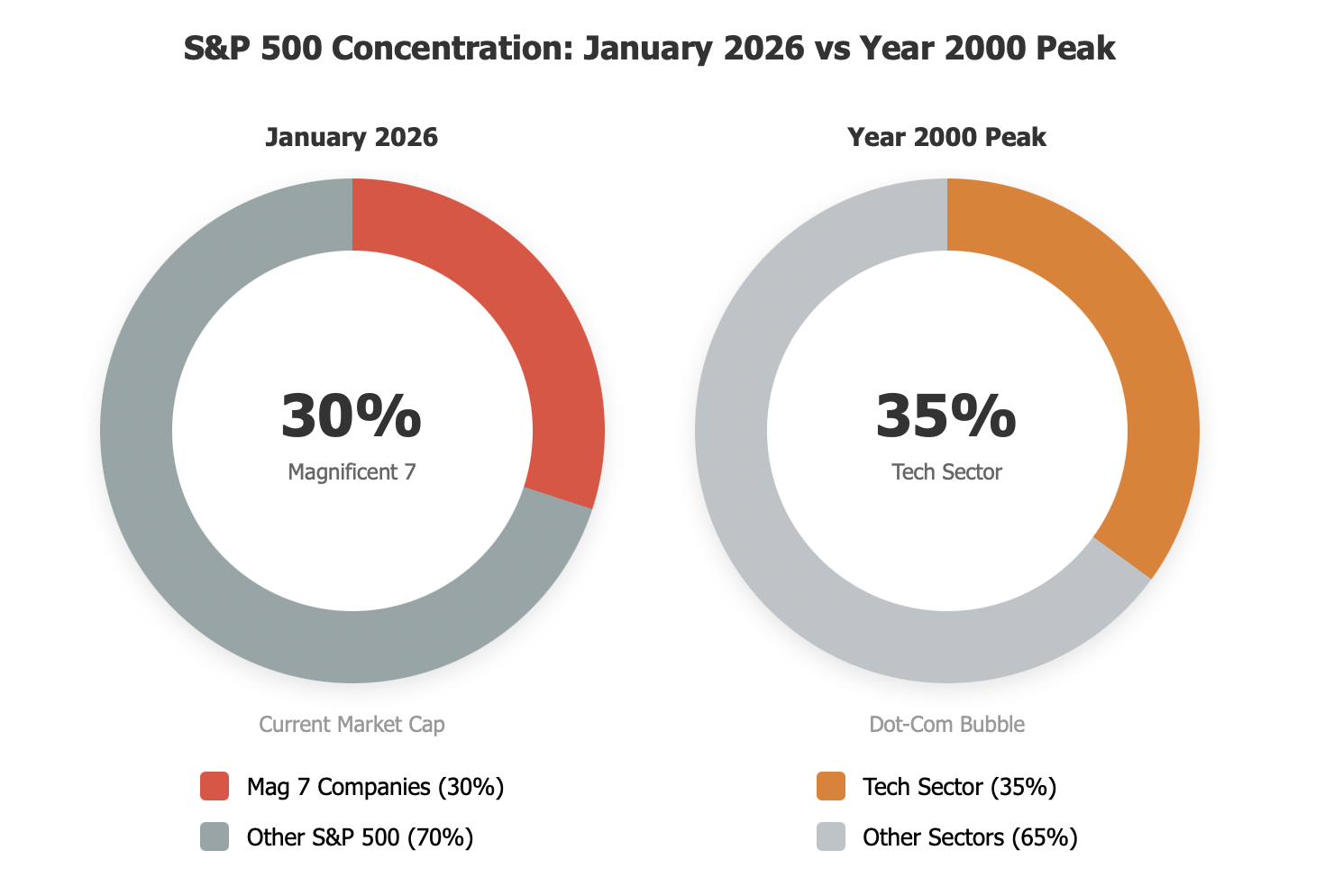
However, and this is a big however, the two times are very different from each other from a fundamentals perspective. In 2000, the valuation of all companies was based on eyeballs and clicks and not cash flow or profits. Pets.com was valued at billions of dollars even when the company was losing money on each product sold.
Today, all of the technology giants, i.e. Apple, Microsoft, and Alphabet, are making money, with Apple being one of the most profitable companies globally. Although Tesla and Meta have challenges as well, both companies are still doing well from an overall profitability perspective.
On the other hand, their valuations have clearly become overstated, especially with Nvidia trading with an expected P/E of 30-35x and with both Apple and Microsoft having P/E ratios around mid-20s. While these multiples aren't at the levels experienced during the bubble in 2000, they are also not cheap. If companies begin to see lower earnings growth in the upcoming years, or interest rates remain elevated for an extended period of time, there is legitimate risk for these companies and their shareholders to see declines.
Concentration risk is a concern, too! If any two or three of the Magnificent Seven experience issues, this could affect the entire S&P 500. We already saw this happen in early 2026 when Tesla's results were below some analysts' expectations, and fears of iPhone future sales were expressed, thus contributing to a broader market decline.
Does this mean you should completely avoid the tech-related ETFs? Not necessarily, but you should at least consider diversifying away from technology to help safeguard your investment portfolio from a massive decline. For instance, pairing an ETF like MAGS or QQQ with a defensive position, such as energy-related or value-related ETFs, or with some form of international exposure, would be an effective investment strategy. Regardless of how gold-plated the eggs look today, don't put all your eggs in the technological basket!
Beyond MAGS: The Next-Gen ETFs That Could Steal the Crown
Is the dominance of the Magnificent Seven already starting to wane? In 2026, we see the early stages of a rotation between sectors as more and more money flows into AI Infrastructure, semiconductors that do not include Nvidia, and mid-cap growth companies that still have plenty of room to grow.
The SMH (VanEck Semiconductor ETF) has outperformed by a wide margin. While it includes Nvidia, the SMH ETF gives you access to TSMC, ASML, AMD, and Intel, all of which are making the hardware that makes artificial intelligence possible. The SMH had an almost eight percentage point return advantage over the MAGS in Q1 2026, which demonstrates that the semiconductor narrative is about far more than one company.
We should also continue to monitor mid-cap growth ETFs such as VOT and IJH. The mid-cap focused ETFs include companies with a total market capitalisation (market cap) between two billion dollars and ten billion dollars. This market cap puts them in a position where they are large enough to generate stable profits but small enough to continue to have explosive growth potential. Even in the later stages of an advancing bull market, mid-cap companies tend to generate better returns than do the Magnificent 7.
The problem with the Magnificent Seven is that they are so large that it is becoming increasingly challenging for them to achieve double-digit rates of growth each year. Apple will need to find an additional several hundred billion dollars in new revenue to have any impact on its stock price. A mid-cap company can double its market capitalisation with a moderate amount of revenue growth.
Tesla is facing increased competitive pressure from traditional automobile manufacturers in the growing Electric Vehicle market. Apple has encountered numerous growth challenges within both its hardware business and services business. NVIDIA may be the leading supplier of chips for artificial intelligence, but it will soon face increased competition from AMD and the custom chip designs of Amazon and Google, as well as geopolitical issues in Taiwan.
This does not mean abandon the MAGS and purchase everything else. Rather, this suggests investors need to think about whether 100% technology exposure still makes sense or whether diversifying into new technology leaders could generate better risk-adjusted returns.
The Lazy Investor's Dream: Why One ETF Might Be Enough
Most people do not want to spend hours researching individual stocks, rebalancing their portfolios over time, and attempting to time the market. All they want is simply to gain exposure to the best companies in the world, without having to think about it very much.
One way that MAGS or QQQM excels as a minimalistic investing strategy is that it offers all of these things:
-
Automatic rebalancing four times per year
-
An investment in seven extremely dominant companies across their respective industries
-
No need to worry about picking stocks, as they have already been pre-selected for you
-
Built-in diversification within technology, all companies contained within this strategy are in a different sector within technology
If you were to invest in seven individual stocks, you would have to:
-
Decide how much to invest in each stock,
-
When to rebalance those stocks,
-
How to handle the tax consequences of your investments, and
-
If and when to sell those stocks when a company has a bad quarter.
Most DIY investors have no idea how to make those types of decisions, and therefore typically underperform because they usually sell when they shouldn’t have, or they let their winning stocks run too long while their losing stocks continue to drag them down.
If you used dollar-cost averaging to create a MAGS position from 2023-2025, your position would have grown substantially without having to think about when to invest or what type of strategy you should employ – all you would have done is continuously purchased the same amount every month, and the automatic re-balancing of the ETF would have taken care of the rest of your investments.
The expense ratio for this strategy is .29%, which is basically the "lazy fee" – you are paying someone else to handle all of the rebalancing and weighting decisions for you. Most investors feel that it is well worth the cost, as they would have made many more costly mistakes in managing their own investments.
For those who would like even lower fees and even further diversification, QQQM would also offer a ‘lazy’ investment with 100 companies instead of just 7 companies. Either way, the goal is to obtain one-ticker exposure to technology without all of the work.
The Verdict: Which ETF Deserves Your Money in 2026?
What is the best ETF for the Magnificent 7? The answer to that question depends entirely on your objectives for buying an ETF.
If you are looking for concentrated, pure exposure to only the seven largest companies, you believe they will remain dominant and can tolerate the associated risks, MAGS is your choice. It also comes with a .29% fee.
If instead you want significant technology-based exposure to a broader range of companies than just the Magnificent 7, but you also want to keep your costs down and plan on holding your investment long-term, your best choice is QQQM.
If you want exposure to the FANG concept with a greater number of companies that exhibit growth, FNGS is the right fund for you. It may be challenging to justify purchasing this fund based on the higher fees associated with investing in technology.
If you are an average investor, most likely your best choice is QQQM. It provides for large exposure to the Magnificent 7 in terms of size; however, there are an additional 93 other companies in the index that help mitigate concentration risk. Additionally, QQQM has an extremely low fee on the expense ratio at .15%.
If you are very excited about investing in only these seven companies, MAGS will provide that for you. Keep in mind that you are taking on greater risk in exchange for possessing only the seven companies.
The more relevant question to ask is not which ETF is better, but whether investing so much in large-cap technology stocks is a good idea. Given how expensive large tech companies are historically and the concentration of investing in technology stocks at or near historic highs, investors should consider building a balanced portfolio that contains both growth and defensive investments in 2026.
If you are ready to begin trading MAGS, QQQM or want to trade leveraged technology ETFs, when you trade with TradeWill, you can do it with confidence, regardless of whether you dollar cost average or utilise market timing.
Disclaimer: The content of the blog does not represent any position of Trade W, does not serve as any trading-related decision advice, and does not endorse any third-party.