
 Trade W

The topic of offshore forex brokers has been debated for many years. Much of the available content focuses primarily on whether offshore brokers are safe or dangerous, often overlooking the broader context of how these firms operate. As a result, many traders make decisions based on marketing claims rather than developing an understanding of how the forex industry functions in practice.
The forex market is a global, decentralised marketplace with no single central governing authority. Consequently, offshore brokers are not only a persistent feature of the industry but continue to emerge as a natural result of the market's structure. Developing an informed perspective on offshore brokers requires moving beyond simplistic assumptions and examining the underlying mechanics of brokerage operations, including liquidity routing, execution models, and overall business architecture. These factors can have a significant impact on a trader's experience and outcomes and are often just as important to evaluate as a broker's regulatory status.
Why Offshore Forex Brokers Exist
Offshore brokers were not created solely as a means for companies to avoid responsibility or oversight. Rather, they exist largely because financial regulation is fragmented across different jurisdictions and regulatory environments around the world. Understanding this distinction is an important first step in selecting a broker that aligns with your trading objectives and requirements.
Major economies such as the United States, the European Union, and the United Kingdom have implemented stringent regulatory frameworks, including leverage restrictions and enhanced compliance requirements. These measures were introduced primarily to address domestic policy objectives and consumer protection concerns rather than to solve a global regulatory challenge. As a result, while regulations have become stricter in many developed markets, the demand among retail traders for higher leverage, broader product access, and greater trading flexibility has not disappeared. Instead, this demand has contributed to the continued presence and growth of offshore brokerage jurisdictions that offer alternative regulatory frameworks and trading conditions.
The difference in leverage limits between brokers regulated by the CFTC and those operating under ESMA regulations is both clear and significant. CFTC-regulated brokers generally allow retail clients to access leverage of up to 50:1 on major forex pairs. By comparison, retail clients under ESMA regulations are typically limited to leverage of 30:1. At the same time, demand for higher leverage remains strong in many regions, particularly across Asia, South America, the Middle East, and Africa, where leverage ratios of 200:1, 500:1, or even higher are commonly sought by retail traders. When traders are unable to access their preferred leverage levels through ESMA-regulated firms, some choose to open accounts with brokers operating in jurisdictions that legally permit higher leverage.
Jurisdictions such as Vanuatu, Seychelles, Saint Vincent and the Grenadines, Belize, and the Cayman Islands have established licensing frameworks that generally involve lower capital requirements and fewer compliance obligations than those imposed by many tier-one regulators, such as those in the United Kingdom or the United States. This enables brokers licensed in these jurisdictions to offer services to a global client base while operating with lower regulatory costs than brokers regulated in more stringent jurisdictions. As a result, a parallel segment of the global brokerage industry has emerged, serving traders who seek different trading conditions while operating alongside, rather than directly in conflict with, heavily regulated markets.
Brokers also utilize offshore structures for practical business reasons, including faster client onboarding, lower operating costs, and access to larger international markets through more flexible product offerings. These advantages are often made possible by operating within regulatory environments that are less restrictive than those found in the jurisdictions where many of their clients reside.
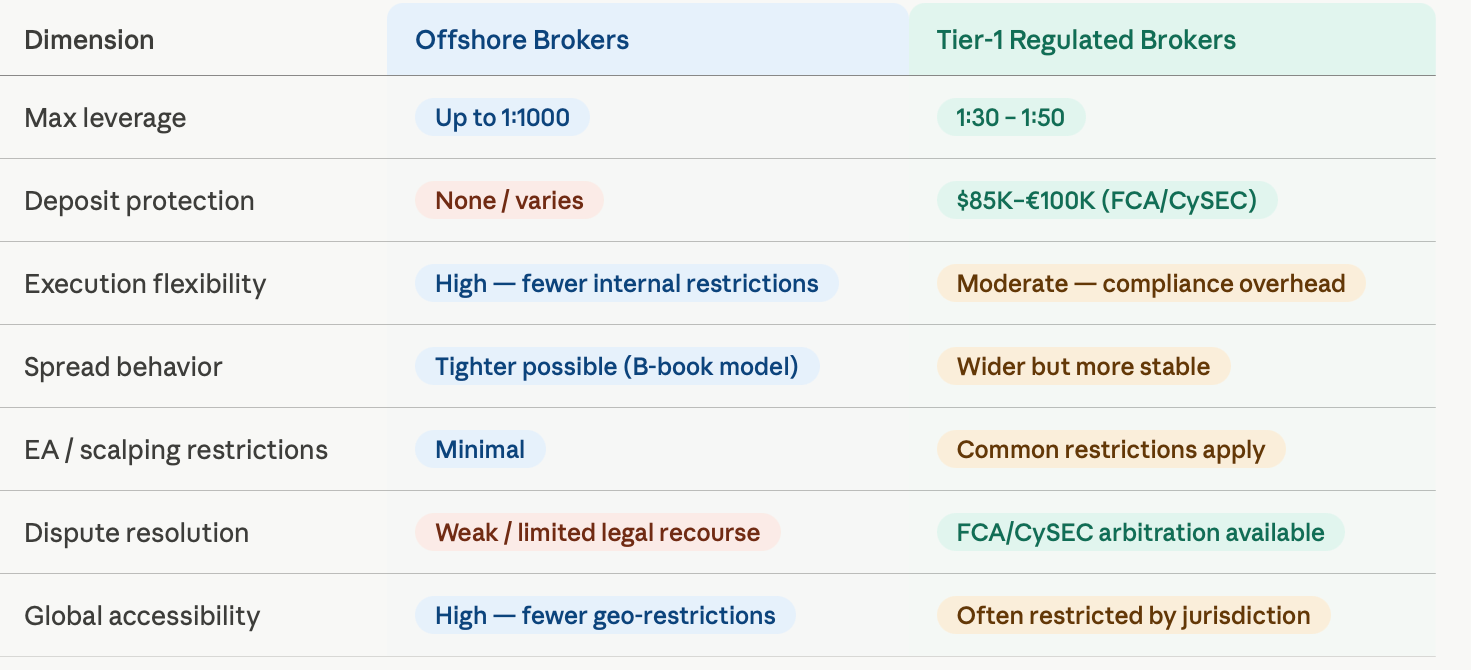
While this is not inherently beneficial or detrimental to traders, it does alter the way broker risk should be evaluated. As a result, broker comparison articles that focus exclusively on regulatory jurisdiction may fail to capture the full picture. Factors such as execution quality, financial stability, client fund handling, operational transparency, and overall business practices can be just as important as regulatory status when assessing the risks associated with a particular broker.
How Regulatory Arbitrage Actually Works Inside Broker Architecture
Many traders have a habit of viewing brokers as a single legal entity that is either “regulated” or “not regulated.” However, brokers are actually made up of many different parts, and understanding this will change the way you evaluate any broker you are considering working with.
Almost all major Forex brokers are large companies with many different legal entities operating in many different countries and offering many different types of services. An example of a multi-entity Forex broker would be a company that has a large global brand that is well known to traders and is regulated in Cyprus, the United Kingdom, or Australia, but also has an offshore entity located in Seychelles or Vanuatu for traders wanting higher levels of leverage and fewer restrictions on their trading products, and uses a separate, regulated prime broker to provide liquidity and trade execution across both structures.
This multi-layered corporate structure is entirely legitimate and is designed to operate across multiple regulatory jurisdictions simultaneously, a practice commonly referred to as regulatory arbitrage. When an individual opens an account with a broker through an offshore entity, they are generally operating within a recognised legal and regulatory framework, although the protections available to clients may be more limited than those provided under a tier-one regulatory regime.
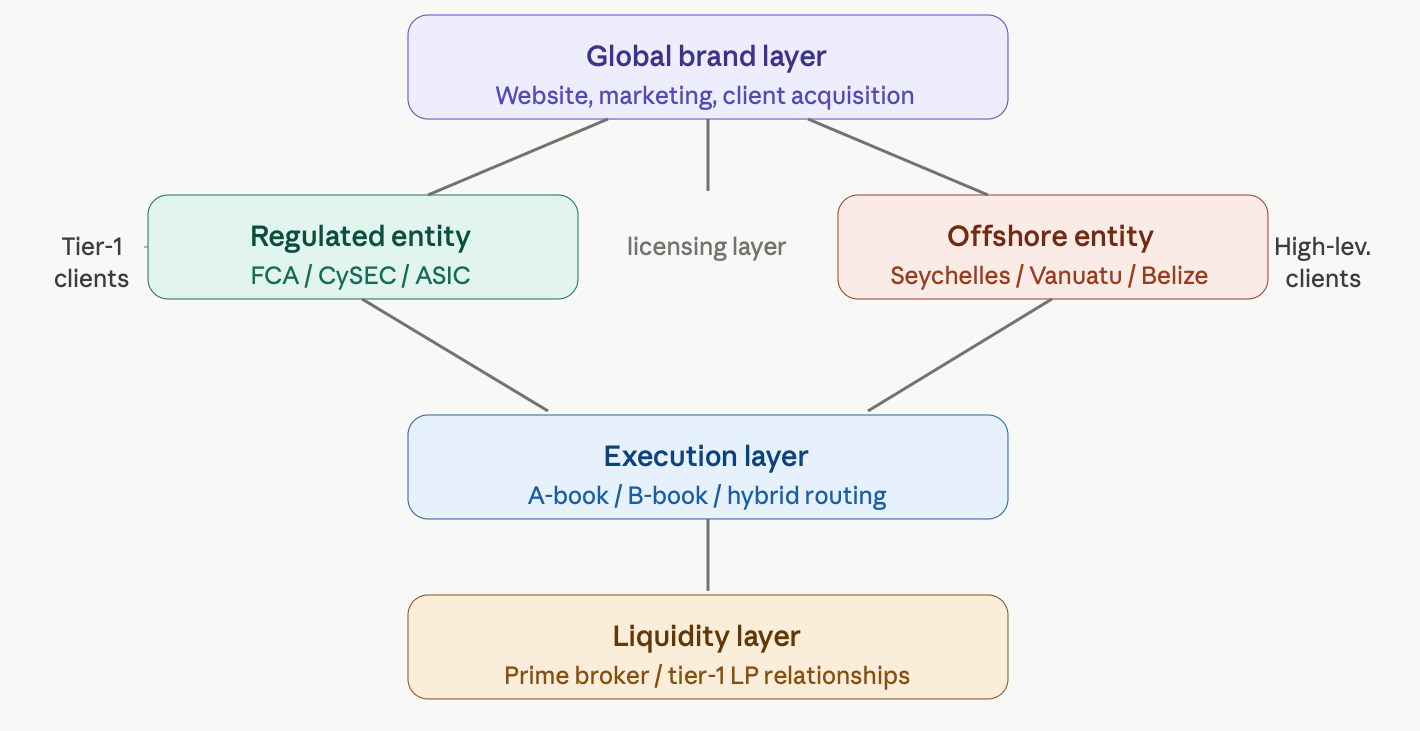
Once this distinction is understood, the key question shifts from "Is this broker legal?" to "If I am dealing with an offshore broker, what level of protection and recourse is available to me?" This approach encourages traders to focus on practical considerations such as client fund protection, dispute resolution mechanisms, financial transparency, and the broker's operational track record rather than relying solely on the location of its regulatory license.
Traders who wish to better understand how decisions made by global monetary authorities can influence forex markets, and why broker jurisdiction may become increasingly important during changing market conditions, may benefit from studying topics such as quantitative easing, interest-rate policy, and their effects on FX market liquidity and execution risk. A solid understanding of these factors can provide valuable context when evaluating different categories of brokers and the risks associated with each.
Execution Reality: Where Offshore Brokers Actually Differ
The main difference between the offshore and regulated brokerage models comes in how execution is handled; however, this part of the debate isn't covered well by most brokers in their marketing materials. The quality of trade execution determines the price at which you transact an execution order. The price at which you buy or sell is influenced by the broker's internal risk controls (of which there are many), liquidity aggregation models, and exposure management techniques for client positions.
While some regulated brokers are overseen by Tier 1 authorities, they usually have more stringent compliance requirements, meaning that their execution policies are generally more conservative than those used by many offshore brokers and are slower to adapt to market changes. Depending on market conditions, offshore brokers have more flexibility in how they route and execute trades, resulting in faster execution during periods of stable market movement but greater variance when the market becomes highly volatile.
Differences in broker structure often lead to differences in spreads, as each broker aggregates liquidity, manages risk, and determines how much exposure it is willing to assume on its own balance sheet. Brokers that internalize a significant portion of client order flow through a B-book model can sometimes offer tighter spreads during stable market conditions because they do not need to route every transaction through external liquidity providers or maintain full prime brokerage coverage for every trade. Instead, they may take the opposite side of certain client trades and generate revenue from spreads and client trading activity.
However, a lower spread does not automatically translate into a better trading experience. While one execution model may offer cost advantages under certain conditions, execution quality depends on a variety of factors, including liquidity access, order-routing efficiency, risk management practices, and market conditions. As a result, traders should evaluate not only pricing but also the underlying structure that produces that pricing.
Understanding how different broker risk models operate is therefore an important part of broker analysis. Our examination of algorithmic execution systems and real-world case studies demonstrates why execution infrastructure is a critical consideration for algorithmic and high-frequency traders who depend on fast execution speeds, low latency, and consistent fill quality. For these traders, a broker's execution environment is not merely a background service, it is an integral component of the overall trading strategy. Consequently, developing a thorough understanding of execution infrastructure can provide valuable insight into the strengths and limitations of different broker models.
Dismantling the Binary Safety Narrative
Traders put themselves at a significant disadvantage by giving in to the intellectually simple view that “regulated firms are safe” and “offshore firms are risky.” Broker risk consists of multiple variables that are best understood within a multi-dimensional framework. Jurisdictional, execution, counterparty, liquidity, and operational risks can each fail independently of one another; as such, all must be considered when assessing the overall risk associated with a particular broker.
Just because a broker is licensed by the FCA does not guarantee that they will provide the trader with one hundred percent reliable execution. An offshore broker can, in fact, provide highly reliable execution and efficiently process withdrawal requests if it operates a disciplined internal risk management model and maintains adequate capital.
In general terms, traders should evaluate how reliably the broker processes withdrawal requests, how its execution performs during high-impact news events, whether it operates A-book or B-book models and how it determines which account type a trader receives, and what dispute resolution mechanisms exist to protect both the trader and the broker if something goes wrong.
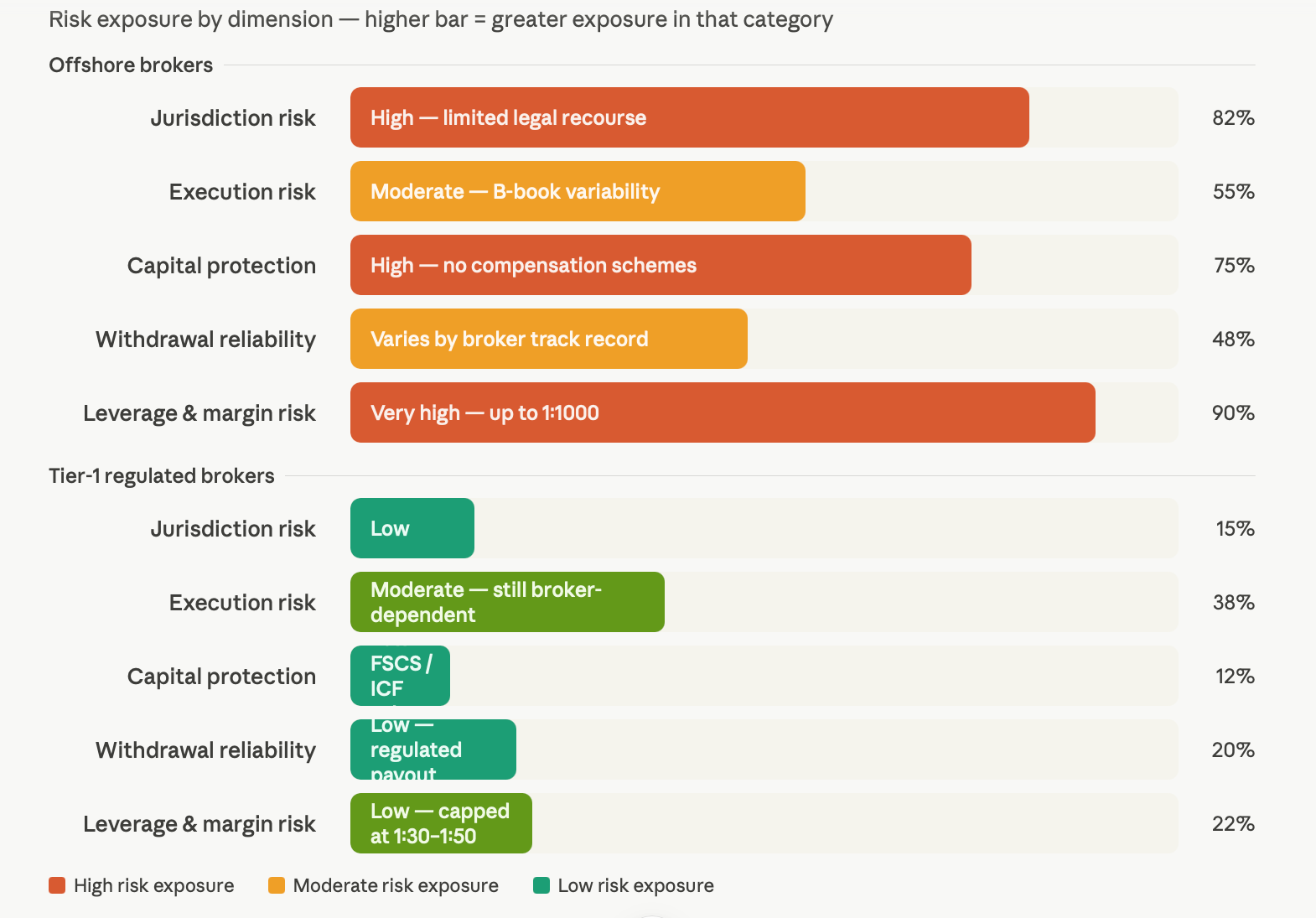
Many historical events illustrate this principle. One notable example was the decision by the Swiss National Bank to remove the EUR/CHF exchange-rate peg in January 2015. The resulting market volatility caused severe disruption across the forex industry, leading to significant losses for several brokers and triggering widespread margin-call cascades. In many cases, traders incurred substantial losses due to execution and liquidity challenges rather than failures of the regulatory framework itself. This event demonstrates that regulatory oversight is only one component of the broader risk-management equation.
Dispute-resolution mechanisms and regulatory jurisdiction play an important role in trader protection, but they represent only one layer of overall risk management. Traders who evaluate a broker solely on the basis of its regulatory jurisdiction may overlook other critical factors, including liquidity access, execution quality, capital adequacy, and operational resilience during periods of extreme market stress.
To better understand how central-bank decisions can create market conditions that challenge broker execution models, it can be valuable to study topics such as the role of central banks in the forex market and the use of Federal Open Market Committee (FOMC) meeting minutes as trading indicators. A deeper understanding of these macroeconomic forces can help traders make more informed decisions when selecting brokers and managing risk during periods of heightened volatility.
The Trader Profiles That Actually Use Offshore Brokers
The success of many offshore brokers can be attributed, in part, to their ability to target specific segments of the trading community whose needs may not be fully addressed by more heavily regulated brokerage environments. Traders seeking particular products, trading conditions, geographic accessibility, or operational flexibility often find offshore brokers appealing. Understanding the types of traders these firms serve can provide valuable insight into the role offshore brokers may play within different trading strategies.
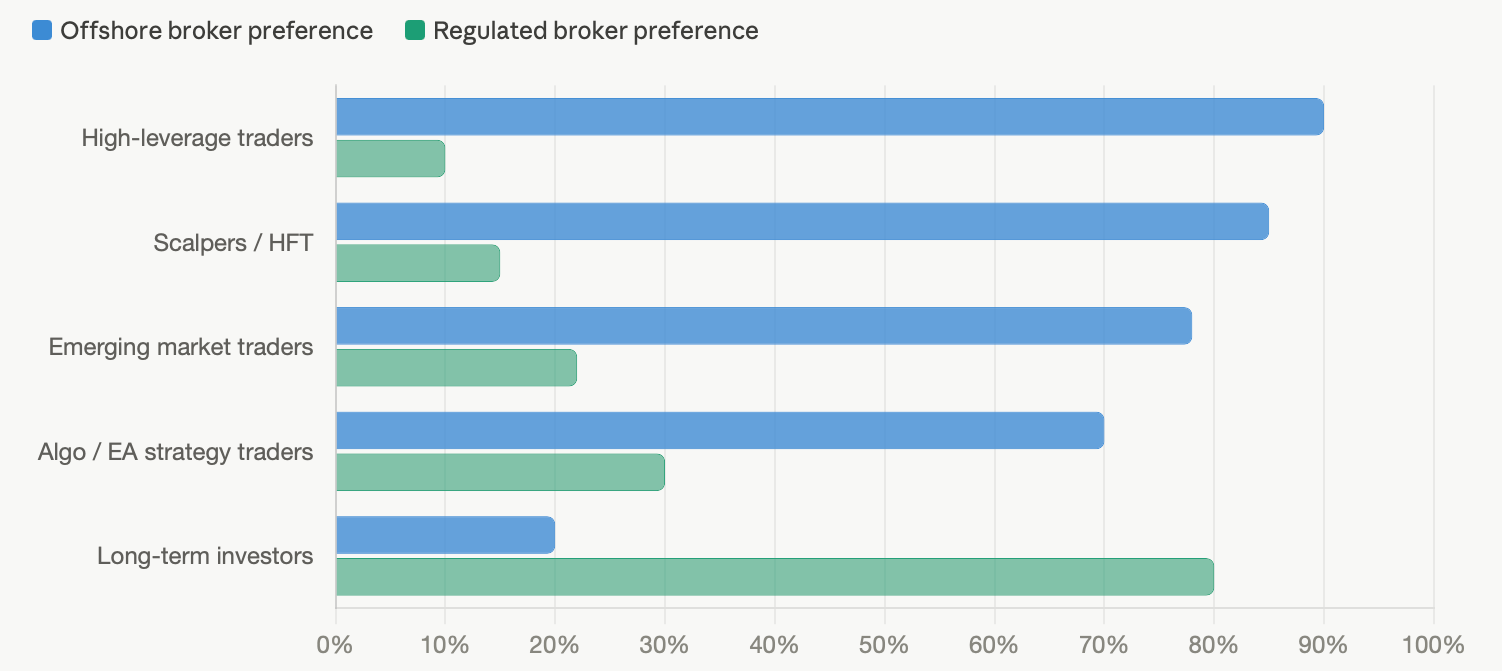
One of the largest client segments served by offshore brokers is the high-frequency scalping community. Scalpers typically require extremely tight spreads, rapid execution speeds, and minimal restrictions on trading activity. Because scalping strategies often generate a high volume of transactions and depend on small price movements, execution quality and transaction costs can have a significant impact on overall profitability.
Some regulated brokers impose trading restrictions or risk-management controls that may limit certain forms of high-frequency trading activity. As a result, traders whose strategies rely heavily on rapid execution and unrestricted order flow may seek brokers that offer conditions more closely aligned with their trading requirements.
For active traders, understanding the components of trading costs, including spreads, commissions, slippage, and execution quality, is essential. A comprehensive evaluation of bid-ask spreads and their impact on trade outcomes can help traders better assess whether a broker's trading environment is suitable for their specific strategy and performance objectives.
Automating traders' strategies causes them to lean toward offshore brokerages, as they usually allow automated trading using expert advisors and provide greater access to hedging strategies, while also offering an execution model that permits automated strategies to operate correctly. Ultimately, our tutorial will show you how these automated strategies work and how to select a broker that is aligned with your strategy.
The Trade-Off Matrix That Most Comparisons Skip
All broker models involve trade-offs, yet many broker comparison articles incorrectly assume that these trade-offs can be eliminated or that one broker model is inherently superior to another. In reality, neither assumption is necessarily correct. Every brokerage structure offers certain advantages while requiring compromises in other areas, whether those relate to regulation, leverage, execution quality, product availability, costs, or client protections.
As a result, the primary consideration should not be determining which broker type is universally "best." Instead, traders should focus on identifying which set of trade-offs aligns most closely with their trading objectives, strategy, risk tolerance, and ability to manage risk effectively. A broker that is well suited to a high-frequency scalper, for example, may be entirely inappropriate for a long-term investor, just as a broker designed for maximum regulatory protection may not meet the needs of traders seeking greater flexibility or higher leverage.
Ultimately, broker selection is less about finding a perfect solution and more about choosing the option whose strengths and limitations best match your individual trading requirements.
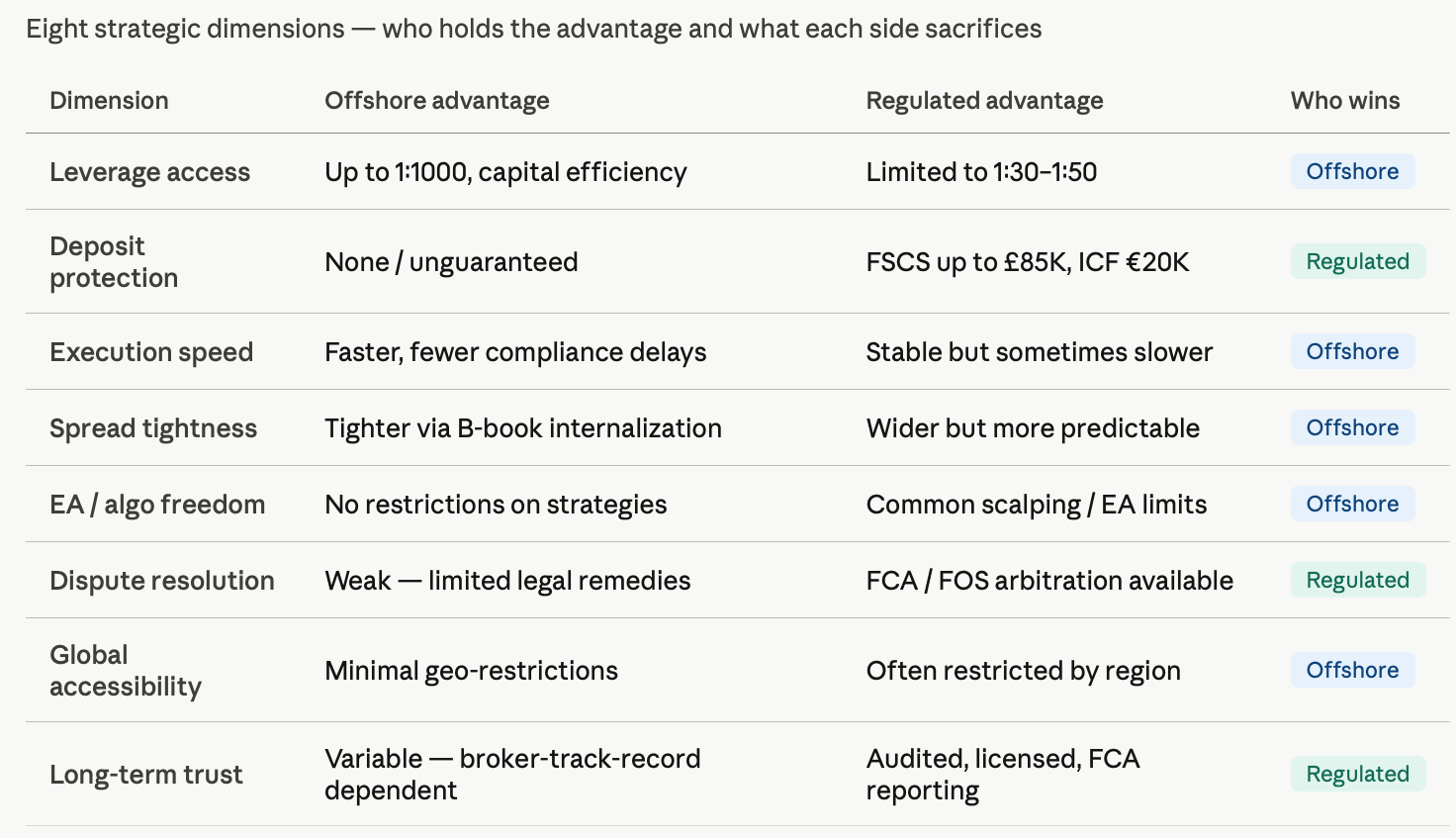
To provide greater capital efficiency, broader global accessibility, and increased operational flexibility, offshore brokers typically operate within regulatory frameworks that offer lower levels of investor protection, less predictable dispute-resolution processes, and varying standards of broker risk management. In contrast, regulated brokers are generally required to provide higher levels of consumer protection, legal recourse, and operational transparency. As a result, they must operate within stricter regulatory constraints than their offshore counterparts. These constraints often include lower leverage limits, restrictions on certain products, and execution systems designed to comply with regulatory requirements rather than prioritize maximum flexibility or speed.
There is no universally superior brokerage model, nor is there a single answer to the question, "Which broker offers the most protection?" A more useful question is: "Which broker's trade-off profile provides a level of risk that is appropriate for my trading style, objectives, and risk tolerance?" The answer will vary depending on the trader. Factors such as leverage requirements, preferred markets, execution needs, regulatory preferences, and account size all influence which brokerage model may be most suitable.
For traders interested in understanding how broader economic forces influence market behavior and, by extension, their trading experience, it can be valuable to study the effects of fiscal and monetary policy on financial markets. These macroeconomic factors play an important role in shaping conditions across both forex and equity markets and can affect everything from volatility and liquidity to execution quality and risk management considerations.
What Brokers Actually Compete On: It's Not Their Regulatory Label
While "offshore versus regulated" is a popular topic at the marketing level, competitive dynamics within the brokerage space are not driven by the type of licence held by the broker (i.e., FCA/UK, Seychelles FSA, etc.). Instead, brokers primarily compete in three key areas: the design of their internal risk engines (internal risk and hedging), the depth of their liquidity aggregation, and their modelling and segmentation of client behaviour with the potential to enhance profitability. All three of these variables have nothing to do with whether a broker holds an FCA or Seychelles FSA licence.
The primary driver of a broker's risk engine is how it allocates risk internally in relation to its external hedging with prime brokers or its ability to hedge through third-party liquidity providers, such as banks. A broker with predominantly B-book client flow (statistically betting on retail clients to lose) earns profit through the spread by internalising order flow (eliminating the need to pass trades to a prime broker), because the majority of its clients' trades are ultimately "closed" at a profit to the broker. Conversely, an A-book broker hedges all sizeable positions with an external party by using either a prime broker, a third-party liquidity provider, or a combination of the two, thus earning profits through both the spread and commissions without needing its clients to close trades at a loss.
In addition, although most brokers operate a hybrid model that combines elements of both approaches and segment clients based on their trading behaviour, routing them through the most appropriate execution mechanism, this practice is common among both offshore and regulated firms.
The quality of execution a broker can provide is heavily influenced by the depth of its liquidity aggregation network, as both quoted prices and trade execution quality are derived from the broker's relationships with prime brokers, banks, and liquidity providers. In some cases, a large offshore broker with substantial capitalization and strong tier-one prime brokerage relationships may be able to offer tighter spreads and higher-quality execution than a smaller regulated broker with more limited access to liquidity. As a result, execution quality is not determined solely by a broker's regulatory jurisdiction.
For traders seeking a deeper understanding of how market structure influences execution and risk management, studying currency pair correlations can provide valuable insights. Correlation analysis can help traders evaluate portfolio exposure, hedge risk more effectively, and better understand how movements in one market may affect positions in another.
Similarly, understanding how derivatives are used in broker risk management and product design can provide important context when evaluating brokerage firms. As offshore brokers continue to expand beyond traditional spot forex products and offer a broader range of derivative instruments, knowledge of these underlying structures becomes increasingly relevant for traders seeking to assess both execution quality and overall broker risk.
An important takeaway for traders is that there are no simple broker labels that automatically indicate execution quality or guarantee reliable withdrawal processing. A broker's regulatory jurisdiction or business model alone does not determine how effectively it will meet your trading needs. To properly evaluate a broker, traders should examine its corporate structure, liquidity sources, execution model, historical performance during periods of market stress, track record in handling withdrawal requests, and the experiences of traders who employ similar strategies.
This evaluation process is more comprehensive than simply verifying whether a broker holds a license from a well-known regulator. However, it provides a much deeper understanding of the broker's operational strengths, weaknesses, and suitability for your specific trading requirements.
The forex brokerage industry in 2026 is more complex and segmented than ever before. The continued growth of offshore brokerage firms, the increasing sophistication of regulatory arbitrage strategies, and the expanding range of products available across both regulated and offshore platforms have created a diverse and highly competitive marketplace. Traders who approach broker selection with an overly simplistic perspective may overlook both the genuine risks and the potential advantages associated with different brokerage models.
A sound broker-evaluation framework begins with identifying your specific trading objectives and requirements. From there, you can determine which types of brokers are best suited to those needs and then evaluate individual firms based on factors such as execution quality, capitalization, liquidity access, operational history, risk-management practices, and client experience. Regulatory jurisdiction remains an important consideration, but it should be viewed as one factor among many rather than the sole determinant of broker quality or suitability.
TradeWill gives you transparent execution infrastructure and institutional-grade liquidity access, built for traders who evaluate brokers the same way they analyze markets, with evidence rather than assumptions. Explore TradeWill's trading conditions and see how the structure holds up under scrutiny.
Disclaimer: The content of the blog does not represent any position of Trade W, does not serve as any trading-related decision advice, and does not endorse any third-party.