

 Trade W
Introduction
The term "Black Swan" emerged from Nassim Nicholas Taleb's very popular book The Black Swan. Prior to the discovery of Australia, everyone thought that all swans were white. The discovery of fresh water black swans startled the world. This is an example of how limited rare events can overturn everything we think we know.
Black Swan events in forex trading are important occurrences. They come out of nowhere. They can upend entire markets. They can wipe trading accounts out in moments.
Picture a scenario involving a sudden thunderstorm. You check the weather. It says sunny all day. You plan a picnic. Then dark clouds appear seemingly from nowhere. A rainstorm comes and ruins everything. This is what Black Swan events do (or can do) to forex markets.
A great example of this is the COVID-19 pandemic in 2020. Nobody saw that coming. Stock markets crashed. Currency pairs went haywire. The US dollar first weakened then strengthened. The price of gold went up. The price of oil went negative. Traders all over the world lost millions.
This article will provide information on Black Swan events. I will explain what they are, provide real examples from history, explain why the predictive computer models didn't help, and explain how trader psychology exacerbates these events. Most importantly, I will explain how to protect your trades.
Black Swan events will always exist. They are impossible to predict. But you can prepare for them! Smart risk management can save your trading account and you can even profit when others are panicking.
Definition & Characteristics
A Black Swan event has three important characteristics: it is rare, it has a huge impact, and people concoct explanations to make it appear less rare after it happens.
Think of a Black Swan event as something that has a low probability of happening but conveys a high impact. For the majority of days in Forex, the market moves in predictable ways with currency pairs tracking technical patterns and creating expected reactions to economic news. Then a Black Swan occurs and the entire market has changed in minutes!
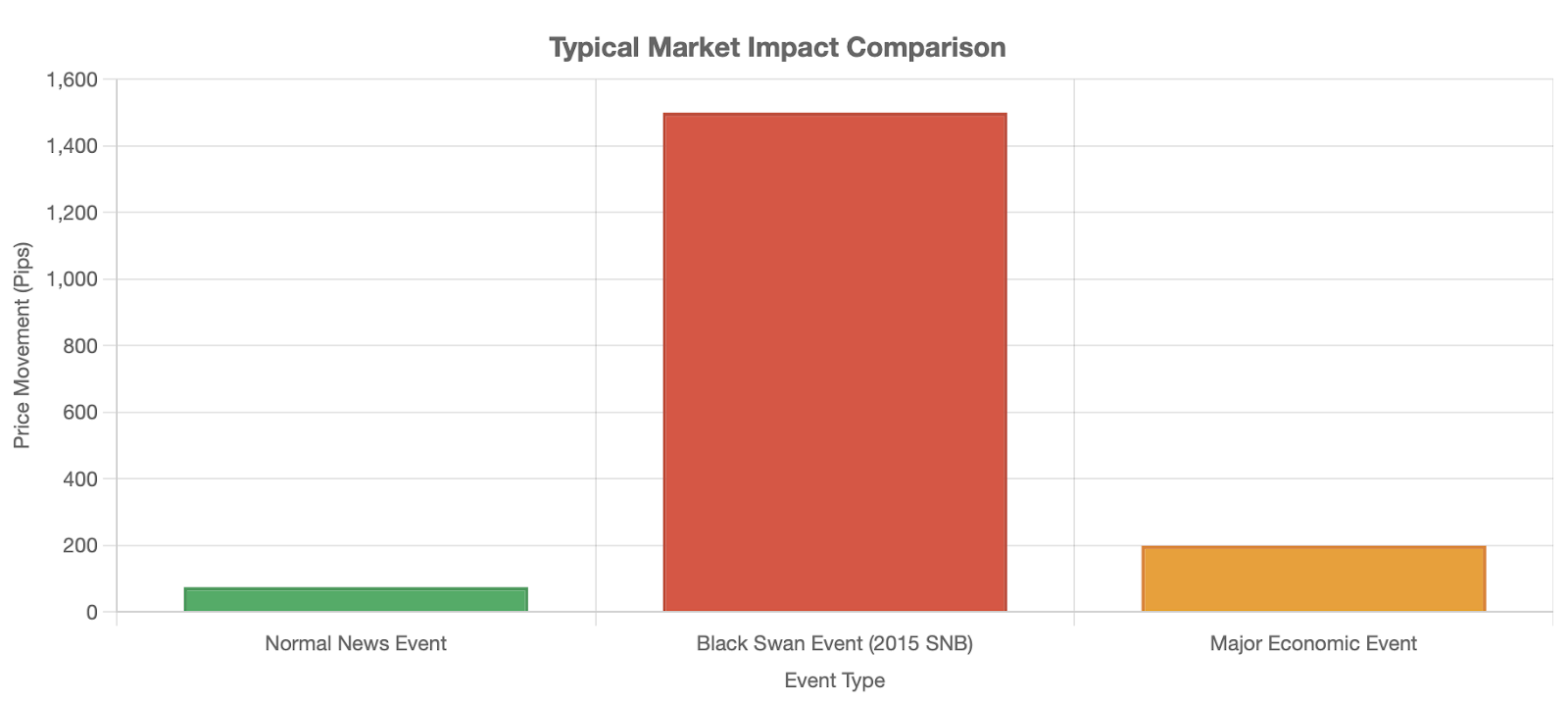
The rarity factor means these events are not happening all of the time. You will probably see one every two or three years, and some traders go their entire careers—without experiencing a major one. This rarity becomes part of the risk of Black Swan events, and make would be risk-takers ignore the risk, thinking "it won't happen to me!"
The magnitude of the impact is what makes them dangerous. A normal news event would move a currency pair by 50-100 pips. A Black Swan event can move the same currency pair by 500-1000 pips, or more, in a single day. In fact, the Swiss National Bank (SNB) event, on January 15, 2015 moved the EUR/CHF currency pair by 1500 pips instantly.
The third element is tricky and can vary depending on when you ask an expert about the Black Swan event. After it happens, experts will come out of the shadows to explain Black Swan events. All of them will tell you the signs were there all along; it was predictable and it was only predictable because they predicted it! I believe it is called hindsight bias and this portion of hindsight bias makes the next Black Swan seem like it will be easier to spot.
Here is an example: your school teacher always gives multiple choice tests, and you studied only for multiple choice questions. Then suddenly, your teacher gave you an essay test. You were not prepared for it, and you failed it. Your friend said "I knew the teacher was going to do something different". And that was hindsight bias.
The 2008 Global Financial Crisis fits into this. Very few people predicted the crisis and almost all banks, institutions, and investors experienced it unprepared. The crises began with housing problems in the US and slowly spread the banks throughout the world, crashing stock markets, and turning the US dollar from being weak to a safe haven. After it was over, there was no shortage of experts that told us they saw it coming.
Black Swan events shatter the rules of normal markets. They cause extraordinary volatility. They can provoke margin calls. They can bankrupt even large financial services firms. The main takeaway is simple: Black Swan events cannot be predicted, but they can have large consequences for forex traders.
Black Swan vs. Grey Rhino
Not every dangerous event is a Black Swan. Some risk events are not Black Swans because they should be easy to see but people ignore them. These are called Grey Rhino events.
A Grey Rhino event is a high probability/high impact event that people see coming but do nothing to prepare for. Imagine a charging rhino in an open field headed directly towards you! Obviously, it is headed towards you. It's definitely going to cause damage. However, many just stand there and hope the rhino will change directions.
Black Swans are the opposite; they are low probability events that shock everyone when they appear. Nobody sees them coming. They come out of nowhere and cause massive damage.
Let's do a straightforward comparison:
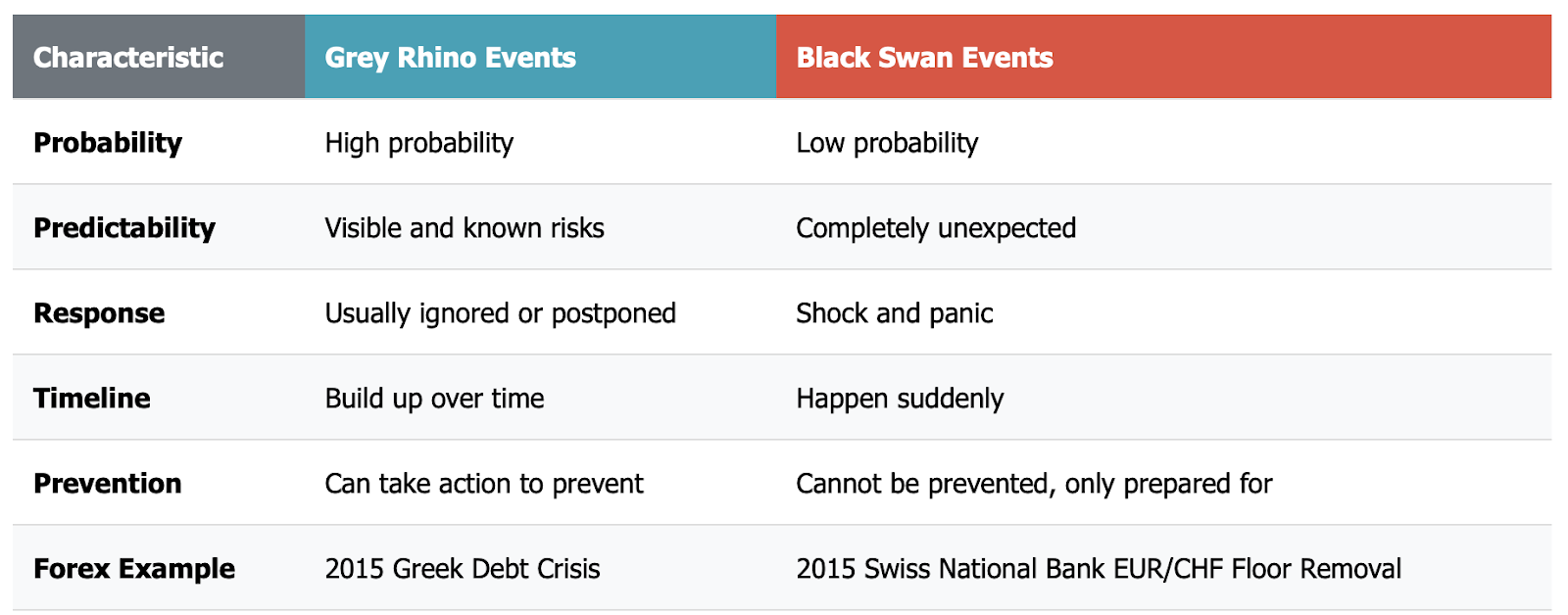
Grey Rhino events:
- High probability of occurring
- Known risks
- Usually ignored or postponed
- Build up over time
- Can take action to prevent
Black Swan events:
- Low probability of occurring
- No one expects them
- Cannot be predicted exactly
- Happen suddenly
- Cannot be prevented; only prepared for
Let's use the school analogy again. A Grey Rhino, is like knowing you have an exam coming up next week. Your teacher told you. You have study guides. But you keep pushing studying off. When exam day arrives you fail because you did not study.
A Black Swan is like arriving to class to find out the teacher quit yesterday. There is a sub who is teaching a completely different subject. There is no way you could have prepared for this.
In forex markets, the 2015 Greek Debt Crisis was a Grey Rhino. Everyone knew Greece was going to have money issues. The indicators had been quite clear for months. A number of traders were already positioned for a Greek exit from the eurozone. This was a clear and understood risk.
The 2015 Swiss National Bank incident was a Black Swan. The SNB had stated they would defend the EUR/CHF floor at 1.20. They repeated this same story numerous times. Then one day, the surprise news was that they would remove the floor and EUR/CHF dropped 30% within minutes. Nobody had it on their radar screens.
Understanding the difference between a Black Swan and a Grey Rhino event will help you make better trading decisions. Grey Rhinos can be planned for. You can see the early warning signs. You can adjust your trades. Black Swans require you to prepare differently. You need strong risk management systems that work during the unforeseeable.
Historical Timeline of Black Swan Events
Let's look at some major Black Swan events that rocked the forex markets. Each one took traders by surprise. Each one changed the way they look at currency trading.
1997 Asian Financial Crisis
The crisis was born in the country of Thailand. The Thai government had depleting currency reserves, and they could no longer defend their currency peg. The Thai baht dropped overnight. This started a chain of dominoes falling across Asia.
The South Korean won declined by 50%. The Indonesian rupiah lost 80%. The Malaysian ringgit imploded. Even the strong Singapore dollar saw a huge drop. The US dollar became the safe haven currency. Gold prices surged as investors fled risky assets.
2001 September 11 Terror Attacks
The tragedy of the 9/11 attacks was not only human. It wreaked havoc on financial markets. All US markets were closed for four days. When the markets reopened, panic selling began.
As investors worried about whether America was stable, the US dollar sold off. Then as money flowed back to US Treasury bonds, the US dollar rallied. The Swiss franc and Japanese yen became strong as safe havens. Oil prices soared because of supply worries. Gold prices surged to multi-year highs.
2008 Global Financial Crisis
The crisis started in the US housing market. The banks made too many risky mortgage loans. When property prices began to decline, the banks began to fail. And the US crisis affected the world because of global financial interconnection.
Major investment banks failed. Lehman Brothers went bankrupt. AIG needed a government bailout. Currency markets were chaotic. The US dollar initially sold off, then it became much stronger. The British pound crashed to 25-year lows. The euro also plummeted. Even the safe haven Swiss franc was initially under pressure.
Removal of the Swiss National Bank EUR/CHF Floor on January 15, 2015
The Swiss National Bank (SNB) had defended a EUR/CHF floor price of 1.20 since September, 2011, purchasing euros regularly to maintain a weak CHF, which was helpful to Swiss exporters. On January 15, 2015, the SNB abandoned the EUR/CHF floor policy by announcement at 9:30 a.m. local time in Switzerland.
During the next minutes, EUR/CHF crashed from 1.20 to 0.85 - a 30% move within a trading session. A number of forex brokers failed during market closure. Retail trading accounts were wiped out.
2020 COVID-19 Pandemic
The COVID-19 pandemic constituted the largest Black Swan event in our lifetime. When the COVID-19 pandemic started, stock and equity markets ignored the possible impacts of the pandemic. Panic ensued in March 2020.
Market selloff, or fear, was severe. Stock markets sold off about 30% in about 4 weeks after the major selloff began. The Volatility Index (VIX) reached levels we had not seen before. Currency markets experienced extreme volatility.
The US dollar weakened against other currencies initially, then strengthened due to buy and hold, safe haven positions. The Australian and New Zealand dollars fell sharply due to commodity exposure. Extreme weakness was shown in the yen and Swiss francs. Gold reached new recent highs above $2000 per ounce.
These events occur in similar ways. They appear from nowhere. They were not signaled by traditional models. They created violent movements in the markets. They caused panic selling. They separated the prepared from the unprepared trader.
The lesson is clear: Black Swan events are only identifiable after they occur. Smart traders are prepared for Black Swan events, even thought they don't know precisely when or how they occur.
Why models fail to predict black swan events
Models of traditional risk are great during normal market conditions. They are completely useless during Black Swan events. Understanding why this is crucial to keeping your trading account's head above water.
Most financial models make the assumption that markets behave in a normal manner. Most models rely on historical data for predicting future risks. Financial models calculate probabilities based on past events and then match those probabilities with calculated losses. This is effective in simple, everyday, market moves, but it fails completely when there is a rare event.
Value at Risk (VaR) is among the most popular risk models. It tells you the maximum loss you may face on an average day of trading, 95% of the time. For example, you may be told that you will not lose more than $1000 on 95% of days. Useful, right? But what about the other 5% of days?
Black Swan events occur in that other 5%. VaR models almost never predict these extreme losses. It had been predicted that the worst-case scenario for the portfolio would be a $1000 loss in a day. Then a Black Swan occurs and you lose $10,000 in one day.
Think about the forecast for weather. The weather models can tell you with a fair degree of accuracy if it is going to be raining/sunny or if it will be warm/cold. However, it cannot model when an earthquake happens, which displaces magma that erupts in a volcano, which changes the entire hemisphere's weather pattern. Financial models have this problem too.
Normal distribution curves is another issue. Every model assumes prices move in a bell curve. Small moves happen all the time. Large moves happen infrequently. Extreme movements happen almost never.
Real-life markets do not work this way. Extreme moves happen more than models indicate. The "fat tails" issue implies there are more larger moves than models suggest. It is actually in these "fat tails" where Black Swan events reside.
This was clearly evident in the 2008 financial crisis. Many banks relied on statistical risk models as part of their due diligence. Their models indicated there was a safety net in their mortgage investments. The models were vastly incorrect, and they had losses that were 10x greater than predicted. Some banks filed for bankruptcy.
Models also assume that markets are always liquid. They assume that you will always be able to buy and sell currencies and that you will always get a fair and reasonable price. Black Swan events destroy market liquidity. Bid-ask spreads also widen enormously. At other times, there are no buyers at any price. Your stop losses may not function as you intended.
This situation is compounded by computer algorithms. Many trading systems are based on the same models. When a Black Swan is encountered, the algorithms will all try to sell at the same time. This can create flash crashes and extreme upward or downward volatility spikes.
The Swiss National Bank event in 2015 is a great example to use. Most automated trading systems had stop losses just below 1.20 in EUR/CHF and when the Swiss National Bank removed the floor, the stop losses all tried to sell at the same price at the same time. There were not enough buyers available. The liquidities of that currency pair gapped down 1500 pips in a couple of minutes.
Don't put your faith in models and computers. Use data and models as devices but do not use them on their own. Use the output of models and your understanding of human behaviour and common-sense risk management as your defense, while always preparing for the types of events that models will tell you are "impossible."
Investor Psychology during Black Swan Events
Human emotions have the potential to magnify Black Swan events. It is fear and greed that drive people into making dreadful decisions. Understanding crowd psychology can help you avoid these decisions.
When a Black Swan hits, most traders panic. They watch their positions go against them fast. They see the balances of their accounts going down. Their first instinct is to sell everything as soon as possible. This panic selling pushes prices even lower.
The COVID-19 market crash exemplifies this quite well. Retail investors panicked in March 2020. They sold equities, currencies, and even gold, as they went into panic mode. Professional investors were considerably calmer. They bought up panic-driven retail trades at low prices.
Herd behavior makes it worse. When traders watch others jump out of the market, they begin to think they should too. Nobody wants to be the last one holding a losing position. This creates flights out of currencies and into something safer.
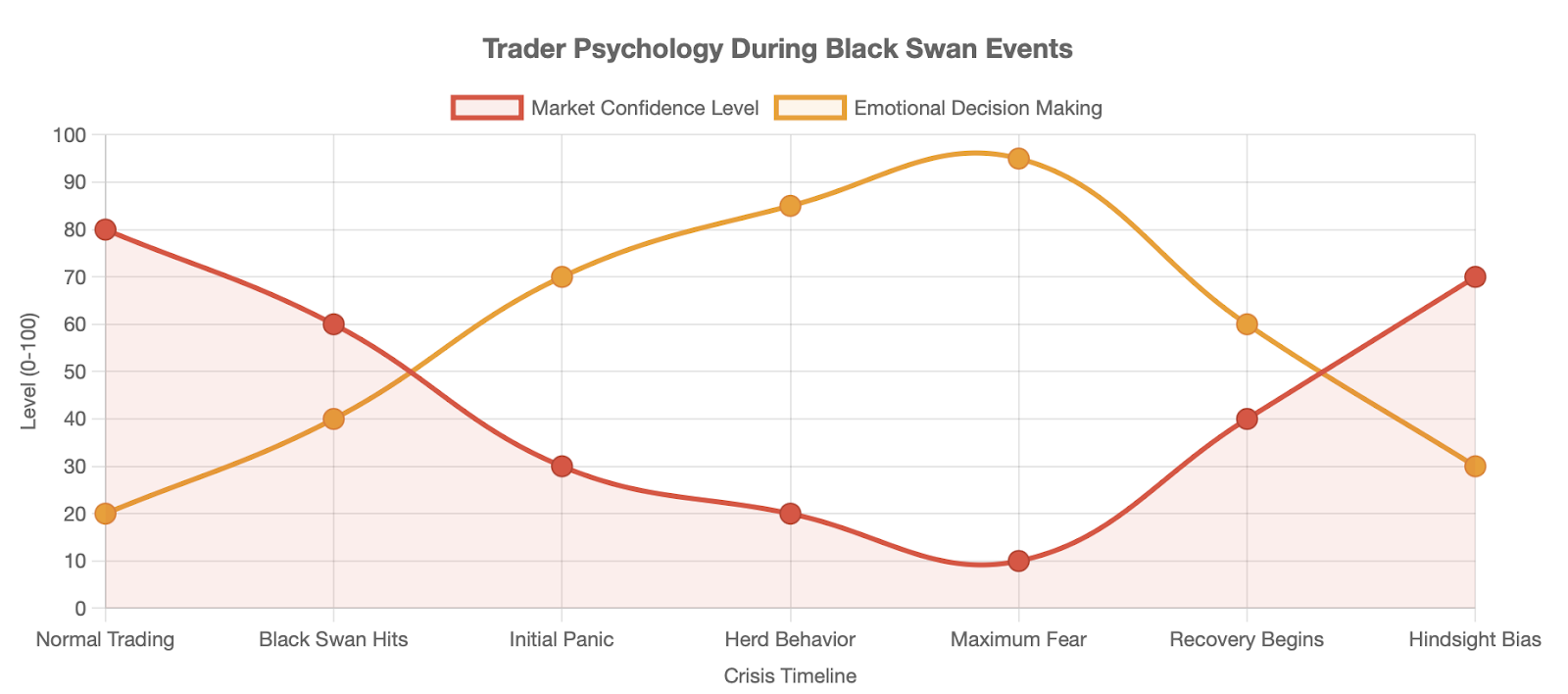
As well, the fear of missing out actually works in reverse during periods of crisis. Instead of fearing that they will "miss out" on profits, they fear missing out on the opportunity to limit losses. So their instinct is to sell, and they always sell at the wrong time when prices are already in panic mode.
After the event occurs, the hindsight/gears of hindsight bias fall into place. People start stating: "I knew this would happen." The signs were obvious, they say. That is false confidence. It leads them to be unprepared for the next Black Swan because they start to believe they can predict it!
Let's consider a simple scenario. You're playing a game, and all of a sudden, the power goes out. Some of the players bolt and lose all their progress; others sit patiently until the power comes back on, and when it does, the patient player's position is much better than the panicking player.
The same is true in forex markets! Panicking losers often close their positions at the worst times. Patient traders with good risk management weather the storm. They often find themselves in a position to make money on the way to recovery when markets do recover after a Black Swan event.
Overconfidence during peace time is just as dangerous! During peace time, traders start to believe that they "know the market" and increase their position size, apply more leverage, and violate risk management steps. They increase their risk during these calm periods, then when the Black Swan materializes, they get wiped out.
The pitfalls of social media exacerbate psychological pitfalls! Traders watch others panic on social media, read scary news headlines over and over, and fear spreads faster than we have ever seen before in modern open communication technology it is more difficult to be calm when fear is rampant all around you.
Professional traders have a knack for remaining calm. Professional traders have written trading plans. As a professional trader always has set stop loss and profit levels. They never make decisions based on emotions during chaotic market moves. Many of the psychological factors that separate winning traders from losing ones, boil down to mental discipline.
The moral of the story is clear; effective trading behaviours during Black Swan events is not due to market movement, but one's emotions. Come prepared for these events. Know your plan. Trade your plan. Do not allow your emotions of either fear or greed to convince you to break your risk management rules.
The Danger inside a Black Swan Event, and Where to Find Opportunities
There are both dangerous and opportunities that accompany Black Swan events. There are many savvy traders and institutions that are able to profit in extreme volatility of the market. They trade amid chaos in the markets.
Hedge funds commonly employ volatility arbitrage strategies. Generally when there is a Black Swan event volatility quickly shooting higher in the form of the VIX (volatility index) present a trip-killer for a fund with short volatility. However, for funds with long volatility outcomes may be worth dramatically higher dollars then they originally paid in.
There are other types of traders that look for Black Swan events. They purchase cheap out-of-the-money options. Cost very little when markets are calm but the worth can be exponential during crisis events. Trading a Black Swan is like having insurance that pays off after the disaster.
The derivatives market is critical during Black Swans. Currency options can be used to protect against large moves. Credit default swaps can hedge against country risks. These instruments all have a price during normal conditions but become priceless during turmoil.
It's like buying a flashlight before a blackout. The flashlight presumably costs money and takes up space. Most of the time you won't need it. But when the lights go out, the flashlight becomes the most valuable item you own.
Gold traders made a fortune during the COVID crash. Gold went down, just like everything else initially. And it had a huge rally when central banks started injecting tons of money into the economy. Traders who bought gold during the panic realized huge profits. Gold crossed $2000 for the fist time in history.
Safe haven currencies also present opportunities. The Japanese yen tends to rally in major global crises. The Swiss franc goes up during serious problems in Europe. The US dollar will typically create opportunities due to its status as a reserve currency. Smart traders will anticipate these moves and position themselves in these currencies either before, or during a Black Swan event.
Currency carry trades are unwound during Black Swans as the carry traders rush to unwound their positions. Carry trades are borrowing low-yielding currencies to buy higher-yielding currencies. When they don't go as planned, traders panic and move to close them. This creates the predictable currency movement that participates can take advantage of.
Some forex brokers look to innovate their forex product offering during times of volatility. Brokers develop products designed to help traders hedge their position. Brokers tweak their spreads, margin, etc. The broker that adapts first often gains market share.
One of the industries that tend to benefit during Black Swan events is technology companies. Trading volume increases dramatically during episodes of volatility. High-frequency trading systems process orders quickly. Data providers see an increase in the number of traders requesting real-time data. Risk management software usefulness increases, less compliance burden and risk cost more.
The last Black Swan event became a period of major financial innovation. The Salomon Brothers fiasco and the 2008 crisis made regulators rethink their risk management, and regulations concerning banks. New platforms for trading and risk management emerged. New asset classes like cryptocurrencies exploded partly due to distrust in traditional finance.
Black Swan events often speed trends along. Central banks accelerated the emergence of digital currencies partially due to the COVID-19 pandemics fast pace. Central banks began experimentation with digital versions of their currencies, which opened the door to a range of digital currency trading activity.
The idea is to be prepared to act when the time is right. Black Swan events highlight the difference between a trader who prepares and one who does not. They reward those who have a reserve of cash. They favor traders with solid risk management systems. They create profits that are life-changing for those who can calm themselves in the middle of chaos.
Potential Future Black Swan Risks
It is impossible to predict when or how or what the next Black Swan event will actually be. We can look at potential areas where Black Swan events may occur. Awareness of risks may assist how you want to prepare in your trading plan.
Geopolitical risk is still very high in every corner of the globe. Wars can start from a small seemingly innocent incident. Trade disputes can escalate very quickly. Sanction decisions can be requested overnight. With the Russia-Ukraine situation, for example, we saw how quickly geopolitical events can affect markets on a global scale - looking at currency pairs that ran and some of the volatility they encountered for affected countries.
Technology risks are increasing year after year. Cyberattacks on major financial institutions could freeze markets. An entire power grid blackout could bring trading systems to a halt. Artificial Intelligence issues could trigger automated selling into waves. All these technology-based Black Swan events could occur without notice.
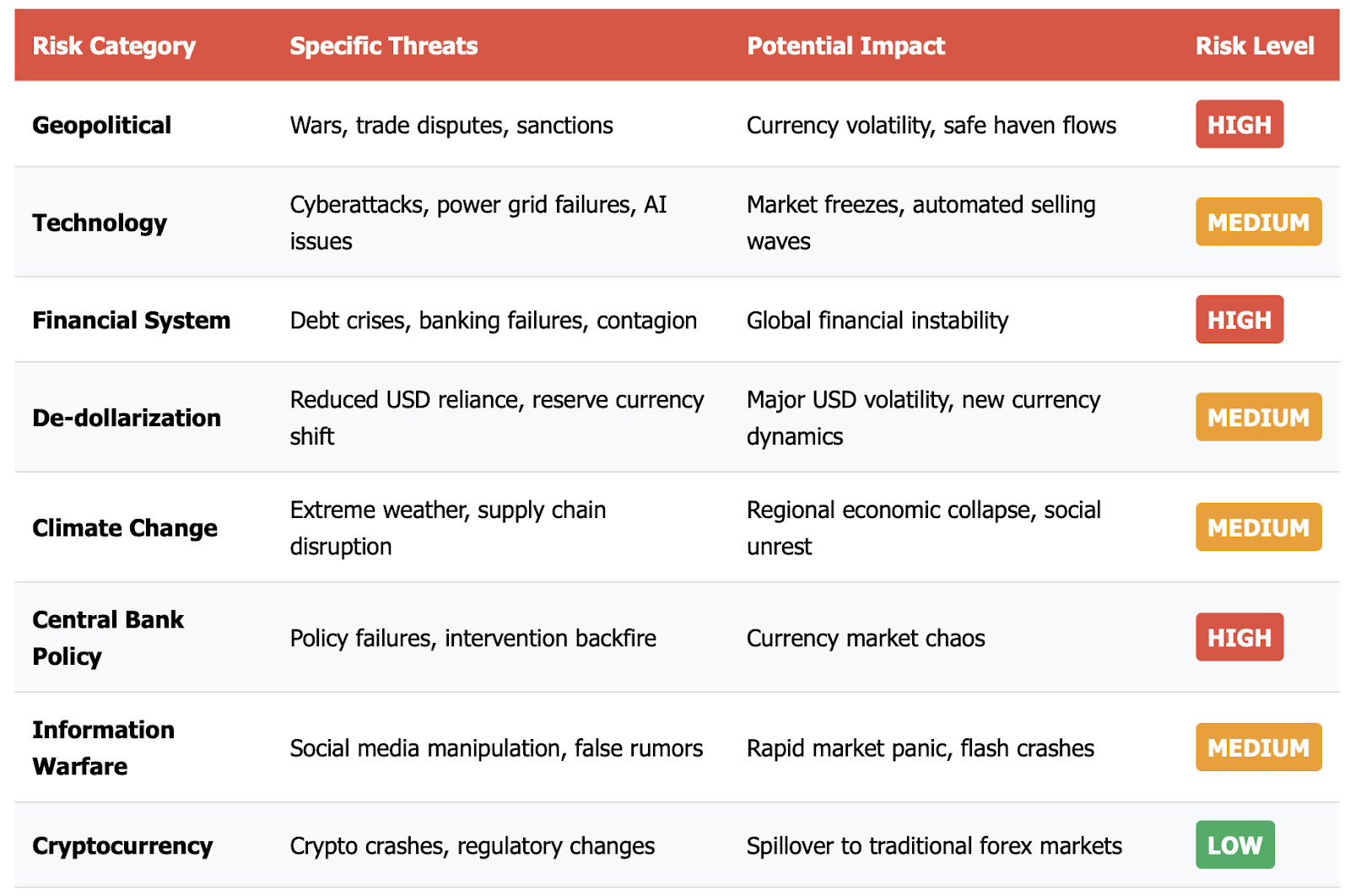
There are multiple points of fragility in the global financial system. Many countries now have high levels of debt. Interest rates could change and sow the seeds of economic debt crises. We are seeing some emerging market currencies at risk of sudden capital outflow (and depreciation). It could be at any moment we could experience a chain reaction of defaults that could create the next financial crisis.
De-dollarization trends could create currency Black Swans. Many countries are trying to reduce their reliance on the US dollar. If this de-dollarization process suddenly accelerates, major changes are likely to take place in currency value. The US dollar has had a stable reserve currency status for decades. This could change quicker than the world of finance could imagine.
Climate change opens up all sorts of Black Swan risks. Extreme/unprecedented weather events occurring with an unprecedented velocity are beginning to occur. This could disrupt supply chains without any warning. Food shortages could lead to much social unrest. Natural disasters could collapse entire regional economies. The frequency and randomness of these types of events in the not so distant future will have all sorts of unknown consequences.
Central bank policy failures could create Black Swans. Interest rate policy or structured policy decisions that markets can no longer track could generate chaos. Currency market interventions could exacerbate existing problems or introduce a new problem altogether. The Swiss National Bank's (SNB) 2015 decision on currency policy demonstrates how decisions made by central banks can create devastating consequences in forex markets.
Social media and the pace of information raise new risks. False rumors can travel faster than they ever have. Panic as well has unprecedented speed. The complexity of social media to manipulate financial markets is evolving. A false story that goes viral, can lead to major moves in currency, before confirmation of the intent anywhere.
New asset classes are also developing complexity. Cryptocurrencies can interact with traditional currencies through a variety of methods and changes and downturns in crypto prices can easily influence traditional currency prices.
A sudden crash in cryptocurrencies can spread to forex markets in milliseconds as participants attempt to hedge losses in existing positions and the correlation of respective asset classes make change favorable for some. Regulatory arbitrage of crypto will present unimaginable side impacts to traditional forms of trading.
The banking system has too many vulnerabilities to create comfort. Despite compliance and regulation, we will still see contagion from bank failures. The speed of contagion curves will change through time. The collapse of silicon Valley bank in 2023 has showed us that modern banking allow for rapid downside risk of bank run. Information today in in the speed of social media allows for rapid panic from depositors.
There are hidden risks created by supply chain dependence. Many nations heavily rely on imported goods for products lifebloods. Any sudden supply chain break could severely trigger currency crises. An interruption in energy supply could indefinitely cripple economies dependent on imports for fundamentals.
The bottom line is to not sweat the actual occurrences. Black Swans are unique events that we cannot expect. Instead, build resilient trading systems, utilize established risk management techniques, maintain a cash buffer and never risk 100% of your capital within one category of trade.
Stay aware of what's currently happening in the world but don't try to guess what happens next. The next Black Swan will come from an unexpected direction that nobody is watching. Prepare for the unexpected events instead of hoping to predict unpredictable events.
Risk Management Concepts
To protect yourself from Black Swan events, you present specific risk management principles. These risk management concepts will not remove all risk, however, they can preserve your trading account when an unexpected event occurs.
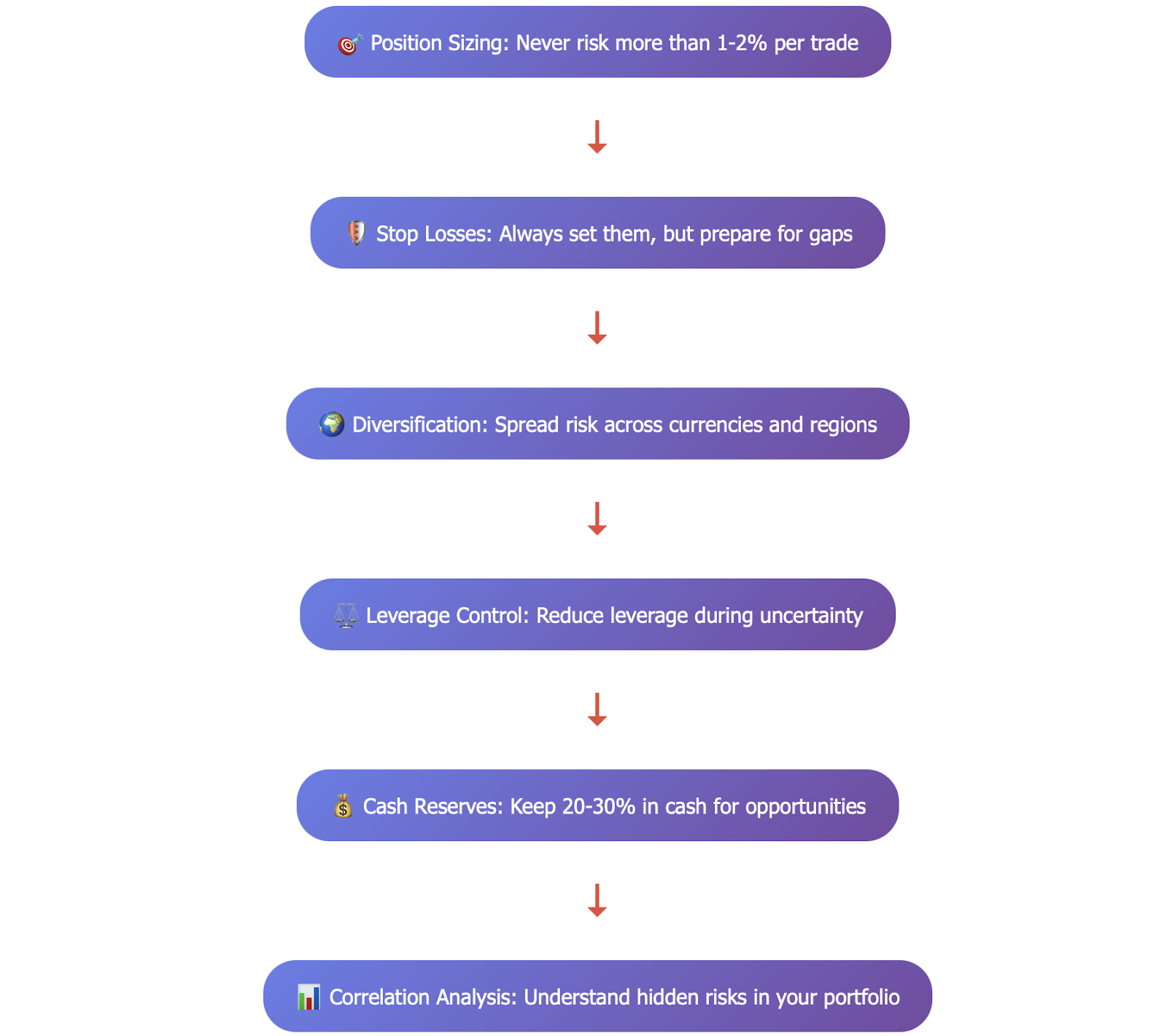
Position sizing is your first line of protection. Never risk more than 1-2% of your account on any one trade. This guideline may feel confining during good periods, but it can be a lifesaver during a Black Swan. If you risk 10% per trade, you can lose 5 trades and lose 50% of your account.
Stop losses are important but not infallible. You should always have them on each trade, no exceptions! However, be mindful that extreme cases can create gaps. Your stop loss set at 50 pips won't get executed when the market gaps against you by 200 pips. Think about this impact when you calculate your risks.
Diversifying across currency pairs diminishes risk. Do not put all of your capital into one currency or geographic region. Diversify your trades about currencies and time zones. One geographical region might face problems, while other regions remain stable or benefit.
Don't over-leverage your trades when things are unclear. If you make too many decisions based on 100x leverage, you magnify your profits, but more so your losses. A 100 funded position can wipe you out with 1% against you. While everyone is trying to figure things out, think about reducing the leverage to 10:1 or less. You will make less money on winning trades, but you can deal with the losing streaks better.
Have cash to keep for your opportunities or emergencies. Many traders put 100% of their capital at work. When Black Swans rear their ugly head, they can't put on a trade because they do not have dry powder on the sidelines to take advantage of the opportunity. Have at least 20-30% capital held in cash or very low-risk investments.
Consider cash reserves like having a spare tire in your vehicle. Most of the time, you don't need it. It is taking up space and not helping you go any faster. However, when you get a flat tire, it is the most important thing in your car.
Take currency options as insurance where necessary. Buying put options can hedge longs in extreme moves. The options may cost money up front. But they may protect your account in adverse major events. This is real insurance for your forex positions.
Correlation analysis will help you understand hidden risks. Certain currency pairs will move together during normal times. During Black Swan events, those correlations may break down, or wetten considerably. USD/JPY and stock markets generally correlate positively. During the collapse caused by COVID this correlation reversed for a short time.
Always stay on top of your overall exposure. You may feel you have five independent trades going on. But if they are all long risk currencies versus safe havens, you are really on a single big trade. When a Black Swan hits all of your positions can go against you at the same time.
Have exit rules in place for extreme scenarios. Make an action plan to follow if your account declines by 20%, 30% or 50%. By having these rules in writing, you remove the chance for emotional decision-making under crisis periods. Stick with it despite the pain.
First, practice with a small position sizes. Don't start your risk management techniques with your whole trading capital. Learn each strategy with small amounts. Evaluate each situations' performance under normal market conditions. Gain confidence in them before needing to use them in an emergency.
Be aware of events, but don't get bogged down with information overload. Follow the big developments in economics and politics. Don't spend your whole day reading ridiculous scary news articles. Remember that too much information can lead to analysis paralysis. Remember to focus on your rules around risk management rather than attempting to predict what crisis is next.
Risk management, unfortunately, is not sexy. It is not a technique that makes you rich quickly. Risk management keeps you in the game long enough so when the next great opportunity arises you can take advantage of it. The traders who survive Black Swan events are the traders who realize a profit in the next bull market. Accounts that are dead don't typically come back to life.
Remember that risk management is more important than predicting Black Swan events. It does not matter when the next Black Swan hits- you just need to be in a state of preparation for it. Good risk management will turn prospective account killers into manageable losses.
Final Thoughts
Black Swan events are something that will permanently exist in the forex markets. They have existed throughout the whole financial history. They will continue to exist in the future. You will not know exactly when they will happen, but you can prepare for it.
The unpredictable nature of these events creates challenges and opportunities. Traders who panic during Black Swans typically end up losing money, while traders with good risk management can make money from the chaos. The differences in outcome are preparation and attitude.
Your attitude towards uncertainty has a greater significance than your ability to predict events. You need to accept the fact that surprise events will occur. Make sure your trading system can withstand them. Do not chase a perfect prediction. Instead, prepare yourself robustly.
Risk management is not just something for you to do if you are serious about trading forex or really any market. Risk management is what can separate long-term success from ultimate failure as a trader. Traders who have survived multiple cycles in the market are properly conscious of the risks of the unknown, of Black Swan events, as newly dubbed by Nassim Nicholas Taleb in his book of the same name.
Black Swan events challenge everything about your approach to trading. They can expose weaknesses in your risk management, your emotional blind spots, and most importantly they can differentiate theoretical knowledge from practical preparation - you should be learning from them and not just avoiding them.
Start working on better risk management now. Don't wait until the next crisis comes to start preparing. Build your habits during the quiet, stable times in the market. When the next Black Swan occurs you will be prepared!
In general, over time, the forex market rewards traders who are prepared. The market also punishes traders who refuse to acknowledge tail risks. You get to choose - you get to choose which group of traders you will be in. You get to choose what kind of trade you will be in the future with the choice you make in the present.
Be sure to check out our site tradewill.com for more forex education and risk management tools and resources. We can never stop learning as traders, especially when it comes to protecting our capital. The more you learn about managing your risk, the better chance you have of being successful as a trader long-term.
Disclaimer: The content of the blog does not represent any position of Trade W, does not serve as any trading-related decision advice, and does not endorse any third-party.