

 Trade W

Trading in Brazil has historically been one of the most expensive foreign exchange environments in the world. In 2026, however, with IOF currently raising the stakes for traders like never before, Brazil is on the cusp of yet another costly regulatory change.
When you convert currency, send money across borders, or use your credit card abroad in Brazil, you are subject to IOF taxation on each and every transaction. This takes place prior to any money settling in your account from these transactions, and it happens whether you are making profits or not.
IOF stands for Imposto sobre Operações Financeiras, which means Tax on Financial Operations in English. This is not an income tax; it is not a capital gains tax. Banks, brokers, and payment processors all withhold IOF taxes from your financial transactions and include these taxes within the exchange rate before you ever receive the money.
Brazil’s IOF tax regime underwent a significant restructuring when Decree No. 12,499 was passed in late 2025. This was the first comprehensive change to Brazil's IOF tax structure, as well as a tightening of cross-border capital flow restrictions. Forex markets were the first to be affected, followed quickly by CFD (Contract for Difference) trading desks, and then arbitrage trades in cryptocurrencies were also severely impacted.
This guide details how Brazil’s IOF tax is applied, outlines the recent changes made pursuant to Decree No. 12,499, and evaluates whether it still makes sense to trade BRL-denominated assets as part of your overall trading strategy for 2026.
What Is the IOF?
Governments use two main types of financial taxes. Profit-based taxes, such as capital gains taxes, are imposed on money earned. Transaction-based taxes, such as the IOF, are assessed at the time funds are transferred. The IOF is classified as a transaction tax, which greatly impacts the manner in which it is incorporated into a trader’s strategic model.
The IOF is a dual-purpose system created by Brazil for two purposes: to generate revenue for the government and to allow the Central Bank to regulate the inflow and outflow of capital. When Brazil wants to reduce the inflow of speculative capital, it raises the IOF. When Brazil wants to attract funds to specific industries or businesses, it lowers the IOF on those products. The amount an entity pays in IOF is based on the type of transaction being completed.
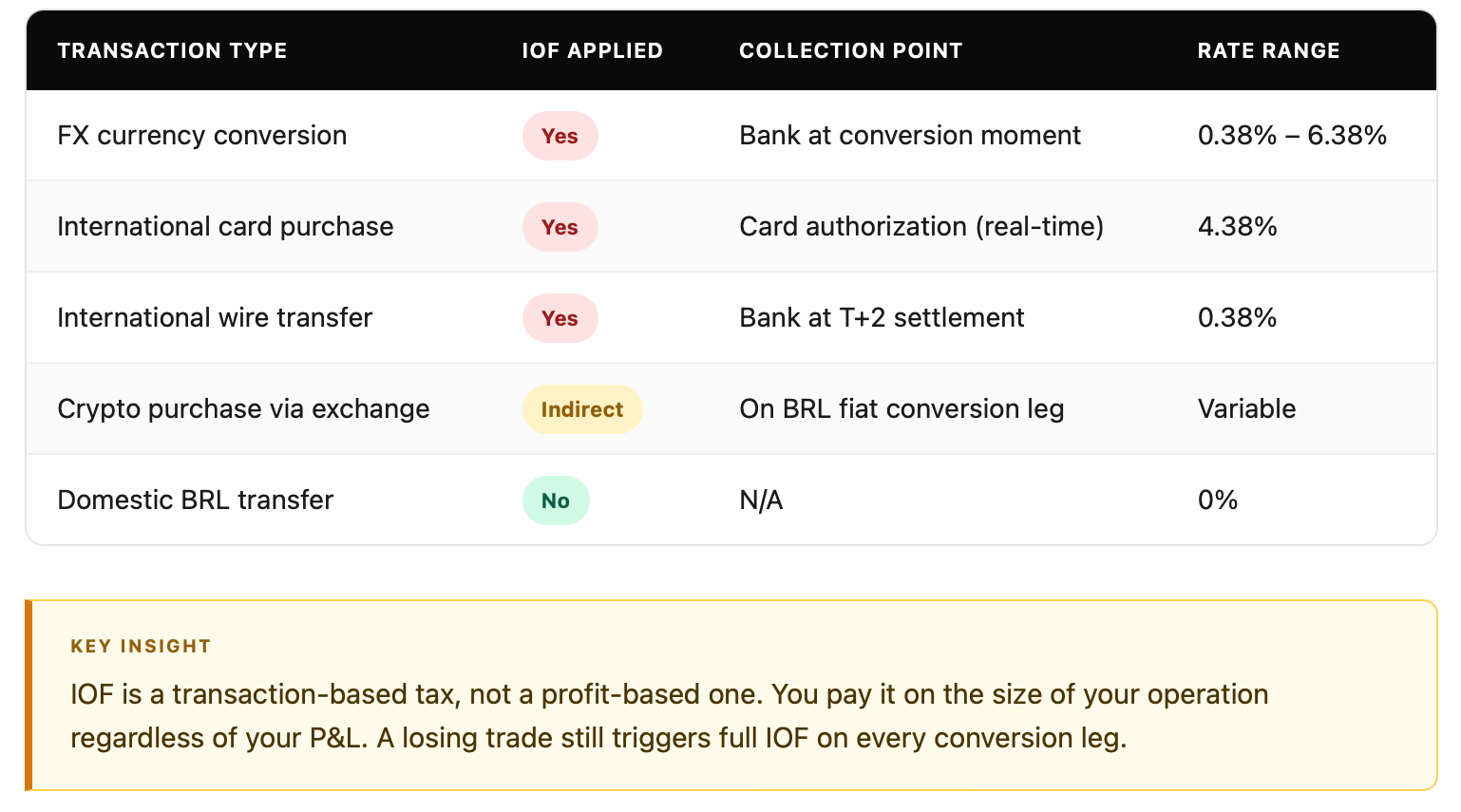
The IOF applies to foreign currency transactions, including any BRL (Brazilian Real) to FX (foreign currency) conversion. It also applies to wire transfer transactions entering or leaving the country, credit card purchases involving foreign currency values, and certain investments outside of Brazil, including loans, fixed-income products, and equities.
Understanding the Process of the IOF in Brazil
The International Operational Fund (IOF) does not appear as a separate invoice. Instead, it is included in the transaction amount, so you will not know the exact IOF amount until you review the settled funds. The IOF is triggered when the currency is exchanged, not when the money is withdrawn or settled.
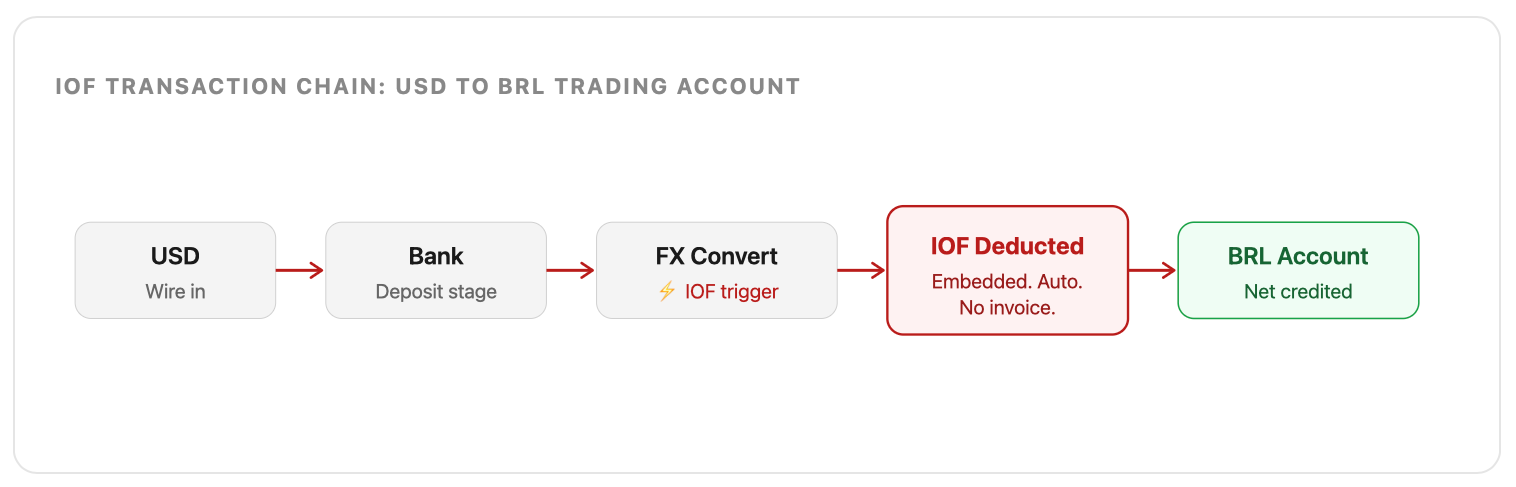
Three entities collect the IOF: banks when you transfer money or convert currency at the account level, brokers when you trade on a trading platform, and payment processors when you make purchases with your credit card in real time. You do not get to choose which entity collects the IOF. Instead, the system automatically routes the IOF to the appropriate entity.
You should be most concerned about double-exposure risk if you send an international wire transfer and then convert currency at the same bank. This creates exposure to two separate IOF triggers against the same underlying capital. By structuring your transfer to reduce currency conversion legs, you can reduce your exposure without creating any legal issues.
The timing of the IOF depends on the type of transaction being processed. Credit card IOF is triggered when you authorize the payment, while wire transfer IOF is triggered at T+2 when the transfer settles. If you process a high volume of transactions, the timing difference between credit card and wire transfer transactions can significantly impact your cash flow planning because these effects may not become visible until you are managing cash flows at scale.
Decree No. 12,499: Changes Occurring Between 2025 & 2026
The Brazilian government passed Decree No. 12,499 in late 2025, implementing several changes, including a complete reorganization of the IOF rate framework. These changes also resulted in more stringent controls on cross-border flows of capital. Because of this, many traders were caught off guard when their currency conversion costs changed without any underlying shifts in the broader market.
The following three changes had the most significant impact on the operations of many traders:
Speculative vs. Commercial FX Classification
The decree clarified the distinction between commercial foreign exchange transactions, such as trade finance, salaries, and supplier payments, and speculative foreign exchange transactions, such as short-term position taking, arbitrage trading, and financial investments. As a result, the IOF rate applied to speculative transactions is significantly higher than the rate applied to many commercial foreign exchange transactions. Therefore, if your broker improperly classifies your foreign exchange conversions as speculative, you may incur a substantially higher IOF tax.
Abnormal Outflow Monitoring
Under the decree, the Banco Central do Brasil, Brazil’s monetary authority, has been granted the authority to identify and monitor abnormal outflows of capital from the country. Brokers and payment processors are now required to file far more detailed transaction reports than were previously required. Although the additional monitoring does not increase the amount of taxes owed, it increases the compliance burden and creates additional paperwork requirements.
Fiat On-Ramp Requirements for Crypto
All exchanges that handle BRL deposits for cryptocurrency purchases must now comply with stricter reporting requirements related to the IOF tax. Although the IOF does not directly apply to the actual cryptocurrency transaction, the compliance burden placed on exchanges is often passed on to users through higher fees and stricter KYC compliance requirements.
How Your Forex Trading Costs and Strategies Are Negatively Affected by the IOF
Before you even attempt to place a trade with your broker, the IOF changes the way your trading costs accumulate.
Most traders include the broker's spread and commission in their overall trading costs, but in Brazil, you must also account for the IOF.
The IOF affects your trading account whether you are winning or losing because it applies every time capital passes through a foreign exchange conversion trigger, meaning the currency pair being exchanged.
The total cost structure for any transaction involving BRL now includes the following: the broker's spread, the broker's commission, the IOF applied to each conversion undertaken, and any additional FX conversion margin the broker may charge above the underlying market rates.
If you exclude the IOF from your overall cost structure for a BRL transaction, you are removing a significant component of your actual operational costs. As a result, your cost model no longer accurately reflects the true operational expenses associated with trading in BRL.
The IOF is especially difficult for scalpers because the average daily profit target for scalping strategies, typically between 5 and 15 pips, involves two separate transactions. The combined transaction costs created by the IOF on both the entry and exit of a position can often negatively impact the trade before the initial position is even completed.
Scalping and high-frequency trading strategies that perform successfully in low-cost markets such as the United States and the European Union require a complete restructuring of their cost models to function effectively within Brazil’s high-friction trading environment.
Swing traders experience a relatively moderate level of impact from the IOF. A swing trader who holds a position for multiple days will typically generate enough profit and loss movement to absorb the IOF as a percentage-based cost. Although the trade will still be taxed, the IOF will generally not be the primary factor affecting overall performance. When a swing trader targets moves of 100 to 200 pips, the IOF can still be factored into the overall trading edge and risk-reward calculation.
Long-term traders feel the least impact from the IOF. A trader incurs IOF when both opening and closing a position, but in long-term trading, this only occurs once on each leg of the trade, making it less burdensome overall. The mathematics work more favorably because the IOF is incurred only one time on each side of the transaction.
Arbitrage trading requires a different discussion. Historically, BRL/USD spread arbitrage opportunities between brokers and exchanges offered small but consistent profit potential through bid/ask spreads. However, the IOF has now eliminated much of that profitability. By the time IOF costs are incurred on both legs of an arbitrage trade, much of the potential profit has often disappeared. In the current interest rate environment, multi-legged arbitrage opportunities are also struggling to produce net profits after IOF costs are deducted.
Crypto and IOF: The Hidden Fiat Exposure
There is no direct IOF taxation on the purchase or sale of cryptocurrencies themselves. Instead, the taxes are incurred through Brazil’s fiat infrastructure, including currency conversion, deposits, withdrawals, and payment processing. As a result, the IOF affects the movement of BRL into and out of crypto markets rather than the virtual currency transactions directly.
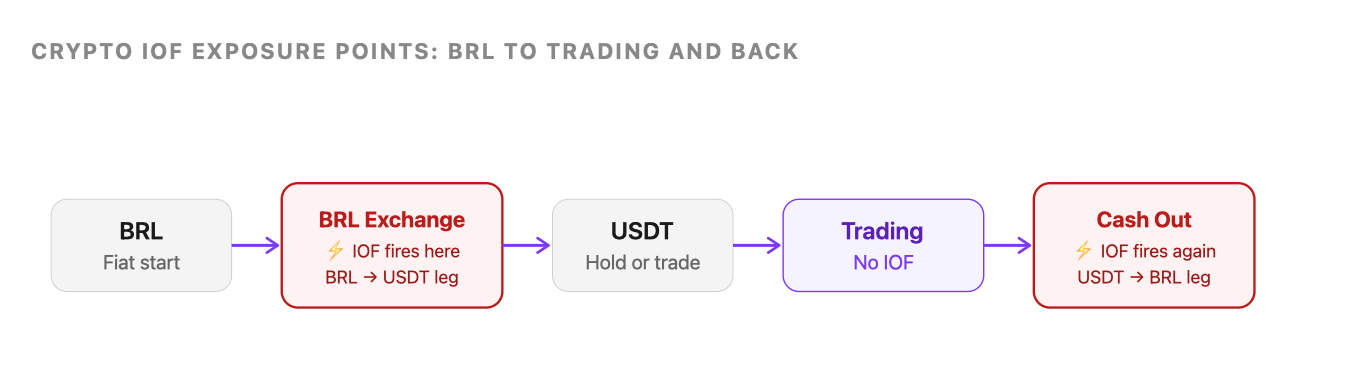
Using a Brazilian exchange to convert BRL to USDT means that the BRL conversion will incur IOF tax. However, once the funds are converted into USDT, subsequent transactions involving the stablecoin itself do not trigger additional IOF charges. Only the initial BRL to USDT conversion is taxed.
P2P (peer-to-peer) trading of BRL between individuals in Brazil is more complex, as many domestic P2P transactions do not incur IOF at the transaction level. However, cross-border P2P transactions involving BRL may still create indirect IOF exposure and continue to be monitored closely by Brazilian authorities.
The stablecoin workaround is real but limited. When you convert USDT or USDC back into BRL, the IOF applies to that conversion leg as well as the original BRL-to-stablecoin conversion. In practice, this means you are deferring the tax rather than eliminating it.
OTC desks face the most direct and visible IOF exposure when executing high-volume BRL-to-USD conversion transactions through the banking system. Unlike retail traders using stablecoins, OTC desks generally do not have a practical stablecoin workaround available to defer IOF exposure.
Brazil vs Other Countries: Comparing Global Foreign Currency Taxes
It is difficult to overlook how different Brazil’s IOF structure is from the foreign exchange tax systems used in most other major trading countries.
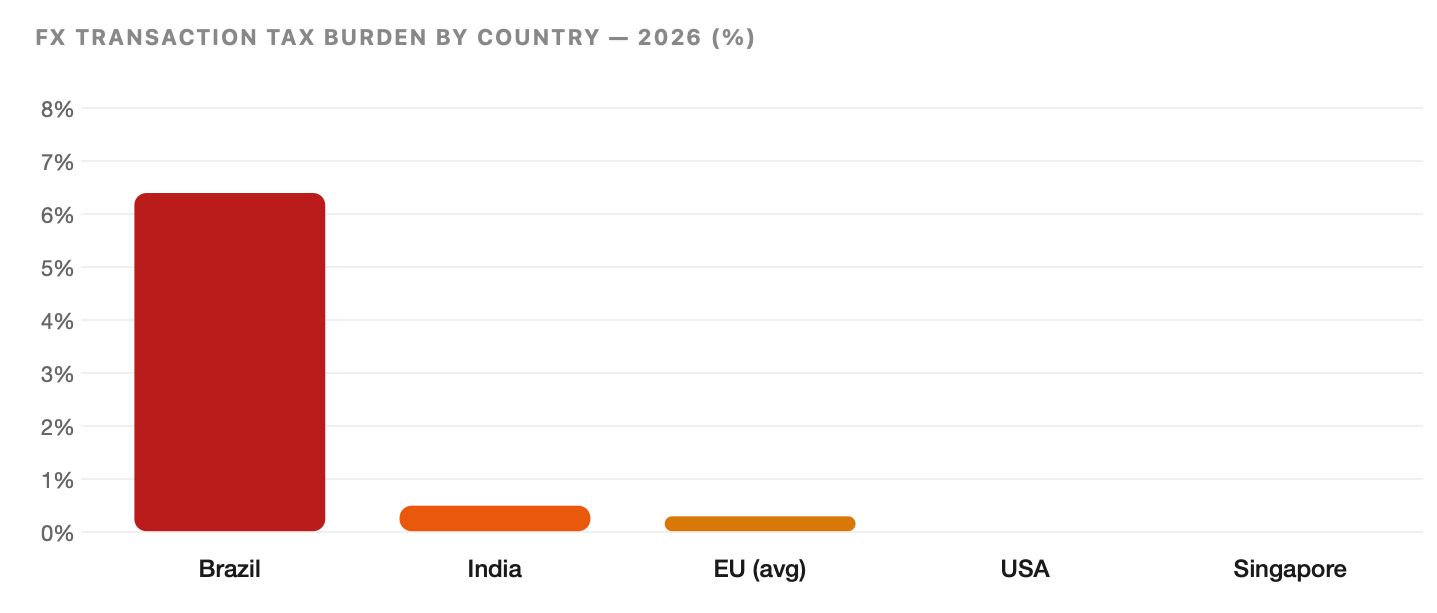
The United States does not impose an FX conversion tax on USD transactions. Taxes are generally assessed only when profits from currency trading are realised as capital gains. There is no transaction-based tax when converting USD into another currency. Some European Union member states impose Financial Transaction Taxes on specific financial activities. However, no major market has a currency transaction tax structure that closely resembles Brazil’s IOF system.
India uses a Tax Collected at Source (TCS) mechanism for certain foreign remittances. However, the TCS structure is generally lower in cost and applies to a far narrower range of remittance activities compared to Brazil’s IOF regime.
Both Singapore and the UAE are structured as global forex hubs with minimal friction. As a result, little to no foreign exchange transaction tax is imposed on currency conversions in either jurisdiction.
Due to Brazil’s higher tax rates, broader scope of taxable transactions, and active monitoring of foreign currency capital flows, Brazil remains one of the few major emerging markets where relocating trading operations without properly modelling tax friction can materially reduce overall profitability.
Risks of Non-Compliance and Legal Obligations
Compliance with the IOF is mandatory and cannot be self-administered. Banks and brokers automatically submit transactional reports to the authorities on behalf of their clients, but it remains the client’s responsibility to ensure that those reports are accurate and that their financial institution’s reporting is correct.
All Brazilian individuals are required to report foreign assets, including accounts exceeding R$1 million, annually through the CBE (Declaração de Capitais Brasileiros no Exterior). Failure to file can result in automatic fines, regardless of whether the individual has any outstanding tax liability.
Offshore banking strategies do not eliminate the obligation to pay IOF. If an individual routes funds through an offshore structure for the purpose of reducing BRL conversion costs, the arrangement must be implemented with proper legal guidance and an appropriate technical structure. Attempting to do this casually or without proper planning can expose the taxpayer to penalties of up to 150% of the taxes owed in cases of gross negligence. Even lower-tier negligence penalties can still far exceed any potential tax savings.
Regulatory oversight is extensive and actively enforced. Foreign capital outflows exceeding certain thresholds may trigger reviews by the Banco Central do Brasil, and brokers are now filing increasingly detailed reports under the updated regulatory framework. If your trading activity creates patterns that could be interpreted as capital flight, you should expect a higher level of scrutiny from regulators.
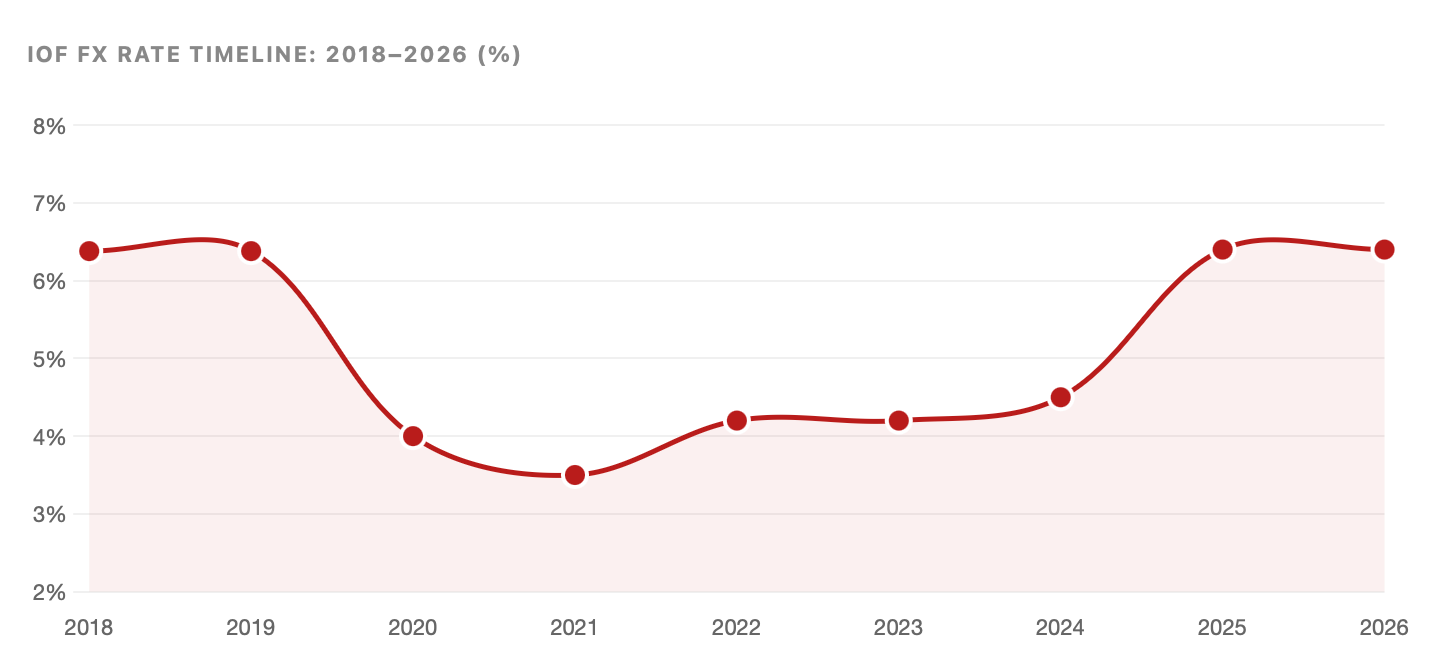
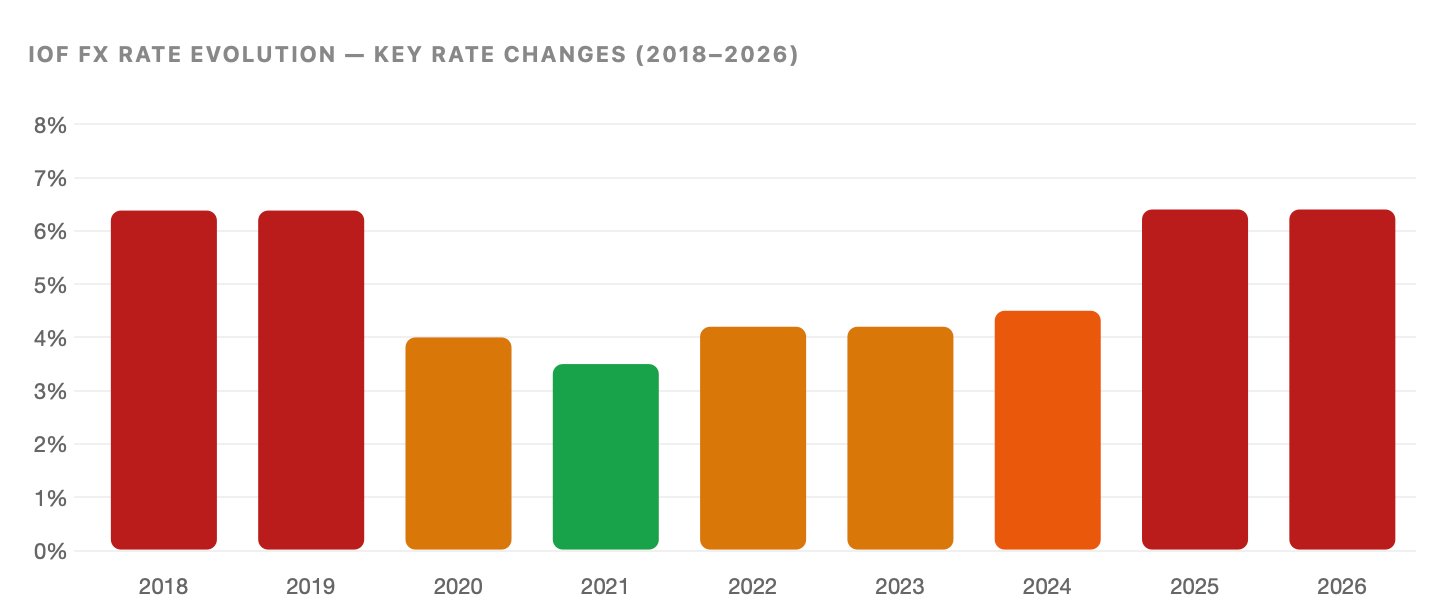
The IOF rate in Brazil has evolved significantly since 2018 and has been revised multiple times in response to economic and political developments throughout the period.
From 2019 to 2021, IOF rates were gradually reduced as part of Brazil’s broader economic stimulus efforts. The reductions were also influenced by the weakening value of the BRL, which was affected not only by domestic economic conditions but also by political uncertainty that discouraged foreign investment and created additional pressure on highly taxed foreign exchange transactions.
Because currency markets are inherently volatile, IOF rates also tend to fluctuate based on macroeconomic conditions and the overall performance of the Brazilian economy. Higher IOF rates are often associated with periods of elevated currency volatility and rapid depreciation of the BRL.
Should You Trade BRL Assets in 2026? A Decision Framework
IOF rates alone do not provide a reliable long-term metric for evaluating investments in BRL-denominated assets because the rates themselves fluctuate in response to macroeconomic conditions across the country’s economy. Instead, the IOF should be viewed as one component of the broader risk profile associated with trading Brazilian assets, alongside volatility, liquidity conditions, political developments, and currency risk.
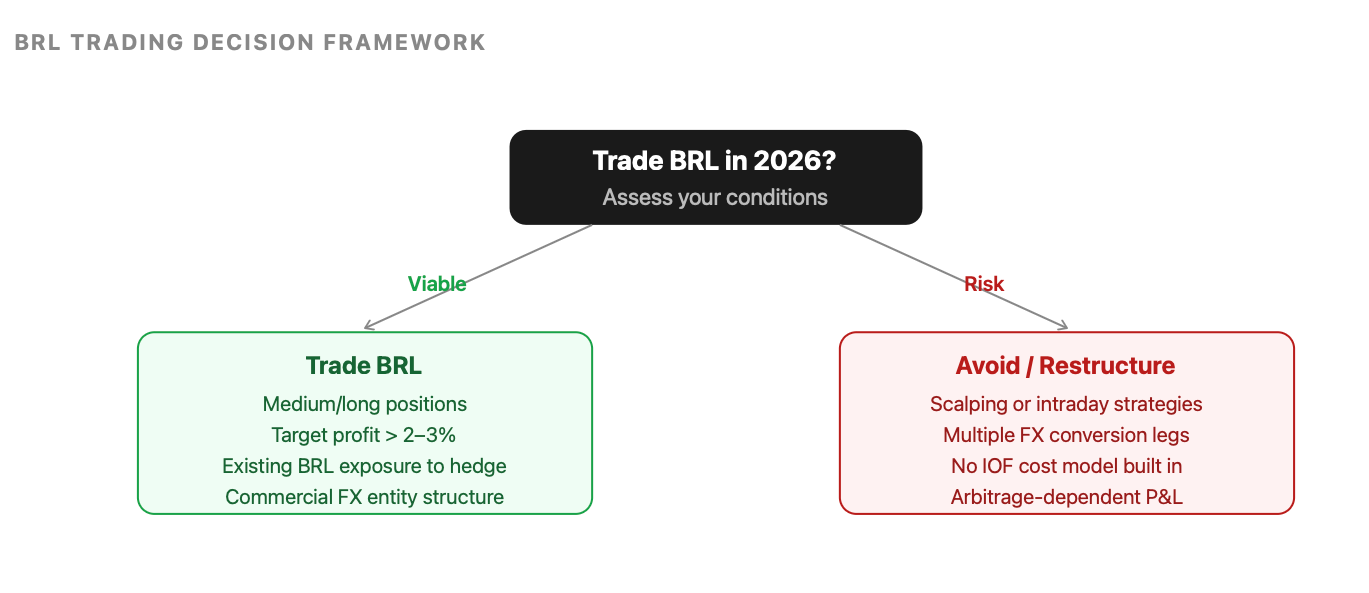
Is Brazil a suitable market for trading BRL-denominated assets in 2026? The answer depends entirely on your trading model, time horizon, and ability to incorporate tax friction into your strategy before investing in any asset.
It is generally more advisable to trade the Brazilian Real (BRL) through medium-term and long-term positions if your target profit per trade exceeds 2% to 3%, if you already carry BRL exposure that requires hedging, or if you are executing trades through a local Brazilian entity that qualifies for commercial-rate foreign exchange treatment.
Short-term BRL trading is generally less suitable when executing scalping or intraday strategies, when your model involves multiple foreign exchange conversion legs, or when you are unable to integrate a clear IOF cost structure into your risk management framework before entering a trade.
The traders most likely to lose money unnecessarily from the IOF are those who fail to understand the applicable rates and how those costs affect their strategy. Losses often occur when traders only recognize IOF expenses after executing trades. If you incorporate IOF costs into your strategy from the beginning, they become part of your planned operational expenses. However, if you ignore those costs, every trade effectively carries an additional hidden loss equal to the IOF expense.
As a result of stricter oversight of capital flows and higher rates applied to speculative currency operations, the IOF (Imposto sobre Operações Financeiras) has become an increasingly significant cost factor for Forex, CFD, and cryptocurrency traders following Decree No. 12,499 (2025). Banks, brokers, and payment processors automatically deduct the tax at the time currency conversions occur.
FAQ: Brazil IOF Tax in 2026
What is Brazil’s IOF tax in 2026?
IOF is Brazil's financial transaction tax. Banks and brokers collect it automatically when you execute foreign exchange conversions, international transfers, or foreign card purchases. The rate varies depending on the type of operation and can reach up to 6.38% on certain speculative foreign exchange conversions following the 2025 policy update under Decree No. 12,499.
Does IOF apply to forex trading?
Yes. Any forex operation involving a BRL conversion triggers IOF. The applicable rate depends on whether the transaction is classified as commercial or speculative under the current regulatory framework. Speculative short-term foreign exchange operations generally attract the highest rates.
How does Brazil charge IOF?
Banks, brokers, and payment processors collect IOF automatically at the transaction stage. You do not receive a separate invoice because the tax is deducted before the settled amount reaches your account. The IOF is triggered at the moment of foreign exchange conversion, not at the time of withdrawal or final settlement.
Can you legally reduce IOF exposure?
Yes, through legitimate structural methods. Operating through a Brazilian legal entity that qualifies for commercial foreign exchange rates, minimizing conversion legs in multi-step transactions, and strategically timing foreign exchange operations can all reduce IOF exposure without creating legal risk. Any offshore structure should be implemented only after obtaining proper legal advice.
Does IOF affect crypto trading?
Not directly, but the impact is still significant. IOF does not tax the cryptocurrency transaction itself. Instead, it applies to the fiat conversion legs, including when BRL is converted to purchase crypto and when crypto proceeds are converted back into BRL. Holding stablecoins may defer IOF exposure, but it does not eliminate it.
Disclaimer: The content of the blog does not represent any position of Trade W, does not serve as any trading-related decision advice, and does not endorse any third-party.