

 Trade W
Introduction
For traders, forex trading can involve a multitude of tools to help them make smart trading decisions. Example of a tool are "pending orders". Pending orders allow you to set trades, ahead of time. It frees you up from needing to have your computer on and staring at the market all day long.
A pending order example is called a Buy Limit Order. This order tells your broker to buy a currency pair when the price drops to a certain level, or below. If you want to use an analogy, think about the Buy Limit Order like you want to purchase something, but only if it gets lower in price.
Buy Limits orders are common in forex trading because currency prices move quickly and up and down constantly. Traders will set Pending orders (Buy Limit Orders) to catch a good entry point without have to watch the market 24/7.
A professional example is a trader sees EUR/USD trading at 1.1000. The trader thinks it may drop to 1.0900 and then go back up. So, the trader will place a Buy Limit order at 1.0900. If the price drops to 1.0900, the order will automatically trigger.
For starters, think of it as online shopping. Let's say you see that you've got your eye on a jacket but it costs $100. You then set an alert to buy the jacket automatically if the price drops to $80. This is what a Buy Limit Order is!
This article will explain how Buy Limit Orders work, when you would use them, the good and bad of them, and provide examples of them in action. In addition, you will learn the common pitfalls to avoid that can lose traders money.
A Buy Limit Order encourages you trade with a predefined plan instead of rush decisions that inevitably correlate to your emotions. A Buy Limit Order keeps you disciplined and focused on your trading plan.
Background & Theoretical Foundation
Buy Limit Orders did not start with forex trading, they were used in stock markets and futures markets long before. Wall Street traders needed a means of buying stocks at an advantageous price to them without having to sit watching the market all day.
When forex markets were opened to retail traders, in the 1990s, these forms of orders came along too. It was thought that the logic that applied to stocks applied perfectly to currency pairs, and it did.
The premise behind a Buy Limit Order could not be easier: "buy the dip"; simply to wait for prices to fall before you buy, instead of chasing prices higher. As long as you are waiting, the market has a chance to come to you.
In the early years of Wall Street, traders would write orders on paper and hand them to the floor traders. It was the responsibility of the floor traders to execute the orders when the conditions were met. Today this is done instantaneously by computers.
Buy Limit Orders gained importance in trading because they solve one of two problems with trading that are fundamentally important. First, prices move quickly and good opportunities are fleeting. You may identify an opportunity (the proverbial setup) developing, but you have better things to do than to constantly stare at the market 24/7.
In theoretical terms, Buy Limit Orders can be defined by patience and discipline. Rather than buying at any price you define the price you are willing to buy. And you maintain that decision even when the temptation of emotion tells you to do something differently.
Buy Limit Orders exist in all markets. The financial instruments may be different such as stocks, futures, commodities and forex the general idea is the same. The rules might differ, but the underlying concept is constant.
Buy Limit Orders are an example of smart money management. They provide better pricing and minimize your potential to buy at market tops. Pro traders have been using this technique for many years.
How Buy Limit Order Work
Buy Limit Orders operate under one principle only: it will trigger under the market price that you chose to set or lower. When you use a Buy Limit Order the market has to go to your Buy Limit before your order triggers. If you set a Buy Limit on the EUR/USD at 1.0900, it would not trigger until the market price hits 1.0900 or you hit a lower price.
This information is different from a Market Order. A Market Order buys on the spot at available market price as soon as possible. A Buy Limit Order waits for your order price.
Traders will routinely use a Buy Limit Order for many reasons. First, traders notably do not want to chase prices that are rising. When they chase prices, they most likely buy at the worst time. Second, traders want to position themselves at their ideal entry points before the market gets there.
The process is simple and follows these basic steps:
- You analyze the market and locate a key support level.
- You place a Buy Limit Order at or around that level.
- You wait for the price to drop to your level.
- When price reaches your level your order triggers automatically.
- You now have the position at your desired price.
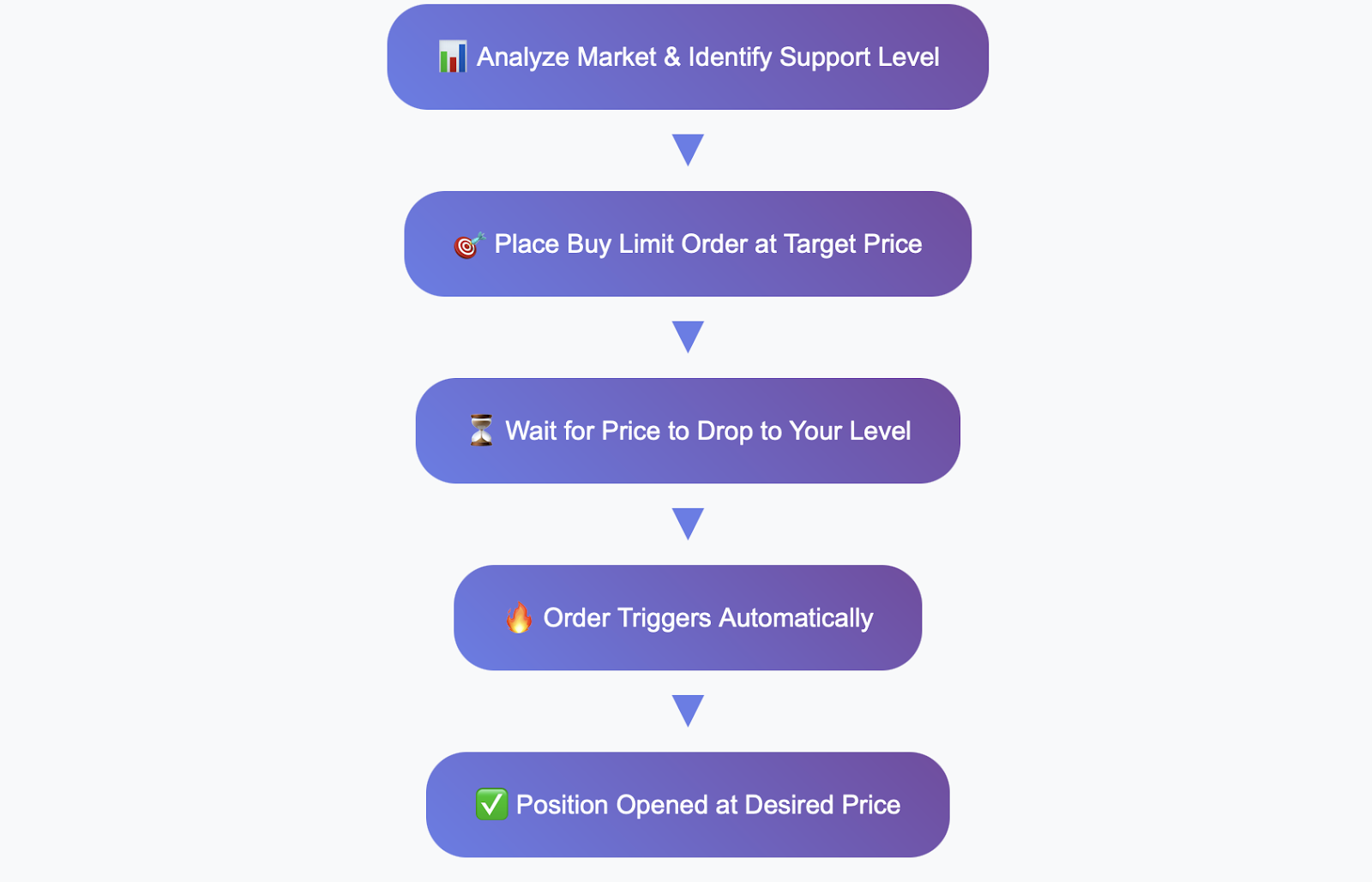
Let us look at it in action using an example. EUR/USD is trading at parity (1.1000). A trader notices strong support at 1.0950. They place a Buy Limit Order at 1.0950. Assuming that EUR/USD falls to 1.0950, then the Buy Limit Order will trigger. The trader has their position at their outlined price.
For beginners, think of it like this: you want to buy shoes for $60. You think they may go on sale for $50, so you have the store monitor the price, and automatically buy them when the price drops to $50 - that is essentially what a Buy Limit Order does.
The most important aspect of a Buy Limit order is the "price condition priority." Your order will only trigger if and when your price condition is met. This gives you control over your entry price.
Buy Limit Orders are always active. The forex market is always open, but you will always be sleeping. A Buy Limit Order watches the market for you and will activate when the time is right.
Comparing the Different Pending Orders
Understanding Buy Limit Orders means you must know how they compare to other types of orders. Each order type has different functions for trading.
Buy Limit - Buy Stop is the most important comparison. Buy Limit Orders are activated when the price declines to your level. Buy Stop Orders are activated when the price rises to your level. Buy Limit Orders are used for buying at lower price levels. Buy Stop Orders are used for buying a breakout.
For example, suppose the EUR/USD is trading at 1.1000. A Buy Limit order at 1.0950 is activated if the price drops to that level. A Buy Stop order at 1.1050 is activated if the price rises to that level. Buy Limits and Buy Stops work in the opposite direction.
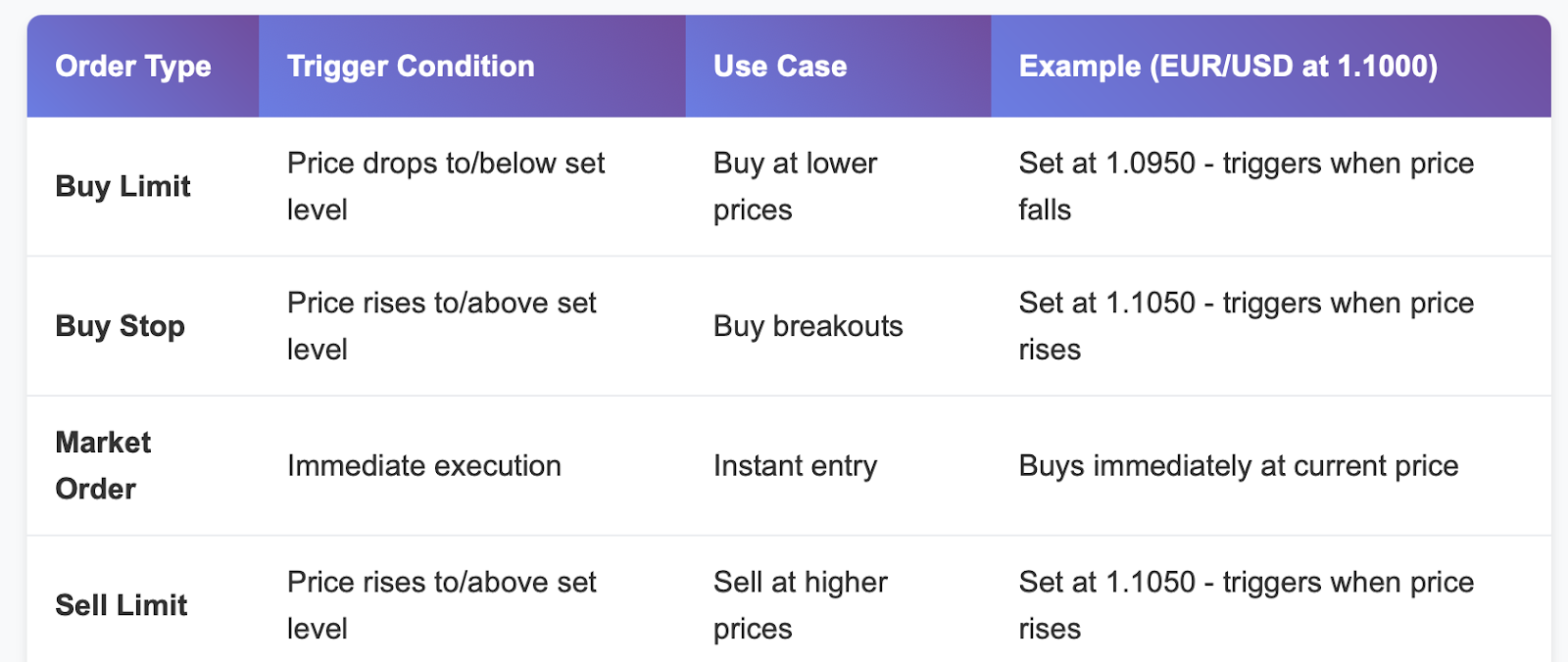
Buy Limit - Sell Limit has the same mirror logic. Buy Limits are waiting until prices are lower to buy. Sell Limits are waiting until prices are higher to sell. A buy limit order is used for entering long positions, and a sell limit order is used for entering short positions.
When it comes to using a Buy Limit vs Market Orders, the difference is timing. With Market Orders you get the current market price with immediate execution. With Buy Limit orders your order will only execute if the market trades down to your price. Market Orders guarantee execution with no price guarantee. Buy Limit Orders will guarantee your price with no guarantee of being executed.
When to use each types of order? When you have a Buy Limit order you might expect price may pull back before price goes higher. When you use a Buy Stop you might expect price to break through resistance and continue to rise. When you use Market orders you need to enter positions immediately.
The practical difference matters because that can matter to your profits and how you trade. For example a Buy Limit order at 1.0950 may save you 50 pips in price from a to buy Fill Market order at 1.1000 which is money in your trading account.
Buy Limit orders help with slippage. Slippage happens when the order fills at at other than the expected price. Because buy limits only trigger at your order price (or better), slippage may be greatly reduced with a buy limit order.
The bottom line of Buy Limit orders is simple, you're buying at lower prices with good risk management. Buy Limit orders allow to have better entry prices, and follow your trading plan.
Integration with Technical Analysis
Buy Limit Orders are enhanced through technical analysis methods. Technical analysis gives you better levels to place orders. Support levels and trend pullbacks are great uses for Buy Limit Orders.
Support levels are truly awesome for Buy Limit Orders. Support is a zone where the price stops falling and changes direction to create a rise. When Buy Limit Orders are placed in combination with support levels, you set yourself up with a good chance of being filled at better pricing.
Chart patterns may also be nice opportunities for Buy Limit Orders. Double bottom patterns can be good Buy Limit opportunities. The second bottom, generally holds price around the same resistance level as the first bottom. A Buy Limit made at that price or close, can give you an entry.
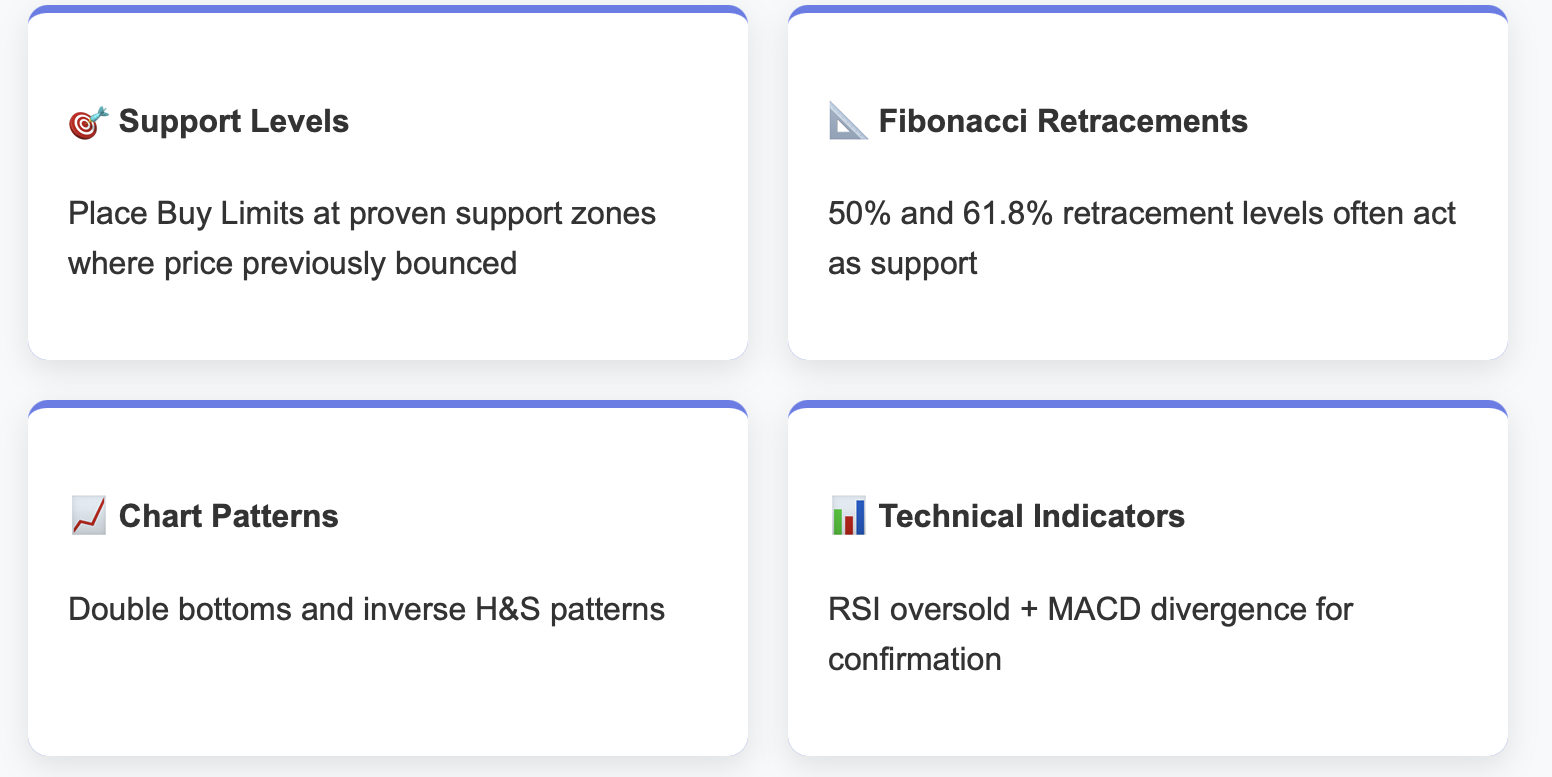
Inverse head-and-shoulders patterns too, create great opportunities for Buy Limit Orders. Typically, the formation of the right shoulder will hold price at or near the same level as the left shoulder, and a buy limit at this level can allow for entry and take advantage of this reversal pattern.
Pullbacks within a trend are a great setup for placing Buy Limit Orders as well. After a pullback during a trend, prices will typically pullback to a good support level before it continues higher. Buy Limit Orders placed on these pull back zones can get you positioned for continued upward trending price action.
Learn to use technical indicators to narrow down your exact Buy Limit location. RSIs reading oversold can give you additional confirmation of a support level for your Buy Limit. If the RSI gets below 30 and is situated at the identified support level, it could be interpreted as a possible end to the pullback.
You could also identify an MACD divergence. If the price makes a lower low and the MACD makes a higher low, this could signal a reversal of trend. Placing your Buy Limit at the very same support level that you identified could provide a good chance of execution.
Aside from being a place to potentially place a Buy Limit, Fibonacci retracement levels are also a favourite stop when used for Buy Limit Orders. The 50% and the 61.8% retracement levels often show as support on pullbacks. Professional traders generally place Buy Limit orders at mathematical retracement levels.
You could visualize what I am describing in a professional context based on this example: EUR/USD pulls back whilst approaching the 61.8% Fibonacci retracement level at 1.0920. A trader may want to place a Buy Limit at 1.0915, just below the Fibonacci retracement level. This way, they may have a higher probability of getting filled if the level holds.
To relate this back to you, think of it as just waiting at a bus stop. You know the bus comes to this stop, not down the street, so you wait there instead of chasing after it down the road. The strategy behind technical levels at tiered price action, is that they show you where price stops to order or large limit buy.
Buy Limit Orders embody intended trading with discipline. Instead of trying to figure out where price is going to go, you analyze the market technically to determine levels of price where you have a high probability of being right. Then you wait patiently for price to come to you.
Pros and Cons of Buy Limit Orders
Buy Limit Orders have some significant advantages that commonly attract traders, and they have well-defined disadvantages that you should also consider.
The first advantage is a better entry price. A Buy Limit's allows you to buy at a price you have selected instead of whatever price is available at this moment. This means that you are often much better off on your set-up than someone who buys at market price, but this may not always happen.
Buy Limits also lead to fewer impulsive trades. Fast moving price action with a really sudden increase in price can lead traders to feel inclined to buy immediately, rather than waiting for an ideal entry point. Having a Buy Limit Order in place means you have to wait for a price you previously planned rather than "jumping" in on highly impulsive and regrettable impulses.
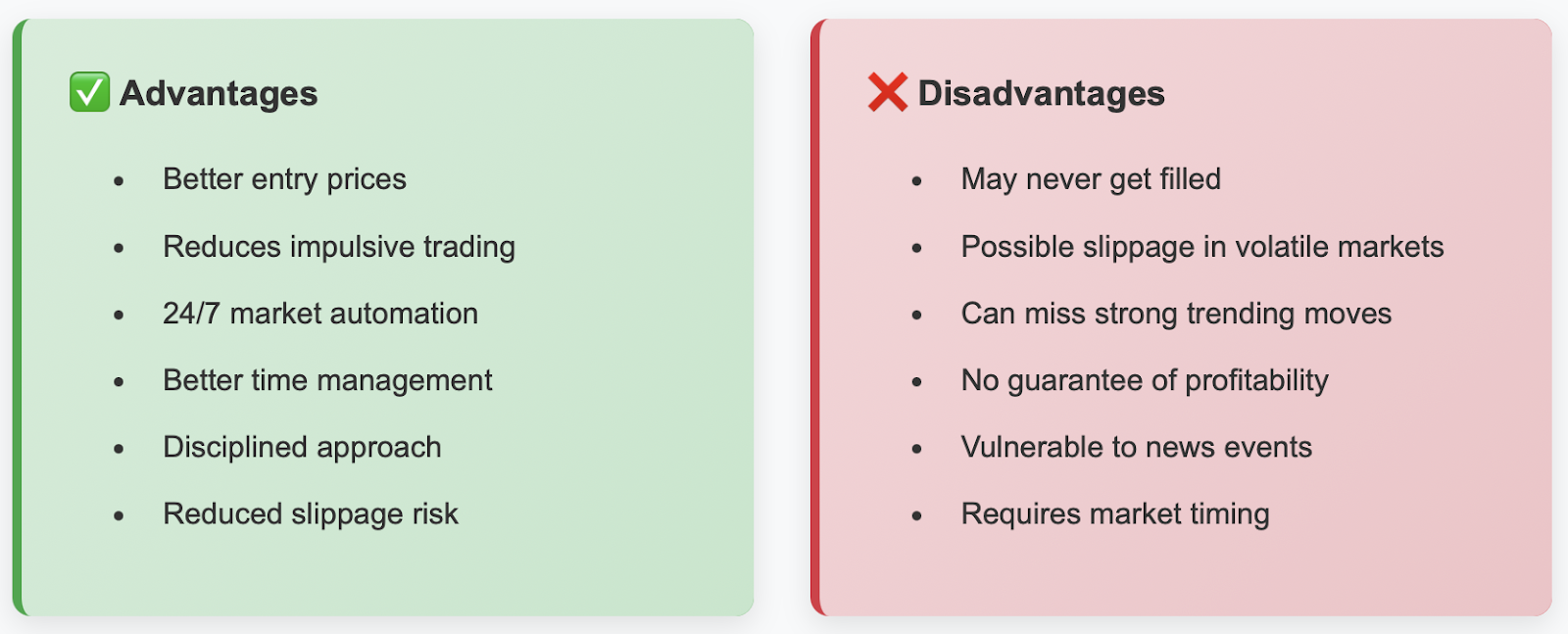
Automation is another significant advantage. You don't have to watch your computer all day waiting for something to happen and to get engaged in the market! In fact, your Buy Limit is watching the market all day^ and when the time is right, it will let you know by triggering a buy.
Buy Limits improve time management. Forex is a market that trades 24 hours now, however you can't trade 24 hours, there will always be times when you are busy, sleeping, or can't trade. Using Buy Limit Orders allows you to participate in those opportunities you may have missed while at school, sleeping or at work.
Disadvantages are important as well. Simply stated, your Buy Limit may never get filled. If the price does not drop to your level, your trade will be considered missed. There is nothing more frustrating when your price reverses just above your Buy Limit.
Slippage can also happen in a Buy Limit Order. When you enter a Buy Limit Order in a fast-moving market, sometimes you may get filled at a price slightly worse than expected. In a news event, this is somewhat common.
Missing trends is another risk. If you set your Buy Limit too far away, you could miss an extremely strong move upward, while you are waiting on your 'better' price point, your opportunity may pass you by badly.
Placing a Buy Limit does not guarantee your trade is going to be profitable. Having the opportunity for your trade to get filled at your predefined level is important, and ultimately that is just the first step. The market could still fall after your order gets triggered.
In "real life" risk scenarios often involve news events, for example; economic announcements can cause huge gaps in price. Your Buy Limit may trigger just before the bad news rolls out and prices drop further.
There is no single type of order in trading because the best option depends on your strategy, the market conditions and your trading personality. Buy Limits can be great for patient traders that like to take their time before they buy in.
Real World Case Studies
Let's see real examples of Buy Limit Orders in action. You will see both successful trades and failed trades so you can be informed.
In case 1, the Buy Limit Order is successful. GBP/USD was in an uptrend at 1.2500. The trader recognized 1.2450 as support from the previous price action. He placed a Buy Limit Order at 1.2450, 1.2400 as a stop loss and 1.2550 for the target.
Price then pulled back over the next few hours and touched the 1.2450 level. The Buy Limit Order was triggered and the trader had a long position. Price then held at the support zone and bounced up, hitting the target of 1.2550 for a profit of 100 pips.
The trade worked because the trader identified a valid support level, and also used risk management properly with a stop loss. The pullback that occurred was normal based on the previous uptrend prior to the trade entry, so price continued upward from the support level.
Case 2 illustrates an unsuccessful Buy Limit Order. The EUR/USD pair was 1.1000 and the trader saw 1.0950 under its previous reports - support. The trader established a Buy Limit Order at 1.0950 with a stop loss at 1.0900 and a target at 1.1050.
Price dropped, and stopped at 1.0950 and triggered the Buy Limit Order at 1.0950. The trader got their position at their planned price. Then bad economic news was announced and price crashed underneath what they thought was the support level. The Stop Loss triggered at 1.0900, this was a 50-pip loss.
The trader's trade failed because fundamental news overwhelmed technical support. The trader did not do anything wrong with the setup or risk management aspect. Remember sometimes external factors destroy good technical levels.
The lesson in both cases is to remember risk management. One trade made 100 pips in profit. The other trade lost 50 pips. Even with a 50% win rate, this trader would be taking home profits.
Another lesson is that Buy Limit Orders do not forecast the future. They will just help you get positioned at the best prices. What happens after that is reliant on many factors that you cannot control.
Setting proper stop-losses is important when using Buy Limit Orders. The order may get triggered at a good level, but the market still can move against you. The stop-loss allows you to avoid large losses.
The targets have similar importance. You need to define your exit before entering the trade. Don't hope for the best after your Buy Limit gets executed.
These examples show that successful trading involves managing many trades over time. No single trade is responsible for your success or failure. Proper risk management and realistic expectations are more important than predicting the market accurately.
Advanced Applications
With certain market conditions and trading environments, Buy Limit Orders can get a little more complicated. Advanced traders must know what situations will lead to complications.
In high volatility periods, there are some unique challenges for Buy Limit Orders. During important news events, like NFP (non-farm payrolls) or central bank announcements, prices may change really fast. Your Buy Limit may get triggered just before a massive move against you.
For example, let's assume the EUR/USD is trading at 1.1000. A few minutes before an ECB announcement, you decide to place a Buy Limit at 1.0950 because you believe there will be a pullback and reversal.
However, the ECB surprises the market with a hawkish policy announcement, causing the EUR/USD to spike to 1.1100. Your Buy Limit never triggers and you miss out on the move.
On the flip side, the ECB announcement can also be dovish. In this case, the EUR/USD could crash to 1.0900 prior to your Buy Limit. Your Buy Limit is hit at 1.0950, but the price continues to fall. They you are left with a losing position and a volatile market.
Not only do algorithmic systems and Expert Advisors (EAs) use Buy Limit Orders differently than retail traders, EAs can have hundreds of Buy Limits across multiple currency pairs and multiple timeframes. EAs will utilize mathematical models to calculate the best placement levels.
Institutional traders do use Buy Limits to scale or enter large positions in one step. When a bank wants to buy 100 million euros, they cannot just go ahead and press buy with a Market Order. Any buyer in the market will move the prices of the euro quite substantial. Instead, they will enter Buy Limits perfect for larger orders.
Retail traders mostly will use Buy Limit Orders to establish a single position on a selected major currency pair. Institutional traders would use them to establish a position on an exotic pair, buy a position during an ideal session relay, or establish their positions as part of a complex exit strategy.
The primary differences are scope and complexity. Retail Buy Limits are concerned with individual trading opportunities while an institutional Buy Limit Order is part of a portfolio management plan.
In the forex world, market makers would rely on Buy Limit Orders to enhance the liquidity of the market. They place Buy Limit Orders below current price levels and Sell Limit Orders above it. This creates a spread and helps maintain an orderly market.
Understanding all these advanced applications helps you to understand the larger picture. Your Buy Limit Order is only a small part of a much larger market ecosystem.
Buy Limit Orders do not work in all market conditions. They work perform well in ranging markets and regular pullbacks. They perform poorly in trending market with thrusting moves in one direction, or on major economic news events.
Trading Psychology and Buy Limit Orders
Trading psychology is one of the most important factors to successful forex trading. Buy Limit Orders help eliminate several trading psychology problems that novice traders experience.
Fear of Missing Out (FOMO) is one of the biggest problems for a new trader. You see a currency pair start to move to the upside and you feel the pressure to hop on board and buy right away. This often leads to buying exactly at the worst time, just before a pullback or reversal!
Buy Limit Orders eliminate FOMO by forcing you to wait for price to come to you. Instead of chasing price, you let price come to you. As a trader this is a very significant change that can impact your trading results tremendously.
The psychological difference from a beginner's mindset and a professional's is immense. When a beginner sees price begin to move higher, they instantly start thinking, "I need to get in before it goes higher!" The professional who sees the same movement would think, "I'll wait for a pullback to my level."
This difference in thought process separates the profitable trader from the losing trader. Buy Limit Orders re-train your mind from thinking like a beginner to thinking like a professional trader.
Emotional trading is another massive problem for traders. If you are looking at charts all day long, every movement in price is going to affect your emotions. A small move up is going to get you excited and a small move down is going to cause you concern. You will be on an emotional roller coaster which obviously has negative impacts on your trading and decision-making process.
Buy Limit Orders significantly reduce emotional stress. You'll have your Buy Limit Order set and you just walk away. You're not going to be watching every pip go up or down or second guessing yourself. Your emotional stress will be taken away, and you can then focus on making the better decision.
Patience is arguably the most important trading skill. Markets typically are consolidate and/or small moves for most of their time. The number of profitable big moves is rare. Buy Limit Orders force you to be patient for a high-quality opportunity.
To put it in behavioral terms, an emotional trader sees EUR/USD moving up and impulsively buys at 1.1000. In contrast, a disciplined trader places a Buy Limit at 1.0950 and waits for the market to come back for them. If the market pulls back to 1.0950 it was worth the wait, the disciplined trader is sitting on a 50 pip advantage.
Buy Limit Orders can also be helpful with overtrading. If you are waiting for a specific price, you will naturally trade less often. Trading less often can ultimately yield better results since you are only taking the best (highest quality) setups.
The psychological benefit of getting filled at your price objective could not be understated. If nothing else, you know you got the best possible entry price even if the trade does not work out. It reduces "buyer's remorse" and allows trades to unfold according to your strategy.
Buy Limit orders are disciplined oriented mechanisms, they force you to pre-plan your trades and adhere to your plan. This is one of the biggest skills to being a successful trader.
Best Practices & Practical Tips
Setting up your Buy Limit Orders correctly is a matter of knowing your trading platform and employing well-established practices.
Most retail traders will have used MetaTrader 4 or MetaTrader 5. To place a Buy Limit on MT4, all you have to do is right-click on your chart and go to the 'Trading' tab, then choose 'New Order'. When the New Order window appears, select 'Pending Order' and in the dropdown box, select 'Buy Limit'. You can then enter your desired price, lot size, stop loss, and take profit.
If you're using TradingView, you can also select a Buy Limit, provided you have your TradingView account connected to a broker. Simply press its 'Buy/Sell' button, select 'Limit' order type, then enter your desired price below the market price. You can then set a stop loss and take profit before you place the order.
Keep in mind, different currency pairs behave differently, so change your strategy where needed. Major pairs such as EUR/USD, GBP/USD, and USD/JPY usually adhere to technical levels better than exotic pairs. Therefore, your Buy Limit orders will have better chances on these pairs.
When working with exotic pairs – for example, USD/TRY or EUR/ZAR – the spreads are usually larger (even 10-15 pips), and the price action will be less predictable. Be more cautious with setting Buy Limits on these pairs and consider making your stop losses larger.
The time of the day is relevant for Buy Limit Orders. Generally, the London and New York trading sessions have the greatest volume and liquidity, which increases the chances of filling a Buy Limit order at a good price.
The Asian session is quieter, which may be beneficial for Buy Limit Orders. The price movement is often smaller and less erratic at this time.
It is suggested that traders practice with a demo account before trading with real money. Place some Buy Limit Orders in the demo account, and pay attention to the way the orders fill. Recognize which setups are working and which setups consistently fail.
Additionally, keep a record of all your Buy Limit Orders, including the currency pair involved, entry price, stop loss and take profit, and the rationale behind the trade. This journal can be a useful tool when checking in on what is working and what is not.
Be mindful of position sizing when placing Buy Limit Orders. Just because you have a good entry price does not mean you should risk more money. Follow your normal position sizing rules based on your stop loss.
Always set stop losses with your Buy Limit Orders. Don't assume getting filled at a good price equals a profitable trade. The market could easily keep moving against you from an entry you thought was good.
The demo-to-live moment is critical. You must start in small position sizes when you begin to use Buy Limits with real money because your psychology instantly changes when money is on the line running the same naked chart strategy.
Common Errors
New traders make several predictable errors with Buy Limit Orders. The sooner you learn about these errors, the better you will be at avoiding costly mistakes.
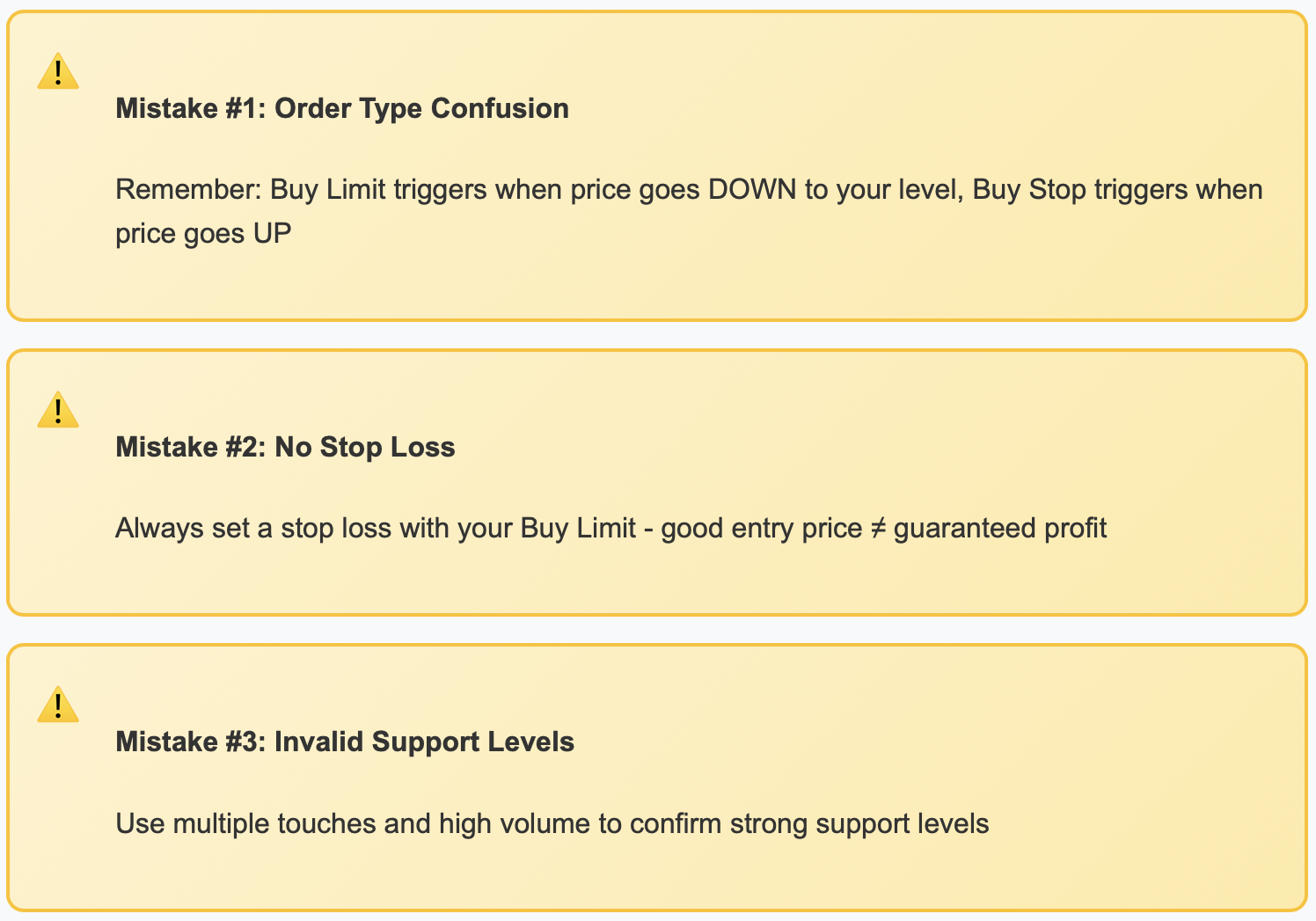
Mistake 1: Confusing Buy Limit and Buy Stop Orders
Note that this confusion costs traders money because the orders work in opposite directions. Remember: Buy Limits are triggered as price goes DOWN to your level, and Buy Stops are triggered as price goes UP to your level.
Here's how this error occurs: EUR/USD is at 1.1000, and you think the price is going to break through the 1.1050 resistance. You accidentally put in a Buy Limit at 1.1050 instead of a Buy Stop. Your Buy Limit will never trigger because Buy Limits only work when the price is below the current level.
Mistake 2: No Stop Loss with Buy Limit Orders
Some traders think that simply being filled at a good price means they don't need a stop loss. Not true; even the best prices (filling levels) can lead to losses due to a change in trend.
If you want to maintain discipline, always set your stop loss at the same time as you place a Buy Limit Order. Don't wait to see how the trade develops once you're filled because your exit strategy should be based on your analysis before you enter your position.
Mistake 3: Placing Buy Limits at Invalid Support Levels
Not all support levels are created equal. Some support levels are considered strong and most probably hold from the price action perspective. Others are weak and most probably fail. Technical analysis is the only way to determine if a support level is considered strong or weak.
Support levels based off the price action may have numerous or relatively strong touches, high volume, and be confluence with other technical factors. On the other hand, we can see a support level based off just one unique touch at a higher price point or just based on wishful thinking.
A perfect example would be setting a Buy Limit at a support level that only bounced once and at a very short distance before continuing on its price journey. In these sorts of instances, we would suggest waiting for confirmations multiple times than simply a single price action touch or at least strong technical evidence.
Mistake 4 - Setting Buy Limits too far away from the current price
If EUR/USD is currently at 1.1000, don't place a Buy Limit at 1.0800, as you may wait forever for a fill. "Your order is too far off that you will miss almost every good trading opportunity."
Keep your Buy Limits relatively close to the current price levels, a good rule of thumb is within 100-200 pips for major currency pairs based on the most recent volatility.
Mistake 5 - Not factoring in market conditions
Buy Limit Orders can work better in some market conditions than others. They work very well when the market is in a range, or a normal pullback. They don't work well while being a strong trend.
Learning to identify when the market conditions favor your Buy Limit Orders strategy and when to avoid it, will come with time and practice observing the market.
Having an understanding of these typical mistakes will allow you to utilize Buy Limit Order more effectively. Because each mistake serves as a lesson learnt through the experience of other traders, you can profit from it without paying the price.
Final Thoughts
Buy Limit Orders bring together the three essential trading components of planned entries, risk management, and trading efficiency. Buy Limit Orders allow you to buy currency pairs at your desired prices, not chase your setups during market action.
Buy Limit Orders are best suited for those who have pre-planned strategies and trading plans. They are not for traders who like to respond quickly to market news or like to trade on impulse.
The most critical fact about Buy Limit Orders is that they must be used as part of a complete trading system. Buy Limit Orders will allow you to get good entry prices but you will still need to manage risk effectively, have clearly identified profit targets, and be able to apply technical analysis successfully.
No matter what order type you are using, risk management should always be your first priority. A Buy Limit Order that you've placed at a perfect technical level can still result in a loss if the market moves against you. Clearly defined stop losses, intelligent position sizing and should be used, and money management are rules that should be applied to all trades.
Technical analysis provides the framework for using Buy Limit Orders successfully. If you are picking random price levels often times the price level will not be very effective. Using tools you learned such as support levels, Fibonacci retracements and other technical analysis tools, Buy Limit Orders will help you identify higher probability entry price points.
Buy Limit Orders are a way to help disciplined traders execute their strategies, not a way to turn a bad strategy into a good one or a substitute for knowledge and skill in the market.
Get some practice on demo accounts before putting any real money on the line. Buy Limit Orders seem very easy in theory, but need to be used with experience. There is no better way to practice than on demo without any financial ramifications.
The forex market is very conducive to a lot of opportunities for Buy Limit Orders. Currency pairs will move into pulls back regularly, which creates a number of options for the disciplined trader to enter the market. The idea is to determine which pullbacks offer the trader a reasonable risk-to-reward opportunity.
Your success in trading is dependent more on discipline and risk management than the pick of entry time. Buy Limit Orders can assist in entry timing, but in actuality are just a small piece of the puzzle in regards to your overall trading.
And lastly, always remember no order type is going to work in all market conditions. Buy Limit Orders shine in good market conditions, and will perform poorly in others. Spend some time learning what order types work best with the current market conditions with tradewill.com, this is an advanced skill to match your order type to market conditions, but it is useful.
Disclaimer: The content of the blog does not represent any position of Trade W, does not serve as any trading-related decision advice, and does not endorse any third-party.