

 Trade W
What is the CAC 40 Index?
The CAC 40 is the largest and best performing stock index in Europe. It tracks stocks of the 40 largest companies traded on Euronext's Paris Stock Exchange. It can be compared to S&P 500 in the United States and FTSE 100 in the United Kingdom.
It is also referred to by its French acronym 'Cotation Assistée en Continu' (translation: 'Continuous Assisted Trading') and has 40 Companies that comprise its composition. These include Major Companies like; LVMH, L'Oréal, TotalEnergies and BNP Paribas, which account for around 90% of the Paris Stock Exchange's total Market Capitalization.
The CAC 40 provides a good indication of how investors feel about the overall economy of France as it rises when investors are feeling optimistic about France's Economic Future, while it falls when investors lose faith in France. The Index uses Market Capitalization Weights to determine its movement by using the Market Capitalization of each company to weight their contribution to the Index's Overall Performance, as well as using a float adjusted Market Capitalization Method that only includes shares available for trading on a Publicly Traded Exchange.
Comparing CAC 40 to the S&P 500
The CAC 40 is different from the S&P 500 in many ways. First, the CAC 40 represents only 40 businesses; therefore, the CAC 40 index is much more concentrated and more vulnerable to significant change than S&P 500. Second, the sectors in which the CAC 40 predominantly represents are luxury items, oil and gas, and financial services, as compared to the predominance of technology companies in the S&P 500. Thirdly, markets in Europe react differently than the U.S. to global economic events; therefore, they create their own unique set of opportunities and risks for investors.
To use an example for students, think of your school as having 40 students in your class, and you want to find out how well your whole class is doing. Instead of averaging all their grades equally, you might instead weigh each student's grade based on their amount of participation in the class (an analogue for Market Capitalization). As such, the grades of students who participate most heavily in class will have more impact on the class average than those students who participate less.
The performance of the CAC 40 index has been erratic in the past five years, with a strong performance in the year 2024, but also declining due to COVID-19 and its effect on the economy during the year 2020. However, being aware of this performance history is essential for investors following this index.
Revenue Sources and Core Industries of CAC 40 Companies
The earnings of the CAC 40 are indicative of the various components of the French economy. Unlike the many technology-focused indexes, which have grown significantly, the CAC 40 consists of five primary categories of companies: luxury items, finance, energy, industrials and consumer items.
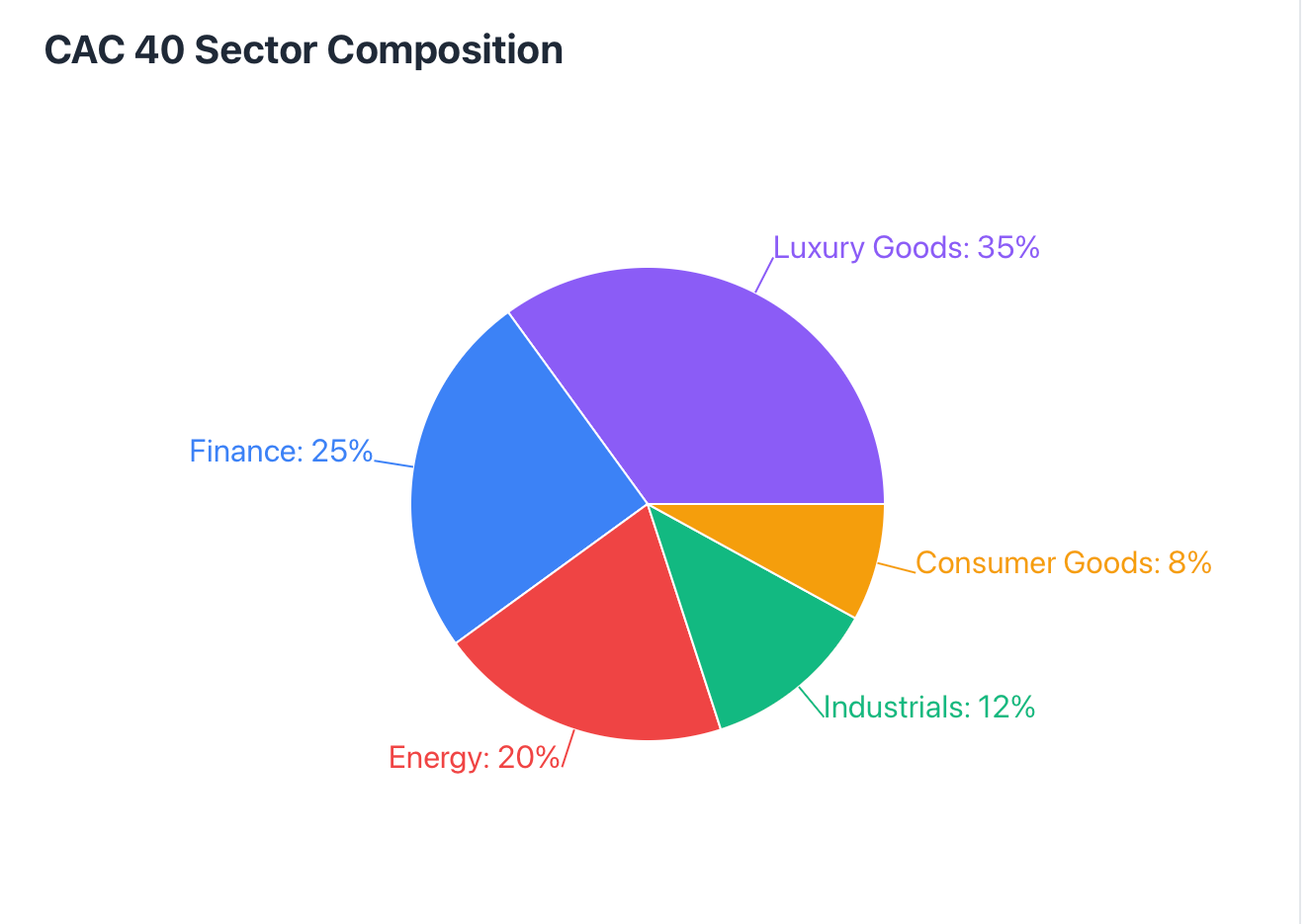
Luxury Items: The Crown Jewel of Luxury markets Worldwide
French luxury brands are considered to be the leaders of the world's luxury markets, with companies such as LVMH, Kering, and Hermès generating billions of euros in revenue through retail sales throughout Asia, Europe and North America. For example, the revenues generated by LVMH are derived from the sale of Louis Vuitton handbags in Shanghai, Moët champagne in New York City and Sephora cosmetics in Paris, as well as the wholesale distribution of their products through department stores and other retailers across the globe. They are also able to achieve high profit margins through direct sales to consumers via their various flagship stores and electronic-commerce sales.
Finance: A Stable Source of Revenue for Financial Institutions
The revenue generated by the majority of the major French banks, such as BNP Paribas, Société Générale and Crédit Agricole, is primarily derived from the traditional banking services they provide to the public. These include both loan and deposit related services, as well as commissions from asset management, investment banking and insurance products. These banking institutions conduct their businesses throughout Europe and beyond and, therefore, reflect the condition of both the French economy and the overall stability of the European Union economy.
Powering Resources
As one of the largest companies within the CAC 40, TotalEnergies is representative of the energy sector’s influence. TotalEnergies makes money from oil and gas production, as well as refining operations. However, as the European Union works towards becoming carbon-neutral, it is important to consider how TotalEnergies' transition plan will affect its revenue sources along with the CAC 40 Index as a whole.
Understanding Revenue Like Personal Income
For those just beginning to understand how companies earn Revenue should think of a company’s Revenue Sources in the same way as individuals earn wages. For example, a person may work part-time (Primary Revenue Source), receive gifts on their Birthday (Secondary Revenue Source) and receive a Scholarship (Special Revenue Source). Similarly, companies also try to "diversify" their Revenue Sources. In addition to making handbags, LVMH owns and operates hotels, produces watches and creates Champagne. Diversity creates additional safety nets during low periods in a specific market.
Understanding the different sectors of Industry is vital because of the different reactions each Industry has to Economic Conditions. For example, Luxury Goods flourish when the High-End Consumer is feeling good about themselves and their financial situation. Financial Institutions profit when the market has stable Interest Rates. The Energy Sector is influenced by Global Commodity Prices. By investing in a CAC 40 ETF, you're betting on this entire mix rising over time.
Gross Margin and Profitability of CAC 40 Companies
A company's gross margin is a measure of how much money a company keeps after paying the direct costs incurred to produce its products or services, providing insight into a company's operational success and ability to price its products favorably.
In fact, there is wide variance between gross margins for the various industries making up the CAC 40. For example, luxury goods manufacturers, such as LVMH, have gross margins exceeding 65%. Because many consumers pay for prestige when purchasing luxury items, luxury manufacturers can set prices significantly higher than their production cost. For example, the production cost of a Louis Vuitton handbag could be approximately $200, but its sales price could be $2,000. Therefore, luxury goods manufacturers have a very strong pricing power.
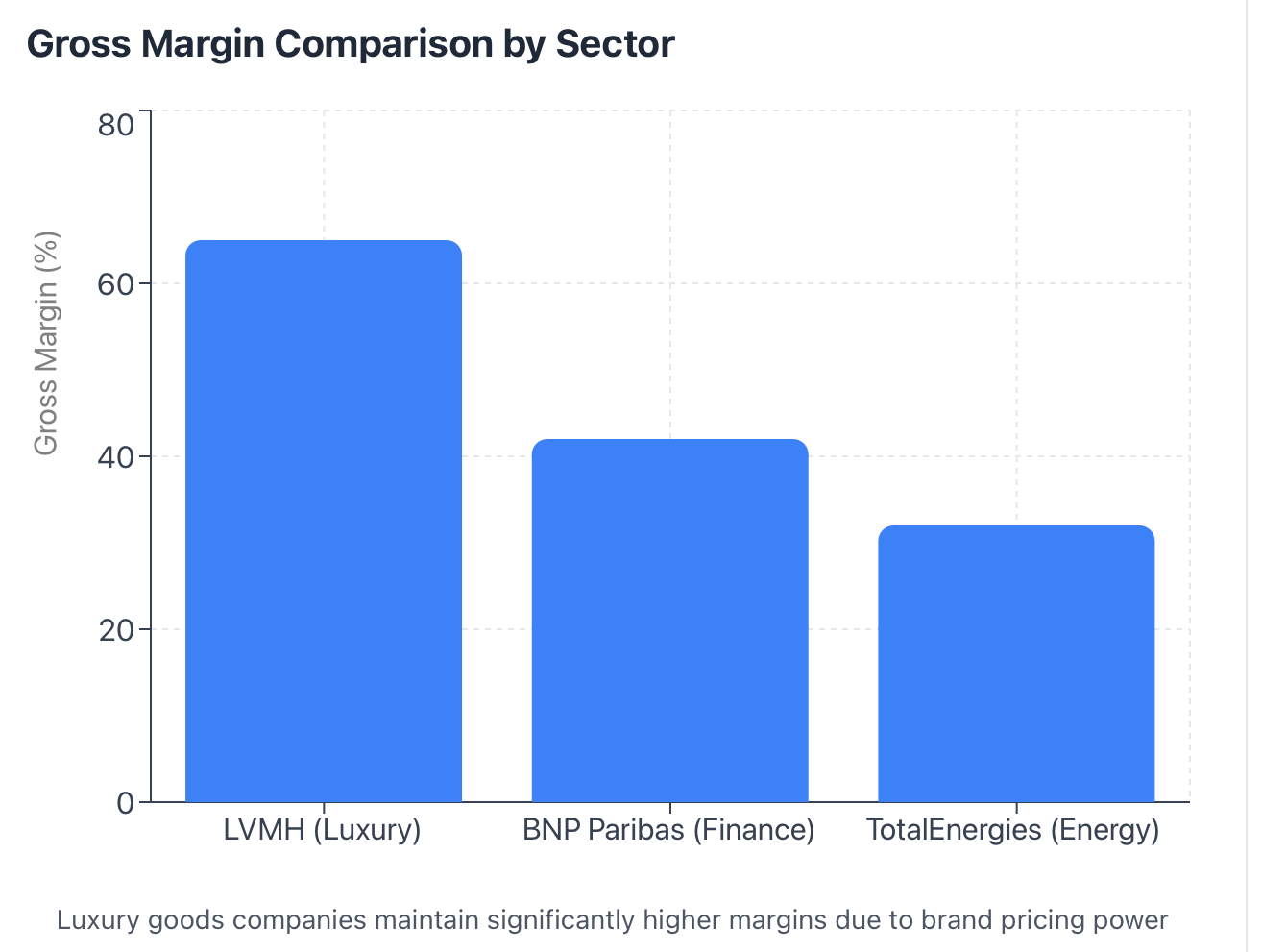
In contrast, TotalEnergies, which falls into the energy industry category, operates on gross margins between approximately 30% and 35%. The energy sector generates revenues through volume and scale, rather than through premium pricing, and is generally a commodity-based industry with narrow gross margins. Usually, banks, such as BNP Paribas, fall between luxury and energy companies with gross margins of approximately 40% to 50% (depending upon the mix of businesses).
A Simple Example
You could start by saying that if you were to sell lemonade for $2, it would cost you $5, netting you a gross profit per cup of $3, giving you a 60% gross margin ; a mark of a luxury good. However, if you could only sell the lemonade for $3 you'd only have a 33% gross margin, similar to that of an energy company. A higher gross margin creates more of a cushion if costs keep increasing or your sales slow down.
What to Look At When Analyzing Your Gross Profit
To properly evaluate a business's profitability metrics, investors look at net profit margins (the total money remaining after all the expenses have been paid including taxes), return on equity (ROE, which measures the efficiency of how a company utilizes its shareholders' resources, ROE, is typically above 20% for retailers, for every dollar of shareholders' equity, LVMH generates $20 gross profit) and return on assets (ROA, which measures the efficiency of how well assets generate profits). The ROE of LVMH is generally above 20%, which means that for every dollar of shareholders' equity it generates $20 in profit. That's an exceptional result.
These metrics show how truly efficient a company operates and how many other LVMH companies leverage the tailwinds of their industry. Companies that maintain high margins and returns will generally have competitive advantages that justify a higher price-to-earnings ratio. When evaluating the CAC 40 in comparison to other companies, it's important to keep in mind that luxury companies push up average profitability ratios and explain the higher price-to-earnings ratios.
Growth Drivers of the CAC 40 Index
The CAC 40 derives its value from a variety of influences that act together to push the index higher or lower.
Domestic Economy of France
The GDP growth of France directly impacts the CAC 40 companies. As the economy of France grows, there will be an increase in consumer spending on luxury goods, banks will have more available money to lend, and manufacturers and industrial companies will have more order placements. There are several indicators that provide insight into future movement of the CAC 40, including consumer confidence ratings, unemployment rate, and retail sales data.
Global Economy
For many companies listed on the CAC 40, 50%-60% of their total revenue is generated from markets outside of France. For example, LVMH depends on the sales of its products to luxury consumers in China, and TotalEnergies sells its energy products and services globally. Thus, CAC 40 companies are responsive not only to the economy of France, but also to the global economy. Therefore, a recession in China may severely harm the stock prices of luxury goods companies, even if the economy of France is experiencing growth.
Corporate Finance and Interest Rates
The actions of the European Central Bank (ECB) affect the CAC 40 companies and stock values. When the ECB lowers interest rates, it creates a situation where it is cheaper for businesses to borrow money to finance their business operations, potentially increasing their profit margins and increasing the value of their stock. The lower interest rates created by the ECB will also cause the yield on bonds to decrease, causing investors to shift their investment preferences to stocks instead of bonds. Conversely, an increase in interest rates created by the ECB would create the opposite effect on the stock market. Higher interest rates will have an appreciable effect on bank earnings in the short term, but will likely have an adverse impact on banks as the economy slows down.
Industry-Specific Trends
Each of these sectors operates with their individual growth drivers: Luxury Goods in Emerging Markets due to the rise of disposable incomes; Technology Companies (while under-represented in the CAC 40) through innovative development, and Energy Companies transitioning to Renewable Energy Sources while maintaining their Fossil Fuel business. By becoming familiar with the above trends that pertain to a specific Sector, one can make predictions on which of the CAC 40 Companies will be key in generating Superior Returns.
The relationship with the CAC 40 is similar to School with the classroom representing all the companies in the CAC 40. The quality of a Teacher (Monetary Policy) combined with the availability of Resources from the School (Domestic Economy) will determine the success of Students at home (Global Economy) and within the classroom (Company-Specific). When these components are acting positively, the CAC 40 increases.
The period between 2020 and 2025 saw the CAC 40 grow as a result of the Pandemic Recovery, Volatility of the Energy Market, Resilience of Luxury Goods, and Uncertainty in the European Economy. Those who were aware of the aforementioned Drivers could time their entry and exit.
Historical Performance and Volatility of the CAC 40
An annual return of 6-8% Average return of approximately 6-8% annually on the CAC 40 for the past 20 years (including dividends) does seem stable; however, the journey to that return has experienced tremendous fluctuations.
Major Events That Shook the Index
The major catalyst for the fluctuations on the CAC 40 has been the global economics crisis in 2008, which caused a 40% decrease in the CAC 40 index due to banks collapsing and the international trading market being frozen. The 2011/2012 Eurozone financial debt crisis continued the negative trend because of uncertainties about the eurozone's future viability. Coronavirus in 2020 was the most recent shock to the CAC 40, as it caused a drop of 30% over a period of weeks with the subsequent bounce back due to massive stimulus by central banks and an expectation of a vaccine being available.
2022 brought both geopolitical turmoil and the ongoing struggle for European energy security and this led to many fluctuations in the CAC 40. Luxury goods companies outperformed expectations; however energy providers continued to fluctuate dramatically.
Understanding Volatility
Volatility indicates how much an index varies; due to its limited number of stocks (40), and to a greater extent by the amount of weight given the sectors that are impacted by economic cycles, the CAC 40 experiences greater volatility than the S&P 500. In simpler terms, it is like riding a roller coaster, while the S&P 500 has fewer ups-and-downs, CAC 40 has frequent high points and low points.
For investors, maximum drawdown tells you of the steepest drop from peak-to-trough experienced by an index, hence allowing them to prepare for the worst case. The maximum drawdown from the peak of the index during the 2008 financial crisis was greater than 50%; during the COVID-19 pandemic the drawdown was approximately 40%. By observing these extreme volatility levels, investors can evaluate their ability to withstand such decreases in value without emotional selling.
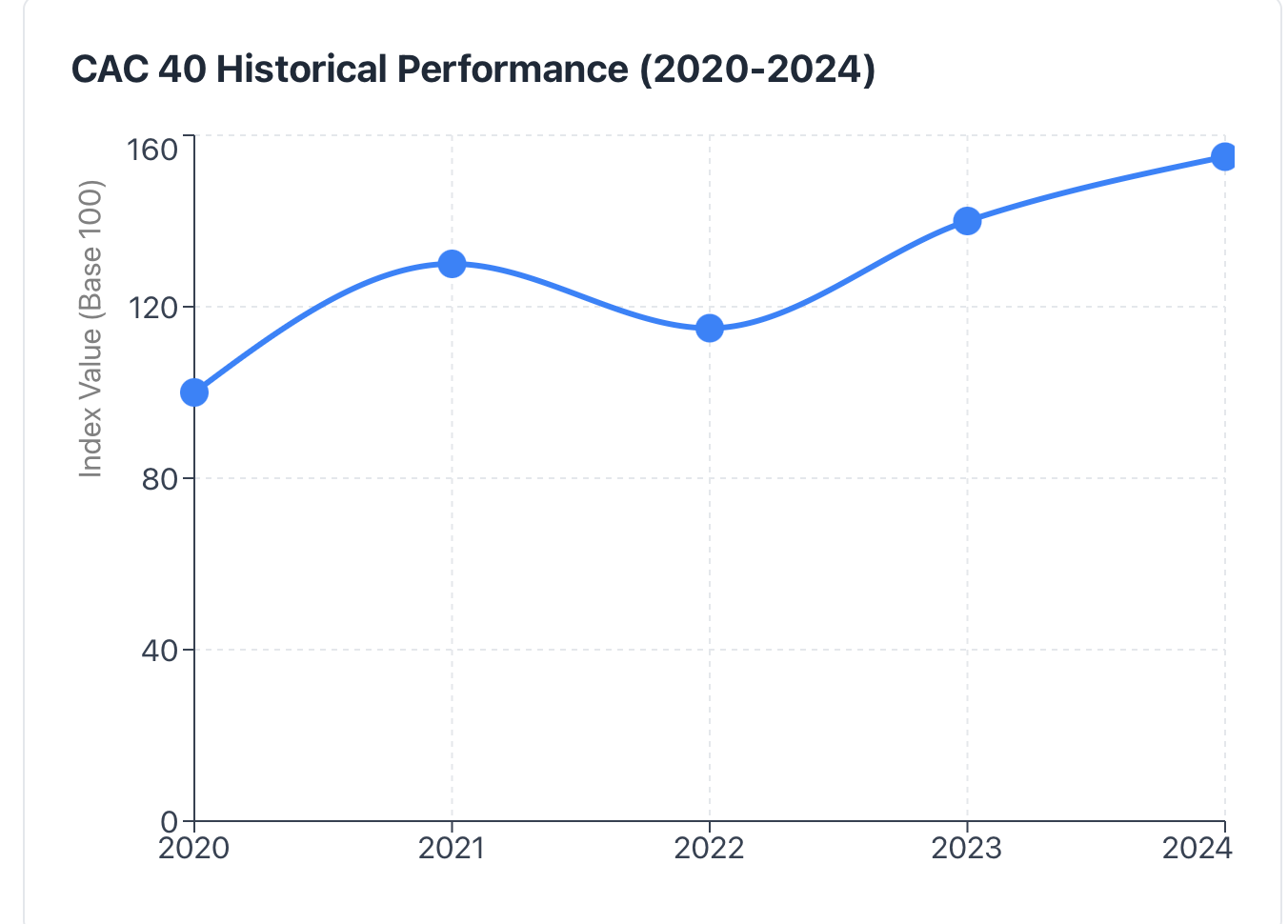
As a novice, the important point to take away is that short-term volatility is common and to be expected as a novice. However long term; what is concerning to an investor is the general trend in the appreciation of an index. Historically, following each crash of the market, the CAC 40 has benefited long-term investors who maintained their steadiness by returning to a new high.
Deep Dive into CAC 40 Components
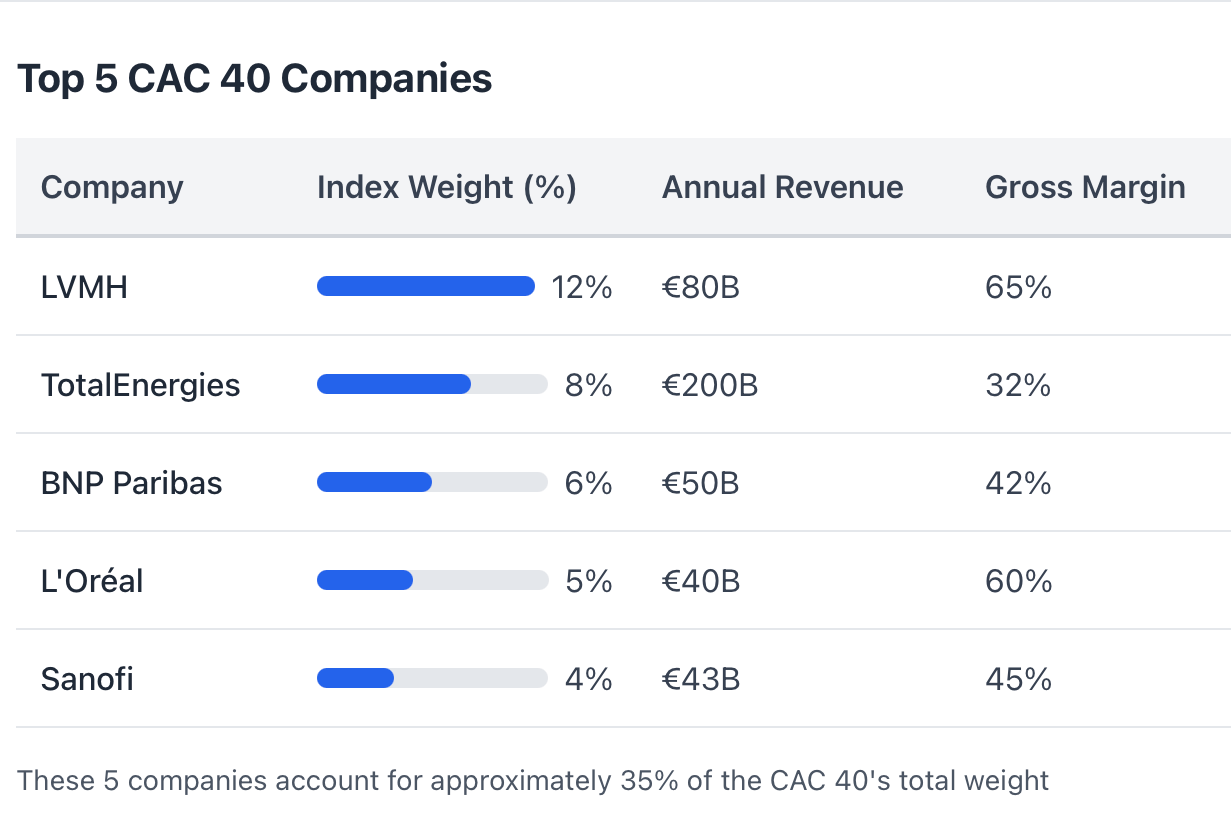
Five companies account for 30 - 40% of the total weight of the CAC 40. The performance of these companies is an important factor that ultimately drives the entire index.
LVMH is known as a "Luxury powerhouse".
LVMH has typically been the largest company on the exchange when measured by market cap. Their business encompasses 75 brands that include fashion, wines and spirits, perfumes, watches, and retail stores. In 2024, LVMH had revenues exceeding €80 billion and gross margins of over 65% and a net profit margin of about 15% and a return on equity (ROE) of more than 20%. LVMH follows the spending of Chinese consumers, but when they don't, their stock price declines.
TotalEnergies: The Energy Anchor
TotalEnergies is considered the "Energy Anchor" for the exchange, representing the 'old economy' energy business, but with a modern outlook. Although TotalEnergies revenue exceeds €200 billion, compared to LVMH, their gross margins are much lower, usually in the range of 30 - 35%. However, the transition to renewable energy sources will be the continuing path for future growth, even though oil and gas continue to drive TotalEnergies' profits. Prices for TotalEnergies stock will usually rise whenever crude oil prices defect higher.
BNP Paribas is a "Banking Backbone".
As one of the largest banks in Europe, BNP Paribas is a diversified financial institution. BNP has three main divisions: Retail banking (consumer banking), Corporate banking (Institutional banking) and Investment Solutions (buy-side). Like most banks, BNP receives most of its profits from interest rates set by the European Central Bank (ECB). BNP has gross margins of about 40 - 45% and ROE is usually around 8 - 10%.
Likening the CAC 40 to a classroom of 10 students and having 5 students who are truly above average and who can increase the overall class average when they do well when any of the top 5 students perform poorly the entire class's performance will decline; therefore, keeping track of LVMH, TotalEnergies, BNP Paribas, Sanofi, and L'Oréal is an easy way to get a feel for where the CAC 40 index is moving toward.
The following is a comparison of financial metrics for all of the companies in the CAC 40 index.
Revenue Growth
The expected average revenue growth rate for LVMH is approximately 10%-15% annually, while that of TotalEnergies is much more volatile and is primarily driven by fluctuations in the price of crude oil. The average annual revenue growth for BNP is approximately 2%-5% with gradual steady growth. The combination of these differing growth rates allows for a well-balanced index and does not offer an overwhelming dependence on the growth of one sector.
Global Factors Affecting the CAC 40
Global forces constantly exert both upward and downward pressure on the CAC 40 and French equities.
The Movement of Currencies
The movement of the Euro's value relative to other currencies is critical. Much of LVMH's revenue is generated in USD and CNY, so if the Euro weakens versus those currencies, it can cause an increase in Euro denominated revenue from foreign sales. Conversely, when the Euro strengthens, the amount of foreign sales converted to Euros will be reduced. Even minor fluctuations of the EUR/USD pair (i.e., 10% change) may have a material effect on luxury and energy company earnings.
Oil Prices and Commodity Prices
The price of Brent crude has a significant effect on TotalEnergies' Financial performance. In 2022, energy stocks rallied whenever the price of oil exceeded $120 per barrel. Conversely, when the price of oil declined substantially in the early days of the pandemic, energy stock prices also declined. Other CAC 40 constituents also see secondary effects. Increased oil prices result in an increase in transportation costs (e.g., shipping costs), which puts downward pressure on the margins of certain industrial companies.
Correlation to the U.S. Stock Market
The performance of the CAC 40 and the S&P 500 has shown that both indices are correlated (although not perfectly). Traditionally, when Wall Street is gaining, European markets follow suit. Though the Federal Reserve does not have an influence over European monetary policy, the level of risk aversion investors have globally is determined by U.S. economic releases and the monetary policy decisions of the Federal Reserve.
The Importance of China's Economy
The amount of business done in Greater China is significant for luxury brands; on average, they generate between 20-30% of their revenues from this region. When either the Chinese economy slows down or when there is a Pandemic-induced Lockdown, Luxury Brand Sales collapse. The CAC 40 has become reliant upon consumer confidence from China, making it different from many of the other domestic-based indices and making it uniquely vulnerable.
Think of external variables just as the weather influences the performance of a professional athletic team. Weather can potentially hinder teams’ ability to perform; for example, rain is a major factor in slowing down offensive teams (exporters). Similarly, the weather can help some players (consumers) and hurt others (energy companies), so the better an understanding of the weather, the better the chances you have for forecasting the outcome of a game.
Risk Management in Investing in the CAC 40
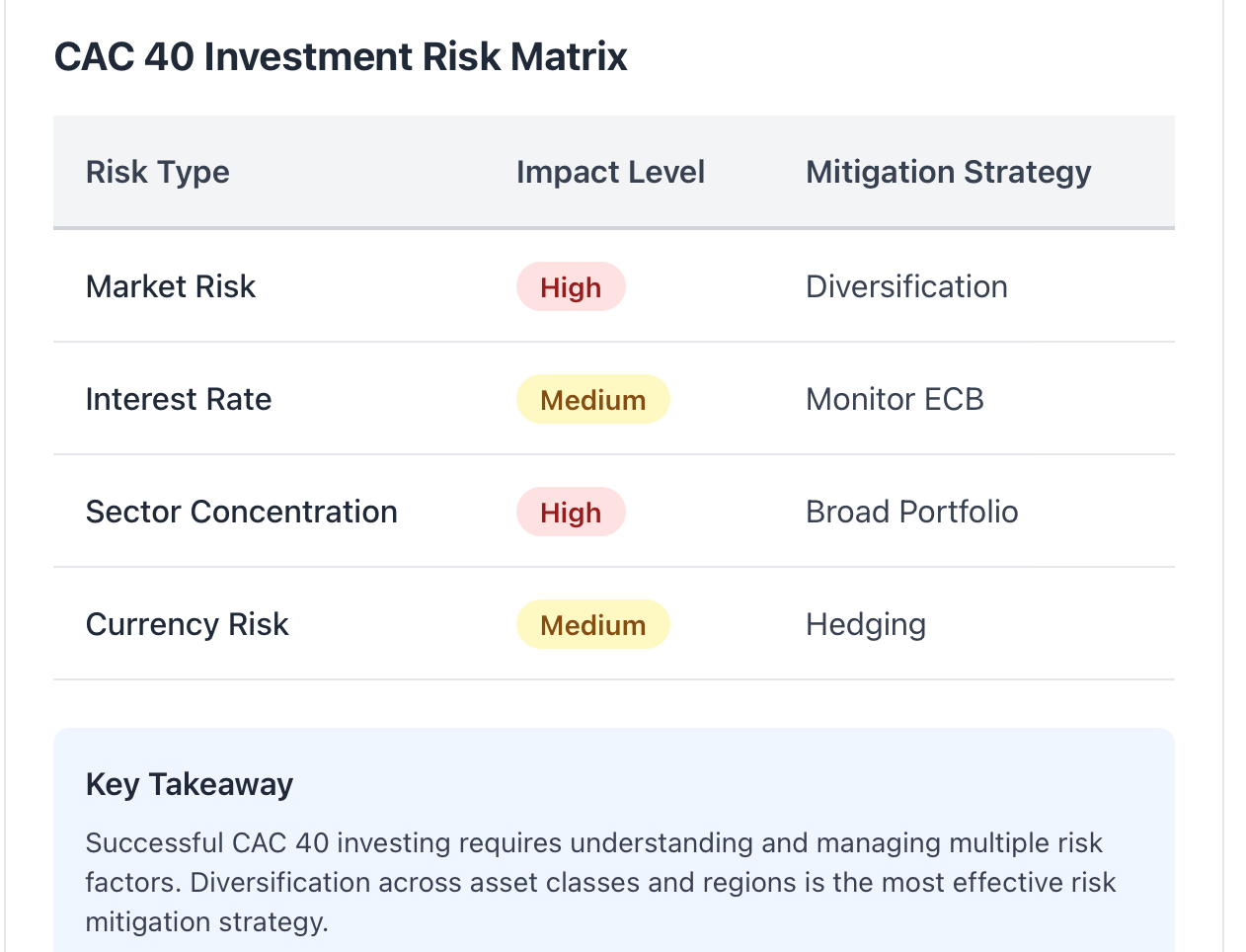
Investments come with risk. The CAC 40 is one example of this, and successful investors will be able to understand and manage those risks, whereas unsuccessful investors will not.
Market Risk
Market Risk is the risk that the value of an index will decline due to broad events, such as economic recessions, geopolitical upheaval or general market panic. While it is impossible to eliminate this risk, it can be minimized by maintaining a well-diversified investment portfolio across multiple asset classes. Never put all your money into one asset class, such as French Stocks. Instead, you should structure your investment portfolio to have an equal amount of exposure to the CAC 40, Bonds, International Stocks and other assets.
Interest Rate Risk
Changing interest rates tend to negatively impact stock values. Stock prices go down as interest rates rise because future earnings will be less valuable at a higher interest rate. While banks may benefit from higher interest rates initially, the CAC 40 index generally has negative pressure due to the changing interest rate. You need to keep a close eye on the actions of the ECB and adjust your position sizes accordingly, depending on whether it appears that interest rates are rising or falling.
Sector Concentration Risk
The fact that the CAC 40 has a significant concentration of stocks in the Luxury Goods, Energy and Finance Sectors, means that it faces Additional Concentration Risk. If Demand for Luxury Goods declines or the Energy Sector faces higher regulation, the CAC 40 will suffer a much greater loss in value than a more broadly diversified index would. Investors should also consider diversifying their CAC 40 positions by investing or targeting sectors or regions outside of the CAC 40.
The Risk of Currency
Investors from outside of the Eurozone are faced with an additional layer of risk associated with Currency Fluctuations. A CAC 40 investment may realise a 10% gain in euros, but this gain may be offset by a decrease in your home currency when viewed against the euro. Some investors will use currency hedging strategies to protect against this risk, while others see this as a potential risk of investing internationally.
Practical Tools to Mitigate Risk
You can minimise your potential loss by using stop-loss orders which automatically sell your investment when it reaches a predetermined price point. By using Position Sizing, limiting the amount of money you risk on any individual investment to 5 to 10 per cent of your overall investment portfolio, you can mitigate your risk of experiencing catastrophic losses. You should also regularly rebalance your investments in order to ensure that your CAC 40 exposure is not disproportionately large compared to other investments within your portfolio.
Using risk management techniques is very similar to wearing a helmet when you ride your bike. You hope you never need a helmet, but if you are ever involved in a bicycle crash, you will be very glad that you took that precaution. Professional investors use Options to hedge against risk, but for beginners, it is generally recommended to take a more straightforward approach through diversification and proper Portfolio Position Sizing.
How to Invest Using the CAC 40 Index
There are several different methods to invest in the CAC 40 index, each having its own set of advantages, disadvantages, costs and risk profiles.
CAC 40 ETF's
The easiest way to invest is through an ETF which tracks the performance of the CAC 40 index. CAC 40 ETFs hold all 40 companies in the same proportion that they are represented within the index giving you instant diversification across many sectors of the economy. The most popular types of CAC 40 ETFs are Amundi and Lyxor, with annual fees ranging from 0.15% to 0.25%. CAC 40 ETFs can be purchased through any standard brokerage account and will allow you to gain access to the long-term growth potential of the CAC 40 index without having to pick individual stocks.
Individual Stocks
An experienced investor may wish to invest in individual CAC 40 stocks themselves, allowing them to overweight certain companies (such as LVMH if they are bullish on Luxury) while underweighting other companies (such as banks if they are bearish on European Financials). While investing directly in individual stocks increases your risk, the potential returns may also be higher, but require more research and monitoring.
Contracts for Difference
Contracts for Difference are financial instruments that react to price fluctuations of the CAC40 without the buyer owning any underlying stocks for reference. CFDs allow you to have a significant amount of market exposure even though you have a smaller amount of invested capital. Therefore, when buying large positions in CFDs, the possible rewards and losses placed on your investments will be magnified. For example, if the CAC40 has a 2% move up or down, a trader with a 5x leverage on his investment could see a result (either profit or loss) of 10%.
Typically, CFDs appeal to short-term traders, however, beginners must also understand that if they participate in trading from the CFD market they risk losing more than what they originally invested.
Long-Term vs. Short-Term Strategies
Long-term investment strategies through the purchase of Exchange Traded Funds (ETFs) are typically held for many years to realize the potential benefits of compounded growth over that time frame. By being a long-term investor, an investor is able to benefit from any volatility that occurs during this time as well as any improvement in CAC40 price indexes.
Conversely, traders will use CFDs to attempt to generate profits based upon daily or weekly market price fluctuations and require them to keep close tabs on the financial markets and maintain safe trading practices. Traders that engage in CFD day trading typically feel increased stress from the daily requirements imposed on them.
As a simple analogy for beginners regarding ETF purchases, think of purchasing a variety pack of snacks. You will have several different kinds of snacks to try and have less chance of being disappointed by an empty bag of one type that's not to your liking. When purchasing individual stocks, you are simply picking out the snack that you would prefer. Also, CFD trading is like wagering on whether you believe that specific snacks will be in greater or lesser demand the next day. Each of these three scenarios works for someone dependent on their investment objectives and trading experience.
Practical Investment Strategies for the CAC 40
Understanding how to invest and when to invest does not give you an advantage if you don’t have the correct amount to be able to purchase shares with.
Dollar-Cost Averaging
The best way to invest is through dollar-cost averaging. You purchase a smaller amount of shares each month, ($500) if you want, regardless of what the price is for that day. When prices are low, you can purchase more shares. When prices are high, you purchase fewer shares. Dollar-cost averaging offers you the advantage of not having to perfect the timing of your purchase and it provides you with protection from unforeseen volatility.
Value Investing Approach
Some investors are observing the CAC 40 index, waiting for the index to fall significantly before they purchase shares. They will typically wait until the index has fallen 15-20% from its previous high before considering a buying opportunity. As with dollar-cost averaging you will need the same conviction not to panic when everyone else is freaking out.
Basics of Technical Analysis
Many traders will use charts to help them understand both trends and support/resistance levels. A simple way to use technical analysis is to look for a point where the CAC 40 breaks through a major resistance level on a high volume of trades; when this occurs it is likely that there is additional upward momentum. Conversely, if the CAC 40 breaks through support, there is a high chance the index will continue to decline.
Framework for Asset Allocation
Your investment plan should reflect how you're currently allocated to the CAC 40 (or the CAC40). Long-term aggressive investors may hold as much as 20% to 30% of their total asset allocation in French stocks or equity as part of their overall European investment strategy. However, more conservative investors may limit CAC 40 exposure to 5% to 10%. Be sure to evaluate how age and other life cycle factors, your financial goals, and risk tolerance will affect how much you allocate to the CAC 40.
Rebalancing Your Investments
After determining your target allocation for the CAC 40, reallocate your assets annually. If CAC 40 stock has performed well and represented 35% of your portfolio rather than 25%, then you would want to sell some portion of your CAC 40 holdings and use the proceeds to purchase some of the lower-value assets in your portfolio. Rebalancing will allow you to continually sell high and buy low.
When you invest, you are going to think of it like creating a meal plan for yourself. You will be looking to have some sort of protein (fixed income or stable investments) and vegetables (equity or growth-focused investments) in your meal plan. And depending on your nutritional needs and preferences, you may even want to include some desserts (more speculative investments). CAC 40 stock is just one of the ingredients in your balanced portfolio, and how much of it you have depends on your financial goals and your personal risk tolerance.
For example, Investor A may invest €300 monthly in a CAC 40 ETF for a longer 20-year investment horizon while ignoring daily market volatility. Investor B, on the other hand, may trade CAC 40 CFDs, knowing that they are risking only 2% of their portfolio per transaction with a very tight stop loss on their trades. Each is capable of achieving success, but they are operating on a completely different playing field when investing in the CAC 40.
Summary and Investment Tips
The CAC 40 Index is a representation of France's leading companies and a way to invest in European Markets. Here is a summary of how these products are different.
The index includes 40 of the largest publicly traded companies in France by Market Capitalization. Luxury goods, Energy, and Finance make up the majority of the index's sectors which results in an entirely different product exposure compared to U.S. products. Revenue streams vary greatly from Global luxury sales through LVMH to Commodity-based energy sources from TotalEnergies. Gross Margins also vary considerably between 30% (energy) to greater than 65% (luxury), thus determining overall profit and investment return levels.
There are several macro and micro factors that are driving growth in the CAC 40 index. French Economic Health, Global Demand, Monetary policy of the ECB and Specific Sector Trends (e.g., Luxury Market Expansion, Energy Transition) are all contributing factors. Historically, the CAC 40 index has provided investors with long-term returns, however, it has also seen considerable volatility associated with periods of crisis. Some of the most influential components of the index include LVMH, TotalEnergies and BNP Paribas.
There are many Global factors, including Euro exchange rates, oil prices, and Chinese Consumer Confidence that have a continual impact on the valuations of companies that make up the CAC 40 index. Risks associated with investing in the CAC 40 index include; a slow-down in the markets, rises in interest rates, Concentrated sectors, and currency fluctuations. To mitigate these risks investors should utilize Diversification, Position Sizing, or Stop-Loss orders.
Actionable Investment Tips
If you are new to investing, look to invest in a CAC 40 ETF. This investment option gives you low-cost instant diversification and allows you to reduce your timing risk through dollar-cost averaging which gives you the ability to gradually build your portfolio and on occasion buy more shares if the market dips. Key indicators to monitor will include the French GDP, European Central Bank Economic Policy Decisions, and Luxury Goods Sales activity trend in determining CAC 40 index movement.
An additional warning to all investors is to refrain from 'chasing performance'. Assume the CAC 40 has risen 20% in value; it could be a better time to buy, rather than buy immediately, as it may decline before your purchase. As you contemplate selling during a drop, consider if the fundamental situation has actually worsened. An investor should balance their assets in the CAC 40 index with holdings of other types of investments in each region, such as Equities, Bonds, etc. An equity portfolio should generally not have more than 20-30% of total assets allocated to any one region or sector, even if French Equities are the most attractive to the investor.
For advanced investors focusing on stock picking, invest in CAL's largest equities, as those with significant competitive advantages, proven profitability and the ability to withstand multiple business cycles. Examples of these stocks would include LVMH and L'Oréal.
For those considering trading CFDs, it is recommended to keep your trades small and avoid excessive use of margin/leverage, as larger trades can result in significant portfolio losses if you are not knowledgeable or skilled at this style of trading. You should always consider practicing with a demo account before committing to a partial or full-time CFD trading style.
Although the CAC 40 has its imperfections due to its limited stock number of 40 and thus its larger industry focus (Sector Weighting), it is still an effective option for those looking for European portfolios without the hassle of doing significant research on multiple countries and companies. By using rational analysis to assess the underlying fundamentals of the index and by being honest with yourself about your level of acceptable risk and time frame for investing, you can use your understanding of CAC 40 investing to achieve better results.
Sign up for your account on TradeWill.com now to start receiving up-to-date market information, very low spreads, and advanced trading tools for both experienced and beginner investors alike.
Disclaimer: The content of the blog does not represent any position of Trade W, does not serve as any trading-related decision advice, and does not endorse any third-party.