

 Trade W
Introduction
Think of borrowing some money at 1% interest, then investing it at 5% – sounds good to be true! Well, "carry trading" is an actual method of trading foreign exchange, where this wish is not a requirement. Carry trading is when you borrow a currency that has a low interest rate and use it to buy a currency that has a high interest rate, pocketing the interest differentials.
It is currently the hottest method of trading foreign exchange from the largest institutional investment firms to the retail trader, because it allows the trader to earn a steady passive income. It is an attractive idea – while you have a position in the market, you are earning the differentials between the two interest rates of the countries.
However, there is a downside if the exchange rate is volatile enough to wipe out any interest income that you have received. Carry trading is not just a simple process of arbitrage. There are significant market risks that are hidden below the surface. You are at risk every day that you trade!
A strong understanding of the risks involved with carry trading will make you a more successful trader. In this article, we will explain everything, from basic information to advanced strategies, and use historical examples as we demonstrate the opportunities and failures of carry trading.
If you are a novice wanting to grasp the basics of carry trade or an experienced trader looking for specific detailed strategies, you will find useful examples and professional perspectives to help you with this complex, but potentially lucrative trade structure.
Basic Concept of Carry Trade
Think of carry trade simply as comparing savings accounts, to gaining from the interest difference on compiling cash balances on the countries, rather than on this process by bank, so instead of banks, you trade with entire countries and currencies. The interest rate differential is simply the 'gap' of what one country pays on its currency and what another country pays on its currency.
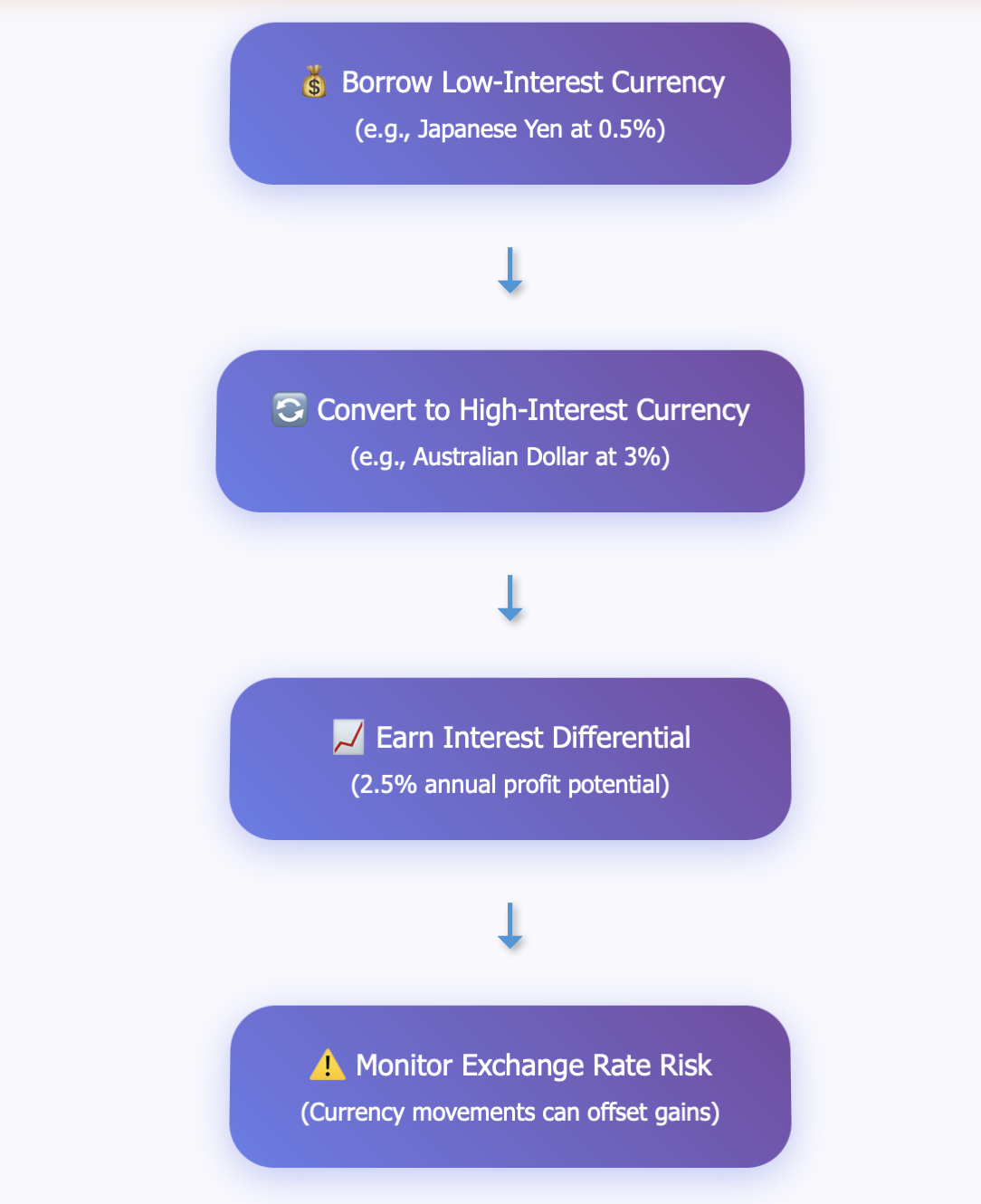
Here is how it is supposed to work: you would borrow Japanese yen at Japan's low interest rates (historically close to zero), and with borrowed money, you would buy Australian dollars (which usually have higher interest rates). For every day you keep the position open, you would earn the difference of that interest, better known as rollover interest.
The key advantage of a carry trade is the diverse applications of the holding strategy. For example, a short-term trader might hold the trade for a few days or weeks to take in the interest payments while hoping for favorable exchange rate movements. A longer-term trader would hold a trade for many months, or even years, allowing the interest differentials to compound in their favor.
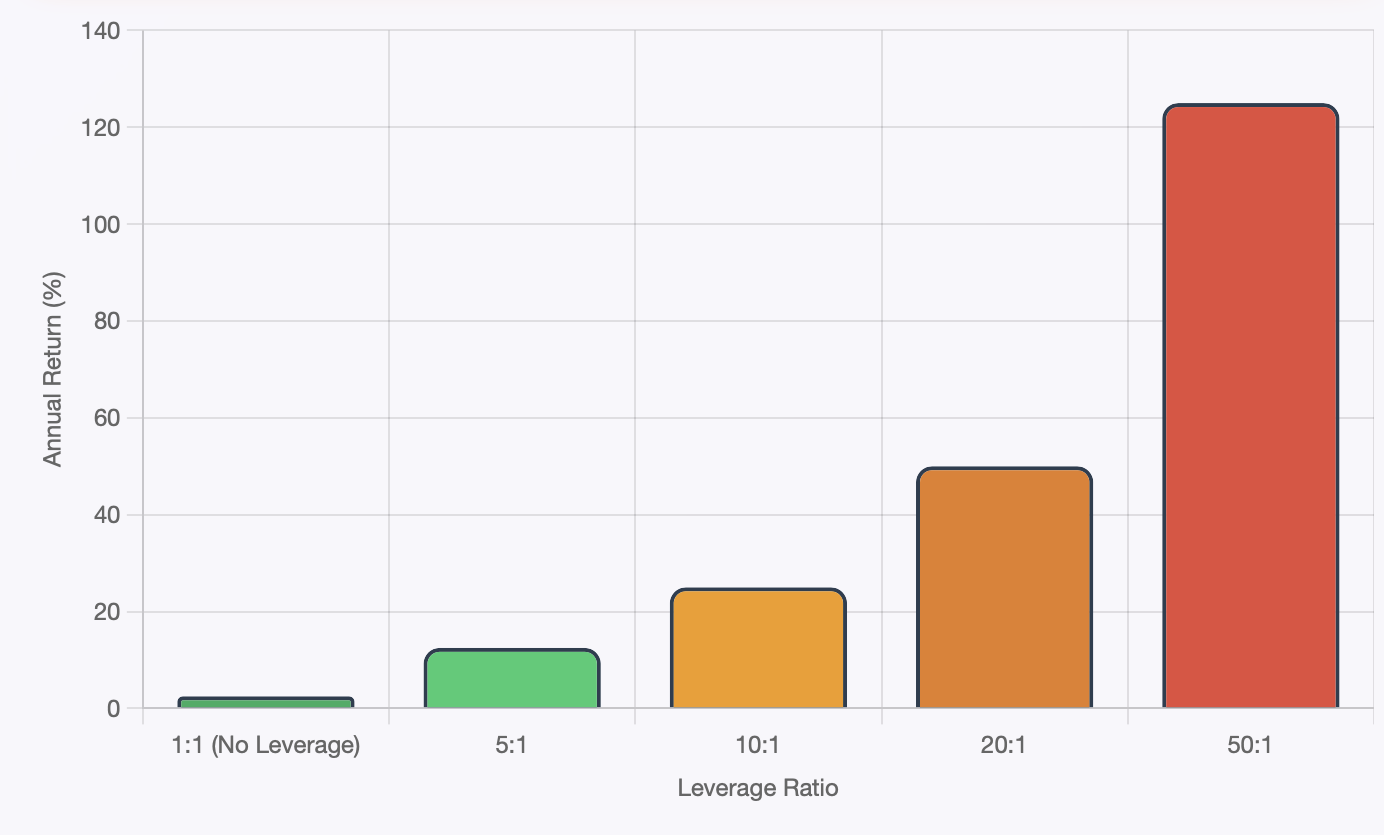
Leverage can enhance your performance on carry trades. If Australia is paying 3% interest and Japan is paying 0.5% interest, you're making a 2.5% annual interest differential. If you use leverage at 10:1 this can become a 25% annual return on your margin, which assumes exchange rates don't move against you.
Let's take a basic example for more clarity. You have $10,000 and want to carry trade the AUD/JPY. You borrow yen at 0.5% interest and then buy Australian dollars that earn 3% interest. You have a 2.5% net gain, annually, or $250 on your position size of $10,000. When you add leverage into these equations, these numbers start to multiply very quickly.
However, please remember that your profits from a carry trade come primarily from the interest rate differential, and not the appreciation of the currency. The ability to benefit from favorable exchange rate movements will enhance your performance, but they are not your primary goal or focus - the interest differential is your white bread and butter.
Historical Case Studies
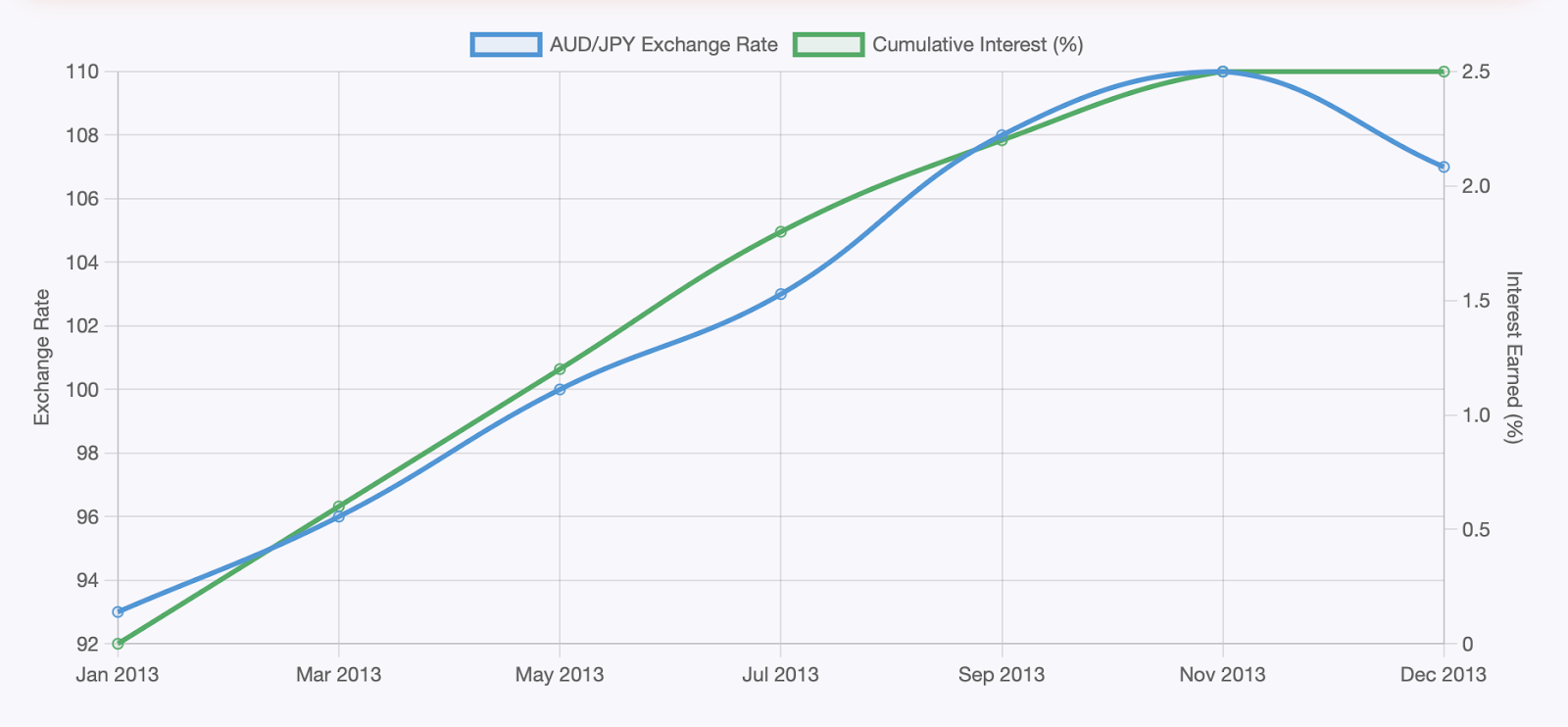
The AUD/JPY carry trade of 2013 is one of the most successful examples in recent years. The Reserve Bank of Australia (RBA) offered an interest rate of approximately 2.5%, while Bank of Japan (BoJ) remained close to 0%. Traders who bought halfway across the world, the Australian dollar (AUD), and sold the Japanese yen (JPY), were able to not only take the interest differential but also profit from the appreciating AUD.
During a period of patience, traders who were carry traders received about 2.5% a year just from the AUD/JPY interest rates, and the currency pair appreciated just under 15% over the course of a year. When considered with reasonable leverage, highly profitable trades yielding over +20% for traders were generated, a carry traders' nirvana!
Fast forward to 2015, and the day of reckoning occurred with the "black swan" event of the Swiss National Bank. On January 15th, 2015 the Swiss National Bank lifted the euro-pegging of the Swiss franc and had a currency appreciation of approximately 30% in minutes! Traders who had previously sold Swiss franc in exchange for AUD, JPY, or any other manner of trade found themselves exposed to massive losses cruelly wiping out the interest accrued differential for good measure, and possibly wiped out months or years of interest didn't outrun the clutches of trading loss after a black swan.
An event is a perfect example of the Achilles' heel of carry trading, when the trade has been profitable for many years and traders get the interest differential while the peg makes it feel secure, only to see the peg break and leveraged holdings liquidate into millions in one moment!
The moral of the story is this: while carry trades may produce steady and attractive returns when nothing out of the ordinary occurs, unexpected market conditions may lead to catastrophic losses.
To be sure, many successful carry traders lost 50% or more of their capital on that day, even though they were managing risks properly. These little examples show why carry trading requires patience through the periods one is outperforming and also strict risk management to deal with normal temporary shocks in the market.
Market Conditions & Currency Pairs
Carry trading relies heavily on the market conditions and the currency pairs traded. An ideal scenario comes with a stable interest rate differential that is combined with a low volatile environment- similar to calm seas versus stormy seas.
Periods of low volatility are what carry traders want to see as fluctuations in the exchange rate will not take over their interest payments. In contrast, if markets are moving around a lot, the movement of currency in one day can wipe out weeks of earned interest. The ideal situation for successful carry trades is a combination of political stability and predictable policies of central banks.
Traditional high-yield currencies are likely to be the Australian dollar, New Zealand dollar and Turkish lira (historically). The funding currencies can be the Japanese yen, the Swiss franc, and on rare occasions you can use U.S. dollars when the interest rates are extremely low.
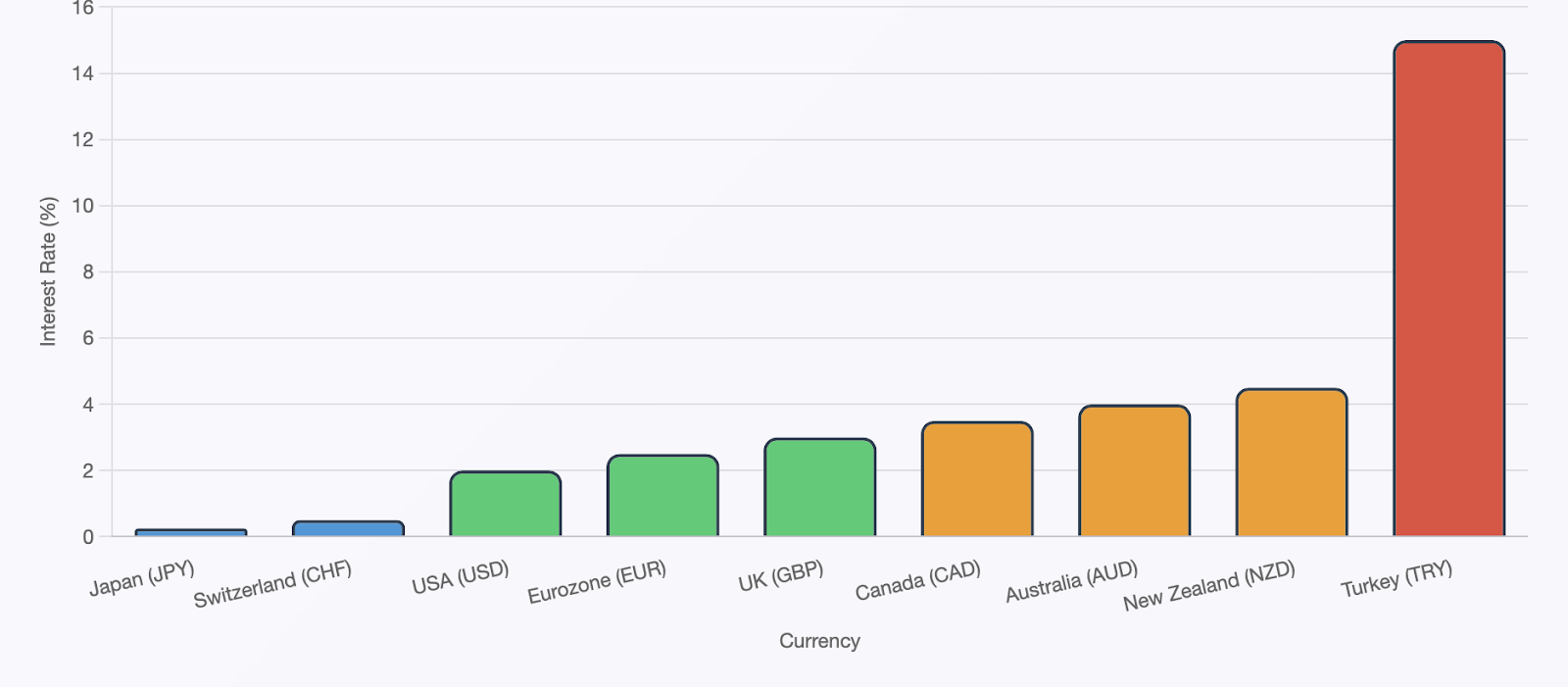
Let's consider AUD/JPY and USD/TRY (even though they are discounted because of the extreme variable risk). The USD/TRY currency pair typically has the largest bid/ask spread at any given time, this currency pair has provided likely some of the largest interest differentials (Turkey maintain double-digit interest rates).
However the combination of volatility (the lira can move 5-10% in a single day) and the potential for political risk make this pair maybe a poor choice for most traders. Any certainty obtained through the interest differential may be erased quickly through volatility. AUD/JPY relationship certainly is going to be smaller interest differentials, but much more stable.
I like to think of it as if you had money to invest in either individual stocks that paid potentially huge dividends or bonds that paid minor interest; the stock may pay greater dividends, but the bond allows you to lay your head on the pillow each night. Similarly, while there will be tempting interest differentials in exotic currencies, the ranges in major currency pairs provide certainty which makes carry trading viable over the long-run.
You should not carry trade at any period where central bank meetings are likely to occur, major economic announcements, and when major geo-political drama is likely to occur. These announcements (and geo-political dramas) can create strong directional movements where gains from interest earnings can be dwarfed by directionality.
Calculating and Yield Simulation
Carry trade mathematics is very important for realistic profit expectations. The mathematics of carry trading is pretty basic: (higher interest rate - lower interest rate) × position size × time = interest profit.
Let's work through a practical example using AUD/JPY as our example. Assume Australia is providing 2% annually, and Japan is providing 0.25% annually. So, you are receiving a net 1.75% interest per year. On a $100,000 position, you would earn approximately $1,750 annually or approximately $4.79 per day.
Leverage greatly increases the earning potential. In the case of 10:1 leverage, you would use the $10,000 margin to control the same $100,000 position, meaning your annual return is actually 17.5% on the investment capital, assuming there is no movement in the exchange rate.
Another quick reality is that exchange rates will not remain static. So let's see how an example would play out:
Scenario 1 (1 month position): Interest earned = $146, AUD appreciates by 1% = $1,000 currency profit. Total profit = $1,146 on $10,000 (11.46% monthly return).
Scenario 2 (3 month position): Interest earned = $438, AUD depreciates by 2% = $2,000 currency loss. Total loss = $1,562 (15.62% loss).
Scenario 3 (6-month hold): Interest earned = $875, AUD was flat. Profit: $875 (8.75% return over 6 months).
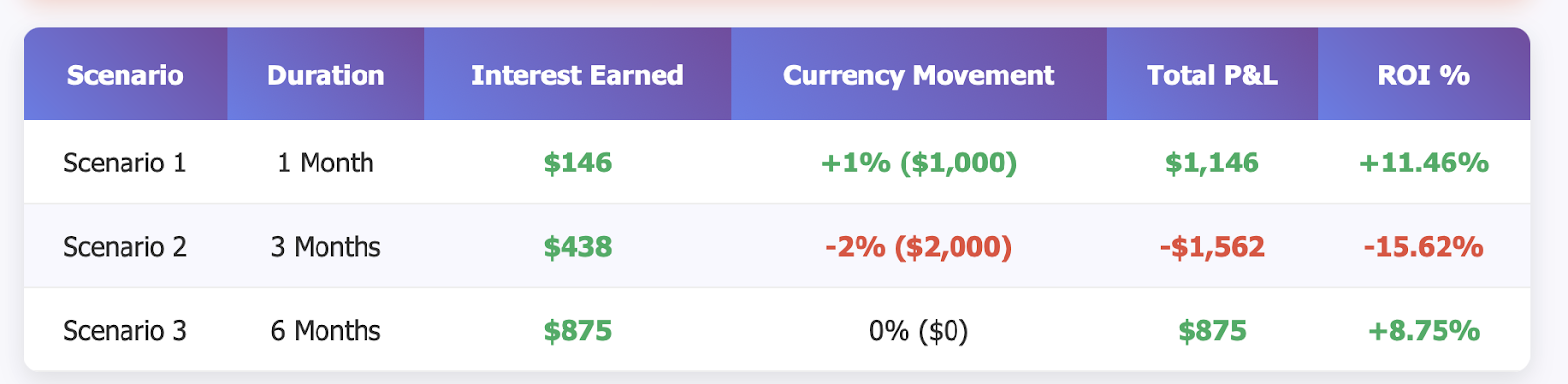
These scenarios illustrate the inherent inconsistency of carry trading - exchange rate movement can rapidly wipe out any interest earning. In our example, a 2% negative currency counter action erased nearly five months of interest income.
The takeaway is that longer holding periods are favourably aligned with carry traders, since interest can build over a longer period of time and any short-term noise in the exchange rate tends to be balanced out, but only if you can survive the inevitable periods when the currency moves against you.
Risk Management & Hedging
Exchange rate risk is carry traders greatest foe. While you would be enjoying the attractive interest differential, currency movements are capable of destroying months of profits in a matter of hours. It is prudent to develop smart risk management strategy, starting with the size of your position - never risk more than you can afford to completely lose.
Interest rate risk can come in different forms. Central banks can unexpectedly cut rates, eliminating your differential advantage. Liquidity can dry up during times of market stress meaning you may not be able to exit positions at appropriate prices. All of these risks are compounded during major economic events.

Standard professional hedging techniques involve buying put options on your long currency position. A put option acts like insurance against a major decline. FX swaps can solve your position but allow you to lock in an exchange rate when wanting to maintain interest exposure to the currency. Currency ETFs also provide hedging options but are not as precise as taking direct currency positions.
As a new trader start small, and think of the first few trades as expensive education as opposed to newly funded profit centers. Many brokers have demo accounts that you can practice with for free. Many brokers offer micro lots that allow investors to risk very little capital when testing your strategies.
More developed traders will often create multi-currency portfolios to spread risk across several carry trade pairs. For example, they may go long AUD/JPY while shorting simultaneously NZD/CHF; they are diversifying their interest rate exposure while hedging some currency (if any) risk.
Stop-loss orders are important, and even more complicated in carry trading. If your stop-loss order is too tight, normal volatility can stop you out affecting profitable trades. If you place a stop-loss order too loose, a large trade can have a devastating loss. Many successful carry traders utilize time-stops, if it doesn't work after a predetermined amount of time, they will exit no matter what their current profit or loss position is.
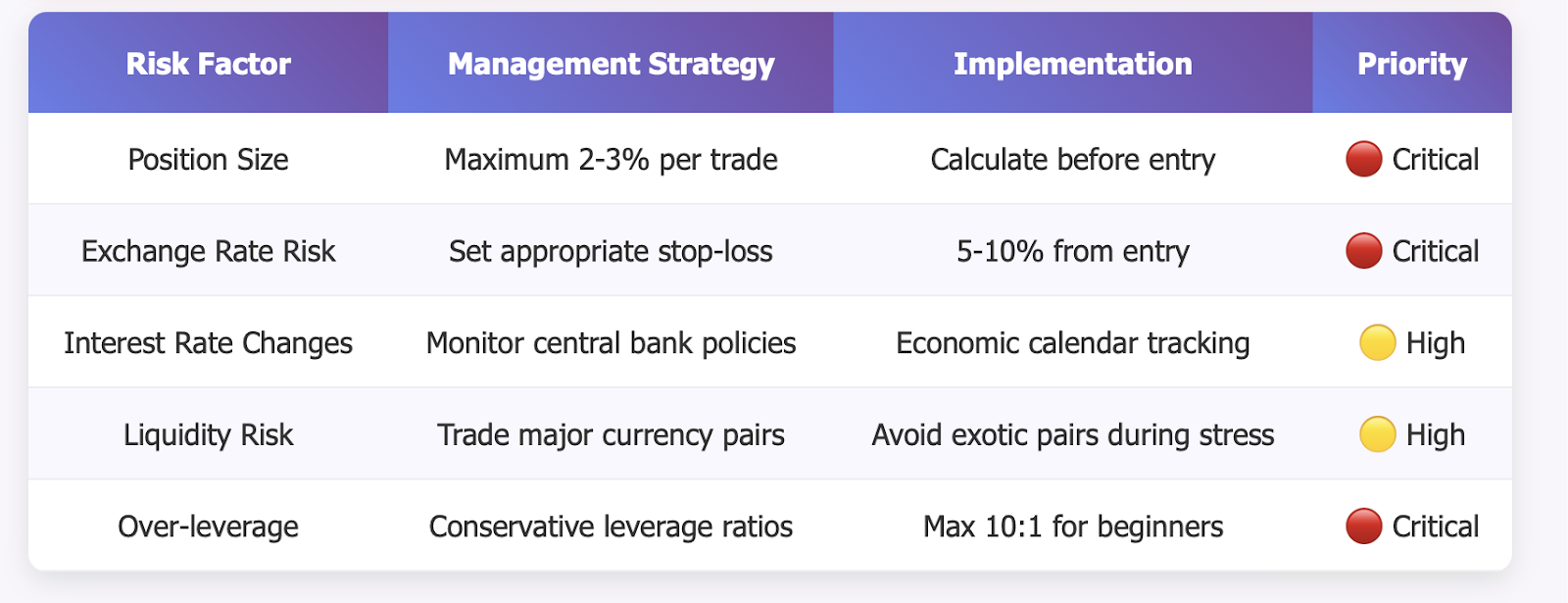
The rules of risk control should be sacrosanct. You should never risk more than at best 2 - 3% of your account on one carry trade position, always know what your maximum potential loss will be, before entering into position.
Psychology & Trading Discipline
Because carry trading generally has a consistent income stream, there are considerable pitfalls and traps related to psychology. The steady flow of interest income feels like "free money", and can often lead traders to increase position size or ignore obvious warning flags; small accounts become sizeable amounts of losses.
Greed is shown when a trader lets the daily interest credits lead them to think "if $100 dollars a day is good, it only makes sense that $1,000 could be better than $100." Many traders increase leverage or simply put on more positions ignoring the additional risk. Panic occurs when exchange rates start moving violently against their positions. This is often where traders develop a habit of breaking and abandoning their trading plan/ideas at the worst possible time.
Over-leverage is a silent killer of carry trades. The combination of steady interest performance, with seemingly low volatility, lulls traders into getting over-leveraged. When the market is in a high volatility, it becomes impossible to manage over-leveraged positions in the market.
Mental training starts with demo trading. Not to learn how to trade, but to feel the pressure of emotions forcing you to watch your positions go the other way. Keep a trading diary: not just win and loss statistics but note what your emotional state is in different market conditions.
For example: consider the retail trader who took $5000 and, after a successful run on AUD/JPY carry trades, had grown the account to $15,000. Feeling on top of the world, they began large position sizing. Until they get entirely wiped out... They woke up one morning to find the Australian dollar crashing, with the commodities selloff. After huge volatilty, and $20,000 loss later (in two days), their total position is now way over-leveraged; account balance of $-5,000.
The most successful carry traders (of which I hope to include myself) often do it as a business - not as a gambler. These successful traders typically have proper position sizing, exit rules, and emotional discipline. And if you add it up, the successful carry trader makes money out of small consistent profits through time, which add up to substantial wealth.
Discipline and mindset are what separate a profitable carry trader from everyone else. The strategy can be profitable, but only if the individual is able to manage the markets as well as themselves.
Myths and Misconceptions
The biggest myth surrounding carry trading is that it is a risk-free arbitrage opportunity. New traders see the interest differential and think they are getting free money. This myth has destroyed more accounts than any other single market event.
High interest differentials don't equal high profits. Yes, Turkey may offer 15% interest rates, but the volatility of the Lira can wipe out monthly interest gains in a single session for sellers of the currency. Smart carry traders typically prefer small and stable interest differentials to sudden, high, volatile differentials.
Traders love their excessive leverage because they believe carry trades are relatively safe, with slow moving markets. The trader thinks to themselves, "the currency only moved 0.5% today, so no problem with 50:1 leverage." What the trader is ignoring is that currencies can gap 5-10% overnight in a crisis.
Many traders think that interest differentials are fixed and plan out long-term forecasts from current rates. Central banks make unexpected policy changes, and what seemed like a 3% annual advantage, now becomes a 1% disadvantage, because of an unexpected 50-basis point cut.
The 2015 Swiss franc event is a classic case study of how wrong these assumptions can be. EUR/CHF carry traders have offered a consistent interest rate for many years and the price barely moved. The Swiss National Bank's peg removal appeared impossible – until it wasn't. The currency pair moved 30% in minutes.
Exchange rate crashes don't just reduce profits in current open positions; they can wipe out years of accumulated profits at a flick of a switch. For example, a 5% adverse move, translates into three years of 1.75% annual interest differential erased. The math makes it critical to size positions appropriately and enforce risk management.
Recognizing these misconceptions early can prevent a costly lesson later on. Carry trading does work, but it is not as simple or easy money as it appears on the surface.
Advanced Strategies
One compound way sophisticated carry traders will trade is use algorithmic systems alongside a traditional approach. It is an ongoing challenge for traders to successfully watch multiple currency pairs at the same time. An automated system can actively watch currency pairs while also doling out adjustments to position sizes, as a function of volatility measures.
Multi-currency portfolio strategies introduce risk across several carry pairs while enhancing potential return. Instead of putting it all into one pair, AUD/JPY, a sophisticated trader might hold three positions, deciding to hold positions in both, AUD/JPY and NZD/CHF, as well as CAD/JPY, exposing the trader to interest rate changes in several economies.
Long/short combinations provide hedging dynamically while retaining interest exposure. A trader can go long AUD/USD and Short (sell) EUR/USD to synthetically create a position in AUD/EUR. This will allow the trader to separate the risk of the carry trade from the volatility of their overall portfolio while maintaining their profits from the carry trade.
Prepared traders will have a systematic approach to risk management beyond stop loss orders. A systematic process using "value-at-risk" models can assist traders in developing position sizes based on historical volatility and highlight correlations between trades.
It is important that if a trader is holding a position in each of the major economies, a correlation analysis can help to ensure that if risk escalated in one position, it would not do so simultaneously in the other.
Professional level risk management is much more than just defining stop loss levels. Institutional investors use team approaches with analysts tasked specifically with monitoring central bank communications, macroeconomic data, finance, and political announcements. Institutional structures use risk management systems that automatically adjust position sizes, reducing portfolio risk if market conditions change.
In the case of a hedge fund carrying $100 million across 15 different pairs, each month they would decide appropriate position sizes using a monthly volatility forecast then activate risk management alerts on automated reporting systems for the news feeds and economic calendars to reduce their positions before important news is released.
These complex strategies will require not only significant capital but sophisticated technology and extensive knowledge about the market as they will not be suitable for anyone to start with. However, they are meant to show how professional traders might engage in carry trading not just as a play on interest rates but as a serious investment strategy.
Also be aware that complex strategies are not necessarily a guarantee of success – some fairly straightforward Carry trade strategies can reward or generate better returns than complex systems. The best thing to do is find a strategy that fits your capital, ability and risk appetite.
Conclusion
Carry trading does provide a genuine opportunity to take advantage of interest rate differentials but successfully implementing carry trading involves a lot more than just buying currencies with higher interest rates and selling currencies with lower interest rates. Since most carry trades can provide great returns during stable conditions, significant losses can be incurred if there is market volatility and/or unexpected events occur.
Risk management is a prerequisite for all successful carry trading. Position sizing, stop losses and diversification will protect your capital when the markets eventually move against you. The most successful carry traders focus on capital preservation above profits maximization.
Your individual circumstances should determine your carry trading path of least resistance. As a new trader, if you enter carry trading it is preferable to begin with a demo account and take small positions; you should not consider your first trades as a way of earning income, consider them educational.
An experienced (or professional) trader can consider the more sophisticated strategies in carry trading, but should always have the structuring of risk in place. While analysis and strategy are important elements, the most important elements of carry trading are discipline, emotional control, and risk awareness.
The traders and strategies that survive long term have the strictest rules regarding position size and risk management, even when everything seems calm and profits are coming in consistently.
Carry trading can provide you with profits, but only if you have respect for what you are profiting from, and what you are risking. When you understand the principles of carrying trading, controlling your risks, and maintaining discipline . You can make fundamental developments long-term that are more important than the methodologies of any trading technique.
Ready to begin your carry trading journey? Use our free demo account to practice risk-free carry trading strategies while building your confidence before putting any of your money at risk.
Use our risk management checklist to ensure you're prepared for whatever challenges and opportunities you'll encounter carry trading!
Join thousands of successful traders who have learned the ins and outs of carry trading fundamentals; your profitable forex future is contingent on your education and preparation.
Disclaimer: The content of the blog does not represent any position of Trade W, does not serve as any trading-related decision advice, and does not endorse any third-party.