

 Trade W

Introduction: Why Your Trading Style Is Closely Related to Your Personality
Have you ever questioned the reasons behind the thriving nature of some traders in volatile markets while others seem to excel during steady trends? The answer frequently isn't found in the technical knowledge or sheer capital of these individuals but in their personality traits. Trading Contracts for Difference (CFDs) offers remarkable flexibility that eludes many other trading methods, allowing traders to profit from markets that are doing anything but maintaining a steady trend. Yet even with access to the same tools and information, different individuals often react in dramatically different ways to the same market conditions. Why is this?
Envision this circumstance: A pair of traders observe a sharp 3% downturn in the S&P 500. Trader A promptly assesses an array of technical indicators, combs through several economic calendars, and painstakingly size up what bets to place before placing them. Meanwhile, Trader B implicitly trusts their better judgment and, with barely a second to lose, initiates a short in the S&P 500, reaping the rewards of a market that appears to be tumbling down. Both outcomes entail a set of profitable trades, but they illustrate two starkly different paths one can travel in the trading world.
Your character forms the way you handle information, manage risk, deal with stress, and make decisions under pressure. These psychology patterns are what you're working with when you develop a trading strategy. If you align your strategy with your natural tendencies, you're much more likely to achieve consistent success in trading.
The central question every trader must answer is: "Which type of CFD trader are you?" By identifying your personality-based trading style, you can build strategies that work with your strengths while managing your inherent weaknesses. This self-awareness becomes the foundation for long-term trading success.
Personality Overview: Mapping Psychology to Trading Styles
We can look at established psychological frameworks, such as the Myers-Briggs Type Indicator (MBTI) or the DISC model, to understand how personality affects trading behavior. These well-known systems shed light on the valuable insights they provide—along with frameworks that may not be as well-known but nonetheless are useful in understanding trading behavior—into how different types of individuals make decisions, assess risks, and process information.
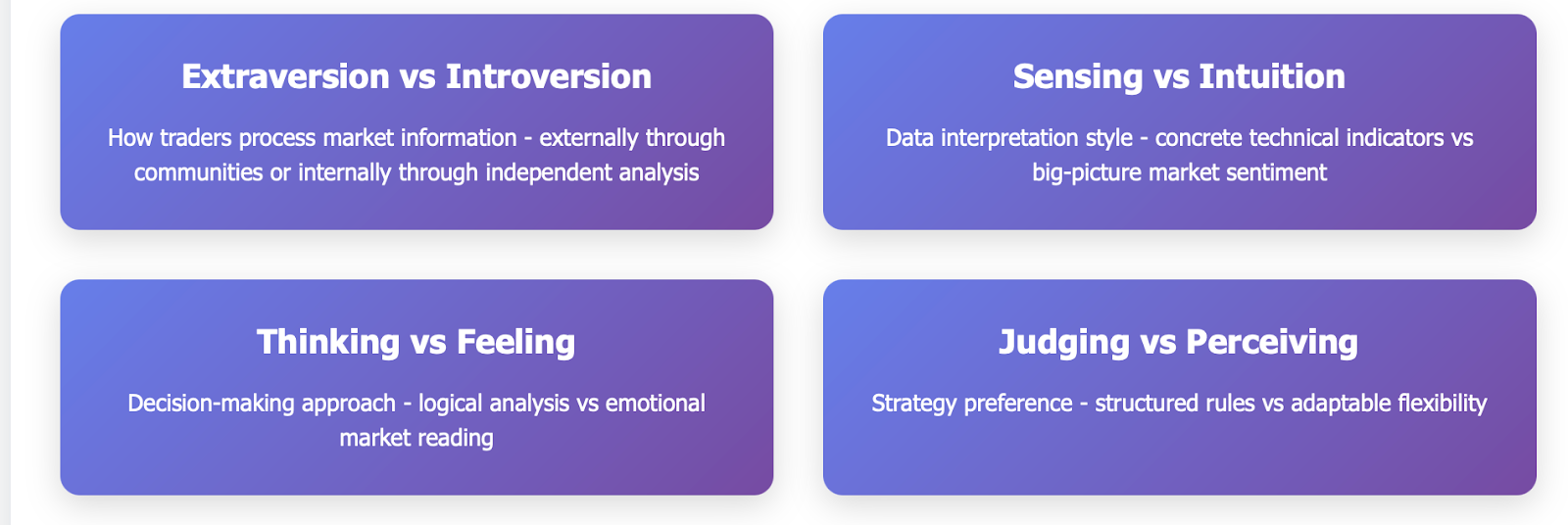
The MBTI framework identifies four key dimensions that significantly impact trading behavior:
How traders collect and process market data can be traced back to a trader's orientation. Extraverted traders often look to external market opinions, follow trading communities, and make decisions based on this multitude of external input. Introverted traders may be doing just the opposite. They seem to prefer independent analysis, and they may take a lot of time researching and mulling over independent data points before they pull the trigger on a trade.
Sensing versus Intuition is how traders interpret market data. Sensing traders focus on was is right in front of them; concrete technical indicators, historical patterns, and quantifiable metrics. These traders have a very specific and in-depth focus. They are not going to stray from what has proved to be a successful path in the past. Intuitive traders, on the other hand, are using a focus that is more like the wide-angle lens of a camera. They tend to see the big picture and are more likely to make from-the-gut decisions. They are not crazy about using technical indicators but are more in tune with the emerging trends of the market.
Influences on traders' decision-making include whether they are more inclined to think or to feel. Those who think tend to favor rational, logical, and objective methods when making trading decisions. They often use and trust the analysis-type tools and number-crunching mechanisms at their disposal. On the other hand, many traders apparently have a strong need to feel—they seem to need the market to feel good before they can do anything in it.
Judging and Perceiving: The majority of traders can be placed in one of these two categories. Judging types prefer a structured and stable environment, where they can impose their order on the world around them. Once they make a decision, they stick to it and like to have everything neatly organized. They also like rules and prefer trading strategies that have clearly defined buy and sell signals. Perceiving types are better at going with the flow and tend to be more adaptable. They are comfortable with trading strategies that don't have clear exit signals because they can make quick decisions on the fly. These personality types are the yin and yang of trading.
Alternatively, the DISC model categorizes personalities into four types that directly correlate with trading preferences:
-
Dominance (D): Decision-makers who are fast-paced and results-oriented. They love competition.
-
Influence (I): Traders who are focused on people and are optimistic and may follow the sentiment of the crowd.
-
Steadiness (S): Traders who are patient and methodical and who prefer stability and consistency.
-
Compliance (C): Traders who value accuracy and precision and who are analytical and detail oriented.
Behavioral finance has established that personality affects how people make financial decisions. A CFA Institute study shows that traders who understand their personality-based biases make better financial decisions. These traders earn better risk-adjusted returns than those who either deny having any biases (and thus don't understand themselves well) or who understand but don't know how to work around their biases. This seems to suggest that having better self-understanding leads to better decisions.
No personality type is better than another for CFD trading.
But, some of us have a CFD trading personality that is more conducive to success in this arena. We can trade in the manner of our choosing—using fundamental analysis, technical analysis, a combination of super-secret sauce methods, or some blend of creativity and rigor that reminds you of a child solving a Rubik's cube.
Four Common CFD Trader Archetypes
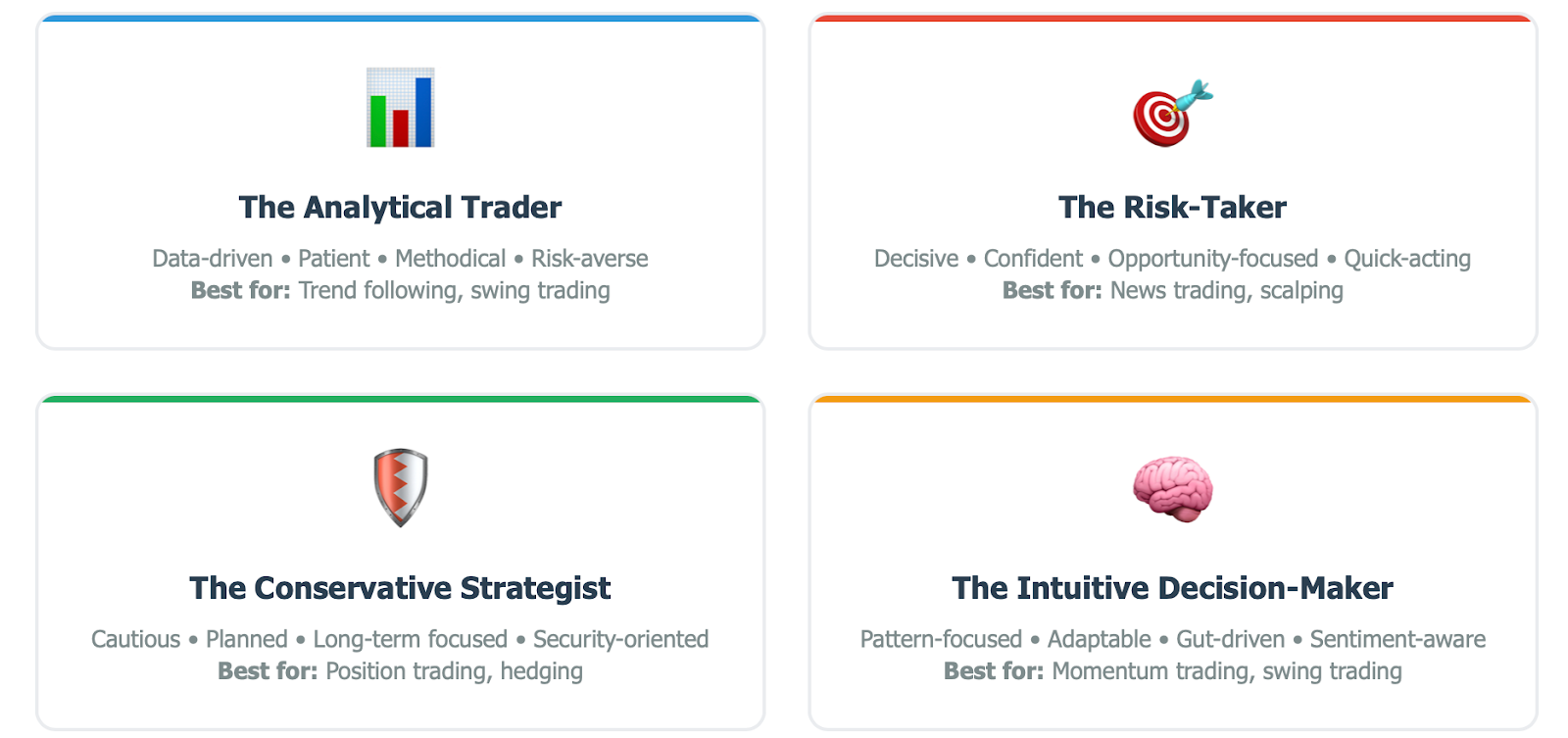
Based on extensive research and trading observations, most CFD traders fall into one of four personality-based archetypes. Understanding these categories helps identify your natural trading style and optimize your approach accordingly.
The Analytical Trader
Core Traits: Data-driven, patient, methodical, risk-averse
For analytical traders, trading CFDs is a lot like being a scientist and conducting an experiment. These traders tend to spend huge amounts of time conducting detailed and exhaustive research and pull the trigger only when they feel 100% comfortable with a decision to trade.
As a group, they have a much higher propensity to trade in what is, by most standards, a fairly straightforward and rather dull set of market conditions—conditions where they can identify what are, in their eyes, long-term trends and make with reasonable certainty decisions that won't go against them. In other words, they fancy trading in conditions where the sun is shining and the path is straight, even if the road stretches long before them.
Strengths: Analytical traders typically avoid impulsive decisions that lead to significant losses. They maintain detailed trading journals, consistently follow their predetermined rules, and excel at risk management. Their systematic approach often leads to steady, consistent returns over time.
Optimal Strategies: Trend following, swing trading, position trading with longer time horizons. They perform well using technical analysis tools like moving averages, RSI, and MACD. CFD instruments suited for analytical traders include major forex pairs, blue-chip stock CFDs, and index CFDs that exhibit clear trends.
Potential Pitfalls: Analysis paralysis can cause analytical traders to miss time-sensitive opportunities. They may over-optimize strategies, leading to curve-fitting that doesn't work in live markets. Additionally, they might struggle in fast-moving markets where quick decisions are essential.
Case Example: Sarah, an analytical trader, noticed a potential bullish divergence in EUR/USD over several weeks. She confirmed the signal using multiple indicators, calculated precise entry and exit points, and waited for the perfect setup. While she missed the initial 50-pip move, she captured a 200-pip trend that lasted three weeks, demonstrating the power of patient analysis.
The Risk-Taker
Basic characteristics: clear in purpose, confident to the point of being clement with risk, having a never-satisfied need to win. Market ups and downs and the almost irresistible temptation of incomplete information prompt would-be traders of contracts for difference (CFDs) to make quick decisions.
For them, CFD trading is not just some run-of-the-mill trading vehicle—it is a way of testing their own mettle and seeing if they have what it takes to be big winners. They see the goings-on of the market as chances to stake a claim on a huge pot, with the pivotal qualifier being "in a short period of time." Their distinguishing ability is the capacity to take advantage of movements that, while momentous to them, might be considered by some to be merely pedestrian.
Strengths: When it comes to instant decisions and seizing prospects, opportunity responders may as well be the poster children. They do well when doing fast and when doing easy (the instant opportunities that are easy to see, e.g., acting on a news announcement).
A news story breaks and opportunity responders make a story trade. A company announces its earnings, and opportunity responders make an earnings call trade. Some people call this style of trading momentum trading, which is a bit of a misnomer, as it is really trading on news momentum. Opportunity responders tend to trade big.
Optimal Strategies
News trading, scalping, and high-frequency day trading are three forms of superactive trading that suit extremely volatile instruments such as cryptocurrency and emerging market currencies. They also accommodate equity CFDs around earnings announcement times.
These three trading types have almost nothing in common with a buy and hold strategy, which is what honest-length trading works best for (and at). In fact, they're trading book nightmares for brokers who pretend to be friends of the trader by offering a "no commissions" model.
Potential Pitfalls
Taking too much risk can lead to blown-up accounts and confidence can lead to risk-taking. The best-proacticed protocols for position-sizing and stop-losses may be nearly nonexistent or poorly executed by those who take risks. They may not only feel the need to overtrade in order to recover from losses but also lack the patience to let more sustainable, long-term, payoff-rich plans blossom.
Case Example
A risk-taker, Mike noted an unusual amount in Apple stock CFDs prior to earnings. Almost instantaneously, he established a hefty position based on his reading of the amount pattern. Trading in this way—very aggressive, very hazardous—had the potential to work out real well for Mike. It had that same potential to do real bad by him, too.
The Conservative Strategist
Core Traits: Cautious, highly planned, long-term focused, security-oriented
Conservative strategists prioritize capital preservation over aggressive growth. They view CFD trading as a method for steady wealth building rather than quick profits. These traders develop comprehensive trading plans and stick to them regardless of short-term market fluctuations.
Strengths: Conservative strategists excel at risk management and rarely experience catastrophic losses. They maintain realistic expectations, avoid emotional decisions, and focus on consistent, sustainable returns. Their disciplined approach often leads to compound growth over extended periods.
Optimal Strategies: Position trading, dividend-focused strategies, and conservative leverage usage. They perform well with major index CFDs, established stock CFDs, and currency pairs with lower volatility. CFD hedging strategies appeal to their risk-averse nature.
Potential Pitfalls: Excessive caution can limit profit potential and cause missed opportunities. Conservative strategists may exit winning positions too early and struggle to adapt when market conditions change rapidly. They might also under-utilize the leverage advantages that CFDs provide.
Case Example: David, a conservative strategist, developed a systematic approach to trade S&P 500 CFDs using a combination of fundamental analysis and technical indicators. He used minimal leverage and maintained strict stop-loss levels. While his returns were modest compared to aggressive traders, he consistently grew his account over several years without significant drawdowns.
The Intuitive Decision-Maker
Core Traits: Quick decision-making, pattern recognition, gut-feel driven, adaptable
Intuitive decision-makers rely on their ability to recognize patterns and sense market sentiment. They often make successful trades based on "gut feelings" that they struggle to explain logically. These traders excel at reading market psychology and identifying turning points.
Strengths: Intuitive traders can spot opportunities that analytical methods might miss. They're highly adaptable to changing market conditions and can quickly adjust their strategies. Their pattern recognition abilities often lead to excellent timing on entries and exits.
Optimal Strategies: Swing trading, momentum trading, and sentiment-based strategies. They perform well trading CFD instruments that are sensitive to market psychology, such as cryptocurrency CFDs, growth stock CFDs, and emerging market indices.
Potential Pitfalls: Intuitive decision-makers can be inconsistent and struggle to replicate successful trades. They may rely too heavily on subjective interpretations and ignore objective risk management principles. Emotional trading and overconfidence in their "instincts" can lead to significant losses.
Case Example: Lisa, an intuitive trader, sensed a shift in market sentiment toward renewable energy stocks. Without extensive analysis, she opened positions in several clean energy CFDs based on her interpretation of news flow and social media sentiment. Her intuitive approach led to substantial profits during the sector's rally, but she also experienced losses when her sentiment readings proved incorrect.
Recommended Strategies for Each Personality Type
It is only the first step to understand your trader personality. The real value comes from aligning your CFD trading strategy with your natural tendencies and using appropriate tools and techniques to maximize your strengths and minimize your weaknesses.
Strategies for Analytical Traders
Traders who perform analysis and work systematically should consider which of their capabilities naturally lend themselves to a systematic approach. For some, it will be their patience. Others will find that research is where they shine. These capabilities will set them on a path to an execution model that works for them. I like to think of the backbone of these systematic traders" strategies as being technical analysis with indicators like moving averages, Bollinger Bands, and RSI. These traders may also see patterns in trends and use these as part of their strategies.
Preferred method: Formulate a complete trading blueprint with explicit standards for when to enter the markets, how large to size positions, and when to exit trades. Backtest to confirm that these strategies work and keep a copious record of all your trades to find out what works for you.
Trading tools: Use sophisticated charting packages, economic calendars, and automated trading systems that execute predetermined strategies. Platforms required for this trader type include CFDs with powerful analytical tools and access to historical data.
Managing risk: Implement stop-loss and take-profit levels that are made analytically and are intended to protect the account from adverse market conditions. Use position sizing formulas to determine how much money is put at risk on a trade. Make decisions based on account size, volatility of the market, and risk tolerance. Occasionally use CFD hedging strategies to protect the account from large adverse market moves.
Strategies for Risk-Takers
High-stakes traders must concentrate on extremely volatile trading opportunities and apply rigorous risk-control measures judiciously to circumvent potential trading disasters. Such traders might find news trading and scalping methods far more agreeable and commensurate with their decision-making rates and fondness for frenetic market activity.
Proposed methodology: Formulate a systematic methodology for high-frequency trading, which incorporates pre-established risk parameters and performance objectives. Direct your attention to the most liquid CFD markets, where spread tightness and execution speed make for a HFT-friendly environment.
Tools for Platforms: Platform tools with advanced order types are essential for one-click trading and for real-time news feeds. These are necessary for Archimedean captures of time-sensitive opportunities. For consistent execution, use trading algorithms.
Manage risk: Set firm limits on how much can be lost in a day and constrain the size of positions taken. Use simple, effective methods—like the trailing stop—that let profits run while maintaining a risk-reward profile. Follow the rules religiously, and discipline yourself against the impulse to overtrade when market emotions run high.
Strategies for Conservative Strategists
Conservative strategists should focus on low-risk, steady-return strategies that emphasize capital preservation. Position trading with longer time horizons allows them to benefit from major market trends without the stress of day-to-day volatility.
Recommended approach: Develop a diversified portfolio of CFD positions across different asset classes and time frames. Focus on established markets with good liquidity and predictable patterns.
Platform tools: Use platforms with comprehensive risk management features, including guaranteed stop-losses and negative balance protection. Portfolio analysis tools help maintain appropriate diversification and risk levels.
Risk management: Use conservative leverage ratios and maintain significant cash reserves. Implement position sizing strategies that limit individual trade risk to 1-2% of account value. Consider using CFD hedging to protect against adverse market movements.
Strategies for Intuitive Decision-Makers
Intuitive traders should develop systems that capture their pattern recognition abilities while providing objective criteria for decision-making. Sentiment analysis and momentum trading strategies complement their natural market-reading skills.
Recommended approach: Create a systematic framework for evaluating and acting on intuitive insights. Use technical analysis to confirm intuitive signals and provide objective entry and exit criteria.
Platform tools: Utilize platforms with social trading features, sentiment indicators, and market heat maps. Copy tradingcapabilities can help validate intuitive insights against successful traders with similar styles.
Risk management: Implement predetermined stop-loss levels to prevent emotional decision-making during adverse market movements. Use position sizing rules that account for the subjective nature of intuitive signals.
Personality and Psychology: The Cognitive Biases Behind Trading Behavior
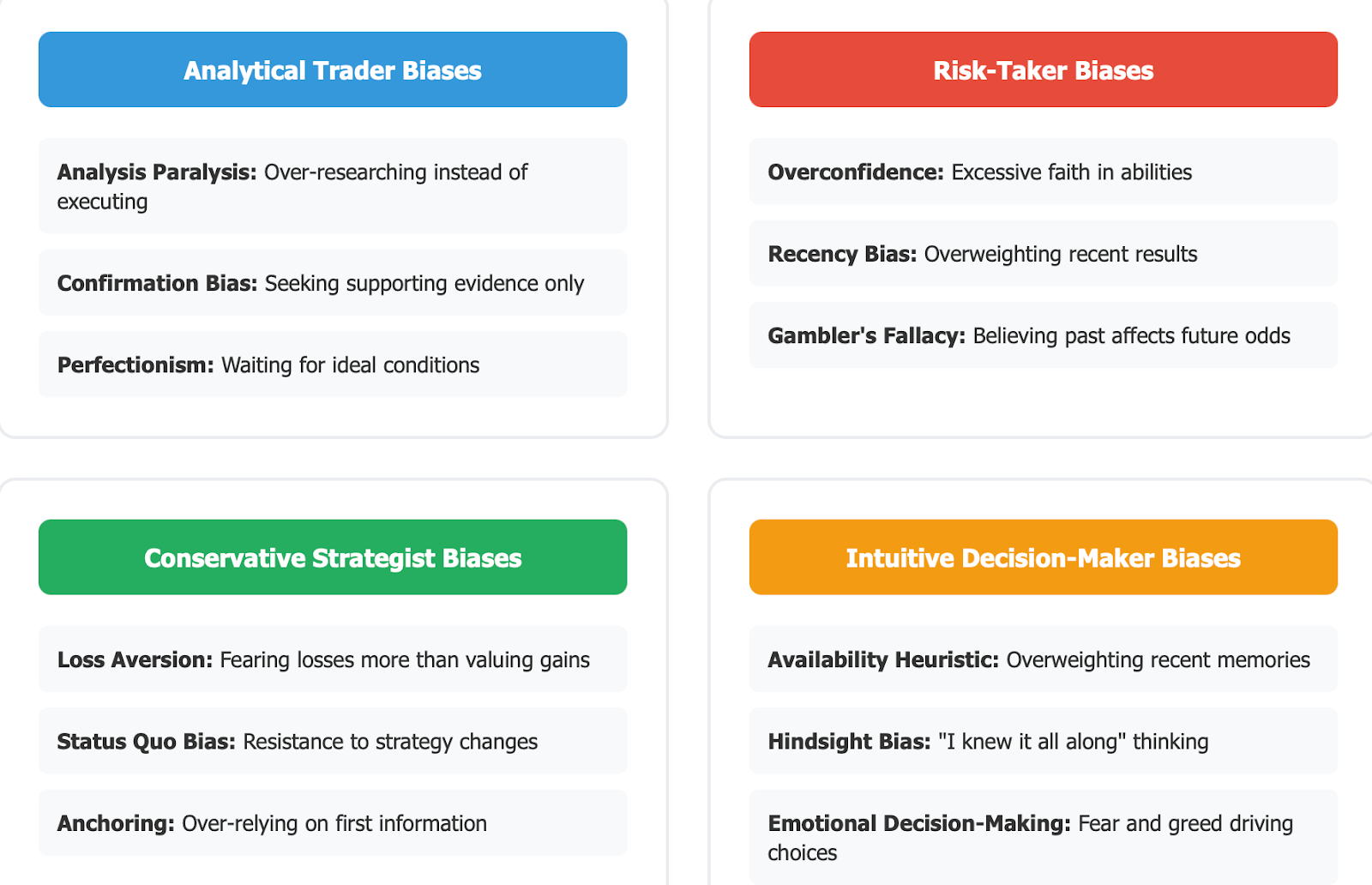
Every trader personality type is susceptible to specific cognitive biases that can significantly impact trading performance. Understanding these psychological patterns is crucial for developing awareness and implementing corrective measures.
Analytical Trader Biases
Analysis Paralysis: Analytical traders often suffer from information overload, spending excessive time researching and analyzing instead of executing trades. This can lead to missed opportunities and reduced profitability.
Confirmation Bias: They may seek information that confirms their existing analysis while ignoring contradictory evidence. This selective attention can lead to overconfidence in flawed strategies.
Perfectionism: The desire for perfect entries and exits can prevent analytical traders from taking profitable trades that don't meet their ideal criteria.
Management Strategies: Set time limits for analysis, use systematic checklists for trade evaluation, and implement automatic execution rules to overcome hesitation.
Risk-Taker Biases
Overconfidence Bias: Successful risk-takers often develop excessive confidence in their abilities, leading to larger position sizes and increased risk-taking beyond prudent levels.
Recency Bias: They may overweight recent trading results when making decisions, leading to poor risk management after winning or losing streaks.
Gambler's Fallacy: Risk-takers might believe that past results affect future probabilities, leading to poor position sizing and timing decisions.
Management Strategies: Implement systematic position sizing rules, maintain trading journals to track decision-making patterns, and use predetermined risk limits regardless of 1. Recent performance.
Conservative Strategist Biases
Conservative traders often fear losses more than they value equivalent gains. This fear leads them to exit winning positions too early and to hold losing trades for an inordinately long time.
-
Status Quo Bias: Even when the market condition changes, they might stick with their well-known tactics, which limits their flexibility and profit-generating ability.
-
Anchoring Bias: Right Side strategists might hold onto past market values while making decisions that land beneficially on their side of the street.
-
Management Strategies: Use methodical profit-taking rules, periodically reevaluate and reinvigorate trading strategies, and apply objective criteria for making position adjustments.
Intuitive Decision-Maker Biases
The heuristic of availability can adversely affect intuitive traders. For these traders, the kinds of information that come most readily to mind—like trading decisions based on a memory of an especially good or bad past trade—are overweighted. This is not the way to make trading decisions.
Hindsight Bias: Investors frequently think they understood the direction in which the market was moving when it was moving that way, and this leads them to be overly confident about their ability to intuit the direction in which the market is going to move next.
Emotional-Decision-Making: Intuitive traders are especially at risk for fear and greed. These powerful emotional forces drive some traders to make impulsive trade decisions and to manage risk very poorly.
Styles of Management: Use objective measures as the basis for entry and exit decisions. Stop-loss orders are key. If you use them wisely, they will help prevent making emotional decisions. Keep good records. You cannot become a good decision-maker unless you identify and understand patterns in your trading behavior.
Personality Adaptability in Different Market Environments
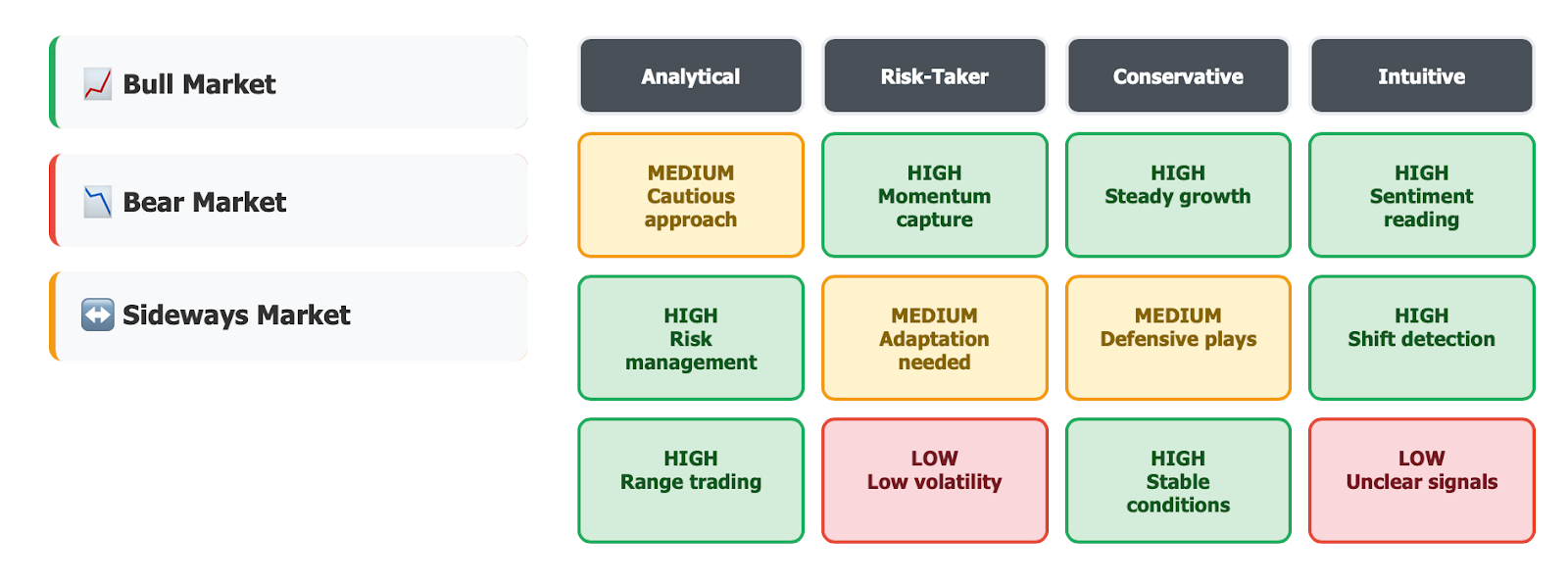
The market is in constant flux, and different sorts of traders do better in what are essentially an ever-shifting set of conditions. By understanding exactly how "the market" evolves and these dynamics, we come to understand better the strategies that certain individuals choose to employ—and, crucially, we also come to calibrate our expectations regarding how effective these strategies are.
Bull Market Performance
Analytical traders usually find it tough to operate in raging bull markets. This is because they sit on the cautious end of the trading scale and tend to miss the rapid upward surges that happen in such market conditions. This approach to trading rewards carefulness and is roughly calibrated such that if one were to operate using this approach but at a faster speed, one might end up in a bubble and lose some hair.
Individuals who take risks tend to perform quite well in times of market optimism, when stock prices are rising and the overall economy is doing well. These "risk-takers" harness the stock market's upward momentum and often utilize a fair amount of leverage (debt) to juice (intensify) their returns. Their personality style fits very well with the current uptrending stock market. And it also fits well with an economy that seems to be doing quite well.
Everyone benefits from bullish trends in the markets. But conservative market analysts gain the most since bullish stock markets allow these to-the-point strategists to act in an upwards direction with greater conviction than in a down-trending market. After all, a bull is a bullish trend. Bull markets tend to go up, and they tend to go up with a little more sureness than in a down-trend. (Think: bear market.)
People who make decisions based on intuition can do really well in bull markets. They read market sentiment exceptionally well and identify rotation opportunities between sectors and asset classes like no one else. They usually don't even have to think that hard about what they're doing; it just seems to come really naturally to them.
Bear Market Performance
Analytical Traders : People who employ an analytical technique in their trading are far more likely than the average trader to make money in a bear market. This is primarily because they have a level of risk aversion that is conducive to making money when the market is going down.
Risk-Takers : When they are wrong, they know it and get out. And when they are right, they slowly build their way into a position where they not only cover short risks but also make money on the downside.
Conservative Strategists : A bear market can be hard on risk-takers who don't shift their strategies. Even if you are a trader who primarily enjoys the profits of a bull market, you can still prevail in a bear market if you do the opposite and short-sell. That is, you bet on the market going down instead of up.
Intuitive Decision-Makers : Decision-makers who rely on intuition can be much better at sensing the kind of shifts that happen in market sentiment and in identifying situations where the market has become extremely oversold.
Sideways/Range-Bound Markets
Analytical Traders : Market oscillation between set limits tends to be a trader's best friend. When this happens, it is as though price oscillation in a range is between two doors—not very creative but quite honest. A trader knows that in order to make a rangy market go up or down, it needs to be pushed or pulled quite a bit, and if it does get pushed or pulled, it probably won't go very far before it reverses direction and starts moving in the opposite way. This is an oscillation market, and these types of markets have some of the best setups a trader can ask for.
Risk-Takers: Risk Takers can find it very difficult to manage in flat markets. These are the times when we have seen a definite decrease in volatility and a near-total disappearance of profitable, upward-or-downward-momentum opportunities. Even the best day traders might feel like they are barely keeping their heads above water. Now picture a Risk Taker day trader in flat market conditions. To them, it must feel like an extended bear market.
Conservative Strategist: Conservative market strategists win when the markets remain within a strict range; they succeed and make us look good by putting their investment philosophy into action, which closely resembles ours, in that it, too, places the highest value on the long-term accumulation of dividend-paying securities.
Intuitive Decision-Makers : If intuitive trading is your main means of making decisions, then you are probably going to underperform when the market price is moving sideways. This is especially true if you find yourself in a range that the market is pricing in and a direction that it has not yet resolved.
Adaptation Strategies
All types of successful trading personalities must cultivate the skills needed to identify shifting market dynamics and adapt their strategies in response. This might involve:
-
Scaling position sizes in accordance with market volatility
-
Modifying time frames to suit current market conditions
-
Switching among various CFD instruments based on relative performance
-
Hedging during periods of unusual market activity
-
Employing risk management techniques appropriate for the present market environment
Recommended Self-Assessment Tools and Practical Tips
To figure out your trader personality, you need to engage in clear, honest self-assessment and to employ in the necessary systematic tools of assessment. There are many instruments and methodologies that can help you get to the bottom of this fairly important thing and that can also assist you in formulating some adaptations of your trading strategies that need to be tailored to who you really are.
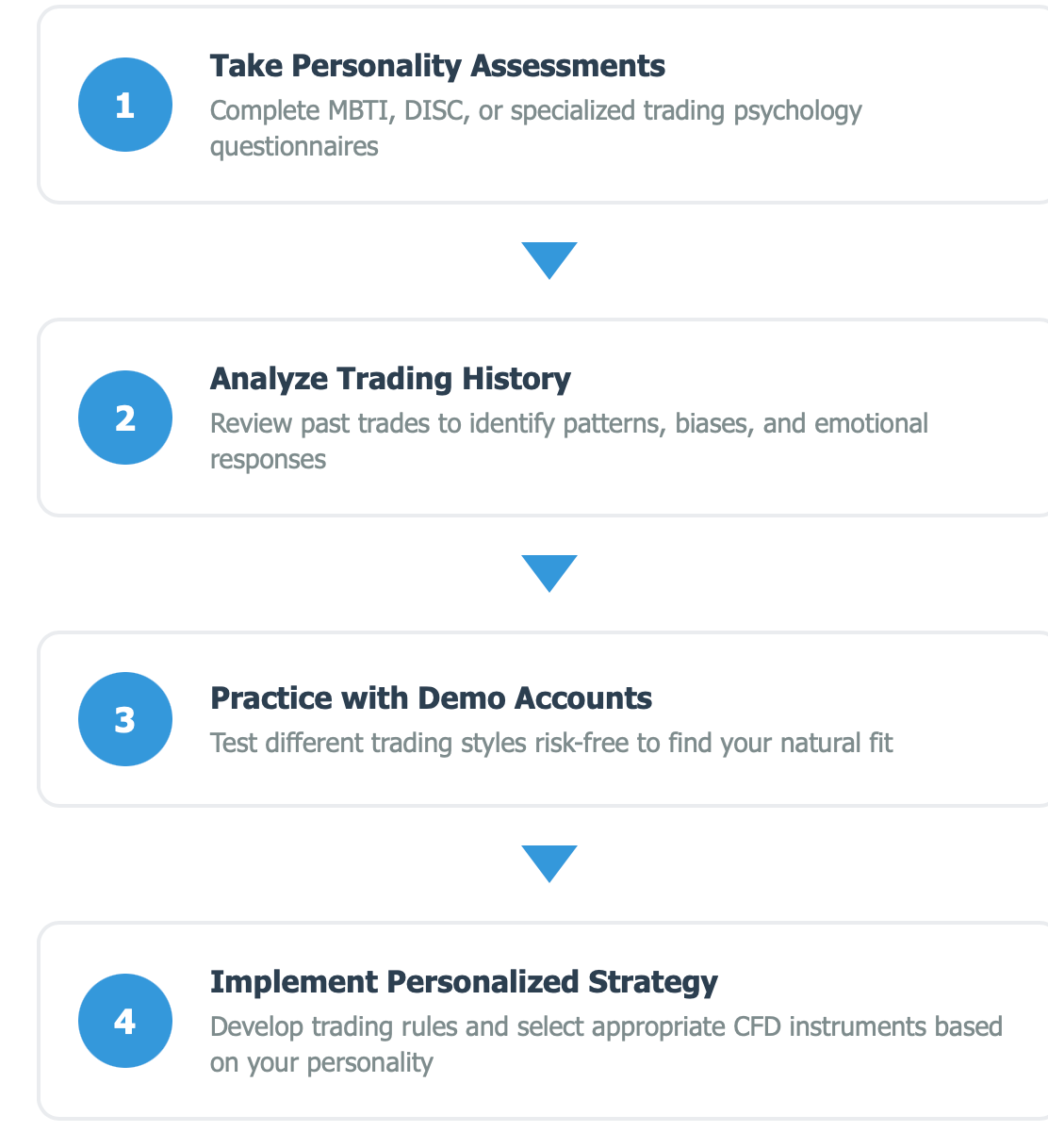
Personality Assessment Tools
-
16 Personalities (Myers-Briggs): This no-cost online assessment yields in-depth insights into your personality type. It offers us the guidance we need for careers and decision-making, and the types of situations we find ourselves in that translate perfectly well to trading.
-
DISC Assessment: There are many platforms that not only offer these tests but also correlate them directly with trading risk and behavior. They help us understand the natural communication styles we have, the decision styles we use, and the types of stress we respond to in a certain way that makes us better or worse for trading.
-
Trading Psychology Questionnaires: There are several CFD platforms and trading educators that offer specialized questionnaires designed just for traders. They focus on our risk tolerance, how fast we make decisions, and the way we prefer to analyze the market.
-
Risk Tolerance Assessments: Financial risk tolerance questionnaires help us understand how comfortable we are with leverage ratios and sizes of positions that make us feel good or not so good.
Practical Self-Assessment Techniques
Trading Journal Analysis: Go over your previous trades to spot patterns in how you made decisions. Search for consistent behaviors, emotional responses, and strategic preferences that you exhibit across multiple trades.
Simulation Trading: Use demo accounts to test out different trading styles without the risk of losing real money. This can help you figure out which styles suit you best and yield the most consistent results.
Evaluation of Stress Reactions: Observe your physical and emotional responses to the market's ups and downs. Pay attention to how you handle win situations, lose situations, and when the market is just plain wobbly.
Time Preference Assessment: Assess your inclination for making rapid decisions or for taking ample time to ponder before reaching a conclusion. This illuminates the proper time frames for your trading style.
Implementation Tips
Having established your personality as a trader, put these practical measures into effect:
-
Adjust Your CFD Trading Environment: Configure your CFD trading platform so it complements your working style. Traders who need to analyze data nearly to the molecular level get along just fine with our platform. But for traders who prefer to work with undiluted data and to make their moves in a more freewheeling way, we offer a one-click trading style that opens up your stops and targets for your more risk-friendly working style.
-
Develop trading rules that take into account the natural biases and tendencies of your personality. For instance, analytical traders might need time limits for analysis, whereas risk-takers might need maximum position size limits. They probably also need limits on the number of positions they can take at once. Otherwise, some of them might start backing up the truck.
-
Select Appropriate Markets: Choose the CFD instruments that favorably align with your personality and trading strategy. If you are a conservative trader, you might focus on the CFDs of major indices. But if you are more of a risk-taker, you may prefer the CFDs of cryptocurrencies or CFDs of emerging market assets.
-
Periodic Self-Assessment: Now and then, check your personality and trading style anew, as you gain the experience that trading demands. You might like and be able to do different things in trading a year from now than you do and like today.
Successful Trader Profiles and Case Studies
Looking at prosperous traders with various personality types reveals that there is not just one way to find success in trading CFDs. Every unique kind of trader can, in fact, turn a profit by either sticking to or being very flexible with their individual style, a condition that the literature calls trading by kind.
George Soros: The Intuitive Macro Trader
Intuitive decision-maker: George Soros
Famous for breaking the Bank of England in 1992. Large-scale intuitive insights are his thing, but he's not just a gut player. His approach combines:
Macroeconomic intuition (reading global economic and political trends) with reflexivity (understanding how market participant psychology affects prices) and strings them together in a narrative.
Then he acts, decisively: taking large positions when his conviction is high.
And if he's wrong? Cuts losses quickly, maintains disciplined risk management.
Ray Dalio: The Analytical Systematic Trader
Analytical trader personalities can only achieve so much success before hitting the ceiling of a personality type. Research and analysis can only get you so far. But what if you could always achieve the maximum potential of your personality type? That is what Ray Dalio did when he went from being an underachiever to being the all-time greatest trader.
The reason he could do that is that he took analytical trading to its logical extreme and achieved ultimate consistency. If we take his success story as an example, we could say that—practically speaking—analytical traders can succeed only if they achieve the ultimate in systematic, rules-based strategies that also leverage their research and analytical abilities.
Paul Tudor Jones: The Adaptive Risk-Taker
Risk-taking, of course, has a downside. If we only paid attention to that, we might become too risk-averse and miss opportunities. But what makes Jones truly impressive is that he takes risks in an exceptionally disciplined way.
Not only that, but he combines systematic risk management with a style of trading that requires adaptability. He does not fit into any easily recognizable box. Jones trades from a macro perspective. He does not shy away from using massive leverage, which could get any normal person fired. And he seems to do all of this with a sort of impish glee. And this is the real kicker: for all the fun he seems to have with trading, he is also a serious maker of money.
Common Success Factors
Successful CFD traders have several traits in common, regardless of their personality type: Self-awareness: They have a good understanding of their natural tendencies and biases.
-
Discipline: They follow rules that they've predetermined for their trading, even when their emotions are screaming at them to do something else.
-
Continuous learning: They're engaged in a process of ongoing personal development and they adapt their trading strategies to fit their market conditions.
-
Risk management: They virtually all seem to prioritize capital preservation over what you'd think would be an aggressive, profit-seeking motive.
-
Realistic expectations: They have a much better grasp than I do on the amount of time and patience that intensity consistent profitability requires.
Conclusion: Build Long-Term Trading Success Based on Your Personality
Your CFD trading behavior is significantly influenced by your personality, but it is not your path in the markets set in stone. Knowing your natural tendencies lets you work with the foundation that is your personality to develop strategies that leverage your strengths—rather than making you work against them.
There are four trader personality types—Analytical, Risk-Taker, Conservative Strategist, and Intuitive Decision-Maker.
Each of these personality types offers some unique advantages and faces some specific challenges.
That is, if you're one of these personality types, I think it's better not to try to change your personality (it obviously hasn't worked for me), but to find systems and strategies that work for you given your natural strengths (and, of course, your natural weaknesses).
Keep in mind that trading based on personality isn't about putting limits on what a certain personality type can do. It's about figuring out the best way to work with what you've got. Here's a rundown on how six different types can achieve success in CFD trading:
Identifying and understanding inherent decision-making patterns Working with natural decision-making patterns Risk management strategies appropriate to the individual Assessing instruments and time frames Selection Systems that compensate for individual personality-based biases that affect decision making Adaptation and continuous change processes that allow improvisation and use of good forms when the market changes unexpectedly.
The best traders trade with regularity. They are not hit-and-run traders who dive into the markets with all available cash and then stay away until they’ve forgotten all about the market. The best traders are not completely frozen in indecision and are not too far along in their trading systems to have the good sense to change when they need to. And, for all their trading skills, what the best traders do most of all is reflect on why they have been successful and why they have failed.
Begin with personality tests, an analysis of your previous trading conduct, and the use of demo accounts to try out various strategies. This process of self-discovery is a vital step on your way to long-term trading success. It's an investment in your future.
Ready to discover your trader personality and optimize your CFD trading strategy? Take our comprehensive trader personality assessment and explore our educational resources to develop a personalized approach that aligns with your natural strengths and market goals.
Disclaimer: The content of the blog does not represent any position of Trade W, does not serve as any trading-related decision advice, and does not endorse any third-party.