
 Trade W

Forex consolidation does not indicate a lack of opportunity; rather, it represents a preparatory phase within the market. Retail traders often become increasingly impatient when price enters consolidation, leading many of them to enter poorly timed or uninformed positions. Institutional players, however, remain highly active during these periods. Because institutions require lower volatility to build large positions quietly, consolidation phases provide an opportunity to establish exposure that would be difficult to enter during a high-volatility trend without causing the price to move against them.
Nearly every significant currency movement begins from a boring, flat, or range-bound environment. For example, EUR/USD often compresses into a narrow range ahead of a Federal Reserve decision, while GBP/USD may consolidate within a channel before a Bank of England announcement. The absence of aggressive price movement does not imply randomness. Instead, it creates an environment where participants with the largest pools of capital can prepare and accumulate positions that cannot be efficiently executed during fast-moving market conditions.
Beneath the surface of every consolidation phase are two primary forces: accumulation, which involves building long positions ahead of an upward move, and distribution, which involves reducing or unloading positions ahead of a decline. Although these structures may appear nearly identical on a chart, their trading implications are significantly different.
This guide explains how to interpret market consolidation phases, how institutional capital uses these structures to accumulate or distribute positions while retail traders often remain at a disadvantage, which trading strategies are most effective within consolidation ranges, and how to distinguish genuine breakouts from false moves designed to trap retail traders and drain liquidity from their accounts.
What Is Consolidation in Forex? Key Patterns and Market Structure
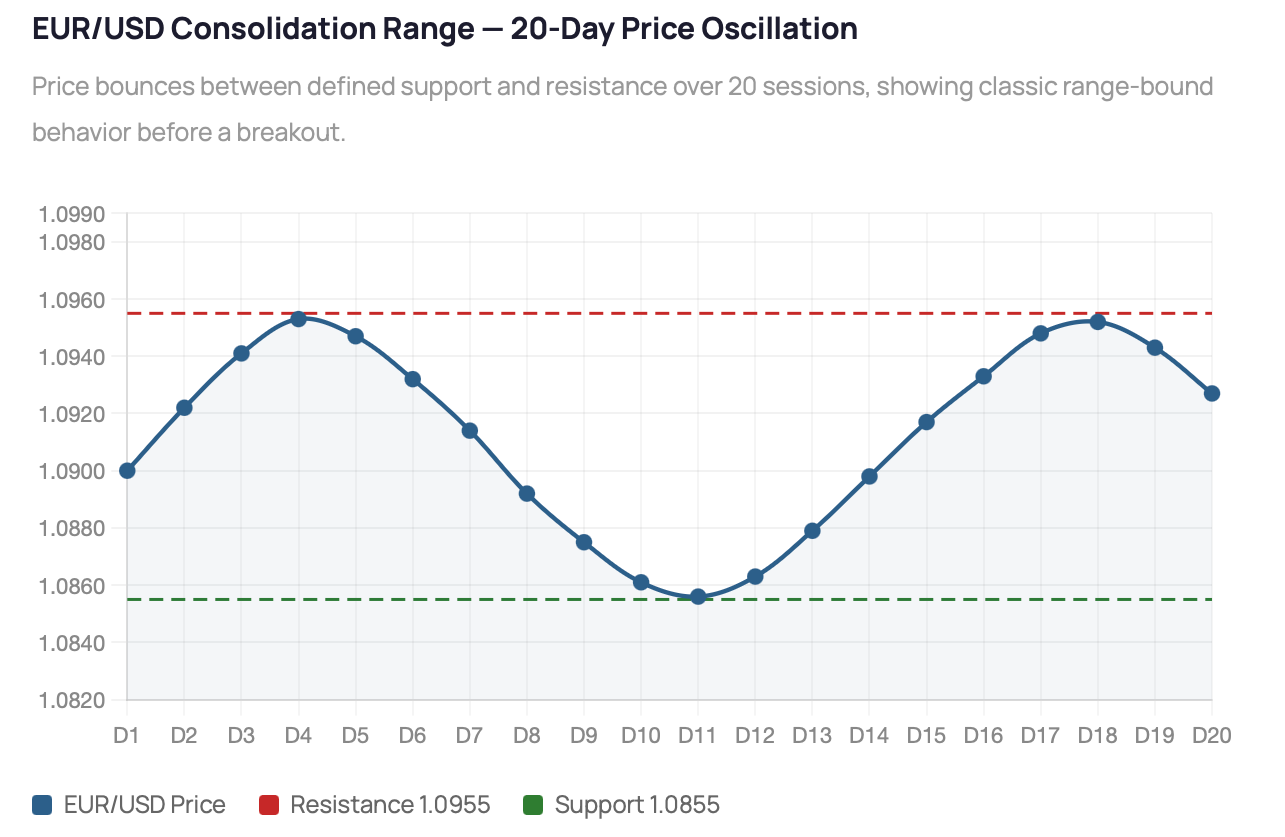
Consolidation occurs when buyers and sellers reach a temporary balance within the market. During this phase, price stops creating new highs or new lows and instead oscillates between two previously established boundaries.
Support acts as a floor where buyers repeatedly enter the market to prevent the price from falling further. Resistance acts as a ceiling where sellers consistently cap upward price movement because selling pressure dominates at that level.
Common patterns that occur during forex consolidation include horizontal ranges, triangle patterns, and tight ranges. Horizontal ranges feature flat tops and bottoms, providing traders with some of the clearest entry and exit points on a chart. Triangle patterns gradually compress the available trading range. As buying and selling pressure tighten against one another, the market stores kinetic energy that often results in an explosive breakout move. Tight ranges involve extremely compressed price movement with very little day-to-day volatility. These conditions often appear before major breakout events.
The difference between consolidation and trending market conditions is relatively straightforward to identify on a price chart. Trends display a continuous sequence of higher highs and higher lows during bullish conditions, or lower highs and lower lows during bearish conditions. Consolidating markets do neither. Instead, price repeatedly reverses direction within established boundaries without producing sustained directional movement. A decline in trading volume may also indicate weaker directional conviction among large market participants during ranging conditions.
The width of the consolidation range largely determines the most appropriate trading approach. Wider ranges exceeding 100 pips may provide enough movement for range-trading strategies, while narrower ranges below 50 pips are often more suitable for breakout-oriented setups.
 Accumulation vs Distribution: The Hidden Forces Inside Consolidation
Every consolidation range represents either institutional accumulation or institutional distribution. Institutions are either quietly building positions or quietly reducing them. Understanding the difference between these two phases is often what separates consistently profitable traders from retail traders who become trapped inside the range.
Unlike retail traders, institutions cannot enter positions in a single transaction without significantly affecting price. For example, placing a $500 million long order on EUR/USD in one execution would cause a major price movement before the order could even be partially filled. Institutions would then be forced to continue buying at increasingly worse prices.
During accumulation phases, institutions gradually build long positions by buying near lower levels within the range and increasing exposure during dips toward support. As retail traders sell into support, institutional capital absorbs that selling pressure. This is why some support zones may appear weak on the surface but continue to hold firmly despite repeated tests.
During distribution phases, institutions take the opposite side of retail enthusiasm. They sell positions into buying pressure near the upper boundary of the consolidation range. Retail traders often expect a bullish breakout above resistance, which allows institutions to distribute their positions into incoming demand. Once institutional selling is complete and the buying support that maintained the range disappears, price often declines sharply and fails to recover back into the prior range structure.
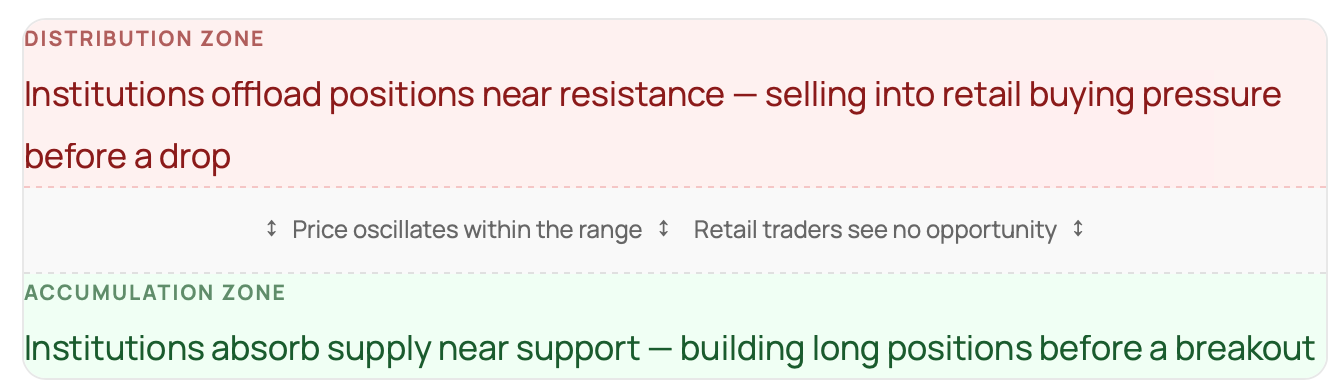
To determine whether accumulation or distribution is taking place, traders should watch for several key signals. Heavy volume near support combined with multiple successful bounces often indicates an accumulation phase. Repeated failures at resistance, accompanied by elevated volume near the top of the range, usually suggest distribution. A false breakout below support followed by a rapid recovery back into the range within one to three candles is also commonly associated with accumulation. In many cases, this type of move represents a liquidity sweep where institutional participants trigger retail stop losses in order to obtain better pricing for large position entries.
Stop hunting is a real market behaviour. Institutions may intentionally push prices below support levels to trigger clusters of retail stop-loss orders, allowing them to fill large buy positions at lower prices before reversing the market upward.
How Institutions Accumulate Positions Without Moving the Market
Institutions typically build positions in layers rather than through a single large order. For example, during an accumulation phase in EUR/USD, a large fund may place buy orders every 5 to 10 pips throughout the lower third of the consolidation range. As price declines into that zone, the institution systematically absorbs incoming sell orders and averages its entry price across multiple fills instead of aggressively chasing one specific price level.
An additional advantage of this layered accumulation process is that it helps prevent obvious breakdowns below support. If market participants observed a clean and decisive support break, many traders would immediately enter short positions, making it more difficult for institutions to continue accumulating quietly. By maintaining the appearance of a stable range, institutions can continue building positions without attracting unnecessary attention.
Range traders frequently misunderstand the mechanics behind false breakouts. For institutions, the final requirement before positioning for the real breakout is liquidity, meaning the availability of sufficient orders at the desired price level. To create that liquidity, institutions may first push the market below support and trigger stop losses among retail traders, often referred to as the "weak hands." This process generates a surge of sell orders as stops are activated, providing institutions with the supply needed to establish positions before quickly reversing the price in the opposite direction of the initial breakdown.
Understanding the difference between a liquidity sweep and a legitimate breakdown can significantly alter trade timing and execution. Liquidity sweeps typically close back inside the range within one to three candles. These moves often feature long wicks accompanied by sharp spikes in volume, followed by an immediate decline in activity that suggests stop-loss liquidity has been absorbed. Momentum then reverses sharply, producing strong candles in the direction opposite the original breakdown.
Legitimate breakdowns behave differently. They usually display follow-through candles that close below support alongside increased and sustained volume. Rather than snapping back into the previous range, price tends to remain below former support and often consolidates at those lower levels before establishing a new directional move.
Best Trading Strategies for Consolidation Forex Markets
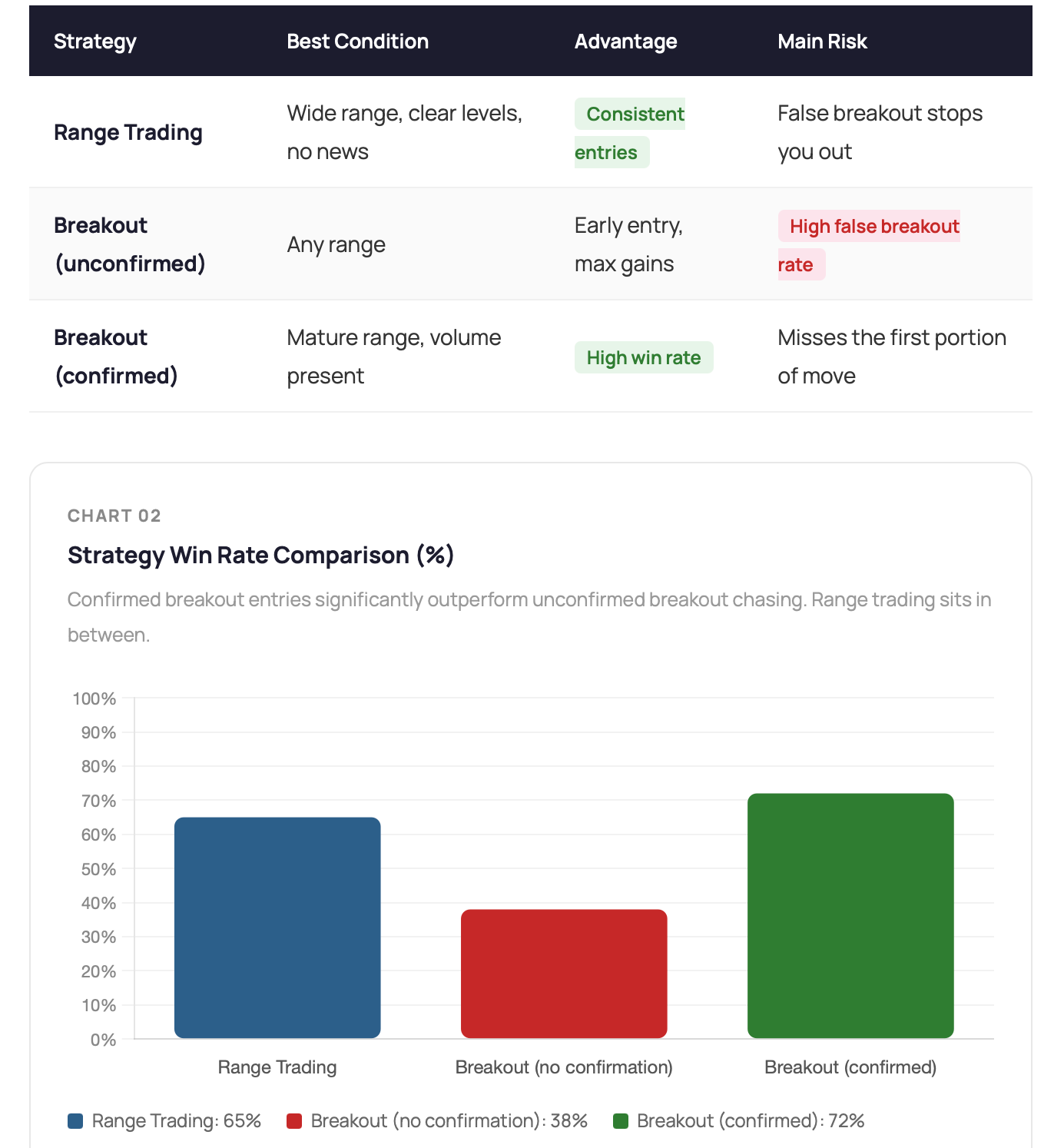
The two primary strategies used to trade consolidation forex markets profitably are range trading and breakout trading. The effectiveness of each strategy depends heavily on the surrounding market context.
Range Trading Strategy
A range trading strategy requires a market that has tested both boundaries at least two times, maintains a width greater than 80 pips for major currency pairs, and has no major economic news releases scheduled within the next 48 hours. Range trading should generally be avoided within two days of a central bank announcement because these events often trigger sudden breakouts or major range expansions.
For a buy setup within a range trading strategy, price should approach the support area within approximately 10 pips of the lower boundary of the range. A bullish reversal candle should then form, such as a bullish engulfing candle, hammer, or pin bar with a long lower wick. In addition, the RSI should indicate oversold conditions, typically with a reading below 40.
Once these conditions are confirmed, the trade entry occurs at the close of the bullish reversal candle. The stop-loss is generally placed 15 to 20 pips below the most recent swing low. The initial profit target is typically set at 70% to 80% of the total range width between support and resistance rather than targeting the full resistance level itself. In many cases, price reverses before reaching the exact boundary of the range, so targeting a slightly smaller portion of the move can help improve consistency and maintain a stronger long-term risk-to-reward profile.
This setup can also be reversed for selling near resistance. In this case, traders look for a bearish reversal candle near the upper boundary of the range, an RSI reading above 60, a stop-loss positioned above the recent swing high, and a profit target placed either near the middle of the range or approximately 70% to 80% of the distance back toward support.
Breakout Trading Strategy
Breakout traders prefer to trade confirmed directional moves rather than trading within the range itself. These strategies focus on price breaking beyond established support or resistance levels and then confirming the breakout through continuation or retracement behaviour.
Breakout moves often generate significant momentum because many traders who were previously trapped inside the consolidation range exit their positions simultaneously. This creates additional buying or selling pressure that pushes the price further in the direction of the breakout through a self-reinforcing process.
Using confirmation techniques, such as waiting for a retracement back to the breakout level before entering, can help filter out many false breakouts that typically cause breakout traders to lose consistency over time.
Differences Between the Forex and Cryptocurrency Markets
Both the forex and cryptocurrency markets experience consolidation phases, and the underlying mechanics are similar. However, the pace and overall behaviour of the two markets are very different, and attempting to trade them using identical strategies will often lead to poor results, especially in cryptocurrency markets.
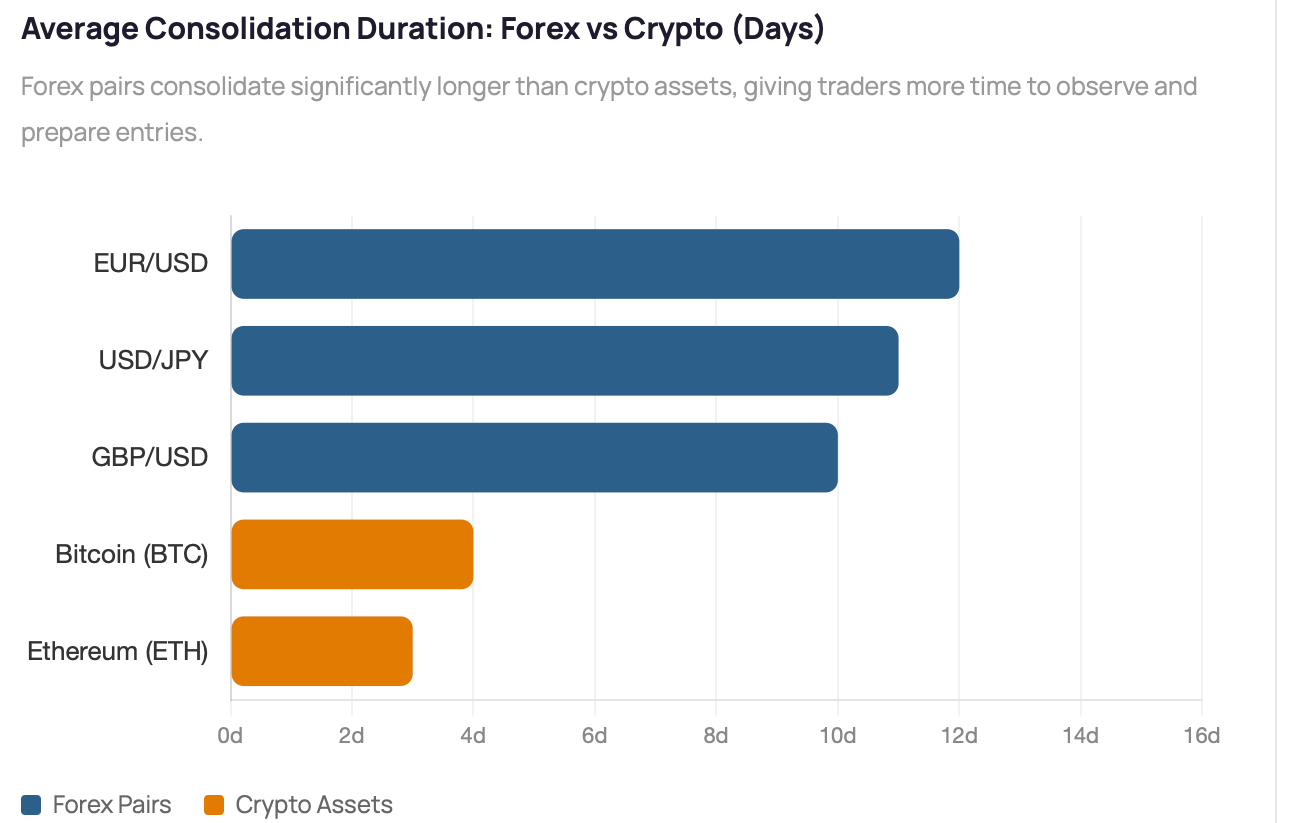
Consolidation phases in forex tend to last longer than those in cryptocurrency markets. Major currency pairs such as EUR/USD and USD/JPY commonly remain in consolidation for approximately 8 to 14 days before making a directional move. This slower pace benefits patient and methodical traders because it provides time to observe the range structure, analyse price behaviour, and prepare entries without excessive urgency.
Cryptocurrency consolidation phases move much faster. Bitcoin may complete a clean consolidation range in only 3 to 5 days before making a major directional move, while many alternative cryptocurrencies experience even shorter consolidation periods. Traders who wait too long after consolidation ends in crypto markets often miss the majority of the move entirely.
The volatility profiles of the two markets are also dramatically different. On a typical trading day, EUR/USD may fluctuate roughly 50 to 70 pips between its daily high and low. Bitcoin, by comparison, can easily move 2% to 4% in a single day depending on market conditions. Because of this difference, stop-loss placement strategies that work in forex markets are often too tight for cryptocurrency markets and may result in traders being stopped out by normal price fluctuations before the trade reaches its intended target.
The underlying drivers of price movement also differ significantly between the two markets. In forex, large directional moves are often driven by central bank decisions, monetary policy expectations, and institutional transactions involving major financial institutions. In cryptocurrency markets, price movement is far more heavily influenced by retail participation. This creates conditions with more false breakouts, lower liquidity, faster consolidations, and sharper volatility spikes compared to traditional forex markets.
Why Most Traders Lose During Consolidation in Forex
Consolidation in forex markets can be damaging for many traders. During periods of sideways price movement, traders often lose money because of boredom and a lack of discipline. After several days of consolidation, often around eight days or more, many traders become impatient and begin forcing trades at poor locations within the range. This may include buying in the middle of the range, entering breakout trades without volume confirmation, or opening positions immediately before major economic announcements. Every unnecessary or low-quality trade gradually reduces a trader’s edge. By the time a legitimate trading opportunity finally appears, the trader’s account balance may already be reduced enough to create pressure to increase risk in an attempt to recover losses quickly.
Another major reason traders struggle during consolidation phases is Fear of Missing Out (FOMO). This occurs when traders see the price breaking above resistance while many other market participants rush into the breakout at the same time. Shortly after entry, the price often reverses within one to three candles, trapping breakout traders and forcing them into losses. Institutional traders frequently use these liquidity events to establish larger positions while retail traders absorb the losses from the failed breakout attempt.
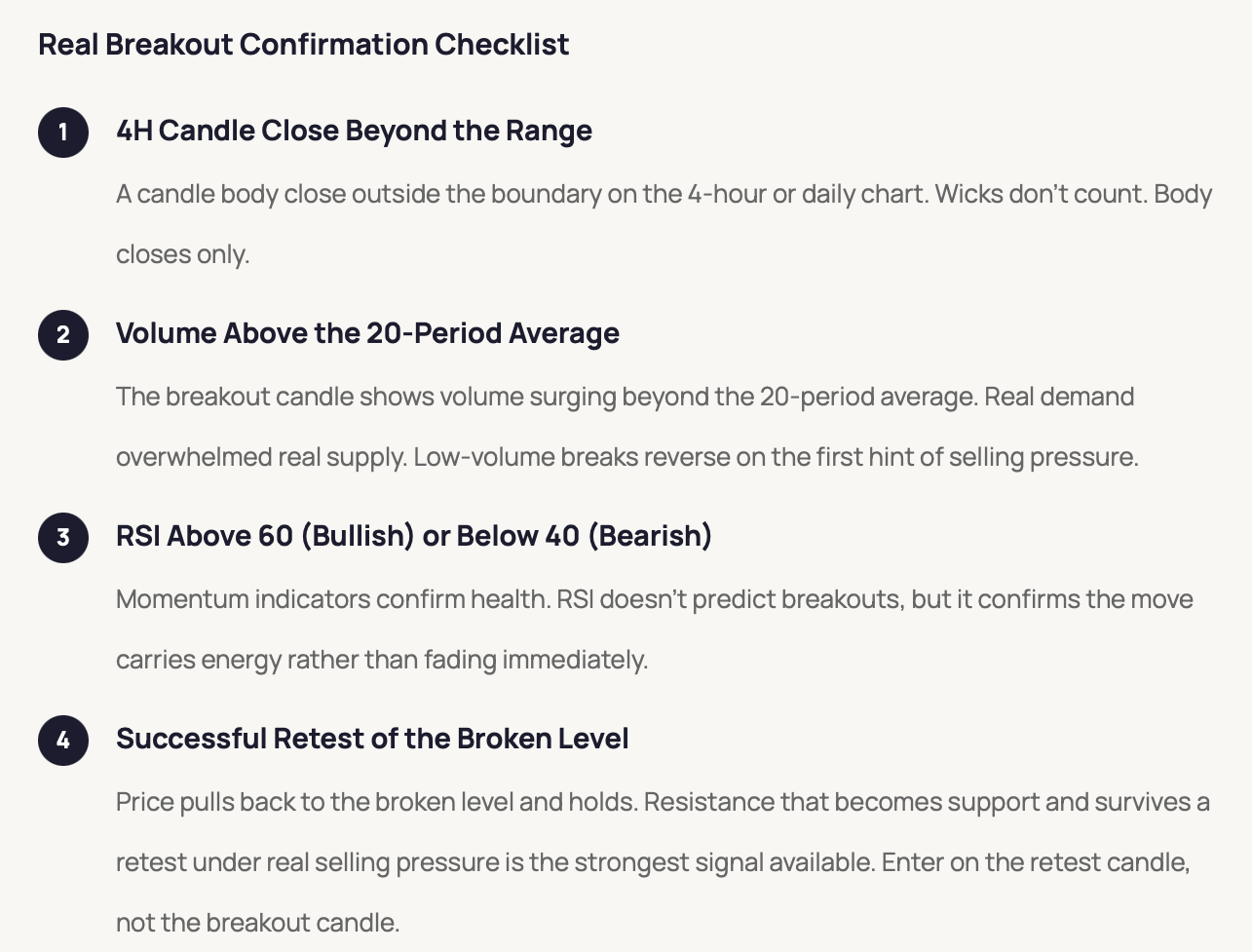
FOMO itself often becomes the catalyst for false breakout reversals. One way to reduce this problem is by using a strict confirmation checklist before entering any breakout trade. Requiring all predefined conditions to be met before executing a position can significantly reduce emotional decision-making and help traders avoid reacting impulsively to false breakout setups.
Impatience when range trading is what completes the list. Once you buy at support and bounce back to resistance, then stall at the halfway mark for 2 days before having the impulse to exit your trade for a small profit, 48 hours after the stall, price completes its move to resistance; so you were right on direction but had a smaller win due to nerves. Establish your target before entering and hold it unless your original reason for taking the trade breaks down completely.
Consolidation more clearly shows discipline than skill because most successful traders use the waiting period actively to manage their edge.
How To Recognize A Real Breakout After A Period Of Consolidation
A candle that closes outside of range boundaries does not necessarily mean that you are going to have a valid trade. Most breakouts are failing trades. Successful breakouts are confirmed by the four criteria; therefore, rather than looking at breakouts as a method of searching out valid trades, look for real breakouts from false breakouts by applying the four criteria.
Session timing gives context to when breakout trades happen. A breakout that occurs at London (7 AM GMT) or New York (1 PM GMT) has more relevance than one that occurs at 2 AM GMT, when there is limited liquidity in the Asian market. Likewise, if the same technical setup is seen in an active market versus an overnight market, it has a higher probability of success when the market conditions support that trade occurring.
Trader Decision Framework: What Should You Do in a Consolidation Market?
When faced with a consolidating market, you need to know whether to trade within the range now, wait until it breaks out, or stay out altogether. Having a clearly defined framework will help you make that decision quickly and unemotionally.
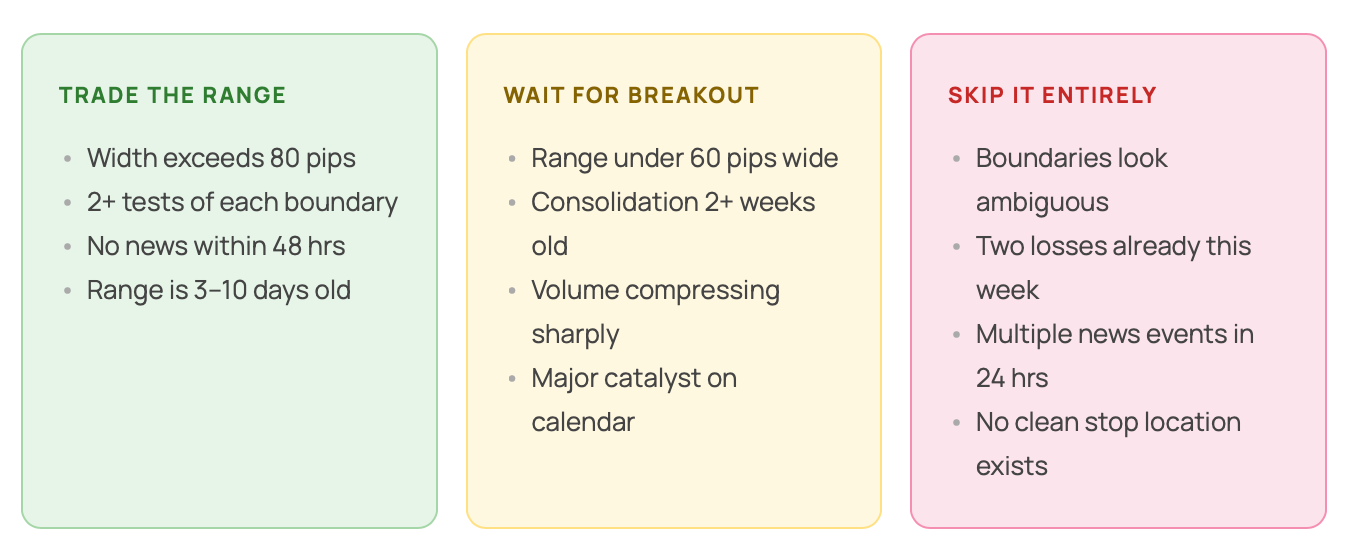
Waiting to confirm your trade is just as valid as trading in the current range. Preserving your trading capital by making no trades during periods of uncertainty allows the trader to take maximum risk on high-probability setups when market conditions improve. The best trades you make this year will be ones you haven’t had to force yourself into. These trades will be easily identifiable on the chart and will have a clear place for a stop loss and a reward-to-risk ratio that makes sense. If a trade setup seems forced or hard to arrive at, it's because it truly is not a high-probability setup.
Frequently Asked Questions
What is consolidation in forex?
Consolidation in forex refers to a period when price moves sideways within a defined range, bouncing between a consistent support level below and a resistance level above. Neither buyers nor sellers gain enough control to push the price significantly in either direction.
Is consolidation a good time to trade?
Yes, with the right approach. Range trading within well-defined boundaries offers consistent, repeatable entry and exit points. Breakout trading after confirmation captures explosive moves. Both work. The key is matching your strategy to the current range characteristics.
What causes forex consolidation?
Supply and demand reach a temporary balance. Large institutional players need time to build or offload large positions, and major catalysts haven't arrived yet to push the price decisively in one direction. Both forces produce sideways price action.
How do you trade consolidation in forex?
Range trade by buying near support and selling near resistance with reversal confirmation. Or wait for the breakout, then confirm it with volume, RSI, and a successful retest before entering. Both approaches outperform chasing the first breakout candle without confirmation.
What is accumulation in forex?
Accumulation describes the process where institutional traders gradually build long positions near the bottom of a consolidation range. They absorb sellers systematically over days or weeks, keeping the price from breaking below support until they've built the full position they want.
Stop Guessing When the Market Will Move. Visit TradeWill.com
Disclaimer: The content of the blog does not represent any position of Trade W, does not serve as any trading-related decision advice, and does not endorse any third-party.