

 Trade W
Introduction: What is a Currency Peg?
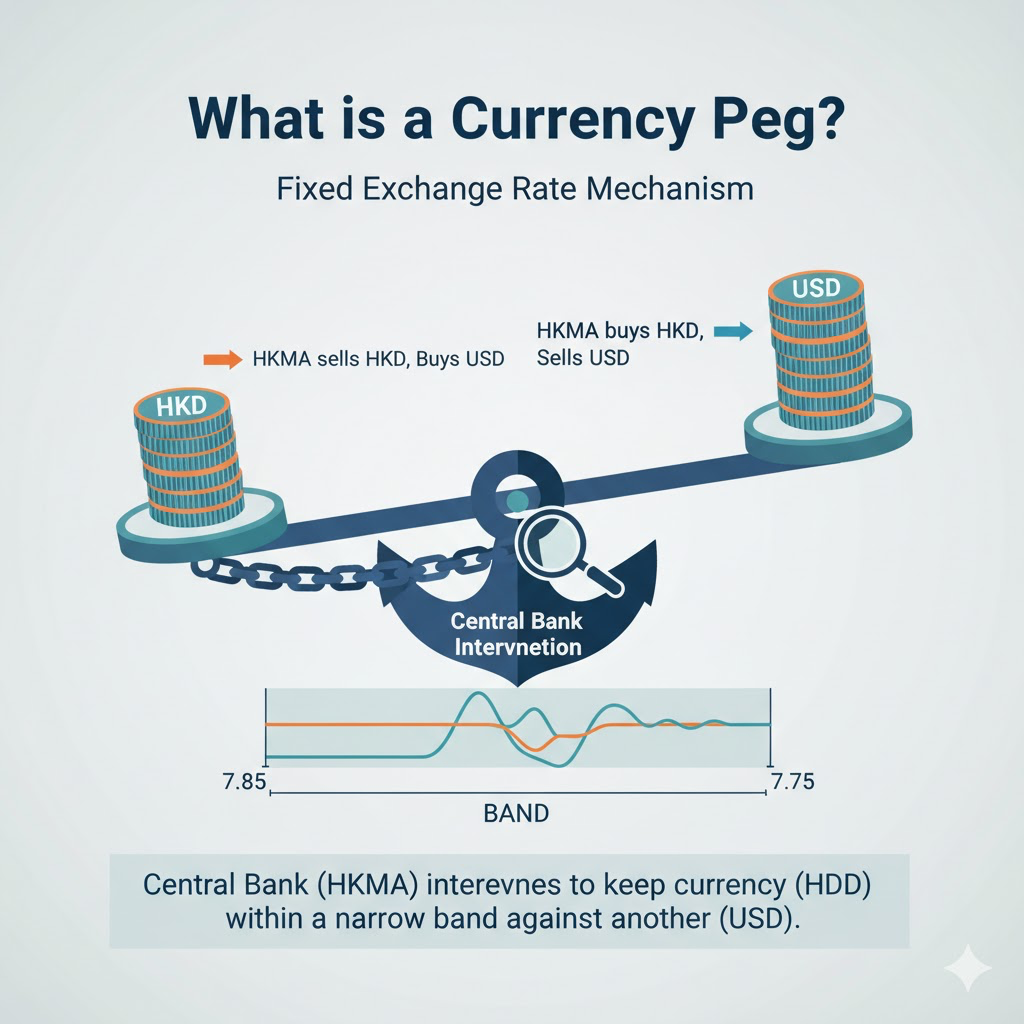
A currency peg or fixed exchange rate is established when a country pegs the value of its currency to another currency or a currency basket. Rather than permitting the market to determine the exchange rate (which is the practice for most of the major currencies), the central bank uses active intervention to keep the exchange value at a predetermined value.
The difference in currency pegged versus floating currency seems to be quite simple. Currencies that float, such as the US dollar, the euro, and the British pound change in value on a constant basis based on supply and demand. A pegged currency will stay within a narrow band of value against its currency peg. Think of a pegged currency like a voucher for candy, you can always exchange that voucher for candy regardless if candy gets scarce or plentiful; you will still receive the same amount of candy when exchanging your voucher.
Currency pegs have great importance in the forex market, for international trade, and for investors. They provide stability for businesses that are engaged in trading across international boundaries as they lessen the exchange rate risk of potentially losing value. However, at the same time, a currency peg inhibits a country from independently conducting its own monetary policy, while sometimes becoming targets for speculators to exploit.
The Hong Kong dollar is a perfect example. Since 1983, the HKMA has pegged HKD to USD within a target rate of approximately 7.80 within a trading band of 7.75 to 7.85. If market pressure moves the exchange rate toward either band, the HKMA will intervene by buying or selling USD to maintain the value of HKD within the target guidelines.
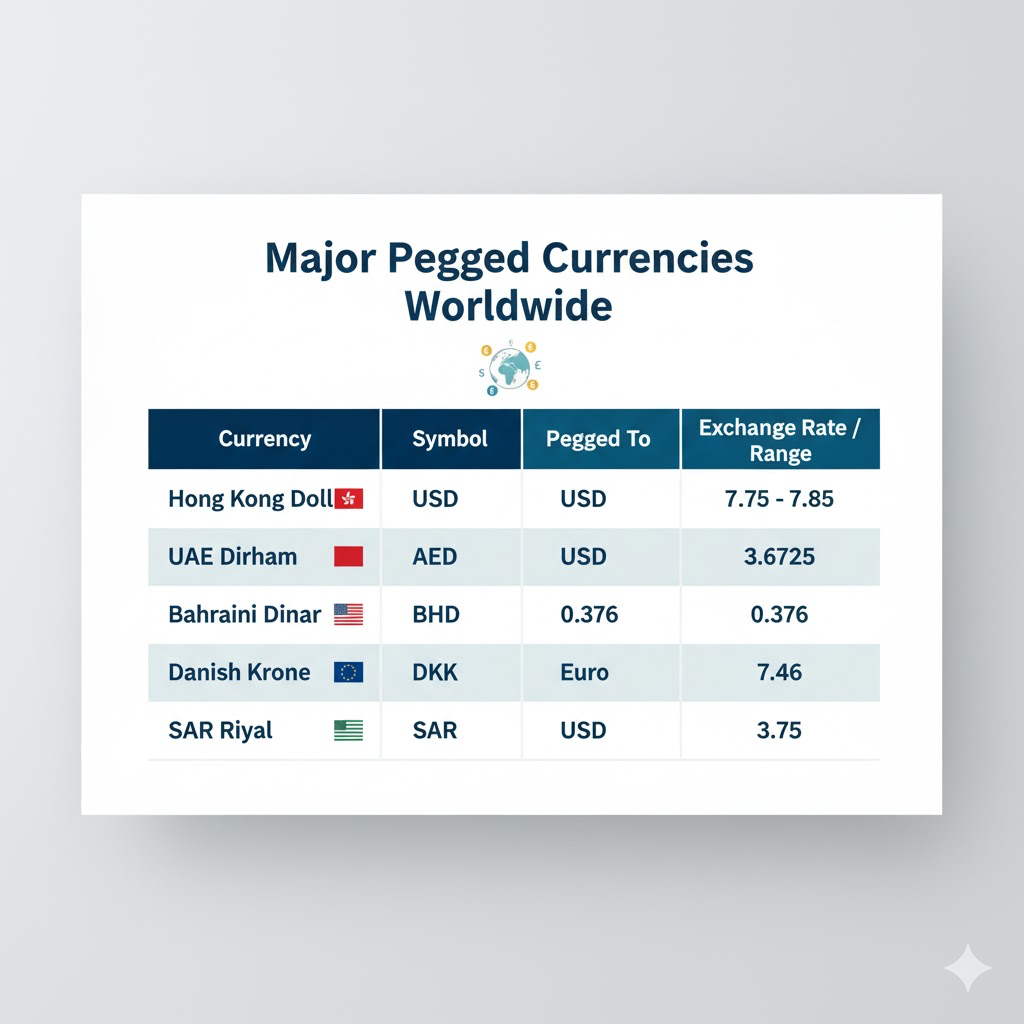
Other pegged currencies include the UAE Dirham (pegged to USD at 3.6725), the Bahraini Dinar (pegged to USD at 0.376), and the Danish Krone (pegged to the euro). Each currency meets different economic needs, but they share the same basic method of maintaining a fixed exchange rate.
Understanding currency pegs affects not only how you analyze exchange rates but also helps predict central bank actions and assess market volatility. For traders, this knowledge becomes a critical tool for identifying opportunities and managing risk.
History and Classic Examples of Currency Pegs
Pegs of currency emerged as countries desired stability in their international trade and investment. After World War II the Bretton Woods system pegged most major currencies to the US dollar, which was convertible to gold; though that system collapsed in 1971, many countries went on to use pegs to anchor their monetary system.
Countries typically establish currency pegs for three main reasons: to stabilize prices and control inflation through monetary discipline established in a country with a stronger economy, to promote trade and investment by removing exchange rate uncertainty and third, to establish credibility for their central banks, particularly in developing economies with histories of monetary instability.
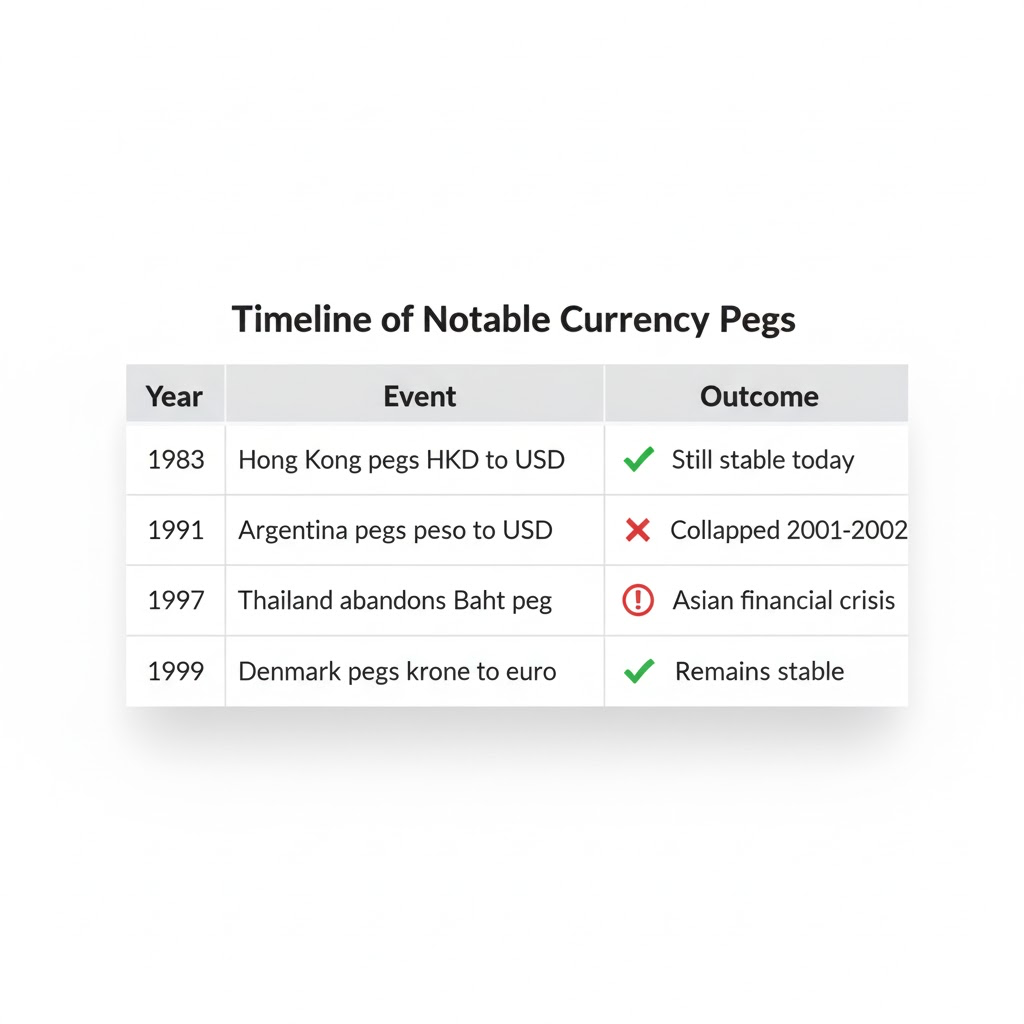
The Hong Kong dollar peg is regarded as one of the most successful in history. Established in 1983 during a crisis of confidence, the peg has survived the 1987 stock market crash, the 1997 Asian financial crisis, the 2008 global financial crisis, and more recently geopolitical conflict. The HKMA holds large amounts of foreign exchange reserves and has defended the peg during this time through market purchases, as well as policy adjustments.
Not all of them survive, however. The Thai Baht crisis in 1997 illustrates how abruptly a peg can collapse when faced with pressure. Thailand had pegged the Baht to a basket of currencies but heavily weighted towards the USD. As the dollar got stronger in the mid 1990s, Thai exports became uncompetitive. The country was running large current account deficits while accumulating short-term foreign debt. Speculators attacked, sensing weakness in the Baht.
After digging into their foreign reserves, Thailand, in July 1997, released the peg. This caused the collapse of the Thai Baht and caused more extensive currency collapses across Asia, leading to a financial crisis.
Argentina's experience serves as another cautionary tale. In 1991, Argentina pegged the peso to the dollar at a rate 1:1 using a currency board system. Initially, the pegging brought the inflation under control, thus restoring confidence. However, by the late 1990s, due to the strong dollar, Argentine exports had become expensive, while Brazil, their main trading partner, devalued its currency.
Unable to devalue its own currency in the face of mounting debt, Argentina plunged into recession. The peg collapsed in 2001 and 2002, causing economic mayhem and a sovereign default.
Think of it like candy vouchers again. When the voucher system works, everyone knows exactly how much candy they'll get, which makes planning easy. But if the candy store runs low on supplies or too many people rush to exchange vouchers at once, the whole system can break down overnight.
Historical cases provide the following valuable lessons for traders. Successful pegs have strong foreign reserves, sound fiscal discipline, flexibility in the economy, and the peg currency is aligned with the economic cycle of the anchor currency. Failed pegs tend to have similar warning signs: running low on reserves, serious trade imbalances, strong political pressure for policy change, and excessive speculative position accumulation against the currency.
For investors and traders with a longer time horizon, understanding these patterns will help you assess whether a peg (now or in the future) is at risk of sustaining. A policy change, whether in favor of defending a peg or abandoning it, will create serious market volatility and profitable trading opportunities for those who can identify the warning signs in advance.
Types of Currency Pegs
Currency pegs are various types, each with unique traits that have implications for central banking operations and trading decisions. By understanding a currency peg, you can help determine the degree of stability and evaluate the predicted behavior of central banks in your trading activities.
A hard peg, often chosen for its rigidity and sometimes called a currency board, requires no alteration to the pegged exchange rate. Central banks that adopt a hard peg guarantee convertibility of domestic currency into foreign currency at a fixed rate and hold foreign reserves equal to or greater than the domestic money supply as a backing. Think of a hard peg's lack of wiggle room as locking in a price. The Hong Kong Monetary Authority has one of the most well-known hard pegs in the world today. Every Hong Kong Dollar (HKD) in circulation is backed by USD reserves, and when the HKD touches 7.75 or 7.85 in value against USD, the HKMA will intervene automatically. With this type of peg, the authority has almost full discretion removed from its monetary policy, as its interest rates must closely follow USD interest rates to preserve the peg.
A soft peg (sometimes called a managed float) is a more flexible approach. The central bank will target an exchange rate, but will allow it to fluctuate a small amount around that target. When it moves cooperatively far from the target, the bank will re-enter and set the rate back. Nonetheless, a soft peg allows the bank to maintain more policy independence than an entirely hard peg. One classic example is Singapore.
The Monetary Authority of Singapore (MAS) aims for the Singapore Dollar (SGD) to manage against an undisclosed basket of currencies, allowing the currency to gently appreciate or depreciate within an undisclosed band. This offers Singapore the ability to alter monetary policy consistency to meet domestic economic circumstances while still maintaining some relative exchange rate stability.
It's like the thermometer scale in which the temperature will vary a little bit, but it's not going to be a completely uncomfortable level (or in this example, excessively hot or cold). This, of course, is easier said than done, but it helps offer a general idea of the approach of a managed float towards a dual peg.
A basket peg pegged a specific currency to a pegged average of multiple currencies instead of a single currency. This obviously offers some diversification of risk and tends to better mirror the trading landscape of a given country. The most notorious basket is the IMF's Special Drawing Rights (SDR), which is a weighted basket of the currencies of the United States, the euro, the Chinese yuan, the Japanese yen, and the British pound.
For instance, the Kuwaiti Dinar (KD) is pegged to an undisclosed basket of currencies relative to its major trading partners. An analogy, which we use for example exchange rates, is a bag of candies in which you buy an equal amount of several types of candy. Each candy is an equivalent exchange and you count up a group of candies as an exchange or mass.
Each type has a different trading impact. Hard pegs produce the most predictable ranges, but there is also the greatest risk of a sudden break occurring when the fundamentals no longer align. Central banks must intervene frequently to maintain their hard pegs and do so aggressively, meaning that we can use those intervention points as reliable trading signals.
Soft pegs create a more gradual adjustment and do not feature the extremes of intervention. Traders must also look ahead to the policy statements and economic data that could trigger the central bank to change the target range. Soft peg currencies will typically trend slowly within wider ranges than hard pegs.
Basket pegs are the most complex case, because there are several exchange rates impacting them. Therefore, traders must take into account multiple anchor currencies and how they are moving relative to each other. This is an opportunity for traders when the currencies in the basket are going in different directions.
The peg options tell us a lot about the priorities of the central banks. Hard pegs demonstrate that the bank cares most about the credibility of the peg and stability. Soft pegs demonstrate that the central bank is balancing stability with the flexibility to set policy. Basket pegs demonstrate a country that desires to have a diverse trade, but be independent of any one economy.
By understanding peg types, you begin to anticipate the central bank's behavior, assess the likelihood of intervention and better detect what the best trading strategy will be for each pegged currency that you encounter.
Macroeconomic Impacts on Pegged Currencies
Macroeconomic aspects place continuous strain on currency pegs, and understanding such forces allows traders to forecast instability and take advantage of opportunities to profit. In this environment, the most influential factor is the interest rate spread between the pegged currency's country and its anchor.
When the central bank of the anchor raises rates and interest rates in the pegged currency's country remain low, capital will flow towards the higher yield. This converts the capital flow patterns into selling pressure on the peg that forces the central bank to intervene. Conversely, if interest rates are higher in the pegged currency's country, the currency will benefit from a natural capital inflow that creates selling pressure that strengthens the peg. For instance, when the Federal Reserve aggressively raised rates in 2022 and 2023, the Hong Kong Monetary Authority was forced to raise rates to maintain the HKD peg, even though the Hong Kong economy might have benefited from falling rates.
Inflation differentials play the same important role. If inflation is higher in the pegged country than in the anchor country (in this case anywhere other than the US) the real exchange rate appreciates through the nominal exchange rate staying fixed. An appreciating real exchange rate (a weakening of the pegged currency) leads to lower exports and higher imports, and potentially trade imbalances. When the USD appreciates globally, the HKD appreciates (because of the peg). While this helps control inflation in Hong Kong by making imports cheaper, it also harms Hong Kong exporters who are competing internationally for business.
Similarly, GDP growth rates between the two economies create tension too. Fast growing economies tend to need an appreciation of their currency to avoid overheating, and slow growing economies need depreciation of their currency in order to create demand. A pegged currency does not have the flexibility to respond to these necessities. If Hong Kong were to have a booming economy while the US economy were to slow down, the HKD peg stifles appreciation that would normally put the brakes on the Hong Kong economy.
Trade balances also only tells part of the picture, but is an important part of the story. Trade deficits that occur over a sustained period will also deplete foreign reserves if a country has a negative trade balance, and the country will eventually have less foreign reserves than required. Once there are low levels of reserves left, speculators tend to attack the currency peg. The 1997 Thai Baht Crisis began when the current account had been in deficit for years, depleting reserves due to continued imports and the peg became unsustainable.
This leads to what economists call the impossible trinity, or trilemma.
Specifically, a country can only achieve two out of three goals: a fixed exchange rate, free capital, unfettered capital flows, and an independent monetary policy. Hong Kong has settled on a fixed exchange rate and free capital flows at the expense of independent monetary policy. Singapore opts for some, but not complete, fixed exchange rate stability and independent monetary policy at the expense of free capital flows. Understanding what trade offs a country makes provides insight into where vulnerabilities may lie.
Key Economic Indicators Affecting Pegged Currencies
For those who trade, keeping an eye on the indicators provides alert signals early on. Increasing trade deficits, declining reserves, or widening interest rate spreads that the central bank cannot close all indicate mounting peg pressures. Increasing peg pressures almost always precede intervention or outright peg abandonment in extremes.
These economic forces also create arbitrage opportunities. When the interest rates on pegged currencies deviate from interest rates on anchor currencies, traders can simply borrow in the low interest rate currency and invest in the high interest rate currency while earning the spread, all the while risking very little on the exchange rate risk as long as the peg holds. If the peg were to break, however, losses on these positions could be catastrophic.
Smart traders will monitor reserve levels, central bank balance sheets, and corresponding policy statements all in conjunction with traditional technical analysis. Macroeconomic shifts provide the fundamental backdrop that ultimately sets the tone for whether technical levels hold or break. So a strong economy with robust reserves makes peg defense credible, and weak fundamentals present technical support levels as traps.
Market Psychology and Speculative Risks
Market psychology turns economic pressures into acute crises for pegged currencies. Even fundamentally sound pegs can fail when speculators coordinate attacks on a peg, which makes understanding these currencies a matter of psychology as much as a matter of economics.
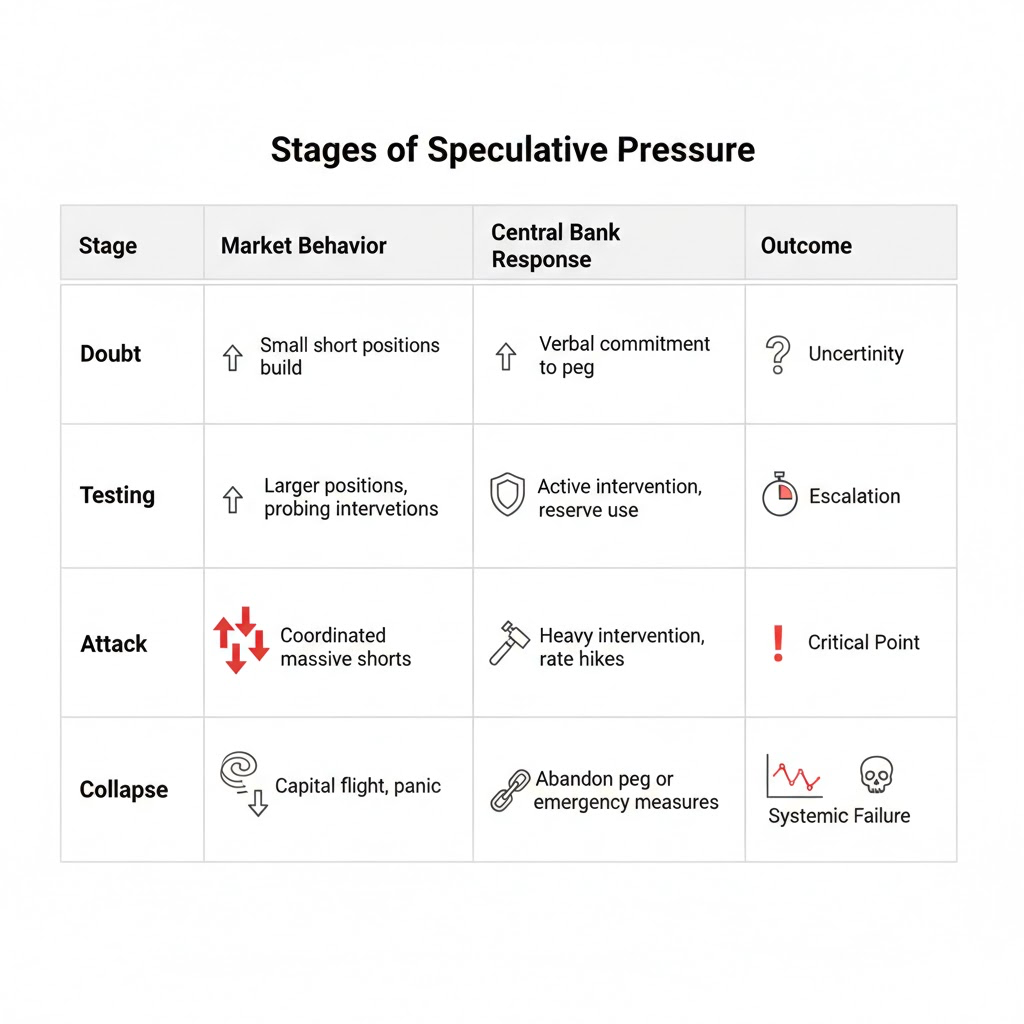
Speculators can only exploit pegs through a strategy made famous by George Soros's attack on the British pound in 1992. The logic is relatively simple but very powerful. If a peg is looking vulnerable, speculators borrow the almost without risk currency, sell out of that for the anchor currency, and wait. If the peg breaks and the value of the pegged currency falls, the speculator establishes a massive profit margin by simply repaying the loan with devalued currency.
If the peg holds, the speculation accepts that they will lose the accruing cost of borrowing the pegged currency as a cost of the strategy. A growing perception within the market that the peg is weak creates an asymmetric payoff associated with taking a massive speculative position against the peg to exploit the inherent unsoundness.
The Thai Baht crisis is a perfect example of this dynamic. After all of Thailand's economic challenges became apparent in 1996 and into early 1997, hedge funds and banks built massive short Baht positions. Each new short Baht position exerted additional pressure on Thailand's reserves. This process made the Bank of Thailand spend billions resisting the short selling, but the bank's actions were insufficient to stymie speculation.
Eventually, the dollar reserves available to back the Baht ran out and Thailand abandoned the peg on July 2, 1997. The Baht promptly devalued almost 20% with the value continuing to drop , ultimately losing over 50% of its nominal value. Speculators profited billions while Thailand succumbed into a recession.
Argentina also saw pressure at this level around 2001 and 2002. As the recession worsened and public debt grew, everyone recognized that the one to one peso dollar peg could not last. Argentines sprinted to change their pesos into dollars before the inevitable devaluation. The bank's reserves were drained. When the money supply was cut, and a limit was placed on how much cash holders of pesos could withdraw, public protests broke out in response. After months of uncertainty, the peg broke, and the peso plummeted from ~1 dollar to nearly 4 pesos to the dollar.
You can think of it like the rush for a candy voucher. If everyone believes that the store might either run out of candy, or that the store might change the terms of the voucher, they all line up to exchange vouchers right away. The crowd rushes to exchange their vouchers, which ultimately depletes the store's candy supply and forces the store to change their terms, or shut down altogether.
Herding behavior amplifies these issues. If the major hedge funds decided to attack the peg, other traders pile on, half to not be left out of the opportunity and half in fear of being on the wrong side of a trade. Media coverage of the herd behavior will also exacerbate public awareness, and thus create a trigger for wealthy citizens and businesses to abandon the country. The use of social media, such as information cascades, makes speculation trades today much faster, and potentially more violent than speculation of historical times.
Market expectations are important even if there is no active attack on a currency peg. If traders think a central bank does not have the will or reserves to defend a peg or soften the deficit in the exchange rate, they will demand higher interest rates to hold that currency. As interest rates increase, funding pressure will develop that negatively impacts the economy of the country and the currency peg. This self-reinforcing cycle can collapse even the most sustainable, initially strong pegged regime.
Nonetheless, it is indeed possible to effectively defend. Hong Kong has successfully responded to multiple speculative attacks in the past. For example, during the Asian financial crisis in 1998 speculators went short on both HKD and Hong Kong based stocks, thinking that the HKMA would either:
1. Increase interest rates so high that stock prices would collapse, or
2. Abandon the peg altogether.
The HKMA startled the market by intervening and buying Hong Kong stocks, and while maintaining the peg bruised aggressive speculators, it still added to confidence in the peg.
As a trader, the lesson is that to understand the market psychology, the trader has to clobber position data, news, and reserves at the same time, as negative sentiment builds on the pegged currency, so when a typical bit of economic data gets released, the market moves sharply because speculators work their position for a peg break.
So the bottom line is clear. Even a pegged currency can produce total chaos and volatility when at an extreme. The peg creates a feeling of stability that can unravel in a shocking way when the psychology changes. Traders need to be careful of this risk with leverage. Once the peg breaks, it can be very quick from the peg rate to what it will be overly aggressive in movement to capacity or their position is no longer and collapse in extreme loss.
Currency Peg in Forex and CFD Trading
Because pegged currencies combine consistency and uncertainty, they offer unique trading opportunities. If you understand how to trade them safely and profitably, it's worth understanding their distinguishing features.
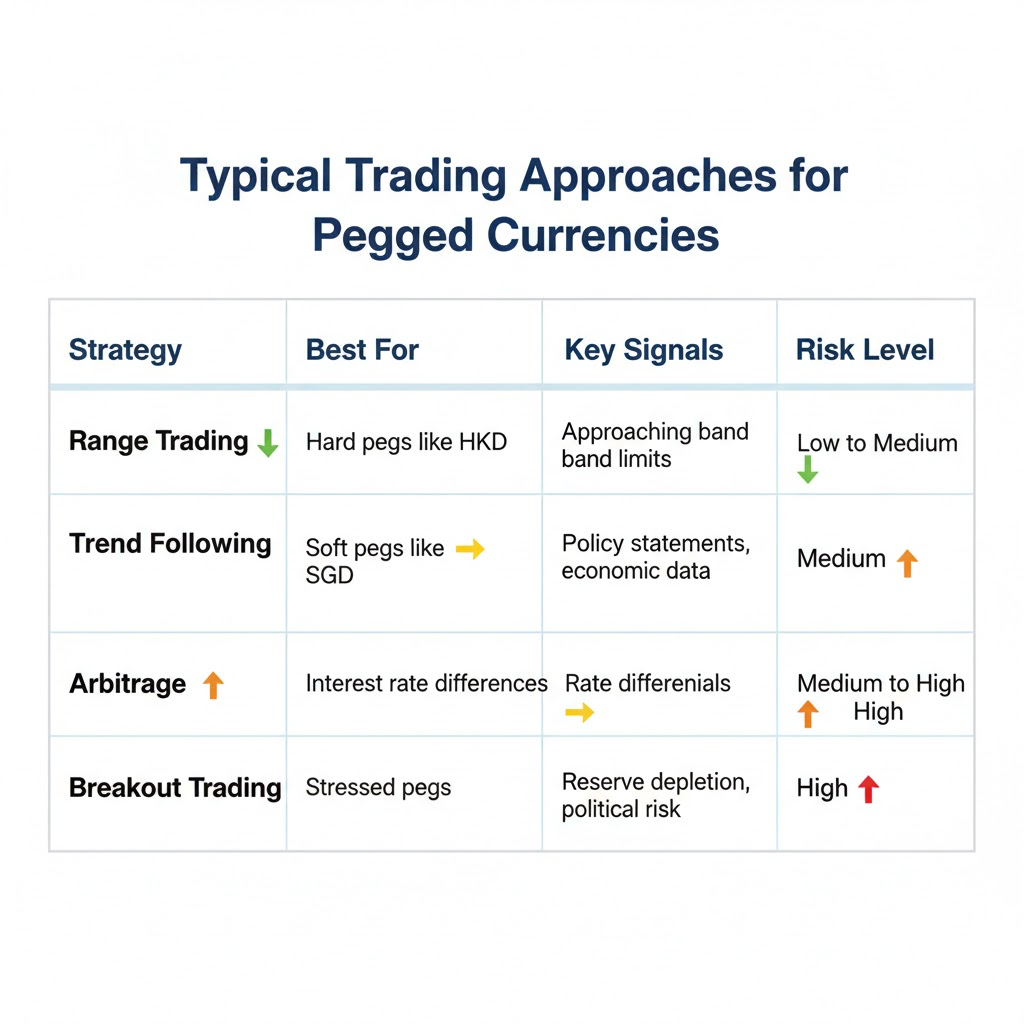
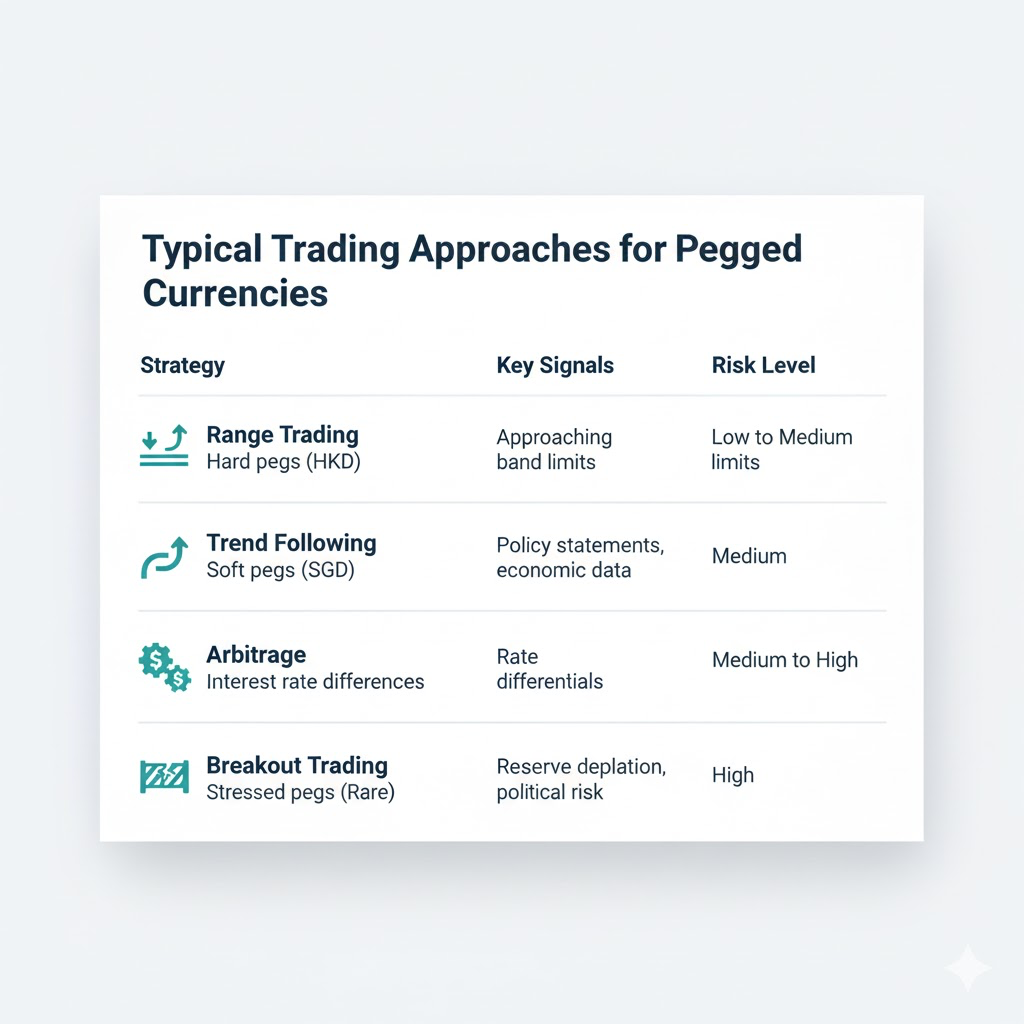
To trade pegged currencies profitably, especially against floating currencies, is to exploit low day-to-day volatility. Major pairs when traded, such as EUR/USD or GBP/USD, might move one percent or more on any given day. On the contrary, USD/HKD’s day-to-day change is typically 0.1 percent or less, which is more stable than a consolidated stock index fund. The stable environment of low volatility is ideal for range trading strategies whereby you can profit from the relatively predictable fluctuations of the currency pair between a support level and resistance level.
For example, USD/HKD trades typically in a band of 7.75 to 7.85. When the USD/HKD approaches 7.75, you can expect the HKMA to allow the currency pair to trade weaker as it buys HKD and sells USD to defend the 7.75 level. Therefore, as an example of a trade position near 7.75 USD/HKD, you can sell the pair with an expectation for mean reversion toward 7.80 as the price settles into the value range.
Again, near 7.85 as an example, you can expect the HKMA to intervene or allow the currency pair to appreciate back toward the mid-levels of the 7.75 to 7.85 range, and take the position of buying the pair. In summary, the trading positions exhibit modest but stable returns with low risk.
In a nutshell, if you were purchasing vouchers for candy that appeared to trade between 90 and 100 cents, you would buy at 90 cents, and sell at 100 cents, over and over. Each trade is a small profit. You can count on it being reliable as long as that trading paradigm is intact.
Now, using CFD trading we can leverage these specific trading scenarios to larger positions. If you trade USD/HKD at a 100:1 leverage, a move of 0.05% in the pair, would yield a 5% return on margin. Then over the course of the year generating multiple smaller range trades cumulative in a hurry. But as we mentioned, leverage brings about risk for both outcomes. If the peg is broken, the loss can be the opposite of the profit in the same magnitude, or potentially put you over your account balance!
Cross currency trading; we’ve all benefitted being able to look for price movement opportunities between pegged to non pegged currencies. For instance, already AUD/HKD becomes AUD/USD plus a couple minor adjustments because HKD essentially tracks the USD. So when there is a positive or negative AUD data released, it will ultimately move the AUD/USD rates, and that being the same for AUD/HKD. Traders with the awareness of this correlation can utilize the discrepancy to gather price moves on speculations or utilize pegged currencies instead of direct exposure.
Singapore Dollar would be the same sort of opportunity or potential. SGD is in a softer pegged position, making it positional to trade over time. SGD trader looking for more cosine trend change, rather than habitual reversal. If the MAS signals any change of policy, the SGD may trend for weeks or months as a larger band to move into. This trading format is a great fit for swing trading style traders, in or out of positions, instead of totally range style trade positions in a bonded price.
Breakout trading becomes relevant when there is stress on a peg. Traders will position themselves for potential abandonment by buying put options on the pegged currency or selling the pegged currency against its anchor currency. Typically, the trades will lose money as most pegs withstand stress tests, but the very few times a breakout trade works, the potential returns will more than compensate for many small losses.
Risk management is absolutely critical. A trader's position sizing should reflect that there is a possibility (however small), that the peg breaks suddenly. Stop losses offer only partial protection because often there will be a gap through a stop. Many traders limit pegged currency positions to a small percentage of their investment portfolio, considering them stable but not risk free investment.
The time of day matters much less for pegged than floating currencies. Major forex volatility occurs around London and New York openings, however pegged currencies will typically remain calm during these volatile times, unless there is a specific intervention or economic news. They provide the opportunity for a trader who is not able to watch the market during these times.
Finally, watch for political and policy risk. Central bank commentaries, government fiscal policy, and geopolitical events can move markets, signal intervention, or increase speculation about the viability of a peg. Good pegged currency traders are able to read policy statements with care and cognizance of their larger economic and political implications.
This is the key realization for trading pegged currencies. The peg mechanism creates the opportunity initially. Low volatility means range trading and carry trades are possible. The former will generate trade opportunities and the latter will generate high potential explosive moves if there is a stress to the peg or a peg abandonment.
Any trader that understands the mechanism at play, is reading for fundamental indicators, and is managing risk is positioned to profit in stable markets and disorderly markets.
Technical Analysis and Trading Strategies
Technical analysis exhibits unique aspects in pegged currencies. The artificial price limits set by central banks give rise to unique price patterns that demand modified approaches.
Range trading is the dominant technical approach to hard pegged currencies. Since intervention limits are well-known, we find significant reliability in support and resistance levels. The 7.75 and 7.85 levels in USD/HKD are not simply psychological barriers, but rather commitments to policy backed by billions of dollars in reserves. Consequently, they carry much more weight than abstract technical levels.
Bollinger Bands work exceedingly well on pegged currencies. All they need is a 20 day moving average with standard deviation set at 2. You will find that price usually violates the bands. When USD/HKD comes into contact with the lower Bollinger Band, near 7.75, it is typically a buy signal. When it contacts the upper band, near 7.85, it is typically a sell signal. Usually, price tends to gravitate towards the middle band to book profits.
The Relative Strength Index is used, especially in conjunction with entry timing. When RSI dips below 30 as price nears the intervention floor, the oversold condition now tends to support the buy case. RSI above 70, near an intervention ceiling, indicates an overbought condition and supports selling. Other than that, divergences are not significant since intervention is expected to prevent prolonged trends.
Moving averages serve to discern the peg's center of gravity. The 50s and 200s usually cluster about the midpoint of the range. Any real discernible deviation of prices from these averages would increase the probability of mean reversion. Unlike trend-following markets, where average-crossing suggests entering into new trends, pegged currencies regard average values as a type of magnet whereby prices are pulled back.
A practical strategy for currencies pegged like the HKD/USD would entail watching price action within the band of 7.75-7.85. When prices hit 7.76-7.75, occasionally under RSI 35, set a long position aiming for 7.80, and using a stop loss of 7.74. This will give you a rough reward against a risk ratio of 3:1. Whenever you trade, you should never take the risks you've actually to swallow per trade higher than, say, 1-2% of your capital due to the possibility of gaps opening. Take the profit when attaining midpoint of the range; passing-it toward a full range may find price action bumpy, courtesy of interventions near either side of the band limits.
Technical Indicators for Pegged Currency Trading
Breakout strategies come into play when fundamental stress is observable. You may wish to set alerts just beyond the outer boundaries of intervention. For example, the USD/HKD will have a breakdown of the peg if the quote trades above 7.86 or below 7.74.
But these trades have to be conducted with extreme caution because false breakouts occur when a central bank temporarily allows price to overstretch before the intervention takes place. It is important only when you see sustained breaks beyond the boundaries that a real peg failure is taking place.
For soft pegs like the SGD/USD, channel trading works better than strict range trading behavior. Draw trend lines connecting recent highs and lows which will form a channel. When trade occurs off the channel boundaries, make and take a position. Be aware of channel breaks that might indicate a shift in the policy of t Mas. When you see channels that break then reconstitute at different angles, this is an indication of a gradual revaluation of the peg.
Volume analysis indicates intervention. Spike volume with no obvious news generally indicates action taken by the central bank. The Hong Kong Monetary Authority does not announce interventions in real time or per transaction but a quick view of unusual volume near boundaries reveals that they are engaged out at different levels. Following these signals in volume analysis tells you when there are intervention support levels and the lines suggest active central bank support.
Correlation analysis provides an additional level of insight. You can begin tracking the correlation between your pegged currency and its anchor. For example, HKD/USD should show near perfect correlation with zero since it is pegged at a fixed rate. If you see correlation decrease, dig into whether fundamental factors are stressing the peg. Similarly, cross rates such as HKD/JPY should move nearly identical to USD/JPY. Divergences indicate potential arbitrage opportunities or developing issues.
Risk Management merits its own technical discussion. Use position sizing calculators, such as the ones that factor leverage. If you're trading a pegged currency with 50:1 leverage, and a characteristic stop loss of 1%, you are risking 50% of margin for that trade. In fact, many traders neglect this important detail because of the adequate peg. You will want to set maximum position limits on pegged currencies, no matter how attractive the setup.
Diversifying across peg types will also help. A hard peg range scenario in conjunction with a soft peg trend will be reducing correlation. In the event that global risk sentiment is impacted, both currencies may take a considerable hit, but in a normal scenario the two currency pairs will behave distinct enough to smooth returns.
The combination of fundamental analysis and technical analysis distinguishes the successful pegged currency traders from the unsuccessful ones. Technical analysis focuses on pinpointing the exact points to enter and exit trades, while fundamental analysis determines if the peg structure remains intact. A technical setup is useless if reserves are declining or political will disappears. You must always verify reserves, consistently look for economic data points, and review any policy statements before entering a technical trade.
Common Misconceptions and FAQ
Numerous durable myths regarding pegged currencies can cause traders unneeded pain. Knowing these myths will allow them to better frame their approach to these markets to maintain reasonable expectations.
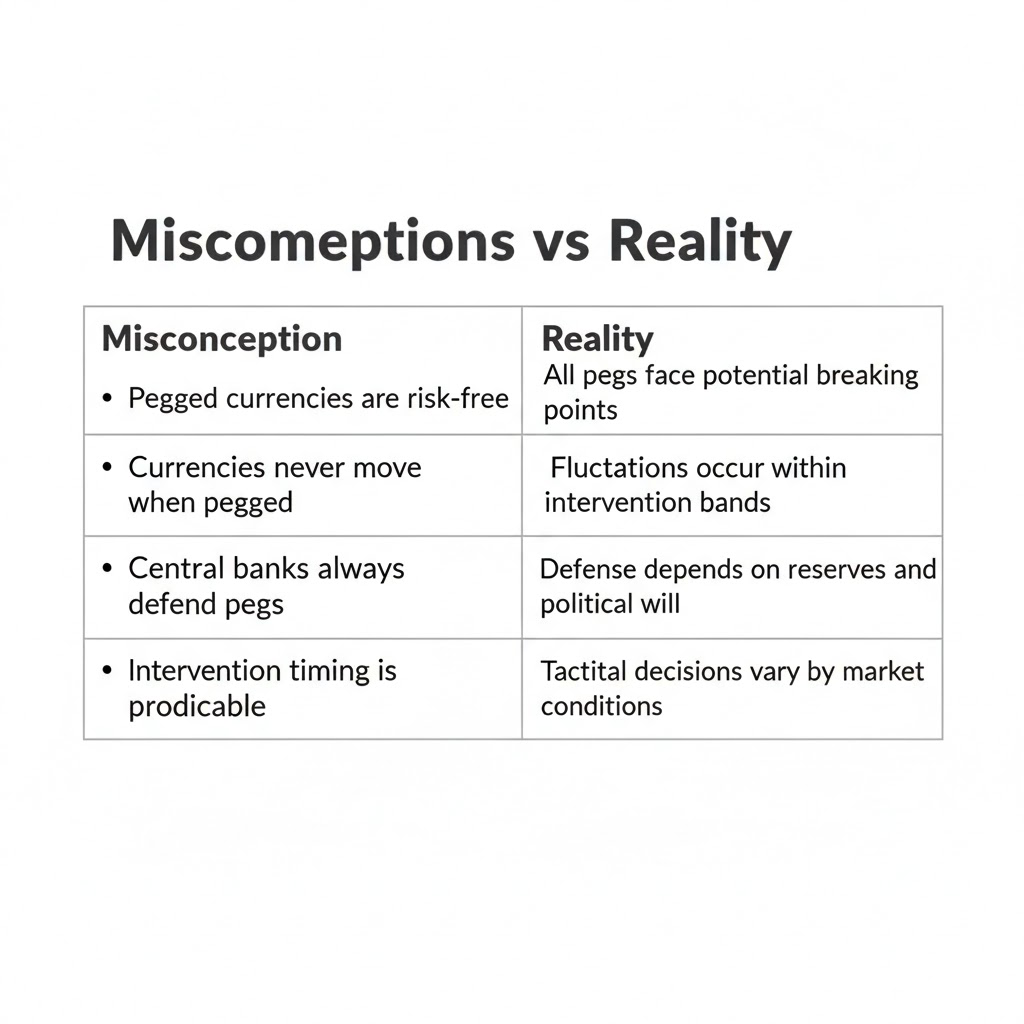
Myth: Pegged currencies are perfectly safe investments.
Truth: No peg is ever truly permanent. Even the most honorable peg incurs ongoing costs and trade offs. The Hong Kong dollar peg has lasted almost 42 years, but the peg still undergoes incredible threat and necessity of management. In the case of pegged currencies, there are always many examples of the peg becoming unpegged. Just ask the countries of Thailand and Argentina about needing some event to justify pegging a currency to the US dollar that is sometimes instant. Just to be safe and honest, if one views the pegged currency as "risk free," one is likely to lose money when reality knocks.
Myth: Pegged currencies never move.
Truth: Pegged currencies do fluctuate within their bands, and can even do so significantly. The USD/HKD trades in a USD 7.75-7.85 range which is more than 1.3% total movement. Since traders often use leverage, this can be a reason to earn substantial profits and/or substantial losses. The days of volatility, even within the bands that the trader is working within, invariably create an opportunity. The peg may constrain the price movements, but does not eliminate them.
Myth: Central banks will always be able to defend their pegs.
Reality: Central banks only defend pegs if they have sufficient reserves, political will, and economic rationale to continue doing so. If the costs exceed the benefits of defending a peg, rational policymakers will abandon it. The Bank of Thailand exhausted its reserves trying to defend the Baht peg before finally giving up. Britain's abandonment of its peg in the European Exchange Rate Mechanism in 1992, despite the fact that it had intervened on a massive scale, is simply a reminder that even wealthy countries sometimes cannot or do not want to pay the price to defend a peg.
Myth:: You can know exactly when (or at least narrow down with certainty) when the central bank will intervene in a peg.
Reality: Although some intervenable pegs are able to have boundaries are known, the timing and magnitude of intervention is unknowable. The HKMA might intervene at 7.75, or it might allow the market to drift to 7.749 before intervening (and when it does intervene it might buy aggressively or it might buy enough to stabilize). These tactical decisions hinge on market conditions, liquidity, and other broader policy considerations. Assuming that you will know that the central bank will intervene at an exact level creates a false sense of confidence.
Why does a peg still fluctuate?
The peg establishes a range, such as 7.75-7.85. The actual exchange rate is determined by the forces of supply and demand in the market within that range. The HKMA only intervenes on the boundaries of that range. In between the two levels, the exchange rate moves based on normal supply and demand; the effects of different time zones; and temporary imbalances in supply and demand, as discussed in the previous post. The peg is designed to give the market some flexibility and to limit large swings in the exchange rate.
How do I find out if a central bank will defend a peg?
You should watch a collection of indicators together. For hard pegs, the foreign reserves should significantly exceed the monetary base level in the domestic economy. The strength of the current account will also play a role in building your reserve. Political language and budget policy will indicate a level of commitment to defend the peg. Economic growth will indicate if the peg is helping or hindering the monetary policy goals. However, no one fact will ever indicate success or failure, but multiple indicators that might deteriorate can lead you to increase your risk assessment.
Can I use high leverage safely on pegged currencies?
Leverage may amplify profits but also increase the potential for losses. Although day-to-day volatility may be low, the risk of sudden peg breaks makes very high leverage extremely dangerous. A 100:1 leverage ratio (which is common among retail forex traders) still implies that an adverse 1% move will wipe out your entire account. A peg break will likely gap your account down 10%, 20%, or more in an instant. Many traders believe they are safe with an extremely low leverage ratio because "the HKD never moves", only to lose their entire account during a crisis moment. If you want to use leverage, I highly recommend using a moderate amount on any pegged currency, combined with strict position limit rules, instead.
Are pegged currencies good for beginning traders?
Yes and no. It's true that the low volatility and clear support and resistance boundaries can help beginning traders learn technical analysis faster, particularly range trading concepts that make trading concrete rather than abstract. However, the risk of catastrophic peg breaks, as well as the hidden fundamentals that could sabotage the sustainability of the peg, requires more sophistication and understanding than beginning traders typically have time to develop. My advice to a beginning trader is to trade tiny positions in pegged currencies while working to develop a more sophisticated understanding of market intervention patterns affecting the peg prior to scaling up.
What will happen to my positions if a peg breaks?
Your broker will mark positions to market on the new exchange rate, and depending on the break, that will be significantly different from your entry price. If you're wrong-side of the break, the loss will exceed your account balance, resulting in negative equity. Brokers vary in their approach. Some offer protection from negative balance, which means they would absorb any losses above your deposit. Others will pursue clients for additional funds. Always understand your broker's policy around gap risk before trading pegged currencies with leverage.
The basic idea is straightforward. Benefit from pegged currencies as ways with lower volatility not without risk. The characteristics of pegged currencies lead to trading opportunities but also unique risks which require strategies and expectations that are appropriately tempered. Traders who find the proper balance will generally outperform others substantially over time.
Summary: Strategies and Takeaways for Currency Pegs.
Understanding pegged currencies creates unique trading options but flags "special risks" that need to be respected and prepared for. Let's distill the critical ideas to thoughts that can be practically applied.
A peg is a currency that is fixed/pegged by the intervention of the central bank to another currency or basket of currencies. Hard pegs (e.g. HKD) are the most rigid with ranges both +/- that give the market participants to know that without intervention by the Central Bank the currency will not move outside that range. A soft peg (e.g. SGD) allows the currency to do the same thing but within a slightly softer budget less drastic than hard. A basket peg is when a currency is pegged to a basket of currencies to reflect the complexities of trade. Depending on the peg the treatment and strategies vary, with a hard peg allowing for more range bound trading and a soft peg more trend following.
The histories of currency pegged arrangements provide valuable insights. Successful pegs such as Hong Kong's show that credibility, reserves, and policy discipline allow for fixed rates to be maintained through multiple crises. Conversely, failed pegs, such as Thailand's Baht and Argentina's peso, show how quickly even long-standing currency pegged arrangements can fail when economies fall out of alignment, reserves are depleted, and speculators attack. These patterns provide traders with warning flags when dealing with pegged currencies now.
Macroeconomic factors place continuous pressure on a peg. Interest rate differentials between the pegged currencies and the anchor currency creates capital flows that require intervention. Inflation gaps erode competitiveness. Trade imbalances create drain on reserves. If traders understand this basic scenario, the sustainability of the peg can be evaluated outside of technical charts.
Speculation and market psychology magnify economic pressures into major crises. Even well-ordered currency pegged movements can give way to coordinated attacks by hedge funds, or herding behavior by traders in the market, as soon as confidence fails. On the flip side, strong responses by a central bank can cause significant losses to speculators; this can also reinforce confidence and capital for a peg for years.
There are many successful strategies for execution in practical trading. The first strategy is range trading where you are working with known intervention boundaries and applying a high probability mean reversion setup. You will then use indicators such as Bollinger Bands, or even RSI, to time your entries at the range edges. If you are working with soft pegs, you will instead use trend following or channel trading, and catch the slow and gradual process of revaluation. Additionally, in the case of some difference in rates of return, you will find arbitrage opportunities, but leverage and rollover risk will be a concern with this practice.
Holding cross currency positions with pegged currencies isolates and clarifies certain exposures. For instance, trading the AUD/HKD currency pair is similar to trading AUD/USD at the margins. Understanding these relationships, though ultimately simple, will help to avoid confusion and spot mispricings in the market.
Trading Strategy Workflow
-
Identify peg type and intervention parameters
-
Assess fundamental factors: reserves, economic indicators, policy statements
-
Apply technical analysis: identify range boundaries or trend channels
-
Execute with strict position sizing: limit each trade to 1-2% risk
-
Monitor for intervention signals: volume spikes, policy changes
-
Exit at targets or if fundamental deterioration appears
Risk Management Checklist
✓ Never risk more than 2% of capital on any single pegged currency trade
✓ Use moderate leverage accounting for potential gap risk
✓ Diversify across multiple pegs and non pegged currencies
✓ Monitor reserve levels and economic indicators regularly
✓ Set alerts for intervention boundary breaks
✓ Understand your broker's negative balance protection policy
✓ Maintain cash reserves for margin calls during volatile periods
The opportunities in pegged currency trading arise from the friction commonly caused by the tradeoffs between an artificial stability and the underlying economic forces. In most cases it is successful in creating a predictable and profitable trading range. But when the external forces and the peg are misaligned it can result in explosive price movements for those that are positioned favorably and swift punishment for the contrarian who does not respect the peg or has not planned for outcomes that are more than noise in the market.
Your success or failure will hinge on your ability to combine a thorough analysis of policy, a general awareness of market psychology, and systematic technical execution. You should be following central bank communication. You should also be following reserve data as if you were following the weather before a major hurricane to determine if it will make landfall as a TS or a Cat 5 hurricane. The external intervention policies should be respected, or you should be prepared to engage the market when the external intervention is inevitable, respect the anchor.
Pegged currencies are one of the things that will claim a spot in many trading strategies, but the bogus signals will not be your saving grace for risk and reward analysis. Considerations should always be made for the complexity above and beyond their usefulness, and understand that the peg itself is never risk free. Manage position size conservatively and be aware of how the stabilizing measures are in constant tension with destabilizing forces.
At first, practice in paper trading or using minimal sizes to comprehend patterns when there is outside influence and to develop an intuitive feel of how policy matters and how markets interact, develop competency and gradually scale, not forgetting to keep risk controls in mind. The juxtaposition of low daily volatility with sporadic extreme volatility will reward patient and disciplined traders that operate with an understanding of the market and its intervening policies.
Ready to put your currency peg knowledge into practice? Open a demo account with Tradewill today and test these strategies risk free before committing real capital. Master the mechanics of pegged currency trading in a safe environment, then transition to live markets.
Disclaimer: The content of the blog does not represent any position of Trade W, does not serve as any trading-related decision advice, and does not endorse any third-party.