
 Trade W
The process of buying and selling various currencies in order to earn a profit by speculating on changes in exchange rates is referred to as currency trading (also known as forex or FX) and occurs through the global currency exchange market, the largest and most liquid financial market on the planet. Currency trading can be considered interchangeable with forex or FX, as they all refer to the same activity.
The amount of currency traded each day is estimated at $9.6 trillion (BIS) as of April 2025 and represents an approximate increase of 28% over the amount traded in 2022. Furthermore, this figure makes the currency market more than three times larger than all other financial markets combined.
Currency trading is highly speculative and carries substantial risk. Furthermore, a significant percentage of retail traders lose capital when trading with leverage.
Why Currency Trading Is Worth Understanding in 2026
The foreign exchange market was once accessible exclusively to commercial banks, large institutions, and governments involved in managing national reserves. With today's technology, however, almost anyone can access the foreign exchange market and participate through a regulated broker account. Individuals with a smartphone can now access the same market and price points that generate trillions of U.S. dollars in daily trading volume. While this accessibility does not guarantee profitability or success, it does provide an opportunity for anyone willing to invest the time and effort required to learn how the market operates.
The information contained in this guide is critical to understanding how floating exchange rates work and how monetary policy tools, such as quantitative easing, influence currency valuations. You will learn about the mechanics of currency trading, including what a real trade looks like from entry to exit, with examples provided. You will also learn which currency pairs to consider when beginning to trade and how to evaluate the factors that influence exchange rates between different currencies. In addition, you will learn about leverage, which can increase profit potential but often comes with a corresponding increase in risk. Finally, I will provide guidance on placing your first trade, helping you take your first steps toward becoming a successful trader without risking capital in a live investment account.
What Is Currency Trading?
The buying of one country's currency in exchange for an equivalent amount of another country's currency is referred to as currency trading, or trading currencies. For example, if you want to invest in euros through your broker and believe the euro will strengthen against the U.S. dollar, you would place a euro-to-U.S.-dollar trade. Conversely, if you believe the U.S. dollar will strengthen against the euro, you would place a U.S.-dollar-to-euro trade.
Currency trading is also referred to as foreign exchange trading, forex trading, or FX trading. The term forex is simply short for foreign exchange, while FX is an even shorter abbreviation. These terms are used interchangeably and do not describe fundamentally different activities.
Prior to 1973, currency prices were typically determined by fixed exchange rates established under the Bretton Woods system. When the Bretton Woods system came to an end, currency values began to be determined by supply and demand within open markets. As a result, modern retail traders are able to participate because central banks, commercial banks, corporations, and retail traders all operate within the modern forex market and create the conditions under which trading takes place.
Central banks set the interest rates that drive monetary policy, and their decisions can have some of the fastest and most dramatic effects on currency values, often within seconds of an announcement becoming public.
Commercial banks account for the largest share of daily trading volume. They trade on behalf of their customers as well as for their own operations and, therefore, execute the majority of forex transactions.
Corporations use the forex market to hedge their exposure to currency risk. Companies that operate in multiple countries can hedge currency exposure when purchasing from suppliers or receiving payments in foreign currencies.
Retail traders make up a relatively small percentage of total trading volume, although their participation continues to grow. Retail traders generally trade through regulated brokers and often use Contracts for Difference (CFDs). CFDs allow speculators to buy and sell currencies based on market price movements without owning the underlying currencies.
Based on BIS data from 2025, approximately 89.2% of all global forex market transactions involve the U.S. dollar. As a result, all of the ten most-traded currency pairs include the U.S. dollar.
How Does Currency Trading Work?
Principal Currency Pair
When trading in the foreign exchange market, you always trade a currency pair. Each currency pair consists of two currencies referred to as the base currency and the quote currency, and the two currencies are always quoted against each other. For example, the euro is the base currency in EUR/USD, and the U.S. dollar is the quote currency. If EUR/USD is quoted at 1.1050, the value of 1 euro, the base currency, is equal to 1.1050 U.S. dollars, the quote currency.
When you believe that the base currency will strengthen against the quote currency in a currency pair, you buy (go long) the currency pair. Conversely, if you believe that the base currency will weaken against the quote currency, you sell (go short) the currency pair. Unlike the stock market, where special arrangements may be required to profit from falling prices through short selling, the forex market allows traders to profit from both rising and falling currency values with relative ease.
Bid/Ask Prices
When trading a currency pair in the forex market, you will see both a bid price and an ask price simultaneously. The bid price is the price your broker will pay if you sell the currency pair, while the ask price is the price you will pay to buy the currency pair. The difference between the bid price and the ask price is referred to as the spread. The spread represents a trading cost and is effectively the amount you pay when entering a trade. Since lower spreads result in lower trading costs, understanding how spreads are calculated and how they differ among brokers is important when selecting a forex broker.
Pips
In most currency pairs, the smallest price movement is called a pip, which is equal to 0.0001. However, there is an exception for currency pairs involving the Japanese yen (JPY), where one pip is equal to 0.01. For example, if EUR/USD moves from 1.1000 to 1.1050, it has moved 50 pips. Each pip has a monetary value that depends on the size of the trading position. Understanding how pip values relate to decimal places is often more important to new forex traders than they initially expect. Becoming familiar with pips, pipettes, and the relationship between decimal places and pip values will provide a solid foundation for calculating trading costs before placing live trades.
Lot Sizes
When trading in the forex market, each position is measured in units referred to as lots. The size of your lot determines the monetary value of each pip and, therefore, directly affects both potential profits and potential losses.
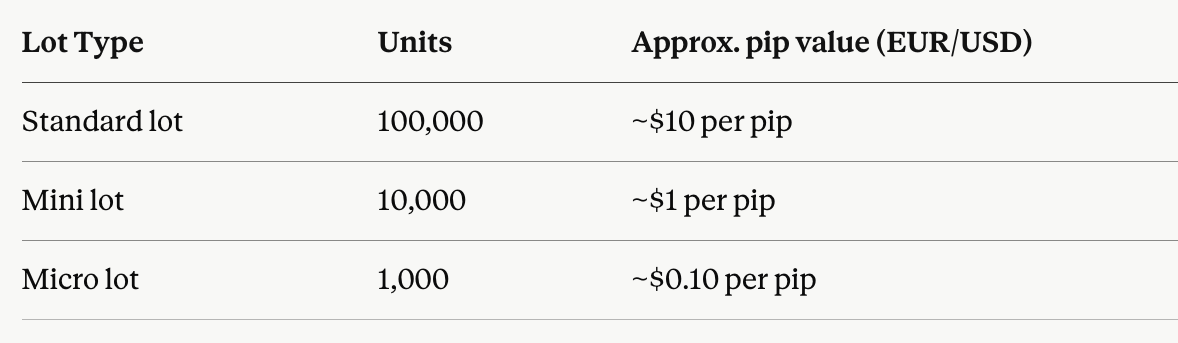
Most beginning traders will generally commence their trading careers by using either micro lots or mini lots. This allows them to manage the cost of each pip movement while gaining additional trading experience. If you are a novice trader, moving to a standard lot without first becoming comfortable with pip values and position sizing can be one of the quickest ways to blow out your account.
A Currency Trade From Start to Finish
To help you visualize and connect the mechanics described above with a real-world example, we will walk through a complete EUR/USD trade.
Example of a Trade Setup
Entry Price = 1.1000 to Buy EUR/USD 1 × Mini Lot = 10,000
Stop-Loss Price = 1.0975
Take-Profit Target = 1.1050
Example Scenarios
Scenario A = Win
Price moves from Entry Price = 1.1000 to Take Profit = 1.1050 = 50-Pip Positive Move
With 1 Mini Lot, the Value of Each Pip = Approx. $1
Therefore, the Total Profit = $1 × 50 Pips = $50
Scenario B = Loss
Price moves from Entry Price = 1.1000 to Stop-Loss = 1.0950 = 50-Pip Negative Move
With 1 Mini Lot, the Value of Each Pip = Approx. $1
Therefore, the Total Loss = $1 × 50 Pips = $50
However, the loss would have been closed out by the stop-loss order before reaching the full price decline to 1.0950.

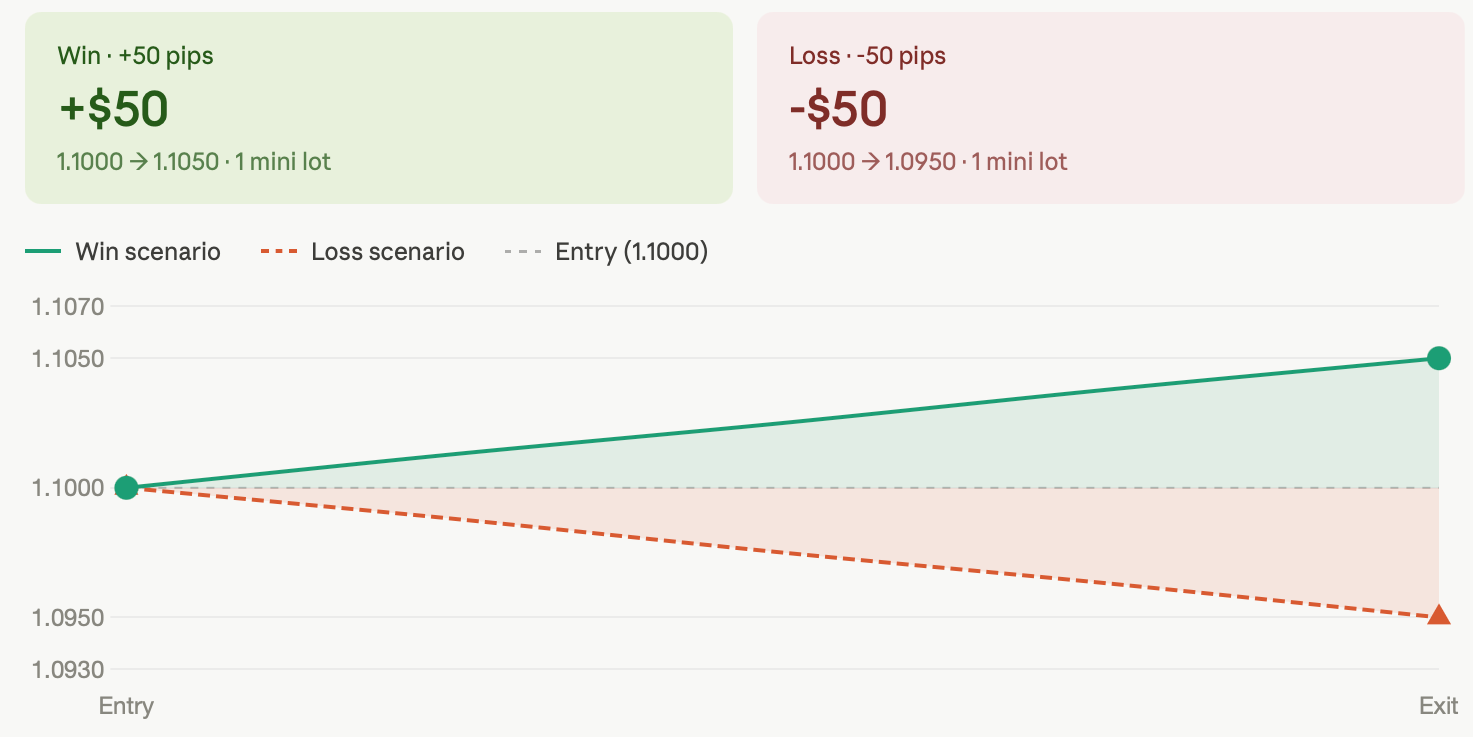
Profiting $50 from a market move also means you can lose the same $50 if the market moves against you. That is true for every trade you make in the market.
You will incur a cost immediately when you enter a trade because of the spread. Before you can break even, the price of your position must move at least the value of the spread in your favor.
A mini lot in EUR/USD at a price of 1.1000 will have a notional value of roughly $11,000. If you use 1:30 leverage, the margin required to control that position would be approximately $367. The amount of leverage you use does not change the pip movement of the market; rather, it determines how much of your own capital is required to control the position.
For risk management to work effectively, you might choose to risk 1% of your account on any trade, which means your maximum allowable loss on a single trade would be $50 if your account balance were $5,000. A mini lot would allow you to place a stop-loss order up to 50 pips away while limiting the potential loss to approximately $50. The stop-loss helps ensure that a single bad trade does not cause catastrophic damage to your account.
You can create a demo account with Tradewill, use a virtual account balance of $10,000, and place trades using real-market spreads and simulated execution conditions without risking real money.
Currency Pairs Explained
Not all currency pairs carry the same trading cost, volatility level, or depth of available market analysis. The three main categories are majors, minors (also called crosses), and exotics.
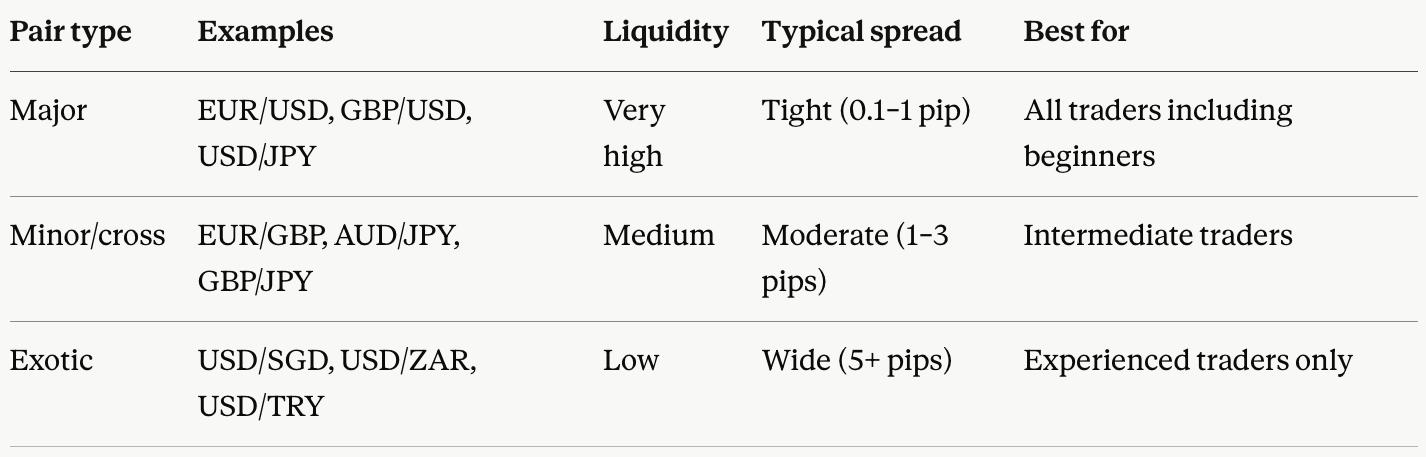
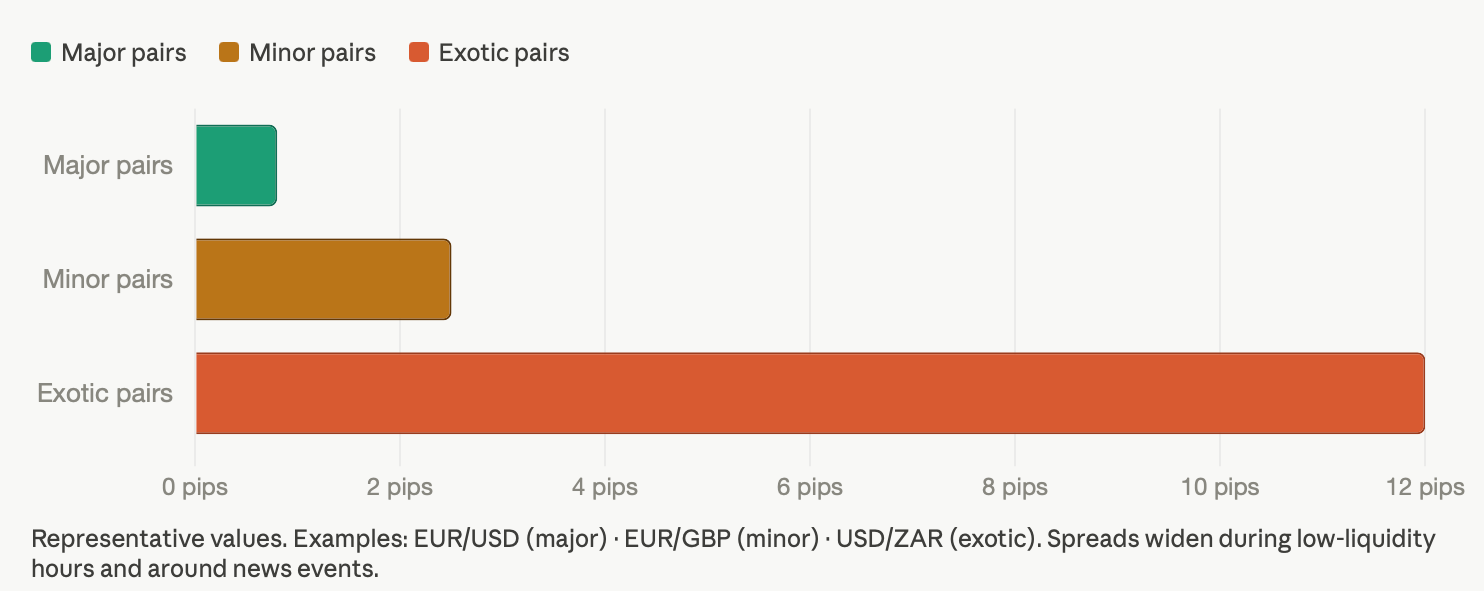
The vast majority of the world's most frequently traded currency pairs include the U.S. dollar. Evidence of this can be found in the BIS 2025 report, which shows that approximately 89.2% of all forex market transactions involve the U.S. dollar. For new forex traders, EUR/USD is often the first currency pair they trade because it is the most liquid pair, meaning it has the highest trading volume, and there is a wealth of trading resources available, including analytical reviews, blogs, and market commentary.
Once you have gained experience trading EUR/USD, you will likely want to expand into other currency pairs. GBP/USD, for example, has its own characteristics and volatility profile compared to EUR/USD. If you are interested in trading currencies that do not involve the U.S. dollar, you should refer to the Cross Currency Guide, which explains the mechanics and practical considerations involved in trading cross-currency pairs.
What Moves Currency Prices?
Knowing why currencies rise or fall can help distinguish traders who have valid reasons for each trade from those who make trades based on random guesses. Four primary factors drive currency fluctuations: interest rates, inflation, economic indicators, and central bank monetary policy.
Interest rates have the single greatest long-term influence on currency pair prices. When interest rates rise at the central bank level, capital tends to flow into that currency as traders and investors seek higher yields from deposits and bonds. For example, if the U.S. Federal Reserve is increasing interest rates more aggressively than the European Central Bank, traders may sell euros to buy U.S. dollars. This downward pressure on EUR/USD occurs because the euro offers a lower yield relative to the U.S. dollar, a phenomenon known as the interest rate differential effect. The carry trade strategy is based entirely on profiting from differences in interest rates between currencies.
High inflation can harm the value of a currency over the long term because purchasing power declines as inflation increases. As a result, markets may reduce demand for that currency relative to currencies issued by countries with lower inflation rates.
Economic indicators such as GDP, unemployment figures, and consumer price indexes (CPI) provide traders with information about the strength of an economy and clues about potential central bank actions. If a trader observes that U.S. economic data consistently exceeds expectations, indicating stronger-than-expected growth, they may expect markets to begin pricing in higher interest rates for a longer period. As a result, the U.S. dollar may appreciate before any official policy change occurs.
Central banks can move currencies by hundreds of pips within minutes of a public statement regarding monetary policy. Therefore, understanding role central banks play in forex markets is essential when trading around major news events. The FOMC meeting minutes guide are a valuable resource for examining how the Federal Reserve influences the value of U.S. dollar-based currency pairs. Currency prices can gap significantly higher or lower following monetary policy announcements, creating substantial risk for any open leveraged positions at the time of the event.
Leverage and Margin: The Double-Edged Sword
For retail investors, using leverage in forex trading creates an opportunity to participate in the market regardless of account size. However, if you do not understand the risks associated with leverage, trading with high leverage can significantly increase the likelihood of losing your investment. At a leverage ratio of 1:30, for every dollar of equity you have, you can control a position worth 30 times that amount. For example, with $1,000 in equity, you can control a position worth $30,000. Therefore, leverage magnifies both profitable trades and losing trades by the same ratio.
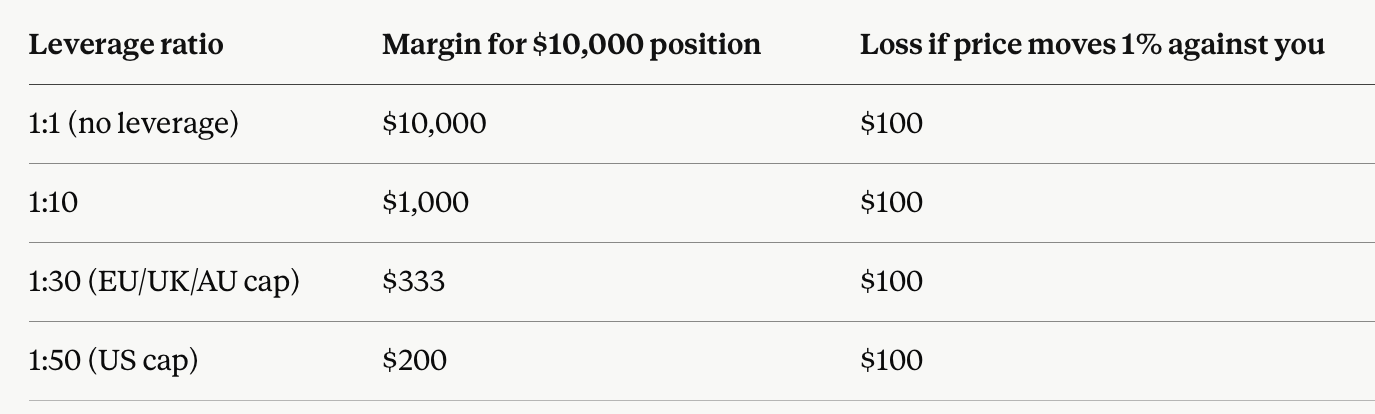
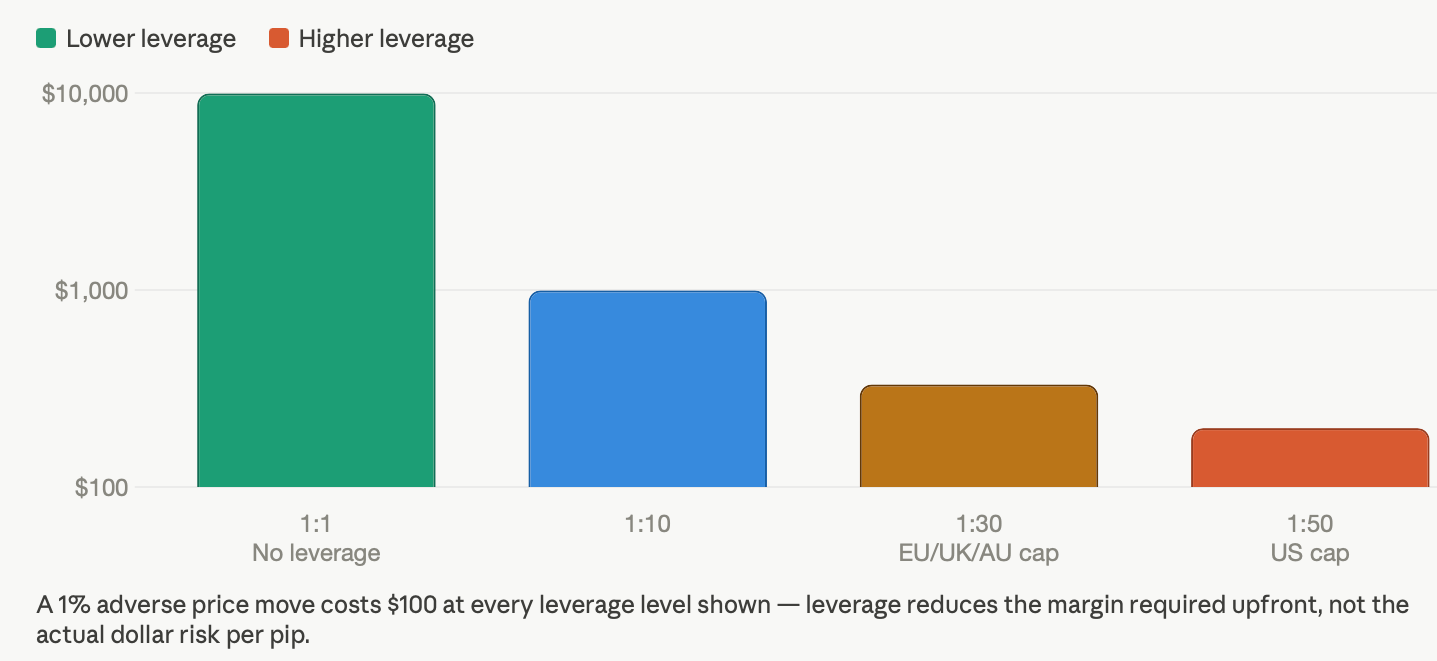
The dollar loss resulting from a 1% price movement against your position is determined by the size of the position itself, regardless of the leverage used. However, the percentage of your own capital at risk depends on how much leverage you employ. At 1:30 leverage, a price movement of approximately 3.3% against a fully leveraged position could eliminate your entire margin deposit. Such a move can occur within a short period during highly volatile market conditions.
For example, retail traders in the European Union, the United Kingdom, and Australia are generally limited to leverage of 1:30 on major currency pairs, 1:20 on minor currency pairs, and lower levels on certain other asset classes. In the United States, retail traders can access leverage of up to 1:50 on major currency pairs. These limits are not designed to restrict potential profits; rather, they exist to help protect traders from catastrophic losses associated with excessive leverage.
When your account equity falls below the margin required to maintain your open positions, your broker may issue a margin call, requiring you to deposit additional funds or reduce your exposure. If sufficient action is not taken, the broker may automatically close some or all of your positions at the current market price. This process is known as a stop out. During periods of extreme volatility, trades may be closed much more quickly than many traders expect. The most effective way to reduce the risk of stop outs is through proper position sizing and risk management.
Using excessive leverage does not create a trading advantage. It simply increases your exposure to market risk beyond what your capital may be able to withstand.
Currency Trading Strategies
There are two primary methods of analyzing the forex market, and most successful traders use a combination of both. Technical analysis involves reviewing price charts, support and resistance levels, and technical indicators, such as moving averages or the Relative Strength Index (RSI), to determine how price has behaved historically and how it may behave in the future based on established technical patterns. Fundamental analysis examines economic factors such as interest rates, inflation, and economic data releases to determine whether significant developments may create a directional bias within the forex market.
The method you choose will largely determine how long you hold positions and how frequently you trade.
The two most popular trading styles among retail forex traders are day trading and swing trading. A ultimate guide to forex day trading methodology, as well as practical examples of day trading strategies. Price action trading is another widely used approach and offers one of the most transferable skill sets across different trading styles and timeframes for traders who prefer to read market behavior without relying heavily on lagging indicators.
Regardless of the method you choose, effective risk management is a foundational component of any trading strategy. A risk-to-reward ratio of at least 1:2 means that your potential reward on a trade is at least twice your maximum acceptable loss. By following the rule of risking no more than 1%-2% of your total trading capital on any single trade, you can withstand periods of losses without causing irreparable damage to your trading capital.
How to Start Currency Trading
It is common for a new trader to make the mistake of jumping into a live account before properly understanding the fundamentals. The following sequence of steps generally produces better results than rushing into live trading.
Step 1: Learn the fundamentals thoroughly. Before risking any real money, you should be comfortable with and understand currency pairs, pips, lots, leverage, spreads, and risk management principles, all of which are covered in this guide.
Step 2 : Choose a broker regulated by a Tier-1 authority. Look for regulation from the FCA (United Kingdom), ASIC (Australia), or CySEC (Cyprus/EU), and compare spreads, platforms, and minimum deposit requirements when deciding which broker best suits your needs.
Step 3: Open a demo account and take it seriously. A demo account provides a real trading environment with virtual funds, real market spreads, and realistic execution conditions. Treat it with the same discipline you would apply to a live account, use it for several weeks rather than a few hours, and do not move to live trading until your results become consistently satisfactory.
Step 4: Develop a trading strategy and risk management plan. Define your trading style, establish how much you are willing to risk on each trade, and always use stop-loss orders on every position you open without exception.
Step 5: Fund a live account with an amount you can genuinely afford to lose. Start with micro or mini lots, keep your leverage low, and treat the first few months of live trading as paid education rather than a source of income.
Is Currency Trading Risky?
Due to the high risk associated with currency trading and the large percentage of retail traders who lose money, broker disclosures across the UK and EU indicate that an estimated 70%-85% of retail CFD accounts lose money. These figures are often even higher for traders during their first year of live trading. Forex trading is not an easy way to earn a living, and investors should not assume that they will become wealthy quickly through trading.
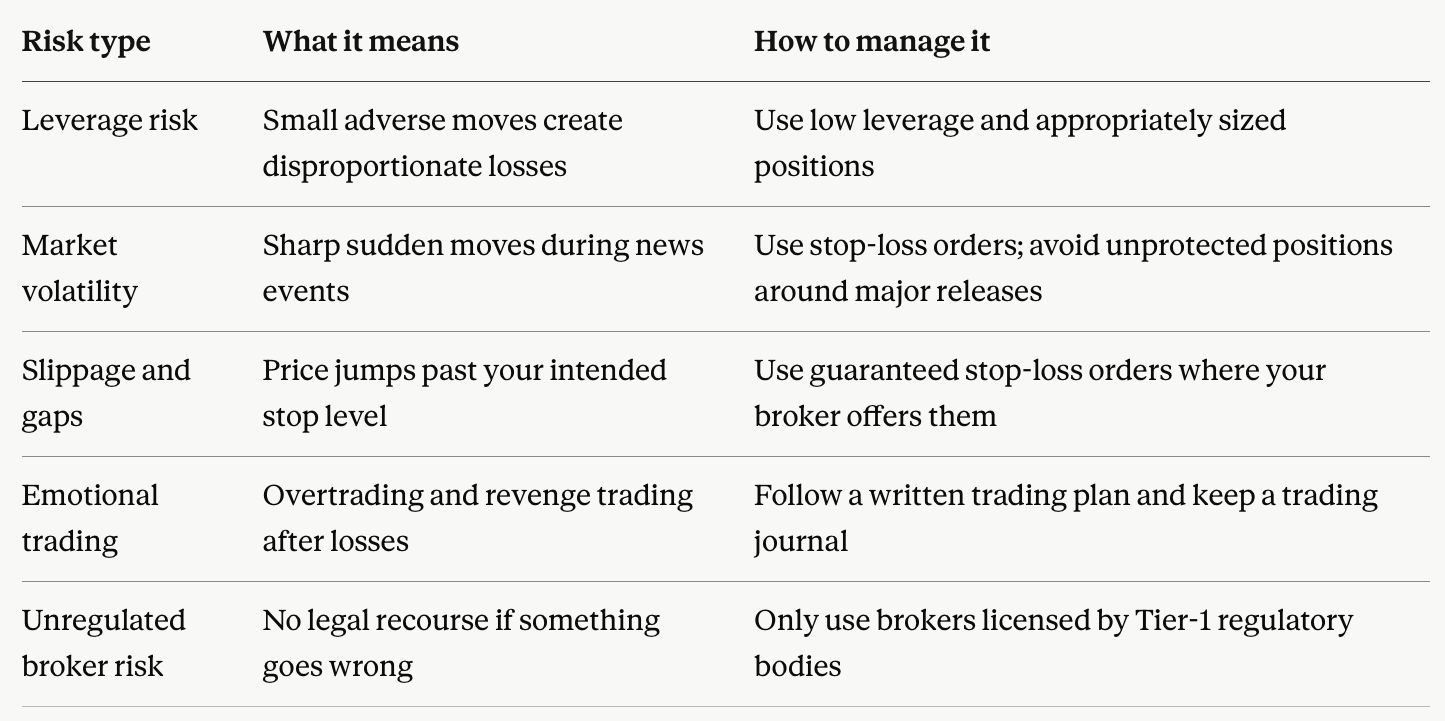
Traders who have achieved long-term profitability have generally done so through disciplined money management, proper position sizing, and the consistent application of risk management techniques, rather than through excessive use of leverage or an ability to predict price movements more accurately than everyone else.
Currency Trading vs Stocks vs Crypto
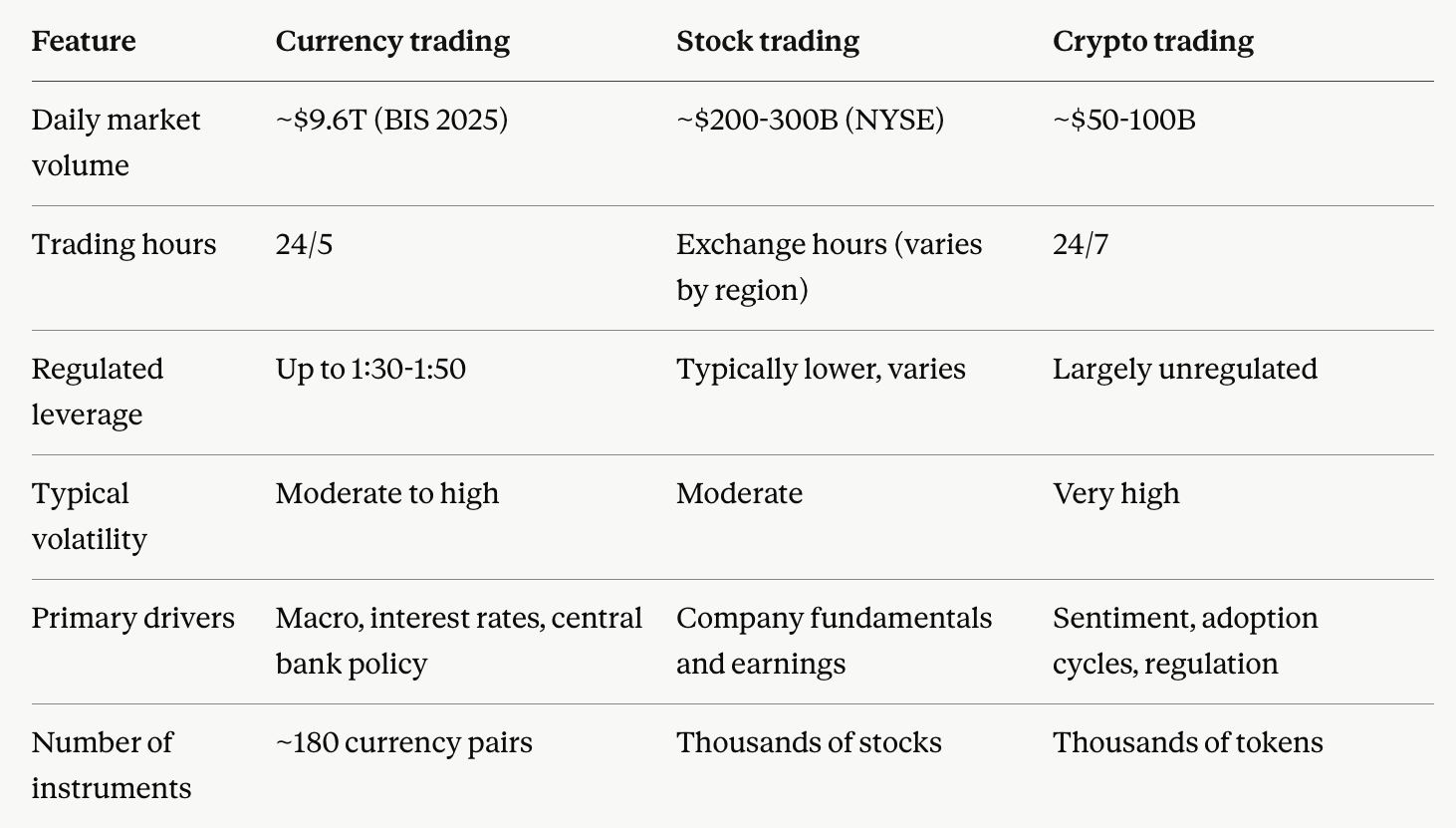
The Forex market has a smaller number of available instruments than either the stock market or the cryptocurrency market, but this can actually be an advantage for traders who are new to trading. The Forex market limits the number of variables that new traders need to monitor at one time.
Compared to Forex, stocks are more focused on the performance of individual companies and are typically traded between 9:30 a.m. and 4:00 p.m. on weekdays. In contrast, the cryptocurrency market operates 24 hours a day, 7 days a week, and exhibits some of the highest levels of volatility among all tradable asset classes, along with highly inconsistent regulatory oversight across different regions of the world.
Best Time to Trade Currencies
The forex market runs 24 hours a day, five days a week, cycling through four major trading sessions as financial centers around the world open and close throughout the day.
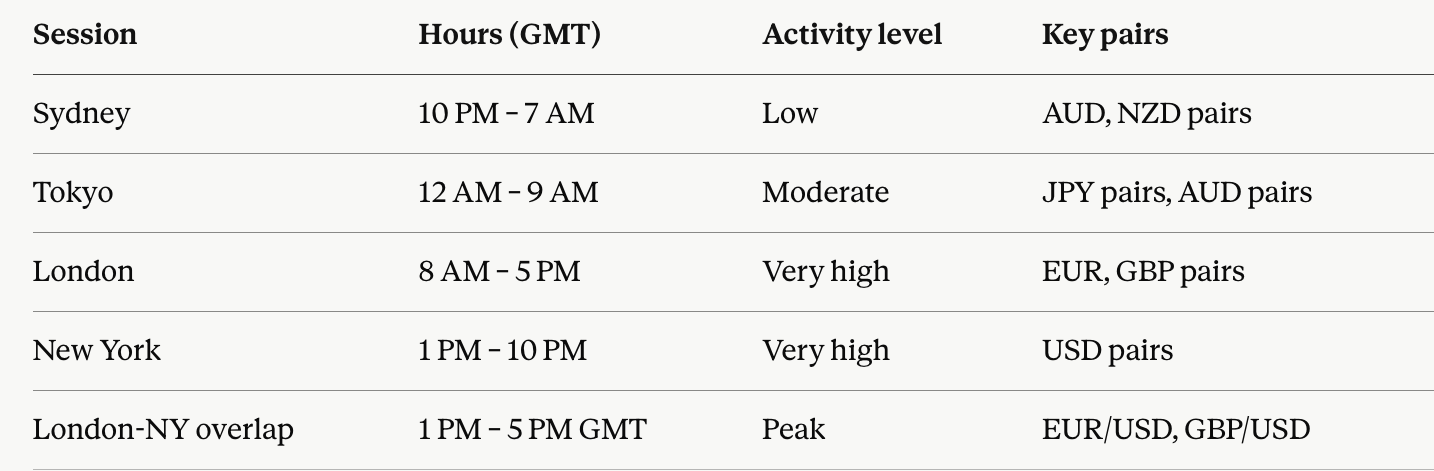
Between 1:00 p.m. and 5:00 p.m. GMT is the period of greatest global liquidity, when spreads are typically at their narrowest and trading volumes are at their highest within the shortest period of time. This is often an ideal time for active traders to access the markets, particularly when trading major USD and EUR currency pairs. In contrast, low-liquidity trading periods, such as parts of the Sydney session, are typically characterized by wider spreads, slower price movements, and technical setups that tend to resolve less cleanly.
Frequently Asked Questions
What is currency trading?
Currency trading is the buying of one currency while selling another, such as EUR/USD, to profit from exchange rate changes. It's also called forex or FX trading and takes place on the global foreign exchange market, which trades approximately $9.6 trillion per day according to BIS 2025 data.
Is currency trading the same as forex trading?
Yes. Currency trading, forex trading, FX trading, and foreign exchange trading all refer to the same activity: exchanging one currency for another in the global forex market to profit from movements in the exchange rate between them.
How much money do I need to start currency trading?
Many regulated brokers allow low or no minimum deposits, and micro lots allow very small position sizes from the start. A practical starting range for a live account with micro lots is $100 to $500. Only ever trade money you can genuinely afford to lose entirely.
What is the best currency pair for beginners?
EUR/USD is the most widely recommended pair for beginners because it offers the highest global liquidity, the tightest typical spreads, and more freely available market analysis than any other pair. It's generally cheaper and more predictable to trade than minor or exotic pairs.
What is leverage in currency trading?
Leverage allows you to control a position much larger than your actual deposit. At 1:30, $1,000 controls $30,000 in market exposure. It amplifies both profits and losses with equal force, which is exactly why regulators cap it for retail traders in most jurisdictions.
Is currency trading legal?
Yes. Currency trading is legal in most countries when conducted through a properly licensed broker. Always use a broker regulated by a Tier-1 authority like the FCA (UK), ASIC (Australia), or CySEC (EU) to ensure your funds have proper protection.
What is a pip?
A pip is the smallest standard price movement in most currency pairs, equal to 0.0001. For JPY pairs, a pip is 0.01. Pips are the unit through which profit and loss get measured in forex, and your pip value depends on your lot size.
What moves currency prices?
Currency prices are primarily driven by interest rates, inflation data, economic indicators like GDP and unemployment, and central bank policy decisions, all of which ultimately influence supply and demand in the foreign exchange market.
What is the best time to trade currencies?
The London-New York session overlap from 1 PM to 5 PM GMT offers the highest liquidity and tightest spreads of any period in the trading week, making it the most favorable window for active trading on major USD and EUR pairs.
Can beginners make money trading currencies?
Some beginners do generate positive returns, but most retail traders lose money during their early period, and published broker disclosures confirm this consistently. Long-term profitability depends on disciplined risk management and consistent execution rather than accurate market prediction every time.
What to Do Next
While currency trading may be one of the easiest financial markets to enter, easy access does not translate into easy profits over the long term. You now understand what a currency pair is, how currency pairs form the structure of the market, what a real trade looks like from entry to exit through a detailed example, which factors influence currency movements, and how critical risk management is to a successful trading strategy from start to finish. The most practical next step is to apply everything you have learned in a demo environment, where no capital is at risk but all of the mechanical elements, from order types and margin requirements to live spreads, closely mirror real trading conditions.
Traders with a deeper interest in the derivatives market may wish to explore a forex derivatives guide covering futures, options, and CFDs, which explains how these instruments relate to the spot forex market. In addition, forex currency correlation and hedging guide can help explain how professional traders assess and manage risk when holding multiple positions simultaneously.
Currency trading involves a significant risk of financial loss. Only trade with capital that you can afford to lose in its entirety, and consider seeking independent financial advice before opening a live trading account.
Visit Tradewill.com!
Disclaimer: The content of the blog does not represent any position of Trade W, does not serve as any trading-related decision advice, and does not endorse any third-party.