

 Trade W

Introduction: Why Fees Can Make or Break Your Investment
Most likely you check your investment returns often. You cheer for the market going up, worry when it drops, and scrutinize charts. What you probably don't realize is that your actual return is not just about how the market is performing. It is based on how much you take home after all fees.
Let's say an investment return is 12% gross. After paying a broker, the fund manager, and any other hidden fees, you may only take home 8%. That 4% loss compounds over time (years and decades) into real money that you did not keep but went to someone else.
The situation becomes more severe fairly quickly based on what you actually trade. Commissions on your stocks? Not a big deal. Forex spreads? That can decimate an account without you realizing it. CFD transactions? Those fees compound with leverage. The difference in cost between asset classes is staggering.
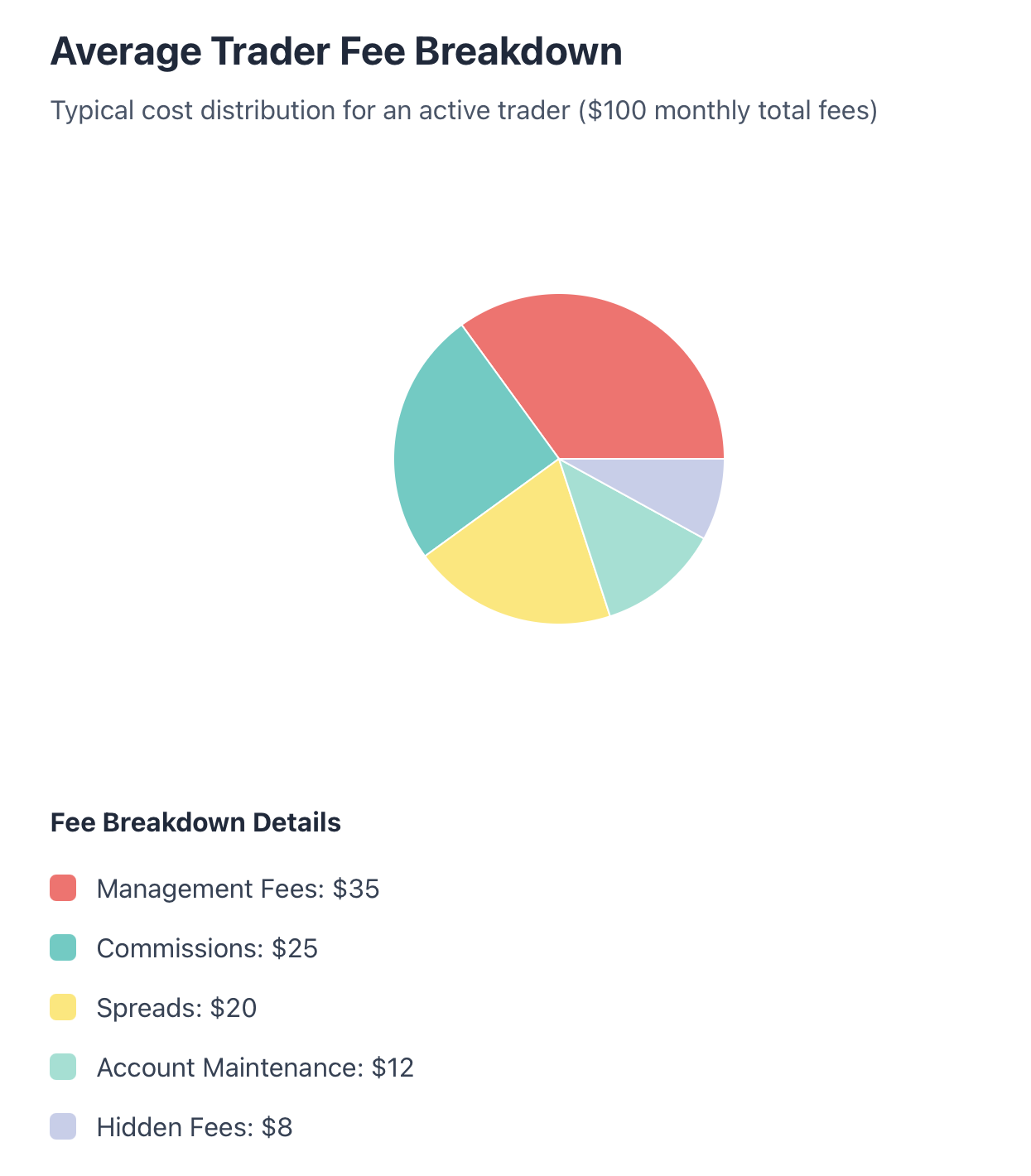
If a professional fund manager is executing 200 trades a year (that is a low average) their management fees, commissions, and spreads can take 15% of their returns compensated through the costs of doing business every year. That is not underperformance to the market, that is pure cost drag. Or consider a brand-new trader actively using a trading app to trade stocks. They are incurring $5 per trade, twice a week. That is $50 a month. That comes out to $600 a year that they vanished just from commissions.
The hard truth: trading costs are silent profit killers. They go about their business while you’re busy picking winners. Unlike market fluctuations, you are the one who is in control of your costs. In fact, controlling your costs may be more important to your bottom line than identifying the next hot stock.
Types of Trading Fees: Understanding Brokerage, Commissions, and Hidden Costs
Fees exist in different forms, and most traders are not aware of all of them. Knowing what you are paying for is your first line of defense against paying more than is necessary.
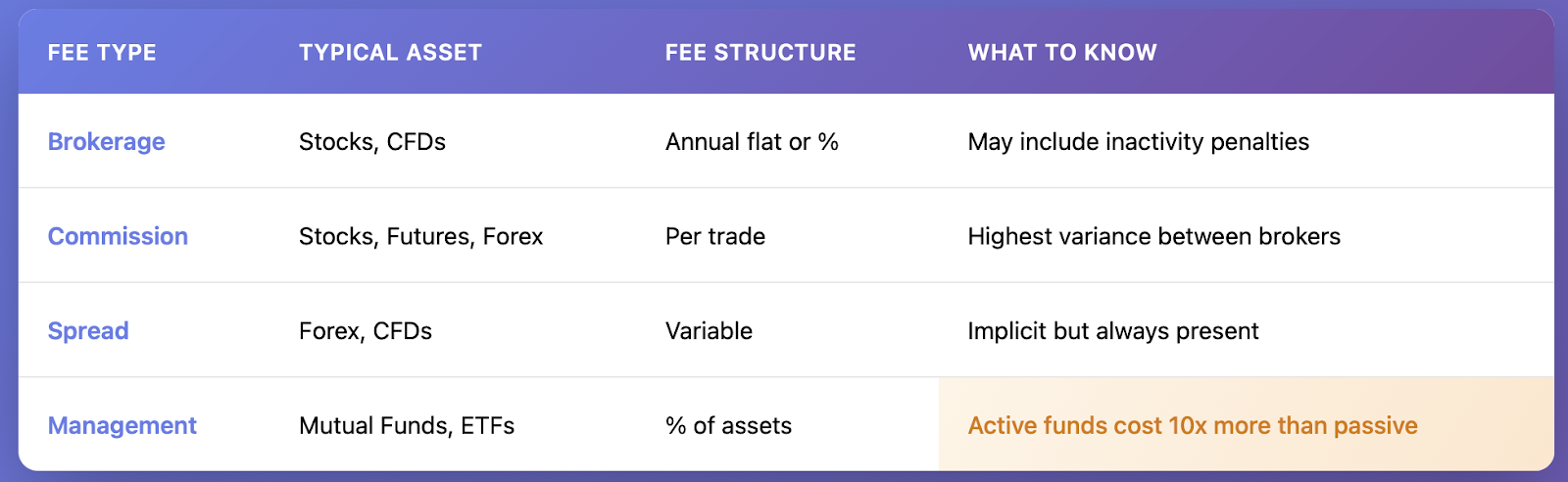
Brokerage Fees are the annual maintenance fees your broker collects simply for being allowed to trade with them. Some brokers charge a flat fee, others charge a fixed percentage of assets. In addition, you may be subject to an inactivity fee if you do not trade enough, and these can be buried in the terms of your account and easily overlooked.
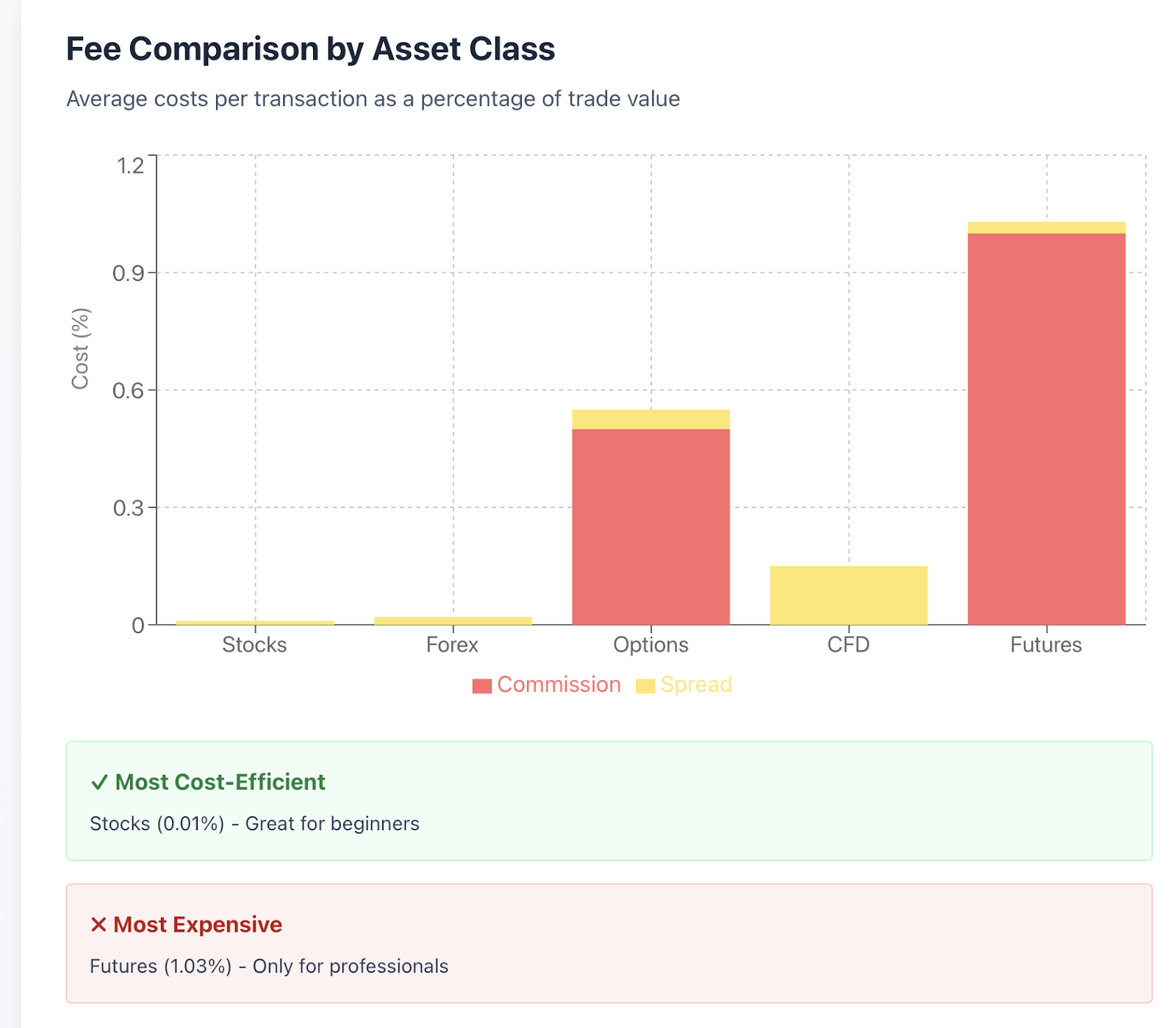
Commissions are easy to understand; they are fees charged per transaction. When you purchase 100 shares of stock, you are charged a commission. When you sell a futures contract, you are charged a commission. Commissions vary extraordinarily between asset classes, and also between brokers. Some brokers charge $10 a trade, while others charge no commission.
Spreads are the hidden killers in CFD trading and Forex. In this case, the spread is the difference between the buying price and selling price when you trade. The spread is how the market makers earn their profits. A 0.5 pip spread on EUR/USD may not sound like that much, but if you trade 1,000 pips per month, you could lose $500 without a single line on your monthly statement showing what you just lost.
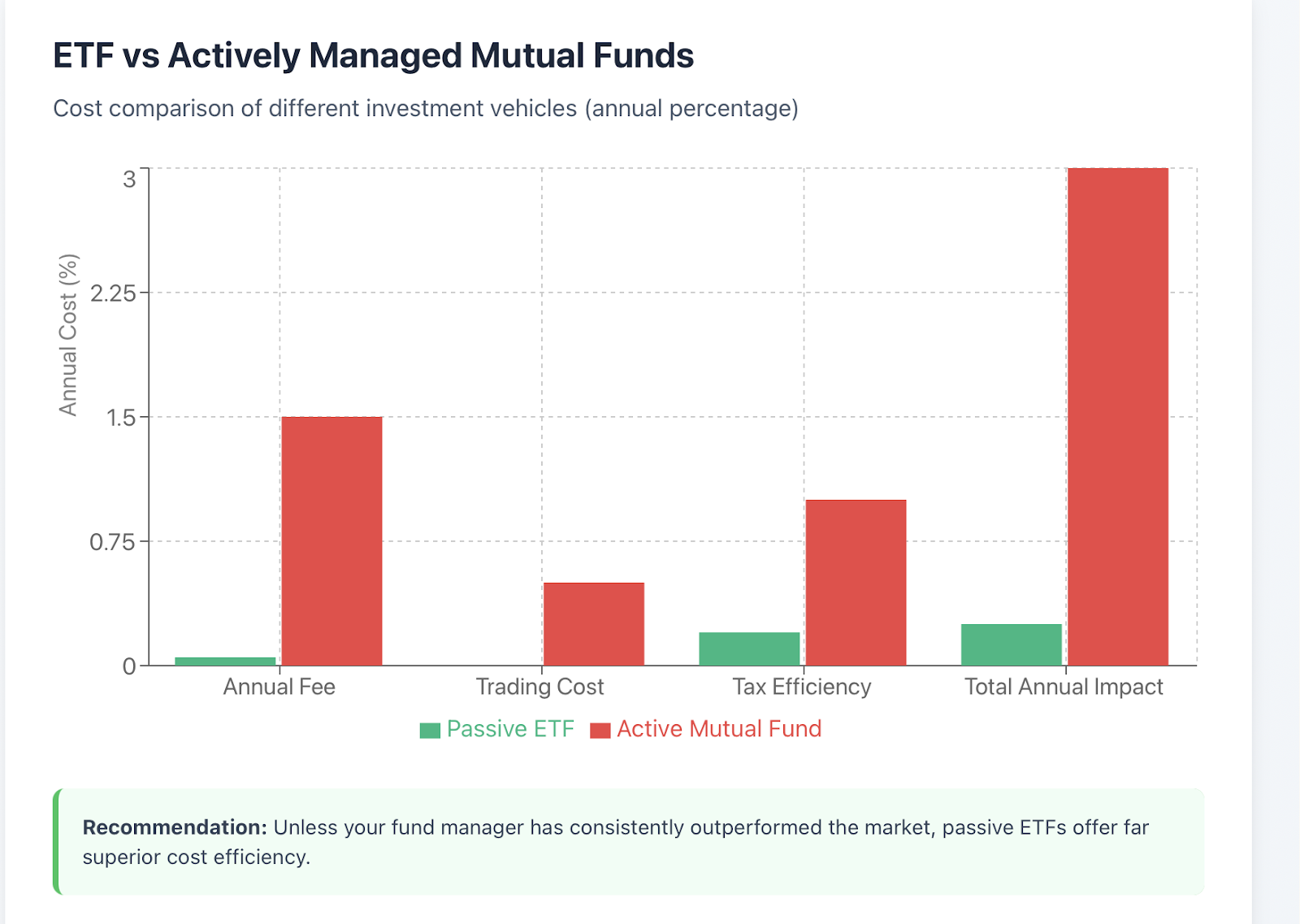
Management Fees typically apply whenever you use funds or asset managers. Active mutual funds charge on the order of 0.5% to 2% in fees on an annual basis. Passive ETFs may charge 0.05%. This fee is deducted whether you are making money or losing money, which is why they can be hidden.
Some more hidden fees may be found in options trading, when you buy bonds, within the expense ratios for ETFs, and when you withdraw. Some brokers charge you to transfer your account, other brokers penalize you for having too small of a balance and the list goes on.
An ETF trading broker with zero commissions could lead to savings of $20 to $50 per month. A day trader paying $5 per trade would incur a commission cost of $100 everyday just on commission. Those are not insignificant amounts to most investors!
The bigger issue: the fees wear you down into a long-term "hidden tax" that will slow the growth in your wealth. The 0.5% management fee may not sound overwhelming if you think of it for just one year. Over a 30-year time frame, however, that could cost you hundreds of thousands of dollars in earnings. Financial literacy begins with understanding what you're actually paying.
How Fees Impact Your Investment Returns: The True Cost of Trading
The arithmetic is simple but ruthless. Your actual return is calculated using this formula:
Net Return = Gross Return - Trading Fees - Management Fees- Taxes
Everything else – what you buy, when you buy, trend analysis - doesn't matter if fees take away profits. Let's look at some real examples.
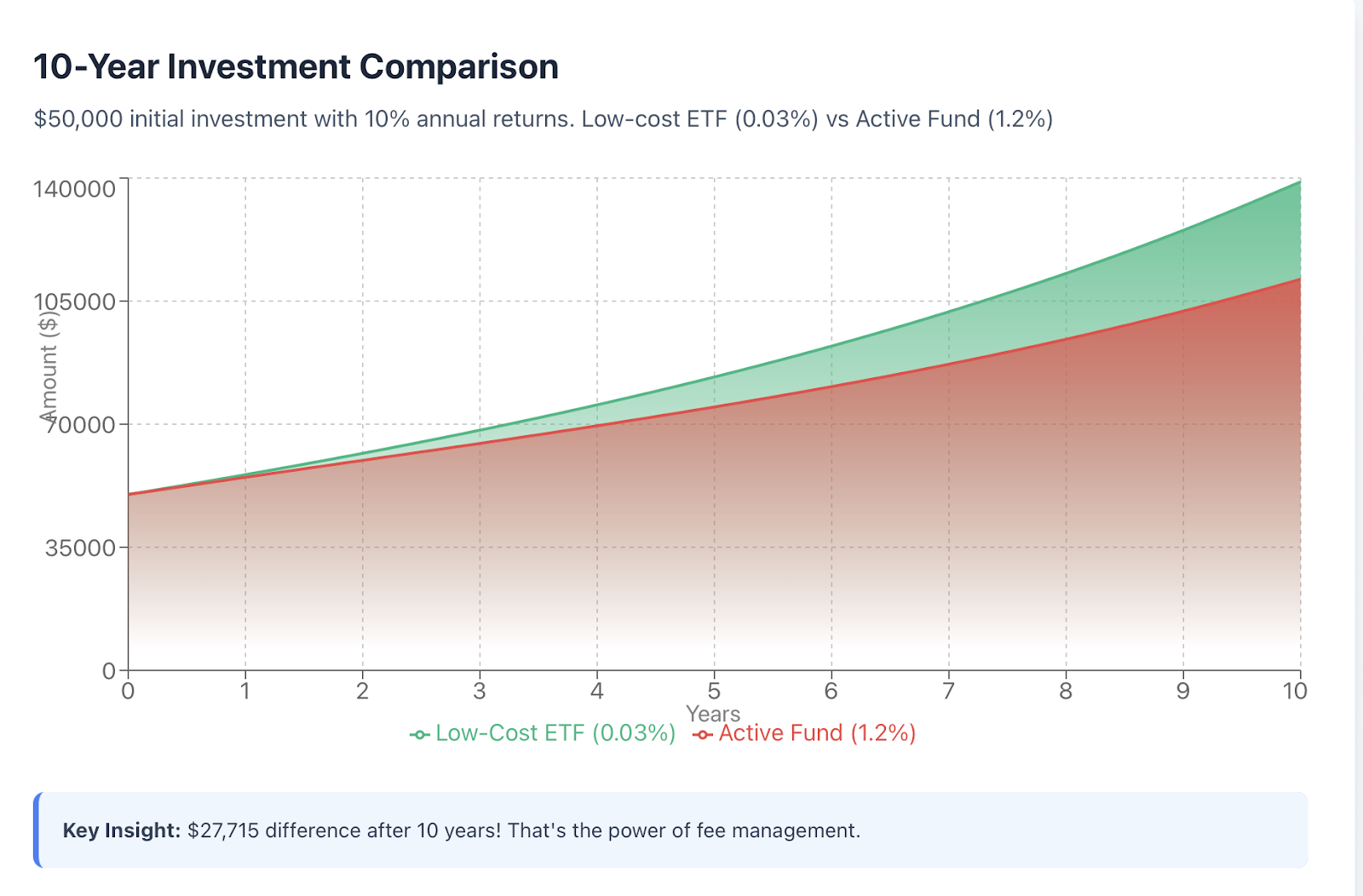
There are two investors in ETF's starting with $50,000. Both get 10% annual market returns. One bought a low-cost index ETF with a 0.03 percent annual cost. The other purchased an actively managed fund that charges a 1.2 percent annual fee. By year 10, the low-cost investor is ahead by about $27,000 compared to the high-cost investor. Same market, same capital to start, completely different result. What is the difference? Fees.
High-frequency trading makes matters even worse. A trader that makes 50 trades at $5 per trade pays $3,000 in commissions per year. If they make a gross return of $20,000 per year, their profits are thus impacted by nearly 15 percent of profits lost. Now add the costs of the spread, withdrawal costs, as well as fund management fees. Now they are lucky to keep 60 cents of every dollar made.
The most shocking part is when fees outnumber returns. Remarkably, this is not common, but might occur. A newcomer who actively trades in and out of positions regularly might accumulate $200 in monthly fees while his positions deliver a return of $150 monthly. Such rare outcome results in the person essentially losing money while the market is going higher.
The statistics show the truth. High-frequency trading in a high-fee context transforms into a wealth diet. Merely breaking even would take extraordinary analysis of the market and its timing. Most traders are not equipped with that kind of advantage.
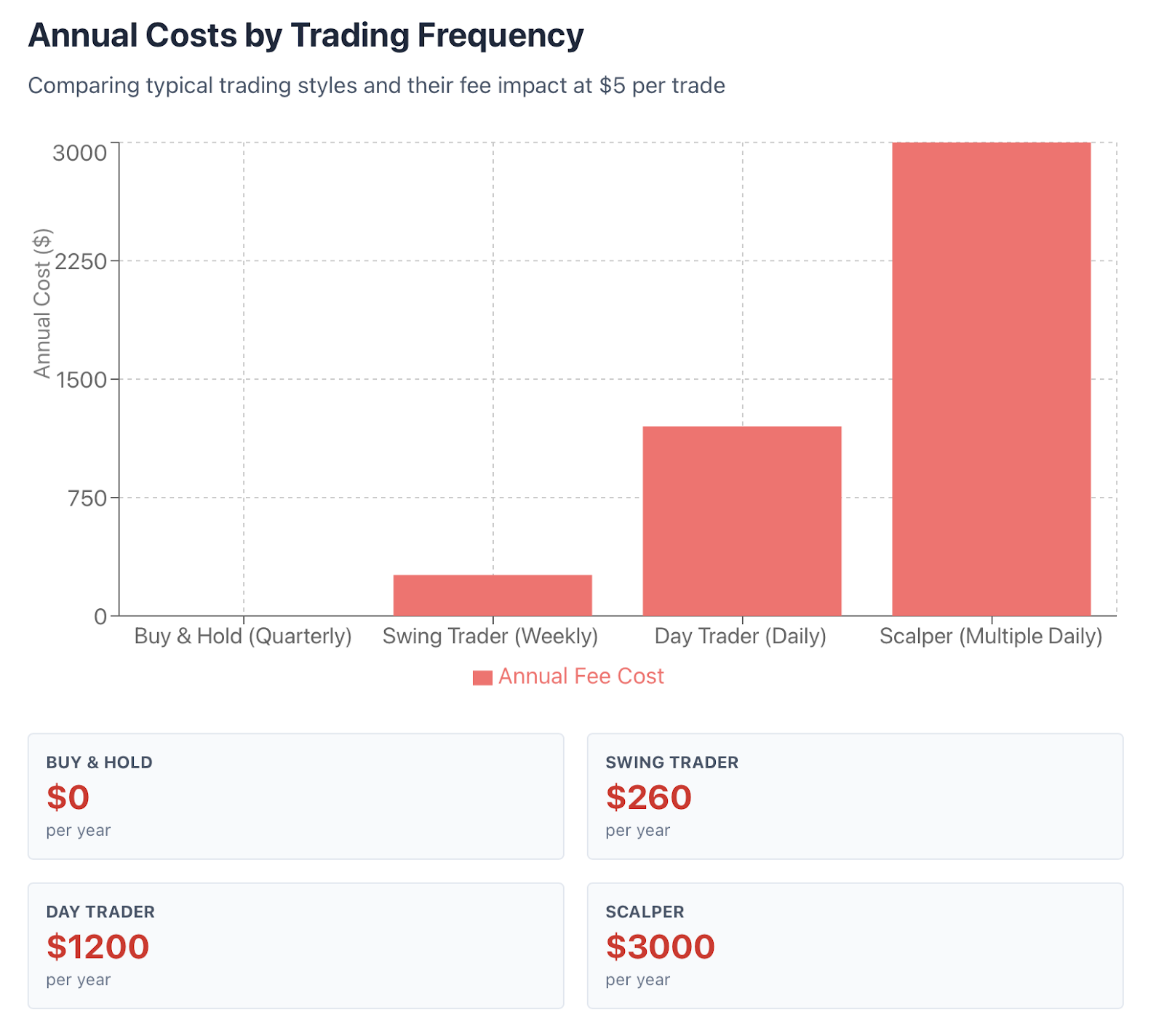
Long-term investors have a different advantage. You buy an index fund once a quarter and hold it for multiple years. Your annual fee takes a tiny toll, maybe, for example, 0.05% of your assets. The market does the work for you and you keep most of those returns. You won't be winning honors for glamor, but it probably will work.
What have we learned? The investment strategy must be built around the attitude of evaluating net return on investment as compared to gross return. A 7% net will always beat a 12% gross return. Understandable performance is not dull, it is the foundation.
Proven Strategies to Minimize Fees: Maximize Your Net Returns
While eliminating fees entirely isn't possible, it is possible to significantly reduce fees. Here are the strategies that can help you achieve significant fee savings.
Select a Zero-Commission or Low-Commission Broker
In 2019, the brokerage community changed when firms realised that retail investors would switch firms to save on commissions. Today, almost every broker has zero-commission stock trading. Some might charge a minimal fee for options and futures, but just changing your brokerage fees can eliminate 70% to 90% of your annual fees.
The catch? Zero commission does not mean no cost. Brokers have just widened their spread of commissions to recover their lost commission on the trade. However, for traditional stock-buy-and-hold owners, zero commission is all upside.
Opt for ETF Over Actively Managed Mutual Funds.
Passive ETFs have fees as low as 0.03% and rarely more than 0.20% per year. Actively traded Mutual funds have a fee structure as high as 2% and can start at 0.5% per year. Passive ETFs can even trade as stocks, allowing you to take advantage of broker commission benefits with true stock brokers. Active mutual funds require work on a managed account, where the active fund manager must maintain higher overhead.
Unless you have a specific manager whose skill has been proven through outperformance, passive ETFs are the way to go.
Utilize Robo-Advisors for Passive Investing
The automating of portfolio management means no more costly financial advisors for your portfolio management. Instead of paying fees of 1%-2%, robo-advisors charge annual fees of 0.25%-0.50%. Robo-advisors will automatically rebalance your portfolio, optimize for tax efficiency, and manage everything without requiring any personal involvement from you. For fatigued investors who have $50,000 - $500,000 in assets, robo-advisors can save serious money.
Batch Your Trades and Consolidate Your Investing
Don't purchase $500 in stock monthly. Save up four months of investing into one quarter and invest quarterly. This will reduce the trading frequency by 75%. This is less critical with commission-free stock trading, but with options, futures, or even just international stock purchases, the financial savings multiplied will add up to hundreds of dollars.
Optimize Your Spreads and Stop OverTrading
Scalpers and Day traders in forex and trading CFDs will kill themselves with costs associated with spreads. Each pip spread they incur will potentially stack up into thousands at the end of the month. Position traders and swing traders can keep spreads at 2% - 3% of total trades in their trading.
To simplify: if your edge is less than the carrying cost of the spread, do not make that trade for that time-frame.
Make Use of Tax Advantaged Accounts
In the US, 401(k)s, IRAs, and HSAs allow for either tax deferred or tax-free growth. Your country likely has comparable tax benefits. Use these first. Taxable accounts should be last in priority. This does not eliminate trading fees, rather it means that taxes will not compound your losses.
One Tiers and Bulk Trading Discount Programs
Higher net worth clients frequently negotiate for lower fees. A handful of brokers offer graduated commission rates based on volume. Professional trading programs offer API connections with lower spreads. If you clear volume, be sure to ask. Many brokers have flexibility that most traders don't know about.
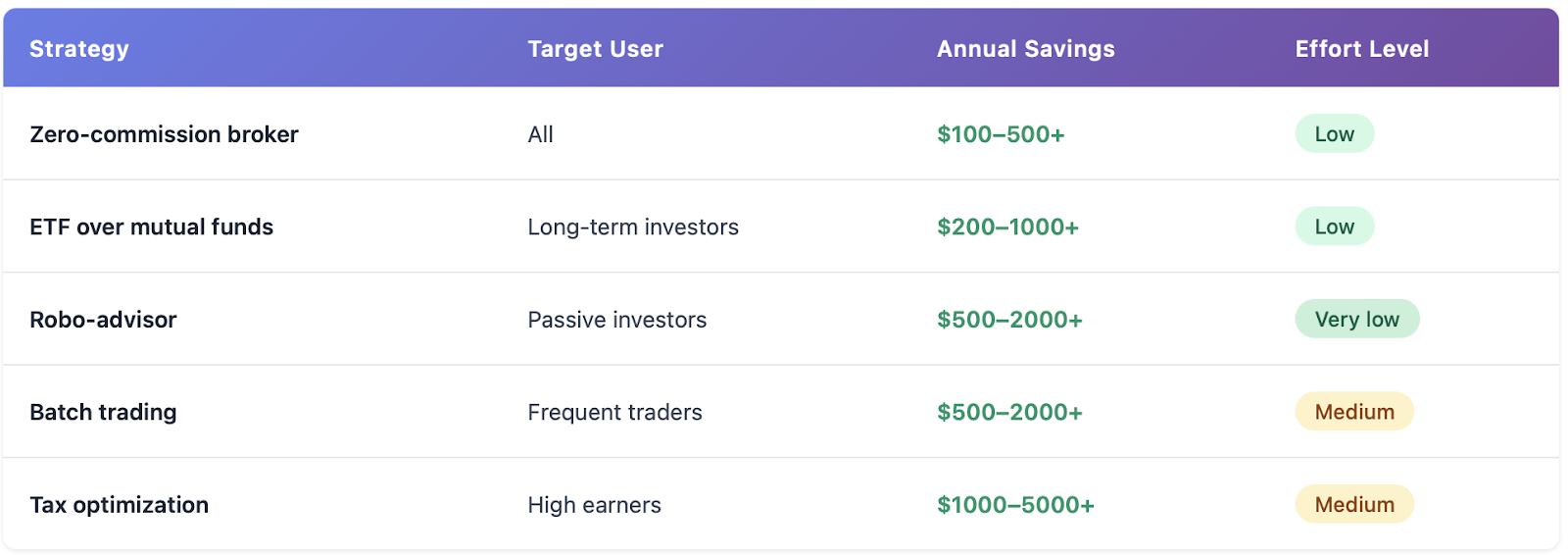
The truth: actively reducing fees functions like finding free money. A 1% reduction in fees is worth more than a 1% improvement in trading performance. One you control completely.
Global Comparison of Trading Fees: Which Markets Are Most Cost-Effective?
The fees that you pay at a broker depend on your geographic location and the asset class you want to trade. Along with different competitive dynamics depending on where you are in the world, fees can vary pretty substantially depending on the broker you choose, and it is important to understand these differences.
U.S. brokers generally provide commission-free trading on stocks and ETFs but will charge more fees to trade options (generally around $0.50 to $1 per contract). Forex and contracts for difference (CFD) spreads typically run 1-3 pips on major currency pairs and 1-5 pips on CFD, depending on the asset. Forex and CFD traders generally tend to be attracted to brokers located in the U.S. due to their very low spreads, but discounts will commonly come at the upcharge of account fees.
European Forex brokers will also charge zero commissions when trading stocks and ETFs, but they generally will have less favorable leverage on CFDs due to regulatory restrictions. The spread on major currency pairs is typically around 0.5-1 pips. CFD spreads also tend to be competitive, but will vary between products. There are numerous brokers located in Europe that are among the cheapest in the world.
Asian brokers, primarily in Singapore and Hong Kong, offer commission-free trading on equities trading with a low account minimum. Forex spreads are very tight (0.5-1 pip on major currency pairs) while CFD will vary 1-3 pips depending on the instrument traded. Asian brokers attract traders from around the world because they have such low fees (both trading and account fees) while still providing a strong regulatory framework for trading.
In Australia and New Zealand, brokerage fees on foreign exchange and stock trades are usually less expensive than other parts of the world, typically using a zero-commission system with more modest forex spreads (1-2 pips) and spreads applying 2-5 pips for derivatives and contracts for difference (CFDs).
For a professional trader who trades multiple markets and securities, using a broker in the US for stocks, a European broker for CFDs, and an Asian broker for forex and determining where someone is located to ensure they are trading at the best cost (10-20% in total cost savings compared to one broker trading in one location). For the uninitiated investor buying and holding exchange-traded funds (ETFs) that are indexed to a market it is best to use any broker in your vicinity which is offering any form of zero-commission trading.
You will likely determine that if fees in even actively managed funds burden your trades, eventually it pales in comparison as differences of the commission fees becomes negligible. It is true regardless of your location that there always are global markets that will offer you more choices throughout a week's worth of trading and the strategy will direct which locations mean the most. Finally, be sure to continue to compare again and again what your costs are because inevitably your local choices will never be the most competitive costs - never assume it is competitive.
Advanced Cost-Saving Techniques for Experienced Traders
After putting in the time and effort to learn the basics, advanced traders utilize well-defined strategies to manage costs while concurrently influencing their exposure and retention.
Portfolio Optimization Through Low-Cost ETFs
A professional might set core positions utilizing low-cost, broad market ETFs (0.03% expense ratio). Once established, they execute tactical trading around these core holdings. Most of the money is passively being managed in low-cost ETFs while tactical positions are generating returns on a much smaller overall base. This scenario benefits traders by balancing low costs overall exposure with flexibility from trading.
Strategy of Hedging to Manage Spread Impact
An example of the balance of managing exact or tracking profit by selling a position without ever selling the position is using an offsetting position or option in lieu of selling the profit on the position. An experienced trader does not want to keep "turning over" or "round-trip" as this keeps the overall spread cost to the trader lower than a multiple-full lower EBIT would trade as well.
Leverage Strategies to Reduce Trade Frequency
CFDs leverage allows traders to establish a position size without executing multiple trades. Rather than buying 10 lots of a stock, you could execute one leveraged CFD position. The leverage involved in CFDs will cost much more in spread costs to execute. The downside/risk is great enough to deter inexperienced, potentially passive traders from even considering this option.
Discount Programs and High-Net-Worth Benefits
Institutional and high-volume traders are given access to a dedicated account manager and customized fee structure. For example, if you have $1 million in assets or trade 1000+ contracts each month, then your broker has some room to adjust commissions. Just ask for it, negotiate, and the worst you will hear is no. Many brokers are willing to negotiate fees as they have a relationship with the trader.
Algorithmic Execution and Structured Products
Certain brokers have algorithmic execution, which breaks up the large order or trade into smaller executions over the day when the stock may experience more liquidity. Structured products contain multiple exposures in the form of a trade, which often helps substantially reduce the number of transactions on the trading platform.
Both of these strategies are efficacious for professionals given they possess enough capital, knowledge, and volume of trade to justify that level of complexity. Beginners should stick with the simpler approaches - they are more effective than you think.
Conclusion: Keep More Profits in Your Pocket with Smart Fee Management
The success of your investing hinges substantially more on fees than most traders think. For instance, the difference between a 1% annual fee and a 0.1% annual fee is potentially worth millions of dollars to you over a 30-year time horizon. This isn't hyperbole, it's math.
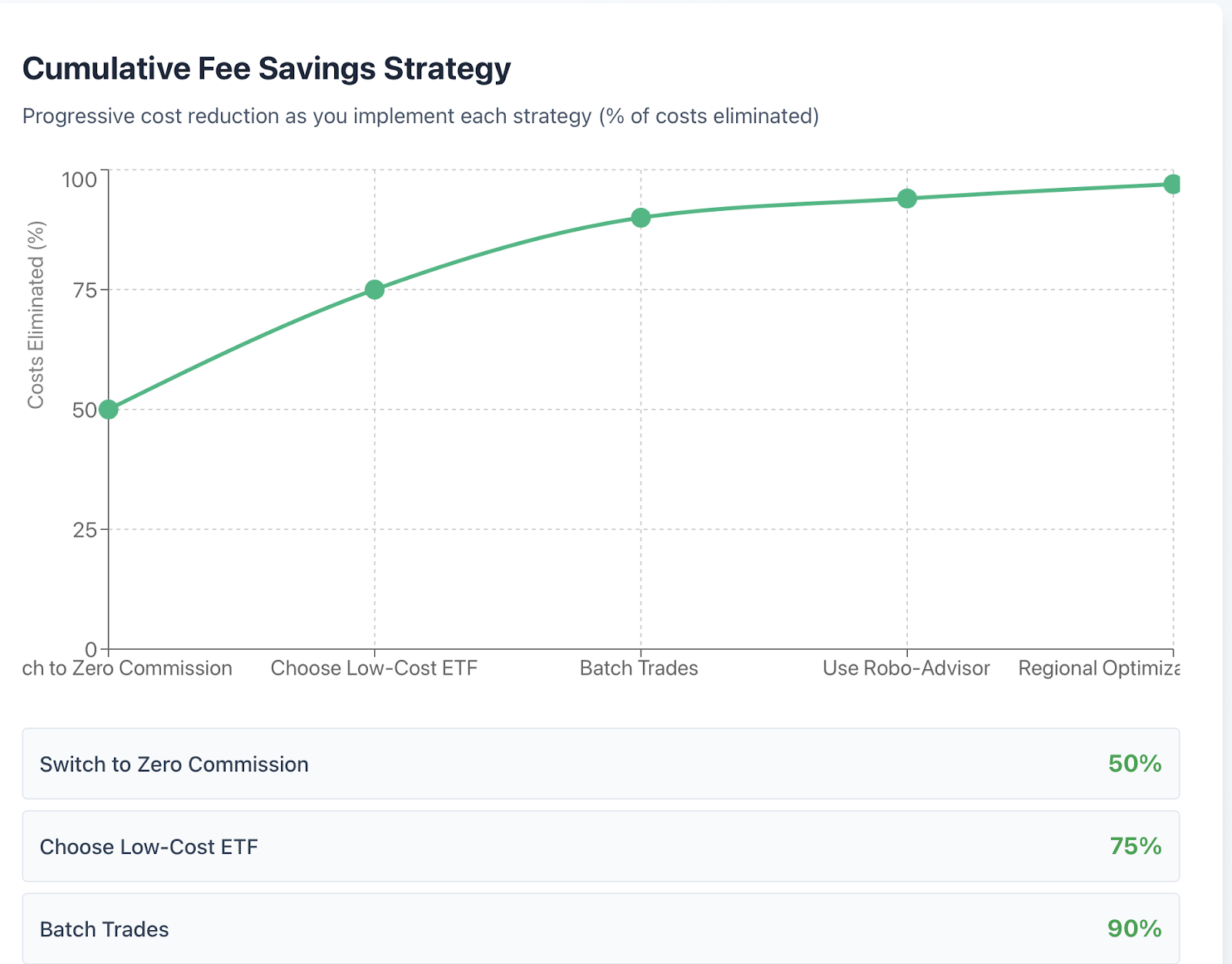
The strategies you can implement in this guide are relevant to traders of all experience levels. For instance, a novice can save approximately 50% on their trading cost by using a zero-commission broker and an exchange-traded fund (ETF) in place of a mutual fund. An experienced, professional trader has the potential to eliminate another 10-20% of fees through regional optimisation and advanced execution techniques.
What is the common thread? You have full control over your fees. Fees are not market risk. Fees are not timing risk. Fees are simply operational costs, and you can eliminate them through prudent choices.
Are you ready to get started? Visit Tradewill.com and check our fee-efficient accounts for your global trading needs. We provide fee-efficient accounts for stocks, forex, and CFDs. Regardless of your choice, we've designed our platform around reducing costs so you can keep more of what you earn. Compare our spreads, commission structure, and account minimums against your broker, and prepare to be surprised!
Disclaimer: The content of the blog does not represent any position of Trade W, does not serve as any trading-related decision advice, and does not endorse any third-party.