

 Trade W

Introduction
In the world of CFD trading, which is always changing, succeeding isn't about using a single, universal method. Instead, it's about personalised strategies that suit the many different trading personalities out there. Some traders benefit from leverage. Others prefer to go long, and some like to go short. Many like to own their assets, and some thrive in asset-light environments. There are many next-gen CFD trading strategies out there that can help you win at this game. But first, you need to understand yourself and your elusive trading style.
Consider two traders. Sarah starts her day at 6 a.m. and monitors currency pairs as closely as any trader can. By the time the market closes, she's made all her trades and is done for the day. Michael, on the other hand, rarely looks at a chart that isn't at least a week old and holds onto his positions for months. He happens to use the same CFD trading platform that Sarah does, but their trading styles couldn't be more different. Sarah's a day trader, thriving on the quick decisions and immediate results that her high-frequency trading lifestyle demands. Michael's a position trader, focused on long-term market trends.
A position trader is not simply someone who has better timing than a day trader; he or she has a mindset that favours longer periods. This mindset is essential for ruling out the temptation, which many day traders succumb to, of exiting a trade when the market ticks against them for a few moments instead of when the market ticks for them, as they originally planned. The key feature of this taming technique is that it is not done with willpower alone. It requires setting up conditions that make following the discipline easier and exiting when you shouldn't a difficult thing to do.
This far-reaching guide aims to take two different but complementary stabs at comparing trading styles. One stab is purely psychological: we help you figure out which trading style resonates with your personality, goals, and one-of-a-kind life circumstances. The other stab is more objective: we dissect the risk management requirements and the practical implementation strategies that separate the trading styles from each other, making clear to you what the heck you're getting into before you dive in.
What Is a Day Trader vs a Position Trader?
Day Trading Defined
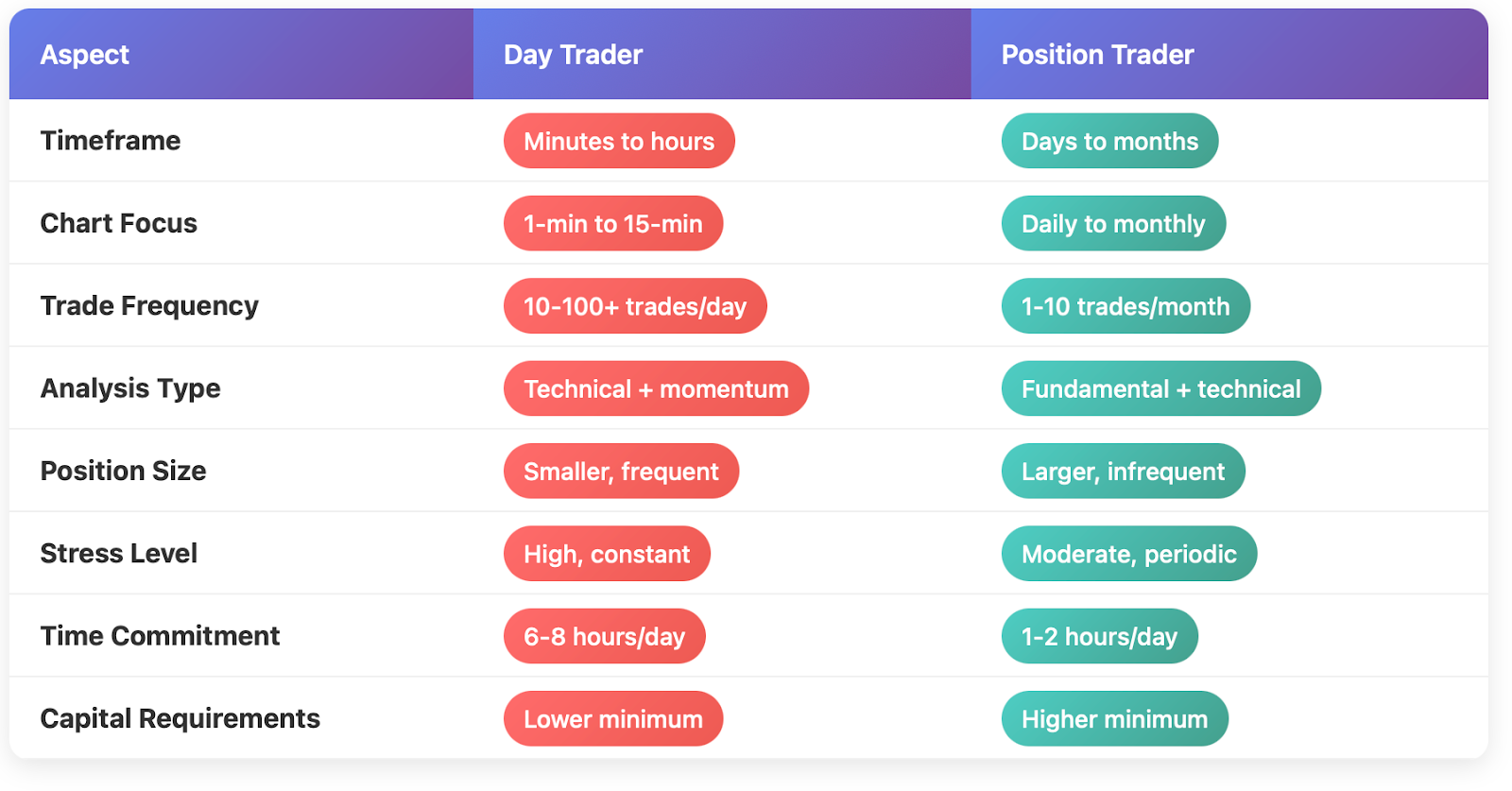
The most active form of CFD trading is day trading. Day traders in the CFD market capitalise on intraday volatility across various instruments—from forex pairs to stock indices. They rely on high-frequency trading decisions and often execute dozens of trades per day. The goal is to accumulate small, consistent profits that compound over time. Day traders focus on capturing short-term price movements, typically holding positions for minutes to hours. Their primary tools include 1-minute, 5-minute, and 15-minute charts, with decisions based on technical indicators, price action, and market momentum.
Position Trading Explained
Position trading takes the opposite approach, focusing on longer-term market trends.Traders who take positions in CFDS are those who hold their positions for days, weeks, or even months. They are after substantial price movements that are driven by fundamental factors. These traders do their charting mainly on the daily, weekly, and even monthly time frames. They base their trading decisions on some combination of the following:
economic indicators, company earnings, and the general market mood or sentiment.
Traders take positions to catch the big moves, to ride the major trends. They may not get in on all the short-term fluctuations (up and down) that happen between the points where the market reverses direction and the moves look a lot like zigzags, and they may not get 100% of the time calls when we're going to reverse from looking like we're in a trend to not being in a trend anymore—that is, to not being in what's called a trending market anymore.
Key Differences ComparisonOn the same pair, David, a position trader, has run the same analysis but on a different time scale. Yuvi, a day trader, spots a EUR/USD breakout on a 5-minute chart. She enters at 1.0850, sets a tight 10-pip stop loss, and exits at 1.0870 within 30 minutes for a 20-pip profit. Meanwhile, David, a position trader, has traded the same pair, but on a much larger scale. He has analysed the pair on charts of a much larger time scale and has identified the same breakout but in a much more profitable long-term trend. David, the position trader, enters at 1.0800 with a 200-pip stop loss, targeting 1.1200 and planning to hold for several weeks.
Trading Psychology: Who Handles Emotion Better?
The Day Trader's Psychological Challenge
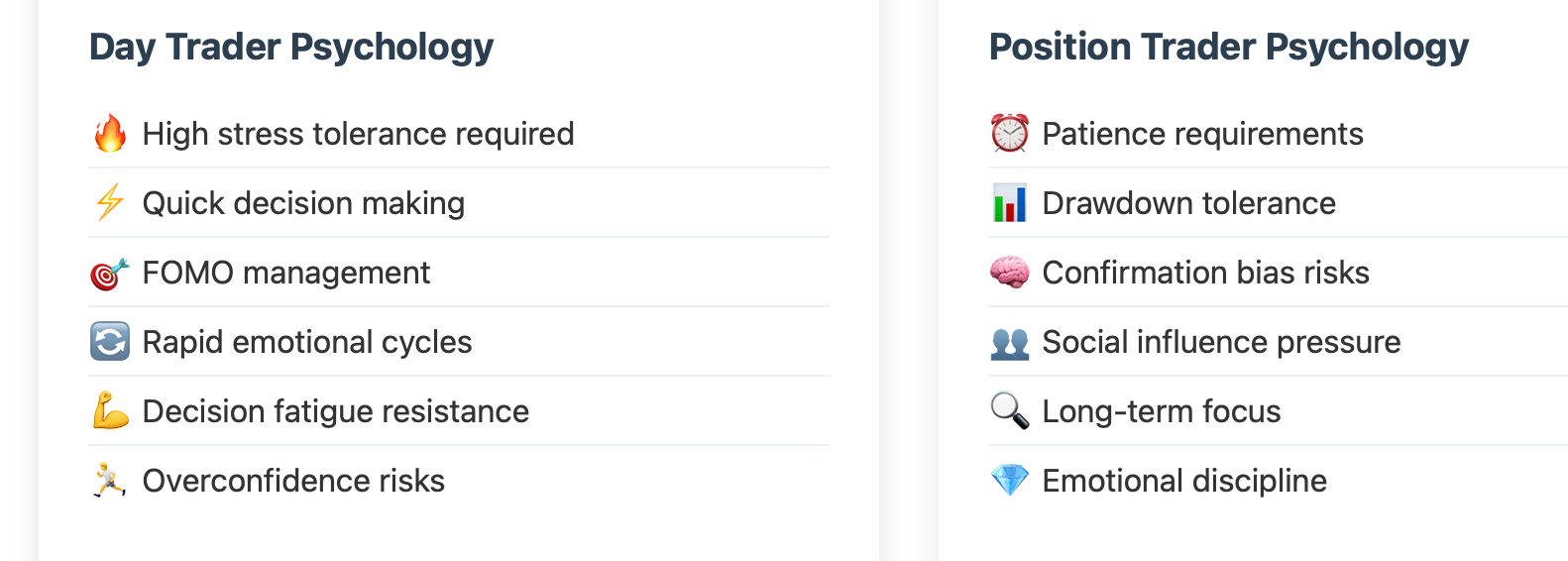
Day trading can make individuals face intense and overwhelming psychological pressure. The need for constant, quick decision-making creates a high-stress environment where emotions can quickly spiral out of control. The poor trading discipline associated with allowing emotions to get the better of a trader generally results in quick losses that can sometimes add up to financial ruin. In this high-stress, emotional environment, we need to examine the factors that influence trading psychology.
Day traders grapple with a number of different psychological issues. The most common ones are listed below.
FOMO (Fear of Missing Out): As day trading gives a person the chance to make quick bucks and forces a person to sell at high once the stock starts going up and to buy back at low once the stock starts falling, in essence, day trading leads a person to become an investor in the stocks for just a day becoming an impulsive trader.
Getting Even Through Trading: After taking a hit to their accounts, traders can become emotional and want to make back what they lost as quickly as possible. This can lead to trading on a bigger margin—that is, trading larger sizes in more leveraged positions.
When traders do this, they not only risk larger amounts of capital and a greater chance of a margin call, but they also get caught up in the desire to make back losses and even achieve a revenge fantasy. Instead, traders need to go back to trading plans, which are guides to help make decisions that are not based on emotions.
Overconfidence: A successful series of trades can lead to a misleading sense of confidence that results in larger position sizes and a lack of discipline in managing risk.
Decision Fatigue: The mental energy spent making hundreds of decisions each day can deplete one's resources, resulting in poor decisions made later in the trading session.
The Position Trader's Psychological Demands
Different but equally challenging psychological hurdles confront position traders. The mindset of a CFD trader must withstand longer periods of uncertainty and larger temporary drawdowns. The key psychological challenges include:
Patience Specifications: Position traders must withstand the temptation to shut down winning trades too soon or to abandon losing trades too soon. This takes outstanding patience and also takes believing in their analysis to a degree that seems almost absurd.
Tolerance for Detrimental Drawdowns: Position traders often have to hold onto trades that are showing significant unrealised losses before they start moving in their intended direction. It takes a lot of confidence, and sometimes a lot of foolish pride, to not get shaken out of the market when your balance is swinging in a big way.
Confirmation bias: A lengthy analysis provides time for traders to find—and focus on—information that confirms their positions and discount anything that doesn't.
The Pressure of Social Influence: When you have friends and family who truly care, it seems natural for them to question the sanity of clinging to positions that are not only losing but also historically bad. Their concerned questioning creates an external push toward doing what seems logical to them, and following their advice would mean liquidating a not-so-fun position.
Emotional Trading Patterns
Emotional trading affects both styles differently. Day traders experience rapid emotional cycles—euphoria from quick wins followed by frustration from immediate losses. This emotional rollercoaster can lead to inconsistent decision-making and strategy abandonment.
Position traders experience longer emotional cycles but with greater intensity. A position trader might watch a profitable trade turn into a significant loss over several weeks, testing their emotional resilience more severely than a day trader's 30-minute loss.
Research in behavioral finance shows that loss aversion affects position traders more severely due to the larger absolute dollar amounts involved. However, day traders suffer from recency bias more frequently, allowing recent losses to disproportionately influence their next trade decisions.
Building Emotional Discipline
Successful traders in both styles develop emotional discipline through:
-
Strict Rule Following: Predetermined entry and exit criteria eliminate emotional decision-making
-
Risk Management: Proper position sizing reduces the emotional impact of individual trades
-
Journaling: Recording trades and emotions helps identify patterns and triggers
-
Mindfulness Practices: Meditation and stress management techniques improve emotional control
The trader who masters their emotions—regardless of style—significantly increases their chances of long-term success in CFD trading.
How CFD Product Features Influence Trading Style
Leverage Impact on Trading Styles
The effect of leverage in CFD on two types of trading:
Day trading and position trading. They are impacted in unique ways, and consequently, their chances and threats are varied.
Day trading: average leverage 10:1 to 50:1. Minor shifts in price, and also leverage is used by day traders to convert tiny price movements into substantial, profitable shifts.
Trading positions: leverage reduced to between 2:1 and 10:1.
Day trading is a pursuit that demands traders make intensely rapid, almost reflexive decisions, which is a fundamental reason why making a living at it is extremely difficult, even with the advent of the online broker.
For a day trader, using leverage allows them to make money from minimal price changes. For instance, if an index moves up or down just 0.1% and the day trader is using 50:1 leverage, that same index move results in a 5% gain or loss in his account (obviously a gain in this instance if one is betting against the index).
Now, what about the poor guy using a stock index for position trading with only 10:1 leverage? He not only has to breathe in time with the market, but he must also accommodate overnight market gaps and sustained moves adverse to his positions. If that index moves down just 10%, he must survive it. Otherwise, he gets a margin call.
Swap Fee CFD Impact
Charges for swaps and contracts for difference (CFDs) have a sizable impact on traders who hold onto their positions overnight. The charges, often labeled as "overnight financing costs," can rack up to rather hefty sums over a period of weeks or months. However, these fees do not affect traders who perform all their trading machinations during daylight hours and shut everything down before the market says goodbye and good night.
Consider a trader who takes a long-term position and maintains it for an extended duration. For this instance, let's refer to a long position held in a contract for difference (CFD) based on an equity security. Assume, for this example, that the trader utilises a $10,000 CFD account and that the equity security's swap rate is 3% per annum. If the trader held the position for three months, then they would effectively be paying the broker about $75 to have the position held for that duration. The day trader using the same account set up is not incurring that cost; why?
Individuals who take positions in the market must factor in the cost of a swap when they are working out how much profit they expect to make on a trade. If the individual has been long-term as their outcome, and they do make these calculations, they tend to suffer from what behavioural economists refer to as the illusion of control. In this scenario, it is just like any other form of poor decision-making at the moment of inception of an investment. For some traders and for some trading strategies, this can really affect the viability of a strategy.
Spread and Slippage Considerations
Trading spread impact affects day traders more severely due to their high transaction frequency. Day traders may execute 50-100 trades daily, meaning spread costs can consume 10-20% of their profits. Position traders, executing fewer trades, face lower proportional spread costs.
Slippage—the difference between expected and actual execution prices—poses greater risks for day traders during volatile market conditions. A day trader expecting to enter at 1.2500 might get filled at 1.2503 during high volatility, immediately creating a 3-pip disadvantage.
Position traders experience less slippage impact due to their longer holding periods. A 3-pip entry disadvantage becomes insignificant when targeting 200-pip moves. However, position traders must consider slippage when sizing positions, as it can affect their risk management calculations.
Long/Short Flexibility Benefits
CFD trading's long/short flexibility benefits both styles differently. Day traders can quickly switch between long and short positions based on intraday momentum, capitalising on both rising and falling markets within the same session.
Position traders use long/short flexibility to implement hedging strategies or capitalise on longer-term directional biases. They might hold a long position in a growth stock CFD while simultaneously shorting a broader market index to hedge against systematic risk.
The key advantage for both styles is the ability to profit from market declines without owning the underlying asset. This flexibility is particularly valuable during bear markets, where traditional buy-and-hold strategies suffer.
Risk Management & Capital Allocation: Day vs Position
Implementation of the Stop-Loss Strategy
Day traders and position traders have very different requirements for stop-loss strategies. Day traders tend to use tight stop-losses (in the forex market, 10-50 pips; 0.5-2% for stocks) to contain losses from adverse price action that happens too fast to react to. Their stop-losses are often based on technical analysis, support/resistance levels, and a sort of trading logic that amounts to buying/selling when the price reaches a certain technical target.
Position traders, on the other hand, use much wider stop-losses (100-500 pips in forex, 5-20% for stocks), because they can't afford to be stopped out by the normal noise in the market when they are trading on a longer time frame. Position stops are set using fundamental prices, long-term technical price levels, and even measures of market volatility.
Position Sizing Calculations
Calculating position sizes must consider the unique attributes of each style. For day trading, one can use a much larger position size relative to the account balance because stop losses tend to be tighter. A day trader with a $10,000 account might, for instance, risk $100 (1%) per trade with a 20-pip stop, which allows for a position size of $50,000 in EUR/USD. For swing trading, one would use a smaller position size, again relative to account balance, because stops have to be much wider to accommodate the expected movement over a longer time frame. The same trader using a 200-pip stop would only trade $5,000 in EUR/USD to maintain the same $100 risk level.
Risk-Reward Ratios
Styles of trading have risk-reward ratios that vary based on their different approaches to the market. For example, day traders frequently work with ratios of 1:1 to 1:2, taking many trades with high win rates to compensate for those lower ratios. A day trader might risk 20 pips to make 30 pips, and as you can see, between trades, volume here is key to profitability.
CFD Risk Management Best Practices
No matter which way you look at it, successful CFD traders put the principles of risk management into practice. They do several things. They limit losses. They work with set profit targets, and just using those alone, they profit. They also use stop losses.
And in a large part, they work overtime. That is, with a combo of tools and principles, they keep working at it long enough to find towel-size, not thread-size, profits in the haystacks that are the markets. And when they do that, they succeed.
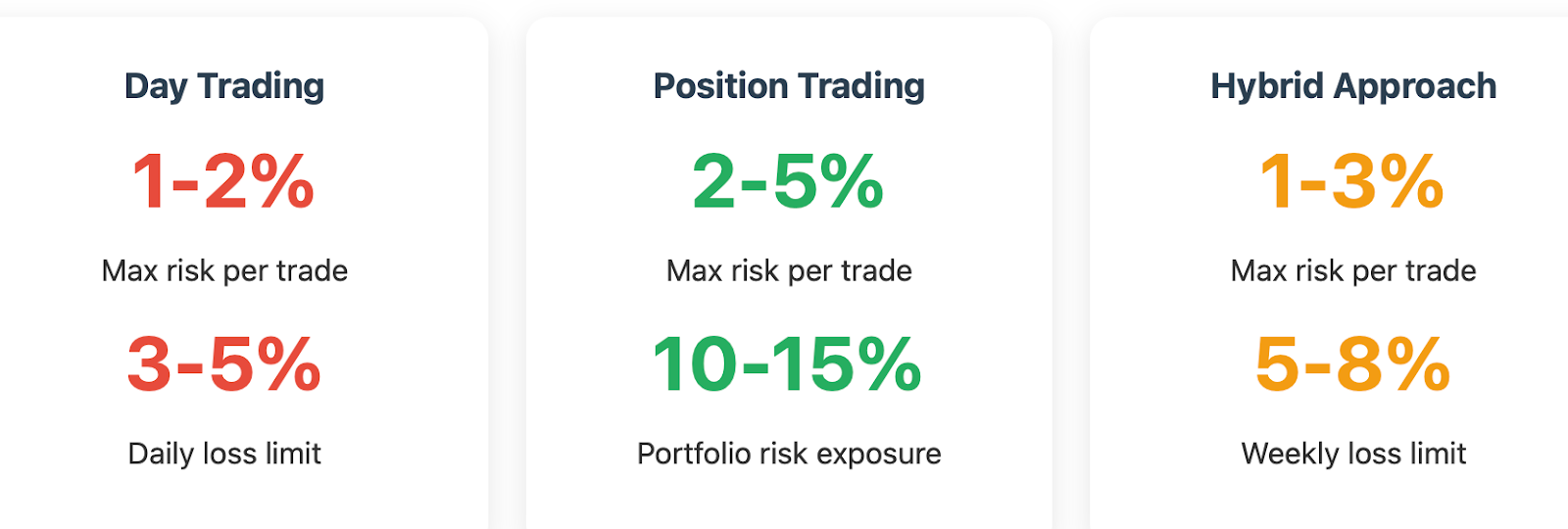
Maximum Risk Per Trade: Do not risk more than 1-2% of your account balance on a single trade.
Maximum Daily Loss: Day traders should set daily loss limits (3-5% of account balance).
Maximum Portfolio Risk: The position traders should limit their total portfolio risk exposure to 10-15 per cent.
Correlation Management: Avoid taking up several positions in instruments that are very likely to move in the same direction.
Leverage Discipline: Use leverage conservatively, particularly at the outset.
Capital Allocation Strategies:
Generally, all their capital being in cash or very short-term instruments allows day traders the most flexibility to seize fleeting opportunities. When they work, day traders might use more leverage than usual to make up for the fact that they don't have their trading capital working in the market.
Investors who take positions usually have 50-70% of their wealth in active investment at any one time. They maintain cash reserves of 30-50% to seize new investment opportunities or to add to existing positions. This setup gives investors flexibility and a decent exposure to the market.
Consider, for instance, two traders, each holding an account balance of $50,000.
-
Day trader: Maintains cash balance of $50,000; uses leverage to adjust position sizes.
-
Position trader: Retains $20,000 in cash, $30,000 in active investments.
Both strategies can achieve success when implemented correctly and supplement good risk management practices.
Which Trading Style Suits You? Self-Assessment Guide
Day Trading vs Swing Trading Quiz
To find out your ideal trading style, there are some questions to answer. Be honest. And then, to get the right score, do the math.
Almost every question in this section assesses you on a scale of 1 to 5, with 1 indicating 'not at all like me' and 5 indicating 'very much like me.'
Question 1: Capability of market monitoring
-
Are you able to commit to 6-8 hours each day for active market monitoring? (Day: +3, Position: -1)
-
Is your preference to check the markets 1-2 times each day? (Day: -2, Position: +3)
-
Do you feel at ease with slight supervision of the market? (Day: -3, Position: +2)
Question 2: Tolerance for Stress
-
Do you excel when things are intense and happening quickly? (Day: +3, Position: 0)
-
Can you keep your composure when your account is changing really fast? (Day: +2, Position: -1)
-
Are you someone who likes to take time and make decisions in a slow, deliberate manner? (Day: -2, Position: +3)
Question 3: Risk Tolerance
-
Do you find it acceptable to make many small losses? (Day: +2, Position: -1)
-
Are you able to endure for a long time large unrealized losses? (Day: -3, Position: +3)
-
Do you like to cap your maximum loss per trade at under 1%? (Day: +1, Position: +1)
Question 4: Availability of Time
-
Can you be present in the principal market sessions? (Day: +3, Position: 0)
-
Are you working full-time or have other obligations that take up your time? (Day: -3, Position: +2)
-
Are you able to make trading decisions while the market is open? (Day: +2, Position: -1)
Question 5: Psychopathological Sequelae
-
Do you like to make decisions quickly and see results right away? (Day: +3, Position: -1)
-
Do you exhibit patience and a high comfort level with delayed gratification? (Day: -2, Position: +3)
-
Would you rather look at a small number of trades and consider them thoroughly? (Day: -1, Position: +2)
Question 6: Capital Situation
-
Have you begun with an amount smaller than $10,000? (Day: +1, Position: -1)
-
Are you able to make $25,000 or more available for trading? (Day: 0, Position: +2)
-
Are you able to have money locked up for long stretches of time? (Day: -2, Position: +3)
CFD Style Test Results
Score for Day Trading: 10+ points. You are very well-suited for this kind of trading. Your distinct personality, your availability, and your risk tolerance align with the requirements of active trading that takes place during the day.
Position Trading Score: 10 points and above. Position trading aligns with your profile brilliantly. It requires the kind of patience that most people lack but that you possess alongside your considerable risk tolerance. You are a natural for a more extended market participation.
Consider swing trading (holding positions for days to weeks) as a hybrid approach that combines elements of both styles. This produces a mixed score somewhere in between for swing trading, giving it a score from -5 to +9. As the name implies, swing traders aim to catch the "swings" in price movement. This very short-term strategy demands intense focus and concentration.
Lifestyle Compatibility Assessment
Profile of a College Student Trader:
-
Age: 22, flexible schedule, moderate risk tolerance.
-
Which trader are you? A day trader who has time, availability, and motivation to learn.
-
Recommendation: Begin with small position sizes, and make education your primary focus.
Analyst Lena Profile: 35 years old, full-time, with an analytical mindset and limited time.
-
Traders like Lena tend to take more short-term positions, but they don't have to. If Lena were to trade for longer terms, she'd be well equipped to do so.
-
Unlike many of us, Lena actually has an edge when it comes to fundamental analysis, since she really understands it. (It's probably safe to say that in aggregate, relative to what most of us know and understand, Lena has a greater likelihood of being right at key fundamental inflection points.)
-
Recommendation: Focus on fundamental analysis. Trade around major market events.
"Robert the Retiree" Profile:
-
Age: 60, flexible time, conservative risk tolerance, significant capital
-
Which trader are you? Position trader - capital preservation focus and time availability
-
Recommendation: Lower leverage, dividend-paying stock CFDs, conservative position sizing
Personal Compatibility Factors
Look past the quiz results and think about these essential elements:
Personality Traits:
-
Decision-makers who are impulsive vs. those who are deliberate.
-
Comfort with uncertainty and ambiguity.
-
A competitive nature vs. a collaborative one.
-
An orientation to detail vs. an orientation to the big picture.
Life Circumstances:
-
Demands of a career and their flexibility
-
Obligations to family and the support system that comes with it
-
Goals related to finances and the time needed to reach them
-
Place of residence and access to the job market
Learning Style:
-
Learn best when they can practice (day trading).
-
Learn best when they can research (position trading).
-
Have a level of comfort with technology and platforms.
-
Have a willingness to change and evolve strategies.
Your natural tendencies should complement the trading style you choose. They can also challenge you while you grow into the trader you wish to become. But here's the reality of trader formation: Success comes from alignment, or at least a lack of friction, between your personality, life situation, and chosen trading approach.
Common Mistakes When Choosing a Trading Style
CFD Trading Mistakes: The Copy-Cat Trap
One of the rookie trader errors that cause the most destruction is just copying successful traders without understanding their actual situations, how they mix up investment strategies, or their tolerances for risk and loss. Many social media platforms let you see directly how much profit certain traders are making (and if you know what kind of leverage they're using, you play a dangerous guessing game with your own risk tolerance when you assume you can replicate their results).
Take Tom's case. For three months, he copied the signals of a successful day trader. The signals worked, and the signal provider was making money. But Tom was losing money. Why? In a nutshell, Tom has different tolerances for speed, risk, and emotional stress than the day trader. And the signal sender wasn't giving Tom a personalised trading plan.
The Personality-Style Mismatch
The styles that many traders choose are based on what they see as potentially profitable rather than on what is personally compatible. A naturally patient, analytical person might choose to be a day trader, as it "looks exciting," while an action-oriented individual might go for position trading, since it "seems easier."
This unmet need builds internal tension. The day trader finds that he or she is being forced to hold a position overnight—and for a longer period than day trading normally allows—when what he or she really wants to do is trade during the day only.
Trading Strategy Consistency Failures
The worst mistake is to alternate between styles of trading when experiencing a loss. Most traders fail because they don't develop competence in any one approach. If you can't stick with a single strategy long enough to master it, you're bound to fail.
Sarah started her career as a day trader but moved into position trading after a bad week. She next tried her hand at scalping, swayed by what she read online. Each transition felt like a fresh start—learning all over again and building the necessary skills for each style. If she failed courting one style, she hoped to succeed in another.
Ignoring Time and Resource Constraints
Common among traders of all kinds, time and resource underestimation generally affects those who think they can trade while also doing something else. Day trading might let you out of some conditions of the normal 40-hour workweek, but it still usually requires at least that much time. And it surely needs your presence in front of the screen for a portion of each of the hours that the market is open.
Here is a common scenario: a full-time employee chooses day trading as a side activity, intending to monitor trading positions during the workday. This approach practically guarantees that the budding trader will overlook most trading opportunities, will execute trades very ineffectually contrary to the way in which day traders are supposed to trade, and will wind up feeling extremely frustrated.
Risk Management Misalignment
Risk management is often applied inappropriately by traders to their selected style. Day traders might use too-wide stops, which are more appropriate for position traders, while traders who use positions might apply too-narrow stops that are more suitable for day trading.
Frequent stop-outs for position traders and excessive risk exposure for day traders are outcomes of this misalignment. Each of these styles requires risk management parameters that are in line with their holding periods and expectations of the market.
The Grass-is-Greener Syndrome
When periods of losses are unavoidable, traders often feel other styles would be more lucrative. Day traders consider it "easier" to position trade in a volatile market, while position traders think day trading provides "better control" in a trending market.
This condition hampers traders from obtaining the know-how and emotional steadiness that they must have to run a successful trading operation. Every trading style goes through periods of stress that test the patience and perseverance of the traders using that style.
Platform and Tool Mismatches
Selecting the wrong tools and platforms for your trading style creates unnecessary hurdles. If you're a day trader, for instance, and you use a platform designed for long-term investors, you will inevitably face obstacles; for example, execution delays, poor charting capabilities, and maybe even almost the opposite of what you'd call a trader-friendly interface. If you're a position trader who is paying up for a platform designed for high-frequency trading (HFT) that you do not use in any meaningful sense, you are most certainly facing the same situation in a slightly different flavour. In both cases, you have platforms that are built for an entirely different trading style than the one you are using.
The Key to Avoiding These Mistakes
Success requires honest self-assessment, patience to develop competence, and commitment to continuous improvement within your chosen style. The most successful traders spend years mastering one approach rather than constantly switching between styles.
Remember: There are no shortcuts to trading success. The style that fits your personality, circumstances, and goals—executed with discipline and proper risk management—will ultimately prove most profitable.
How to Apply Your Style on the Tradewill Platform
Tradewill CFD Trading: Platform Overview
The Tradewill platform seeks to equally support day trading and position trading styles through a set of features that is, in their view, comprehensive. But is it? And how does one even know if a trading platform has reached a comprehensive enough status to really get a handle on either day trading or position trading or, as is more often the case, a hybrid of the two styles that the user requires? Understanding whether a platform is sufficiently feature-rich is key to understanding how to configure it for either style.
Day Trading Platform Configuration
The Tradewill platform has various features to help day traders carry out their activities. These features are all conveniently located on a single screen.
Chart Customisation:
-
Simultaneously set up several timeframes (1-minute, 5-minute, 15-minute).
-
Technical indicators for fast decision-making need to be configured. These include the:
- RSI
- MACD
- Moving Averages
-
Price alerts for key levels and breakouts must be enabled.
-
For support/resistance identification, the drawing tools need to be used.
Order Management:
-
Establish keyboard shortcuts for rapid order entry and exit
-
Configure default position sizes based on risk parameters
-
Employ OCO (One-Cancels-Other) orders for efficient trade management
-
Enable trailing stops for profit protection
Risk Controls:
-
Establish daily loss limits to stop emotional trading.
-
Configure maximum position sizes for each instrument.
-
Utilize the platform's risk calculator for position sizing.
-
Enable margin warnings to prevent forced liquidation of your account.
Example Day Trading Setup: John, a day trader, uses the following Tradewill configuration to trade the EUR/USD:
-
Primary chart: 5-minute EUR/USD with 20-period EMA
-
Secondary chart: 1-minute for precise entry timing
-
Position size: 0.5% account risk per trade
-
Stop-loss: 20 pips, Take-profit: 30 pips
-
Daily loss limit: 2% of account balance
Long-term CFD Trading Tools Configuration
Traders who take a position need a different type of platform configuration. They need to be able to take a longer-term view of the trades they are making.
This requires a different type of monitoring and a different type of analysis. When looking at a chart, the position trader focuses on much higher timeframes. Their primary focus in on the daily and weekly timeframes. But looking at these types of timeframes requires the use of different types of indicators. Position traders use much longer-term indicators. One of the most common longer-term indicators is the 200-day moving average.
Example Position Trading Setup: Maria, a position trader, uses Tradewill for long-term stock
CFD trading
Main figure: Daily S&P 500 alongside 50-day and 200-day moving averages
-
Set the position size to 2% of the total account risk allowed per trade.
-
Stop-loss: 8% under entry, Take-profit: 24% over entry
-
Rebalancing and reviewing the portfolio on a monthly basis
-
Instrument Selection by Style
Day Trading Instruments:
High liquidity is found in the major forex pairs (EUR/USD, GBP/USD, USD/JPY).
How much the prices of the most important stocks change. Measures of volatility extend beyond individual stocks to cover stock indices, like the S&P 500. When we talk about how volatile something is, we are really talking about how much it varies. So we say that stock prices are highly volatile when they change a lot. And when we say that stock indices are showing high volatility, we mean that the prices of the stocks they include are varying a lot.
Goods during dynamic trading intervals
Single stocks that have a high average daily volume
Position Trading Instruments:
Exchange Traded Funds (ETFs) are an ideal investment vehicle to obtain diversified exposure to large number of securities. In most of the cases, they offer much better liquidity than mutual funds because they are traded on the stock exchange. Most of the ETFs which track broad index can be considered as good investment options to get diversified exposure.
Demo Account Testing Strategy
Both of the trading styles should use the demo account features of Tradewill before putting real capital on the line.
Day Trading Demo Approach:
-
Practice quick order entry and exit.
-
Evaluate feelings caused by sudden losses.
-
Cultivate regularity and control yourself.
-
Configure platform parameters to achieve optimal performance
Position Trading Demo Approach:
-
Patience is paramount when working with open positions.
-
Examine how well a test performs when it's responding to potential losses that haven't yet materialised.
-
Develop basic skills in fundamental analysis.
-
Refine risk control factors.
Live Trading Transition
Day Trading Transition:
-
Commence with the smallest possible position sizes.
-
Centre on what you're doing and how you're doing it.
-
Don't let profit motives cloud your creativity and your direction.
-
Up to now, every successful entrepreneur has focused on process.
-
Successful entrepreneurs do what they do in a certain way.
-
Whether they do it well or not, usually it ends up being the reason for their success.
Position Trading Transition:
-
The follow-up from our last meeting was mainly focused on the identified issues.
-
The bulk of our discussion covered the 2023 issues.
-
Position sizing and risk management are your primary means of controlling the dollars at risk in every trade. They should be the center of your trading plan. Think of them as the first skill to master before learning to predict market direction.
Why are they so important?
For one thing, if you don’t control risk, you can lose large chunks of your trading capital. And for another thing, if you can control risk well, trading can be a very low-stress activity. You can trade with high probabilities and a solid plan, and the worst that can happen is that you go to bed a little earlier than usual because you won a few trades.
Take a moment to look at these first two sentences and condense them into a single idea. Why is position sizing and risk management important for a trader?
-
Cultivate patience and fortitude.
-
Slowly grow to complete portfolio
-
Platform Performance Optimization
Day Trading Optimization:
-
Make sure that there is a fast internet connection to ensure that the execution speed is fast.
-
Employ a specialized trading workstation to eliminate diversions.
-
Set up different displays for an extended view of the workplace.
-
Ensure the platforms are updated regularly so that they can function at optimum performance.
Position Trading Optimization:
-
Establish text alerts for really important price levels.
-
Set up automatic reporting to convey how the portfolio is doing.
-
Utilize calendar integration for earnings and economic events.
-
Backup systems should be maintained for position monitoring.
The platform from Tradewill delivers the required flexibility and necessary tools for both of the trading styles to function. Success with the platform is reliant upon the configuration being both proper and optimal; the configuration must also be consistent and be based around the appearance of certain performance results.
Conclusion & Call to Action
To achieve successful CFD trading, one must first comprehend oneself, then the markets. In this all-inclusive guide, we have investigated the essential contrasts between day trading and position trading. We have not only examined the technical sides of these two trading methodologies but also applied a magnifying glass to the psychological, lifestyle, and risk management prerequisites that seemingly dictate the long-term success of one trading method over the other.
The most important thing to realise is that there is no single trading style that is universally "the best." There is only the style that fits you, your unique personality, circumstances, and goals. For some traders, the day offers too many distractions for them to focus clearly on their trades. Yet, for the next trader, the day may be just the right trading environment. A position trader might seem to some an almost lazy trader, and yet, is there a more disciplined way to trade? A way that requires more serious consideration and better emotional discipline than trading for major market moves?
Key Takeaways for Your Trading Journey
-
Assessing oneself is very important. This importance is actually heightened when it comes to your trading. Unlike other forms of investing, too much equity in a poorly understood business model can really hurt you, because trading is a poor substitute for a better business model. And unless you trade for a living, a trading style that isn't directly conducive to your natural tendencies, available time, risk tolerance, and psychological makeup is just as harmful as doing an untimely and unsettled trade.
-
Managing risk is non-negotiable, no matter what trading style you prefer. With proper risk management, which includes position sizing, stop-losses, and the diversification of your portfolio, you can achieve success in trading. Poor risk management leads to account blow-ups.
-
Mastery of a platform is crucial. Knowing how to set up and fine-tune your trading platform to fit your unique style can sway the scales of trading in your favor. This is one area where I have seen far too many traders come up short.
Beats Perfection Consistency: One trading style is developed, and the competence therein is gained, not by switching around all the time, but by sticking to one (at least until you feel like mastering another).
Educating Yourself Pays Off: To remain in the money and stay competitive, both day traders and position traders must continue to learn not just about the financial markets but also about the array of strategies and risk management techniques they employ. They don't have the luxury of being able to stop their educational progress.
Your Next Steps
Being successful in CFD trading means that you must take action backed by knowledge. If you've found your style of trading through this guide, it's time to take the next step and start trading: Practical.
If You Want to Be a Day Trader:
-
Begin with demo trading to cultivate your skills and the emotional discipline required for high-stakes decision-making.
-
Make split-second choices without the buffer of a real-money trade contingent on your must-win mindset.
-
Develop the risk management systems that will allow you to stay in the game despite the inevitable ups and downs.
-
Work on the psychological resilience that will enable you to handle the kind of trading pressure that could literally be heart-stopping.
If you wish to become a position trader who holds trades for the long term, you must first educate yourself in fundamental analysis and the longer-term style of chart reading.
-
Position trading requires patience, the ability to correctly analyze overall market trends, and the emotional strength to withstand the temporary drawdowns that even the best trades will inevitably incur.
For Individuals Who Have Yet to Make a Decision: Try beginning with swing trading, which is a hybrid method. Maintain positions from several days to several weeks while you assess which style is the best fit for you.
Start Trading Now with Tradewill
Tradewill's platform aims to serve every trader, regardless of trading style.
They all support us traders, somehow, someway. charting tools to help you interpret the market; almost any type of position setup you want; and some leverage options, basic risk management, and a few other tools to allow you a semi-reasonable, fully customizable trading experience.
Open Your CFD Trading Account Today:
CFD Demo Account: Use selected pretend funds and zero-risk to discount when trading
Trading Account for Real-time Operations: Prepare to trade with substantial funds when feeling ready
Mobile Trading App: Use the complete trading platform from your phone
Education Materials: Access practical guides on how to trade; view free webinars about trading; and read free, sharp market analyses
Don't let overthinking stop you from starting your trading journey. The perfect time to begin your education is now, and the ideal place to start your practice is with a demo account where you can perform risk-free exercises.
Take Action Today:
-
Create a demo account with Tradewill to test your chosen style.
-
Get the app for easy market access. Subscribe to our newsletter for an easy learning experience.
-
Receive the finest of our efforts in continuing education right in your inbox.
-
Keep in Contact!
Pick a trading style that suits you, practice it in demo mode, and hone the skills and patience that will see you through in the live trading environment. Your future self will thank you for taking the steps to prepare today. The markets are waiting, and your trading odyssey starts with a single decision.
Disclaimer: The content of the blog does not represent any position of Trade W, does not serve as any trading-related decision advice, and does not endorse any third-party.