

 Trade W

Inflation has increased to the point that bank deposits will likely lose value due to this same inflation. Depending on your stock investment choices, you may feel like you're riding an amusement park ride. How do you determine the correct place to invest? Well, the recent success of debentures is one option, an unsecured bond that has no value or protection against default in the form of collateral, but provides higher investment returns. Whether it is bank deposits or stock, asset classes have generally lower-than-expected returns since 2020.
The best analogy for debentures would be to treat them like middle children. Middle children generally are treated as the least favourite by their parents and are given the least amount of security and attention. These high-yielding securities will generate higher interest than traditional bonds because they are based solely upon your assessment of the creditworthiness of your debtor, as opposed to a fixed asset to be used as backup to secure your loan.
Therefore, the question will become whether you consider that receiving an additional interest point when investing in a debenture fund outweighs the risk that the borrower may not repay you the principal plus accrued interest. Again, it will all come down to an individual's comfort level with risk when they determine if investing in debenture investment securities would be part of their overall investment portfolio.
What Are Debentures? A Beginner's Guide to Unsecured Bonds
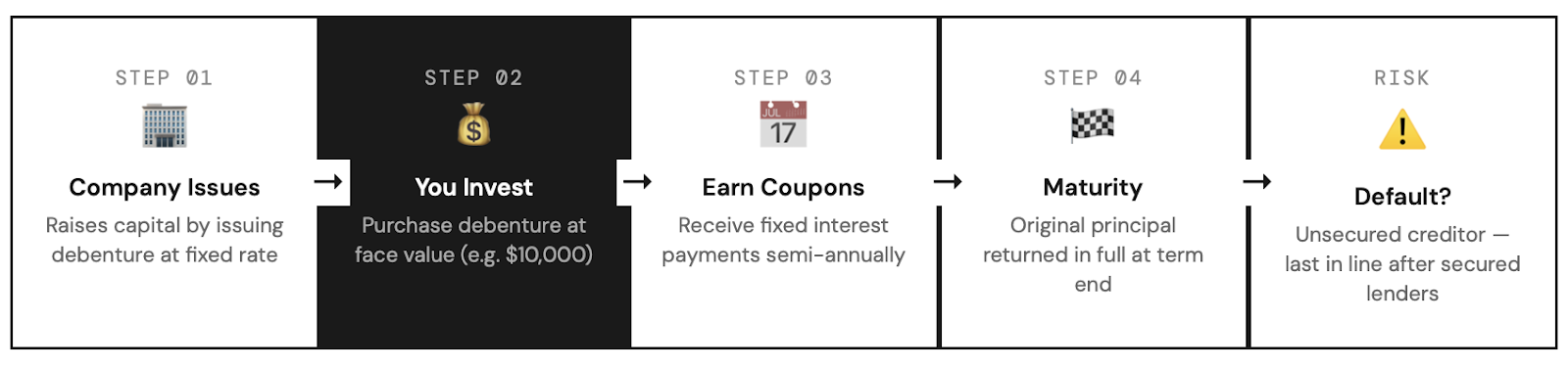
A debenture is considered a type of long-term loan or debt instrument where an organisation requires funds. In contrast to bonds that can be secured by property, machinery, or other assets, debentures rely solely on the credit rating and reputation of the issuer. In essence, you are making a loan based on trust and prior performance.
Here’s how a debenture works: A company issues a debenture that pays 4.5% interest per year for five years. You buy the debenture for $10,000, receive $450 interest every year, and at the expiration of 5 years, you receive your original $10,000 back, assuming the company has not gone bankrupt. Because debentures are unsecured, if the company goes bankrupt, you will be considered just an unsecured creditor along with all the other creditors.
This is one reason why people find debentures appealing; the rate of interest you receive for a debenture is usually much higher than you could earn with either secured bonds or deposits with a bank. In the year 2026, when central banks are continuing to maintain a lower than average benchmark rate, high-quality corporate debentures with interest rates of 4-5% annually make a compelling investment opportunity when compared to bank accounts that will be yielding between 1-2%.
Debentures vs Regular Bonds: What's the Difference?What is the Most Important Difference Between Mortgage Bonds & Debentures?
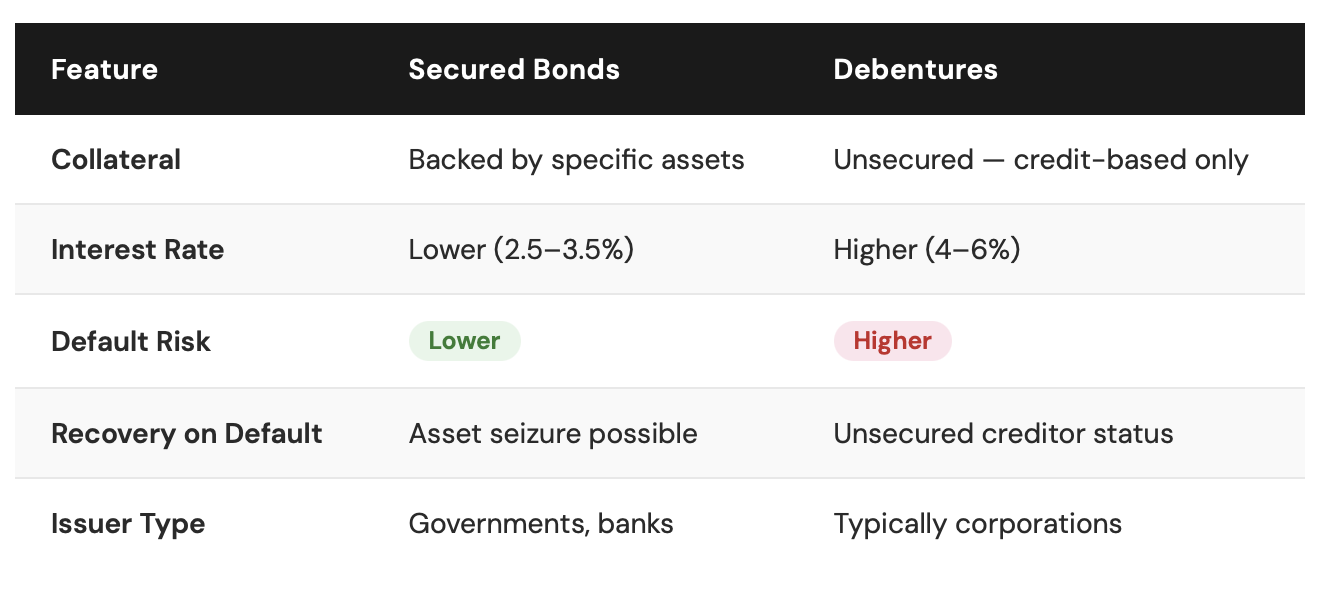
The main difference between these types of securities is found in what happens if there is a failure. In the case of a mortgage bond, if the issuer defaults on the bond, the bondholders have a legal claim against specific assets - i.e., specific property, such as a building, equipment, etc. On the other hand, with debentures, the bondholder's hope is that enough general assets will remain after the secured creditors have taken their share.
Professional Example: Technology giants, such as Microsoft and Apple, issue debentures based on their excellent credit ratings (commonly AAA or AA+). For instance, an Apple debenture with five years to maturity may yield 4.2%. This is a higher rate than U.S. Treasury bonds but a lower rate than would be expected for small, more risky companies. If the company cannot pay the investors, the investors are willing to accept such risk due to the financial strength indicated by the company's balance sheet and its cash flow.
Beginner Example: Think about lending $100 to two friends. If one friend offers to put up their bike as collateral, you would charge them $3 to borrow the money; if the other friend does not want to put up any collateral, but has a good job and is reliable, you would charge $5; this is the debenture concept - higher reward for trusting the creditworthiness rather than physical security.
Platforms like TradeWill make it easier to manage your investment tracking on debenture opportunities because they provide a central location for consolidating debenture listings, credit ratings, and yield comparisons. In addition, by filtering by issuer, maturity date, or yield, you can quickly identify which instruments are suitable for your risk tolerance.
Debentures vs Mortgage Bonds: Key Differences Investors Must Know
We need to further analyse the distinction between secured and unsecured investment types; this distinction will greatly impact your Risk Profile.
Mortgage bonds, which may also be referred to as asset-backed securities, are directly tied to the specific collateral that backs each loan. When a Mortgage Bond is sold, and a bank's lending portfolio serves as the collateral, if the bank were to become insolvent, investors would have a first claim on all loans in the lending portfolio. By having a group of loans to back each bond, the bank would issue bonds at lower interest rates due to the reduction in risk.
Debentures create an inverse scenario. With no collateral backing them whatsoever, the only source of protection for your investment would be the financial strength of the issuer. In evaluating whether or not you want to invest in debentures, you would review balance sheets, cash flows, and credit ratings, versus reviewing the value of the specific collateral to determine your investment decision.
Head-to-Head ComparisonIn the first part of this example, we will use a small bank that is issuing $500 million of mortgage bonds with a 3.2% coupon rate secured by mortgage loans, compared to issuing $500 million of debentures with a coupon rate of 4.8% that are not secured. While the mortgage bonds have a lower yield, they provide superior protection because if the bank fails to pay, its mortgage bondholders will be the first to be paid out before debenture holders receive anything.
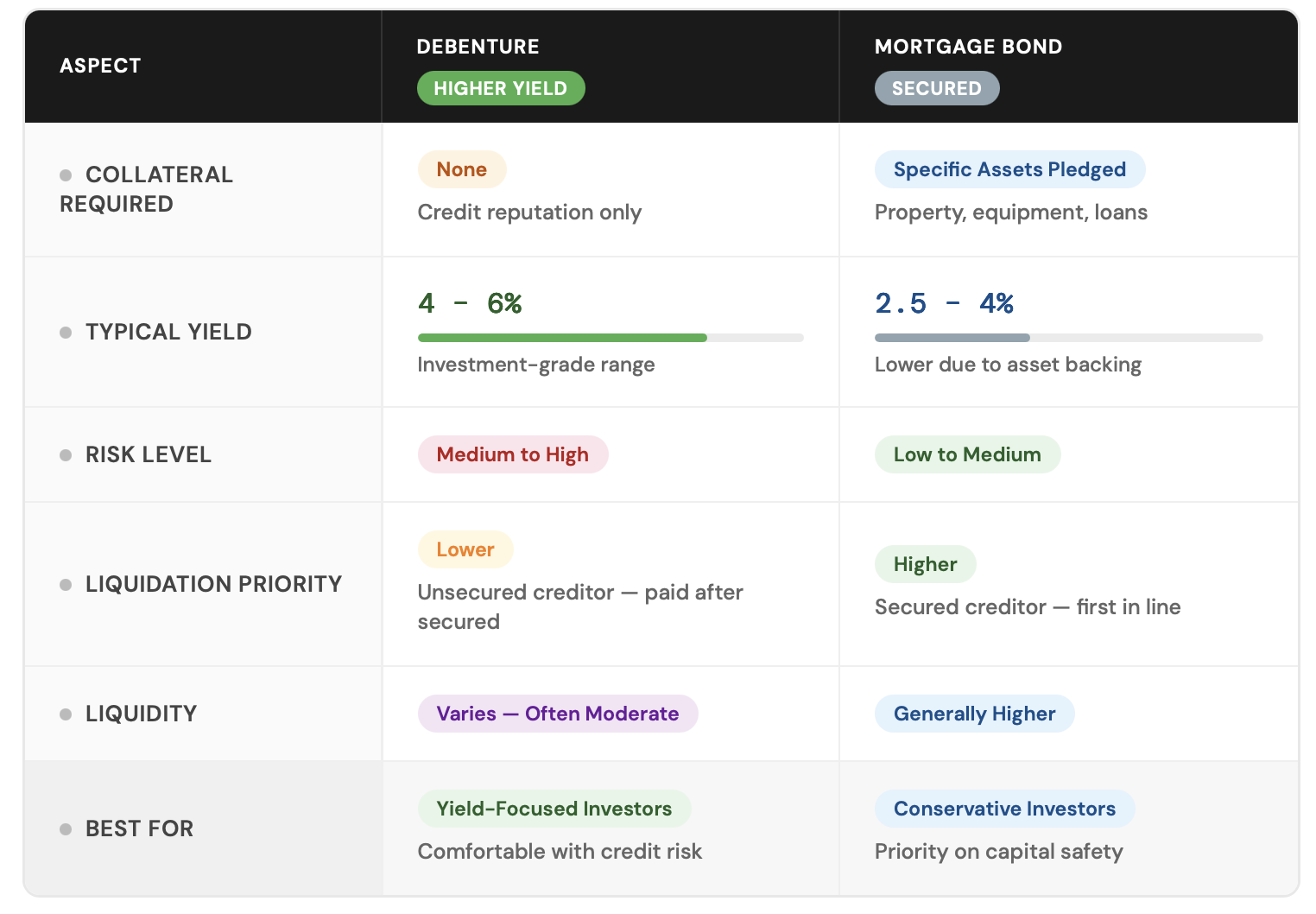
In this example, your friend needs $10,000 to start his/her own business. To secure your loan, your friend will give you a car title and obtain a 3% interest rate. In the second option, your friend won't provide any collateral, and you will receive a 5% interest rate based on the history of good jobs and savings. This is analogous to the debenture model, where there is trust and some form of remuneration due to the increased risk.
Debentures also have credit ratings assigned by independent rating agencies, which is the primary mechanism to determine the level of security in a debenture. An A-rated corporate debenture has a lower risk than a BB-rated corporate debenture, even though both are considered unsecured.
TradeWill has made a bold move by displaying credit ratings of all its listed debentures in a format that makes it easy to quickly determine whether the potential yield compensates for the associated credit risk.
Why Debentures Are Trending in 2026: High-Yield Opportunities in a Low-Rate World
Due to the recent economic climate, debentures have become very popular. The global economy has remained relatively relaxed regarding central bank policy, and therefore, interest rates have been kept low. As a result of these low-interest rates, traditional safe investment options such as savings accounts, CDs, and government bonds have not provided adequate returns (i.e., returns that are greater than inflation).
At the same time, corporations need to raise capital, yet many would prefer not to dilute their equity by issuing additional shares through public stock offerings. Corporations can issue debentures and obtain interest rates that are attractive for investors, but are less expensive than traditional equity financing.
The 2026 Interest Rate Landscape
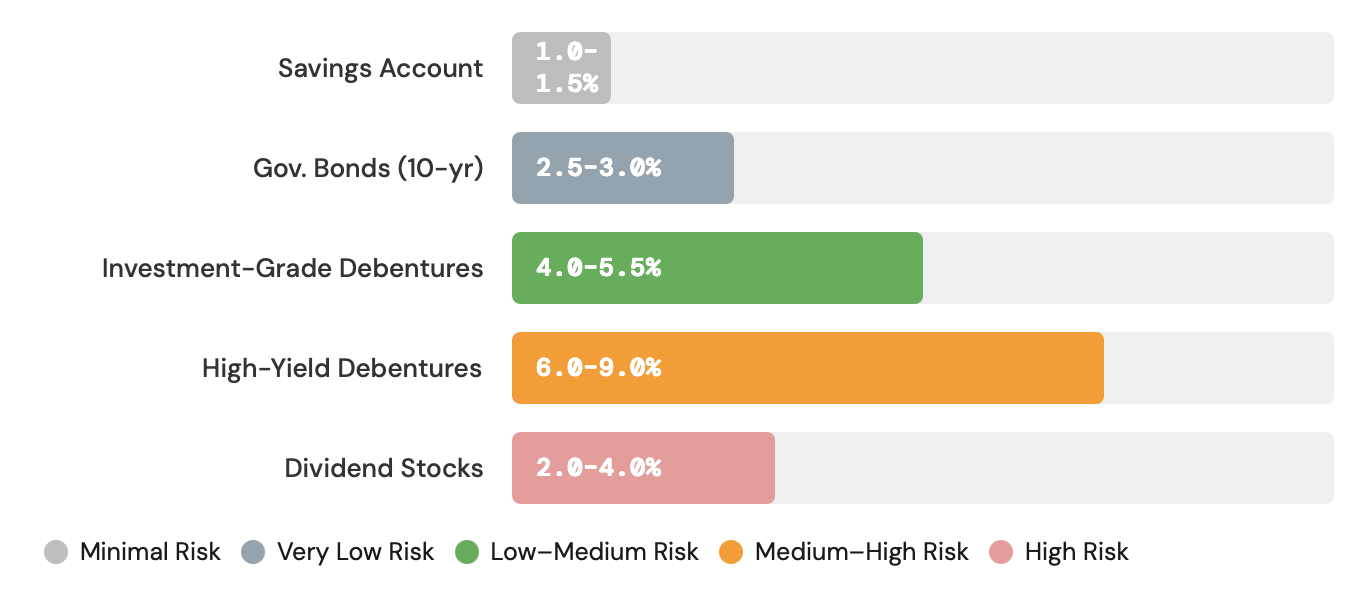
The difference between very safe investments and bonds has become so great that it makes them less risky for many investors. A 3-4% benefit versus their bank savings will really change how much someone can spend in their lifetime, especially in cases where the most important consideration is keeping one's money safe rather than having large amounts of it grow explosively.
The ratings given to issuers of credit determine everything. Generally and for the most part, an A or AAA-rated bond will be 2-3% higher than the government equivalent for 3-4 year corporations. If the company is BBB rated, then the yield will be 3-4% higher than the government equivalent. However, if the rating is BB (meaning high yield), then the yield difference is 5-6%.
Also, when looking at bonds that are lower than investment grade (BBB) and rated BB, the yield is 5-7% higher than the government equivalent and therefore represents a greater risk of default.
Professional: For example, a 5-year debenture issued by a Fortune 500 Company rated AA would provide roughly 4.8% on $10,000 invested. This provides an additional $200 per year compared to a 5-year treasury note yielding 2.8%, which would allow the debenture investor to accumulate an additional $1,000 over the five-year term. Thus, an individual who has $100,000 to invest would receive an additional $10,000 in interest over five years.
Beginner: Suppose you have a savings account and earn $10 for every $1,000 you save for 1 year at the current interest rate. Also, suppose there is a local business owner whom you know personally and like, who would pay you $45 for every $1,000 you give him to invest for the same one year. There is no FDIC insurance or other guarantee on the funds; trust will be established by their business record. The total amount of return from the two (the $45 versus the $10) is what investors receive in an unsecured environment.
To further enhance investing in debentures, TradeWill provides aggregated access to debentures from different companies based both on their sector and their credit rating and allows investors to track daily pricing and interest rate spreads on debentures by really-time monitoring of yield curves in debentures, as well as setting up alerts for when selected corporate credit-rated debentures reach investors target yields to convert passive search to an active investing strategy.
Debenture Interest Income and Safety: How Fixed Returns Protect Your Investment
The predictability of debentures is one of their greatest attributes. With stocks, a dividend could be reduced at any time, and stock prices change daily; however, debentures provide fixed-rate coupon payments according to a predetermined schedule, which converts the market's erratic volatility into predictable and manageable ongoing income.
Fixed Income Is A Plus
When you purchase a debenture, the coupon rate (5%) is fixed when the security is issued. Regardless of whether or not the company experiences a significant rise or fall in stock price, your interest remains the same. The ability to avoid experiencing fluctuations in stock market sentiment makes debentures a very desirable investment for:
-
Income-seeking retirees with no desire to draw down on the principal
-
Conservative investors seeking higher returns than with CDs
-
Diversifiers with equity holdings in their portfolios
Return Comparison: Stocks vs Debentures
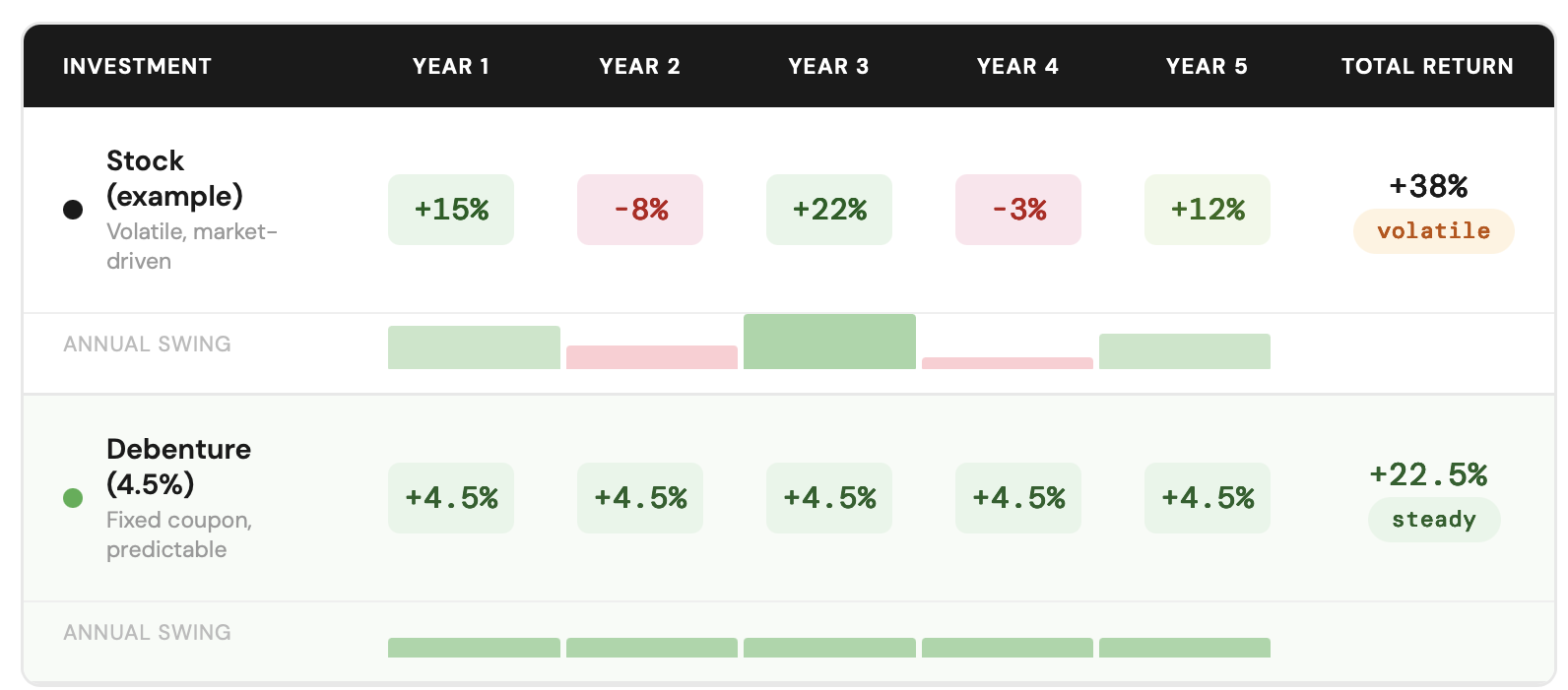
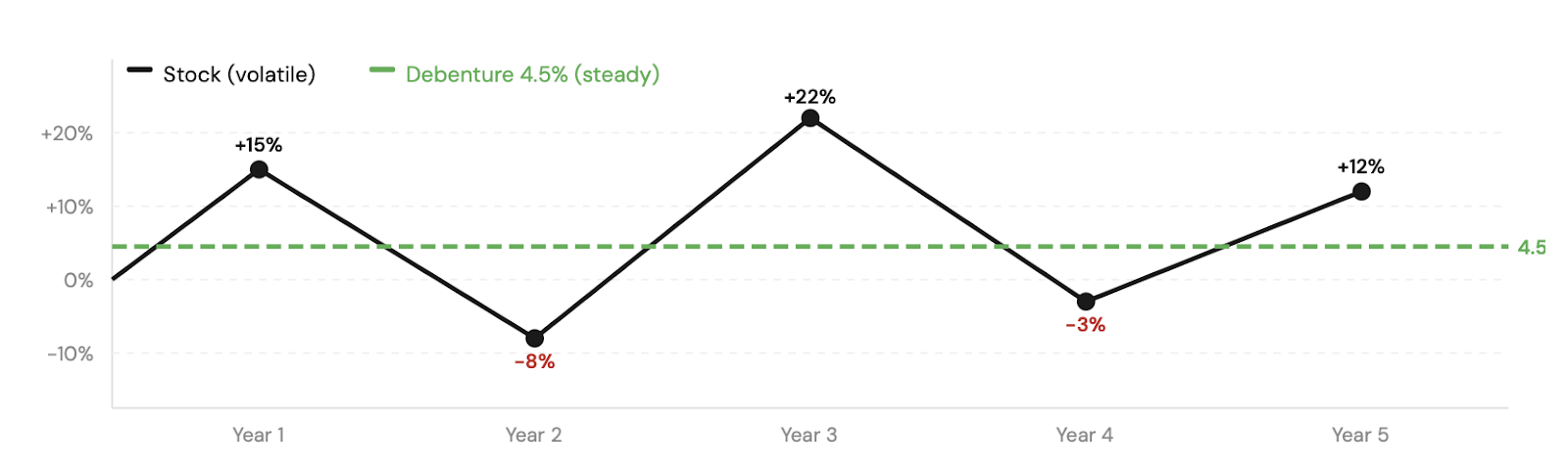
This illustration demonstrates the superior return of the stock market in this case; however, it can also demonstrate severe annual volatility in your investment. You are losing money in years 2 and 4 of your investment in the stock market, whereas debentures pay you a consistent amount every time, in this instance on a 6-monthly basis.
Professional Example: A 5-year $50,000 corporate debenture with a 4.2% annual coupon rate from a telecom company that is rated A+. Every six months, you will receive $1,050 of interest income. After 5 years your total interest income will equal $10,500 and you will also receive back your original $50,000 investment when the debenture matures, regardless of what has happened to the telecom company's stock price over the 5 years, even if it fell by 50%, as the interest payment will not change if the telecom company does not default on the debenture.
Beginner Example: Your cousin has agreed to lend you $100 with a promise of returning $10 in candy every month until the end of the year. When you invest in stocks, the number of candies you receive is determined by how your cousin is feeling or how the weather is at any given time; either way, it could be as many as 20 or as few as 3 each month, depending on these factors. In comparison, investing in debentures would return you a guaranteed number of candies each month: 10 every month, with no variability in the amount received.
Interest Payment Schedule
Except for some debentures that pay quarterly or annually, most debentures will disburse interest payments on a semi-annual basis. This creates an opportunity for natural income planning. It is possible to create a monthly cash flow from bonds that only make payments twice each year by holding a number of debentures that have staggered payment schedules.
The payment schedules and amounts for each debenture are displayed in advance through the TradeWill system. You can construct a bond yield curve by varying maturity dates across several years, thus assuring that you will receive your principal value back for reinvestment or distribution in regular intervals every month.
Debenture Investment Strategies and Risk Management: Maximise Returns While Minimising Risk
Combining risk management and strategic planning is key when picking up debentures. Even top-rated debentures have a default risk. And, if you sell your debenture before maturity, fluctuations in interest rates can impact the amount you’ll get back (i.e., your principal).
Core Investment Strategies
1. Diversification Across Issuers
Investing in a single company or sector can be risky; therefore, spread your investments across multiple sectors (technology, health care, and utility) and credit ratings. Five $10,000 debentures from 5 different issuers would provide a better return than a $50,000 bond from 1 issuer, even if the $50,000 bond had a slightly higher yield.
2. Hold-to-Maturity vs Trading
-
Hold-to-Maturity: Purchase at issuance and receive coupon payments until you get your original investment back. The risk of price changes due to interest rate changes is eliminated because you will not sell the bonds.
-
Trading: You may buy and sell based on fluctuations of interest rates or changes in the credit quality of the issuer. It's more active and could be more profitable if you time your trades correctly.
3. Laddering Maturities
Investing in 1, 3, 5, or 10-year debentures allows you to benefit from different interest rate cycles and have access to your capital on an ongoing basis. Furthermore, you can continue rolling your investments into new debentures for the same amount at the prevailing interest rate after each maturity date has occurred.
Convertible Debentures: The Hybrid Opportunity
Convertible debentures provide both a fixed interest rate and the ability to change into company stock at an agreed-upon price. This type of investment has a very interesting blend of risk and reward associated with it.
Downside risk protection: If the stock drops, you still receive interest payments and will receive your original capital back when the debenture expires.
Upward potential for gain: If the stock goes above the conversion price, you can convert the debenture to shares and enjoy capital gains through owning equity.
Example: You purchase a convertible debenture with a face value of $10,000 and an interest rate of 3.5% with a conversion to shares priced at $50/share for five years. At the end of five years, if the shares remain below $50/share, you'll receive interest payments totalling $1,750 and your principal of $10,000. However, if shares are $75/share at expiration, you can convert your debenture into 200 shares and sell them for $15,000 (i.e. $5,000 gain) plus the $1,750 in interest you received during the life of the debt instrument.
Risk Analysis Framework
Credit Risk: The issuer's ability to make payments. Monitor:
-
Credit rating changes
-
Debt-to-equity ratios
-
Interest coverage ratios (EBITDA ÷ interest expense)
-
Industry trends
Interest Rate Risk: If rates rise, existing debenture prices fall (why buy yours at 4% when new issues offer 6%?). Mitigate by:
-
Shorter maturities (less price sensitivity)
-
Hold-to-maturity strategy
-
Floating-rate debentures (interest adjusts with market rates)
Liquidity Risk: Some debentures trade thinly, making quick sales difficult. Look for:
-
Large issuances (more buyers/sellers)
-
Well-known issuers
-
Listings on major exchanges
Risk Management Techniques
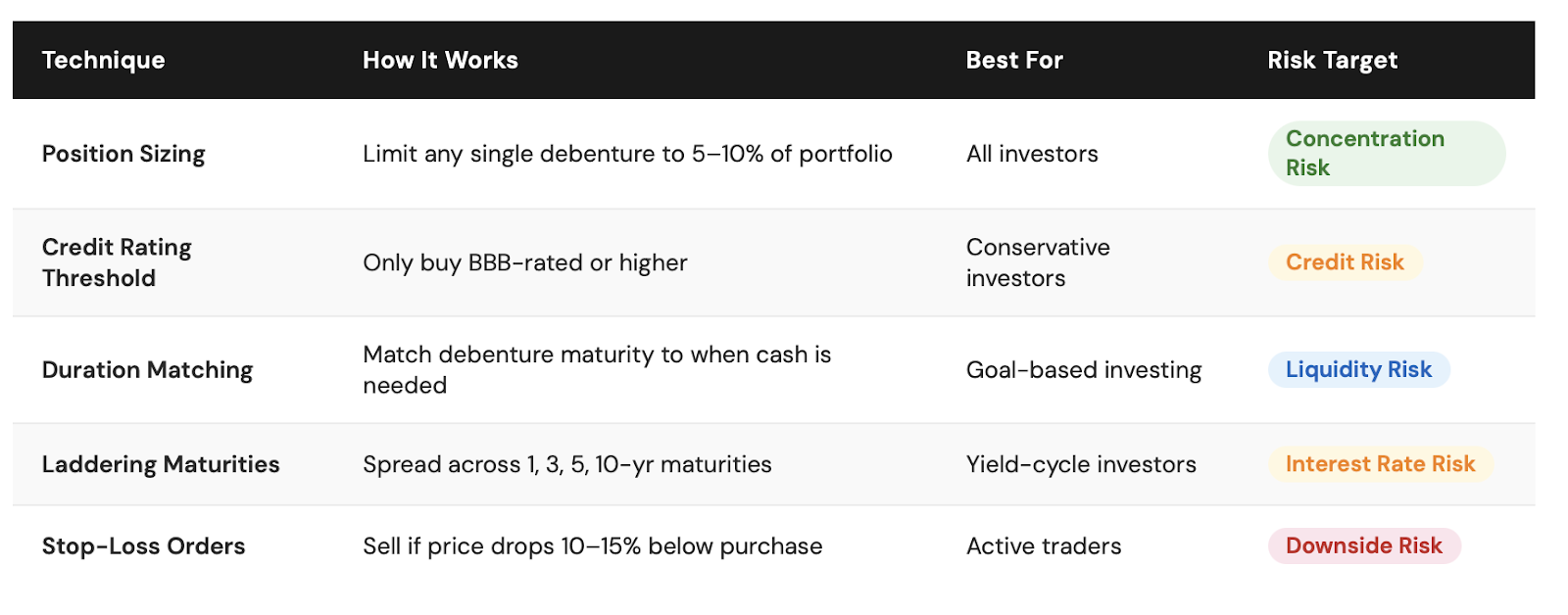
The investor’s portfolio includes investing in AAA-rated technology (4% yield), AA-rated healthcare (4.5% yield), A-rated manufacturing (5% yield), and BBB-rated telecommunication (5.8% yield) debentures. The maximum amount invested in any single company is $30,000, and all debenture maturities range from 2 to 8 years. This diversification minimises your exposure to any one company's financial issues.
As a beginning investor, you lend your capital to two different types of businesses: technology and service (Friend A has excellent credit, so he gets 4% and Friend B has good credit, so he gets 5,% etc.), and would likely want to separate your available funds equally between each business. Friends A through C will each only receive 33% of the total number of your investment,s and therefore you would have less risk if you had 100% of your investments tied up with your least.
TradeWill's investment selection process includes the ability to search by credit rating, yield rate, maturity date, and sector of the investment. You can create mock investments to test your diversification philosophy. TradeWill also provides you with the ability to monitor bond covenants and changes in credit ratings; therefore, you will be notified when there is a material change in the investment issuer and the corresponding risk profile of the investment issuer.
Advanced Topics: Legal Frameworks and Cross-Market Comparisons
Once you're comfortable with debenture basics, understanding legal structures and how debentures fit within broader portfolios separates novices from sophisticated investors.
Fixed vs Floating Charges: UK Legal Framework
Debentures in the jurisdictions of the UK, Canada, Australia, and certain areas of Asia utilise secured debentures, providing the debenture holders with security over the company's assets, even though such security does not attach at the time of issuance. The secured debenture may provide either fixed or floating charges against the assets of the company and grants the debentureholder protection.
A fixed charge attaches to a specific and identifiable asset and provides the debenture holder with the ability to prevent the company from selling that asset without the debenture holder's consent. The fixed charge provides the debentureholder with security that is similar to that of a bond.
A floating charge provides security against a class of assets that may be owned by the company, and the assets represented by the floating charge are subject to change as the business operates in the ordinary course of business, until a triggering event occurs such as default or insolvency, at which point the floating charge will convert to a fixed charge and attach to the assets that exist at that time.
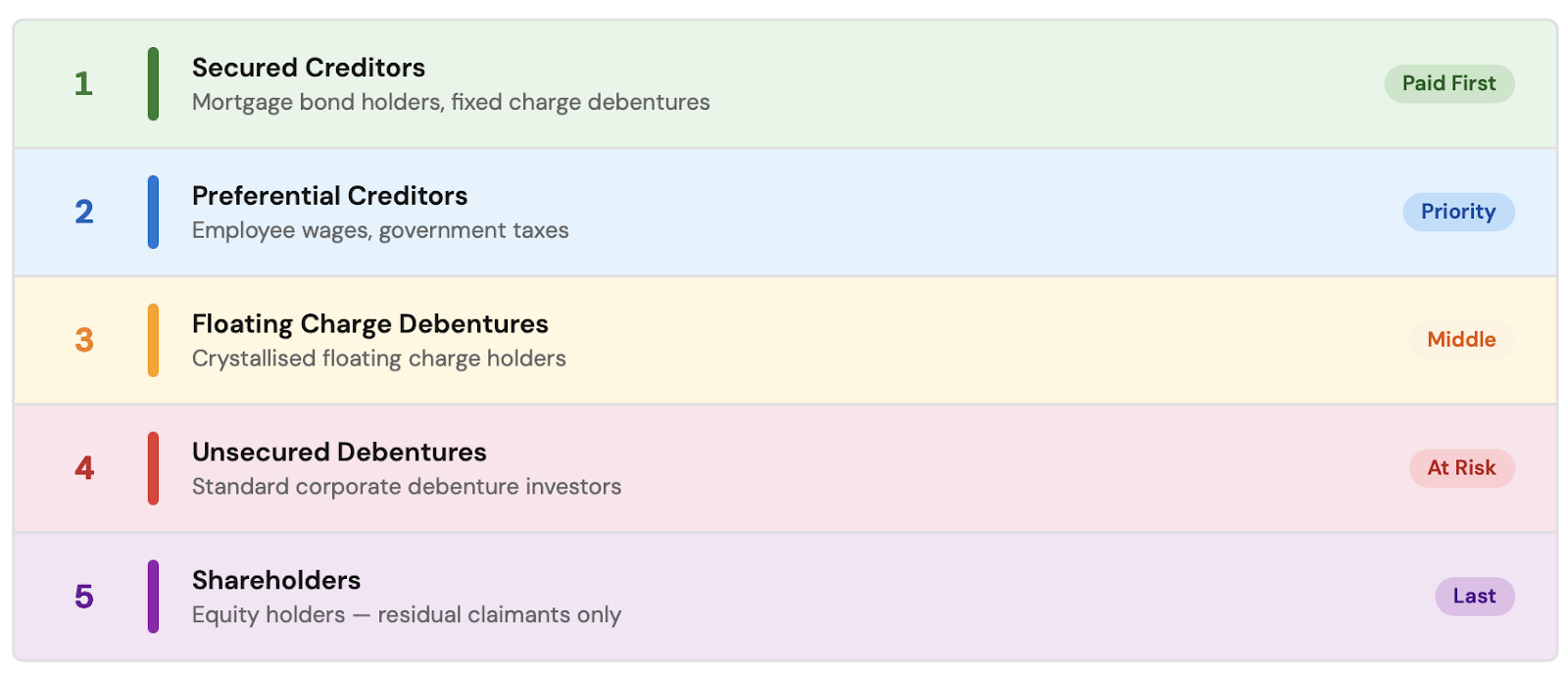
Priority Structure in Liquidation
When a company fails, creditors get paid in this order:
-
Secured creditors (mortgage bonds, fixed charge debentures)
-
Preferential creditors (employee wages, taxes)
-
Floating charge debentures (crystallised)
-
Unsecured debentures
-
Shareholders
This hierarchy explains yield differences. A floating charge debenture might offer 4.5% versus 5.5% for a pure unsecured debenture from the same issuer.
Debenture vs CFD Investment Characteristics
Comparing debentures to Contract for Differences (CFDs) highlights different risk-return profiles:
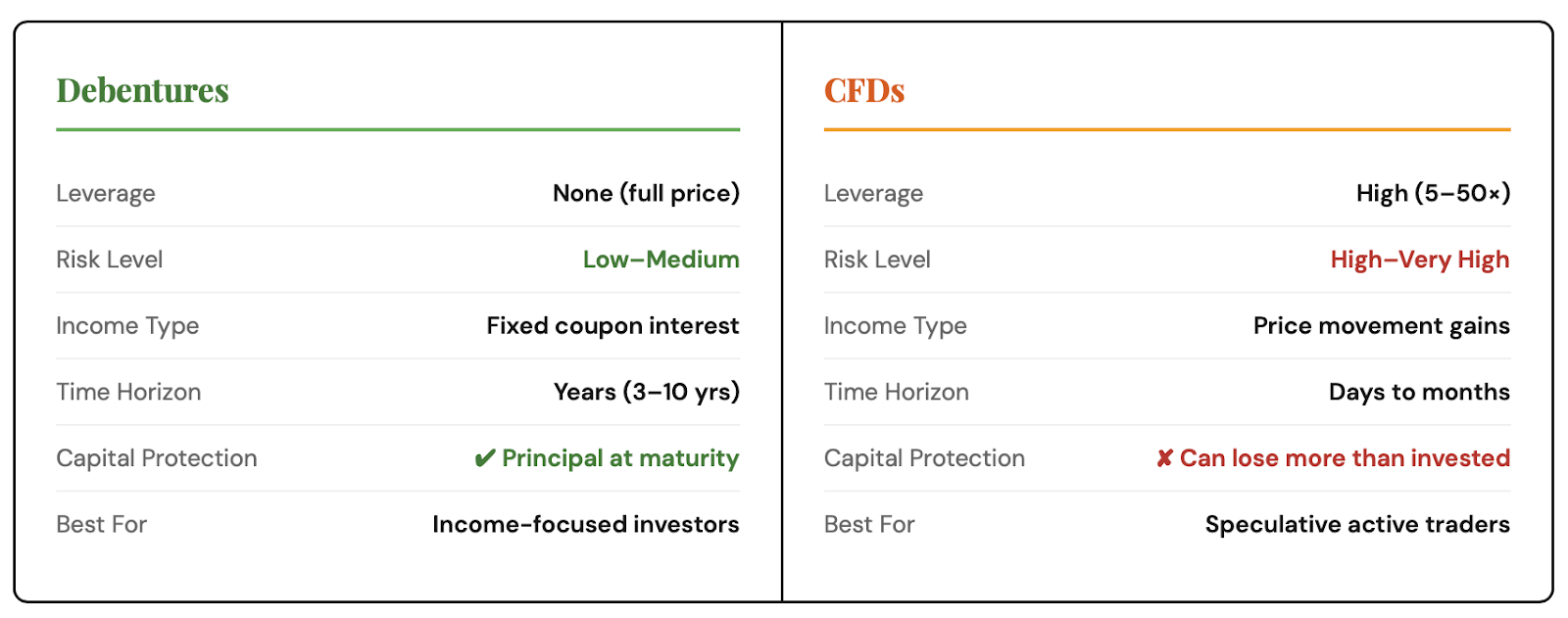
CFDs offer amplified returns through leverage but can wipe out accounts with adverse moves. Debentures provide steady income with principal protection, assuming no default.
Professional Example: An investor allocates $100,000 across both instruments:
-
$70,000 in A-rated debentures (4.8% yield) = $3,360 annual income, low volatility
-
$30,000 in S&P 500 CFDs (10x leverage controlling $300,000 exposure) = high potential gains/losses
This method produces revenue from debentures while simultaneously taking calculated risk positions in equity using CFDs. If the CFDs can generate a 15% return from a $300,000 position, that would produce a $45,000 profit with only $30,000 of the investor's funds at risk; conversely, a 15% loss would produce a complete loss of the investor's funds of $45,000 and therefore a complete loss of the entire CFD position.
The debenture component provides the investor with stability and income regardless of whether or not their CFDs produce a positive return.
Example for beginners: You lend a friend $100 and have an agreement for him to pay you $5 in interest each year (this is the debenture model). Simultaneously, you place a $20 bet on the outcome of a game and have a 5x multiple.
You will receive a consistent $5 per year on your loan to your friend, regardless of the outcome of your bet; if your bet pays off, you will have a $100 or greater return; if your bet is unsuccessful, you will lose your entire $20 bet. By combining the two investments, you will have consistent income and an opportunity for substantial speculative gains.
Cross-Market Strategy Integration
The sophisticated investor uses debentures as the ballast for their diversified portfolio of equity or derivatives. Generally speaking, a common way to allocate in this type of situation would be as follows:
-
Core holdings: 60% in investment-grade debentures (with 4-5% yield)
-
Satellite holdings: 30% in equities (growth potential)
-
Opportunistic: 10% in high-yield debentures or CFDs (for enhanced return)
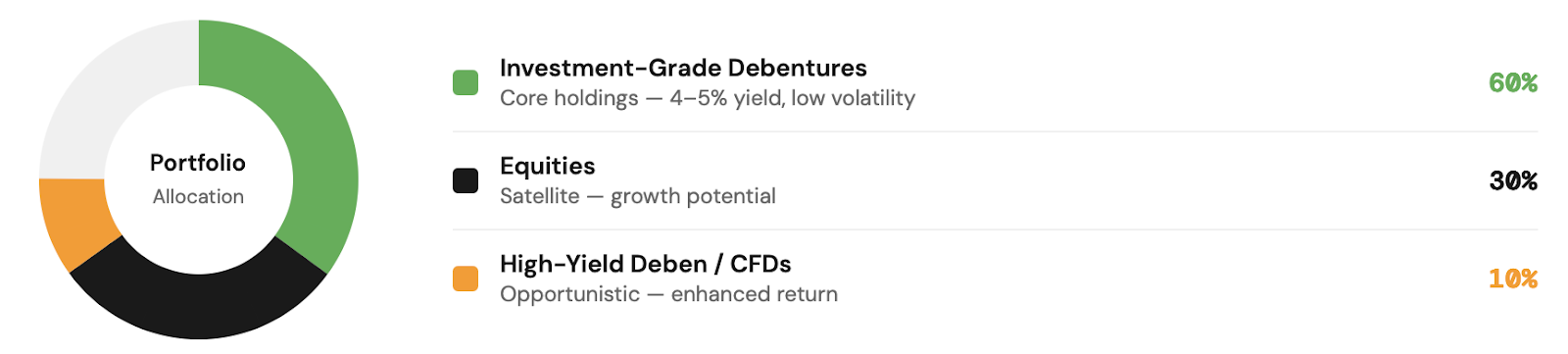
TradeWill’s platform provides an integrated solution that includes both bond and CFD markets and allows you to track correlations, as well as manage your cross-market strategies and trades from a single interface. For example, you can use CFDs to hedge the interest rate risk of a debenture portfolio by taking a CFD position that benefits if interest rates increase or offset equity market risk by investing in debentures that provide you with consistent income.
Tax Implications and Practical Tips: Boost Net Returns with Smart Planning
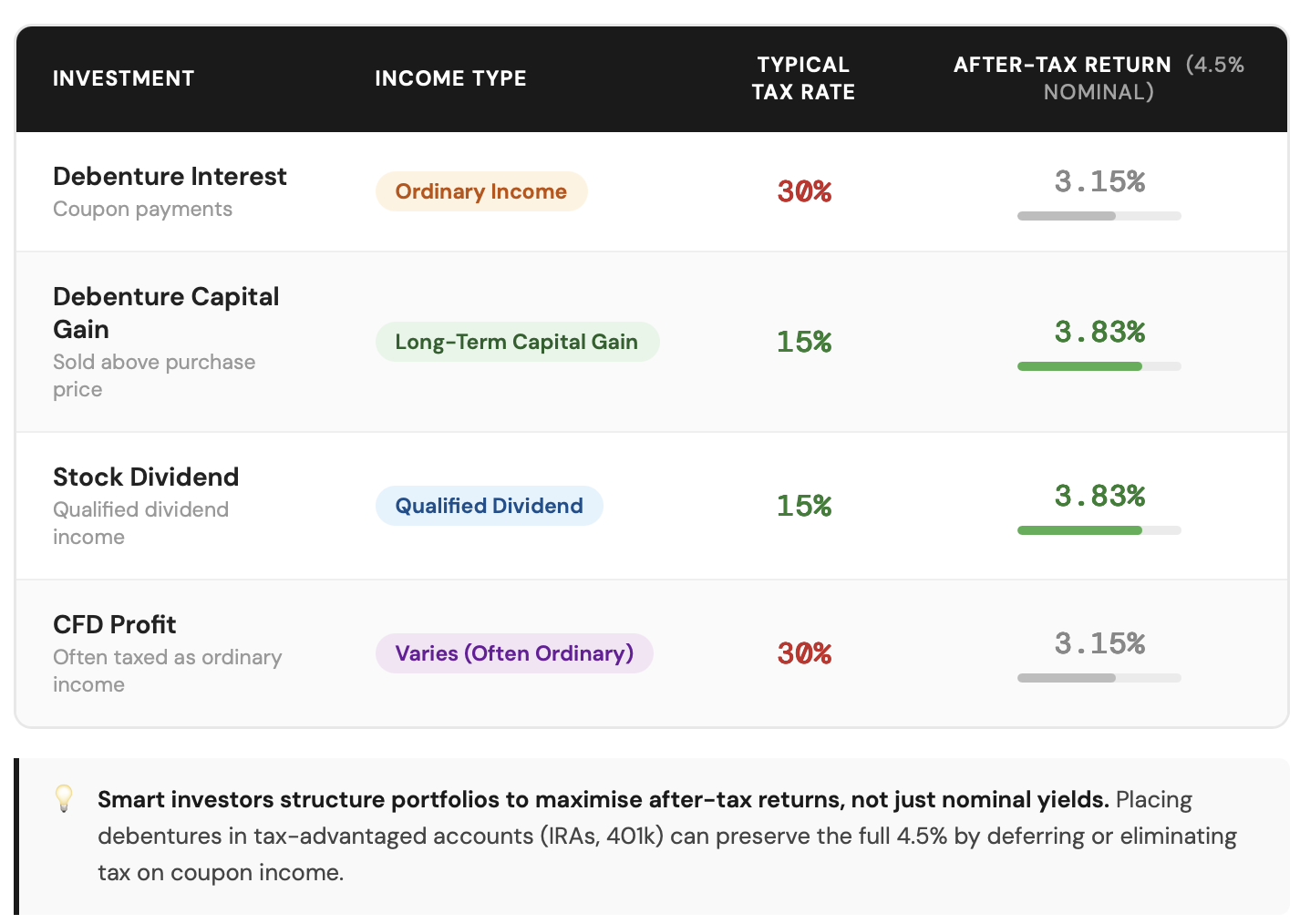
Investment returns can be severely impacted by taxes unless you implement strategic tax planning throughout your entire investing life cycle. Interest from debentures and capital gains from debentures have different tax treatments, which could provide more opportunities for tax planning.
Interest Income vs Capital Gains
Interest income from coupon payments is generally taxed as ordinary income at rates that can be as high as 20% to 40%, depending upon where the investor lives.
Capital gains from selling any debenture for more than what you originally paid for it are subject to a much lower tax rate, typically between 0% and 20%.
If you fall into a high tax bracket, the difference in taxable treatment between interest and capital gain income is critical. You can put your debentures into tax-advantaged accounts such as IRAs, 401k plans or other types of retirement accounts to preserve the tax benefits of investing in debentures.
Tax Comparison Table
Smart investors structure portfolios to maximise after-tax returns, not just nominal yields.
Position Sizing and Diversification
Guidelines for Position Sizing:
-
Keep individual debenture allocations at most 10% of your total investment
-
Keep your total debenture portfolio allocation between 30%-40% (unless you're super conservative)
-
Regardless of what you have in debentures, keep at least 3-6 months' worth of expenses in cash that can be quickly and easily accessed
Diversifying the Portfolio Checklist:
-
5 or more issuers across various industries (for example: the carbon market, sports, floats, et.c)
-
3 or more sectors
-
Different maturity dates (laddered)
-
A combination of credit ratings (mostly investment grade)
Workflow with TradeWill:
-
Screen debentures for yield, rating and term
-
Perform fundamental analysis on the issuer (review financial report cards and credit reports)
-
Benchmark alternatives to those chosen, i.e., to other debentures, bonds, dividend stocks
-
Purchase selected securities at competitive prices
-
Monitor the portfolio with automated alerts for any rating changes
-
Collect income on those securities and reinvest the income or withdraw
TradeWill helps streamline all of these processes by using integrated research tools, one-click purchasing, and consolidated tax reporting. Annual interest statement templates formatted for tax preparation are available for download, saving hours of research time during tax season.
Why Debentures Deserve a Spot in Your 2026 Portfolio
In today's economic climate, debentures provide a unique combination of: higher-than-average return rates for generally considered safe investments; lower relative volatility than stocks; and less uncertainty when it comes to knowing what kind of cash flows to expect over time.
They do have drawbacks, such as credit risk, which exists, and instances where issuers will default. However, if investors conduct adequate due diligence on the underlying credit quality of debentures, they have an opportunity to earn attractive risk-adjusted returns.
The economic situation that will be present in 2026 will provide an excellent opportunity for investors to purchase debentures. There will be low benchmark interest rates, elevated inflation levels, and high levels of stock market volatility.
For instance, a well-diversified portfolio consisting solely of higher-rated corporate investment grade classic debentures, which typically yield approximately 4% to 5%, will provide investors with a high level of real return and also preserve investment capital considerably better than stocks during times when stock prices decline dramatically.
Summary of Major Points:
-
Debentures are unsecured debt and are based on the credit quality of the issuer, not secured by collateral (as is commonly the case with other types of debt).
-
Debentures typically yield 2%-4% more than government securities or savings accounts.
-
Credit ratings are your best tool for evaluating credit risk.
-
Effective diversification and limiting your risk by creating a hold-to-maturity strategy.
-
The legal structures used to issue the debentures can provide additional security to debentureholders (fixed and floating charge).
-
Tax planning and investment positioning should help increase after-tax returns on investment.
Investors That Should Consider Debentures Include:
-
Retired investors who require income without taking excessive risk.
-
Individuals seeking a higher return alternative than a certificate of deposit (CD).
-
Investors who are looking to balance an overall aggressive equity portfolio.
-
Individuals who prefer investing for 3 years or longer and are comfortable with credit analysis.
The lack of collateral underlying debentures does not represent a negative characteristic; it is this lack of collateral that enables the greater yield on debentures than that yielded by other types of debt. By focusing on high-quality issuers and spreading the risk across a large number of individual debentures, there are increased opportunities to transform these "weaknesses" into percentage points that are constructive for the debentureholder.
Ready to explore debenture opportunities and build fixed-income strategies that actually compete with equity returns? TradeWill's platform gives you the screening tools, real-time credit data, and execution capabilities to turn debenture theory into portfolio reality.
Disclaimer: The content of the blog does not represent any position of Trade W, does not serve as any trading-related decision advice, and does not endorse any third-party.