

 Trade W

Every couple of weeks, there seems to be a headline from a technology company that acquires a start-up, two proposed mergers of unions, for example, another headline would indicate that one or more airlines plan on merging with the assistance of a merger or acquisition, etc.
The market reacts to a merging firm’s announcement and acquisition of another company in some fashion; stock prices typically increase on acquired firms, represented by increased demand for these companies due to the continued increases in value of these companies. There is much debate among members of various analysts who review the news surrounding the merger or acquisition, but the average retail trader tends not to understand what just happened or how it could potentially affect their portfolios.
This presents investors with their biggest opportunity if they consider M & A transactions to evaluate their next short-term price volatility and long-term value, as they will be ahead of approximately 90% of the average retail traders.
In this article, you will learn what M & A transactions are, the strategic reasons and logic used by companies when engaged in such transactions and how investment banks structure these transactions as well as; how the financial marketplace reacts to the announcement of merging companies and how retail traders may position themselves around high-profile M & A transactions in the macro-trends of the 2026 global economy.
What is M&A?
Corporate transactions, such as mergers and acquisitions, combine companies through a merger or acquisition. Mergers and acquisitions can create new growth opportunities, market expansion, operational cost savings, access to new technologies, or competitive defences. The legal structure of the transaction affects which company will continue to exist, how the companies will be combined, and how stock will be exchanged; these three areas will affect the financial impact of the merger or acquisition on both companies' stock and balance sheets.
The Real Difference Between a Merger and an Acquisition
There is an important difference between them that affects how companies are valued, which management teams remain with the new company, and other things.
A merger occurs when two companies of roughly the same size decide to share their resources and create a new entity. Each company that merges contributes towards the creation of the new entity and shares in the stock ownership of that entity. Each company typically retains its own brand name, but both companies jointly do business.
An acquisition occurs when one company buys another. The purchase typically takes place by way of cash, exchanging one company's stock with stock in the acquiring company, or a combination of both. After the acquisition occurs, the target company will no longer be an independent company; rather, the acquiring company will absorb the target company, including all of its assets, liabilities, and employees.
After the acquisition, all of the target company's shareholders will either receive cash or shares of the acquiring company's stock. The control of the company will completely shift to the acquiring company.
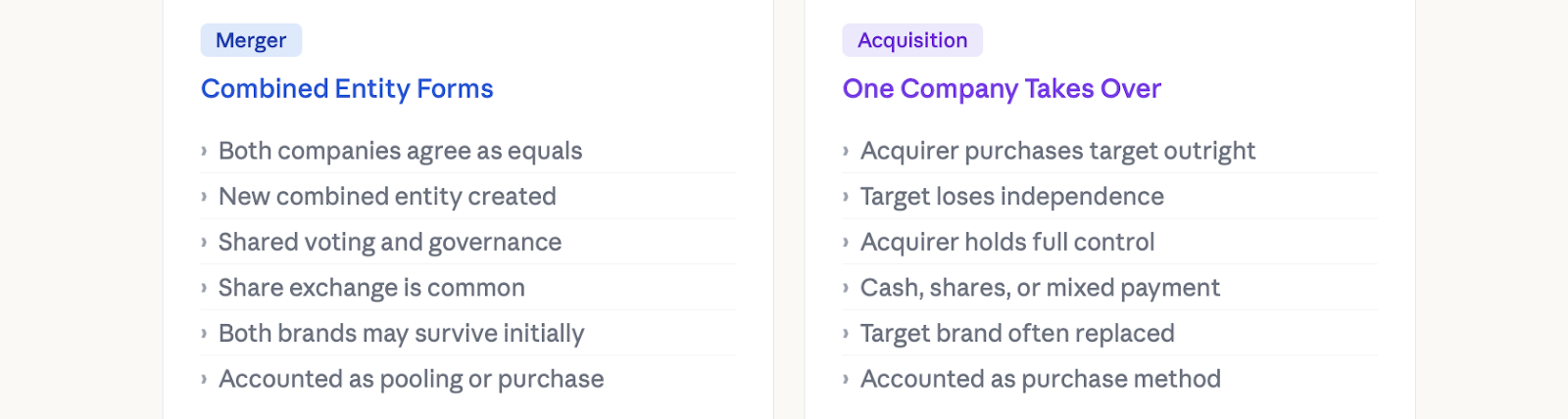
In the real world of transactions, however, many of the mergers that actually happen are really acquisitions with a diplomatic label placed on them. For example, when Disney merged with Pixar back in 2006, it was really an acquisition where Disney paid them in cash and stock; therefore, all of Pixar's owners exited at a premium. Therefore, it was a diplomatic way to represent how the power struggle between the two companies was portrayed to employees from an employee standpoint.
Why Do Companies Pursue M&A? The Strategic Motivations
M&A deals are based upon the idea that when two companies come together, they will make more money together than they would if they stayed separate and that the CEOs who help to put them together are trying to make something happen. The six most common reasons for conducting an M&A transaction are outlined below.
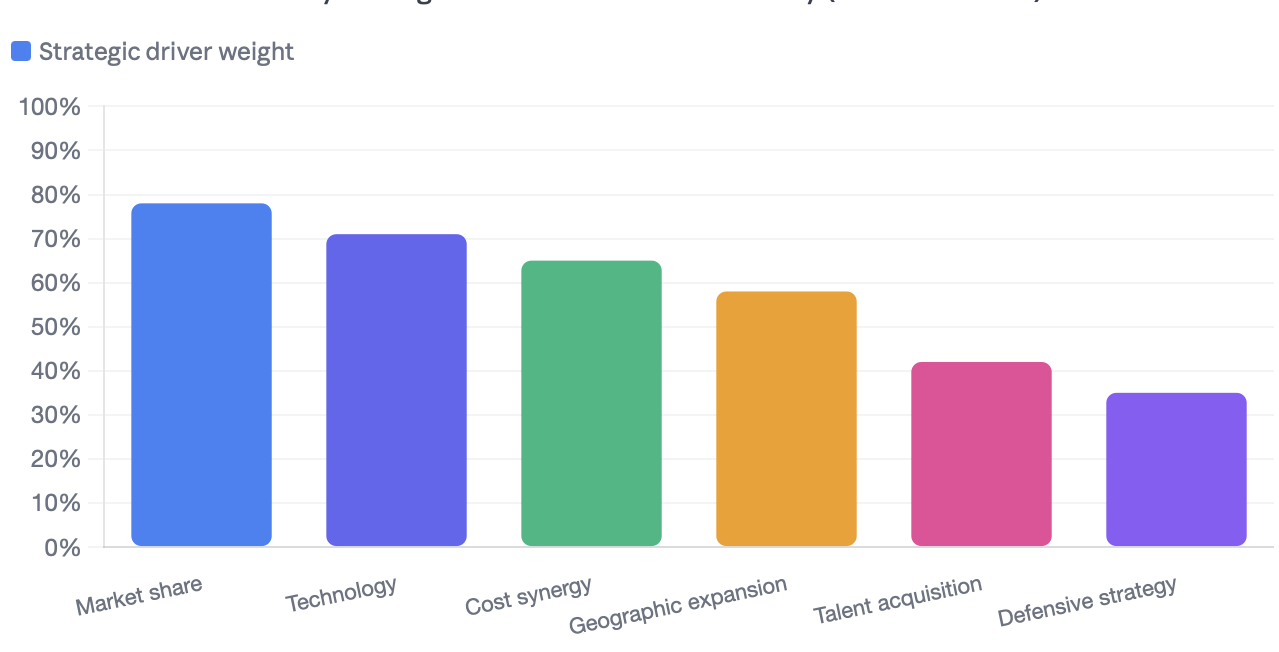
Expanding market share is the most clear reason to acquire another company. A company can grow its market share much faster by acquiring a competitor rather than by competing against them through organic means; furthermore, an acquisition limits the risk of pricing pressures from competitors.
Over the last ten years, acquisitions of technology have become the leading motivation for acquisitions. Instead of building AI, cloud or biotech technologies from the ground up, major businesses have acquired the start-up companies that have already developed these technologies. This is exactly the case for the upcoming wave of AI acquisitions in 2026.
Reducing costs through economies of scale, such as the elimination of duplicate headquarters, shared distribution networks, and combined purchasing power, is known by analysts as "synergies." A realistic synergy number supports the premium that someone pays for an acquisition, and an unrealistic one can cause a deal to fail. Geographic expansion allows a business to instantly enter a new marketplace with an established presence, an established customer base, and an employee workforce. Cross-border transactions can be very complicated for regulatory reasons, but they can condense years of organic growth into a single transaction.
Defensive acquisitions happen when a business is concerned that a competitor may acquire a key supplier, a critical distribution channel or a key technology. In order to minimise their risk, the business prefers to buy the key supplier first.
Investor Warning: Why Acquirer Stocks Often Fall While Target Stocks Surge
When a company is acquired, the stock price of the target usually rises significantly overnight, between 20% and 50%. Conversely, the price of the acquirer typically falls in the same percentage range, between 3% and 10%, on the same day. Understanding the reason for these price changes is a very important thing for every trader to understand when they are trading stocks.
The price of a target jumps up after the acquirer has to pay an acquisition premium, which is the difference between the current stock price and the acquisition price. The acquisition premium compensates the current "shareholders" of the target for giving up their stake in the target company; hence, without it, the current "shareholders" will not approve of the transaction. Acquisition premiums generally range from 20% to 50% over the pre-announcement price.
There are a few reasons as to why the Acquirer tends to drop in price after the announcement. First, the premium could be in question as to whether or not it is warranted by the market. Second, should the Acquirer raise money through the issuance of new shares to finance the acquisition, it maximises the "shareholder dilution effect” on existing shareholders by reducing their ownership interest percentage.
Third, it is expensive and risky to integrate two respective companies into one new company, with studies indicating that approximately 70% of all acquisitions do not create the value promised to their shareholders by management when the respective company was acquired. Therefore, the markets have already priced in this scepticism on day 1 of the announcement of the acquisition.
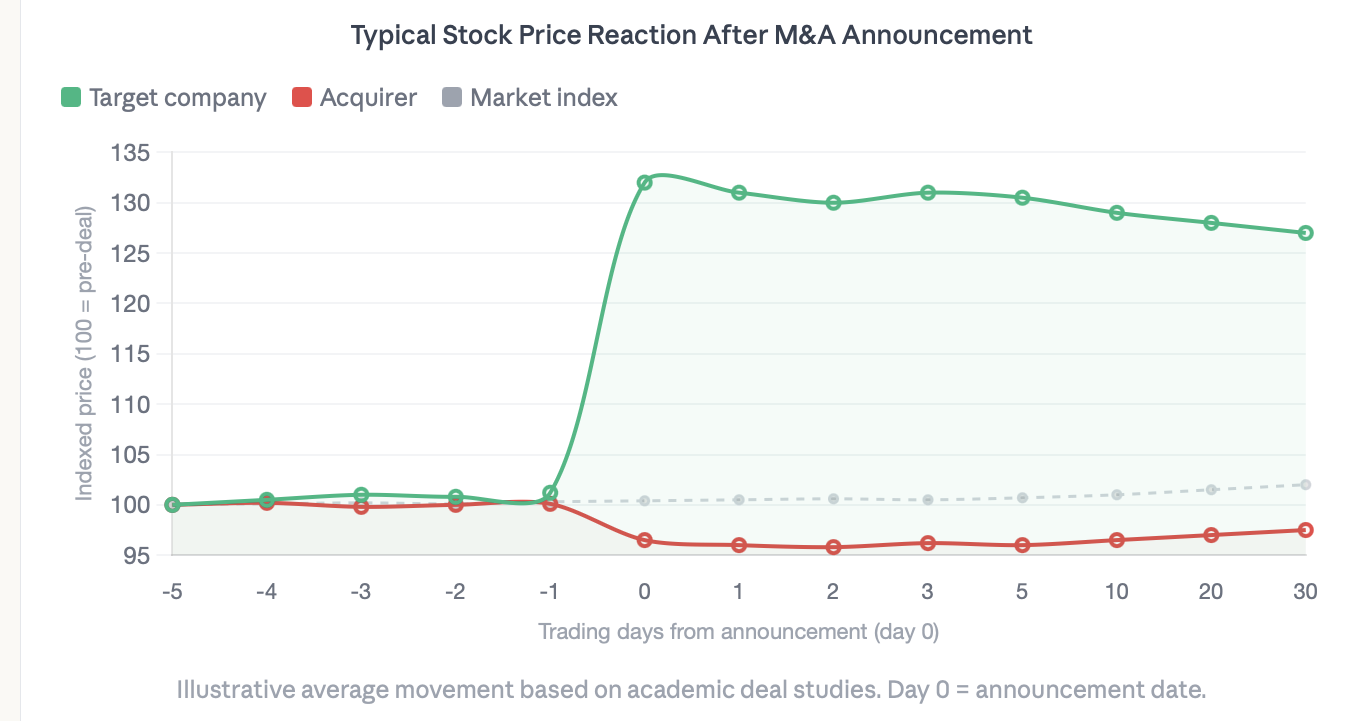
This asymmetry is predictable and tradeable. That's exactly what merger arbitrage strategies exploit.
M&A Advisory: How Investment Banks Structure Billion-Dollar Deals
Acquisition financing is usually done with a small group of investment banks that earn fees, usually between 0.5% and 1% of the total value of the acquisition, based on their ability to manage an acquisition process that most companies only complete once or twice in their entire lives.
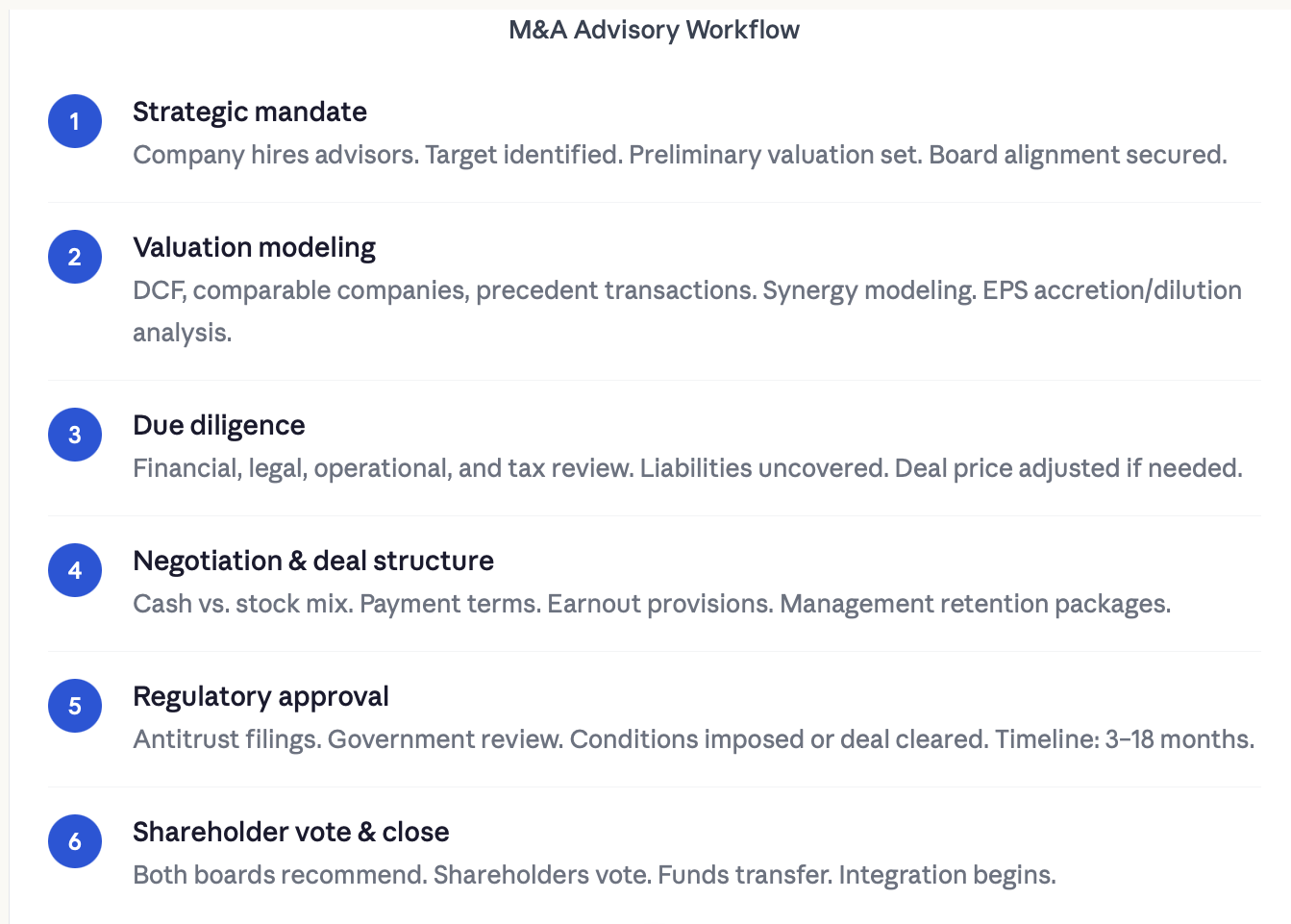
Advisors receive a success fee that is paid only when the deal successfully closes. Therefore, this fee incentive model has aligned the advisor's success to the completion of the deal itself and not to the quality of the deal, which may partially explain why some deals get pushed through even though they do not meet the minimum economic return. Because sophisticated buyers are aware of this fact, they independently test their advisor's assumptions to make sure they hold.
Trading M&A News: How to Capture the Volatility
For active trading, M&A announcements are one of the best examples of a volatility event. The market reacts predictively; there are well-defined timelines on how long it will take to complete an acquisition, and there is a pattern to how the price of a stock will behave before and after an acquisition announcement.
When a merger agreement is announced at a specific price (say, $50), the share price of the target company will increase to that amount (say, $47), but it will not move to that price due to the uncertainty surrounding whether or not the acquisition will close. The difference in prices ($3) is referred to as an "arb spread."
This "arb spread" creates an opportunity for a merger arbitrageur to purchase the shares of the target company for $47 and receive the special $3 profit when the acquisition is completed.
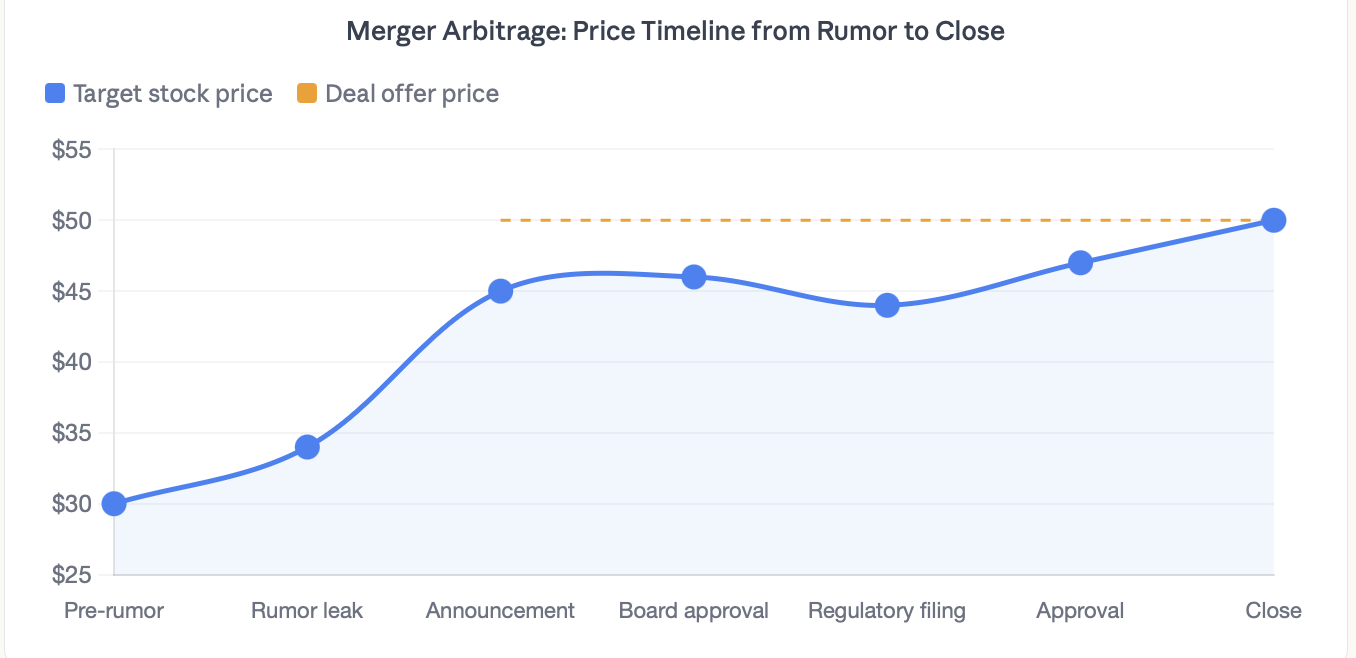
The potential for a deal to fail is the most significant thing about merger arbitrage. Regardless of whether the acquirer walks away or if regulators block the merger, the price of the target's stock will plummet back to its pre-announcement price, with an overnight drop of 25 to 40% so, careful watch for government risk, strategic logical fit and the deal’s terms are essential parts of the merger arbitrage process.
Retail traders can simplify the process by buying shares of the targeted company immediately after they see a premium spike due to the announcement. They should then sell those shares the moment they detect regulatory uncertainty; this is done as a measure of dilution fears when shorting a potential acquirer company based on their likely dilution due to a significant portion of the deal possibly requiring share issuances, combined with high multiples on valuation, in deals in which those rationales exist.
Volume is the key indicator that large player institutions are taking positions in a calm target stock. If there is increased volume in a stock in the absence of news, then a public event or announcement will likely follow soon thereafter. Tracking those volume patterns in conjunction with technical indicators, such as the TD, can help sophisticated traders confirm momentum for sophisticated traders to have already established their positions.
2026 Trend: AI-Driven Mega Acquisitions and Blue Chip Expansion
There are two competing forces driving M&A activity in 2026: First, large companies are aggressively trying to acquire talent with AI; Second, as interest rates rise, the cost of borrowed funds is increasing significantly, which makes it prohibitively expensive and risky for buyers to use debt as a means of financing their acquisitions.
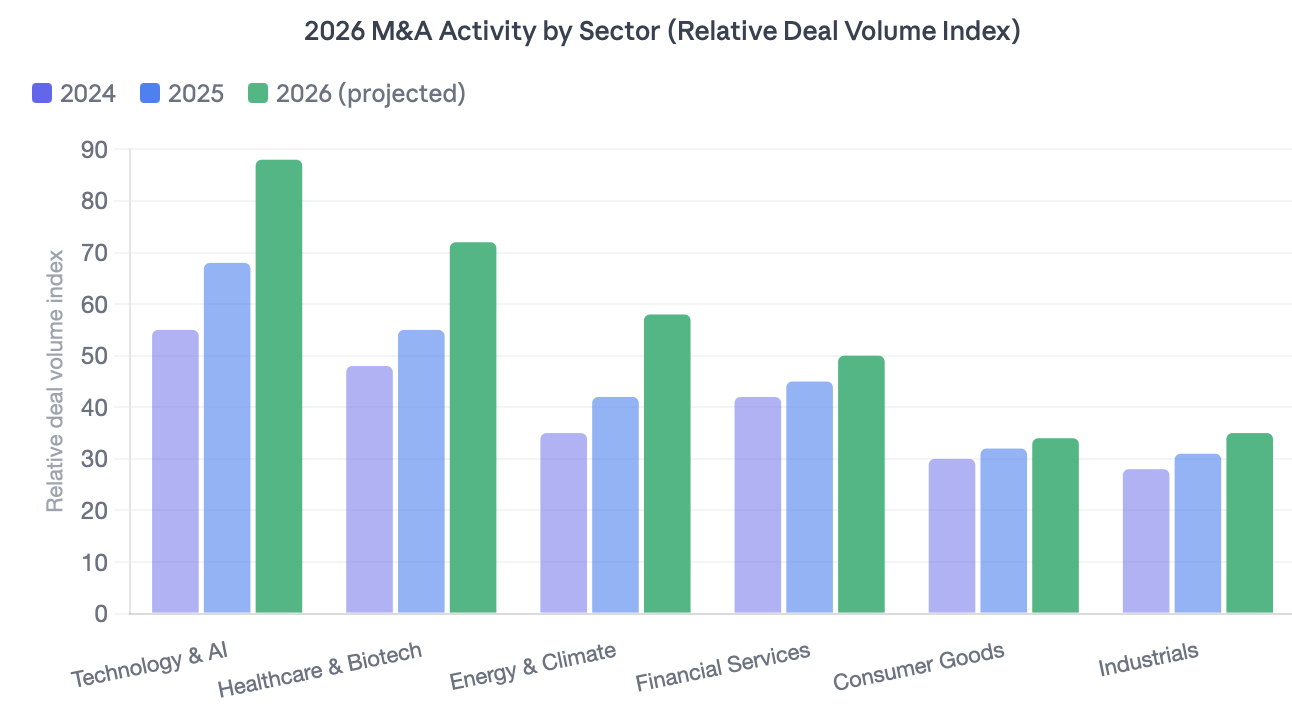
The dominance of technology and AI is being witnessed through the actions of large, financially sound blue-chip companies, such as top-tier technology and pharmaceutical companies that possess large amounts of cash on their balance sheets and are making strategic investments in AI infrastructure, drug delivery platforms, and climate tech, through acquisitions. Companies that have high solvency ratios and low debt are viewed as having the greatest credibility as acquirers in today's mergers and acquisitions environment.
Healthcare M&A activity is at an all-time high due in part to patent expirations that require pharmaceutical companies to engage in biotech mergers and acquisitions in order to create new revenue sources for the future. Major energy companies continue to acquire clean energy-related assets. Financial services M&A remains active as financial technology integration and regulatory pressures continue to force smaller banks to merge with larger banks.
Regulatory scrutiny is a risk in this process. The antitrust enforcement environment for mergers and acquisitions has not been this restrictive since the early 2000’s, especially when it comes to large technology merger transactions. Deal transactions that could have been approved by transaction regulators in 2018 are now subject to three or more years of regulatory scrutiny. Smart companies evaluate potential target companies in industry sectors that have lower antitrust risk, as well as potential acquirers who have a clean history with regulators prior to making an acquisition decision.
The Synergy Model and EPS Mechanics
All M&A financial models are based on the same fundamental question of whether or not a business acquisition will increase or decrease the acquirer's earnings per share. If it increases the EPS, the transaction is referred to as an 'accretive transaction'.
If it decreases the EPS, the transaction is termed a 'dilutive transaction'. The distinction between 'accretive' and 'dilutive' transactions is very important to the market.
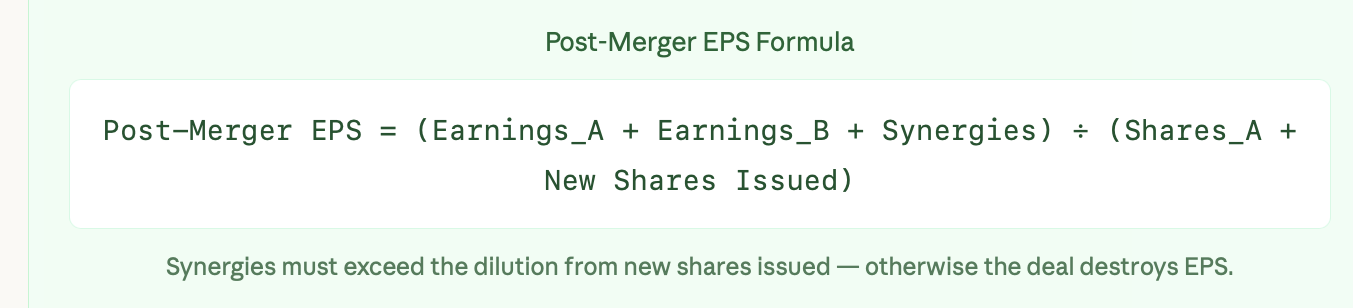
If Company A makes $2 per share and acquires Company B by issuing new shares of stock, then the denominator will be increased. Therefore, if the combined earnings of the two companies plus any synergies do not increase at a faster rate than the number of additional shares that will be issued, then the earnings per share will decline, as will the stock price.
For this reason, cash acquisitions are typically better liked than stock acquisitions; cash does not dilute current shareholders. However, for a cash acquisition to occur, there must be either available cash on hand or debt capital to finance the acquisition.
In this situation, solvency ratio analysis is critical because if an acquirer over-leverages their balance sheet in order to finance the acquisition, there is significant risk associated with the acquirer's ability to meet any obligations arising from the transaction. The Du Pont Analysis of Return on Equity (ROE) is also an excellent tool for assessing whether the ROE model remains valid following an acquisition.
Combining Fundamentals with Technical Analysis
Mergers and acquisitions (M&A) have long-term effects on businesses and their investors by representing a significant event. The proper use of technical indicators can play a huge role in determining when to enter or exit positions related to M&A events.
A spike in volume on an M&A is the first sign that M&A activity is happening. A volume increase of greater than 25% from normal levels, paired with a gradual rise in price as measured by daily changes, could indicate that large institutional buy-side investors have been accumulating shares before an M&A announcement. Due to insider trading laws, spikes in volume will usually be seen weeks or even months ahead of public information related to M&A activity.
The technical levels after the M&A announcement will play a large role for arbitrage traders. For example, if the target company is trading at a 4% discount to the purchase price but is significantly above its 50-day moving average, the stock may lose significant value if the deal fails. By knowing where the technical downside price point exists, an arbitrage trader can more accurately size the position.
As for long-term to mid-term positions in the buyer's stock after the news, trading patterns in the first week of the announcement are critical to follow. If the stock settles and volume decreases, this may indicate that investors have accounted for their uncertainty about the deal and may enter a long position in anticipation of a successful integration of the acquisition.
The TradeWill Economic Calendar is a useful tool to track M&A related regulatory and shareholder votes as potential investments. Lastly, for evaluating the target's long-term value, measuring the effect of the transaction on the target's 5-year compound annual growth rate can help with determining portfolio allocations based on fundamentals.
Frequently Asked Questions About M&A
What does M&A stand for?
M&A stands for Mergers and acquisitions, corporate transactions where two companies combine (merger), or one buys another (acquisition).
What's the real difference between a merger and an acquisition?
A merger creates a new combined entity with shared ownership. An acquisition is a purchase; one company takes full control of another, and the target loses its independence. Most "mergers" in practice are acquisitions with softer branding.
What does an M&A advisor actually do?
Investment bank advisors handle valuation modelling, due diligence coordination, negotiation strategy, deal structuring, and regulatory filings. They earn a success fee, typically 0.5–1% of deal value, paid only on close.
Why do companies merge or acquire?
The most common drivers are market share growth, technology acquisition, cost synergies, geographic expansion, and defensive strategy against competitors. In 2026, AI capability acquisition is the dominant theme.
What is an acquisition premium?
The premium is the amount paid above a target company's current stock price to convince shareholders to sell. Premiums typically range from 20% to 50%, and the day a deal is announced, the target's stock jumps toward the offer price.
How can traders profit from M&A news?
The main strategies are buying the target post-announcement to capture remaining premium, shorting the acquirer if dilution risk is high, and screening for unusual volume patterns in potential targets before deals are announced publicly.
Are M&A deals risky?
Very. Regulatory blocks, integration failures, cultural clashes, and overestimated synergies all destroy deal value. Studies show 70% of acquisitions underperform expectations. The risk is even higher in cross-border deals with complex regulatory environments.
Why do some mergers fail?
The most common causes are overpaying for excessive premiums that synergies never justify, poor integration planning, cultural conflict between management teams, and regulatory issues
conditions that gut the deal's strategic rationale by the time approval is granted.
Track M&A-Driven Volatility in Real Time. Use TradeWill.com to catch regulatory decision dates, shareholder votes, and deal closure events before the market fully prices them in.
Disclaimer: The content of the blog does not represent any position of Trade W, does not serve as any trading-related decision advice, and does not endorse any third-party.