

 Trade W
Introduction: What Makes a Company Hard to Beat?
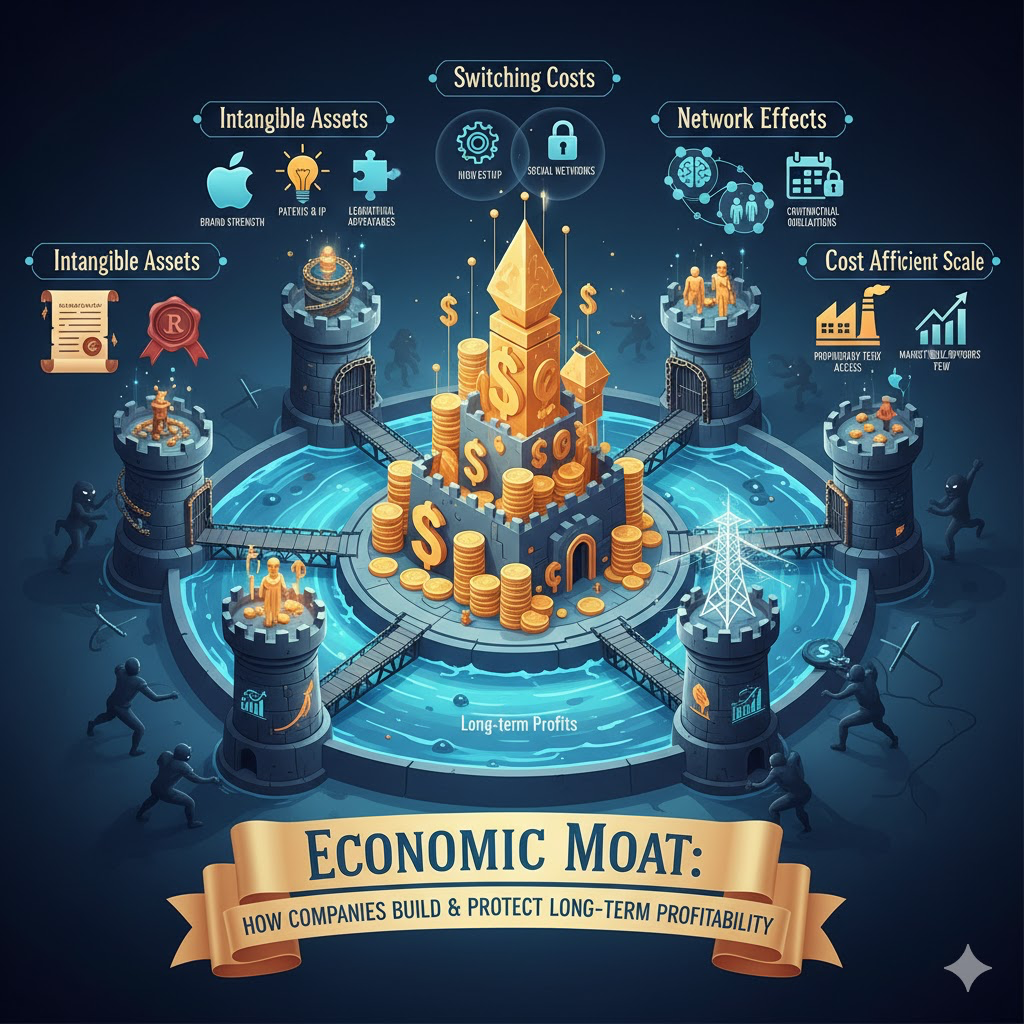
Warren Buffett brought the idea of an "economic moat" into popular use in the 1990s, and it's now a term that anyone who is serious about investing needs to understand. The concept is straightforward: some companies have established competitive advantages that are sufficiently strong that competitors cannot emulate them. These advantages are not simply competitive wins that can disappear in a quarter or two, but structural advantages that are a part of how a business is organised.
Take Apple versus Samsung, for example. Apple sells phones and tablets, just as Samsung does; Apple, however, can charge a premium for its products and generate much stronger customer loyalty. Why is that? Apple has built a moat based on its ecosystem that integrates its devices and its software. If you own one Apple device, using an Android device means losing some of that seamless convenience. This is a clear example of a moat.
A simple example is if your school cafeteria has a contract that allows it to sell Coca-Cola, while every other cafeteria in the area sells nothing but water. That contract gives your cafeteria a structural advantage over every other cafeteria. Students want Coca-Cola; therefore, they will eat lunch in your cafeteria instead of your competitors. Again, this is a moat; it is just a smaller, less consequential one.
This blog will guide you through the concept of the economic moat, how to identify one, why it is important to investors, and how to construct a portfolio that takes advantage of moats. You'll walk away with a sense of why some companies dominate the market for 30 years and some seem to disappear from the conversation.
What Is an Economic Moat?
An economic moat is a structural edge that gives a company the ability to sustain high margins and withstand competition over time. It's not hype. It's not market timing. It's a genuine, measurable edge in thwarting competitors trying to lure customers away from a company.
Without a moat, companies are always under the gun. Competition ramps up. Margins get thinner. Customers find cheaper substitutes. It's a meat grinder of incremental attrition. Companies without a moat often move down the food chain into a commodity market where the only lever they have to compete is to drop price, which simply destroys margin for everyone involved. Think of grocery store brands, where no one cares about the brand because there is no difference.
A company with a competitive advantage? That’s a different situation. They’re able to charge increased prices because customers see higher value. They keep customers even when competitors have similar products. They can handle market swings because they have pricing power and a customer base that is loyal.
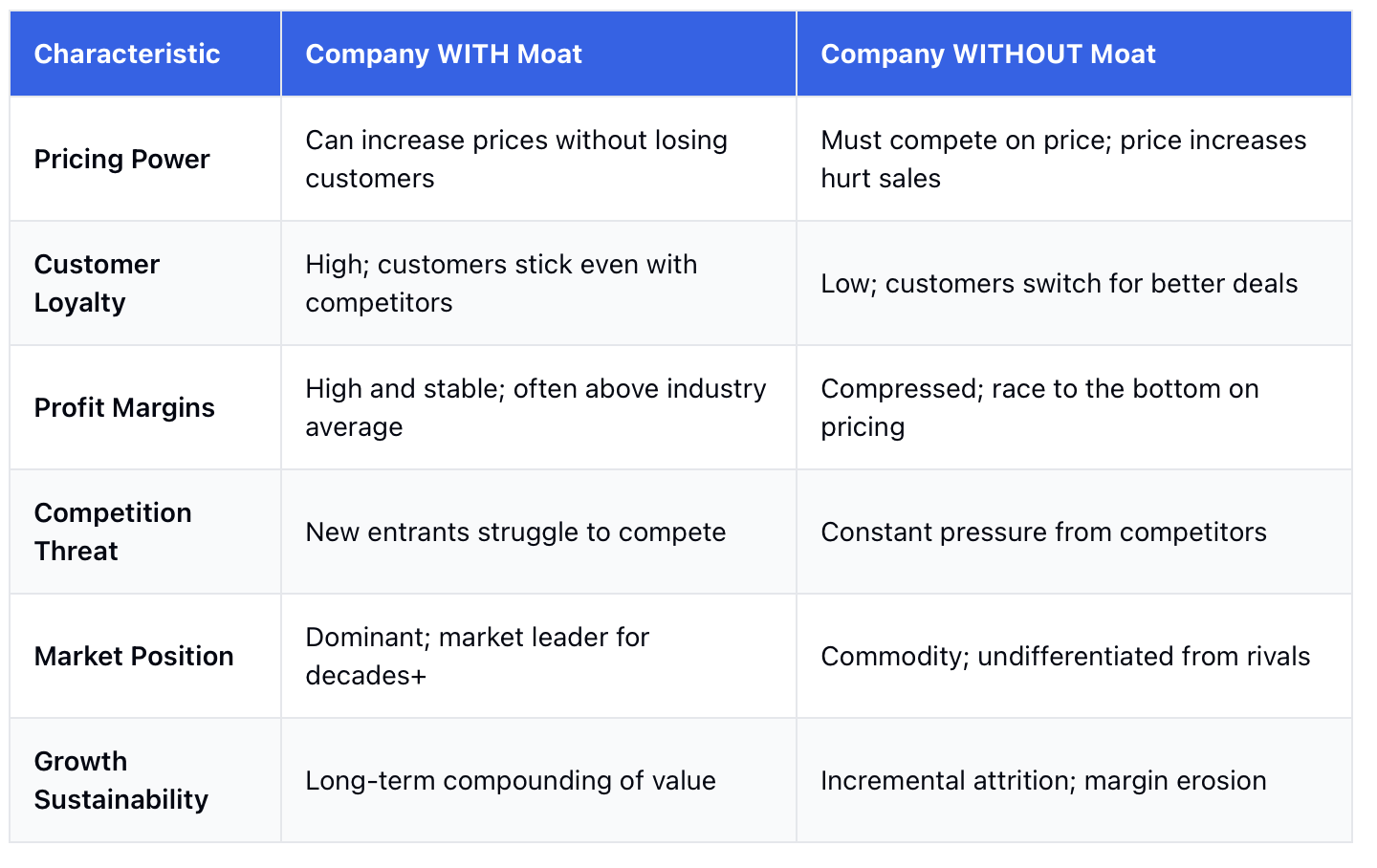
The important difference is sustainability. A competitive advantage is good today, but the idea of a competitive advantage is winning tomorrow, and the day after that. Coca-Cola doesn’t win superior position in the soft drink market because it has the best tasting cola. It has superior position because it spent decades marketing its brand, building its brand, then creating distribution relationships that built a moat so deep that Pepsi has never caught up, even though Pepsi is arguably equally good. That is the difference between a short-term competitive advantage and an economic moat, which is long-term.
To think about it another way, a competitive advantage is what you receive from a good launch. A moat is what you generate over the years that almost makes it impossible for new competitors to launch.
The Main Types of Economic Moats
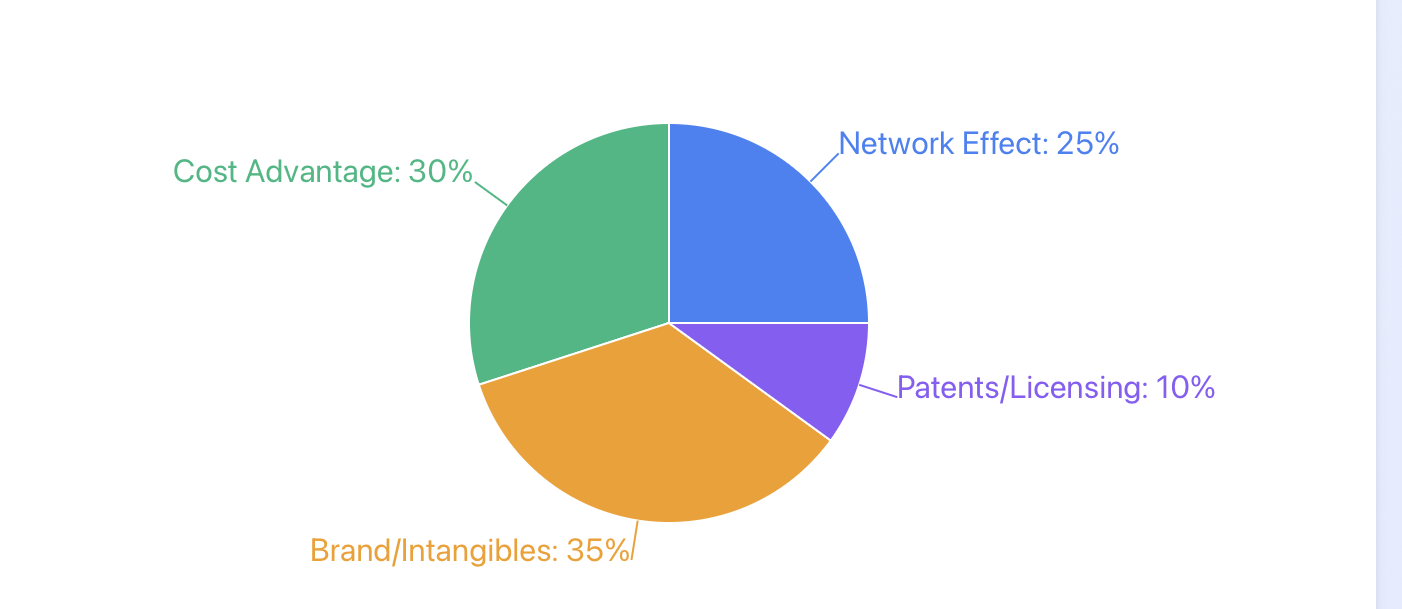
Not every moat is the same, and their functions differ. Understanding the various types will let you recognize which companies have a truly sustainable competitive advantage.
Cost Advantage
Some have a cost advantage - they are just cheaper to run than everyone else. These companies have a production system, supply chain, or scale to which competitors cannot compete.
Walmart is a textbook example. They developed logistics systems and supply chain management that are so efficient that no competitor can bring their costs down the way Walmart can without taking a loss. They purchase products in such huge volumes that they will always create better terms with the supplier.
When you combine that with decades of investment into automated systems and distribution, it just becomes a series of unanimous advantages. A new retailer simply cannot come in and operate at the lower price point that is fundamental to their system unless they have institutional knowledge and the same system.
Think about it like buying in bulk from a wholesale store. The reason why the per unit price comes down is simply that you are buy a greater quantity at a given time. Try to imagine an industry where that advantage was multiplied over decades.
Network Effect
A network effect moat is the opposite - the larger it becomes, the more valuable it becomes to all users, because there are more of them.
The value of Facebook is derived completely from network effects. A social network that no one is on is of no value. A social network that millions of your friends are on is an incredible value. For every new user that joins the social network, the value of that platform increases even more for new potential users, leading to an self-reinforcing loop that is difficult to break apart. Competitors have a big challenge since they are starting with zero users and no reason for any person to come on the platform (their own friends are not there to help justify using it).
Visa works the same way. The more merchants that accept Visa, the more valuable it is to customers, and the more customers that use Visa, the more incentives merchants have to accept Visa. It is certainly the virtuous cycle that makes it nearly impossible for another payment method to displace Visa.
YouTube, LinkedIn, and Discord all benefit a network effect as well. You are on there since your friends are there or and viewers come to watch content because the content creators are there.
Intangibles: (Brand, Patent, Licensing)
There are some companies that develop moats through assets that are More intangible meaning they are not touchable but still something everyone has some recognition with. Brands, patents, exclusive license are the opportunities for moats similar treatment.
Nike has built a brand moat after building the brand for decades through sponsorships, advertising, and athlete endorsement. A shoe company could make an equally good athletic shoe for less, but they can't call it Nike. They can't put the Swoosh on the shoe. They can't market themselves with LeBron James. That brand value is intangible and worth billions and it is entirely impossible to duplicate quickly.
Pfizer is an example of a different type of moat, which is driven by patents. Once Pfizer invents and patents a drug, competitors cannot legally offer their version for 20 years. This allows Pfizer to have pricing power and provides them with a chance to recoup R&D investments. Patents expire, but by that time, Pfizer has likely invested in a new drug.
Identifying a Company's Moat
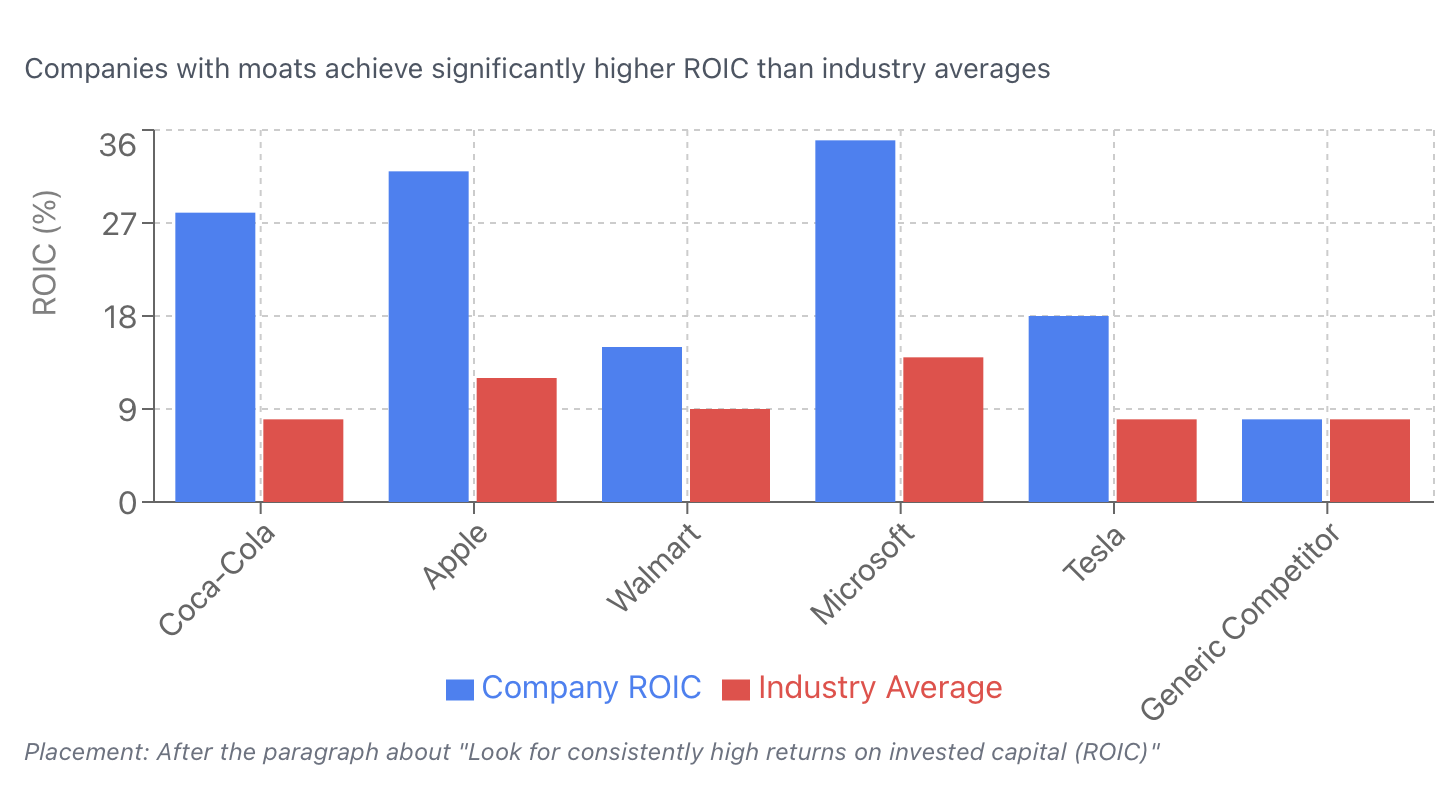
Having a moat is great, but how do you know a company has one? Look to financial performance that shows a moat is in place. The best indication is financial performance that is not easily explainable without a moat. Look for consistently high returns on invested capital or ROIC. If a company is recieving money and then investing money at a 15% return every year while competitors are getting 8% returns, than there is likely a structural advantage allowing for that higher return.
Analyze their gross margins and net margins. Are they consistently above industry averages? And are they able to maintain margins even with tremendous competition? If a company can achieve 40% gross margins while competitors only achieve 25%, then they most likely have a moat.
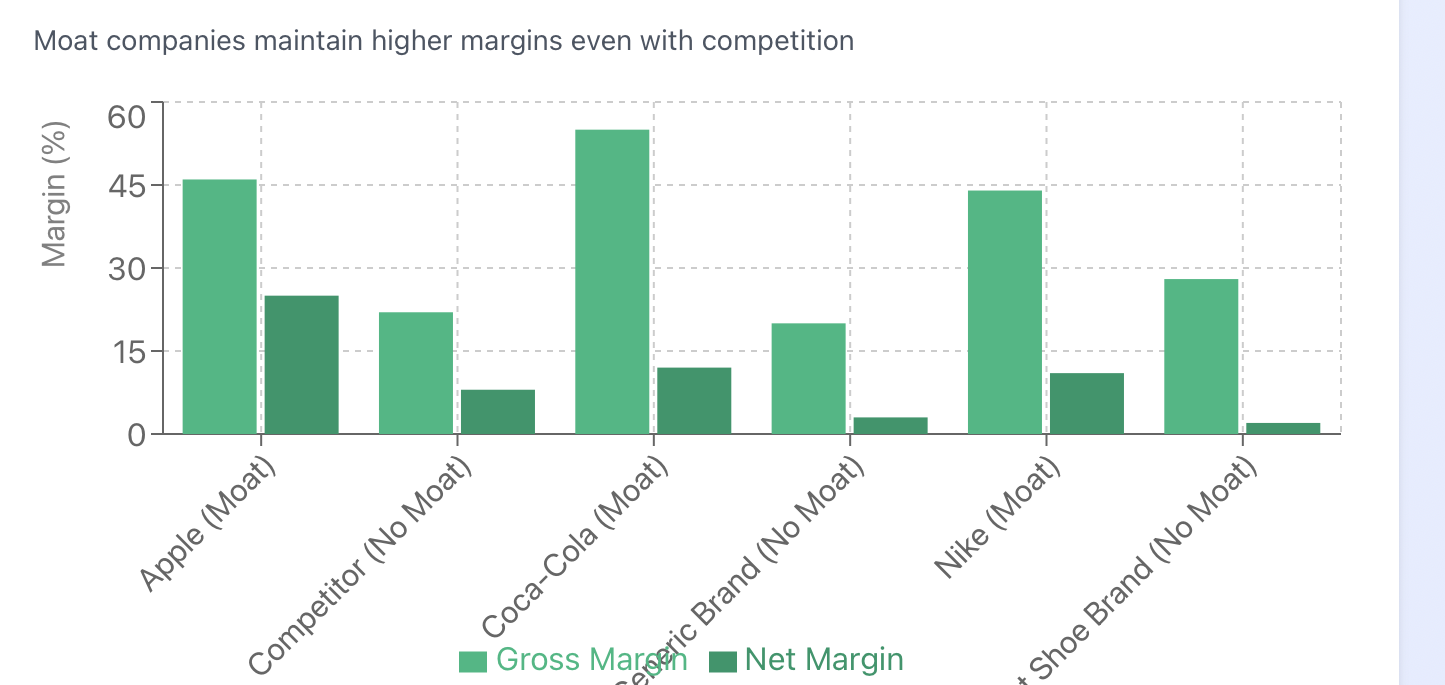
Look at customer retention. Do people stay? Do they grow their market share every quarter? Do they hold prices stable, or even increase prices, without experiencing customer loss? Any pattern of ongoing business can signify an underlying moat.
Examine their spending on money as well. If it’s mostly long-term R&D expenses or spending on their brands, then it signifies that management is actively working to keep and increase their moat. Tesla has an enormous focus on R&D and factory automation. Apple puts significant capital into R&D, design, brand loyalty and the growth of its ecosystem. In other words, these are not just one-off expenses; they are ongoing expenses that deepen their moat each quarter.
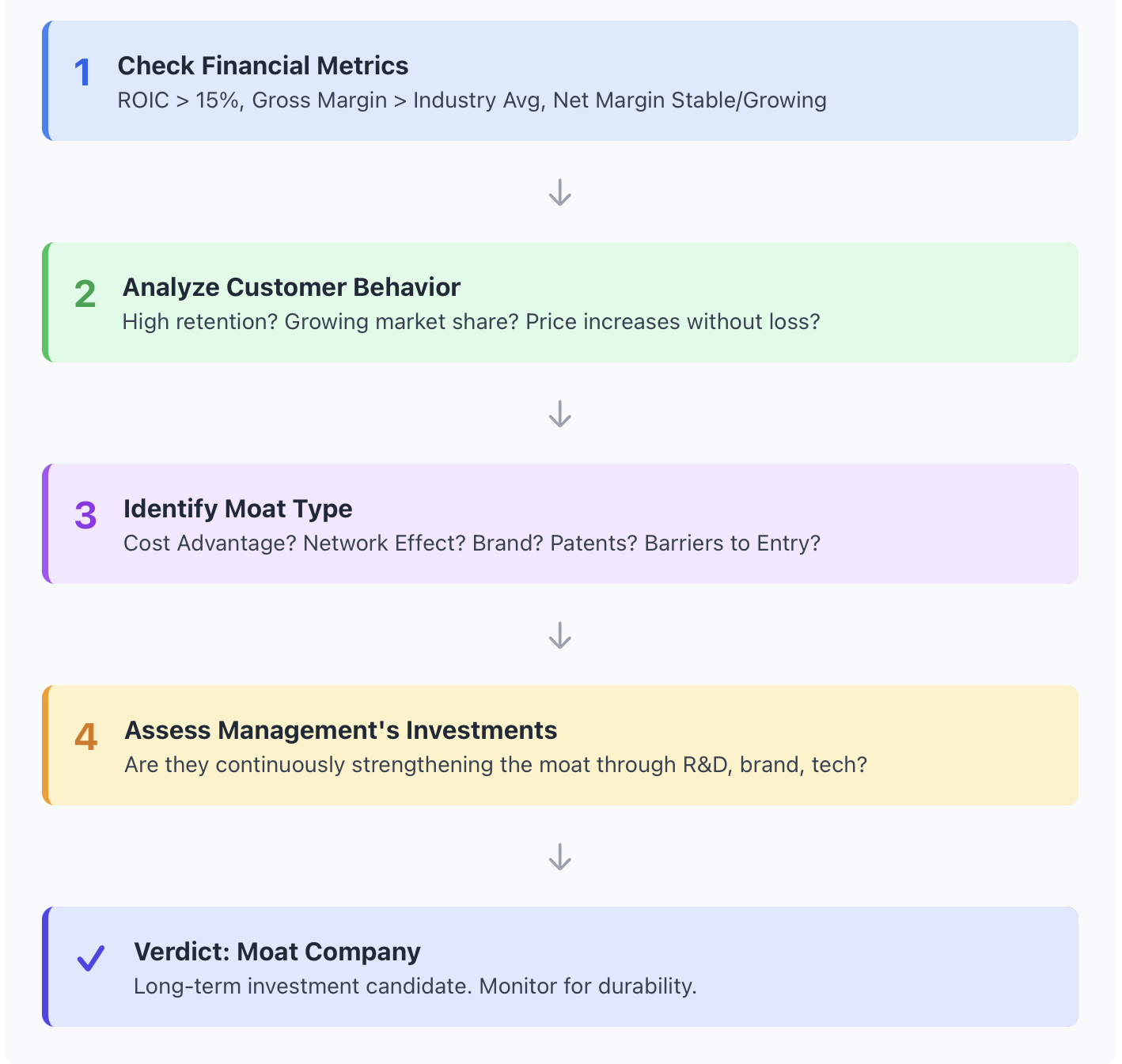
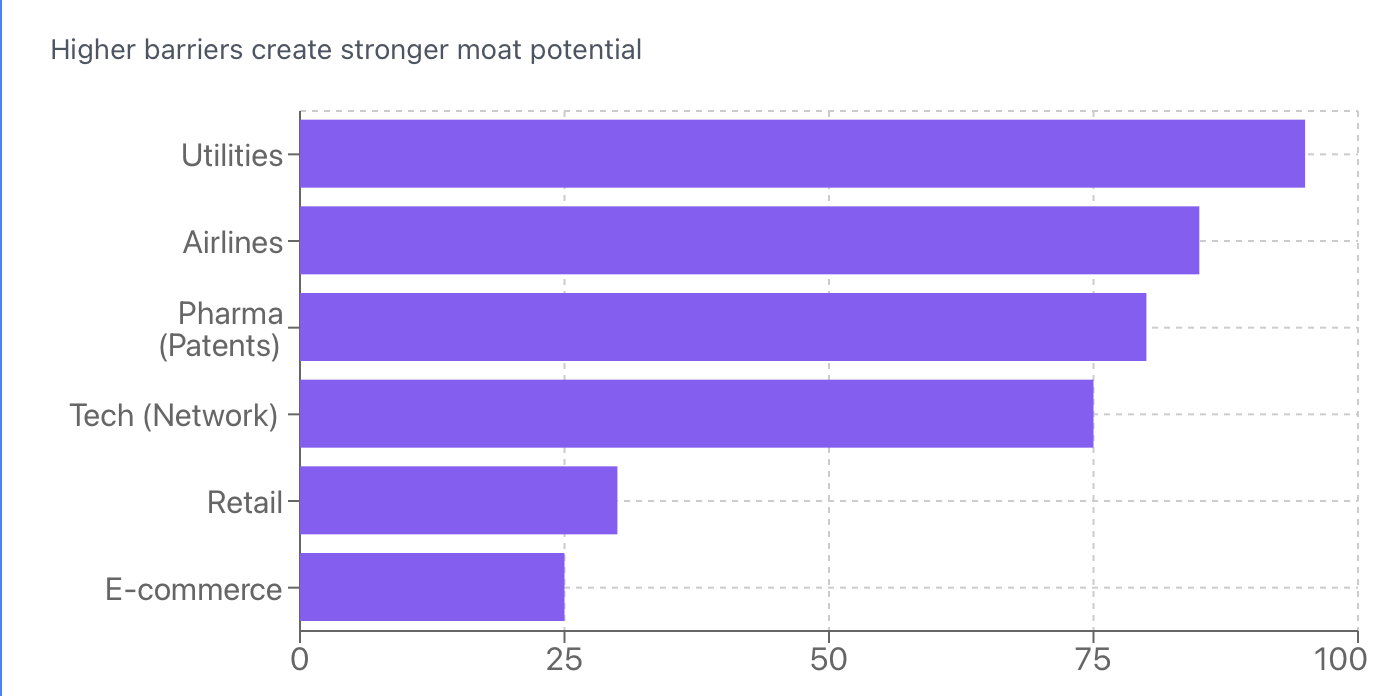
Financials are important, but only tell part of the story. Look to barriers to entry as well. Regulatory requirements, huge capital investments, patents, licensing agreements, etc., are all things that create a barrier to companies from entering the space. You can’t just wake up and start a utility company or airport; the barrier to entry is prohibitive, and that’s one aspect of a moat.
Why Economic Moats Matter for Investors
Moats distinguish companies that will win over the long term from those that will be mediocre. If a company has a moat, it can grow over time without having to worry about competitive forces continually eroding profits. In contrast, a company without a moat has one that lives in a state of constant threat.
For investors, this is relevant because moats are one of the key indicators of a company that is likely to outperform the market over decades. One of the foundations of Warren Buffett's entire philosophy is identifying and investing in companies with strong moats. Two of his most famous investments, Coca-Cola and American Express, have world-class moats that have been almost entirely responsible for shareholder value over generations.
Coca-Cola's moat has allowed it to maintain profits through the Great Depression, wars, and technological disruption. American Express's moat of a premier brand and customer loyalty network has survived numerous economic cycles. These aren't exciting companies that are going to double this year. What they are good-quality, stable, profitable companies that contribute to long-term shareholder wealth for decades at a time.
But the reality is that moats can diminish. Nokia ruled the mobile phone category for years. Their scale, brand, and switching costs gave the appearance of a moat. Then smartphones came along, and none of those advantages mattered. BlackBerry, which has become a cautionary tale, experienced a similar collapse. Technology, regulation, and management actions can all destroy a moat.
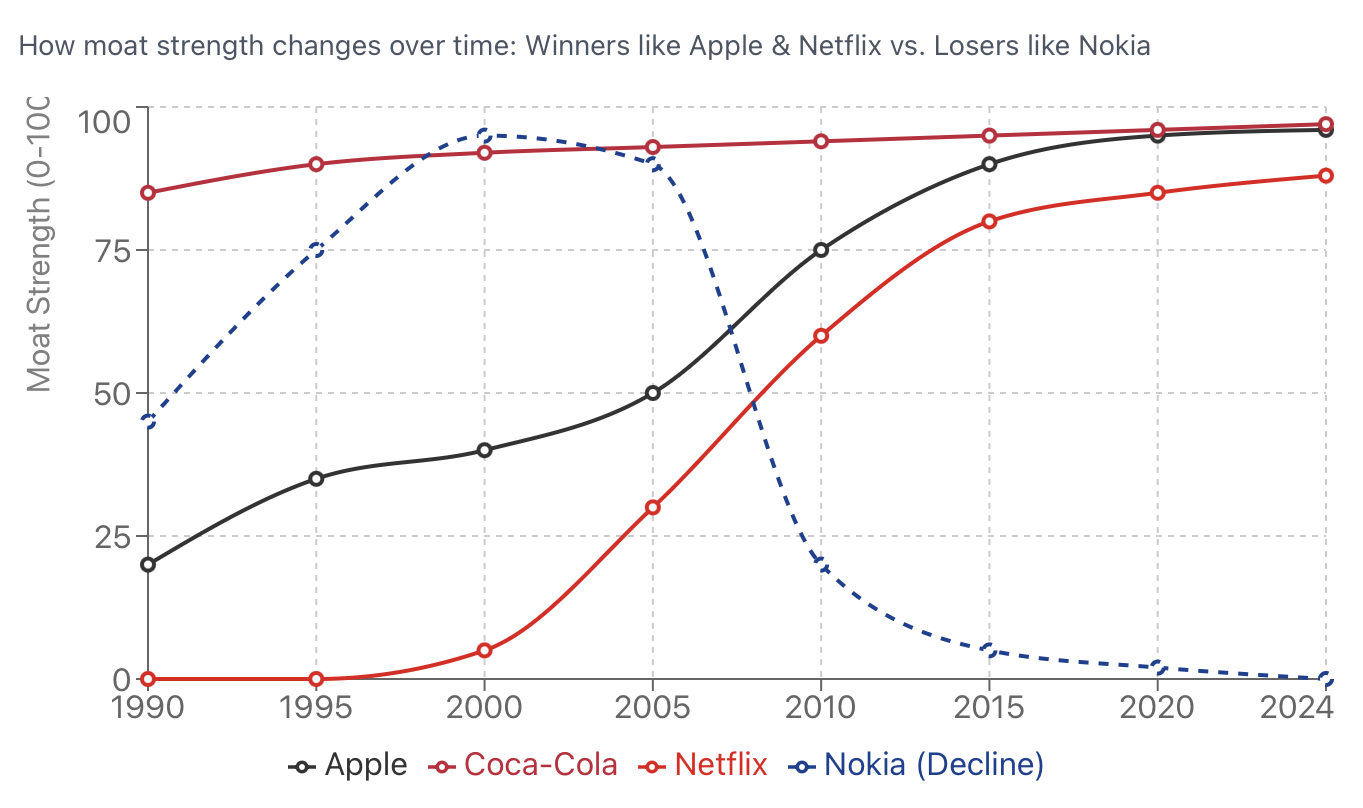
That's why most investors are on alert. You're not buying a company and forgetting about it; you're observing whether or not the moat is actually maintained and strengthened, or losing its durability.
Investing With Moats
Given the significance of moats, how could you invest a portfolio around them?
The direct approach is evaluating the individual stocks and applying the metrics we've discussed to measure each company's respective moat and invest within the companies that have moat sustainability. This has been Warren Buffett’s model for his whole career. He has purchased Coca-Cola, American Express, and See's Candies using each company's moat measures to pre-identify their moat. He simply never chased growth or trending sectors. He sat and waited for a value and then held his quality businesses for decades.
Not everyone is interested in becoming a premier analyst. This is the fun part... the VanEck Morningstar Wide Moat ETF (ticker: MOAT). This fund applies Morningstar's moat rating method which categorizes companies into three buckets:
Wide moat companies have competitive advantages that will last longer than 20 years. These are your best bets.
Narrow moat companies have competitive advantages that will last 10 to 20 years, solid if less certainty.
No moat means that the company has no competitive advantage or advantages that will disappear relatively quickly.
The MOAT ETF invests mostly in companies that have been rated either wide or narrow moat. I call this the lazy method of getting exposure to moats without doing all of the research yourself. Morningstar's analysts do this work, evaluating a company's financial performance, competitive positioning, and market dynamics to offer a moat rating for each rated company.
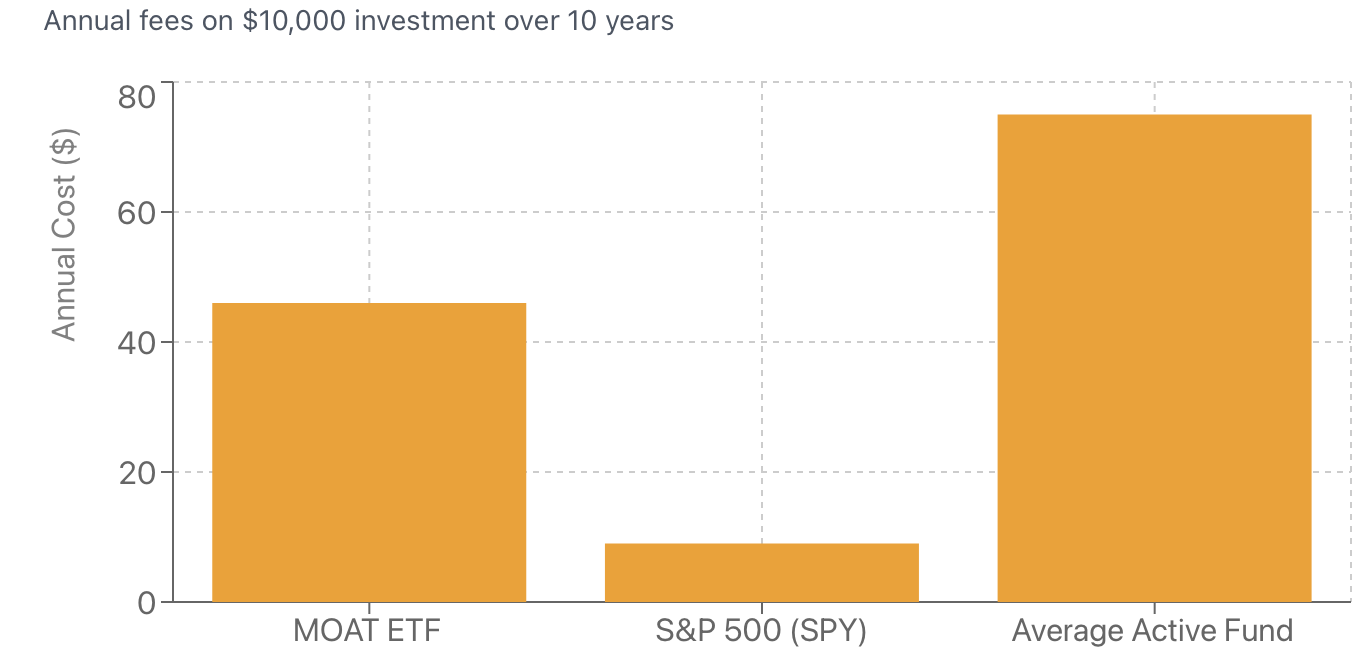
The downside? The MOAT ETF charges you 0.46% in annual fees, compared with 0.09% for the S&P 500 ETF (SPY). If you hold an ETF for decades, that fee difference can matter. You are paying for active management and expertise in research. Whether this is worth it, depends on if you believe that Morningstar has a better chance of recommending moat stocks than the general market on average.
The MOAT ETF has historically performed reasonably, but it hasn't outperformed the general market over the longer term to a substantial degree. This is actually telling you that moats may help a company avoid terminal catastrophe more than they guarantee spectacular growth. What's really good about moats is stability and predictability.
Common Questions About Economic Moats
Is it possible for a moat to go away? Yes. Shifts in technology, changes in regulation, management errors, and new competitors can erode moats. All that being said, they’ll need to be careful. Nokia, BlackBerry, Kodak - all of them learned this.
Can small companies have a moat? Sure! A local restaurant with a secret family recipe, a loyal customer base and no competition has a moat. A SaaS company that has strong switching costs has a moat. Size has nothing to do with whether there is a moat or not.
How do tech companies have moats? Network effects (Facebook, YouTube), switching costs (Microsoft Office, Adobe), or intangible assets like brand and patents. Tech companies can move fast and therefore moats can be established and eroded quickly. .
How long does moat investing take to pay off? Years or decades! Moat investing is not a quarterly market beating strategy - it is a steady, safe, compounding return strategy for your lifetime. Being patient is the real skill.
Conclusion: Building and Defending the Moat
An economic moat is not something a firm constructs, steps back, and ignores. It is,. it demands constant upkeep, spending, and evolution.
Apple continually innovates its ecosystem to keep customers locked into it. Amazon invests aggressively into its logistics and cloud infrastructure so that it can deepen its operating moat. While Netflix innovates its content library and technology to stay ahead of competitors. All of these companies understand that standing still is tantamount to getting eaten.
The best investors are not just watching for firms that have moats. They are looking for companies that are consistently broadening the moat. That is how you find the real long-term winners.
Moat investing is not sexy. Moat investing will not make you millionaire quickly. But it does work. Just ask Warren Buffett, one of the richest people in the world, and one of his most successful investment strategies. In a market addicted to the desire for short-term growth and "hot" companies, simply looking for firms that have economic moats- true sustainable competitive advantages- is quietly revolutionary.
Ready to identify moats in companies you're considering? Start by analyzing one of your current holdings using the ROIC and margin metrics we covered you might discover you already own a moat company without realizing it.
Disclaimer: The content of the blog does not represent any position of Trade W, does not serve as any trading-related decision advice, and does not endorse any third-party.