

 Trade W

Why You Actually Need to Understand Financial Derivatives
If you are making investments now without having any understanding of how derivatives work, you are essentially hoping to get lucky in today’s changing investment environment. Unlike in the past, when financial markets were relatively stable and moved in a fairly straight line, today’s market is characterised by dramatic fluctuations, rising interest rates and unexpected global events that can impact investments at a moment's notice. The fact that most investors simply buy and hold stocks places them in a very risky position.
Where derivatives come into play is in providing some level of protection against price fluctuations. Businesses utilise derivatives to mitigate risk associated with price fluctuations on their inventory or other assets. Money managers utilise these instruments to hedge their portfolios and control their overall exposure to financial markets. Savvy traders utilise derivatives to enhance their overall returns and to keep their risk exposure at a manageable level.
Most of the time, when someone is searching for "what is a derivative in finance", the definitions are either too simplistic or filled with financial and industry jargon. This guide provides an alternative perspective on derivative instruments that will help you understand what derivatives are, where they fit into the overall investment marketplace and how derivatives are not used for gambling, but as a risk management tool by industry professionals.
What Exactly Is a Financial Derivative?
To put it bluntly, the simplest way to sum up a derivative is to say that it’s a contract that gets its value from an asset to be determined at some future point in time; this "asset to be determined at a future point in time" is normally referred to as the “underlying asset”, which could take the form of anything from a stock or an index like the S&P 500, to a currency pair, to a commodity such as crude oil, or even cryptocurrency (for example: Bitcoin).
The most important thing about a derivative is that when you purchase one, you are not actually purchasing the underlying asset; you are simply making a prediction as to the future price movement of that underlying asset.
In a sense, purchasing a derivative is akin to placing a wager on whether a sports team will win or lose; you do not have ownership of the sports team. However, if the team wins or loses, you will either win money or lose money based on the prediction you made regarding their win or loss status.
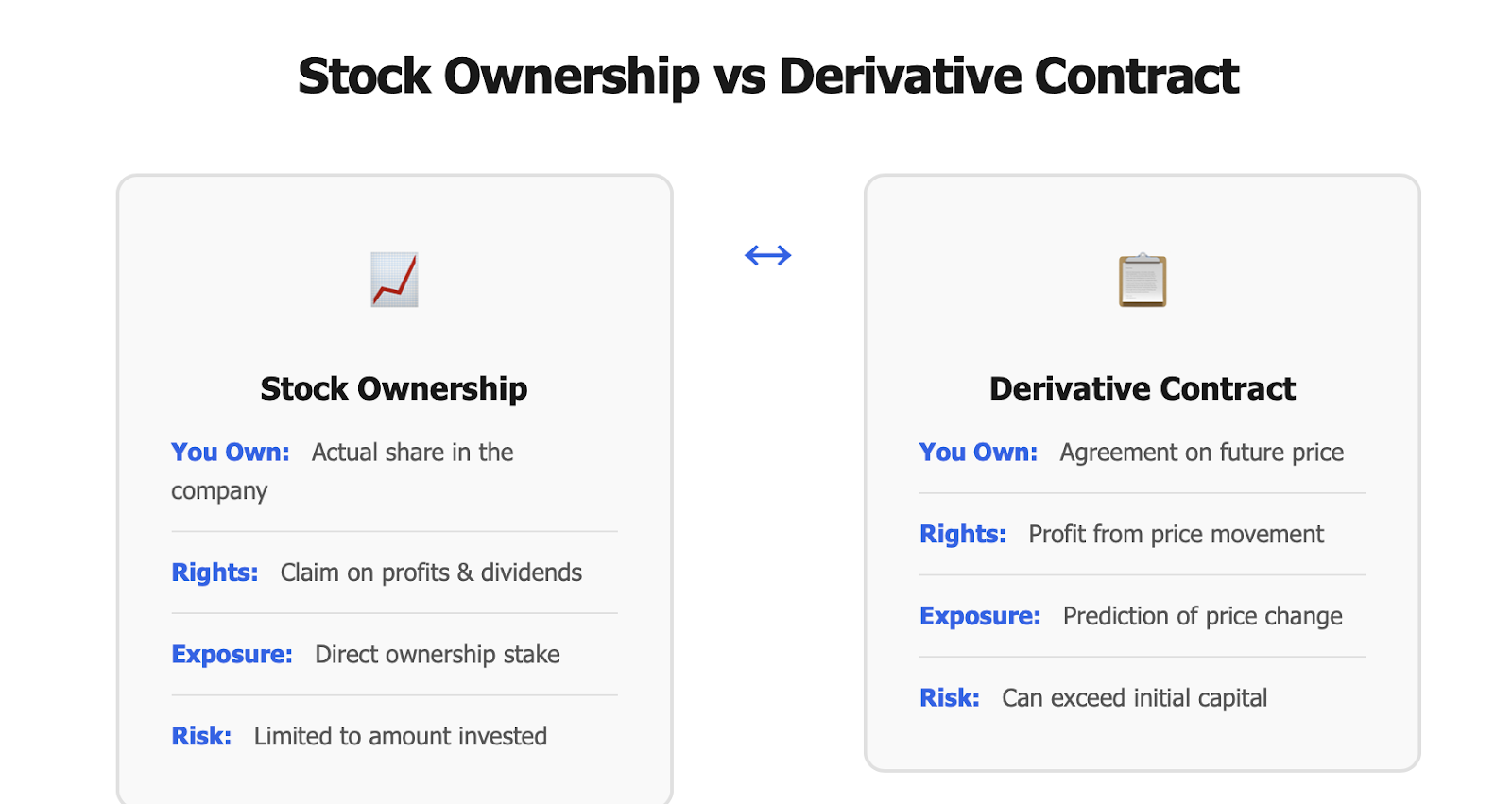
As an illustration, if we take the S&P 500 index futures contract as a reference point, this contract is designed to track the S&P 500 index (it will go up if the S&P 500 index goes up, and it will go down if the S&P 500 index goes down). However, there is no direct correlation between owning 500 stocks and owning the S&P 500 index futures contract; they both serve a purpose, but they function differently.
Furthermore, the term "derivative" also clearly conveys what the value of a derivative is predicated upon, i.e., the "derivative" contract's value is derived from the value of the underlying asset. As a result, a derivative contract does not possess any inherent value by itself.
Why Derivatives Actually Exist: Three Core Functions
A commonly held belief is that derivatives are becoming more and more of a speculative instrument or simply a speculative tool. The other side of the story is that derivatives actually have real-life uses, as they were created to assist businesses in solving real-world issues.
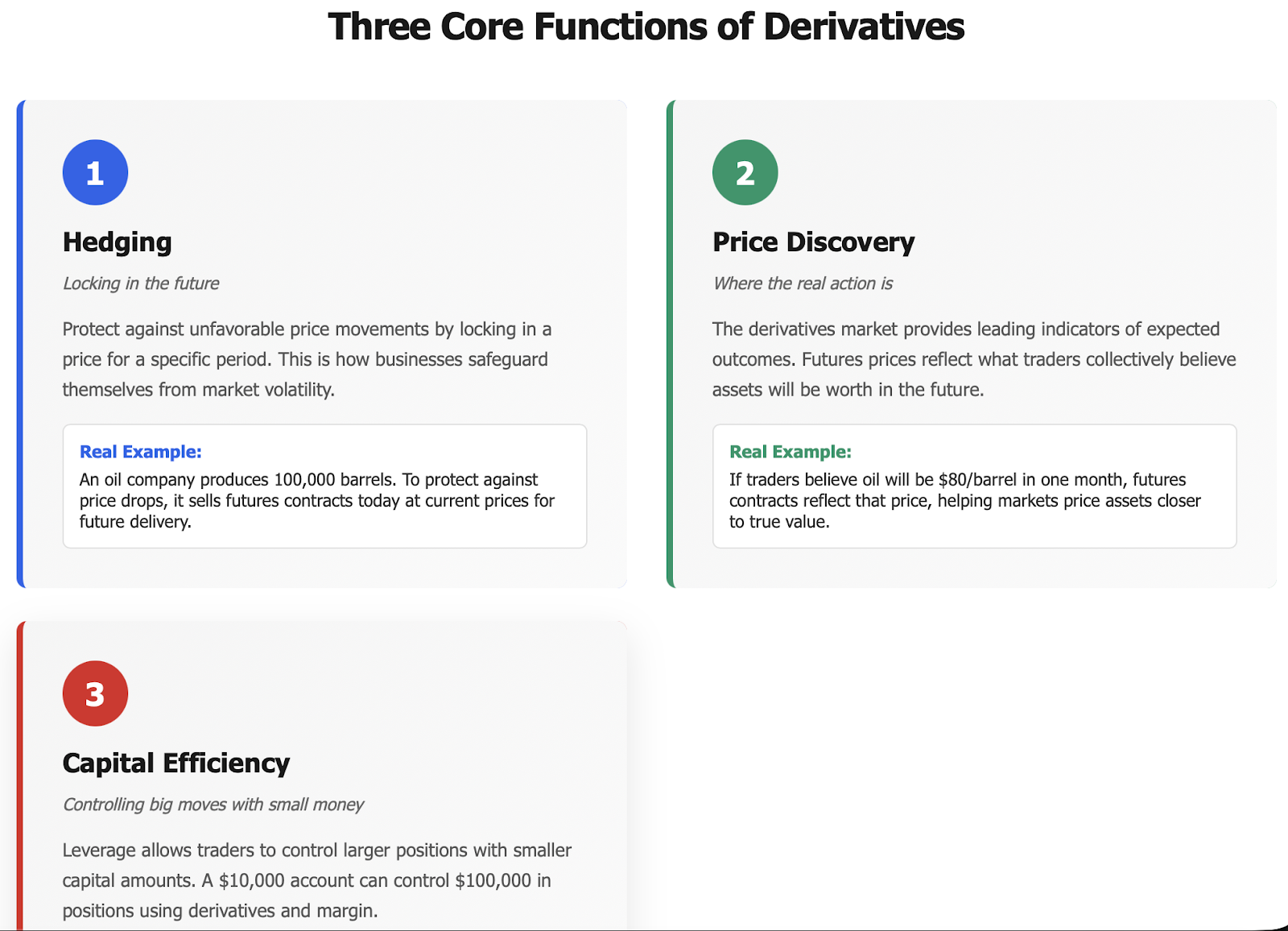
To lock in a price for a specific period of time is called hedging.
Hedging: Locking In the Future
Commodities producers, such as oil companies, are constantly concerned that the price of the product they are producing will drop prior to being able to sell it. For example, if an oil company produces 100,000 barrels of oil, it is concerned about the possibility that the price of oil will decline before it is able to sell the oil. To protect itself from a potential decline in the price it will receive for the oil in the future, the oil company can sell futures contracts today for delivery of the oil in the future at today's price. So, if the price of oil drops below the current market price, the oil company can offset its loss by cashing in on the value of the future contracts.
An airline will have the same concern about the cost of fuel. By using derivatives to lock in its price for a set period, an airline will protect itself against a dramatic increase in its fuel costs that would put it out of business. Thus, the use of derivatives would not be a speculative decision, but rather a vital business decision.
Price Discovery: Where the Real Action Is
The Derivatives market provides a leading indication of the expected outcome of many events ahead of the spot market. For instance, if the majority of traders believe the price of oil will be approximately $80.00 per barrel in one month, the futures price of oil for delivery today will show today's value at approximately $80.00 per barrel. Pricing using this methodology enables the pricing of assets closer to their actual market value.
Capital Efficiency: Controlling Big Moves with Small Money
Leverage is another use of derivatives; the use of leverage allows a trader to control a larger position with a smaller amount of capital. While using leverage may be risky when not used wisely, leverage is a practical way for a company to operate. For example, an individual trader with a $10,000 cash account can have control of $100,000 of positions using derivatives and margin. Many professional traders successfully use margin and derivatives to generate higher returns on their capital.
Leverage can also work against you if you are wrong!
The Main Types: Futures, Options, and CFDs
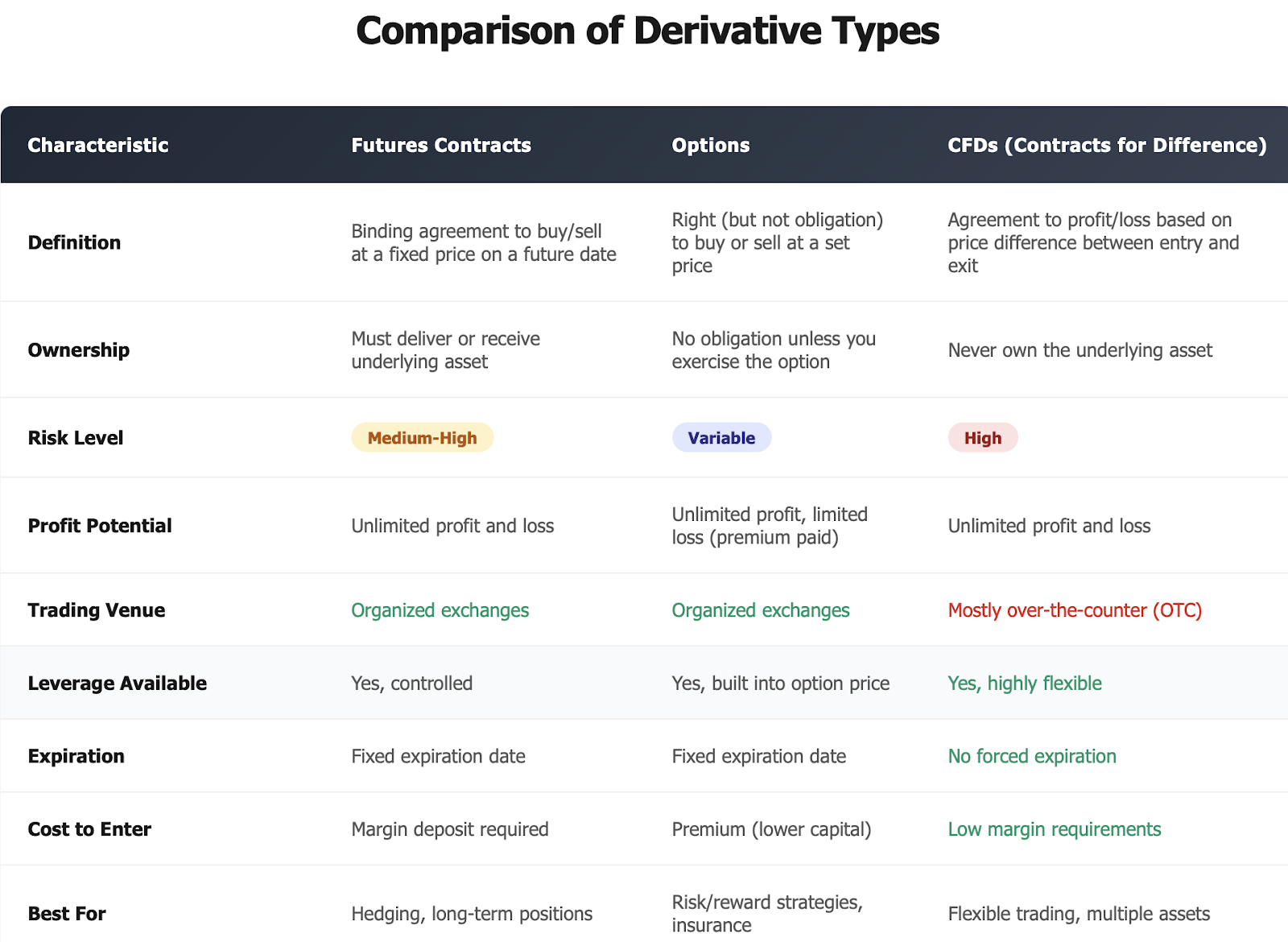
Various types of derivative instruments have been created that can be used for different reasons and also represent different levels of risk. The main derivative instruments include the following:
Futures Contracts
Futures contracts are generally considered to be among the most basic or purest forms of derivative instruments available. A futures contract is essentially a legally binding agreement between you and another party to buy or sell an underlying asset (for example, gold) at an agreed-upon price on a specific date in the future. A futures contract is traded on an organised exchange, so it can be sold before the expiration of the contract. Other examples of futures contracts include stock index futures (for example, the S&P 500) and currency futures (for example, the Euro).
Upon expiration of a futures contract, you would either deliver or receive the underlying asset, or you could close your futures position and realise a profit or loss.
Options
Options are similar to futures contracts in that they can provide you with a way to trade on the future price movement of an underlying asset. However, options provide you with the right to buy or sell an underlying asset at a predetermined price at some future date. By exercising your option, either by exercising a call option or a put option, you can profit from the appreciation of the underlying asset.
In many circumstances, traders are attracted to options because they provide a unique risk/reward profile. With options, your potential risk is limited to the price of the option you purchased, but your potential profit from the price movement of the underlying asset is unlimited. As a result, many traders consider options to be a form of insurance against loss, since you are paying a relatively small premium for the potential benefit of protecting against loss or profiting from the price movement of the underlying asset.
Contracts For Difference (CFDs)
CFDs are a newer and more flexible derivative instrument than either futures contracts or options. When you trade CFDs, you do not actually own the underlying asset. Instead, the profit or loss you make from trading CFDs is based on the change in the price of the CFD between when you entered into the CFD and the time you exited the CFD. Consequently, you can trade CFDs on stocks, indices, commodities and currencies without ever owning the underlying asset. Furthermore, CFDs allow you to trade using leverage and with a relatively small capital outlay, and provide you with the ability to trade multiple asset classes from a single trading platform.
How Derivatives Get Priced
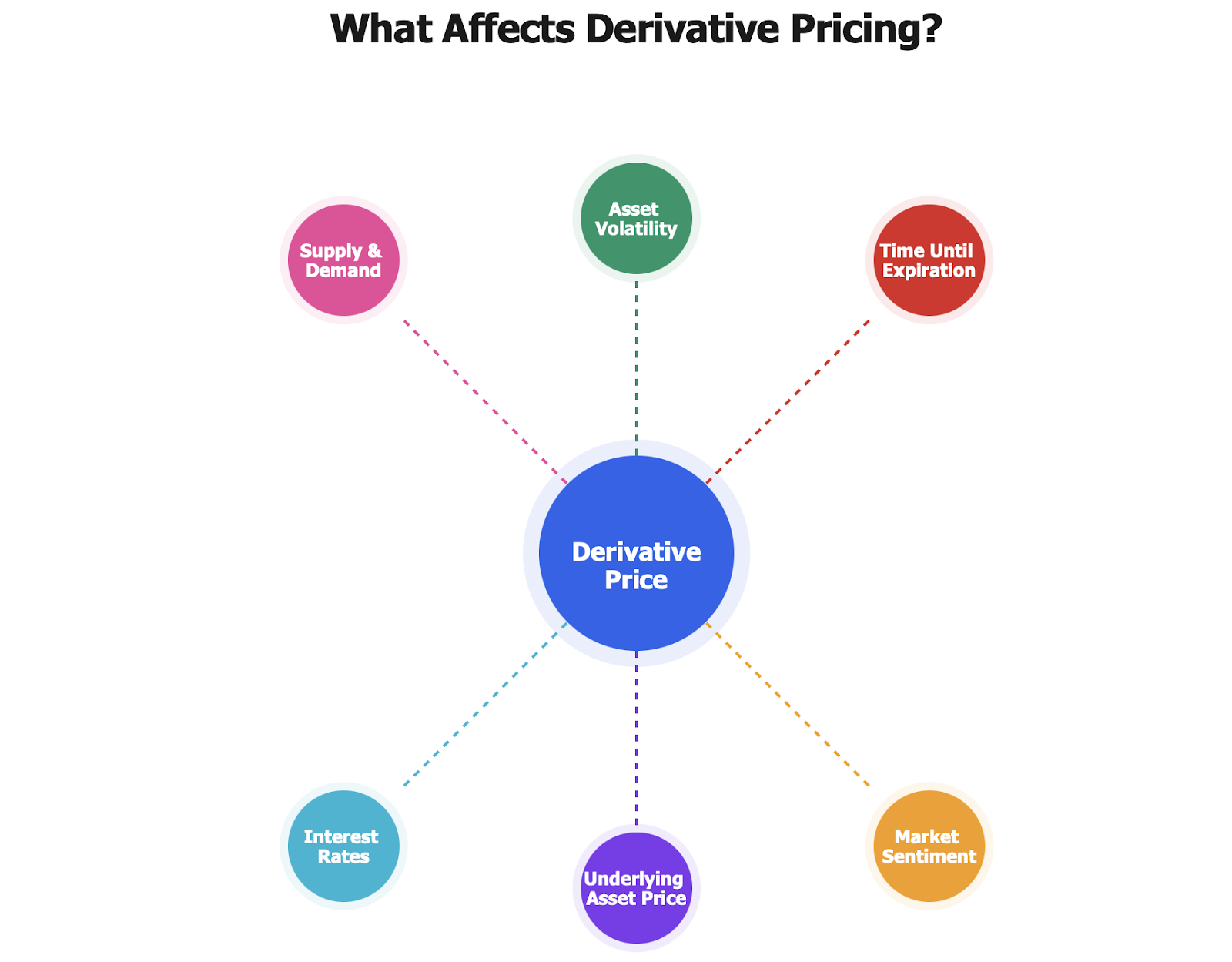
Derivatives have pricing defined by numerous identifiable factors. While the price of the underlying asset is one factor, the price of a derivative depends more on the volatility of the underlying asset than you may expect. Due to the potential for significant price movement, a highly volatile asset typically has expensive options.
In addition to the volatility of the asset, the time until expiration is also an important factor that affects the price of an option. The value of an option closes to expiration changes considerably.
Other factors, such as market sentiment, can also affect the price of options. For example, if the expectation is that an earnings announcement will result in a significant move, the price of options will be higher.
To help give an example of how the above factors affect the price of a derivative, think about how concert tickets are priced. Concert tickets are priced based on the artist's current popularity, but also include factors like demand and the amount of time until the concert occurs. Derivative pricing functions in the same way.
The Real Risk You Need to Understand: Notional Value vs Margin
The point at which beginners get confused, causing them to lose money and make bad judgment calls.
Your margin is the amount of cash you will have to deposit to place your trade. For instance, if you have deposited $5,000 in order to buy an S&P 500 future, your notional value is $500,000, meaning you are going to control $500,000 worth of exposure with just your deposits.
The next important point is that your margin does not represent your maximum loss. If the market goes against you very quickly, you may lose much more than $5,000. This is called a margin call, and when your broker calls for money in order for you to continue to hold your position, if you do not put more cash in, then they will close your position, and you will have locked in your loss.
Professionals will never risk all of their margin on any one trade and may only use 10-20% of their margin for each position while they keep the balance available to offset any additional losses.
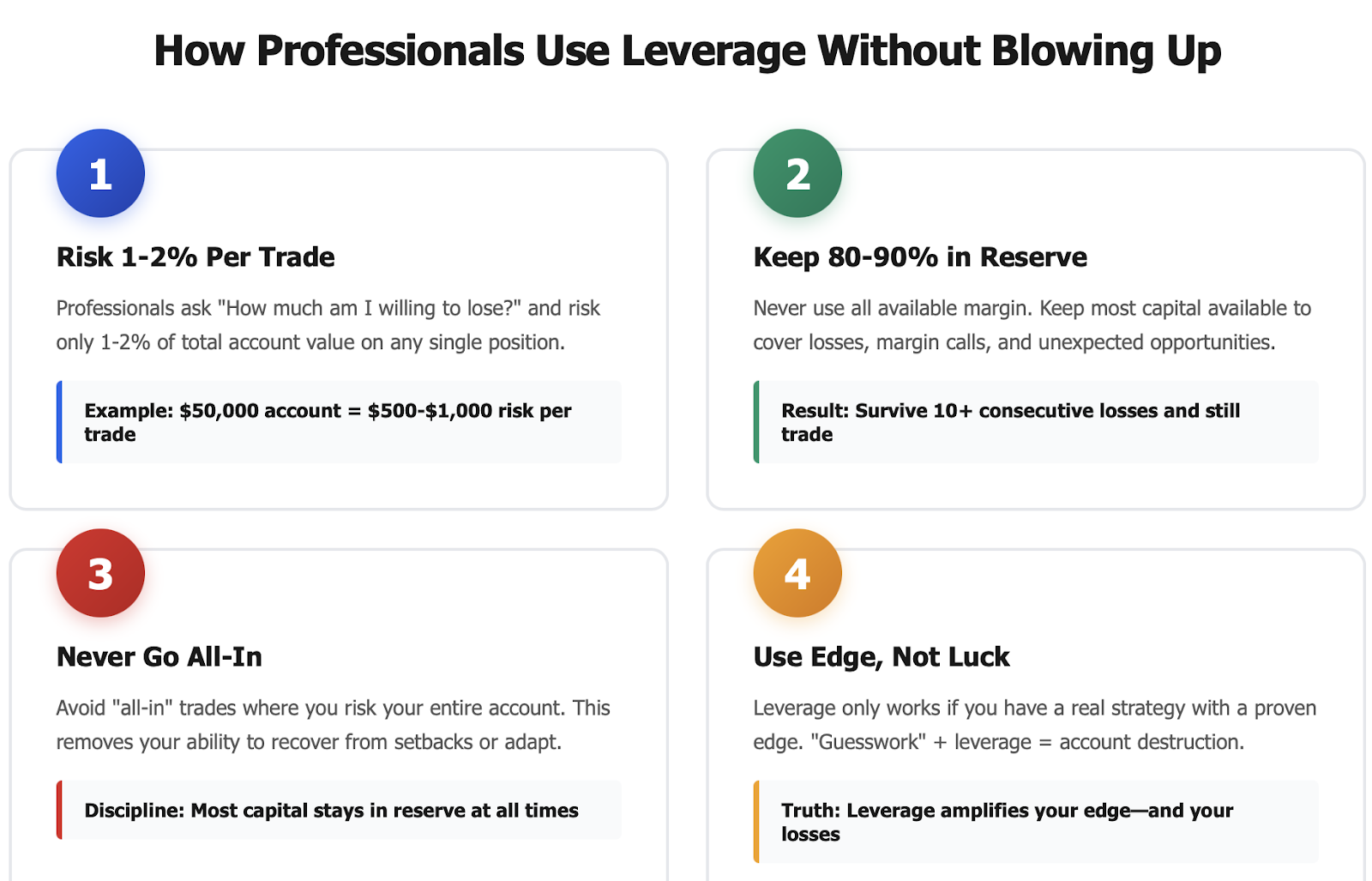
How Professionals Use Leverage Without Blowing Up
Luck and discipline are what separate professionals from amateurs.
Pros know that leverage is used to help fortify your edge with your strategy, as opposed to providing you with an edge through luck. If you have a small edge in your strategy, then utilising leverage will help build and compound on that small edge. If your strategy is based solely on "guesswork", then you will lose your capital and be destroyed by using leverage much faster than if you had used a legitimate strategy.
As such, professionals control their risk by utilising position sizing as opposed to using position sizing to determine how much to make. When professionals enter into an investment or trade, they first ask themselves, "How much am I willing to lose on this trade?" Most typically, risk anywhere from 1% to 2% of their total account value on a single position. As a result, they can afford to be wrong 10 consecutive times and still maintain 80% to 90% of their capital to continue to trade.
In addition to all of the above-mentioned principles, professionals do not participate in making all trades. A good portion of their capital remains in reserve at all times, allowing them to take advantage of opportunities in the market without being forced to liquidate their existing positions in a panic.
Derivatives as Insurance, Not Just Gambling Tools
While speculation gets headlines and sells newspapers, it is completely inaccurate to portray derivatives as a form of speculation when, in fact, they are, or can be, used as a legitimate way of protecting against market volatility.
For example, if a portfolio manager believes that the S&P 500 Index is going to decline in value, he or she could purchase put options to protect against the loss in value of his or her portfolio from this decline. If the marketplace in fact declines, the put options will provide protection. The portfolio manager will lose money on the put option premium if the market does not crash. However, if the market crashes, the put options will be worth many times more than what the portfolio manager paid in premiums.
Additionally, if a multinational corporation is purchasing derivatives in order to lock in foreign exchange rates, this company is also not engaging in speculation. Rather, this corporation is using derivatives to hedge against fluctuations in currency rates.
Because of the above reasons, the derivatives market is large and consists of many institutions that use the derivatives market to manage legitimate business risks.
What History Teaches Us: From Barings Bank to 2008
The 1995 Barings Bank collapse illustrates two key points about financial derivatives. The first is that the risk controls were no match for the ability of one trader (Nick Leeson) to use derivatives to continuously hide their losses and double down on preposterous investments. The totality of the loss led to Barings ceasing to exist after 230 years.
The second point illustrated by the collapse of the U.S. banking system in 2008 is the complexity of layered derivative products on top of other layered products, thus creating a risk that no one truly understands.
Without trust between financial institutions or even individuals within those institutions, the entire system becomes frozen.
What caused these financial cataclysms was not failures of derivatives but rather the failures of human discipline and the failure of inadequate risk management and institutions betting their survival on faulty assumptions.
So long as we recognise that derivatives are not inherently evil, we will have the proper level of respect for them, along with the appropriate level of regulatory oversight.
Counterparty Risk: Why Your Broker Actually Matters
Counterparty risk exists when you trade derivatives, particularly if you are trading off-exchange. You run the risk of losing everything if your broker becomes insolvent, even if you are supposed to be in profit according to the contract.
Because they are cleared through a Central Clearinghouse, exchange-traded derivatives are much less risky than OTC derivatives. The Central Clearinghouse acts as an intermediary between two parties and guarantees performance on the trade. For example, if a party defaults on the contract, the Central Clearinghouse will step in and perform for the other party. For this reason, professional traders prefer to trade on regulated exchanges.
Although OTC derivatives may offer more flexibility than share derivatives, the former carries a higher level of counterparty risk. The counterparty on an OTC trade is not a Central Clearinghouse, which means that, as a trade,r you must rely solely on the broker/accountable party's performance under the terms of the trade.
The lesson here? Always trade on established, regulated exchanges to avoid the pitfalls of unregulated exchanges! Unregulated exchanges often have better rates than regulated exchanges, but those are the exact exchanges that cause issues for traders!
The Mistakes That Actually Destroy Accounts
New traders tend to repeat silly mistakes over and over. And while it helps to be aware of these mistakes, having no clue won't help you avoid them either.
Topping the list is overleveraging; using up all available margins on one trade will be disastrous if the market moves against you.
Closely related is the lack of risk management. Have a plan for the worst-case scenario; where will you exit, and how much of your initial investment are you willing to lose? Pre-decide before trade entry!
Another terrible mistake is treating options and futures contracts like lottery tickets. Options and futures are not get-rich-quick schemes; they are simply financial tools.
Once your beginning trader has had success on his first couple of trades, the confidence level has greatly risen. Next comes the reckless behaviour of overleveraging, getting a large loss, then panicking when they realise there is nothing left in their account.
When it comes to trading, survival is more important than anything else.
Common Questions About Derivatives
What distinguishes a derivative from a share?
Owning a share means that you have a claim on the profits and losses of the business. Derivatives are just contracts, and you do not have an ownership interest in anything when you trade a derivative; you only have exposure to price changes.
Can I transact in futures mathematics?
Yes, provided you have a futures trading account with a broker that gives you access to derivatives. Different brokers offer different types of futures contracts; some may focus on options, for example, and others only provide access to futures.
Is losing my initial investment the worst outcome if I invest in futures?
No, you can lose all of your initial capital plus additional capital due to the rapid movements of market prices. There are also gaps in the market. It is possible to have a negative balance with the broker, for which you owe the broker money.
When will I receive a margin call from my futures broker?
If the value of your account falls below the minimum maintenance margin level, you will get a margin call. Because each type of position has a specific maintenance margin level, your broker will provide you with a notice to either increase the value of your account or move it below the maintenance margin value.
The Real Competitive Advantage: Knowledge
To become a competent investor and trader, simply knowing about derivatives isn't enough. You must have a solid grasp of how derivatives are used to protect yourself and find opportunities where other investors miss.
The vast majority of investors do not take the time to learn about these concepts and stick to only simple buy-and-hold strategies; this is perfectly acceptable, but it subsequently leaves them feeling powerless in the face of volatility. Investors do not have the ability to lock in their price point on a trade, and aren’t afforded an opportunity to protect their portfolio and use leverage smartly.
Once you comprehend what derivatives are, you have weapons available to you that other investors do not. You can protect yourself from risk by using derivatives as a means to hedge, efficiently expressing your opinion on a market without excessive risk. You'll be able to manage uncertainty rather than just accept it.
Finally, understanding derivatives will allow you to recognise the true risks involved in the financial markets and avoid them altogether. You will not blow up your trading account by gambling on long shots as so many investors have. You will be prepared for margin calls because anything can happen in the marketplace; therefore, if you have education and respect for these tools, you will not become a casualty of them.
When you develop your understanding of derivatives, you not only become a better trader but also a more successful long-term investor.
Ready to Trade Derivatives With a Real Edge?
At Tradewell, we help traders move past confusion and into real competence. We provide the tools, education, and support to trade derivatives with discipline, not desperation.
Start your free trial today and see how professional-grade derivatives trading actually works.
Disclaimer: The content of the blog does not represent any position of Trade W, does not serve as any trading-related decision advice, and does not endorse any third-party.