
 Trade W
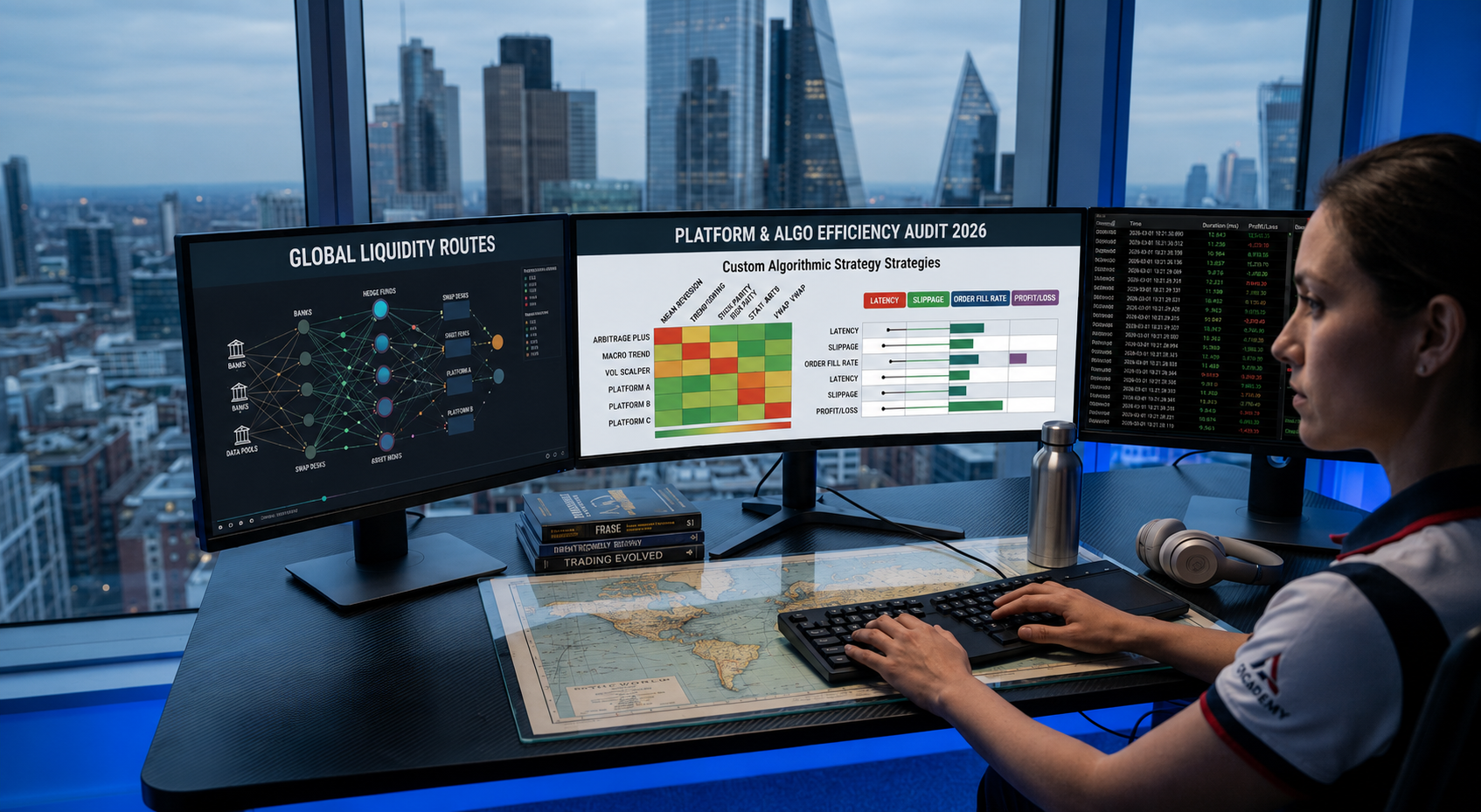
Market makers provide retail traders with access to the forex market through their trading platforms. They execute and price traders' orders while generating revenue primarily through spreads, commissions, and overnight financing costs. In addition to providing market access, brokers offer leverage through margin. The amount of margin available depends on the broker's risk profile and regulatory environment, with leverage ratios typically ranging from 100:1 to 200:1, depending on these factors.
To locate a regulated market maker in your jurisdiction, first confirm that the broker is properly regulated by checking its details in the relevant regulator's official public database. Next, compare the broker's total trading costs, including spreads, commissions, and financing charges, along with the maximum leverage available to clients. Finally, evaluate the types of trading accounts offered, such as demo accounts, and the level of client protection provided. The following considerations should be taken into account when researching and comparing retail forex brokers:
The broker is appropriately regulated by the relevant regulatory authority in its jurisdiction (such as the Commodity Futures Trading Commission (CFTC) or the Financial Industry Regulatory Authority (FINRA) in the United States).
-
Client funds are held in segregated accounts, and negative balance protection is available where applicable.
-
The total trading cost per trade, including spreads and commissions.
-
The maximum leverage available.
-
The types of trading accounts offered and their minimum deposit requirements.
-
The trading platforms supported by the broker, such as MetaTrader 4 or MetaTrader 5.
-
The speed at which orders are executed.
-
The availability of a demo account that allows traders to practice before committing real capital.
Although brokers operate under government regulations, no broker can guarantee trading success. Leverage magnifies both profits and losses, making risk management essential. Traders should independently verify a broker's regulatory status through the appropriate regulatory authority and thoroughly test the broker's execution quality using a demo account before investing real funds.
What Does a Foreign Exchange Market Broker Actually Do?
In the world of finance, the foreign exchange market is the largest and most liquid financial market. According to the 2022 Triennial Survey by the Bank for International Settlements, the forex market has an average daily turnover of approximately USD 7.5 trillion. Since retail traders cannot connect directly to the interbank market, brokers play a key role in providing market access.
A forex broker provides regulated access to the foreign exchange market. Once you create a trading account and place a buy or sell order on a currency pair, such as EUR/USD, your order is sent to the broker, which either executes it internally or routes it through a network of liquidity providers or interbank counterparties. This process typically occurs within milliseconds.
To trade successfully in the forex market, you must understand how central bank decisions and macroeconomic developments influence the value of the currencies you are buying and selling through your broker.
Brokers make margin trading available to retail forex traders by allowing them to control positions without providing the full notional value upfront. For example, with 100:1 leverage, a trader can control a $100,000 position with only $1,000 in their trading account. While leverage can amplify profits when the market moves in your favor, it also magnifies losses when the market moves against you.
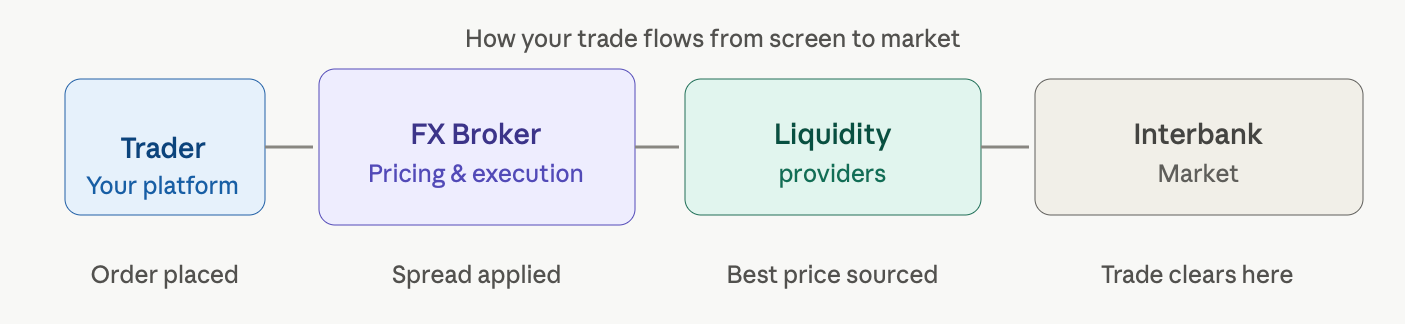
Choosing a broker can affect how well your trades are executed, the size of the spread on each trade, and whether your funds will be protected in the event of the broker's bankruptcy. Many new traders make the mistake of not verifying their broker before opening an account. This is an avoidable mistake, so take the time to research and verify a broker before you begin trading.
Like many leveraged investment products available today, CFDs are complex financial instruments. Approximately 70% to 80% of retail investor accounts lose money when trading CFDs. Before trading, ensure you fully understand how these products work and the risks involved.
Types of Foreign Exchange Brokers and How They Make Money
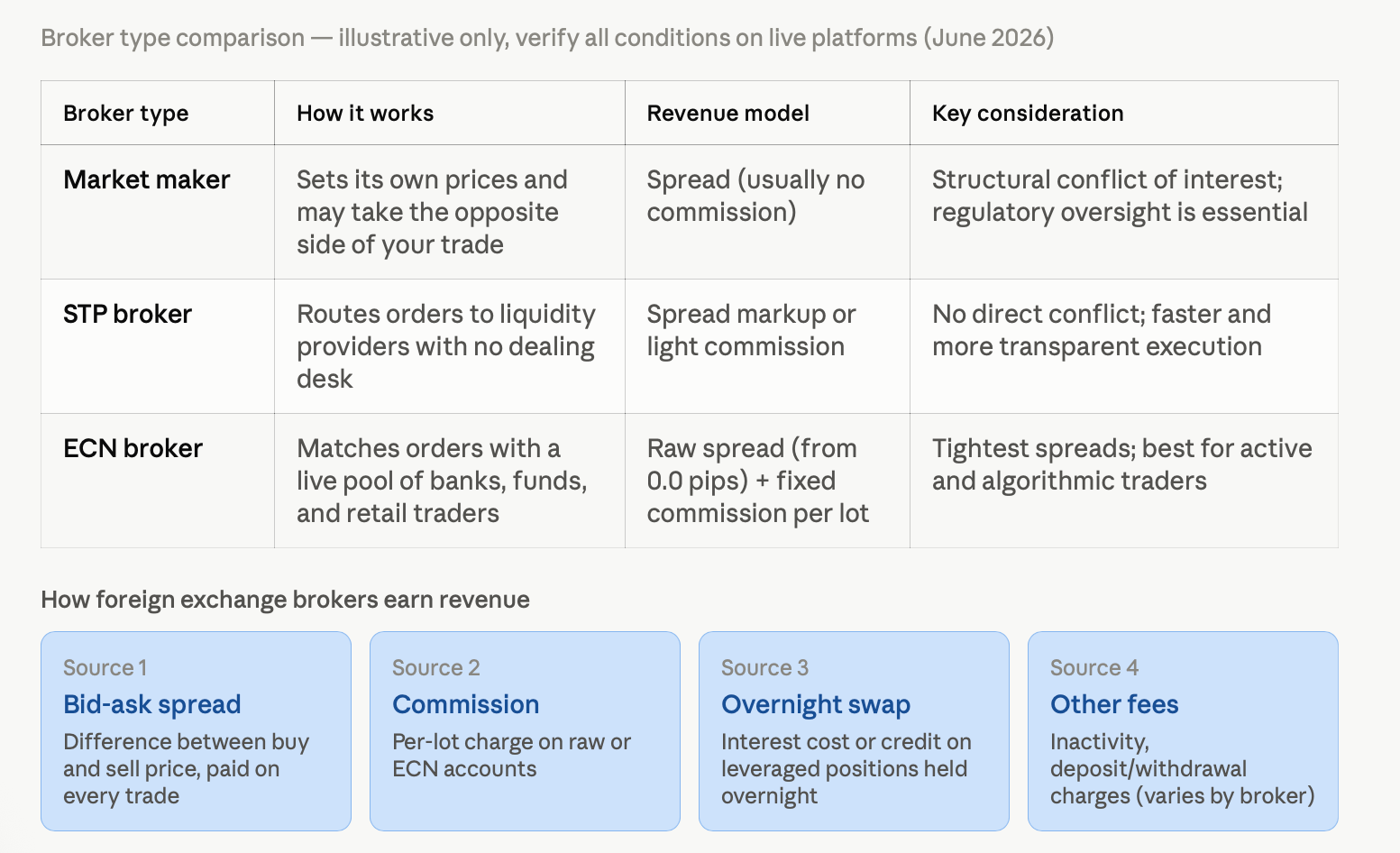
Different types of forex brokers operate in distinct ways, and their underlying business models affect pricing, execution quality, and the potential for conflicts of interest from the moment you place a trade until you close your position.
Market makers (also referred to as dealing desk brokers) create their own bid and ask prices and may take the opposite side of your trade after it is executed. When you buy a currency pair from a market maker, the broker may be your direct counterparty. As a result, the broker can profit when you lose money on a trade, creating a potential conflict of interest that requires appropriate regulatory oversight. Under this model, the broker's revenue is typically generated from the spread (the difference between the bid and ask prices), so standard accounts usually do not charge additional commissions.
STP (Straight Through Processing) brokers route client orders directly to a network of liquidity providers without using a dealing desk. Because orders are passed directly to external counterparties, the structural conflict of interest is reduced, and pricing is derived from multiple liquidity providers. The broker typically earns revenue by adding a small markup to the spread or charging a modest commission per standard lot. As a result, order execution is generally faster and more transparent than with the traditional dealing desk model.
ECN (Electronic Communication Network) brokers connect traders to a shared pool of market participants, including banks, hedge funds, and other traders. Orders are matched based on actual market supply and demand, often resulting in the tightest available raw spreads, which may start as low as 0.0 pips under certain market conditions. ECN brokers typically charge a fixed commission per standard lot instead of widening the spread. This model is especially attractive to active traders and algorithmic traders seeking to execute a high volume of trades while minimising total transaction costs.
Beyond spreads and commissions, brokers also collect overnight financing fees (called swap rates) on leveraged positions held past the daily rollover, and some add administrative charges for inactivity, deposits, or withdrawals.
How to Choose a Foreign Exchange Market Broker: The Checklist
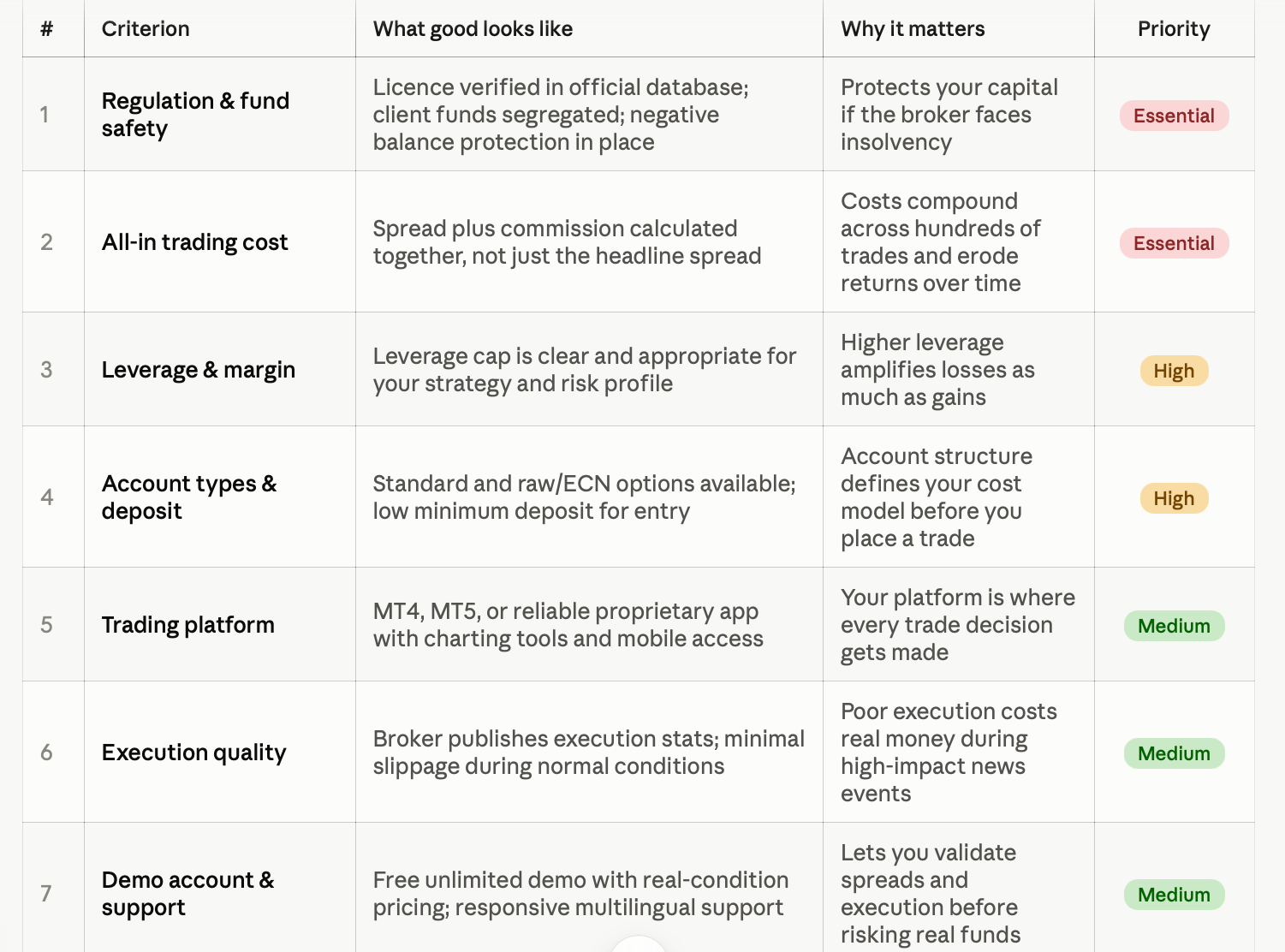
Selecting an FX broker is a process that should be approached carefully and evaluated across seven key pillars. One of the most common reasons traders end up with the wrong broker is rushing the evaluation process and choosing a platform that freezes during major news events, charges hidden fees, or lacks verifiable regulatory oversight.
Regulation and the safety of client funds should be the first consideration in your decision-making process and should always be your highest priority. A legitimate broker is required to segregate client funds from its operating capital, meaning that if the broker experiences financial difficulties, client funds are generally not included as part of the bankruptcy estate. Some of the leading regulators include the FCA (United Kingdom), ASIC (Australia), CySEC (Cyprus/EU), and the CFTC/NFA (United States). These regulators enforce strict capital requirements, audited financial reporting, and operational standards. Some also require brokers to provide negative balance protection, ensuring that clients cannot lose more than the funds they have deposited, even during extreme market volatility.
All potential trading costs, including spreads and commissions, should be evaluated as a combined cost rather than focusing solely on the advertised spread. Our guide to calculating trading commissions explains how to calculate the total cost of trading across different account types and pricing structures.
The leverage and margin requirements of an account determine how much buying power is available relative to the size of your position. The appropriate level of leverage should be based on your trading strategy and risk tolerance rather than promotional marketing or advertising claims.
The account type and minimum deposit requirement also influence your overall trading costs. Standard accounts typically offer commission-free trading with wider spreads, while Raw or ECN accounts generally provide tighter spreads and charge a fixed commission per standard lot traded.
The final three pillars to consider when evaluating a broker are trading platforms and tools, execution quality, and access to a demo account. Any reputable broker should provide a demo account, allowing traders to test the platform and evaluate execution quality using virtual funds before committing real capital.
How to Actually Verify a Broker Is Regulated
Regulated brokers are not the same as brokers that merely claim to be regulated. Clone firm scams occur when fraudsters use the names and branding of legitimate regulated firms to deceive investors into depositing funds with unauthorised entities. The most reliable way to avoid these scams is to manually verify a broker's regulatory status, a process that usually takes less than five minutes.
To manually verify whether a broker is regulated, follow these steps:
-
Locate the regulator's name and the broker's license number in the "Legal" section at the bottom of the broker's website.
-
Visit the appropriate regulator's official public database:
-
NFA BASIC (USA): nfa.futures.org/basicnet
-
FCA Register (UK): register.fca.org.uk
-
ASIC Connect (Australia): connectonline.asic.gov.au
-
CySEC (Cyprus): cysec.gov.cy
-
Search the regulator's public database using the broker's exact legal name and license number. Verify that the legal name, license number, and regulatory details all match exactly to ensure the broker is not a clone of a legitimate regulated firm.
-
Confirm that the broker's license status is "Active" and that it is authorized to offer retail forex and/or CFD trading services.
-
Check the regulator's warning or alert list to confirm that the broker does not appear on it.
If any of these details do not match exactly, do not engage with the broker or proceed any further. This is especially relevant when evaluating brokers that promote trading signals or managed account services, where unregistered operations are more common.
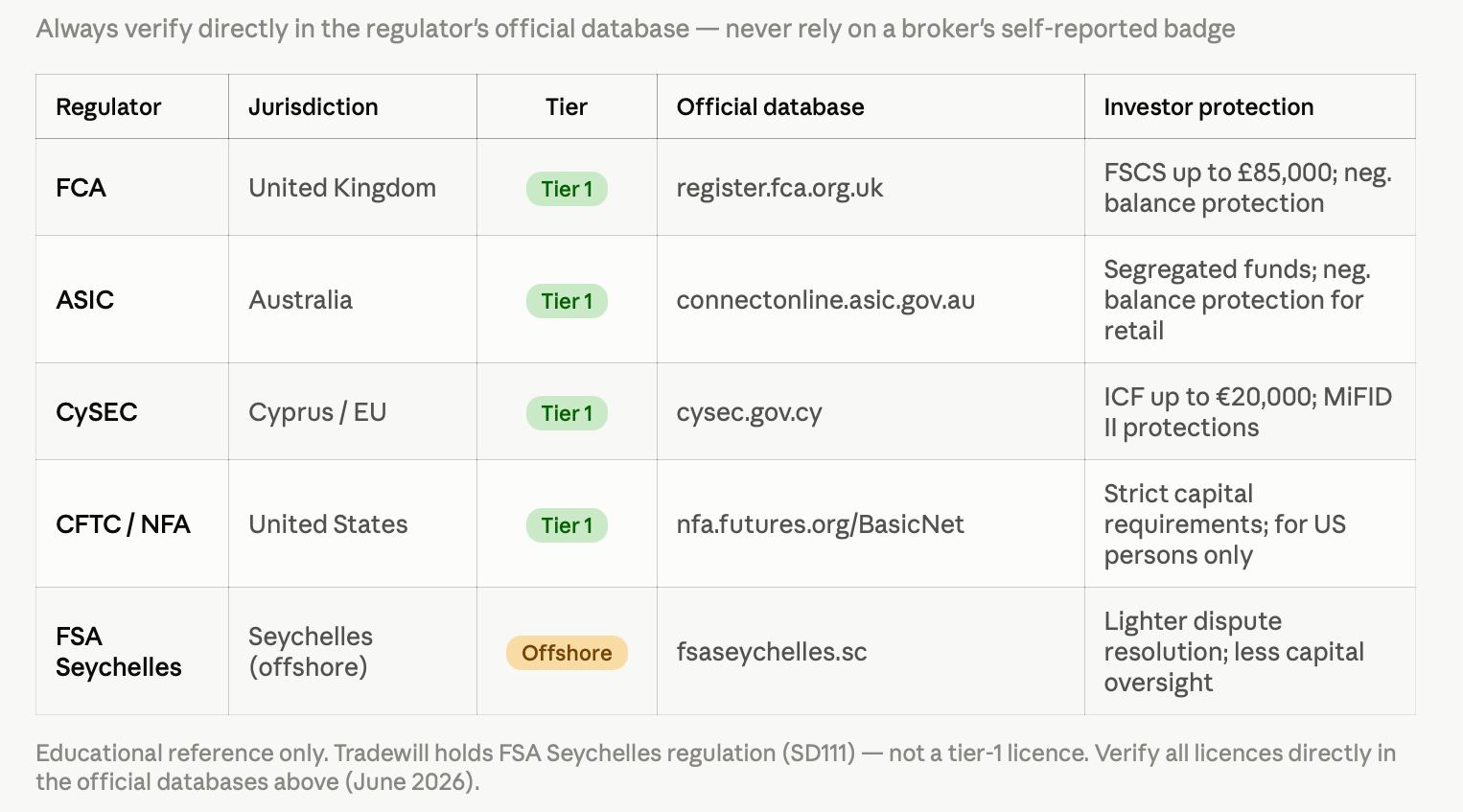
Tradewill is regulated by the FSA Seychelles (Licence SD111), an offshore regulator that does not provide the same level of oversight as tier-1 regulators such as the FCA, ASIC, CySEC, or the CFTC/NFA. For more information, refer to the FSA Seychelles website and verify the broker's regulatory status by following the five-step process outlined earlier in this article. Because Tradewill operates under an offshore regulatory framework, investor dispute resolution procedures and capital oversight are generally less stringent than those provided by tier-1 regulators. This is an important factor to consider before deciding whether to deposit funds with Tradewill.
If you would like to evaluate real-market spreads without risking your capital, open a free Tradewill demo account and perform your verification tests while exploring the trading platform.
Trading Costs Explained: Do the Math
When choosing a forex broker, one of the most common mistakes beginners make is focusing only on the advertised spread (the difference between the bid and ask prices) instead of the total cost of trading, which includes both the spread and any commissions. For example, an ECN account may advertise a spread of 0.0 pips, while a standard account may advertise a spread of 1.0 pip. At first glance, the ECN account appears cheaper. However, once commissions are included, the true cost of trading becomes clearer. To determine the actual cost of each trade, you should calculate the combined cost of the spread and commission. Our comprehensive guide to the bid-ask spread mechanism explains how this pricing model works, while our break-even calculation guide shows how to calculate your total trading costs based on your own trading activity.
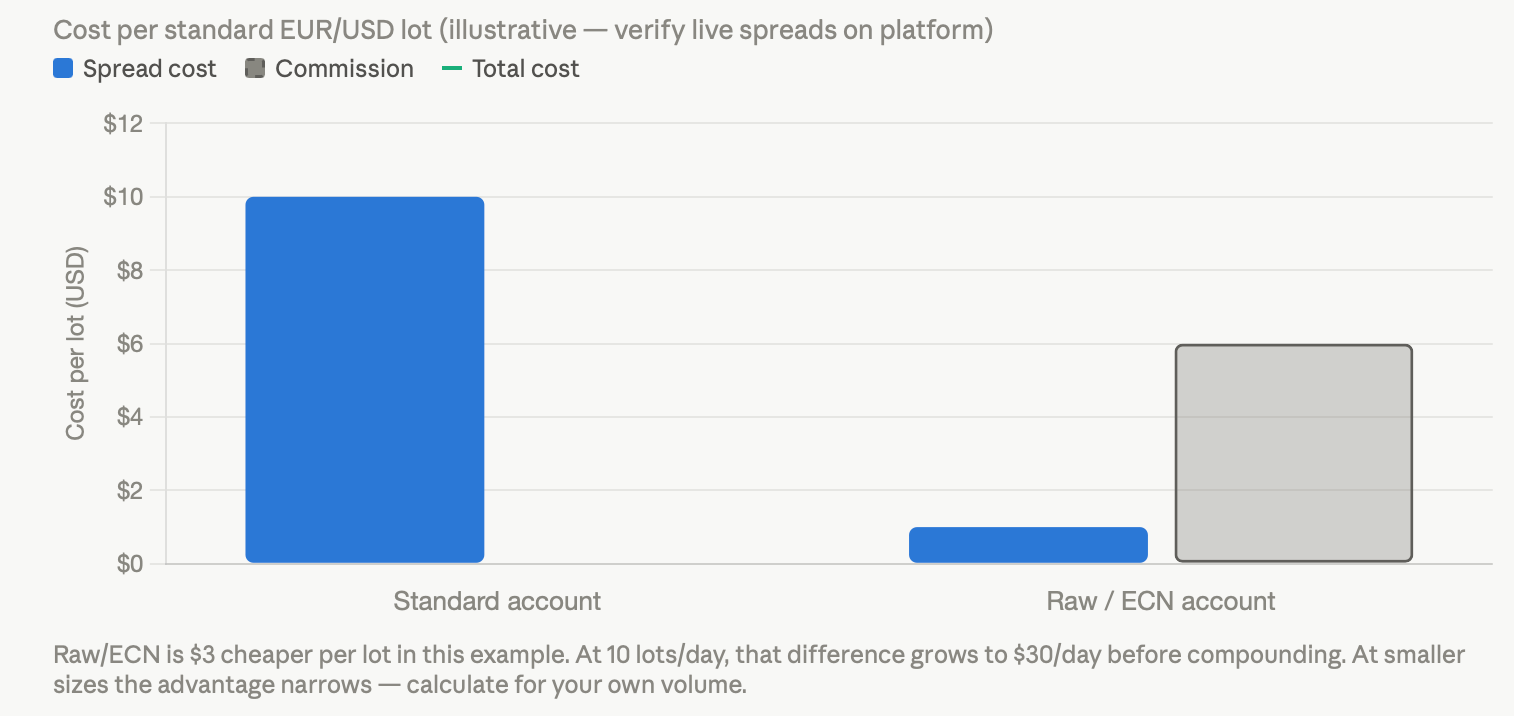
Using the EUR/USD currency pair as an example, you can compare the cost of trading across different account types. On a standard account with a spread of 1.0 pip and no commission, the cost of trading one standard lot is approximately $10. On a raw ECN account, the spread may be 0.1 pip with a $6 commission per standard lot, resulting in a total trading cost of approximately $7 per lot. In this example, the raw ECN account has the lower overall trading cost. However, for smaller position sizes, the commission represents a larger proportion of the total cost, which can make the raw ECN account less cost-effective than a standard account.
All examples are hypothetical and provided for illustrative purposes only. Spreads can widen significantly during major news events and periods of low market liquidity. Always check the live spread and trading conditions on your platform before entering a trade.
Platforms and Account Types: What to Know Before You Commit
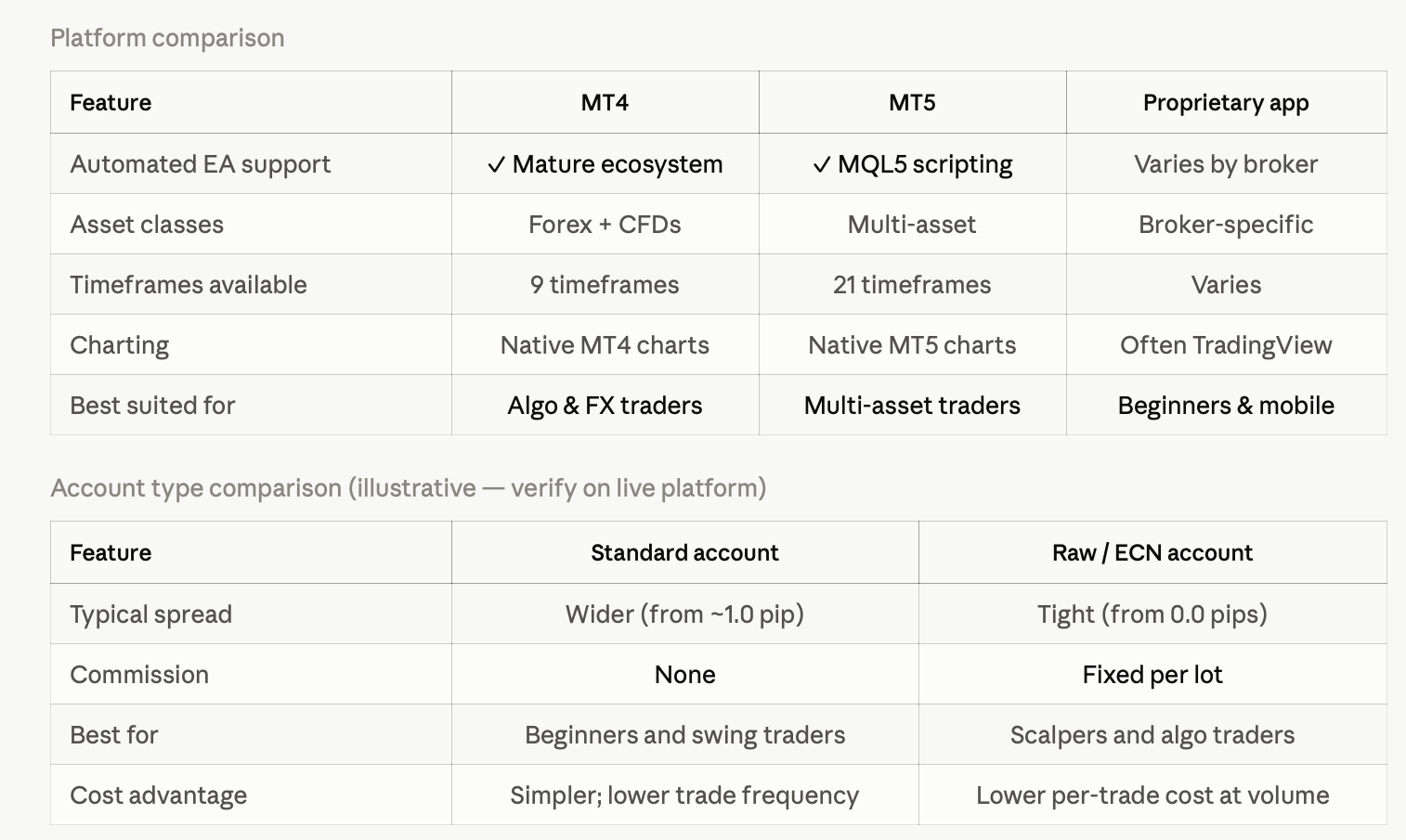
Globally, MT4 remains the most widely used retail forex trading platform. Its popularity has been built on a well-established automated trading ecosystem based on the MQL4 programming language. There are thousands of Expert Advisors (EAs), technical indicators, and custom scripts available for MT4 users. In addition, the platform's extensive documentation and mature community have helped ensure stable performance on relatively modest hardware for many years.
MT5 is built on a newer architecture and supports more timeframes than MT4. It also includes an integrated economic calendar and support for a wider range of asset classes, including futures, making it a more versatile choice for traders who want to access multiple markets from a single platform. In recent years, many proprietary trading platforms have also improved significantly. Many brokers now integrate TradingView's charting engine into their web and mobile platforms, allowing traders to access high-quality charting tools while managing their accounts and placing orders within the broker's ecosystem.
From an account structure perspective, the choice between a standard account and a raw (ECN) account generally depends on your trading style and frequency. Scalpers and algorithmic traders who execute a high volume of trades often benefit most from raw accounts because lower transaction costs can produce meaningful savings over time through the cumulative effect of reduced trading costs. In contrast, swing traders and position traders who hold positions for several days typically find standard accounts easier to manage. Although standard accounts usually have slightly wider spreads, the higher cost per trade is often less significant because these traders execute fewer trades and hold positions for much longer periods. Automated strategies using tools discussed in our guide to forex derivatives and structured instruments also require specific platform compatibility with scripted order types and API connectivity, which varies across providers.
How Tradewill Fits Into This Picture
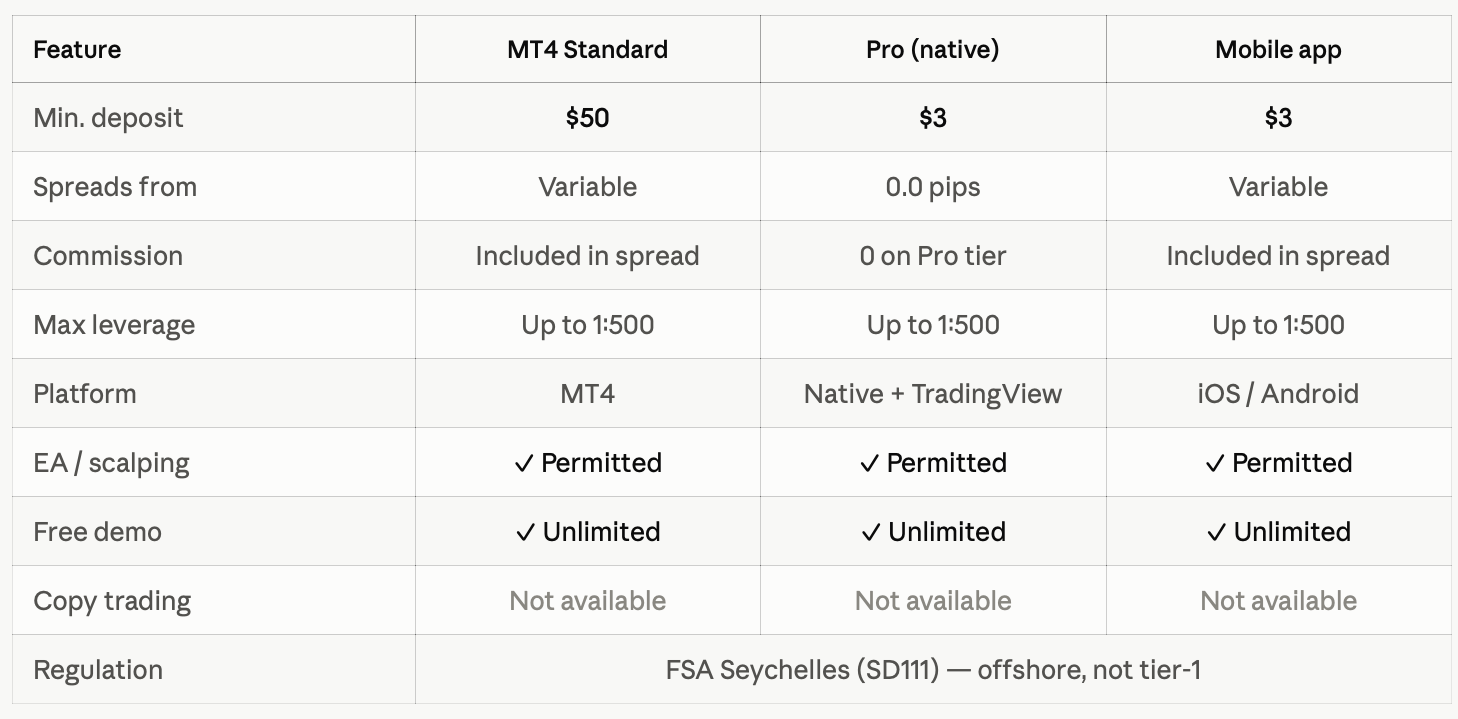
Tradewill offers both MT4 and its own proprietary platforms, including a web trader and mobile application with native TradingView chart integration. However, it does not offer MT5, and copy trading is not available. Both automated EA strategies and scalping are fully supported.
The minimum initial deposit is $3 for proprietary accounts and $50 for the MT4 Standard account. Leverage is available up to 1:500, depending on the account type and traded asset. Spreads on the Pro account can be as low as 0.0 pips. Internal execution metrics indicate average order execution speeds of approximately 0.04 seconds, although actual execution times will vary depending on market conditions. Demo accounts are available free of charge with no expiration period.
Tradewill is regulated by the FSA Seychelles (Licence SD111), an offshore regulator that is not considered equivalent to tier-1 regulators such as the FCA, ASIC, CySEC, or the CFTC/NFA. Offshore regulation generally provides a lower level of investor protection, dispute resolution, and capital oversight than tier-1 regulatory frameworks. Tradewill does not accept clients from the United States, Canada, Israel, or Iran. If regulatory protection is a primary consideration, you should carefully weigh the trade-offs between Tradewill's offshore regulatory status and its product features.
Before making a deposit, verify Tradewill's FSA Seychelles licence through the official FSA Seychelles website by following the verification process outlined earlier in this guide.
All specifications should be independently confirmed on the live Tradewill website, as conditions may have updated since publication (June 2026).
Risks and How to Avoid Bad Brokers
In the retail forex industry, fraud targeting traders is unfortunately common, with many scams directed at individuals using unregulated brokers. Approximately 70% to 80% of retail CFD and leveraged forex traders lose money. As a result, a market for predatory platforms has emerged, exploiting beginners who believe they can make money quickly and easily.
Part of building an effective risk management strategy involves understanding how currency pair correlations affect your overall portfolio exposure. There are two primary forms of risk: market risk, which arises from price movements in the financial markets, and broker risk, which relates to the broker you use to access those markets. Market risk is generally systematic and can affect the entire market, whereas broker risk is specific to the individual broker and requires separate evaluation and monitoring.
Examples of broker misconduct include restricting withdrawals, manipulating order execution, and failing to process withdrawal requests when traders attempt to access their funds. These practices are most commonly associated with unregulated or lightly regulated offshore brokers operating with limited regulatory oversight.
Periods of extreme market stress, such as black swan events or prolonged bear market conditions, often increase the demand for fund withdrawals. Unfortunately, these are also the periods when fraudulent platforms are most likely to delay or refuse withdrawal requests.
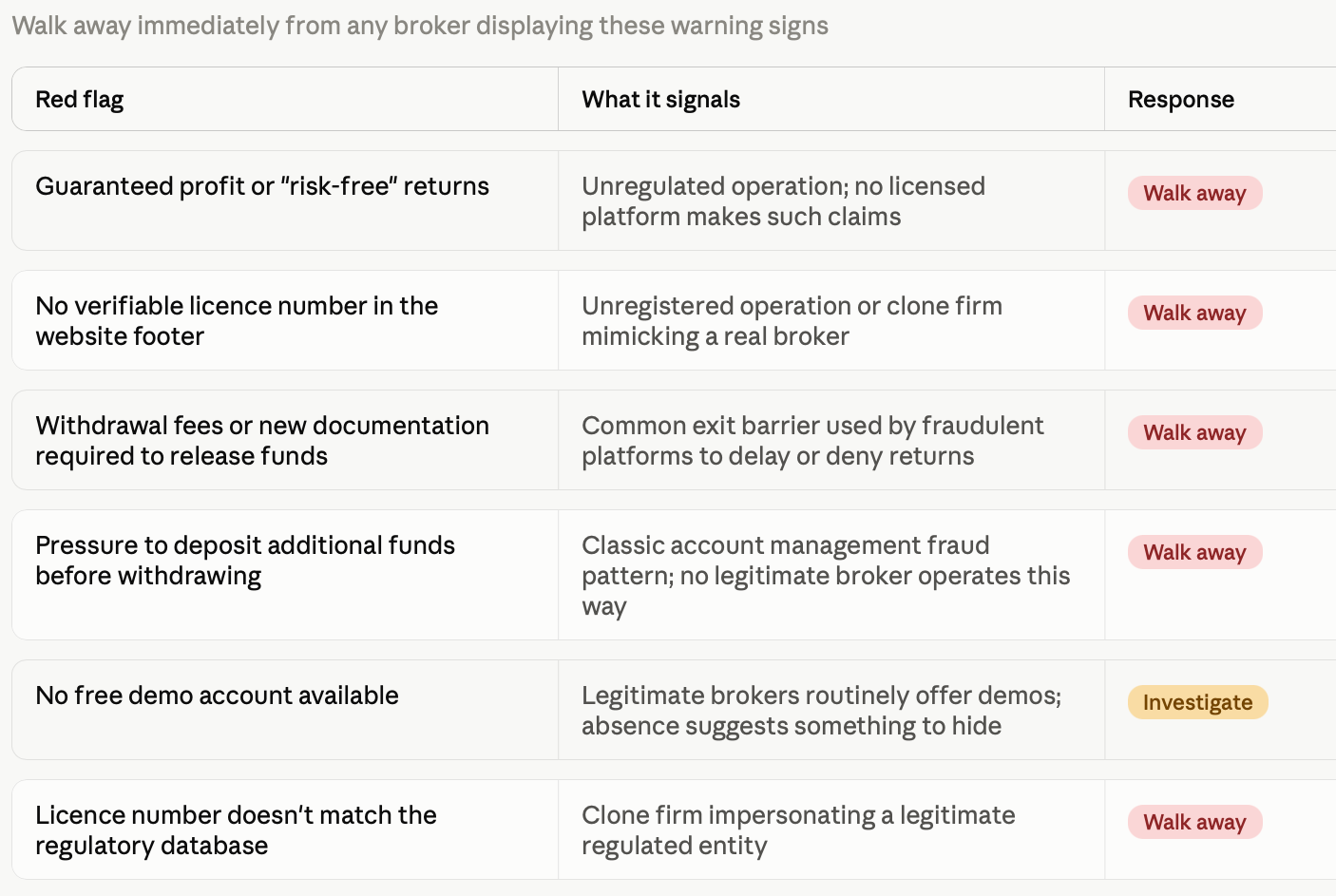
Professional traders often reduce broker-related risk by spreading their funds across multiple brokerage accounts rather than keeping all of their capital with a single broker. Beginners can reduce this risk by choosing a regulated broker, making the minimum deposit permitted by the broker (typically between $5 and $50), and testing the withdrawal process with a small amount before committing larger sums of capital.
This section is provided for educational purposes only and does not constitute financial or investment advice. Leveraged trading carries a high level of risk and may result in significant losses, including the loss of your invested capital.
Frequently Asked Questions
What is a foreign exchange market broker?
A foreign exchange market broker is a regulated company that gives traders online access to the currency market through a trading platform. The broker provides pricing, executes your orders, and offers leverage, earning money mainly through spreads, commissions, and overnight financing fees applied to positions held past the daily rollover.
How do forex brokers make money?
Forex brokers earn primarily through the spread between the buy and sell price, per-lot commissions on raw or ECN accounts, and overnight swap fees on leveraged positions that cross the daily rollover. Some brokers also charge deposit, withdrawal, or inactivity fees that aren't always advertised prominently, which is why reading the full fee schedule before opening an account is essential.
How can I verify if a broker is regulated?
Find the broker's regulatory body name and licence number in the legal footer of its website, then search those details directly in the regulator's official public database, such as the NFA BASIC, FCA Register, ASIC Connect, or CySEC database. Confirm that the company name, licence number, and registered website URL all match exactly to rule out clone firm fraud.
What's the difference between a market maker and an ECN broker?
A market maker sets its own prices and may take the opposite side of your trade directly, earning the spread in the process and creating a structural conflict of interest. An ECN broker connects your orders with a live pool of market participants and liquidity providers, charging a fixed commission per lot instead, typically producing tighter raw spreads without the direct conflict.
What does negative balance protection mean?
Negative balance protection ensures you can't lose more than the funds currently held in your trading account, even if a leveraged position moves sharply against you during a gap event. Some regulators mandate it for retail clients, while other brokers offer it voluntarily, and it's a meaningful protection worth confirming before you trade with leverage.
Is MT4 or MT5 better for forex trading?
Neither platform is universally better, and the right choice depends entirely on your strategy and which tools you actually need. MT4 remains the most widely used retail forex platform with a mature ecosystem of automated expert advisors, while MT5 supports more timeframes, additional asset classes, and newer order types for traders who want to access multi-asset markets from a single interface.
Is Tradewill a good broker for beginners?
Tradewill offers a very low minimum deposit, a free unlimited demo account, MT4 access, and a proprietary app with TradingView charts, which makes it a low-cost testing environment for traders stepping out of demo mode for the first time. It's regulated offshore by the FSA Seychelles (SD111) rather than a tier-1 authority, and it doesn't serve the US, Canada, Israel, or Iran, so verifying the licence directly and starting with a small controlled deposit is the recommended approach.
Conclusion: Putting It All Together
To select a foreign exchange (FX) broker, follow a three-part priority framework regardless of your level of experience: first, regulatory protection; second, total trading costs; and third, platform usability. Since no single broker is suitable for every trader, you should always verify the broker's regulatory status and test its platform using a demo account before opening a live account. Your decision should be based on your trading strategy, trading frequency, preferred instruments, and risk tolerance.
Regulation provides a level of protection and a means of holding brokers accountable if problems arise. Understanding the total cost of trading helps protect your returns from hidden expenses that can compound over time, especially for active traders. Choosing a platform that suits your workflow removes one unnecessary source of difficulty from an already complex trading process.
Use the verification steps outlined in this guide regardless of how professional a broker's website appears or how many industry awards it claims to have received. The only authoritative source for verifying a broker's regulatory status is the official database maintained by the relevant regulator, and these databases are freely accessible.
CFDs and leveraged forex products are high-risk financial instruments that can result in substantial losses over a short period. Make sure you fully understand the risks before trading. Tradewill is not responsible for the content or accuracy of third-party regulatory databases.
Open the free demo today, test a position, check a simulated withdrawal, and decide with your eyes fully open.
Disclaimer: The content of the blog does not represent any position of Trade W, does not serve as any trading-related decision advice, and does not endorse any third-party.