

 Trade W
The forex market is active 24 hours a day across the globe, making it the largest and most liquid financial market in the world. With over $7 trillion dollars in daily volume, currencies continually fluctuate based on economic data, geopolitical events, and most importantly, central banks policies.
Central banks are not just monetary policy setters in an ivory tower. They are active participants in the marketplace and their decisions are reflected in currency pairs within seconds as a result of announcements. For example, when the Federal Reserve raises interest rates or the European Central Bank initiates quantitative easing, those actions will change exchange rates as they create both opportunities and risk for traders.
If you understand central bank behaviors then you are at a big advantage as a forex trader. Central banks use tools, execute at times, and communicate in patterns that follow predictable frameworks that astute traders will utilize to forecast currency for movements. This guide will explain everything you need to know about central banks, from the basis of their role to advanced techniques for interpreting their policies.
We will examine what central banks do, the tools that affect currency value, and most importantly, how to incorporate that into the trading process. You will be able to read between the lines of the policy statements, combine fundamental analysis with technical charting, and manage risk around important central bank events.
What is a Central Bank?
Think of a central bank as the conductor of the financial orchestra. The central bank manages monetary policy to contribute to economic equilibrium. The central bank is the highest monetary authority in your country and has tools to hugely bolster or weaken currencies in seconds merely through an announcement.
Central banks around the world and their functions all have some important impacts on forex markets. First, central banks have the capacity to issue and control the money supply in the economy, which determines the amount of currency that circulates through an economy. Central banks make the decision to print money if they want to increase the supply and change the exchange rate.
Or, they will reduce the supply if they want to reduce the exchange rate. Secondly, central banks determine benchmark interest rates, which affect every interest rate, from your mortgage payments, to the value of the currency. Third, the central banks act as guardians to maintain appropriate financial stability, regulating banks, and acting in crisis situations. And last, the central bank will hold foreign exchange reserves (even the own currency) to potentially buy or sell their own currency to influence.
It is important for traders and investors in the financial world to latch onto the differences between the central banks and commercial banks. While your local commercial bank develops, earns, and functions on lending and deposit functions to earn revenue, the central bank functions with one primary goal of economic stability.
Unlike commercial banks, the central banks have the liberty to literally create money, they can set interest rates for an entire economy, and they can intervene in foreign dysfunctional markets when needed.
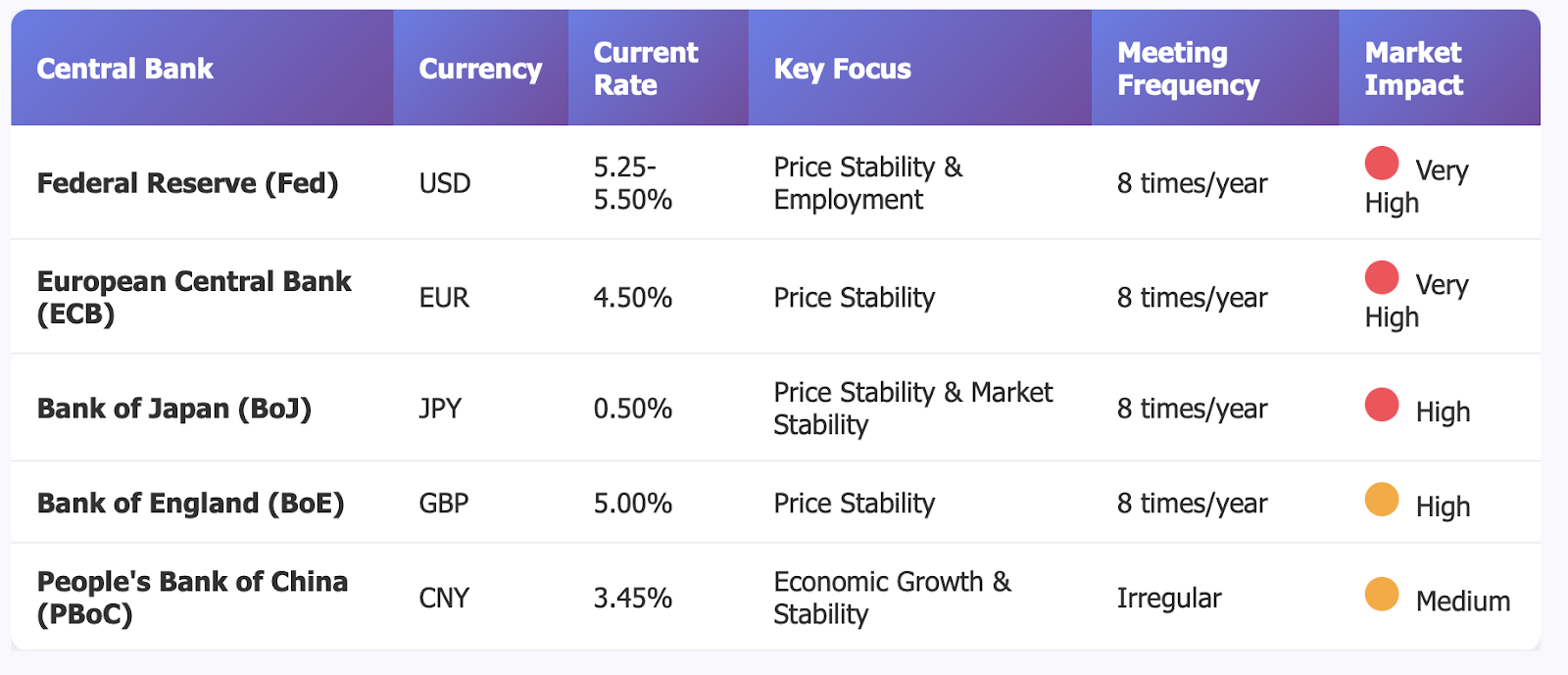
Important central banks include the Federal Reserve (Fed) in the U.S.A., the European Central Bank (ECB) for the Eurozone, the Bank of Japan (BoJ), the Bank of England (BoE) and the People's Bank of China (PBoC). Central banks operate independently of each other within the borders of their jurisdiction but on occasion cooperate with each other in times of worldwide financial crisis.
To put this into easy to understand terms, simply consider a central bank to be like a school principal who controls all the resources and sets the rules that affect every student. When the principal raises the lunch price, students must react accordingly to how much spending money they have.
The same can be said for the actions of the central banks when it sets their interest rates, and just as every student reacts to the school principal in their spending, traders and investors react to a central bank's changes in interest rates by buying or selling currencies worldwide.
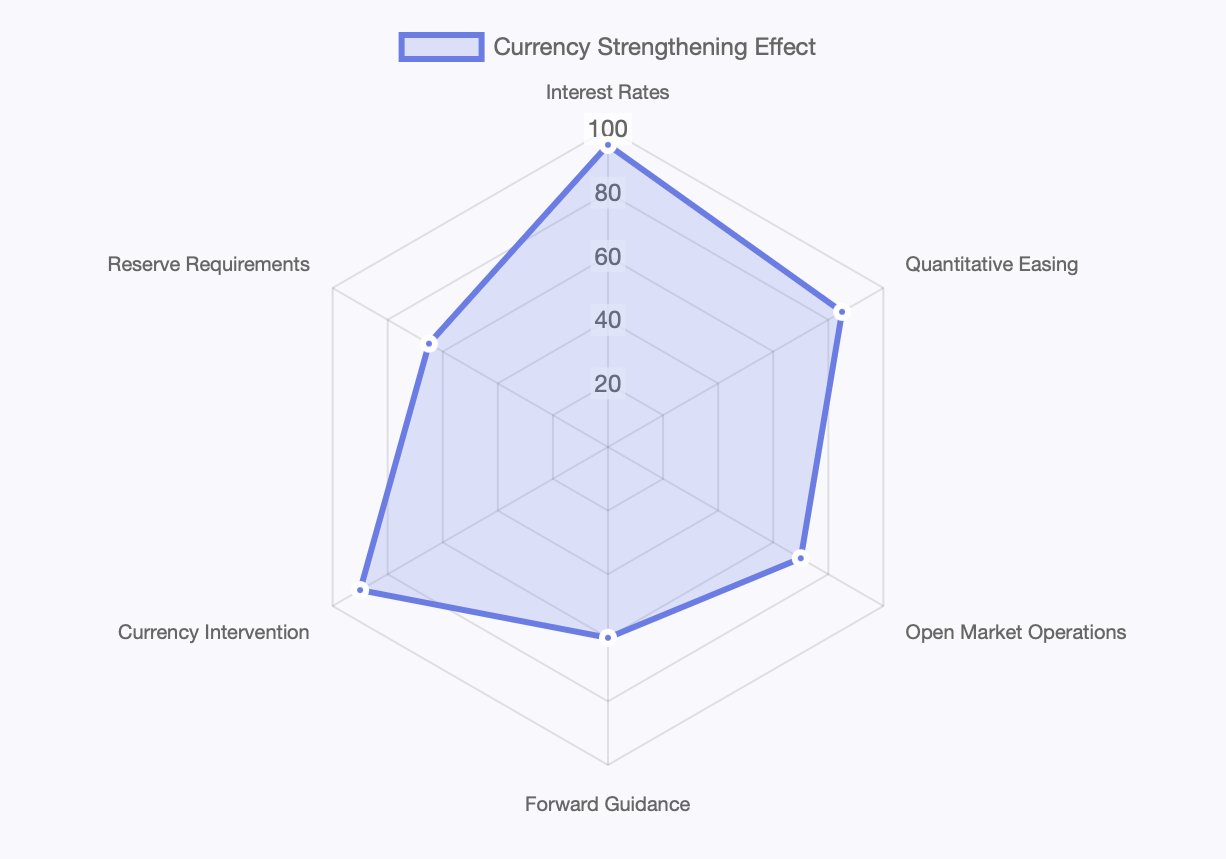
How Central Banks Work in Forex
Central banks affect currency values in the market through three distinct pathways - interest rate policy, open market operations, and direct market intervention. Knowing how central banks work is critical to traders because it allows traders to anticipate and position in the market based on centralized latent currency shifts.
Interest rate policy is the central bank's strongest influence over currencies. When interest rates are increased, we would generally see that currency strengthen due to higher yields attracting foreign investment into the country.
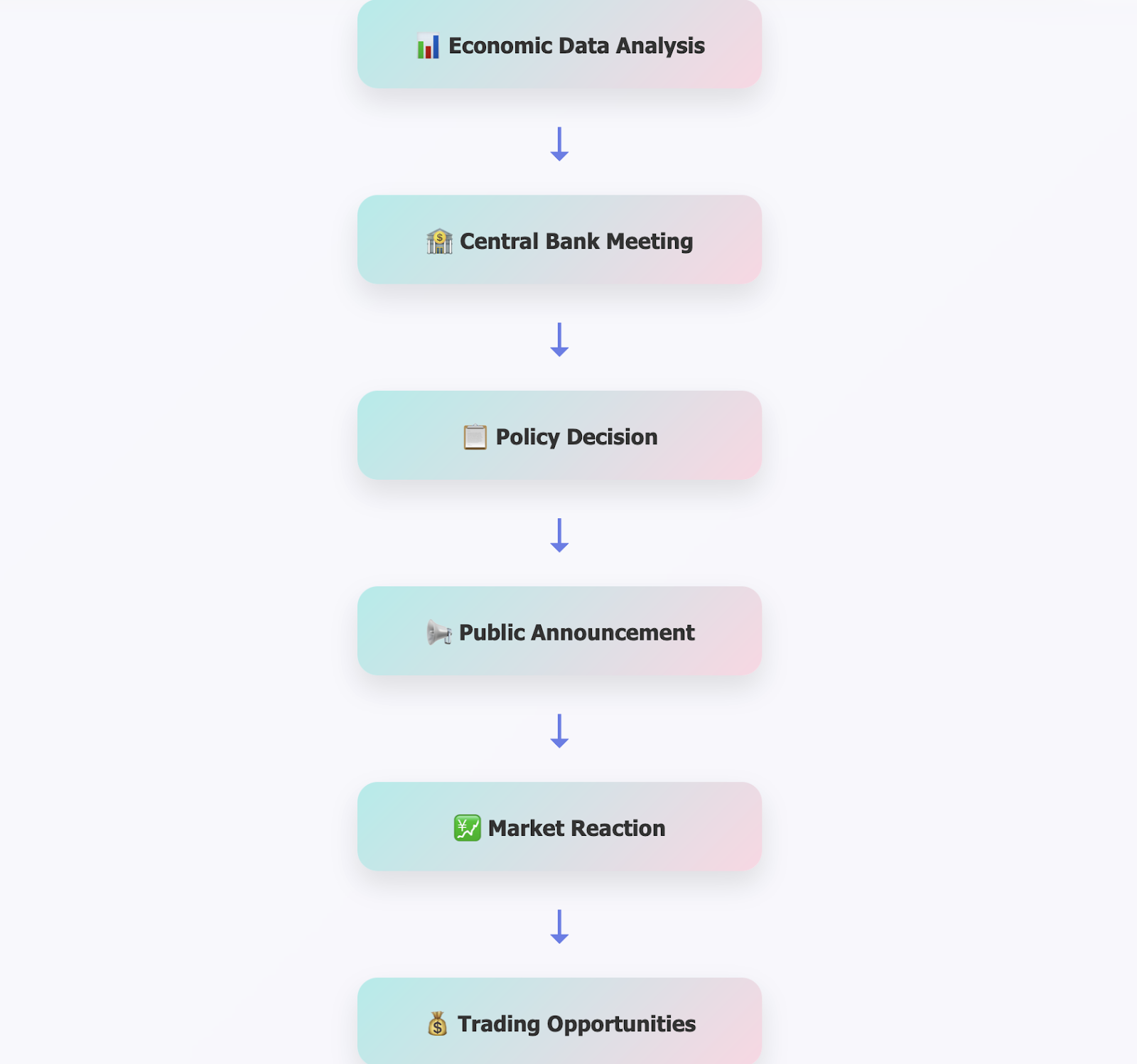
Thus investors move capital to any country where investment returns are greater. Increased demand for that currency drives the pricing higher. And in the opposite direction, if interest rates are low and subsequently cut to decrease demand for currency, then emerging market investors will chase yield and the currency would typically weaken.
Open market operations are when a central bank buys or sells government securities to control the money supply (currency) and the liquidity available in the banking system. When a central bank buys a security, they inject capital (money), or liquidity, into the banking system; while when they sell a security, they take liquidity out of the banking system.
Typically, this liquidity dries up and currency strength strengthens. The Bank of Japan intervenes in the currency market when the yen gets too expensive and threatens exports. It is considered a direct forex intervention because the central bank actively buys or sells its own currency.
Consider the interest rate decisions by the European Central Bank (ECB) and their impact on EUR/USD. When the ECB lowers rates, while the Fed keeps rates the same or increases them, the euro usually decreases in value and becomes weaker versus the dollar. The interest rate differential means capital tends to flow from the euro to the US dollar, all without requiring any influence from the central banks to create a trending opportunity for the currency trader.
Another clear example is the Bank of Japan's intervention in 2011when the country was devastated by a tsunami and nuclear disaster. After the tsunami and nuclear disaster, Japanese firms began bringing cash back to Japan, which caused a quick spike in strength for the yen.
The Bank of Japan intervened by selling yen which caused the price of USD / JPY to climb from about 74 to about 76 - over 300 pips within a single trading day.
Think of shifts to central bank policies like a school changing cafeteria pricing structures. If healthy lunches suddenly cost less, while junk lunch prices go higher, students are going to alter their behavior. If a central bank prices one currency more attractively (in this case with higher rates) than other currencies, it stands to reason that all global flows of money will adjust accordingly.
As such, each time a central bank introduces policy, there is likely volatility but traders need to think about possible directionality and how significant the move could be. Traders who are consistently aware of the central bank calendar and what the expectations are for policy can position themselves pre-event and capitalize on the moves.
The Tools of Central Banks
Central banks utilize several different, yet sophisticated, instruments to influence the economy and, by extension, the value of currency. Knowing about the instruments provided by central banks can help traders anticipate movement in the market and adjust based on shifts in policy.
Interest Rate Tools The key interest rate generally referred to as the federal funds rate in the US, is the cost for banks to borrow money overnight from other banks. Central banks are also responsible for discounting these rates at which banks can obtain lending directly from the central bank. These discounts feed through the entire financial system and affect everything from mortgages to currency values.
Open Market Operations (OMO): Open market operations (OMO) consist of the selling and buying of government securities in the open market to control the overall supply of money. When central banks purchase securities, then additional cash increases the overall liquidity of the banking system, which usually results in a weaker currency. Alternatively, selling the securities decreases the money in circulation, and hence liquidity, and will tend to cause some strengthening of the currency.
Quantitative Easing (QE) and Quantitative Tightening: Quantitative easing, or QE, is a form of extreme monetary easing, where central banks primarily purchase government and corporate bonds to boost the money supply and lower long-term interest rates.
The Reserve Bank of New Zealand recently launched its QE3 program for that simple reason, which injected over $1 trillion into the US economy and led to a process that initially significantly weakened the US dollar. Quantitative tightening occurs when central banks allow bonds to mature without replacement, which means the balance sheet will decrease without the issuance of new debt.
Foreign Exchange Intervention: Occasionally, central banks intervene directly in the foreign exchange market by buying or selling their currency directly in economic transactions. An example of how impactful unconventional intervention policies can be in fiscal policy is when the Swiss National Bank (SNB) decided to abandon their EUR/CHF floor in 2015. This led to the franc appreciating 30% versus the euro in only a matter of minutes!
To get straight to the point, think of a school that has various “pricing” mechanisms to manage students’ behavior. A school with cheap tickets for educational activities encourages you to join. A school with expensive punishments discourages bad behavior. This approach of using mechanisms to drive behavior is similar to how central banks operate, just with different tools.
Understanding how these tools work as a trader is critical for considering where the market will go. When the Fed starts QE, dollar weakness will follow. If the ECB raises rates, the euro will appreciate. The big question in either of these investments is the tool and its market effect.
The Impact of Policy of the Central Bank
Central bank policies are the fundamental underlying environment within which all forex trading occurs. These policies create volatility, change long term trends, and create both opportunities and risks to business which traders need to be careful with.
Currency Movements and Trading Opportunity: Every policy announcement creates an immediate response in the price when markets are attempting to assimilate the new information and probable consequences into their expectations and therefore pricing.
For example, the EUR/USD can move through a range of 100-200 pips after a decision from the ECB, while emerging market currencies can swing even more wildly after a decision by the Fed. While these currency movements are profit opportunities for traders who are prepared, they can put traders on the wrong side of the price movement if they’re not aware of the Central Banks and their policies impacts on the movements.
Carry Trades and Interest Rate Changes
An interest rate change will impact the profitability of carry trades, where a trader borrows a low-yielding currency to buy a high-yielding one. If the Fed raises rates and the Bank of Japan doesn't raise rates and remains at zero rates, the carry trade with currencies like USD/JPY is more attractive. If a trader relies on rate changes and gets that trade wrong, they can quickly take a carry trade from profit to loss.
There are high volatility and price spikes/threats during central bank intervention. This is literally a zero to sixty move in price action where traders can get smoked on a stop loss and lose all of their cash during a central bank intervention in about 6 minutes of time.
In div. 4 when the BoJ intervenes and trades and doesn't show, it can happen in some pretty thin Asia times and knock out many and easy last prices for enough yen to get Japan to try and screw the capital markets outside of Asia to payout curly fries to specific market players that can clearly move price and get back to playing along with their naive interference in the market.
A good analogy would be viewing central bank announcements in the news as surprise sales at your favorite store. So, most smart and savvy shoppers (traders) subscribe to the stores' newsletters (econ calendar to find out what is coming). They look for when the sales happen (FOMC, ECB and BoJ) and plan their sales with a shoppers list (trading plan) and a budget (risk management). Others will be hungry and be ready to buy and miss the surprise sales because they didn't prepare.
Forex traders who want to be successful pay attention to the central bank calendars. They target the days of FOMC meetings, ECB press conferences, and the BoJ policy. These announcements create the biggest market moves, which means they will be careful about their position size, controlled risk, etc.
The primary takeaway for traders is that central bank policies not only produce momentary volatility, but they also create longer-duration trends. The Fed's rate hiking cycle from 2015-2018 created a multi year dollar bull market, while the ECB's negative rate policy continued to keep the euro weak for a multi-year duration.
Historical Case Studies of Central Banks
Learning from historical central bank actions is priceless in understanding how policies ripple through into pricing behavior. These historic examples serve as useful frameworks for thinking about how markets might respond in the future.
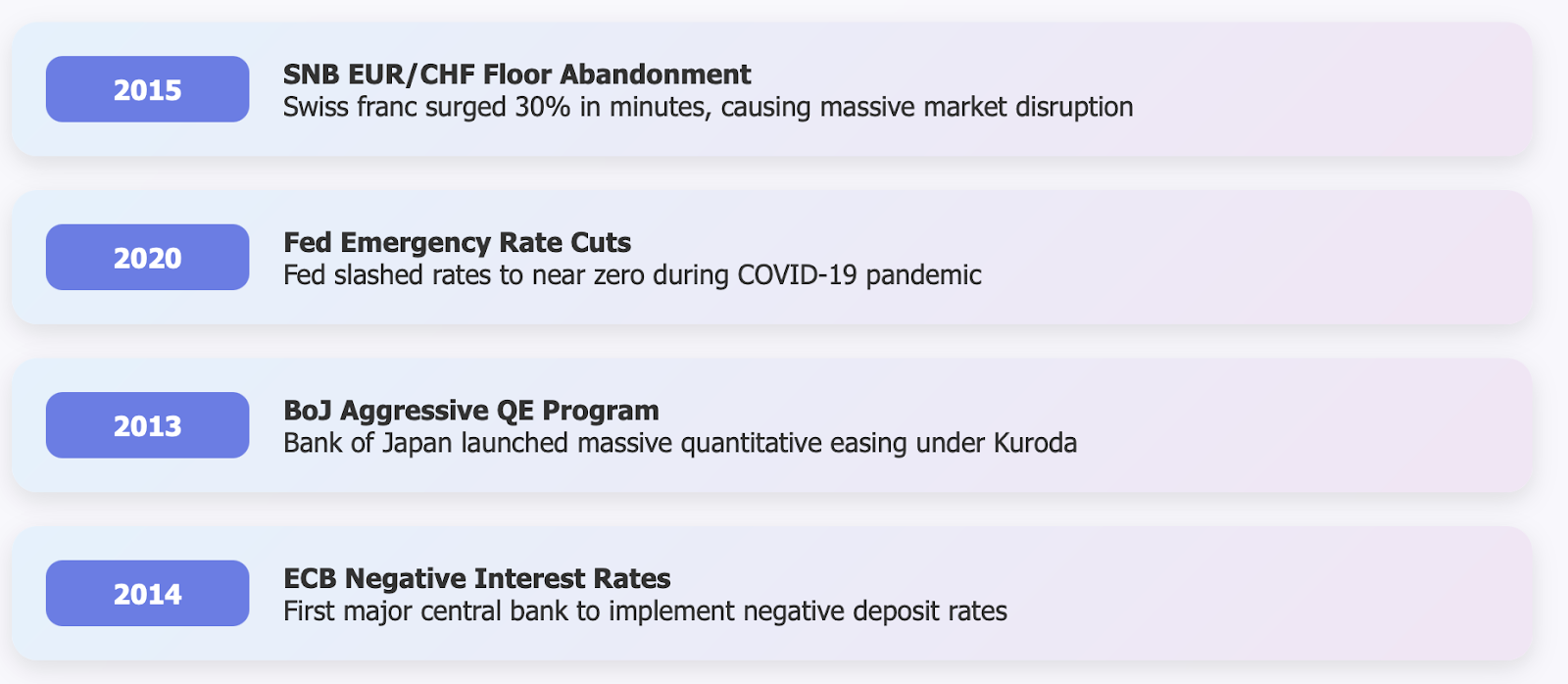
Swiss National Bank EUR/CHF Floor abandonment (2015) : In January of 2015, the Swiss National Bank surprised the market by ditching its 1.20 floor on the euro without so much as a warning. The franc jumped 30% in minutes and traders ill-prepared suffered catastrophic losses, and some retail brokers even went bankrupt. It illustrated well how central banks can make about turn decisions in the blink of an eye; even when something feels stable, risk management should always be an important consideration.
Federal Reserve emergency rate cuts (2020) : In March of 2020 when COVID-19 struck, the fed slashed its target from 1.75% to near zero in unscheduled emergency Fed meetings. The dollar was initially weaker as rate differentials narrowed, only to strength later as global investors sought safe haven assets. This process demonstrated how crisis responses can lead to complex multi-phase market responses.
Bank of Japan (BoJ) Quantitative Easing Program: The portion of the monetary response over the long-term that the BoJ adjusted to quantitatively ease globally emanated from the BoJ in the early 2000s, with q.e. expanding further under the newly appointed Governor Kuroda in 2013.
In this case, monetary policy failed to produce predictable effects on the yen valuation relative to risk during times of global uncertainty/volatility. During risk-off episodes the BoJ's QE could not weaken the value of the yen due to the yen being viewed as a safe haven asset. This suggests that monetary policy impact and efficacy is contingent upon broader market conditions.
European Central Bank (ECB) Negative Rate Experiment The ECB broke first and blew past zero rates to negative rates in 2014, breaking major economy paradigms. Markets adjusted from the initial deep decline in the euro, which was substantial. Initially unprecedented action (negative yields) morphed into the new normal. Policy radicalism loses its value and arrives at policy exhaustion and continued aggressiveness to elicit a same impact in market reaction.
To provide insight, consider a school principal who changes rules at the semester mark. Initially students respond strongly to the new rules - with emotion. Inevitably, students and all involved adapt to the changed conditions of the school environment. As to markets we initially experience dramatic reaction, initially emotional to policy changes and then incorporate into derived baseline reflection.
These historical examples offer valuable lessons for traders. Firstly, central banks can surprise markets even if they telegraph their intentions. Secondly, initial market reactions to central bank actions don’t always persist, as other pieces of information emerge. Thirdly, extreme policies take extreme measures to ensure they continue to work, ultimately leading to the destruction of the efficacy of an extreme policy (the law of diminishing returns).
How to Read Central Bank Policy
Reading central bank policy instead of simply reading statements involves not just understanding the statements, but also understanding what nuances in those statements will help you understand the policy's direction in the future. This is an ability that distinguishes successful fundamental traders from traders that merely react to news headlines.
Understanding policy statements - Central bank statements have a predictable structure; however, those statements can carry a great deal of meaning when you examine the meaning of variations in normal usage.
For example, as the U.S. The Fed is shifting from the terms "patient" to "data dependent", it is an indication to the market that rates may be moving up. The same is true for the European Central Bank when it states some "ample degree of monetary accommodation."
When the ECB involves those words, the market understands to expect scaffolding monetary policy. It is useful to pay attention to adding words, deleting words and modifying normal usage of language.
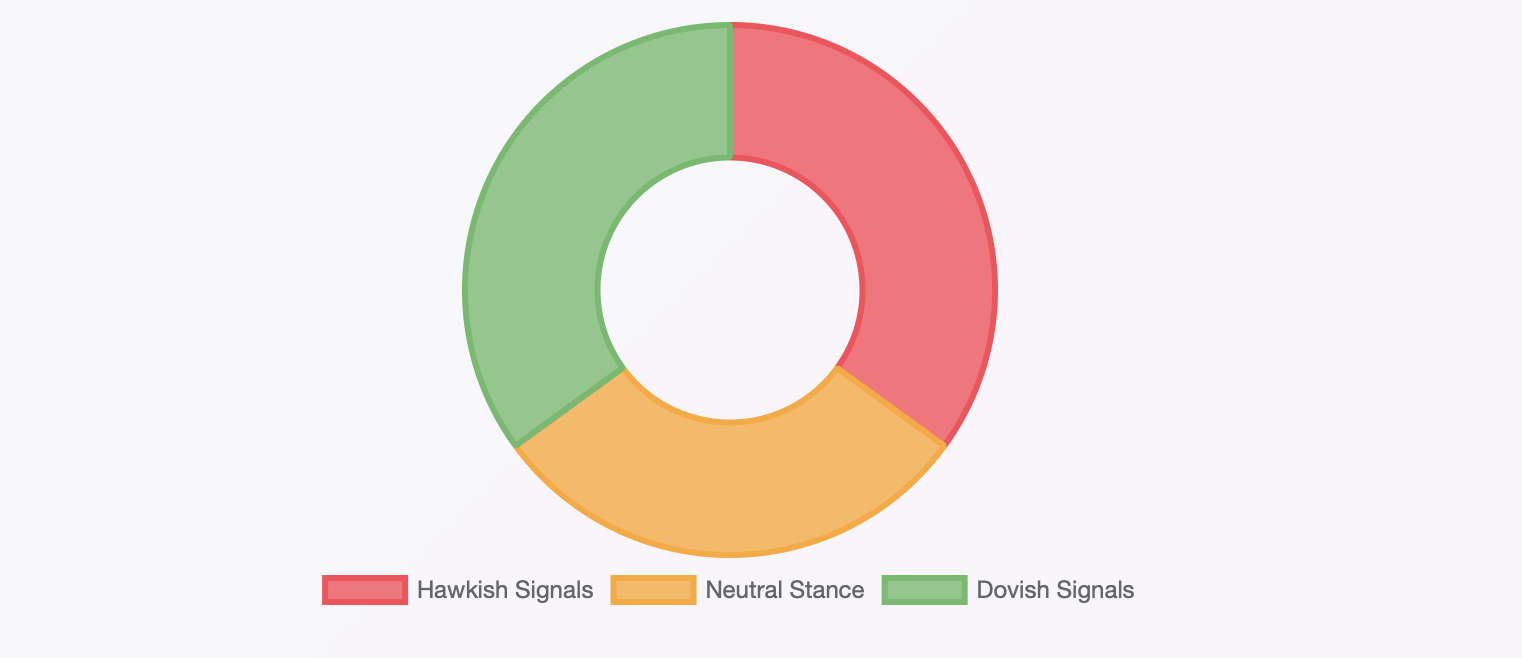
Hawkish vs. Dovish - Hawkish preferred higher rates and higher currency. Dovish wanted lower rates and lower currencies. Central banks would lead the markets into their hawkish or dovish tendency by a number of ways: speeches, interviews and statements of the policy. For example, "vigilant about inflation" suggests to the market a hawkish tendency. The phrase "supporting the recovery" suggests a dovish tendency.
Reading Between the Lines: Central bank officials often utilize nuanced or strategic language in their communiqués which the market then tries to figure out. For example, when Fed officials say they it is "watching the data closely," they are not committing to any action or course of action for policy changes, but readying the markets for consideration of such alternatives. ECB officials might talk about "optionality" when they want to maintain flexibility going forward.
Governor and Official Speeches: Central bank governors often speak on behalf of their central banks outside formal board meetings. These speeches can provide valuable insights into their policy objectives. These officials will often use their speaking engagements as an opportunity to prepare the market for policy decisions or communicate recent policy adjustments. Think of Mario Draghi's "whatever it takes" speech in 2012 which unexpectedly and absolutely changed the dynamics of the eurozone, and it was delivered in an event outside of formal ECB meetings.
For example, think if central bank communications were like hints from a teacher as to what might be on their next exam. The well prepared student (better yet, traders, styled as students here) may pick up on the more subtle clues about what is important, while the distracted ones only hear the more overt statements and totally miss a lot of the very important information.
There is no magic pill, or fool-proof method to know what the communication and behavior patterns of a central bank are, but finding, recognizing, and knowing these patterns can be the key to successfully interpreting policy. There are communication styles and key signal words that each central bank prefers to use. For the Fed, communication is highly correlated to measured, data dependent language.
Meanwhile, the BoJ seems to emphasize market stability more than any other form of communication. If we know these things ahead of time, we'll know if the central bank is shifting and heading for adjustments before these policy signals are obvious to the broader crowd.
Combining Central Bank Policies with Technical Analysis
The best forex trading strategies combine technical chart analysis with fundamental policy analysis to find the best timing for their entry/exit decisions. Analyzing market fundamentals helps to understand why currencies are moving, while analyzing technical price levels should inform when to time your actions.
Pre-event technical preparation Before major central bank announcements, you should plan out the technical levels that you think may be important after the perceived policy announcement. Chart patterns, trend lines, and support and resistance levels give traders an idea of where price potentially may head after the announcement. If you see the EUR/USD trading at a major resistance level just prior to an ECB meeting, if there is a hawkish surprise from the ECB, that currency pair could break out above that resistance, and on the other hand, if the outcome is dovish, it could lead to a reversal.
Volume and volatility Most central bank events will achieve above average volume and volatility, which strengthens the reliability of technical indicators. The Average True Range (ATR) may widen prior to and surrounding major policy meetings, as well spikes in volume will be useful when determining if a breakout is true versus false. You might also look to adjust your position sizes and stop losses prior to the data release based on spike in volume and volatility as well.
Post-event technical confirmation Don't blindly assume the price will follow through if there is a price reaction to a data series without confirming the technical picture. For example, the initial spike move may retrace back to the breakout levels, and narrow minded price action traders who follow trends will miss out on a better entry point. Most importantly, wait for these close above or below critical support or resistance levels, before believing you have started a new trend.
Multiple Timeframe Analysis Combine policy analysis with charts across different timeframes. Daily charts show longer-term policy impacts, while hourly charts help time specific entries around announcements. Four-hour charts often provide the best compromise between trend identification and entry precision.
Imagine technical analysis as weather forecasting and central bank policies as wind direction changes. Meteorologists use both current conditions (charts) and pressure system changes (policies) to predict weather patterns. Similarly, traders need both technical levels and policy understanding to navigate currency movements effectively.
The most profitable trades often occur when technical and fundamental analysis align. A hawkish central bank surprise that triggers a technical breakout provides higher probability opportunities than relying on either approach alone.
Global Market Implications of Central Bank Policies
Central bank policies don't exist in isolation; they create ripple effects across global markets, affecting everything from emerging market currencies to commodity prices. Understanding these interconnections helps traders anticipate broader market movements and identify correlation opportunities.
Fed Policy and Emerging Market Impact Federal Reserve decisions profoundly impact emerging market currencies due to capital flow dynamics. When the Fed raises rates, investors often pull money from higher-risk emerging markets to capture better risk-adjusted returns in US assets. The 2013 "taper tantrum" demonstrated this relationship when Fed tapering discussions caused massive emerging market currency selloffs.
Cross-Currency Effects Major central bank policies affect currency pairs even when those banks aren't directly involved. ECB easing typically strengthens USD/JPY because euro weakness makes the dollar more attractive globally, influencing yen positioning. These cross-currency effects create trading opportunities beyond obvious pairs like EUR/USD.
Commodity Currency Connections Central bank policies significantly impact commodity-linked currencies like the Australian dollar, Canadian dollar, and Norwegian krone. Fed easing often weakens the dollar and strengthens commodity prices, benefiting resource-exporting countries. Conversely, Fed tightening can pressure both commodities and their associated currencies simultaneously.
Safe Haven Flows Central bank policies influence risk sentiment, affecting safe haven currencies like the yen, Swiss franc, and sometimes the dollar. Aggressive easing policies might initially weaken a currency but eventually trigger risk-off sentiment that benefits safe havens. The relationship between policy stance and safe haven flows requires careful analysis of market conditions.
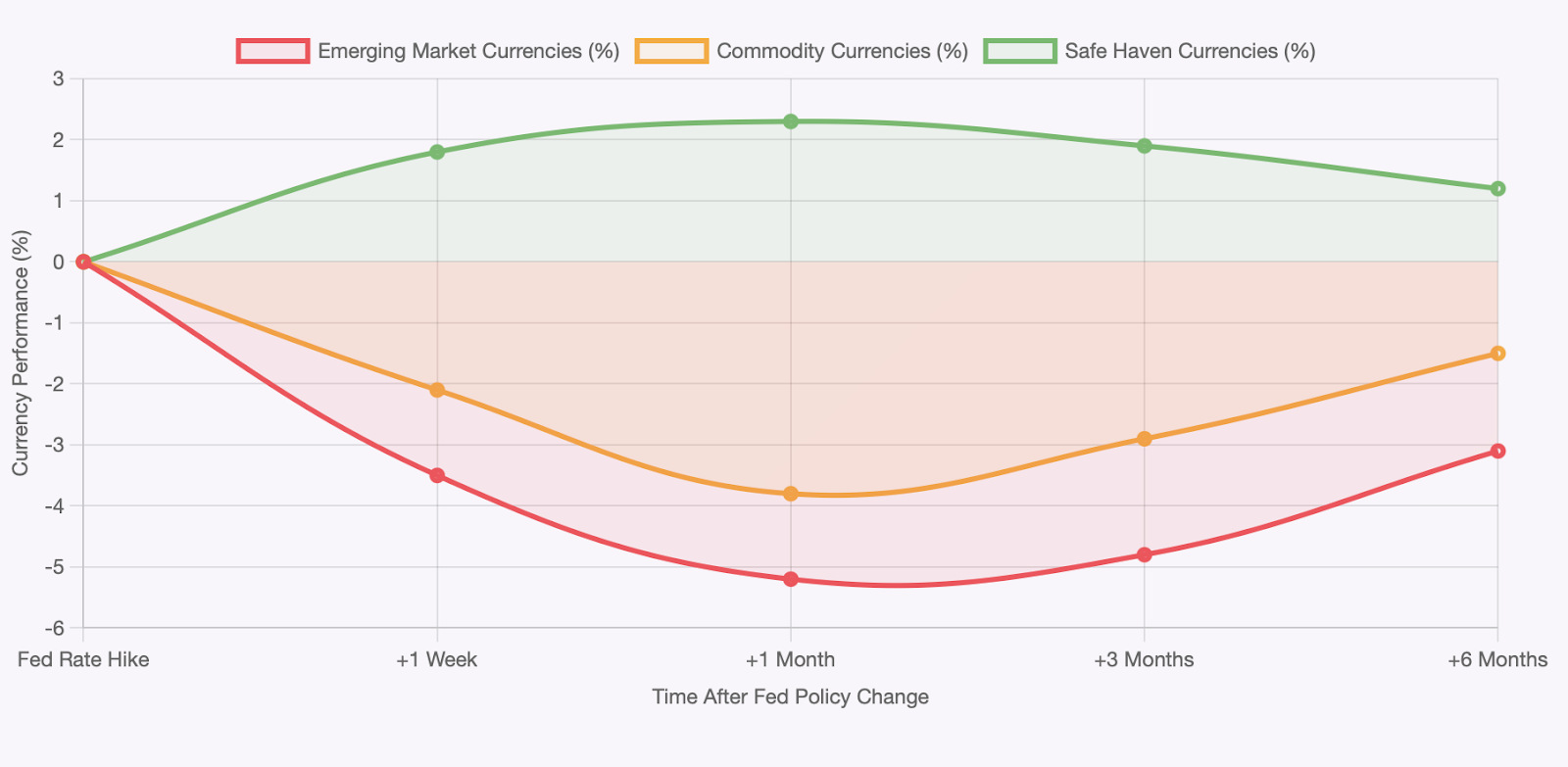
Think of central bank policies like adjusting one valve in a complex plumbing system. Changing pressure in one area affects flow throughout the entire network. Traders need to understand these systemic connections to anticipate where opportunities might emerge across different markets.
The key insight is that central bank policies create both direct effects on domestic currencies and indirect effects through global capital flows, risk sentiment, and cross-market correlations. Successful traders monitor these broader implications rather than focusing solely on individual currency pairs.
Risk Management Around Central Bank Events
Central bank announcements represent some of the highest-risk, highest-reward moments in forex trading. Proper risk management during these events can mean the difference between capitalizing on opportunities and suffering devastating losses.
Position Sizing Strategies Reduce position sizes before major central bank events to account for increased volatility. Many successful traders cut their usual position size by 50% or more around FOMC meetings or ECB press conferences. This approach allows participation in potential big moves while limiting downside risk from unexpected announcements.
Stop-Loss Placement Traditional technical stop-loss levels often prove inadequate during central bank events due to increased volatility and potential gaps. Consider using wider stops or time-based exits rather than relying solely on price levels. Some traders prefer closing positions before major announcements and re-entering after initial volatility subsides.
Avoiding Whipsaw Markets Central bank announcements frequently create false breakouts and rapid reversals as algorithms and human traders interpret policy nuances differently. The initial spike move often doesn't represent the lasting market direction. Patient traders wait for dust to settle before establishing new positions based on clearer policy implications.
Volatility-adjusted risk/position parameters: Use Average True Range (ATR) or implied volatility measures to adjust your risk/position parameters around central bank events. For example, if your normal ATR on a currency is 50 pips but you notice it expands to 150 pips around monetary policy meetings, you would adjust any stop-loss values or profit targets proportional to the extent that the ATR has change. This proactive approach allows you to avoid having your position stopped out for normal market noise.
Diversification benefits: Don't put all your trading capital into currency pairs that are most directly affected by certain central bank policy decisions. Make sure to diversify risk across different currency pairs and even asset classes to avoid correlation disasters. For example, if the Fed surprises the markets (which can happen!) USD based currency pairs often move together so diversification risk within the forex market would not be effective.
Think of participating in global macro events around central bank meetings the same way you would think of driving a car in severe weather conditions. A thoughtful driver would know to reduce their speed, place more distance between themselves and other vehicles, and become more aware of changing driving conditions. A trader should be aware they may have to change their approach when a policy storm is approaching.
The most important truth in trading central bank events is to avoid risking more capital than you can afford to lose in one central bank event. Even the best analysis, and in-depth market knowledge cannot account for unexpected central bank policy surprises or incredibly strong or weak reactions that create temporary chaos in the currency markets.
Conclusion
Central banks are the most powerful entities in the global forex markets since they have the power to increase or decrease currencies within minutes of policy direction. Acknowledge their roles, tools and communication styles and give yourself a monumental head start in the currency markets.
Through this brief discussion we have seen how the central banks are the central planners of monetary policy, with the use of interest rates, quantitative easing, and direct interventions to reach their economic aims. Central bank decisions cause immediate volatility and longer-term trends, creating unique trading opportunities for the informed trader - a potential for profit for traders fully aware of all the factors these public policy decisions produce and create.
And don't think that central bank policies e.g., interest rate movements exist in isolation, they also cause global reverberations affecting general financial market conditions, emerging market currencies, commodity prices and cross-currency relationships. The best traders take a systematic, rather than a pair-by-pair view of the credits, providing a more analysed view of the relevant risks.
And most importantly, always be diligent in your risk management discipline from central bank events.
Trending analysis and position size matters for high-impact events that can generate earth-shattering profits or astronomical losses. Minimize risk around periods of high uncertainty, and load up when indicators turn and the trend can move.
Follow the central banks calendar, policy statements, and speeches. The forex markets will reward a trader who is ahead of policy changes and not just trading the headlines! Practice and observe how the markets respond to different policy announcements that help improve your policy interpretation skills for future monetary policy analysis.
Ready to take your central bank analysis to the next level and change your forex trading results? Utilize your economic data to trade based on the overall prevailing fundamental factors in the market!
Disclaimer: The content of the blog does not represent any position of Trade W, does not serve as any trading-related decision advice, and does not endorse any third-party.