

 Trade W
Introduction
The foreign currency market, or forex market, is the world’s largest financial market. With over $7.5 trillion traded daily, it is the largest financial market by a significant margin, highly liquid and rapidly changing 24 hours a day, and it can be quite volatile. All of this volatility can make forex an attractive but daunting proposition for traders.
That leads to a question, if forex is a global market to transact in where prices can and do change almost instantly, then why do we see prices vary from market to market and from broker to broker? The answer lies in temporary inefficiencies such as time zone overlaps, different levels of liquidity, prices changed at different time intervals, etc. These inefficiencies create small gaps in pricing that create opportunities for one of the biggest advantages in trading, arbitrage.
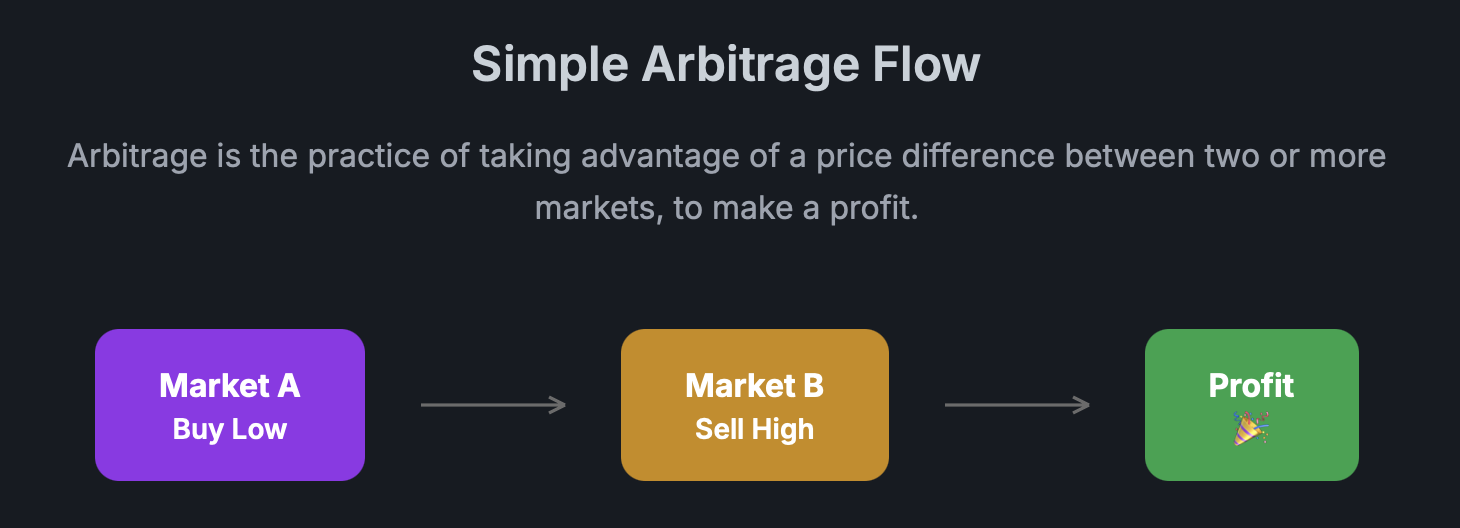
Forex arbitrage utilizes these price differences to generate a profit. Assume for example EUR/USD is priced at 1.1040 in London but priced at 1.1043 in New York. A trader could easily buy EUR/USD low in London and sell it high in New York to lock in a profit almost immediately. And while opportunities could be very small, at scalable rates, and by being quick, they can add up fast.
This article will provide you an overview of the whole world of arbitrage trading, starting with the basic definition, types of arbitrage strategy, and how to determine opportunities, to the how-tos, famous cases, limitations and risk that anyone should understand.
Whether you are a professional trader with the best algorithm or a new trader with basic currency jargon, pieces of this guide should help you in some way.
Key Takeaway: Arbitrage is about profit through market inefficiency without risk but you need to have speed and execution, plus, know your costs.
- What is Arbitrage
At its core, arbitrage is making a riskless profit by taking advantage of price differences in the same or related financial assets. The forex arbitrage concept is to buy and sell currencies at the same time, either in different markets, or in related pairs, at the same time to create a small but consistent spread. In contrast to just speculation, arbitrage is not about predicting the future price on the market; it is taking advantage of temporary lag between market inefficiencies and being able to exploit it faster than anyone else.
The Importance of Arbitrage
In principle, forex prices should be the same across the globe, as all trading happens 24/7. In reality, however, the market has slight variations due to liquidity, time zones, and how quickly information changes. Those price discrepancies won't last long, most of the time only a matter of seconds or milliseconds, but it is enough to create an opportunity. Arbitrage is attractive, because there is no risk of losing money if the trader has fast execution and can locate the most economical transaction costs. 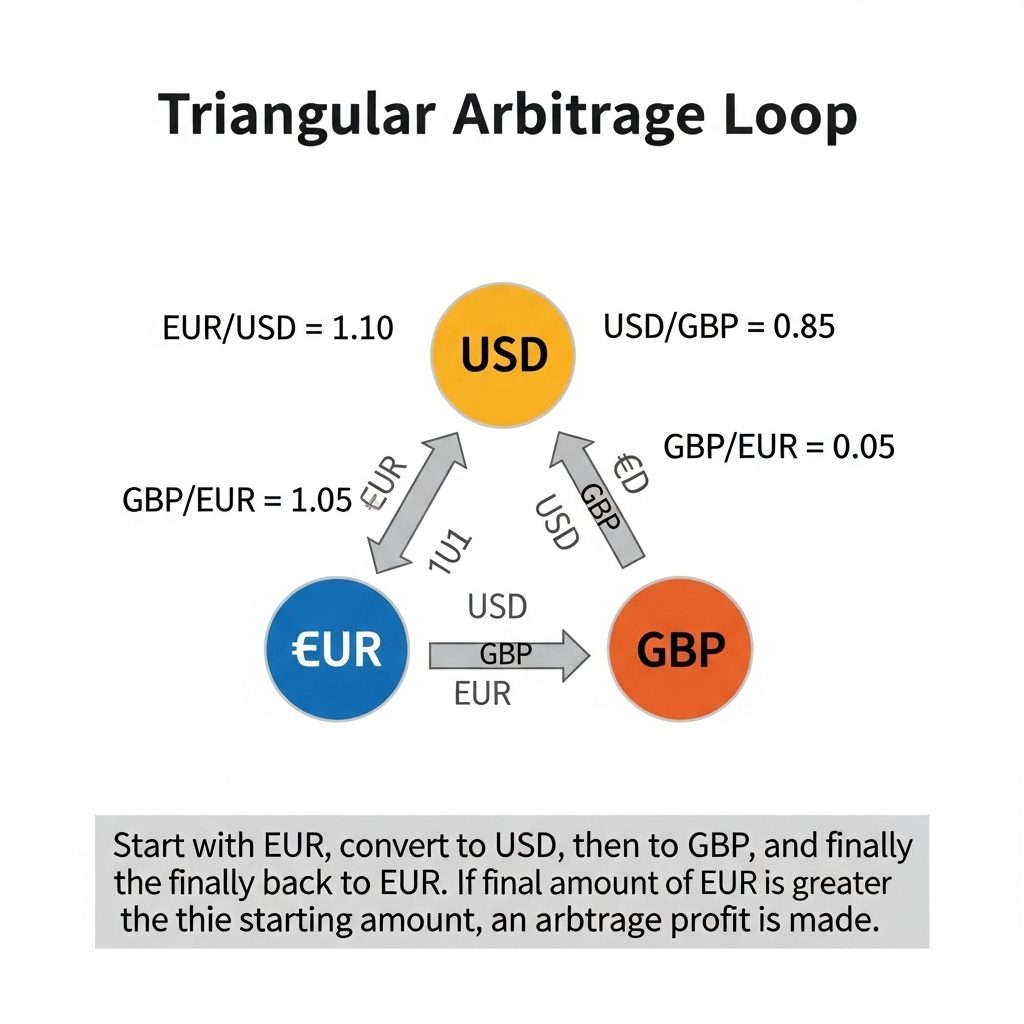
Common forms of Arbitrages
- Spatial Arbitrage
Spatial arbitrage is where a currency pair trades at slightly different prices in two different places or trading platforms. For example, EUR/USD is quoted at 1.1040 in London and at 1.1043 in New York, the trader buys the EUR/USD in London where the price is cheaper to sell the currency pair in New York for a higher price, earning an immediate profit.
- Triangular Arbitrage
Triangular arbitrage exploits the price inefficiency created in 3 different currency pairs to form a loop transaction. If the trader is working with USD, EUR, and GBP, they would turn their USD into EUR, EUR into GBP, and GBP back into USD. If the final USD is more than the initial investment, they will have captured a profit for a loop transaction. The majority of professional traders keep an eye on pairs and potential cross-rate mispricing of pairs with USD/EUR, EUR/GBP, and GBP/USD.
- Statistical Arbitrage
Statistical arbitrage uses models, historical means or algorithmic trading strategies. It detects when prices diverge from their normal ranges and bets they will revert to their mean. Suppose EUR/USD and USD/JPY normally move in almost perfect correlation, but one suddenly exhibits a significant divergence and lags the other. A statistical interpretation may signal to do an arbitrage trade until the normal price relationship resumes.
Examples to Facilitate Understanding.
- Professional example: A professional institutional trader may witness that there is a mismatch among USD/EUR, EUR/GBP and GBP/USD price relationships. They may flip between the three pairs to convert currencies and lock-in their gain without a directional view.
- Amateur analogy: In a more common, everyday context, you might buy a bottle of soda for $1 at one little store on the block, then walk to the next store on the block and sell the same bottle of soda for $1.20, and taking $0.20 profit with no risk; you simply seized a price divergence. This basic example kind of illustrates the logic involved in forex arbitrage.
- Historical lesson: Reports of triangular arbitrage between pairs like EUR/USD, USD/JPY and EUR/JPY during overlapping price sessions in Asia and Europe show how pricing divergences can often yield arbitrage opportunities regionally, for if price matches then there is significant economic fault.
- How Arbitrage Works
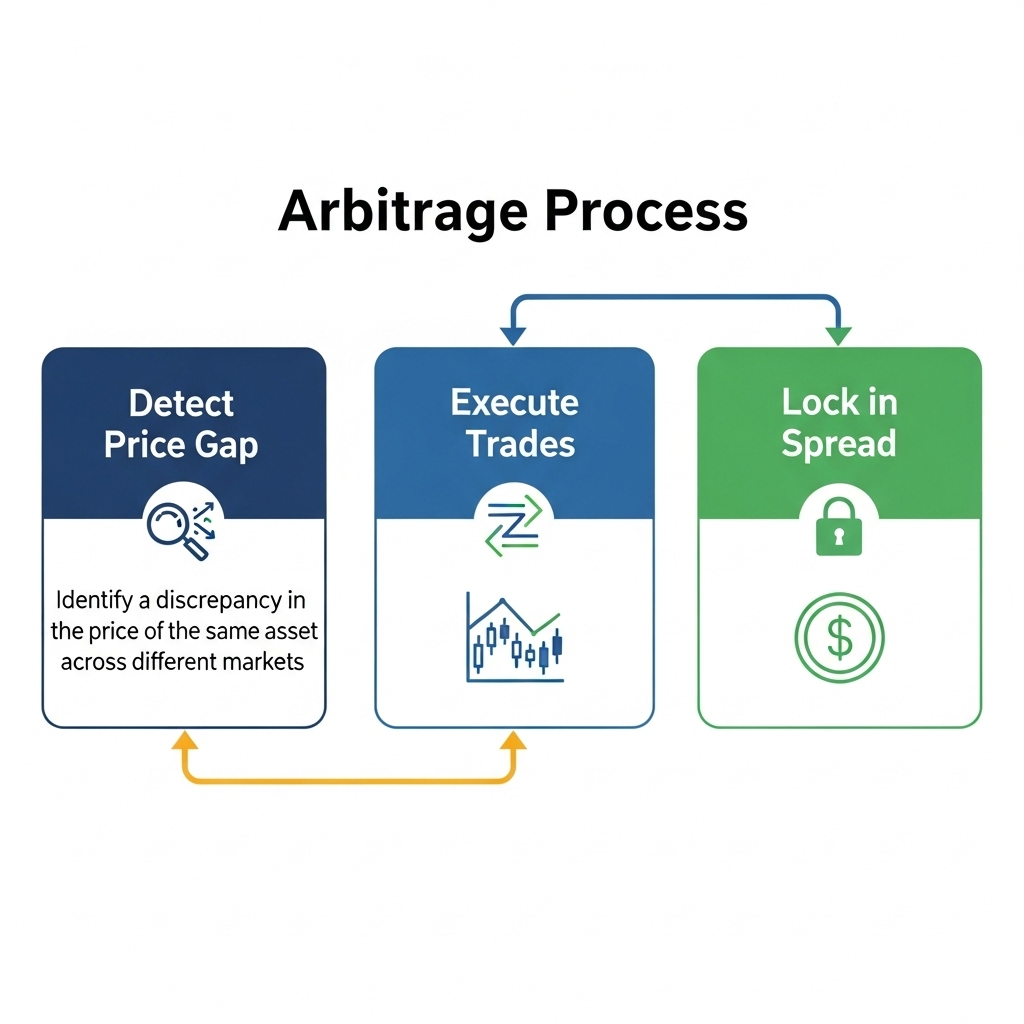
The arbitrage trading process is based on a simple idea; buy it cheaper (or at a lower price) and sell it more expensive (or at a higher price) and then keep the difference as profit. In the forex arbitrage process, the idea is usually to find small divergences in the exchange price of either the same currency or even the same currency traded through different brokers or markets.
While this concept sounds simple, the real challenge comes in two aspects of execution - the speed at which we can execute trades, and the need to accurately lock-in the opportunities before they are no longer valid.
Core Logic of Arbitrage
So, the theory is simple. A trader recognizes there is a gap, buys in the cheaper market, and simultaneously sells in the more expensive market, thereby locking in the spread as profit. However, in practice, the execution is just not that simple because price gaps are extremely small and typically disappear shortly after being posted and in seconds.
Key Elements of Successful Trading
- Speed of Trading: Opportunities only exist for milli-seconds sometimes. Pro firms have high-frequency arbitrage trading systems and use algorithmic trading tools to get the trades done instantaneously. They also place their servers as close to the exchange centers as possible to decrease speed delay.
- Capital and Liquidity: Because price gaps are often small, it takes massive amounts of volume in order to make enough profit to matter. Liquidity also matters because having the ability to get in and out of trades without slippage means having access to deep markets.
- Transaction Costs: All trades come with costs, be it the spread, commission, or fees. If the arbitrage gap is less than those costs, there is no profit for you. This is why monitoring transaction costs is essential, and to make sure you are trading efficiently.
Analogy for Beginners
Imagine two online retailers selling the exact same laptop. Retailer A is selling it for $900 and Retailer B is selling it for $920. In this scenario, if a buyer were to instantaneously buy from Retailer A and immediately sell on Retailer B, the $20 difference would be a quick and easy gain. By using a discount code or some other means to add discount value, the gain grows. This is a very simplistic reflection of arbitrage logic in real time as we go about our daily lives.
Professional Example
Institutional traders have algorithms that identify micro discrepancies in real-time. For example, let’s say Broker X is quoting EUR/USD at 1.1050 and Broker Y has a price of 1.1051. In this situation the system will purchase at 1.1050 and sell at 1.1051 at the same time. So, although the profit is only 0.0001 per unit, an institutional trader is looking to make a large profit by trading millions of units, over and over again.
Lessons from Market Events
The well-known 2010 "Flash Crash," and accompanying adverse disclosure of hedging activities by large pawn brokers was an unfortunate example of how automation and high-frequency arbitrage can simultaneously be good and bad for the market. The algorithms were simultaneously competing to exploit whichever mismatches they could find. The algorithms created market volatility, which was not considered to be a risk by arbitrageurs. In this case, we realize that multiple algorithms were operating as if the price of the forex market was independent, and the algorithm made it risky.
- Detailed Types of Arbitrages
The world of Forex Arbitrage is not confined to just one trading strategy, but rather incorporates various trading strategies, all designed to exploit mis-pricings in the market in different ways. A trader must become acquainted with how each of these types of arbitrage work, the benefits, and the various challenges each strategy brings. The three main types of arbitrage are spatial arbitrage, triangular arbitrage, and statistical arbitrage.
- Spatial Arbitrage
Spatial arbitrage occurs when the same currency pair is trading at different prices across exchanges, brokers, or markets. Traders can profit by buying the currency pair at the lower price and selling it at the higher price.
- Professional Example: An example of this would be, if the EUR/USD was trading at 1.1050 in New York, and at 1.1053 in London a trader could buy in New York, and sell in London for a trade gain of .0003 per unit traded. When done at scale a trader could realize returns with spatial arbitrage.
- Beginner Example: Think of it similar to purchasing soda at the store. In one of the stores in town soda is $1 and in another store nearby soda is $1.20. You would be able to buy soda at one store ($1.00) and sell it at another store ($1.20), this is spatial arbitrage.
This is the simplest and easiest form of arbitrage but can be quite time sensitive particularly as savvy (often tech savvy) traders are able to close the gaps quickly, all it takes is a slow educated decision.
- Triangular Arbitrage
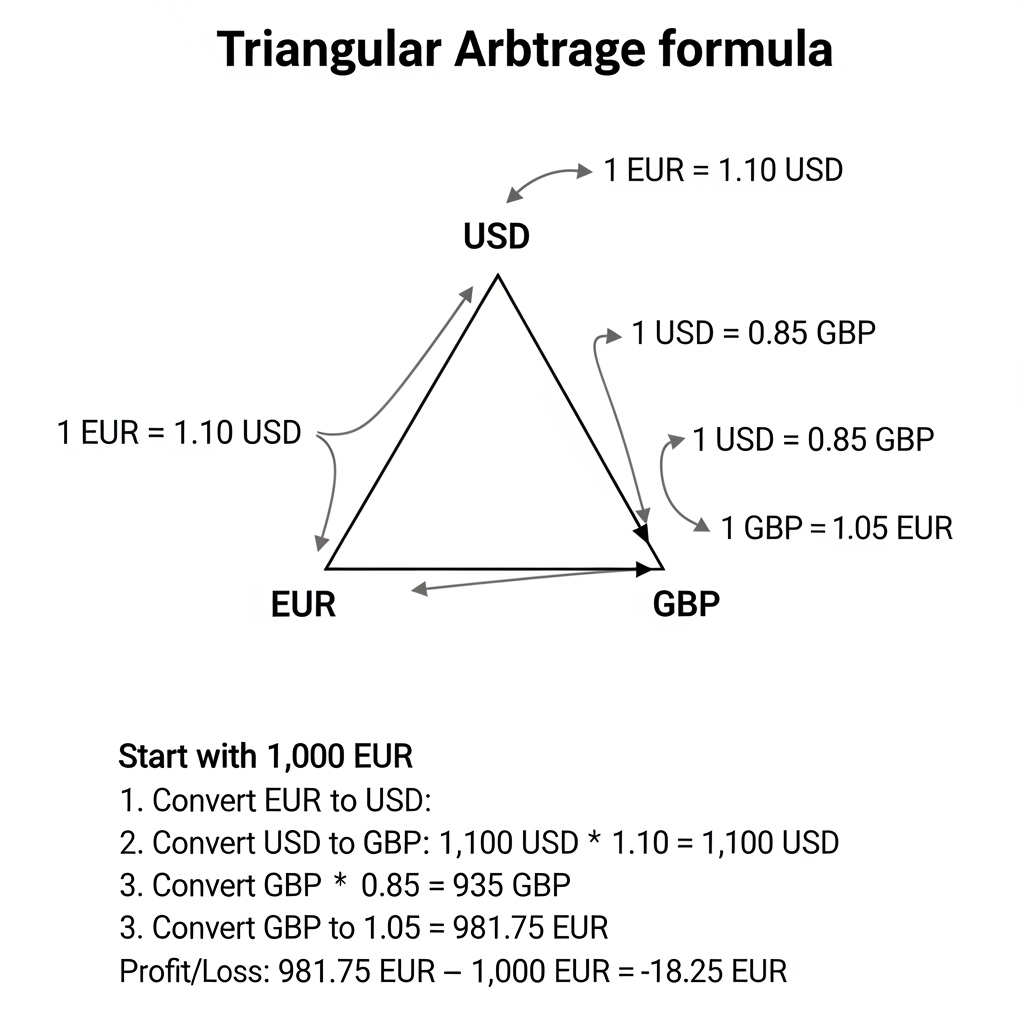
Triangular arbitrage is not as simple but involves three currency pairs. The idea of the strategy is to take advantage of discrepancies that take place in the cross-rates. Traders set up a closed trading loop, converting one currency to a second, the second to a third and finally back to the first currency. If these rates are not aligned correctly, the result is obtaining additional units of the originating currency.
- Professional Example: Using USD, EUR and GBP for the example, a trader may first convert USD to EUR, and then EUR to GBP, returning finally to USD. If the misalignment occurred because the actual cross-rates were mispriced, the loop will yield an immediate profit with no market risk. Such actions are commonplace in institutions and traders who monitor pairs like EUR/USD, USD/GBP, and EUR/GBP.
- Beginner Example: Consider exchange of gaming points. One platform allows you to trade 100 game points into 10 gold coins, a second platform trades 10 gold coins into 5 diamonds, finally a third platform trades 5 diamonds back for 110 game points. The trade results in the illusory extra 10 game points that were realized entirely by triangular arbitrage.
The power of successful triangular strategies is that you are utilizing the discrepancies not between two locations, but with the pricing relationships themselves.
- Statistical Arbitrage
Statistical arbitrage can be described as more sophisticated of a strategy. Notably, it is based on mathematical models, historical averages, and sometimes employed machine learning, for detecting price deviations instead of just obvious price differences. The premise behind statistical arbitrage is that the relationships between currency pairs often revert to historical averages after temporary relationships. With short-term market inefficiencies, there is always an opportunity to exploit divergence.
- Professional Example: A trading company employs an algorithm which is trained on multiple years of EUR/USD and USD/JPY data. The model indicates that the EUR/USD currency pair is undervalued relative to the USD/JPY currency pair (the spread is not in-line with historical spreads). The system takes a position, as it expects the spread between the currency pairs to converge, and will be able to capture a profit as cause the spread finishes in alignment with historical averages.
- Beginner Example: Think about a study on exam results. If historical math average scores are usually very close to historical average science scores, but one anomalous year the math average score is very low compared to the history, then it is safe to “predict” there will be a correction in the next test. The logic I just described is similar to Statistical Arbitrage logic.
Statistical methods are often used by hedge funds and institutions because it relies on computing power, complex mathematical models, and ideas which are tested in-back-testing repeated over time. In my simple presentation for beginners, I think it's important to view it as being about divergence from the average in the sense of identifying patterns from past examples, rather than simply being concerned about differences in price.
Key Comparison
- Spatial Arbitrage: Straightforward, focuses on price disparities between locations, highly competitive and sensitive to costs.
- Triangular Arbitrage: Complex, looks to exploit cross-rate mispricing, frequently used by professionals (typically automated).
- Statistical Arbitrage: Advanced, model-based; seeks to predict reversion to historical relationships, institutions primarily use.
- How to Calculate Arbitrage
The real advantage of arbitrage is in accurate calculation. While recognizing a price disparity is the first step, the trader must ensure that the gap is wide enough to cover the expenses and net the trader profit. Knowing how to do an arbitrage calculation gives either a beginner or professional the capacity to quantify the opportunities they are encountering, and enable them to avoid profits and losses.
Spatial Arbitrage Calculation
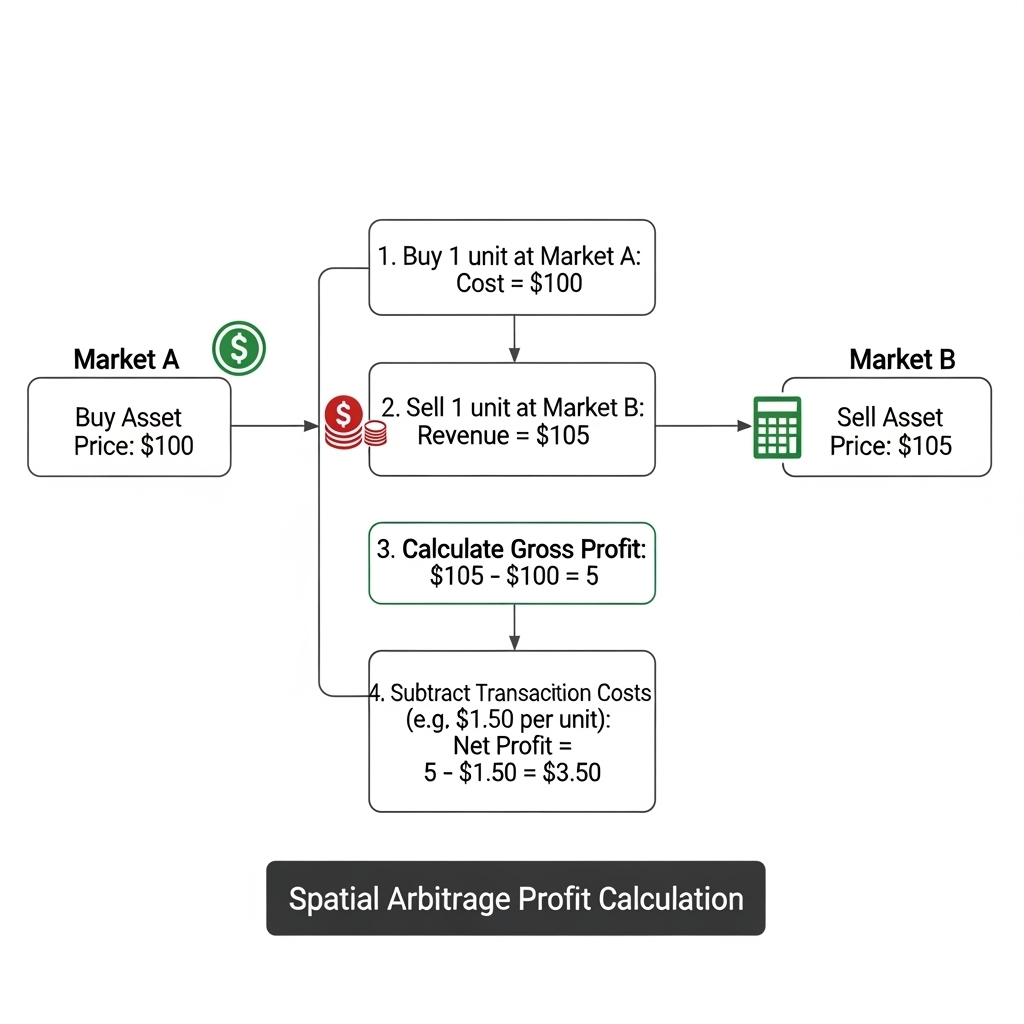
When calculating profit in spatial arbitrage, it is an easy calculation. The formula is
- Profit = Sell Price - Buy Price - Transaction Costs.
- An example: A quote of EUR/USD is 1.1050 on Broker A, and 1.1053 on Broker B. The raw spread is 0.0003. The total cost (spread plus everything else) is equal to 0.0001. The net forex arbitrage profit is equal to 0.0002 per unit. In total, if you were to multiply it out to one million units you would have a profit of $200 any day of the week in what seems like an almost negligible gap.
This shows that a little gap goes a long way when combined with volume. Even the tiniest of differences can translate into value with enough capital and proper cost control.
Triangular Arbitrage Calculation
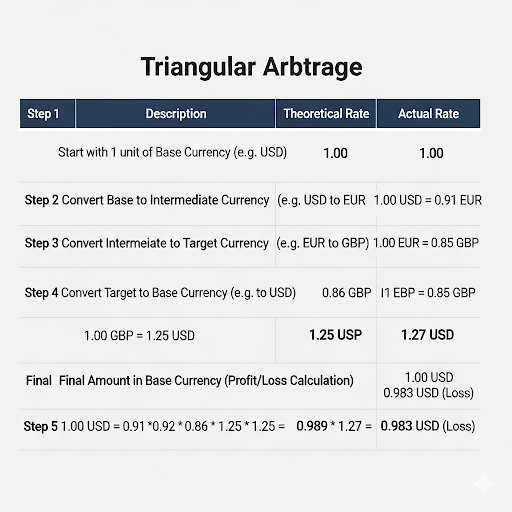
Triangular arbitrage involves more calculations however there is a logic to it. The triangular arbitrage calculation is mostly comparing comparative 'theoretical' quotes, (cross rates) with comparative 'actual' quotes in the market.
Process for calculation:
- Find three exchange rates, for example:
EUR/USD =1.2000
USD/GBP =.8000
EUR/GBP quoted = .9600
- Now you calculate the implied EUR/GBP cross rate using EUR/USD ×USD/GBP = 1.2000 × .8000 = .9600, and compare it to the quoted EUR/GBP rate.
- If instead, EUR/GBP = .9500, converting EUR → USD → GBP → back to EUR would yield more than what you started with creating arbitrage profit.
- Example 1 (Professional Example): A trader dealing in millions of EUR, could calculate this loop in milliseconds and consolidate to immediately take advantage of the gap between the three rates EUR/USD, USD/GBP and EUR/GBP.
- Example 2 (Beginner Example): Think of three different snack markets. If 1 chocolate bar buys 2 cookies, 2 cookies buy 1 soda, 1 soda for 1.2 chocolate bars, you just made a few extra chocolate bars by closing the loop. This is triangular arbitrage basically.
Element of Costs and Capital
Good excutions dont matter if you dont consider transaction Cose. Spreads, liquidity and execution risk can affect your returns. Capital is important too; if capital is smaller, you might not make a catchable profit. If large enough, you can make a larger profit regardless of how small the spread can be.
Reliability of arbitrage does not just result from finding arbitrage opportunities. You need to calculate the return of your arbitrage precisely. Before executing your trade, a trader must ensure that profit exceeds all costs. If a trader is determining which arbitrage calculation method to use, whether it is a straightforward arbitrage calculation or triangular arbitrage formula, what matters most for success and reliability is accuracy, speed, and disciplined use of capital.
- Risks and Limitations of Arbitrage
While seamless arbitrage appears as "free money with no downside,” like all things, it has several challenges that mean it is far from risk-free. Traders should be aware of the varying forms of arbitrage risk to avoid costly mistakes and to encourage safer strategies.
Types of Arbitrage Risk
Execution Risk
Execution risk is one of the most common challenges traders face. Because arbitrage only exists for seconds, a delay or slip-up and that profit margin disappears. A common regret is traders will see lost profit from a high-frequency trading delay. Unfortunately, prices will often adjust faster than us regular humans can react, which is why so many lean on automated systems.
Capital Risk
Profits from arbitrage are almost always tiny, so traders often leverage or place a large amount of volume to increase their returns. This will induce considerable risk from forex trading. If there’s a lack of liquidity or a position cannot be liquidated timely, then a tiffy fluctuation can cause losses. And the other side of limited liquidity is partial fills leaving a trader with restricted profitability.
Regulation Risks
Certain authorities will give traders regulations limiting the pace of trades, citing that they are manipulative. In some markets, the regulatory authorities deal with high-frequency trading risk, by limiting or banning arbitrage strategies. If traders are leaning on arbitrage risky trading without compliance or ignoring the rules set down by the respective regulatory authorities, they may face a penalty or be shut down.
Practical examples
- A beginner example: Imagine selling a used item online. If the buyer has an indefinite delay in completing the sale, and the value of the item goes down during this period, your profit will be lower than anticipated. This delay can be classified as execution risk when arbitraging.
- A professional working example: One example of arbitrage failure came during a forex trading platform that experienced advanced difficulty during the 2010 Flash Crash. The market algorithms appeared to take advantage of tiny differences in the market to obtain small profits. However, as the liquidity vanished, these traders lost a noticeably larger sum than they expected. This demonstrates that arbitrage can serve as a source of instability during periods of excessive volatility in the marketplace.
How to Mitigate the Risks
- Use automated algorithms, and also monitor in real time, to eliminate, as much as possible, execution delays.
- Limit your leverage to minimize exposure and ensure that any small price fluctuation does not turn into larger losses.
- Spread arbitrage trades across brokers and markets and supervise/redesign exposure to local liquidity shortfalls.
- Stay up to date with market regulations to remain compliant and avoid inactivity .
- Use of automated algorithms and real time monitoring can help mitigate execution lags.
- Keep leverage to a minimum to protect against small price movements turning into large losses.
- Diversify between brokers and markets to limit liquidity shortages.
- Keep up to date on rules to avoid regulatory breaches that could cost you your activity.
- Practical Applications in Forex Trading
Understanding arbitrage is one thing; the main challenge is to apply what you know. In trading, theory is nothing if you cannot execute the trade correctly. The profits gained by traders in most cases rely upon speed, accuracy, and applying the right forex arbitrage strategies in the real world. So let's take a look at some different arbitrage applications that traders are utilizing in the forex market.
Short-Term Arbitrage
Short-term opportunities are available within seconds or minutes, in many cases, during intraday price discrepancies. These shorter-term trades trade using enhanced technology, paired with efficiency of execution.
Institutional traders have high-frequency arbitrage algorithms programmed that spot tiny gaps in pairs, like the EUR/USD between Broker A quotes 1.1050, and Broker B quotes 1.1051. Brokers executed a buy from one and sold to the other instantly. These micro-profits added up quickly when executed at scale. This was all relying on advanced technology layered on state-of-the-art systems, as well as real-time monitoring when trading, so I would say this is beyond your skilled trader level.
Long-Term Arbitrage
Longer-term opportunities involve holding positions over hours or days. The lengthy timeframe of position, or trades, lends itself to a strategy based on discrepancies across markets, or differences in broad macroeconomic deviations between two currencies.
Traders also identify inconsistencies between spot prices and futures prices in forex from which to take advantage. As well, investors across regions can trade discrepancies involving potential price impacts caused by political conditions or macroeconomic situations that move pricing differently.
Although profits are typically larger, long-term setups are less frequent because markets have more time to eliminate mispricing.
Beginner-Friendly Example
An easy way to think of arbitrage is through offline retail shopping. Picture a store, say a grocery store, offering snacks as a part of a weekend discount. For simplicity, let’s say there is another shop selling the same product at the regular price.
Buying discounted snacks from one shop and selling them for a higher price mimics short-term arbitrage. It exemplifies that profits are made, not by predicting the higher demand over time, but by taking advantage of the discrepancies that already exist.
Professional Example
On the institutional side, Forex arbitrage examples are significantly more advanced and technical. Large trading houses will have almost co-located state of art servers right near the financial center. They leverage quick trading algorithms that process thousands of quotes per second to capitalize on unimaginably small micro opportunities that on a daily basis can be trapped in countless exchanges. In effect, the professional systems make arbitrage scalable and sustainable.
One real example from the marketplace would be profits made recently from triangular arbitrage on EUR/USD, GBP/USD and EUR/GBP, where a slight misalignment between the rates of exchange of all three currencies effectively created a profit circle. These setups usually collapse in seconds, demonstrating the importance of speed of execution.
Arbitrage with Other Analytical Tools
Relying solely on arbitrage could limit the profit opportunity. If you combine arbitrage with the overall market analysis, you can utilize both of them to build efficiency and fiscal stability.
- Technical analysis can assist in confirming whether or not you can reasonably expect the deviations to revert.
- Fundamental analysis can tell you if certain currencies may exhibit long-term inefficiencies with respect to currency relations.
- Risk management tools can assist you to ensure that any arbitrage opportunities you decide to act on will STILL be profitable if you account for spread and commissions.
- Conclusion & Call to Action
Arbitrage continues to be one of the most exciting possibilities in finance. Essentially, arbitrage is the ability to identify temporary price inconsistencies and capitalize on them for profit. Throughout this guide, we have covered a definition of arbitrage, the key types of arbitrage such as spatial, triangular, and statistical arbitrage; how to calculate arbitrage and practical Forex Arbitrage examples which are suitable for new or experienced traders alike.
The value of forex arbitrage trading is found in its potential for near risk-free profit, however there can also be problems. Execution time, transaction costs and variable market rules can play a role in outcomes.
The successful trader does not only know how to identify the opportunity, but is also aware of and manages a range of foreseeable risks and employs a disciplined and diverse strategy. Arbitrage is strongest when combined with good risk control and fast execution.
For those keen to improve their own skills, one of the best ways to start is to practice. Simulation platforms like Tradewill arbitrage can allow you to put your strategies to the test in real time scenarios without losing money. It is a wonderful way for new traders to build confidence and for experienced traders to perfect their edge.
We invite you to register on Tradewill.com, an arbitrage platform designed to simulate market conditions and enhance your trading approach. To continue learning and improving, follow our blog for more insights into forex trading strategies, tips, and actionable guides.
Disclaimer: The content of the blog does not represent any position of Trade W, does not serve as any trading-related decision advice, and does not endorse any third-party.