

 Trade W
The forex market does not sleep. With over 7 trillion dollars traded daily across the globe in the forex market, you can trade 24-hours per day, by either placing trades or monitoring activity. Traders around the world connect every second from Tokyo to New York.
The forex supply/demand market is a platform to offer currency for sale or for purchase at any given time. However, what a lot of traders do not do is understand how pricing of currency works, every day it can mean success or failure as a trader.
An exchange rate consists of two prices: the bid price and the ask price. The bid price is what buyers are willing to pay for currency. The ask price is what sellers want for the currency. You can think about when you buy something at a flea market. If you are willing to pay $20 for the item (your bid), the seller wants $25 (the ask price). This difference between your bid and their ask price is what affects every independent trade transaction every time you trade!
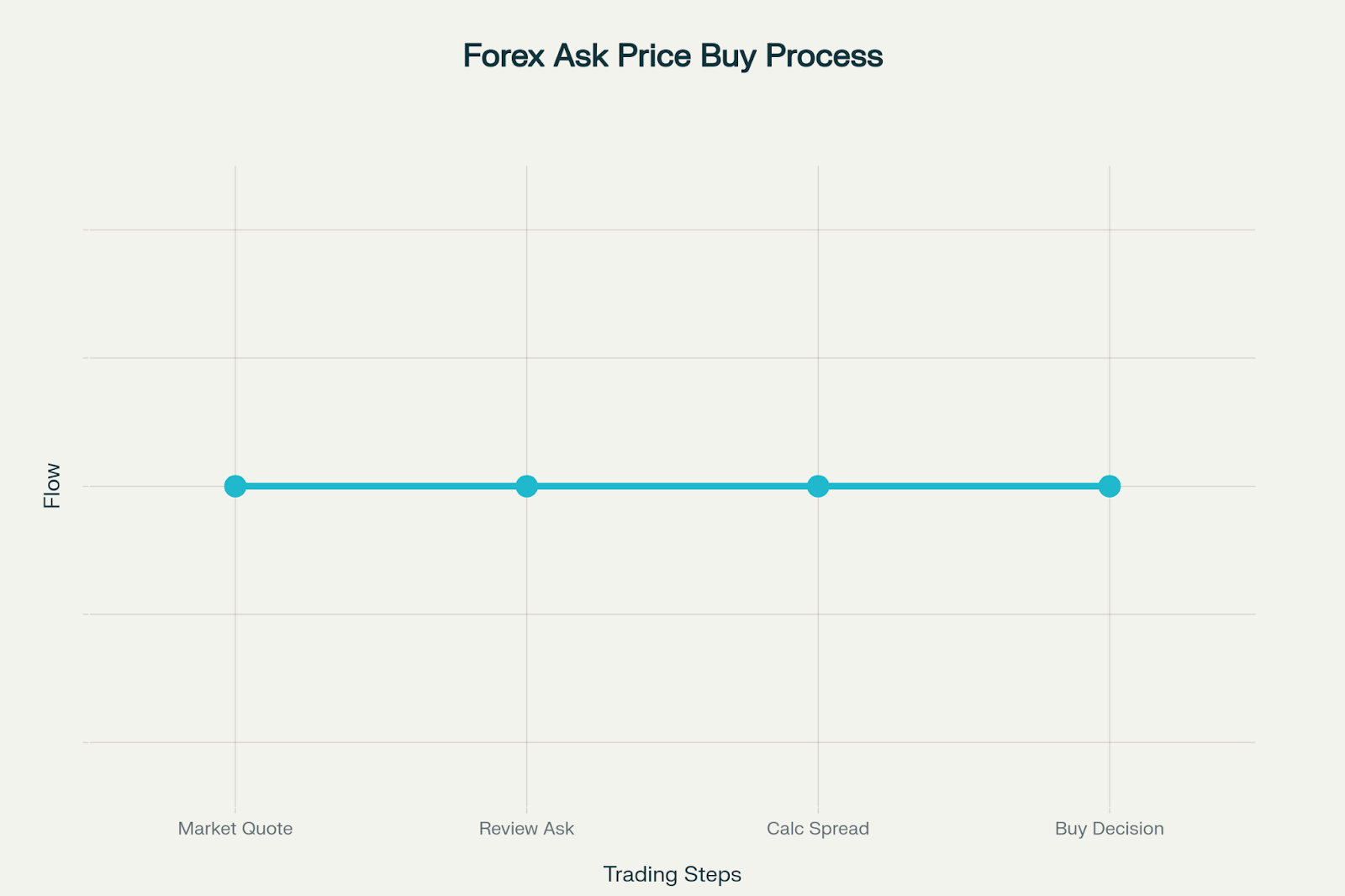
This document is specifically a guide to understanding ask price also referred to as the sell price or offer price. It does not matter if you are just beginning your trading journey or you have been trading for years, it is important to understand the ask price when making trading decisions.
By understanding the ask price, you control the cost of doing business, your risk management, and your overall profit and loss. We will review basic definitions, advanced trading strategies, and mistakes commonly made that end up costing traders money!
You're going to learn how the ask price affects your entry cost, your profit, and important aspects of risk management. You will also discover the extent to which market conditions affect prices, share real trading examples, and illustrate how you can practically apply it to your trading plan.
What is the ask price?
The ask price is the lowest price at which currency sellers are willing to sell. When you want to buy EUR/USD, you pay the ask price, not the bid price. It's as simple as that. However, many traders become confused about which price is relevant for them.
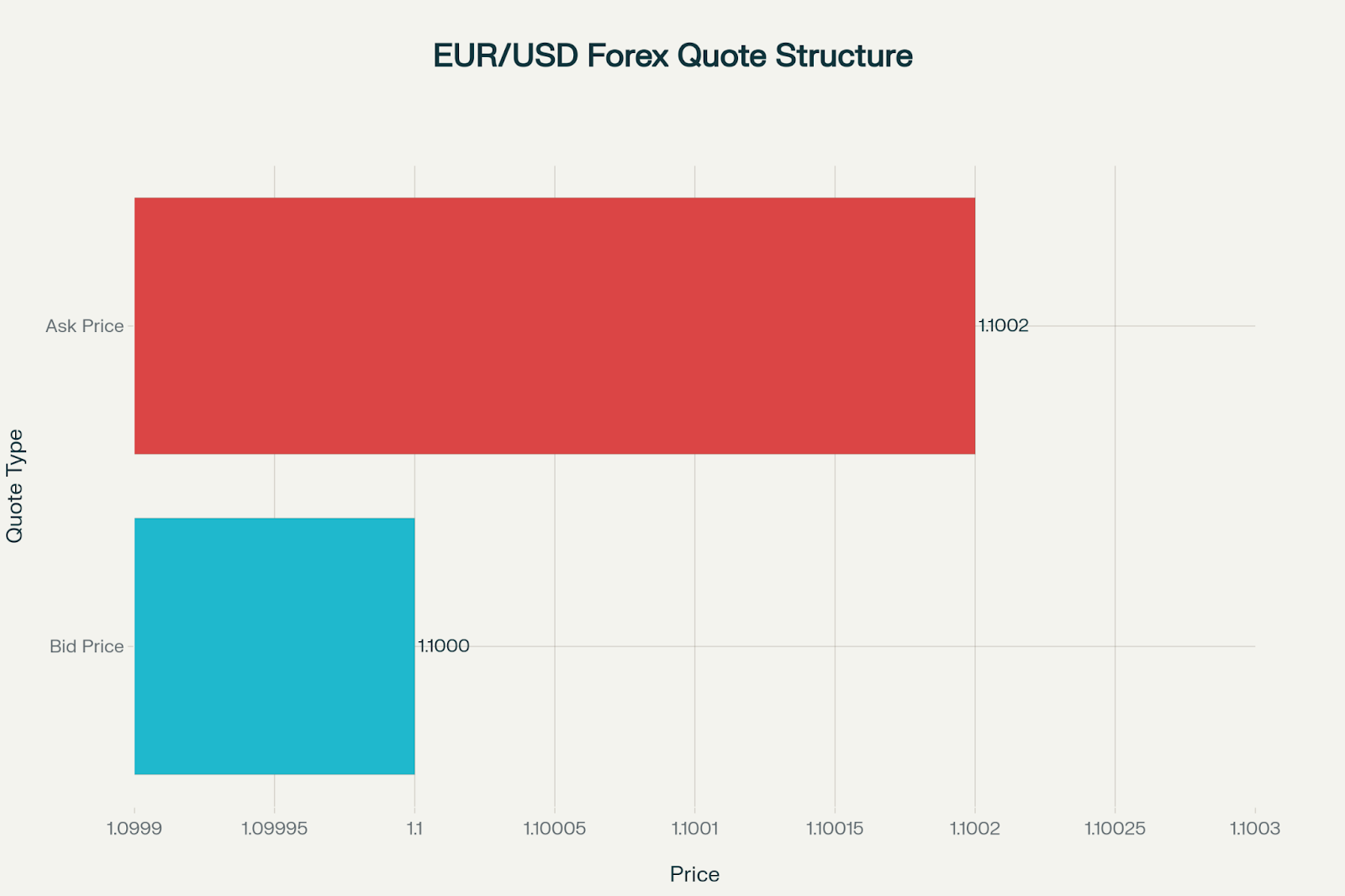
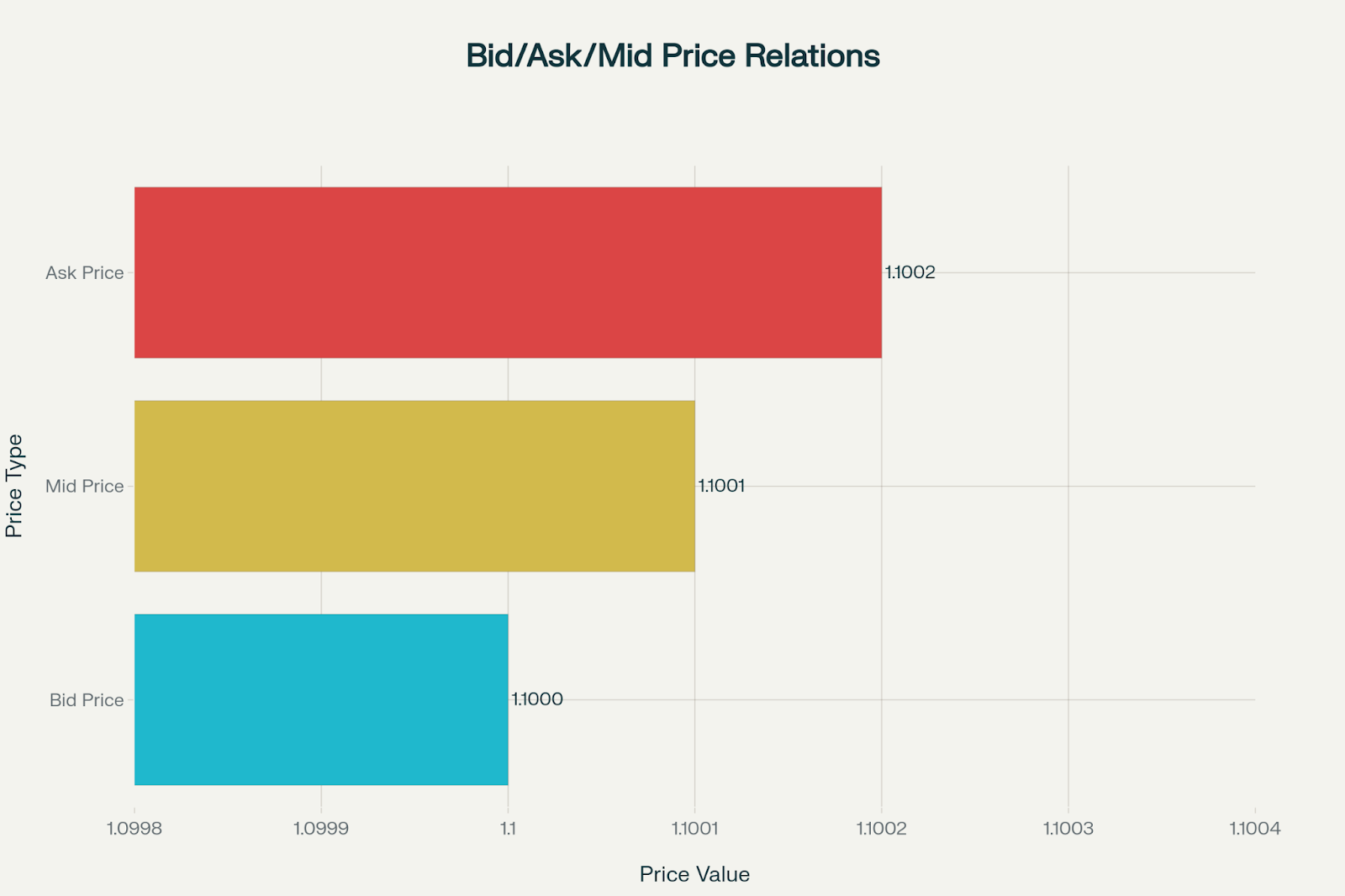
Let me give you an example. Say EUR/USD is quoting at 1.1000/1.1002. In this example, the first number (1.1000) is the bid price and the second number (1.1002) is the ask price. When you click "buy," you will be charged 1.1002 for each euro you buy. The bid/ask spread (in this example 2 pips) is your trading cost and the market maker's profit.
Now the fun part. In your normal shopping, you can negotiate prices, but forex markets don't work that way. The ask price is set, either you pay it or you don't trade. A structured ask price exists because of the large amount of liquidity and the speed of electronic trading platforms.
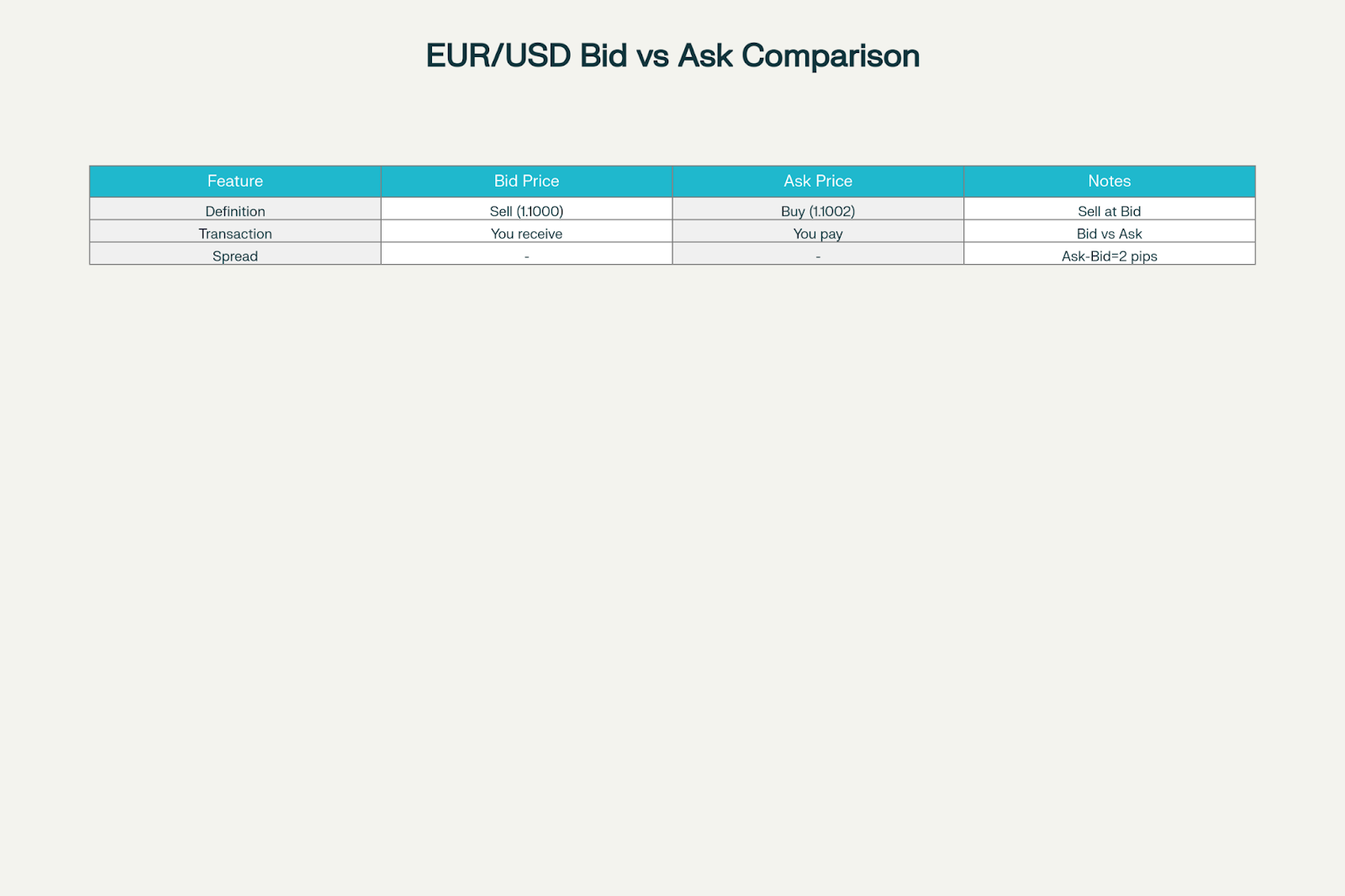
The bid and ask price in combination create what is known as a spread in the trading community. In the EUR/USD example, the spread = 2 pips (1.1002 - 1.1000 = .0002). For most major currency pairs, the spread can be tight at peak trading times – sometimes it can be as little as 0.1 pip depending on the broker you are using. Exotic currency pairs can have spreads of 10 pips or more.
Understanding the differences is important as it directly affects your trading costs. Every time you enter a trade you essentially start at a loss – this loss is the spread. Your price needs to move in your favor by the amount of the spread just to be break even.
Why Ask Price Matters in Order to Achieve Trading Success
Ask price, is more than just a price on your screen – it is the basis for every trading decision you make. If you understand how ask price works, only then are you able to have a better understanding of controlling your costs, timing your trades, and managing risk.
Your costs of trading start with the ask price. For example, you are buying one standard lot of EUR/USD at an ask price of 1.1002. You are buying 100,000 euros for $1.1002 each, which totals $110,020. If the bid is 1.1000 when you enter, then the bid will have to go to at least 1.1002 in order for you to break-even when the spread is taken into consideration.
The cost structure starts weighing on you when you are trading larger position sizes or making more frequent trades. If you are a professional scalper, making dozens of trades per day, then you have to worry about spreads since they can be a significant part of the cost. Even a swing trader can recognize the benefit of timing the ask price into consideration when entering trades, as high liquidity hours generally offer better pricing.
Ask price is also relevant to risk management. When placing stop orders, slippage is always a consideration. The ask price you see may not be the actual execution price at times of volatility, and the degree of slippage will really impact larger orders and major news releases.
Let's look at this situation as an example: You are about to buy GBP/USD and the ask price is 1.2500. You have a stop order placed at 1.2450, expecting to risk 50 pips.
However, if market volatility increases, you could get filled at 1.2445 due to slippage, which increases your actual risk. Knowing the behavior of ask price in different market conditions allows you to put stop-losses in place that are more realistic.
When it comes to position sizing, ask price affects how many units you can afford. If your account balance allows you to risk $1,000, and you are buying EUR/USD at 1.1002 with a 50-pip stop-loss, then you must calculate your position size in terms of ask price for your position size calculation to show you the number of units you could trade.
How to Calculate Ask Price Impacts to Your Trades
Calculating ask price impacts goes beyond knowing the figure on your screen. You must also be aware of how it affects your total trading costs, position size and profits.
The basic formula is simple: Trading Cost = (Ask Price - Bid Price) x Position Size.
Now, lets run through a real example. You want to buy 50,000 units of USD/JPY and the current quote is 149.50/149.52. Your immediate costs are 149.52 yen per dollar for 50,000 units, which totals 7,476,000 yen. Then the spread costs were (149.52 - 149.50) x 50,000 = 1,000 yen.
When dealing with cross-currencies or accounts in other currencies, the math increases in complexity. If you trade EUR/GBP from USD accounts, the conversion impact means you will also need to go back to USD on the spread cost using the most current exchange rates.
A simple way to look at it: Before you enter any trade, ensure you understand your total costs, including the spread. If you buy 1 lot of AUD/USD, and the ask price was 0.6502, this means your total position value is $65,020. If the spread is 1.5 pips, this means you have already incurred a loss of approximately $15. This tells you AUD/USD needs to rise to reflect at least 0.6503.5 before you break-even.
You may experience differing ask prices depending on the broker, especially in times of heightened volatility. ECN (Electronic Communications Network) brokers merely provide raw pricing from the market and charge a separate commission, whereas market-makers will incorporate their respective profits by increasing the spread. This is why knowing something about your broker's pricing model can better enable you to accurately calculate your true trading cost.
Ask prices also vary based on time of day. Major pairs tend to have the tightest spreads at peak trading times, which overlap from the London session to the New York session (8AM - 12 PM EST), where more liquidity tends to mean tighter spreads. This means the difference to you as the trader is that spreads can be wider at other times, driving up your cost to trade.
Ask Price Know-How in today's market
Clever traders will always find ways of using ask price data to time their trades and increase profitability. The trick is using ask prices to determine when conditions might allow for favorable pricing, and timing your trades according to the ask price opportunity.
Ask prices can also be gapped substantially, while a major economic announcement could be made. Imagine that the Federal Reserve has announced a surprise increase (hike) in interest rates. EUR/USD was at 1.0500/1.0502 prior to the announcement, and quickly gaps down to 1.0480/1.0485. If you had a BUY order for the pending price at 1.0502, you would get a fill down at 1.0485, which is 17-pips away from your expected buy price.
Experienced traders will often wait for the market to settle in the few minutes after a major release. Often significant price action occurs immediately after the report is released, typically in less than 5-minutes. The ask price will usually stabilize within the range of the spread (the buy and sell price) in 10-15 minutes after a significant report, at which time new positions can be executed.
Liquidity also affects ask price tendencies in the market. EUR/USD has wider spreads during the Asian trading hours than during the London trading hours. If you are contemplating a larger position, you can often save yourself significant money, if you time your ask price entry during a more liquid market conditions.
Here is a practical approach: Watch the ask price patterns during the different market sessions. Keep a trading journal of the spreads during those session times and after a few weeks you will get a good idea of the best times in the market to enter the position for your preferred currency pairs.
Using limit orders is another example of how some traders improve their ask price performance. For example, instead of simply buying at the ask price, they do a buy limit order - just below the current bid price. If the market were to dip temporarily, they would maintain some sort of price advantage by getting filled at a better price. This strategy would be more useful in a range about market but could lead to missed entry potential during a strong trend.
How Market Forces Take Shape with the Ask Price
As you can see, ask price is not standalone and is always influenced by marketplace liquidity, order flow, and economic circumstances. Understanding these forces and market dynamics will allow you to do your very best to anticipate price movements and take solid trading positions.
Market makers are a major component of the formation of an ask price. These are organizations that constantly provide bid and ask quotes and make their money off of the spread. If the market environment is normal, the market makers should be able to offer you a narrow spread. If the environment is stressful, your ask price may widen as the market participants are trying to hedge against possible fast moves in price.
The structure of the order book will impact whether or not the ask price levels move. If you have a deep market with lots of sellers around your current price level, the ask prices should remain stable. If you have a market with very few sellers listed at your current price levels, even a small buy order can move your ask price up quickly. This is one key reason why major currency pairs will have more stable ask prices than exotic currency pairs.
Also, economic conditions create instant changes in ask price. Employment announcements, inflation numbers from central banks has seen ask prices move up or down in as little as a couple of milliseconds. Also, high-frequency trading algorithms can react faster to news releases than human traders can, which can lead to temporary ask price imbalances.
Seasonality will also create patterns in ask prices. December, for example, is likely to see wider spreads due to limited institutional effect on the market during the holiday season. Summer months can also achieve similar results, particularly in Europe and with European currencies, when many traders take extended vacations.
We can expect predictable borrow/ask price behavior from regional trading sessions. The Tokyo session usually sees ask price volatility in JPY pairs due to local economic releases and the risk of intervention. As liquidity increases during the London session, it's the best session for EUR or GBP pairs, and usually results in the tightest spreads and number of stable ask prices.
Trading Strategies Based on Ask Price Behavior
Professional traders themselves have created strategies to take advantage of ask prices. When used properly, following some ask price behaviors can improve your entry when trading, and save you money in trading costs overall.
The strategy called “spread scalping” takes advantage of currency pairs that usually have tight spreads. When trading this strategy, you want a pair that usually has a tight spread, and then to monitor the ask price for periods of temporarily widening of spreads to enter your position when the spread returns to normal.
For example, if EUR/USD has a normal spread of 0.5-pips; and it goes to 2-pips during a news announcement. An experienced “spread scalper” would wait until the pair returns to normal conditions before entering his position.
The strategy called “news fade” uses spikes in ask price as an entry signal. When news of any kind is released that causes a large shift in ask price from the previous price (the news), contrarian traders tend to put on positions against the spike, expecting it to revert from the announce price back to the previous price. This strategy has a very short time-frame and execution model, and must have extremely tight risk controls.
Session transition trading exploits ask price changes between market sessions to inject a potential edge into the traders entry. Generally, as the day ends in London and begins to increase in New York, ask prices often change as a result of changing order flow. Before these transitions traders begin positioning themselves beforehand which they expect will yield improved ask prices for the new session.
Through multiple timeframe analysis you can find optimal ask price entry points. Whereby there may still be a fair amount of movement in the ask prices for the 1 minute; it is possible the hourly ask prices could indicate a clear trend. The two perspectives would provide information that the trader could use to determine entry when they are able to place aside some short-term ask price volatility in light of a longer-term directional bias.
Cross pair arbitrage is another opportunistic situation that may present itself in that related currency pairs may experience brief periods where their ask prices are disconnected allowing them to be engaged simultaneously. Higher level traders will monitor the ask prices on multiple pairs and look for brief moments where prices diverge enough to exploit through simultaneous trades.
Working with Historical Ask Price Analytics
Utilizing historical ask price analytics to study ask price behaviours is a fundamental way to develop your trading. The more you study the behaviour of price, the more you will be able to anticipate future ask price behaviour and determine the best timing for an entry to get the most favourable ask price.
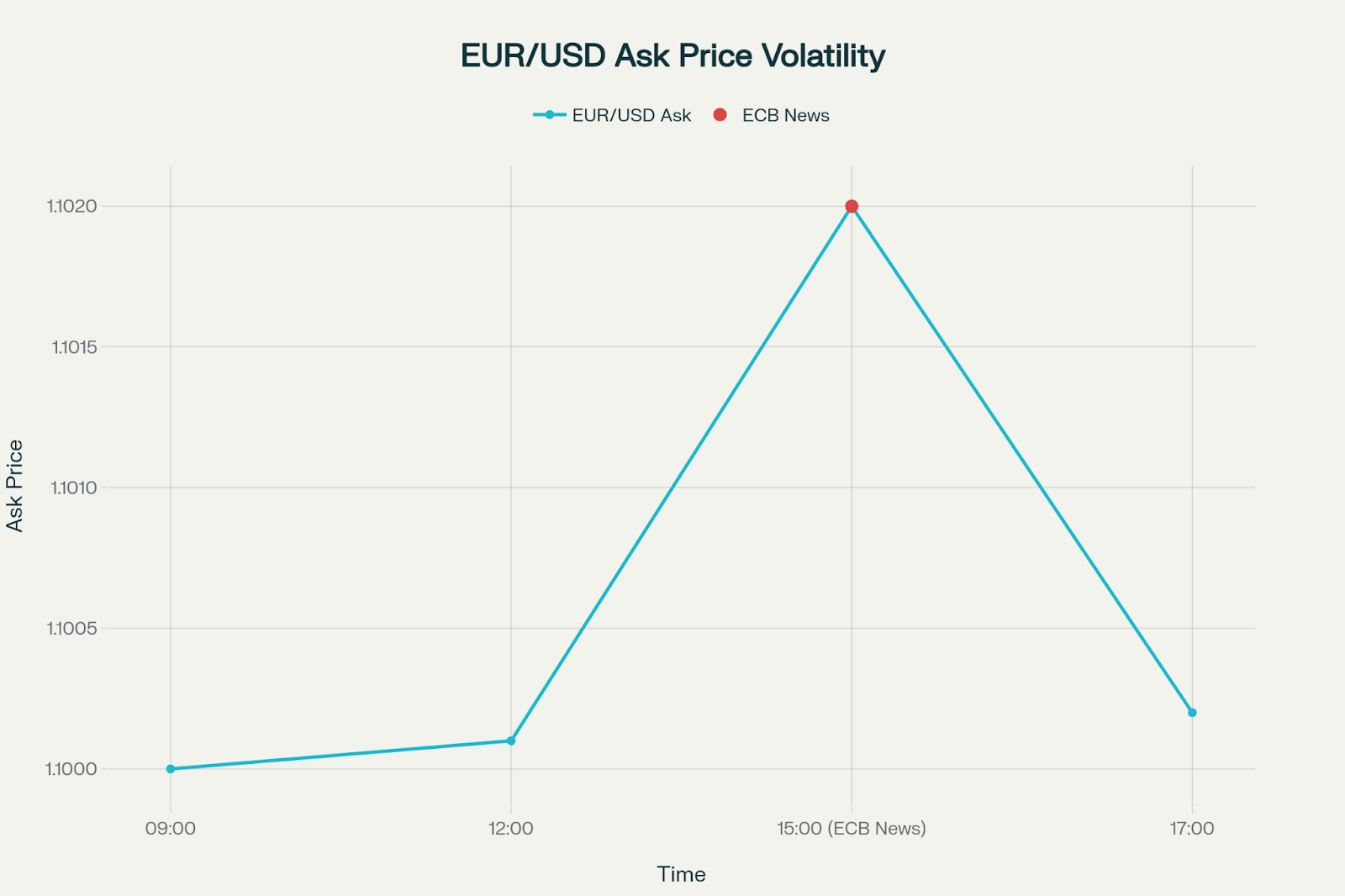
Patterns of seasonal ask price tend to repeat with wonderful regularity. For example, EUR/USD ask prices tend to be more volatile during European Central Bank meeting weeks. On the other hand, USD/JPY ask prices tended to be spiking when the Bank of Japan was intervening. When you track these patterns you can plan for these predictable ask price shifts.
Major economic releases lead to repeating ask price volatility patterns. For example, Non-farm payroll announcements always cause a gap in USD pair ask prices. This gap is quickly followed by 30 minutes of limited movement before a major beak out and trending behavior takes hold.. Interest decisions made by the Federal Reserve often have a similar pattern starting with volatility and ending with consistently trending ask prices behavior.
We can apply technical analysis rules to ask price patterns in the same way we would technical analysis to normal price charts. Usually price levels identify support and resistance accompanied by clusters of ask prices. Clusters or groups of ask prices show us consolidation, or sellers placing their orders in a similar area. When we can group these ask price patterns we are also identifying potential futures ask price barriers.
Long-term trends in ask prices show us the structure of developing changes in the market. The last ten or so years of electronic trading has created generally tighter spreads in our major currency pairs and less volatile ask prices. Lower and tighter ask prices benefit retail traders in their trading costs.
The Ask Price in Relation to the Other Major Forex Concepts
The ask price doesn't stand alone – it interacts with the bid price, the spread, the swap rate, and margin. This interdependence is worth understanding to see the whole picture.
The bid-ask spread is your immediate cost of trading, but it's not your only cost. There are also say overnight swap rates – which is basically for compensation of interest rate differential between currencies. Your overnight swap rate does affect your total cost of trading, and sometimes brokers play with the ask price slightly more to cover their anticipated swap rate.
Also margins use the ask price when calculating position value. When you enter a trade where you buy EUR/USD with an ask price of 1.1000 and you have 30:1 leverage, your margin is calculated based on the full position value at 1.1000 and not the bid price. This is usually important for traders managing different positions at different prices.
Also volatility affects the ask price. As you experience volatility, the price can move fast enough that you may not be able to execute the trade at what you expect. Professional traders typically use volatility indicators to look into periods of time when a stable ask price will be unavailable.
Liquidity providers, banks and other institutions, compete to provide attractive ask prices. Liquidity providers compete, which benefits traders from better execution and tighter spreads. The benefits mostly arise during times when multiple liquidity providers are active and there is more competition.
Ask prices for trading pairs move together because of correlations. When quotes show that euro dollar ask prices go up as the dollar weakens, quotes for other pairs like GBP/USD tend to follow as well. Recognizing these correlations can help and allow traders to anticipate ask movements even if they aren't monitoring every pair.
Common Ask Price Mistakes That Cost Traders Money
Traders can make predictable mistakes when working with ask prices. Many traders are unaware of these mistakes and that they are costing them money. Recognizing common mistakes can save you money and improve your trading.
The biggest mistake is ignoring the fact that there is a spread cost when calculating a profit potential. New traders tend to see a 20-pip profit target as 20 pips. But if the spread is 2 pips, the trader needs to have 22 pips of movement in their favor for the trader to actually break even. This is an example of unrealistic expectations and improper risk-reward ratios.
Another misconception relates to assumptions about spreads being static. Under extreme circumstances - either during major news events or during periods of lower liquidity - spreads can widen by multiple pips. A trader who placed stop-losses using normal spreads could wind up being stopped out at many different levels worse than they had planned, due to changing spreads.
Many traders chart price only using bid prices to quantify the price they buy or sell their positions. They fail to realize that in entering a long position, they will be paying the ask price - resulting in a disconnect between the professional trader price analysis and the amateur execution. As a result, they often enter positions at worse prices.
Many mistakes in position sizing occurs by getting confused by asking prices. For example, a trader plots their position size based on their pre-planned bid price only to discover they can only afford a smaller number of units than they originally planned based on asking prices in their entry to execute a trade. This mistake can be really costly if the trader had a small account.
Overtrading during volatile periods is another costly mistake that traders can make. Sometimes, when ask prices are moving rapidly, the trader feels the need to trade immediately and will enter into positions at lower prices because of how slow they are to react.
By waiting, the trader can enter trade positions again at similar levels, and in these volatile periods, traders that are patient and wait for the price to stabilize, generally have far more favorable execution than those who rapidly respond to fluctuations in ask prices.
Risk Management through an Awareness of Who Pays the Spread
To effectively manage your risk, you need to understand the use, and how ask prices behave under conditions that will affect an ask price. It will become significantly easier to dictate the stop-losses and position sizes that are appropriate, or build risk tolerance to limit the potential for losses because of slippage in price execution.
To reduce the impact of ask price volatility, remember that stop-loss placement matters. If you enter a EUR/USD trade at 1.1000 and place a stop-loss order at 1.0950, it is the bid price that triggers your stop-loss order, not the ask. In volatile conditions, the price you get on execution could be many pips worse than your stop-loss order.
Gap risk is an important inconvenience when explaining the ask price. The weekend will either add to the ask price volatility or remove it, with weekend gaps often causing the ask price to open with a very different ask price from Friday's close. If you hold a position over a weekend and get a large gap, you obviously need to adjust your position size or consider this gap risk in your risk management.
News event risk requires particular attention in regard to ask price movement. News announcements involving major economic events can see ask price movement of 50-100 pips in seconds. If you are holding a position at the time of high-impact news, you may want to consider reducing your position size or simply closing your position before such extreme tasks move.
Correlation risk impacts ask price movements in related currency pairs. If you are holding positions on correlated currencies, adverse ask price movements can affect all of those positions simultaneously, compounding your losses beyond what you would expect.
Broker risk occurs when, for a variety of possible reasons, ask price manipulation takes place, or there are delays in the execution of trade requests. Although reputable forex brokers do not deliberately manipulate an ask price, it is useful to have insight into ask price behavior as it relates to ask price fundamentals so you can recognize any anomalies and protect your trading capital.
Moving from recognition to mastering ask price
Once you understand the ask price you are just starting. The value of what you have learned is only appreciated when it is consistently used in your trading. Like most things, mastering ask price takes practice and continued awareness of ever-changing market situations.
Beginment by looking through your list of currency pairs traded regularly. Focus on their ask prices and document any patterns that ask price. Become aware of the spreads changing the ask price throughout the different trading times and the different market scenarios that may lead to adverse ask price movements.
Practice calculating your total trading costs in your trading account including the impact of the spread for each trade you make. Subsequently, before you enter any trade, ask how much price movement you need to make just to break-even. This account process will produce more realistic levels of profit targets and is less likely for you to execute a trade with a totally unrealistic risk-reward ratio.
Try other methods of ordering so that their execution can improve your ability to get better ask price or ability to protect profit. There are times when limit orders can get you a better price than a market order, especially in volatile market conditions. However, it is important to understand that limit orders and price improvements can be risky because it increases the chances of missing trades when the market is in a strong trending move.
The forex market is constantly changing as new technology and regulations change everything that relates to the way ask prices are formed, so research your changes to this market structure so that you can change your strategies to keep your edge in the market. With advancements in electronic trading over the last couple decades, most changes have generally focused on providing retail traders new opportunities to profit through more competitive pricing or better or different execution opportunities.
The most important take-away is that ask prices are only one part of being a successful trader. While price mechanics is an important part of being a successful trader, it has to be combined with skills in identifying trades with good risk:reward ratios, risk management, and disciplined trade execution. Final thought, try to develop the skills, as mentioned above, together instead of focusing heavily on one aspect.
Do you think you are ready to get going and apply everything that you've learned? You may want to think about opening a demo account to practice your ask price strategies with no risk to your capital.
Take some time to assess how your brokers ask prices and price improvements react in different market conditions, as well as how you are able to develop a strategy for timing your entry and cost management. Check out tradewill.com for more info!
Disclaimer: The content of the blog does not represent any position of Trade W, does not serve as any trading-related decision advice, and does not endorse any third-party.