

 Trade W
Introduction
All Forex traders are faced with a hidden cost that cuts into their profits on the very first trade they make. A commission or fee is not what the effect on profits is not shown on your trading report. It is the bid ask spread effect and it is built into every trade you enter into in the Forex product, or currency.
Let me ask you a question that, if you are like most traders, may sound or feel familiar: Why, after I make some trades that appear to be profitable on my chart, do I immediately lose a small amount of money the moment I hit the "buy" button?
You may not consider or even fully understand it, but it predominantly comes down to spreads. Consider this hypothetical scenario: when you click on "buy" EUR/USD at 1.1000, do you know what you actually pay? It is possible you actually paid 1.1002. So you will not show a profit until the price trades above 1.1002.
Let me give you an example, and for your sake, a business example. Let's say you are going to buy a car from a driveway dealer. The dealer purchased service vehicles at wholesale prices, and sells the vehicle at retail prices. The difference between wholesale and retail price and what the dealer paid is referred to as a "spread." Of course, it is a bit more complex in regards to Forex brokers, but you get the basic premise.
At its essence, the spread is the distance between what buyers want to pay (the bid) and what sellers want to receive (the ask) for a currency pair. It is possible you won't think a spread is much, and sometimes it only varies by a few dime sides, but when trading often or position sizes increase, small spreads can add up quickly.
Knowing what spreads are is more than theoretical knowledge. It is knowledge with real world consequences in terms of dollars and cents. For example, consider a day trader that trades 50 times a day, with a 2-pip spread. That trader is paying 100 pips a day, purely on trading costs. Over a month that is potentially thousands of pips, and that is without any additional factors included.
What is Bid-Ask spread?
The bid-ask spread is simply a distance between two prices, and is relevant across any financial market. Some refer to it as the ask-bid spread, although convention is to have the bid first and there is reason for that choice.
The bid price is the price at which buyers are willing to acquire a currency pair, with the same point in time. It is what you will get (the price you will receive) when you sell. It is the market's perspective on the "buying price."
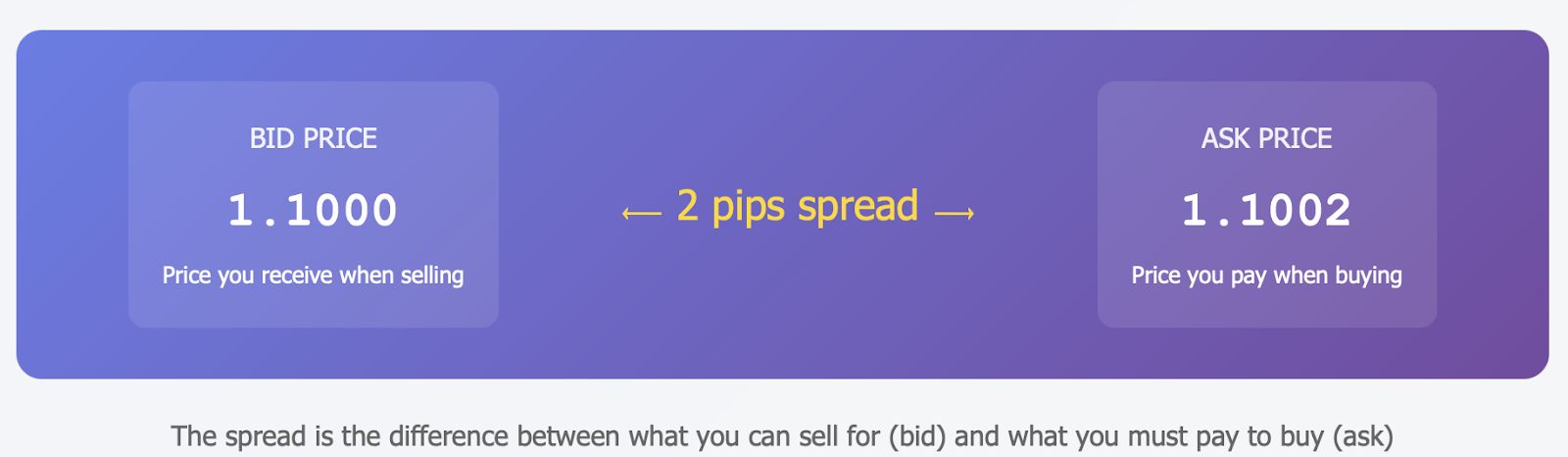
The ask price (also called the "offer price") is what sellers are asking for that same currency pair. It is the price you pay when you buy. This is the "selling" price from the market's perspective.
The spread is simply the difference between the two prices, and is usually measured in pips. A pip (percentage in point) is the smallest price move in a currency pair, usually, the fourth decimal place for major pairs like EUR/USD.
Let's look at an actual example. If EUR/USD shows:
- Bid: 1.1000
- Ask: 1.1002
- Spread: 2 pips
This means you can sell EUR/USD at 1.1000 but need to pay 1.1002 to buy it. This means your immediate cost of trading is the 2 pip difference.
Where it gets interesting is with different types of accounts. An ECN (Electronic Communication Network) account might show EUR/USD with a spread of just 0.2 pips, making your same trade substantially cheaper. The trade-off is that ECN accounts usually charge a different commission for each trade.
For example, think of a phone shop that purchases used phones for $200 and sells them for $250. The spread is $50. While forex moves smaller numbers, the same idea applies. Broke r has to make money from the difference between what they can buy and sell currency for.
Essentially, forex charging spreads means they exist in every trade, whether you are in a position for seconds or months.
On each trade the spread is the first cost you incur and acts very different from commission or swap rates because it is instantaneous and there is no chance of avoiding it either.
Historical Overview of Spreads
As we can see from this example, spreads have not always been tight like they are today. Seeing how spreads have evolved helps us understand why today's traders get way better deals than the previous generations of forex traders.
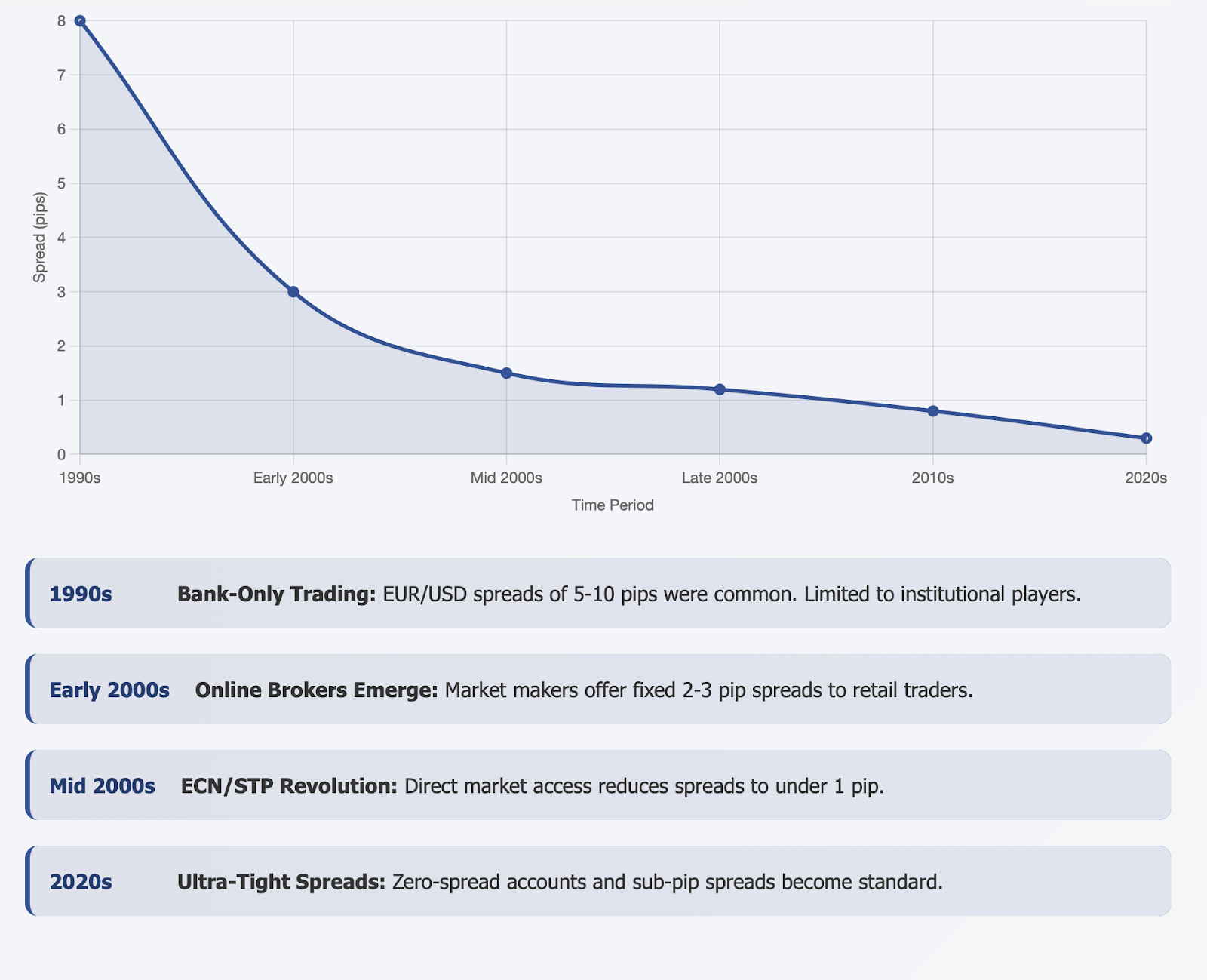
In the early years of retail forex trading spreads were wide. When trading was done mostly through banks or currency dealers before the internet changed trading means, retail forex trades had to go through banks or dealers and both entities have big spreads to protect themselves and make a profit. EUR/USD spreads were 5-10 pips, exotic currency pairs may have spreads of 50 pips or more.
Although retail traders have always been stuck with whatever their local bank (or dealer) offers with limited transparency about pricing, the interbank market where large financial institutions exchange currencies between themselves always had tighter spreads.
This changed with the emergence of online foreign exchange brokers once the seeming revolution of computerized trading took flight in the late 1990s into the early 2000s. As if by magic, retail traders were exposed to something closer to institutional pricing (the ability to trade currencies to what banks traded with one another). At this point, market makers were offering fixed spreads of 2-3 pips on major pairs that felt like a great opportunity for the retail trader.
However, a second upheaval began with the introduction of ECN and STP (Straight Through Processing) brokers that allow retail traders direct access to interbank liquidity. This was game-changing, allowing retail traders to see the same prices as other banks offered to each other. This would drop spreads down even further, with major pairs often trading under a 1-pip spread from the quote the retail trader saw.
Technology continued to keep watering down spreads. Now with some brokers that offer a "no-spread" account, typically, during liquidity flows, there are times when major pairs have "zero spreads" or have spreads as low as 0.0 pips.
Of course the "zero spreads" account charges commissions instead, but the total costs remains lower than the traditional spread pricing method.
Such a change represents improvements in market conditions and competition among brokers. What may have cost retail traders as high as 10 pips in spread could now have reduced to being less than 1 pip, representing a massive reduction in trading cost in just 20 years.
Types of Spreads
It can be very helpful for a trader to understand all the variations of spread models in order to assess their own trading style and account type. Brokers will tend to have 3 basic approaches to the way they treat spreads.
Fixed Spreads means they remain constant no matter what the market condition is. If your broker quotes 2 pips on EUR/USD Fixed Spread, you will have a cost of 2 pips regardless of whether the market is steady or has still may be working through major volatility. Being able to predict your cost certainly appeals to traders and anyone who wants to know their trading costs.
In normal market conditions fixed spreads are adequate, but during high volatility conditions there are disadvantages to fixed spreads. When interbank spreads may widen to perhaps 5-10 pips, your broker may still offer the same 2-pip spread and absorb the cost thereof; they need to build that risk into their offering when pricing during normal times.
Many beginner traders have shown a preference for fixed spreads, especially to calculate their costs. Knowing that each trade will cost you 2 pips makes it easy to test strategies before starting to trade or plan trades.
The commission structure aligns the broker's interests with your own interests too. They are incentivized to provide the best possible spreads since they earn the same commission no matter the width of the spread.
The Quantitative Effect of Spreads on Trading Expenses
Numbers don’t lie, and in regard to spreads they can be eye-opening. Let’s examine the actual comparison to show spreads impact your trading expenses in various situations.
The calculation itself is simple, Spread Cost = Spread (in pips) x Pip Value x Total Lots.
For EUR/USD, 1 pip = $10 per standard lot. If you traded 1 standard lot with a 2-pip spread, you are paying $20 all in the trade immediately - regardless if you hold the trade for minutes or months.
Let’s look at two different profiles. A scalper, trades 100 times per month in EUR/USD with a 1.5 pip average spread. For a total of:
100 trades x 1.5 pip x$10= $1,500 monthly spread cost
A Swing trader trades 10 times per month with the same spread, and paid only:
10 trades x 1.5pip x$10=$150 monthly spread cost
The difference is compounded over time. The scalper is already costing $18,000 annually in spread cost alone, and the swing trader $1,800; therefore, both must generate very large returns to cover the cost of their strategies before generating true profit.
Position size magnifies these effects. For example, if a scalper traded 5 standard lots instead of 1 standard lot, the total cost would increase proportionately. Now, the scalper is incurring $90,000 in spread cost over 5 lots for the year.
Here's an example from the real world that reflects the cumulative effects. Let's say you purchase a $2 coffee every day of work for the year. The coffee shop has a $0.20 "convenience fee" for each purchase. At the end of the year, you've paid $50 in convenience fees. In percentage terms, you have paid 10% more for your coffee.
The same exact thought process can be applied to forex spreads, and the cost can be larger. If your average trade nets a profit of 10 pips but you incur a cost of 2 pips for spreads, you are giving 20% of your gross profit to trading costs. A trader that was able to reduce their average spread from 2 pips to 1 pip would have increased their net profit by 10%.
This math is even more important in shorter-term strategies. With a 5-minute scalping strategy aimed at 3-pip profits and a 1.5-pip spread, you would only make 1.5 pips after accounting for the spread. The same strategy with a 0.5-pip spread gives 2.5 pips after accounting for the spread, a 67% improvement.
These calculations assume perfect execution which does not happen often in real trading conditions. Add in slippage, commissions, and swaps, and spread costs are only one part of your total trading costs. Usually spread trading costs are the largest part of your costs however, especially for active traders.
Factors Affecting Spreads
Spreads are not random numbers assigned to you by brokers. They vary based on several important market factors that we should discuss and that you should understand as a trader.
Market liquidity is the main influence of spread width. Liquidity is defined as the ease in which an asset can be bought or sold without affecting its price.
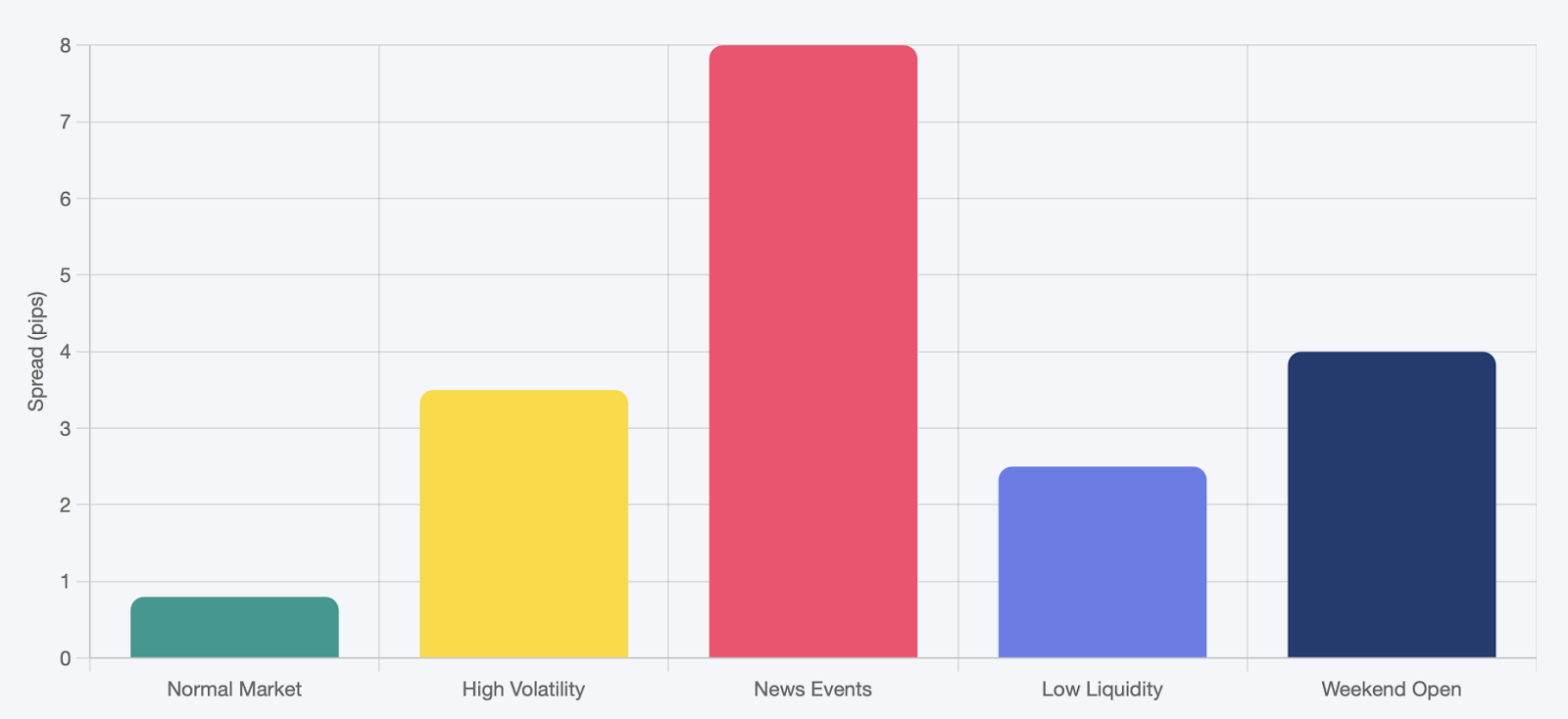
Major currency pairs such as the EUR/USD, GBP/USD, and USD/JPY have huge trading volumes each day, resulting in very deep liquidity pools. Thus, there is no shortage of buyers or sellers, and this keeps the spreads tight (usually at or below one pip during trading hours).
Exotic pairs like USD/TRY, and EUR/ZAR often trade with much lower volumes, which means they have a wider spread of 10-50 pips or more. The lack of continuous buyers and sellers allows market makers to charge higher spreads to account for the risk of holding these positions in which they took in a defined amount of capital to purchase the market as an asset.
Volatility in the market will also have an impact on the widening of spreads. When markets are quiet, spreads will tend to be tight because market makers feel confident that they will not incur any significant loss offering close-in prices, but when large economic news becomes available or unexpected events occur in the market, volatility can increase dramatically, and spreads will typically widen.
Let us consider the 2016 Brexit vote for a case study. GBP/USD typically trades with a spread of under 2 pips, but during the announcement of the results from the referendum, GBP/USD spreads widened 20-50 pips with some brokers. This was to provide market makers with extra cushion against quick price moves that could leave them with a position they did not want to hold.
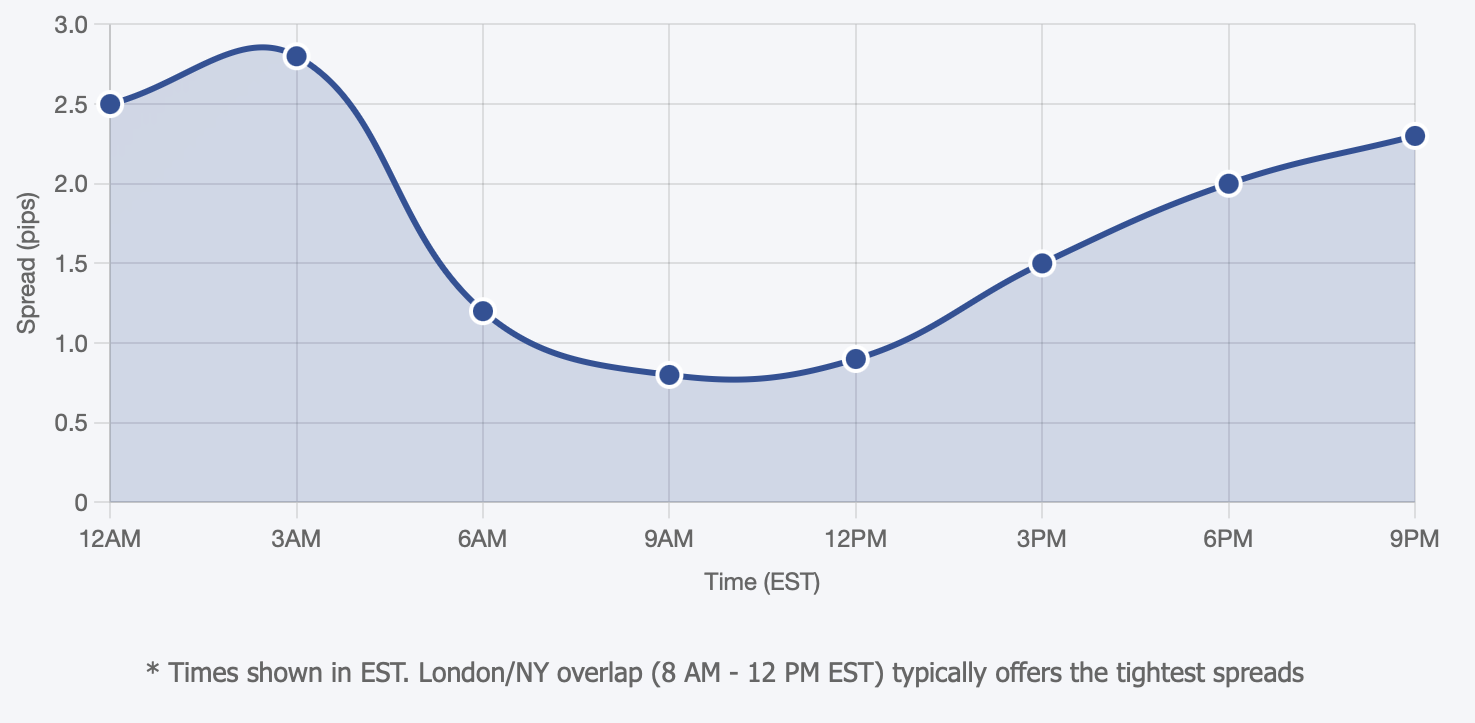
Trading sessions will also contribute to predictable spread shapes. The London/New York overlap trading (8am - 12 pm EST) period has the highest liquidity for major pairs and therefore, is typically able to offer tighter spreads. Conversely, during the Asian session (when European markets and US markets are closed), spreads typically widen.
Weekend and holiday periods can also create affects spread conditions. Sunday evening, when markets first reopen after the weekend, usually will show wider spreads until normal liquidity returns to the market for the regular business week. Major holidays such as Christmas or New Year may create the same situation.
Business models for brokers also have a major impact on how spreads are priced. Market makers will typically set their spreads and make all their profit from the difference between what they charge clients and the hedging cost. ECN brokers many times just pass through the real market spreads with very small markup only, and they make their commissions as separate commissions.
Some brokers will offer "zero spread" type accounts as they market their services. In many situations, these types of accounts will offer higher commissions, or they are limited to different trading hours. Understanding which model your broker uses will assist you in deciding if the spreads they are pricing are actually beneficial to their clients trading style.
Some events such as central bank interventions, geopolitical events, and major economic releases all can create conditions where spreads widen for all brokers at the same time. You just have to recognize the phenomenon and adapt your expectations for trading outcomes.
Spreads in Relation to Other Trading Costs
Spreads are only one part of your total trading cost. Understanding how they considered within' the various other costs of fees will help you consider how to best align your overall trading costs.
Commissions are direct fees that are billed for each trade or lot traded. ECN brokers charge between $2-7 per standard lot in commission and offer extremely tight spreads. Market makers normally create their profit margin in the wide spreads instead of charging a commission.
The combined spread plus commission structure generally provides a much better price for high-frequency traders. For example, a 0.2 pip spread plus $3 commission may in total provide the same cost as paying a 2 pip spread with no commission, especially when you consider larger position sizes.
Slippage is when your trade is filled at a different price than accepted. When the markets are moving fast, you will click "buy" at a price of 1.1000, but in your buzzing mind, you later realize you were filled at 1.1003. The slippage is 3 pips, which could exceed the cost of your spread on that trade!
Market orders usually have greater slippage than limit orders. Scalpers and news traders sometimes have slippage costs that surpass the cost of the spread in each transaction, so in those cases the quality of execution supersedes any advertised spread cost.
Positions held longer than 5 PM NY will incur a swap rate (also known as rollover or overnight interest) that reflects the difference in interest rates of the currency pair. Swap will either add to your total account or be an on-going charge depending on whether the swap is positive or negative.
For swing traders that hold a position for days or weeks, swap costs can often be much higher than those of spreads. For instance, a position held for 10 days at -2 pips daily swap would cost 20 pips which is a lot more than the spread cost was to begin with.
Financing costs are also applicable to certain types of accounts. These accounts frequently use high leverage or trading special instruments. Such costs might include borrowing costs for leveraged positions or daily charges for large positions.
The relative significance of these costs is determined by the type of trader you are. Day traders, who are wrapping up and closing everything before the end of the daily rollover period generally do not pay swap costs, rather their main costs will be commissions and spreads, etc. For a position trader who is holding currencies with negative interest rate differentials, it is possible that swap costs will be their major costs of trading.
A simple approach is to calculate total cost per trade based on what was included above, then systematically optimize the largest costs first. Most active traders, will have spreads and commissions as the majority of their total costs. Therefore the order of emphasis would be commissions and spreads, not worrying as much about the smaller fees.
Case Studies
Real example cases, to illustrate the spread and the impact on real trading performance in various scenarios and for the various trader types.
Case Study 1: The Spread-Oblivious Newbie
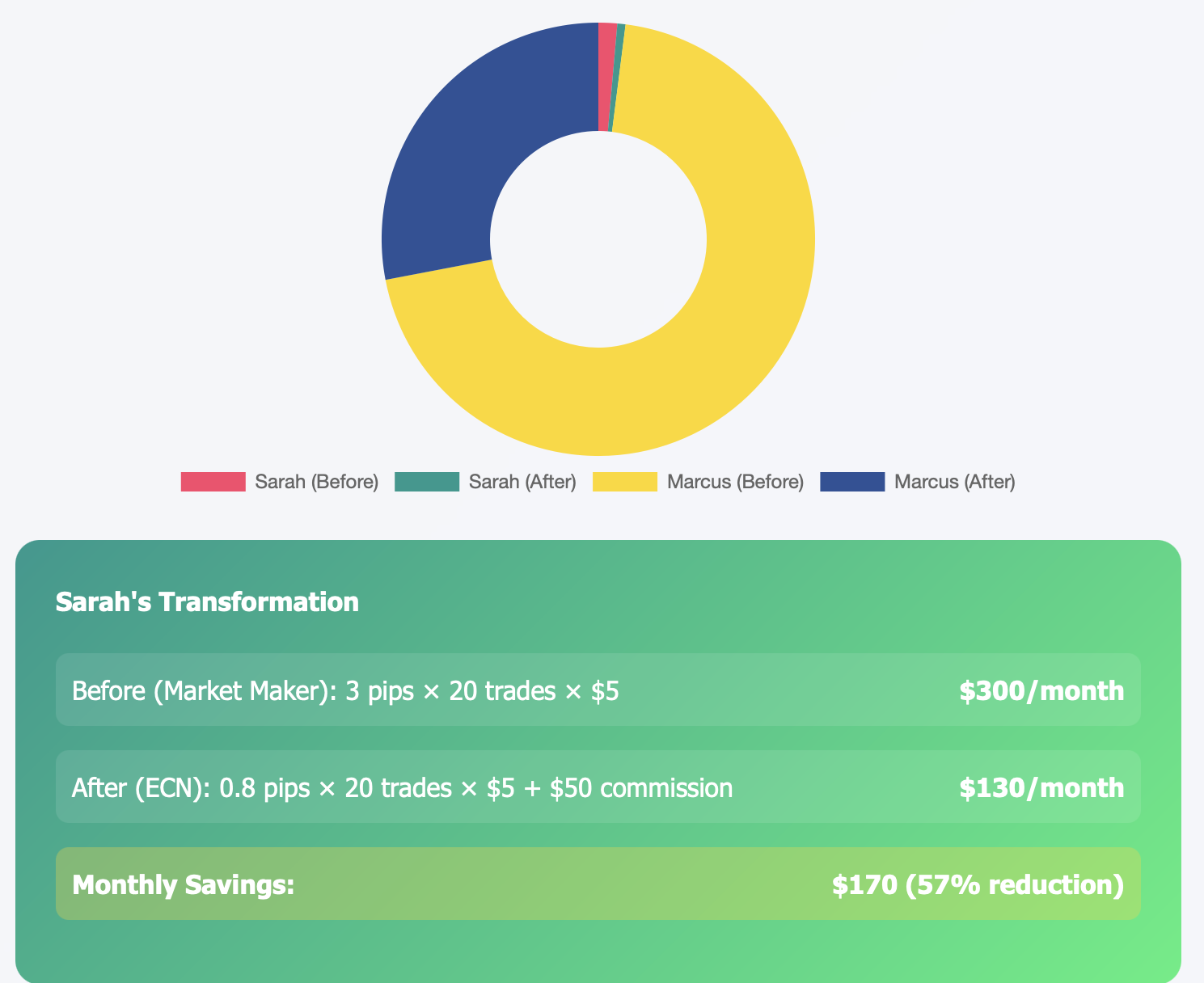
Sarah began forex trading with a $5,000 investment and a very simple moving average crossover strategy. She used a broker that was touting "tight spreads," but did not check what that really meant for her. The broker she used offered the EUR/USD currency pair at a 3-pip fixed spread.
Sarah's trading style produced buy and sell signals about 20 times a month, with each trade having a 0.5 standard lot size which made her pip value $5. Therefore her monthly trading costs for just the spreads were: 20 trades x 3 pips x $5 = $300.
Case Study 2: Optimizing Spreads For A Professional
Marcus is a proprietary trader with a desk on short-term EUR/USD strategies. His team is executing approximately 500 trades per month. They are All trading to multiple strategies and positioning for an average of 2 standard lots.
At first, they were using a standard account with 1.5 pips spreads, their total spread costs for the month amounted to $15,000 (500 trades x 1.5 pips x $20). The 1.5 pip spread cost was a substantial bill when their average profit per trade was approximately 4 pips.
After reaching out to a few different ECN brokers, Marcus found one that offered to average 0.3 pips with $3 commission per standard lot. Their new monthly costs were (500 x 0.3 pips x $20) + (500 x 2 lots x $3) = $6,000 total spread cost.
The bottom line was that their 60% reduction in overall compliance costs, saved them $9,000 per month on their compliance costs. It was nice to know they would be profitable every month now at a healthy level, since the previous month they were scraping by to stay profitable. Raul learned that treating their spread costs with equal seriousness as any other business expense was the key for saving costs and operating a successful enterprise.
Case Study 3: The News Trading Debacle
James used to create economic announcement trading strategies, focusing mainly on announcements such as Releases of Non-farm Payroll releases. His Research and back-testing indicated suitable returns for making 1 pip assumption to trade.
In the course of six months, Sarah paid $1,800 in strictly spread costs, or when considering her entire account balance, almost 36% of her starting account. Her strategy needed to deliver more than 3 pips of profit per trade just to break even on spread costs, before any other consideration like win percentage and risk management.
Once she learned about ECN accounts, Sarah switched to a FIFO broker that offered 0.8 pips average spreads and a $2.50 commission for every half-lot.
Her new monthly trading costs would be (20 trades x 0.8 pips x $5) + (20 trades x $2.50) = $130 a month. Just by making that simple switch, Sarah saved herself about 57% in trading costs just by trading with an ECN instead of a Market Maker.
James was ready for his first live NFP trade. He was prepared to place an immediate buy order in USD/JPY, as soon as the announcement was available. Spreads in this pair usually settled around 1.2 pips with his broker and the news hit, however, he was quickly faced with 8 pips wide spreads.
James' trade filled at the wide 8 pip spread, meaning he started off 8 pips underwater. The market then moved up in his favor for a total of 15 pips, however, when accounting for the 8 pips paid in spreads, James realized the net gain only put him at 7 pips, not the 15 pips as the backtests showed.
If that were not bad enough, the same fast moving prices and 8 pip spreads on the NFP news triggered some of his other trades to hit their stop losses, which would not have been triggered under normal spread conditions. The negative effect became worse - his bad day started with what appeared to be a promising NFP trade.
James learned a solid lesson and avoided trading in the immediate frenzy of markets after major news releases. He learned to wait for the spreads to settle down and began to notice spread behavior right around major news releases. In doing so, he soon found that some brokers offered tighter spreads in volatile market conditions than others.
The above examples highlight an important point - spreads are not just numbers on a pricing sheet. Spreads are costs that represent costs of trading and can impact value in real time. Understanding spreads is critical to the difference between profitable and unprofitable trading.
Cross-Market Spread Comparison
Forex spreads make sense when compared across other financial markets. This perspective helps traders appreciate why forex is attractive to cost-conscious active traders.
Forex vs Stock Trading:
Stock trading typically involves buying shares at the asked price and then selling them at the bid price. This creates a silent spread (implied). Stocks also incur explicit commissions, which discount brokers range at $1-10 per trade and full-service brokers may charge more.
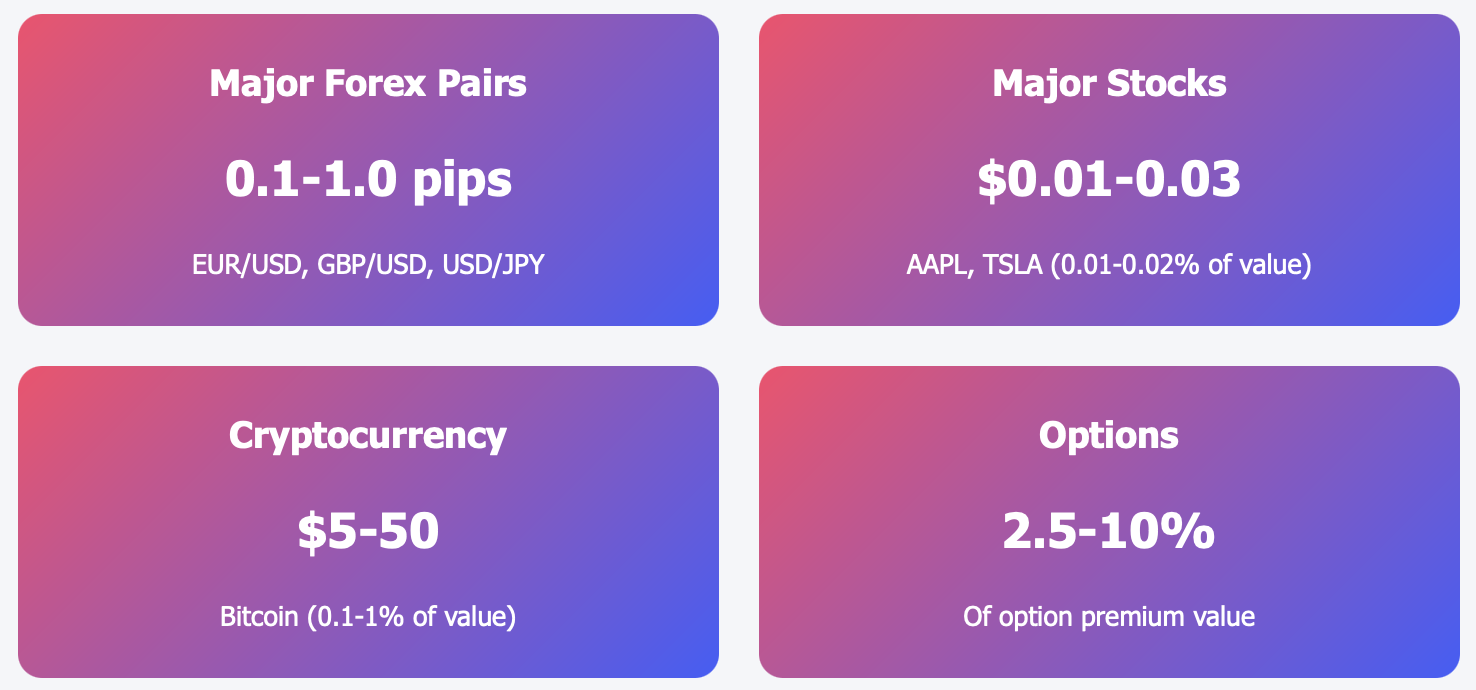
The most well-known stocks, such as Apple (AAPL) and Tesla (TSLA) have bid-ask spreads of approximately $0.01-0.03, which does not seem so bad. However, when calculated as a percentage of the stock price, it means the spread represents 0.01-0.02% of the value of the trade. Major fx pairs typically have spreads that are 0.001-0.01% percent of the value of the trade, so because of this factor, they are generally more attractive compared to stock trading for active traders.
Forex vs Cryptocurrency Trading:
Cryptocurrencies have an even larger spread, especially when traded on smaller exchanges or less liquid pairs. Bitcoin (BTC) can trade at $5-50 spreads depending on the exchange and the market dynamic. Altcoins can also have spreads that represent 0.1-1% of their value.
Although major cryptocurrency exchanges like Coinbase Pro or Binance may not have direct commissions on trades, they do have spreads that often combine trading fees to be from 0.1-0.5% per trade. This indicates that forex is considerably cheaper than trading crypto for traders who are concerned with low trading costs on transactions.
Forex vs CFD Trading:
CFD (Contracts for Difference) on stocks, commodities, or indices are pegged to the movement of the underlying market in the means of spread (that includes broker markup). Generally speaking Stock CFDs will have tighter spreads than trading the stock itself, however commodity CFDs such as gold or oil may have wider spreads than the relevant forex majors.
Index CFDs like S&P 500 may trade with spreads of 0.5-2 points but depending on the level of the index this can translate into quite different 'costs' as a percentage of the market value. The spreads during crisis or significant volatility can become significantly wider and exceed forex spread widening.
Forex vs Options Trading:
Options simply stand for bid-ask spreads + Commissions, which can be quite large. An option priced at $2.00 may have a bidask spread of .05-20 which effectively can be between 2.5 - 10% of that option value. Options strategies can take multiple legs, thus multiplying this cost significantly.
Forex Spreads are typically lower due to high volume - Forex is a daily volume in excess of $6 trillion per day which creates great liquidity in the major pairs. The combination of liquidity and a very competitive broker environment results in tight spreads during normal market conditions all throughout the day.
Forex markets trade 24 hours all week which increases the chance of lower spreads because more of the trading day has opportunities to be filled. The forex markets are decentralized meaning that more than one provider can provide prices at the same time, thus increasing competition and lowering price spreads.
Actionable Steps and Risk Management
Smart spread management can improve your trading bottom line! Here are some actionable steps you can take to lessen your spread costs and avoid mistakes:
Choosing Lower Spread Broker - Most brokers broadly advertise their spreads; however, they often represent the "best case scenario" during optimal market conditions. Ask for a full set of average spreads during various times and periods of different market conditions, especially if you are intending to trade during news events or low liquidity conditions.
Remember to test and demo potential broker's using SMALL accounts before transferring LARGE amounts of your own money. Demo accounts do not always represent a BROKER'S live account spreads; thus, this is the only real test which is reflective of your true cost ingoing forward.
Picking your Trade Entry Point - Whenever possible, you want to pick your trade entry point during a good spread cycle. The London to New York overlap is often the best (tightest) spread conditions for the major pairs. Unless your specific trading strategy dictates otherwise, ingress is generally not recommended one hour after a significant news release.
Also, be very careful when opening trades on Sunday evening and Friday afternoon, as these periods can often create significant spreads. Consider trading elsewhere unless your trading strategy indicates otherwise! If your trading strategy does not call for trading on Sunday or Friday, avoiding these periods can (slowly) lower your average spreads.
Identifying Inflated Spreads:
Some brokers may artificially widen spreads beyond market conditions, increasing their profits, and especially at news events. If your broker has a EUR/USD spread of 5 pips when all others have 1-2 pips, you should consider changing brokers.
Be cautious of any spread advertising which seems "too good to be true." Brokers claiming a constant zero pip spread are usually making up any spread with terrible execution, high commissions, or requotes preventing you from trading at claimed prices.
Stop-Loss Consideration:
Remember to include the spread when you make your stop-loss trade placement. If your stop-loss is 20 pips and your spread is 2 pips, you will need 22 pips of favorable movement in the market just to break even. Some traders will add their average spread to their stop-loss distance to account for the spread.
Avoid placing stop-losses just above or below round numbers since many traders will place their stops at round numbers. In volatile trading, you may trigger a stop-loss due to an inflated spread. If several stops are clustered together, it may trigger these stops prematurely.
Position Sizing and Spreads:
Larger position sizes will not increase your costs per pip, but will increase the total costs impact. If the spread is 2 pips it will cost you $20 trading one standard lot, if you traded 10 lots it will cost you $200. Let the increased costs guide how you size your positions in order for your risk management calculation to be correct.
Account Type Optimization:
High-frequency traders generally want to use raw spread plus commission accounts even if it seems they will be worse off. The critical thing to consider is calculating your total cost per trade given your volume and trading style under each model.
Swing traders holding trades for days or weeks may also want to focus on swap rates more than tight spreads, as overnight costs can exceed spread costs over longer trading horizons.
Monitoring and Adjusting:
Track your actual spread costs, not the advertised spreads. Calculate your average monthly spread cost and compare it against your other trading costs (e.g. commissions and taxes). If your spread cost is more than about 30% of your overall trading costs, you probably want to look at lower-cost options that might improve your trading profitability.
Set alerts or use trading platforms that allow you to see real-time spreads. Some advanced platforms will also show spread histories which can help you determine any patterns or optimize your trading hours.
It is essential to remember that trading at the lowest spread does not always mean that the overall cost is the lowest. When choosing a broker, you should always consider the trade-off on execution quality, customer service, platform reliability, and the safety of regulation. Trading slightly worse spreads with exceptionally better execution may be cheaper than trading rock-bottom spreads where slippage and requotes frequently occur.
Conclusion
The bid-ask spread is the most basic cost associated with forex trading; however, too many traders have under-appreciated the effect this cost has on long-term profitability. Even though the bid-ask spread is a small difference in price between buying and selling, that difference can actually determine success or failure with active trading.
Being aware of spreads is beyond simply knowing what the spreads are. It is about being aware of the interplay of market conditions, broker models, and an individual’s trading style in terms of what the actual cost is for you to trade. Take a day trader who places 100 trades in a month, and a position trader who places 5 trades in a month. Even if both traders employ the use of similar trading strategies, the spreads will be vastly different for both traders.
Today’s narrow spreads when trading in an electronic marketplace have come a long way from what systems were previously. With both bank spreads and averaged spreads, the market structure has increased efficiency tremendously, as well as increased the competition, putting benefits in the hands of modern traders. However, modern traders benefit only if the traders understand how to access and use the benefits of improved efficiency.
Smart spread management is not about finding the lowest advertised spread. Rather, smart spread management is about understanding the total costs exist when you are trading - understanding what account types best suit your trades, appropriately timing when you trade, and choosing brokers that have trading pricing models appropriate to your trading style.
While low spreads alone do not equal trading success, and tight pricing can't make up for bad strategy or poor risk management, knowing and reducing your spread costs provides a strong basis for profitable trading, giving you some decent odds in a tough process.
Ready to take that knowledge into action? The next step is assessing your existing spread costs and determining whether there are better alternatives for your particular trading style and volume.
Disclaimer: The content of the blog does not represent any position of Trade W, does not serve as any trading-related decision advice, and does not endorse any third-party.