

 Trade W
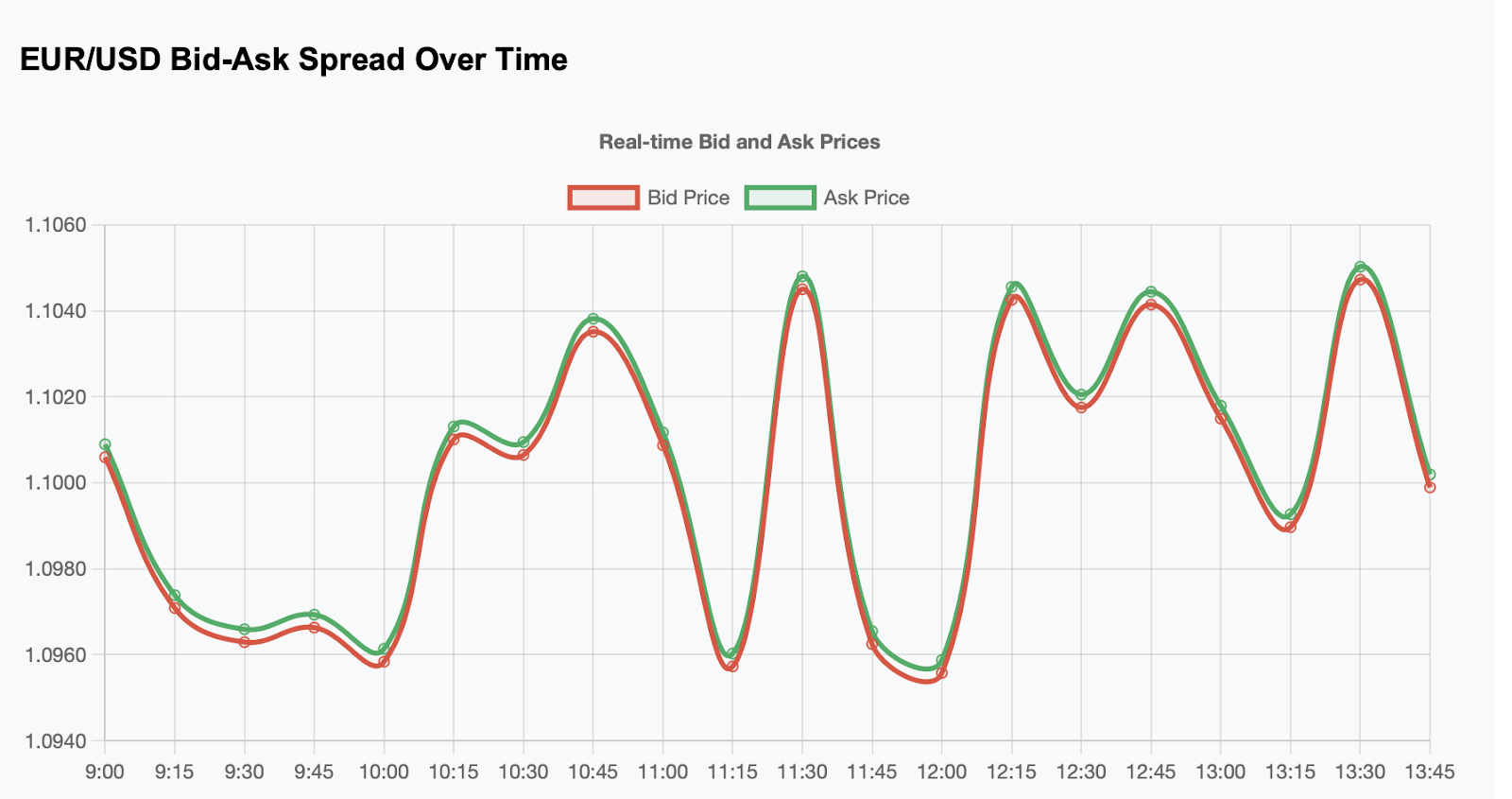
Forex trading is simply buying and selling currencies. For each trade, there will always be two prices: the bid price and lifestyle price or ask price. The bid price is the amount a trader will receive when selling a position. It is essential to understand the bid price in order to be a successful trader.
Why is there a selling price and a buying price? To make money! Brokers need to do exactly that, make money. Brokers will buy the currency for one price and sell it to you for a higher price. The difference between the two amounts would be called the spread.
Think of it in terms of selling your used phone. If a buyer offers you $400 (the bid price), but you want $450 (the ask price), then the $50 difference between those two amounts would be like the forex spread. Professional traders know this concept very well. When they are day trading EUR/USD and they see a bid price of 1.1000, they know exactly what they should receive when they close their position.
What is Bid Price?
The bid price is always the highest price a buyer is willing to offer for a currency pair. Because when you close or sell a position, you will receive the bid price. The bid price is constantly changing throughout the trading day.
The spread is the difference between the bid and ask price. In the case of EUR/USD, if the bid is 1.1000 and the ask is 1.1003, the spread is three pips. A pip is the smallest unit of price movement in forex trading and is usually the fourth decimal place of a currency pair for the major currency pairs.
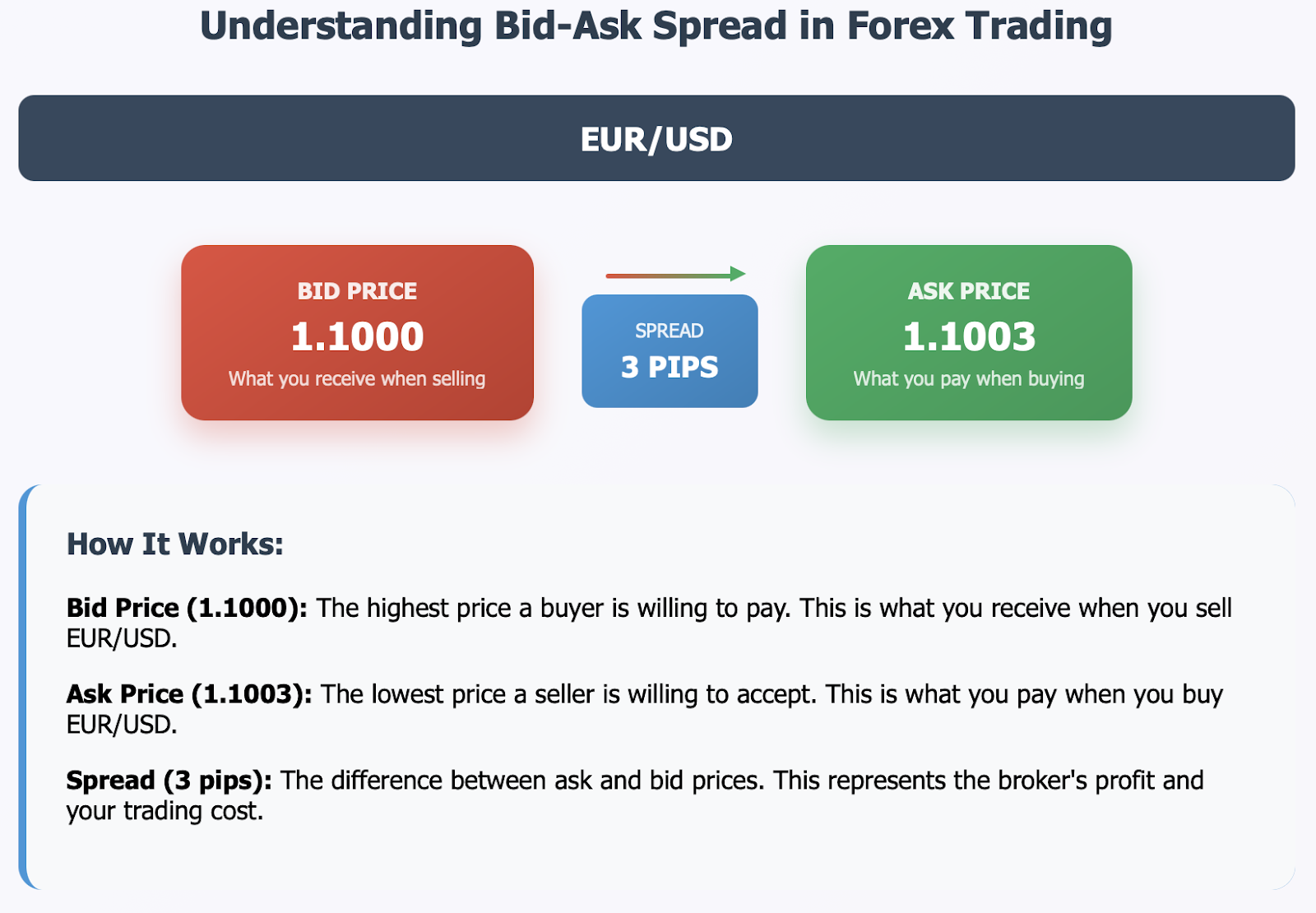
Think of bidding and asking for a second-hand car. The dealer may offer you $15,000 to buy the car (the bid price), and sell you a similar $15,000 car for $16,500 (the ask price). This is $1,500 difference, which is to help the dealer cover their costs and cover their profit.
With an ECN account, you generally will see the tighter of the spreads. For example, a professional trader may trade the EUR/USD as a bid of 1.1000 and an ask of 1.1001; this ends up showing a spread of one pip. The tighter the spreads you have to pay for are, the more reduced cost of trading.
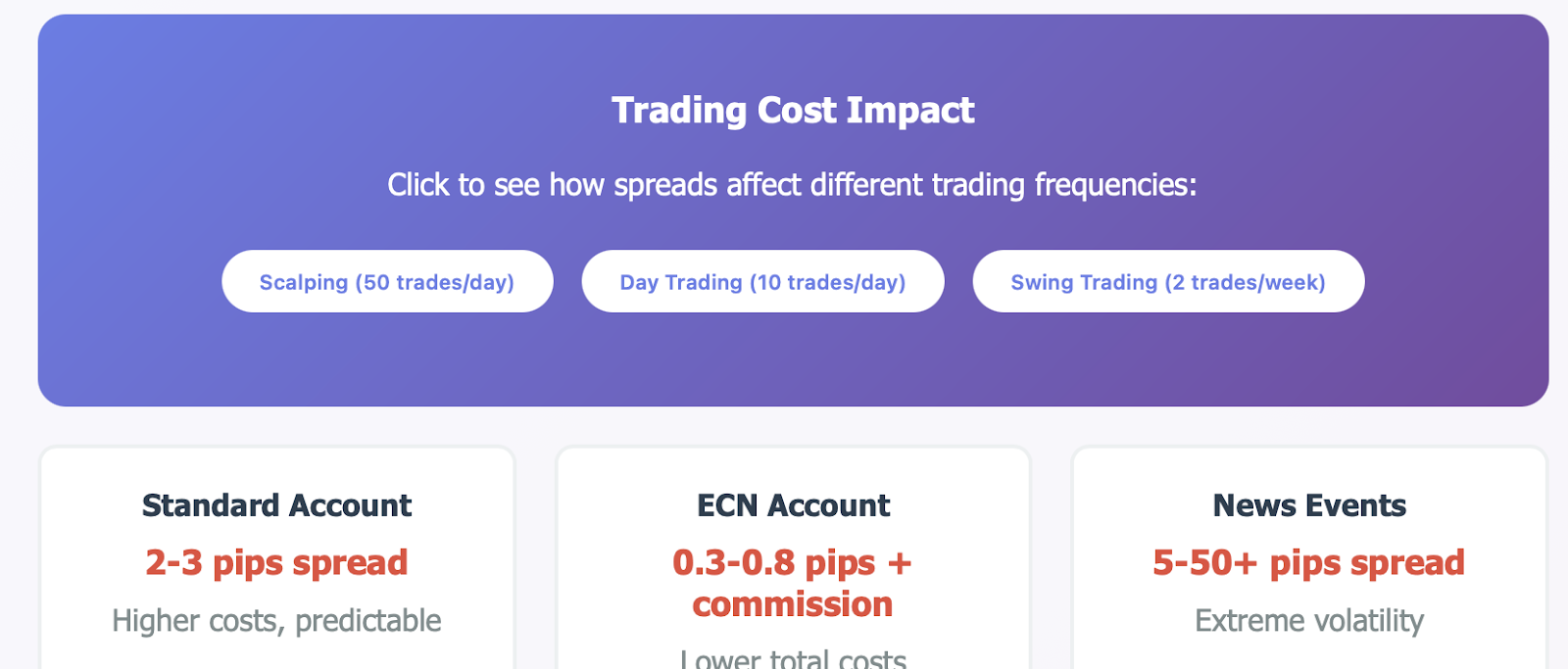
When you open or close a trade, you will ultimately pay the current spread. At this point, when you decide to exit a position, you will lose some of your profit based on the price difference between the bid and ask price. Is the cost of spread important? Absolutely! The bid price determines your profit.
The Evolution of Bid Prices
In the traditional forex marketplace, the spread was often a lot larger than they are today. Banks traditionally traded currencies among themselves, with spreads of 5-10 pips or more. And for retail traders, the costs would have been even larger just to access the marketplace.
Online brokerage firms have changed everything. They brought into existence a whole new entity called electronic trading platforms, where retail traders could trade directly with liquidity providers – improving bid-ask spreads dramatically.
Technology has continued to refine how traders access markets. ECN platforms have started to offer raw spreads with low mark up. Today some brokers allow zero-spread trading accounts, that there will just be a commission as opposed to spreading the price, bid or ask.
Forecasting accounts were a couple of years ago at a national basis, for big currency pairs; EUR/USD for example could easily be a 3-5 pip spread regularly, today that same pair has traded often with less than 1 pip in the active market.
This has contributed to reduced trading costs and improved market access - we are seeking to get the best spread that benefits this markets environment with as much competition as it can have - the factors above will ensure that you are benefitting from this technology, and evolving market conditions,
Types of Spreads and Bid Prices
Fixed spreads are as a mechanism that to novices (fx participants) will enable a predictability price trading cost. This account mechanism will provide the trader with consistent bid pricing, thus allowing for a predictable understanding of the potential losses and profit.
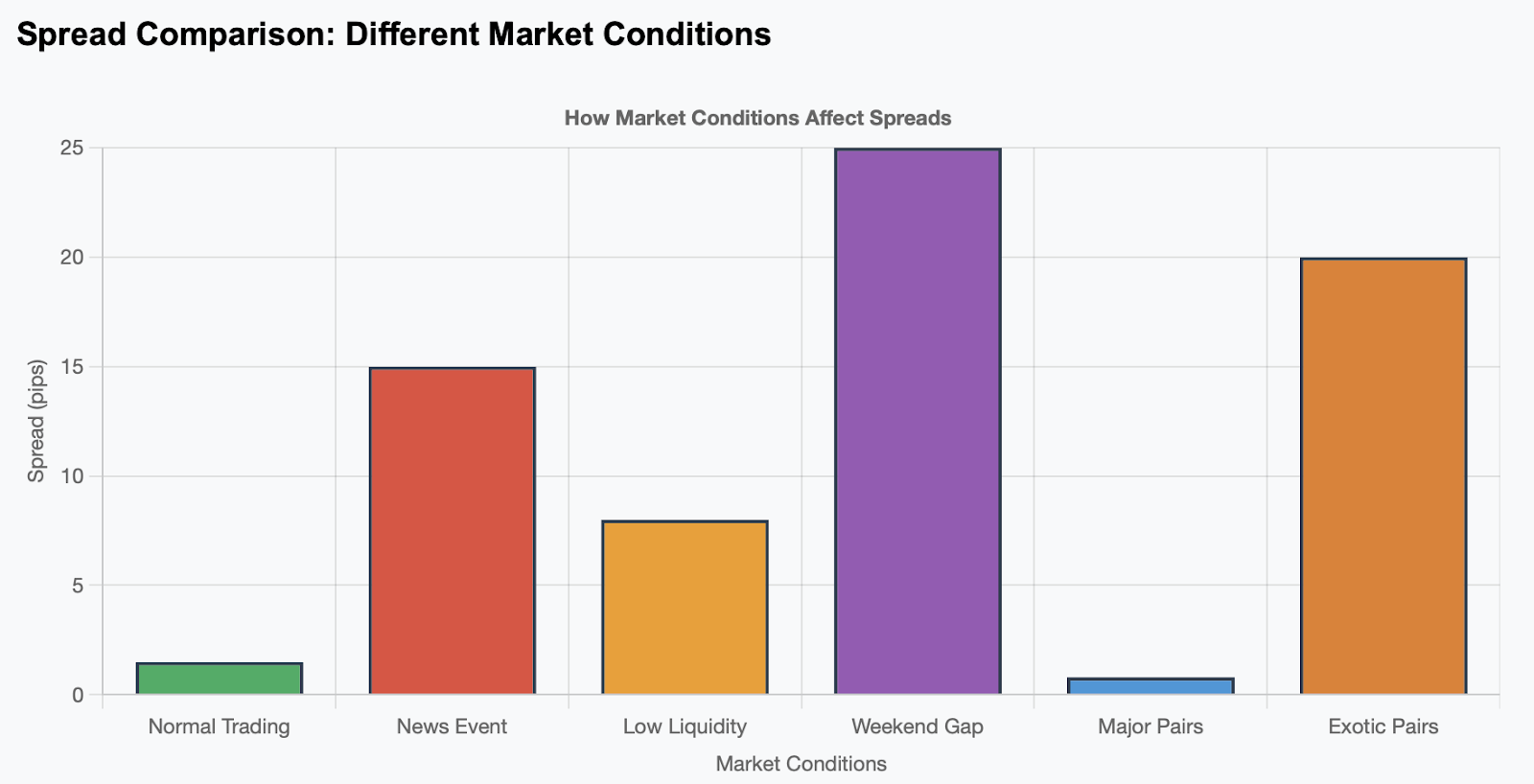
Variable spreads are spreads that will change according to the market price action in the foreign exchange market, hence force majeure and volatility of, a strong news event, or liquidity, will widen the bid price. The increase in buying/selling costs i.e. increase in bid prices will make it unfavourable for you - and your trades.
Raw spread accounts provide access to the best possible spreads but charge a commission on every trade. This model is advantageous to a lot of professional traders because the overall cost is less in total, even if commissions are involved.
Fixed spreads provide protection during uncertain times. When major economic news occurs, variable spreads may widen from 1pip to 10pip or more. Fixed spread accounts retain their original prices through these turbulent events.
Think about going to a store to buy candy (yes, candy). In one store, the price of candy is fixed. Even if the demand rises, the price stays fixed. In the other store, the price of the same candy rises if the supply gets low and popularity rises. Ultimately it is your decision which candy store to shop in based on your lifestyle and desire for predictability.
Utilizing Bid Price in Technical Analysis
Bid prices are the foundational element of the candlestick charts reported to you in your platform. The candlestick shows the time of the open, close, high, and low bid price. While the other elements of technical analysis were hypothetical, the cumulative records show individual transactions that produced patterns. These patterns provide perspective to analyze and help become aware of trends and opportunities for trade.
Support and resistance levels are commonly found at identifiable bid levels. When the bid price bounces at a level multiple times, the level will become a support zone. A break below that level may signal further downside potential.
Moving averages from bid prices help determine the direction of trend. When the current bid price is trading above its 50-day moving average, this is generally indicative of upward momentum. When the bid price trades below this level, it is often indicative of a trend change.
The RSI and MACD also take into account bid price data. These indicators help traders to determine the overbought / oversold scenarios. A pro trader may observe EUR/USD bid price crossing above its 20 day moving average with an RSI reading showing oversold conditions.
Trend lines made on bid price charts will identify a breakout whenever the bid price breaks above a down trending trend line it may initiate the start of an upward move.
Market Psychology of Bid Price
Bid prices are also market participants' overall psychology. When hedge funds are fearful, the bid price falls, because more sellers want to sell. When hedge funds are greedy, the bid price rises, because more traders want to buy.
Incredibly, bid prices can be greatly affected by huge institutional traders. Hedge funds can help move bid prices based on the size of their orders or if they put in a billion-dollar sell order, the brokers have to adjust the bid price down to accommodate all initial sell orders, due to the increased supply of sell orders.
In addition, market makers must constantly reduce the bid price or filter and adjust the bid price to flow of orders. Simply, if they get a large amount of buy orders at one time, they may go straight to their system and raise the bid price based on their buy orders in relation to sell orders to adjust their inventory.
The bid price will initiate continuous movement more than if it is based on up and down days. How news and the economy can settle bid prices. News events have an effect by causing huge movement of bid price influences. If the news is in good faith and sends an exaggerated amount of positive sentiment, the bid price may shoot considerably higher in tandem with positive sentiment.
If news on the economic situation creates negative sentiment, it may send bid prices drastically negative within seconds.
Think of an auction where everyone wants the same item. The bidding (prices) go up fast. When no one wants to bid on the item, then the auctioneer will start lowering the new bid price to attract buyers.
Bid Price and Risk Management
Widening spreads during news releases can cause unwelcome surprises when stops are triggered. Your stop at 1.0950 might execute at 1.0954, if the bid spreads widen during volatile market conditions. All costs of a trade must be taken into account for position sizing.
If you're scalping based on small profit targets, wide spreads can wipe your profits based on fluctuations within the market. You need to calculate widen spreads before entering trades. When spreads are wider, margin requirements can change. Brokers increase margin requirements during volatile times to protect themselves against rapid price movements. If you are over leveraged, this can cause margin calls.
If your stops are too close to your entry prices, it's common that stop losses will force exits because spreads will fluctuate. You need to allow for normal fluctuations in the bid price while managing risk.
There are other risks involved with all the weekend gaps in bid price. Currency pairs can open on Monday with big differences in price from Friday's afternoon close. This gap can also force exits in untimely bid prices.
Real-Life Trading Instances
Sarah was a newcomer to trading with ants. She never really accounted for spread costs in her past trades; she had executed approximately 50 trades that month and was paying the 2-3 pip costs each time. Even with the 60% win rate for that month, she lost money because she was unaware of how large and simple costs like spreads would eat into her profits.
Michael was a consistent trader that at some point changed his opening from a standard account to an ECN account. His average spread went from 1.8 pips to 0.3 pips. After this process, he was able to increase his monthly returns by an extra 2.5% for the same trading strategy.
The 2016 trading announcement during Brexit was shown to be a disaster for trading the GBP/USD after the spreads increased from 2 pips up to 50 pips (some spreads on GBP/USD went over 50 pips). Traders with active trades took massive slippages on their stop losses and many accounts were wiped out in a matter of minutes.
A trader utilizing a scalping strategy focusing on 5 pips profit can't profit with the spreads increasing from 1 pip to 3 pips; the trader must alter their targets to 8-10 pips to remain profitable.
Day traders learnt to avoid opening trades around major news events. The monthly NFP (Non-Farm Payroll) results were another news event that produced large costs in the form of spreads meaning that their short-term trading strategy wasn't effective at the time of the release.
Comparing Bid Prices Across Markets
Given their high liquidity, the forex markets typically have the tightest spreads. For example, EUR/USD might have a spread of as little as 0.1 pip while stock CDFs can have spreads in the equivalent of 5 or 10 pips.
The spreads in cryptocurrency markets can be much larger. The trading of bitcoin may involve spreads ranging from $20-$50 while the major forex pairs have spreads that are often fractions of pips. This can be attributed to lower liquidity in the cryptocurrency markets.
Exotic currency pairs have larger spreads than major pairs. For instance, compared to EUR/USD which may trade for 0.5 pips, USD/TRY might have a spread of 15 pips. Exotic pairs have limited liquidity, which ultimately creates wider spreads.
The bid-ask spread in the stock market is essentially made up of cents or dollars. For example, the Apple stock may have a spread of 1 cent, which is a smaller percentage than many forex spreads could be for the average retail trader.
For commodity CFDs, spreads are somewhat in the middle between forex and the stock market. For gold, spreads may represent ($0.30) per ounce, and for crude oil ($0.05) per barrel.
Practical Tips to Manage Bid Price Costs
- Select brokers that will provide you with the tightest spreads consistently across your preferred trading hours.
- You can look for how close the spreads are during different periods of the market sessions and find out what timing is best for your trades.
- Do NOT trade through major news events unless you are specifically trading the news. Spreads may expand by 10-20 times their normal spread during high impact events.
- If you trade frequency, consider taking an ECN, or raw spread account. The commission may ultimately cost you the least in total trading costs compared to wider spreads associated with standard accounts.
- When thinking about bid price, time trades in times of peak liquidity. The overlap of the London and New York sessions usually provide the tightest spreads for major currency pairs.
- Observe your broker for patterns in their spread widening. Some brokers will artificially widen their spreads while you are trading a profitable strategy or likely around your stop loss order.
Bid Price Issues
It is incorrect to assume that lower spreads mean better trading conditions. Some brokers may offer tight spreads but do not provide the execution quality, or enforce a requote regularly.
Trader expectations that bid price equals a profit potential creates unrealistic and often disappointing experiences. There is always a cost of the spread to overcome before any trade is going to be a profit.
Having priced the spread broadening effect in trading situations, you stand the chance to make losses that you may not expect. Always check the current spreads before entering into a trade - particularly during a news event.
A focus on just spread costs without a consideration for execution quality, can lead to bearing poor trading costs. Fast execution with a wider spread is usually better than a slow execution with a narrower spread.
Don't assume all brokers will have the same bid prices. Market makers may have different bid prices in order to accommodate their own risk management and any client positioning that they may want to make.
Essential Questions About Bid Price
What is the difference in bid and ask price? Bid price is what you get when you sell. Ask price is what you pay when you buy. The difference is called the spread.
What is the impact of bid price on short-term trading? Short-term traders incur spread costs more frequently. The spread must be overcome with every trade to profit, as such, short-term trading (specifically scalping) is well suited to tight spreads.
What broker has the best bid price? ECN brokers generally have the best bid price. Compare the spreads during your active trading time. If possible, consider commission or fee structures across brokers.
Does bid price affect long-term trading? Long-term traders can tolerate wider spreads because their profit target is so much larger than cost. However, tight spreads will enhance return.
How do I avoid getting a bad bid price? Trade when liquidity is high, avoid major news announcements and trade only with brokers that are reputable and have consistent pricing policies.
Final Thoughts
Understanding bid price is one of the fundamental notions of forex trading, and any trader who wishes to be successful needs to have a good grasp of how bid prices function and how customer bid price affects their profit.
The spread that exists between bid and ask prices topped up with the transaction cost is a hidden cost to every trade. When it comes to the cost of trading, for active traders that cost multiplies and makes the effective cost of trading much more than just the spread and trading commissions or fees.
If you can manage those costs sensibly it is possible to improve your trading very significantly.
When selecting a broker you should also consider bid prices provided by your broker. Don't just settle for the advertised spreads and bid prices. Be sure to test actual execution of the trade during your preferred trading time.
Risk management needs to accommodate variations in spreads, particularly for volatile markets where spreads may widen considerably. You should build the cost of the bid and spreads into your trading plan from the outset.
Technology is improving the ability of the trader to access to get into the market and lowering the bid-ask spread. Be sure to take advantage of as much of that technology as you can by using brokers that have the latest trading technology implemented.
Do you want to trade with very competitive bid prices and conditions? Open your account with Tradewill.com now and trade with some of the very tighted spreads available in the industry.
Our ECN technology allows you to trade with institutional quality pricing, and very transparency in execution and costs. Don't let wide spreads erode your profits, trade with us today, along with the thousands of other traders that have already experienced the Tradewill difference.
Disclaimer: The content of the blog does not represent any position of Trade W, does not serve as any trading-related decision advice, and does not endorse any third-party.