

 Trade W
Introduction
Imagine you close a trade thinking you made money, only to realize you lost money once you account for all of the different costs. Does that ring a bell? This frustration happens more often than traders would like to admit and it is all rooted in one simple concept: the breakeven point.
The breakeven point isn't just another trading phenomenon to remember and learn; it's the North Star to your financial journey, revealing to you where you need to be, just to break even (or not lose money) before you can even consider to make profits. Whether you are executing your first trade or managing a million-dollar portfolio, knowing your breakeven point is what sets the successful traders apart from the losers who wonder what happened to their money.
At Tradewill.com, we have seen countless traders completely change their results simply by understanding this one core concept. When you think about breakeven, think about a lemonade stand. If it cost you $5 to make and sell a pitcher of lemonade, then you need to charge $5 just to break even, or not lose money. In forex, the calculations become a little trickier, but you can see how similar these concepts really are.
Are you ready to learn why breakeven point maybe the missing-link in your trading challenges?
What is Breakeven Point
The breakeven point is where your trade makes or loses nothing. Pretty simple, right? This is where most traders make the easy mistake of only paying attention to the hidden costs.
For forex trading the breakeven point isn't just the entry price. The breakeven point equals your entry price plus all costs paid. The costs you'll want to include when calculating your breakeven point are the spread (the difference of the bid and ask), commissions charged by your broker, swap fees for holding overnight, and slippage during market volatility.
To illustrate this example, lets say you buy EUR/USD at 1.1000, and it has a 2-pip spread as charged by the broker. Your breakeven point will not be 1.1000, but 1.1002. You would need the pair to move 2 pips in your favour to breakeven. Let's say you are a beginner, and to illustrate a point - if you buy apples for $5 with a $2 transportation cost to get them into your store, you would not breakeven until you sell them for $7.
Breakeven calculations vary in importance from trading strategy to trading strategy. Scalpers make dozens of quick trades each day and know that they must trade with very small distance spreads. Their profit target may be 3 pips to 5 pips of favorable movement, so they have to factor in their cost and potential losses as part of their approach.
Swing traders, on the other hand, can ignore a higher trading cost because they are waiting for a larger move over the span of several days or even weeks.
Knowing your actual breakeven point is like having a GPS for your trades; without it, you are driving along aimlessly while wondering why a trade that looks profitable continues to realize a loss.
How to Calculate Breakeven Point
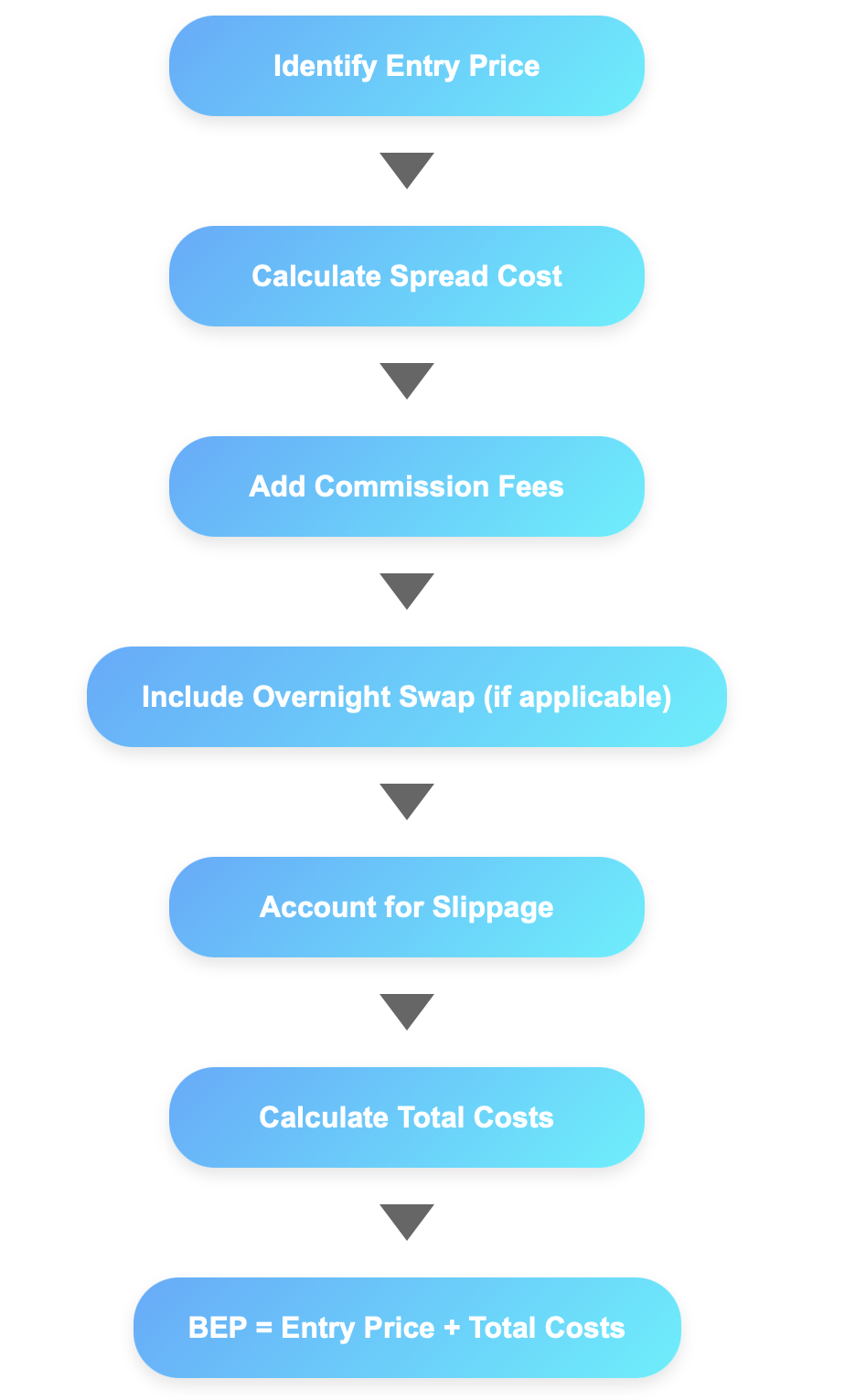
You do not need a PhD in finance to calculate your breakeven point; however, you do need to focus on the details. The basic formula for figuring your breakeven point can be represented as:
BEP = Entry price + total trading costs
But, what are the total trading costs?
Let's go through each of the costs in the order of magnitude:
- Spread: this is generally your biggest cost. In the case of EUR/USD which has a 1.5 pip spread, if you are buying EUR/USD, you need to add 1.5 pips to your entry price.
- Commission: in the case of some brokers, you pay a fixed commission per lot and your trade was one standard lot and there was a $7 commission; this would suggest a cost of 0.7 pips on EUR/USD.
- Swap/Rollover fees: If you keep your position overnight, the broker uses a third-party bank to lend or borrow the currency or currency position to you, and there is interest charged or credited depending on the currency pair and the direction of the position.
Here’s a practical example: You purchase 1 standard lot of EUR/USD at 1.1000. Your broker has a spread of 1.5 pips, $7 commission and you are holding the position overnight (-$2 swap fee). Your total cost will be around 2.2 pips so your breakeven point will be 1.1022.
For stretches, try thinking of it this way: You are selling lemonade that it costs you $3 to make, plus $1 to rent the stand, and an advertised cost of $0.50. You would need to charge at least $4.50 to breakeven.
The moral of the story is to be honest and transparent about all costs. Many traders forget about the commission and overnight fees to their particular broker, and then wonder why their "profitable" trades are losing them money.
Breakeven Point & Trading Styles
Your trading style will affect how much the breakeven point affects your final result. It is a little like a runner who runs marathons, compared with a sprinter! Both runners are fit, but the demands of each are very different!
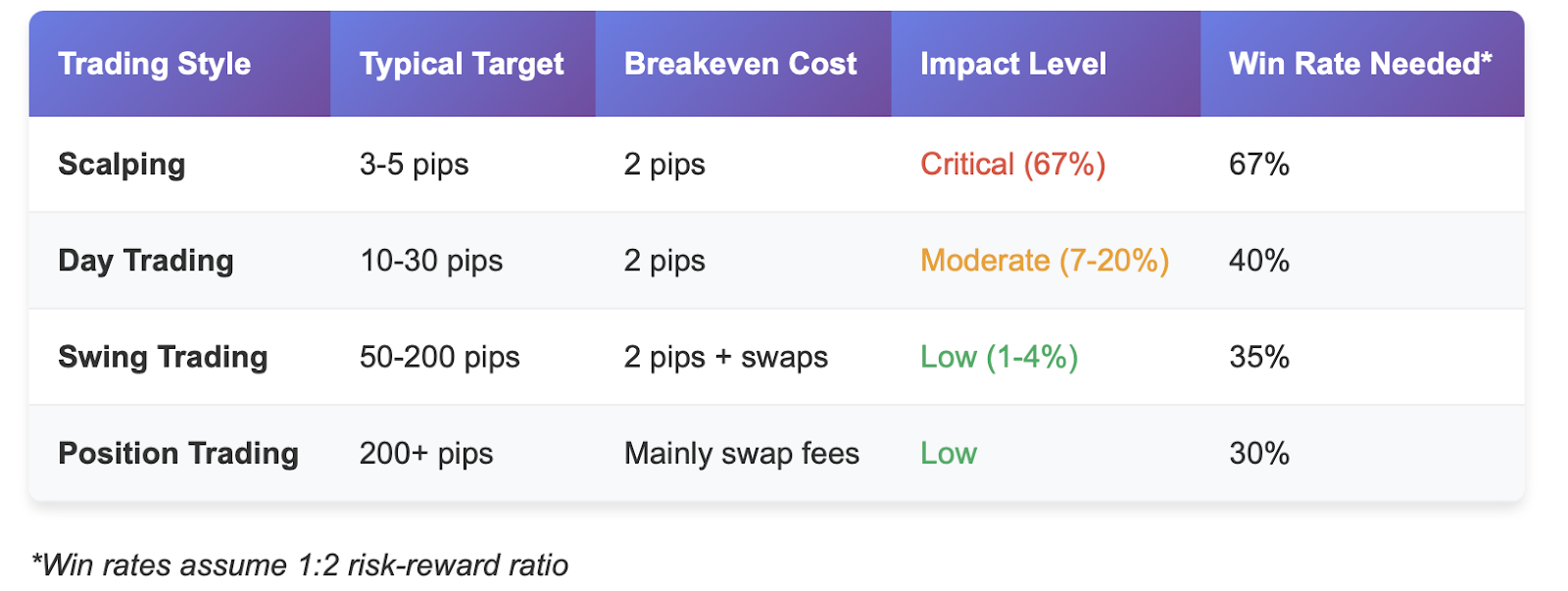
- Scalping: If you are scalping for 3-5 pip profit, and your spread is 2 pips, you effectively need 67% of your trades to be winners just to get your cost back - let alone earn a profit. Hence, scalpers are often obsessed with finding the broker with the tightest spreads and lowest commissions. Every pip is important to scalpers, especially when you are taking on 50+ trades a day.
- Day Trading: Day traders are typically looking for between 10-30 pips on a trade - so the 2-pip breakeven is about 7-20% of their profit target; substantial, but not critical. Day traders are ok with a little wideness on their spread, but still need to be mindful of their breakeven as part of their risk management.
- Swing Trading: Swing traders who take trades targeting 50-200 pips can swallow the cost of trading more easily. A 2 pip breakeven represents 1-4% of their profit target. However, overnight swap fees, are far more important for these longer-term trades.
- Position Trading: If an indicator trader is holding a position for weeks or months, the cost of trading shifts entirely to cumulative overnight fees and not the spread. For example, a position trader may have 0.5 pips of spread, but sends out a fee of $50 of swap on a trade that is on for a month.
Here’s a reality check: If you are just making breakeven profits, odds are your style of trading is incompatible with your broker’s cost structure. It is much like trying to make money selling candy one at a time if the fees for the sale are $2.
Breakeven & Risk-To-Reward Ratio
Here is where most traders misunderstand breakeven: they think by becoming breakeven traders they have succeeded. That is like saying you purposely don't want to lose money with your business, if you are actually not making any profits.
Savvy traders use breakeven as the starting point for establishing a realistic profit target. The rule of thumb is that the minimum profit target should be at least twice the breakeven point distance. Therefore, if your breakeven point is 10 pips from your entry, it must be at least 20 pips found, with other brokers, you could choose anything, and within that distance would also be at breakeven distance from your entry. This represents a risk-reward ratio of 1:2.
Let's see an example in action: You bought EUR/USD 1.1000 and your breakeven point was 1.1010 (10 pips). Your take-profit should be 1.1030 (30 pips) and your stop-loss at 1.0990 (10 pips below entry). Now you have taken a risk of 10 pips as a pure profit to take profits of at least 20 pips after all costs.
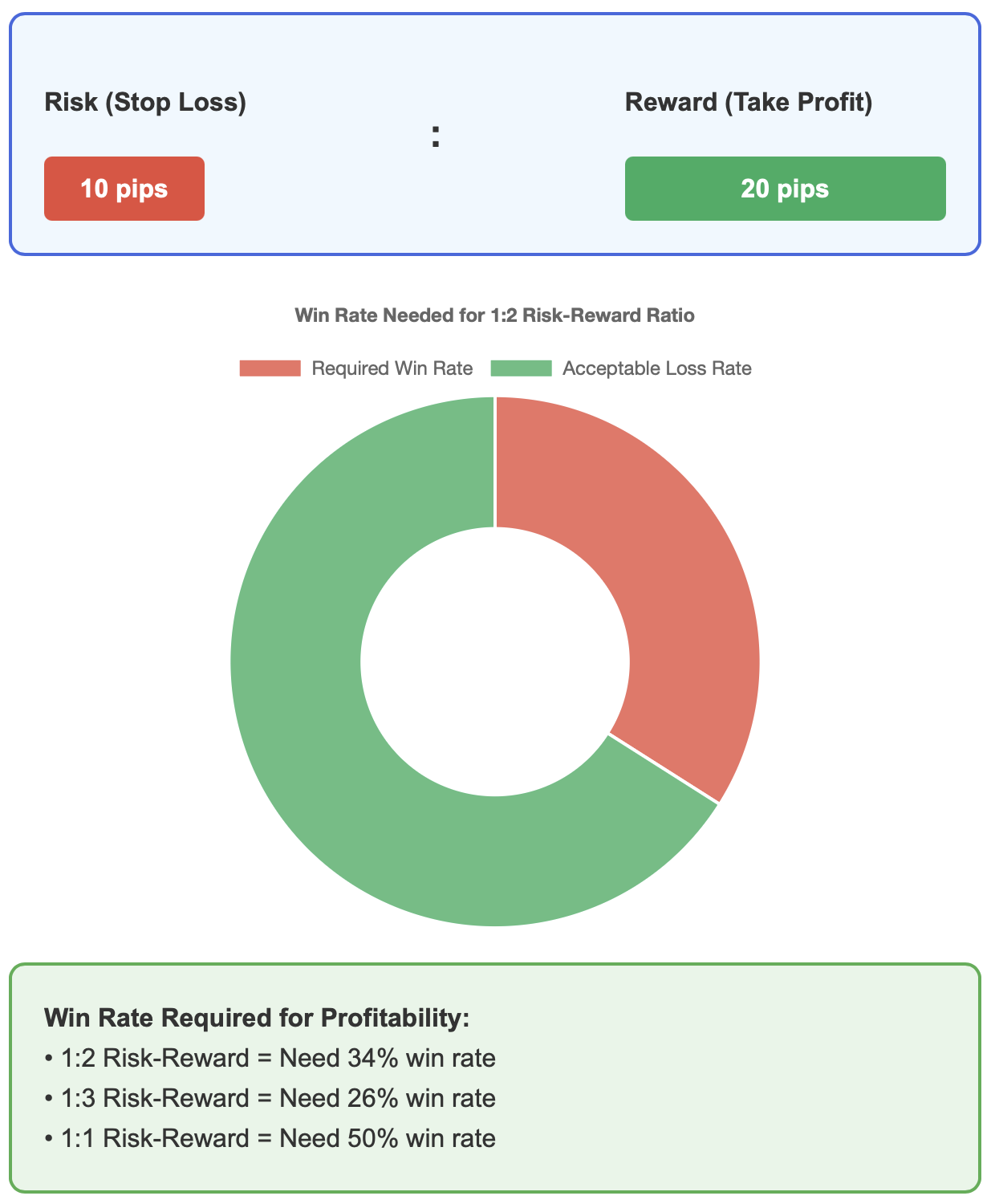
The math is simple, but powerful. If you have a risk-reward ratio of 1:2, then you can be right only 34% of the time to still make a profit. In fact, even a 50% win rate guarantees that you will continue to grow your account.
Many new traders make the mistake of moving their stop loss to breakeven the minute their trade makes a profit. While this eliminates any loss, it also drastically reduces potential profit and instead you have lots of breakeven trades and few winners - something that leads to frustration and stagnation.
Consider breakeven to be a safety net in your trading and not your destination. It is just that, A safety net and should be your goal to make a meaningful profit to justify your time and the risk you have taken.
Breakeven Point and Position Sizing
The size of your position makes all the difference in the world when it comes to the element of breakeven in your trading success. It may not seem right, but sometimes trading smaller positions increases your profitability.
For example, if you trade 1 standard lot of EUR/USD and the spread is 2 pips, it will cost around $20 to breakeven. If you go down to trading 0.1 lots (a mini lot), then you just need to breakeven 2 pips or it's only going to cost you $2. Of course the potential profit is smaller, but likewise the breakeven need is significantly smaller too.
Leverage adds a dimension to this situation. You can gain 100:1 leverage to control a $100,000 position with only $1,000 in your account. You can also increase both profit and loss, but it also increases the size of trading costs. A 2 pip spread on a highly leveraged position could equate to a substantial percentage of your account size.
Using proper position to size means you need to determine your position size according account size and risk tolerance. Remember, all cost to break-even will weigh on your decision process. If break-even performance is larger than 0.1% of your account size in your typical position say you've just traded too big. Most professionals risk less than 1-2% per trade in total cost to break-even.
Consider the following example: Trader A has a $10,000 account and is trading 1 standard lot (risking $200 to break-even), while Trader B also has a $10,000 account and is trading 0.2 lots (risking $40 to break-even). Over series of trades of 100 trades with the identical win rate for both Traders, Trader B's break-even cost or pressure was frequently lesser than Trader A, which was probably highly indicative of a better overall trade clip performance.
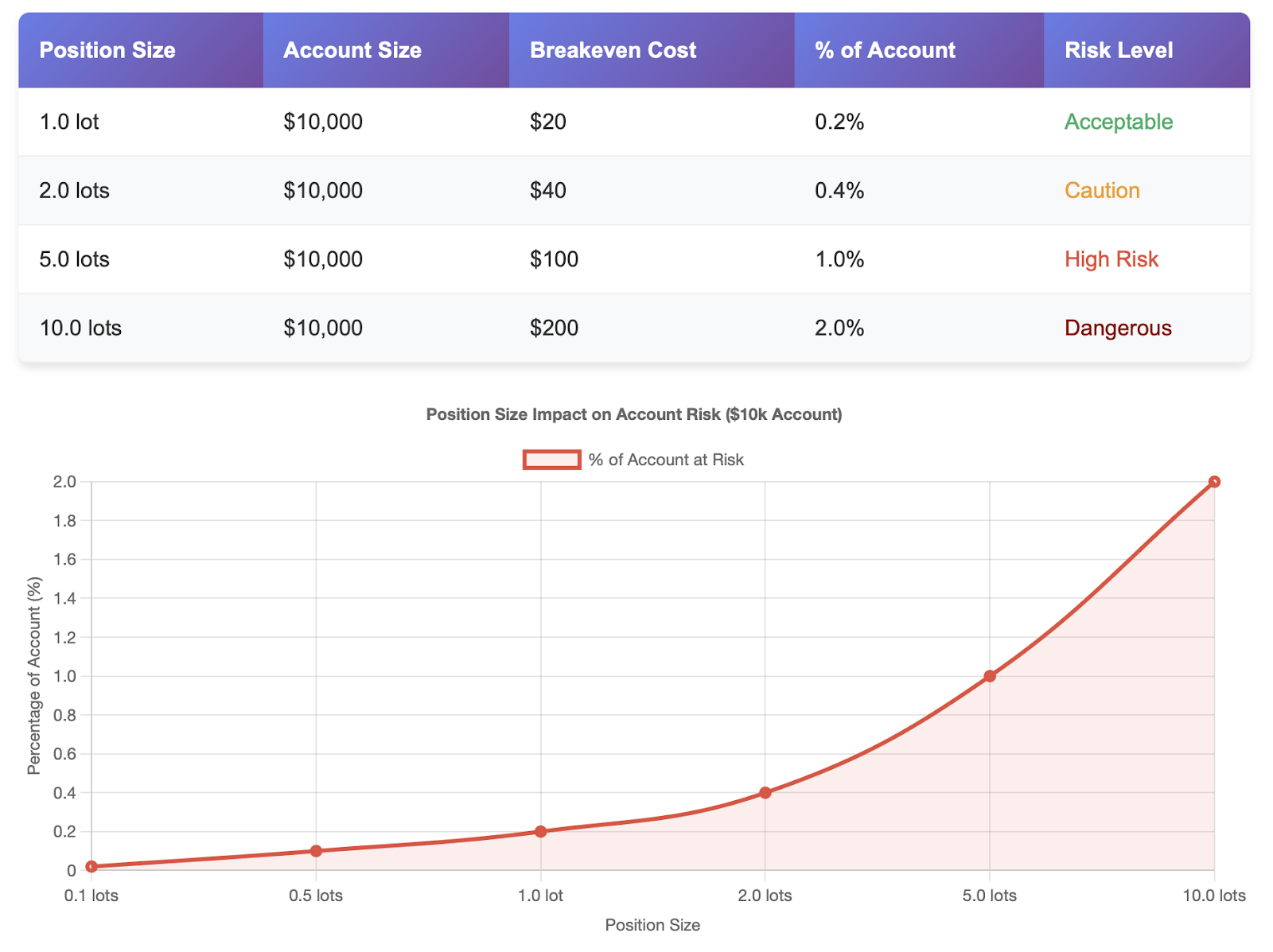
The key is to find a balance where position size is large enough that it creates enough profit, but also that it is small enough that break-even cost becomes negligible relative to the edge.
The Psychological Aspect of Break-Even
The breakeven point can distort your mind in unexpected ways. The human brain completely discounts loss avoidance when compared with gain making. This difference in perception is not going to financially ruin you, but it will impact your trading performance.
The biggest psychological trap? Moving your stop-loss to the breakeven point as soon as you see profit. Because it feels good, and feel safe; you can't lose anyway if you are stopped at breakeven. Not really. You won't lose capital, but you will lose opportunity capital if you keep adopting this defensive strategy; it will consistently give you a lot of small breakeven trades, and very rarely substantial winning trades.
Professional traders have a different thought process when it comes to breakeven. What you will find is that they will often use the breakeven point strategically, and quite often will still not move their stops to the breakeven point unless they have closed a profit equal to 2 times their risk. This allows small winning trades to run, while at the same time protecting your profit as you should systematically be doing with your winning trades.
You'll also find another trap to avoid in relation to breakeven; breakeven addiction, where traders celebrate reaching breakeven like it was a win. You want to avoid losing sight of the fact that reaching breakeven kept you in the game, but simply put just getting back to operational is not a win for traders on the path to becoming a professional trader. Just not losing is not considered success.
When the anxiety of seeing your position after entering your trade that seems to be going nowhere but to breakeven, can lead to closing the bad trade before it reaches its breakeven point. You will see your position down 8 pips when you are looking for 10 pips to break even, then you panic and close the trade. A few minutes later price has retraced and you’re watching it hit the same original profit target you had. It's this type of mental flip that highlights the need to gain a true understanding of and acceptance of your breakeven point from the outset.
Smart traders set their expectations of breakeven in advance of entering the trade and don't revisit it during trade management. They have the capability to know their costs and accept them in advance, and they focus entirely on executing the trade with confidence without being distracted with thoughts of second-guessing their decisions during their trade.
Breakeven Across Markets
Keep in mind that not every market is the same when it comes to breakeven calculations, because each market operates off of its own cost structure and knowing the variances can ultimately change the overall profitability of your trades.
Forex: Forex usually comes with the tightest spreads, especially on major pairs. For example a EUR/USD spread might average anywhere between 0.5-1.5 pips. Breakeven is easy to achieve when the spread is virtually nothing, after accounting for your commissions and your breakeven level.
Stocks: Stock commissions can be broken down into a whole different category, especially if the commission is per share + SEC fees. If you attempt to purchase a $100 share of XYZ stock, your costs could average anywhere between $5-$10. Thus, you are needing a 5-10% move before you are even able to break-even on the hypothetical trade. This is usually the reason why short-term stock trading is less attractive for small accounts as compared to forex.
Commodities: there is a very wide variety of spreads. Gold might be $0.50 in spread for a $2000 price; or agricultural commodities often have much wider spreads in relation to their value. Commissions on futures contracts are often fixed regardless of the contract size.
Cryptocurrency: commonly known for having volatile spreads. Bitcoin may have spreads of between $50-200 during volatile periods making breakeven prices less predictable. Many exchanges charge trading fees as a percentage. Similar to the commodities mentioned above, or stock exchanges.
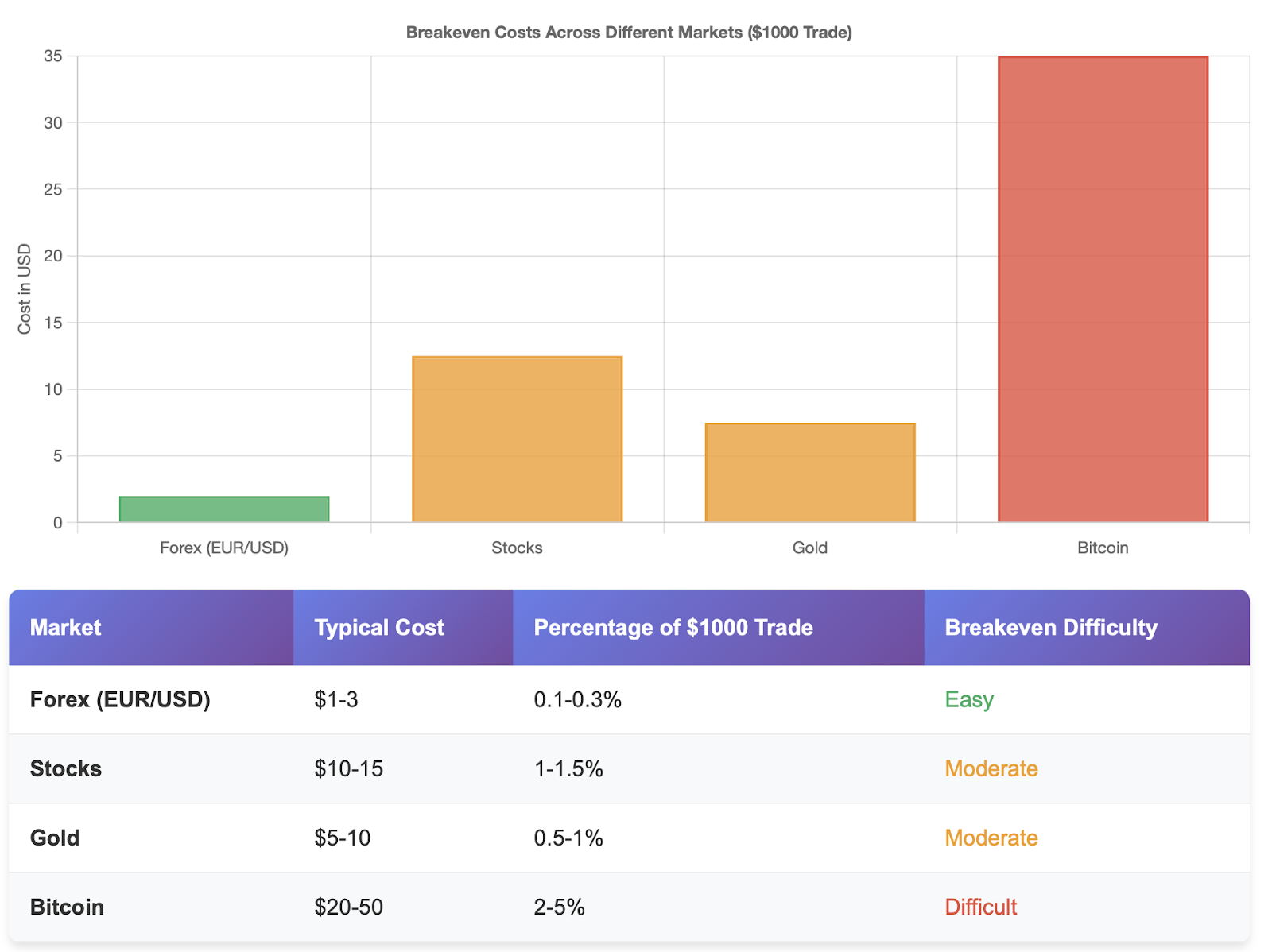
A practical comparison: To breakeven on a $1000 trade you might need
- Forex (EUR/USD): $1-3, (0.1 - 0.3%)
- Stocks: $10-15, (1-1.5%)
- Gold: $5-10, (0.5-1%)
- Bitcoin: $20-50, (2-5%)
This goes a long way to explain why many professional traders' short-term activity is heavily weighted toward Forex: and for long-term activity, stock investments. Product choice should consider trading timeframe and position size.
Breakeven in Algo Trading
Automated trading systems can execute breakeven management more reliably than a human trader will, but they aren't always consistent. You can program and use Expert Advisors (EAs) to move stop losses, at breakeven, automatically when your trade is at some determined profit level.
A very common EA approach: the EA would set breakeven after a certain (15) pips profit was secured. The EA would know to put the stop loss at its initial entry to ensure zero loss on the position but continue to run towards a target. In this automated scenario, no emotion like "fear" or "greed" present, other than programmed logic.
But it is not without obstacles to overcome in managing to breakeven levels. The market can gap past both your entry and breakeven stop loss – it often does especially when news is released or after the weekend. The EA may have the stop loss moved to breakeven, right before the EA calls the back to assumedly produce a small pullback leading to breakeven stop triggering, not securing a potential more profitable run.
The biggest advantage to algorithmically trading breakeven is the consistence of execution. Human traders often don't execute the plan due to emotion that led to deviation; assuming the EA will always follow the rules of the use of third party software. Although this is a massive advantage, it can also be considered a disadvantage in certain market conditions.
If you are implementing EA's into your plan for breakeven management, backtest the trading plan extensively, to ensure depending on market conditions are appropriate. An algorithm may work into predominantly trending markets, but not in choppy, sideways markets. And keep in mind, automated does not mean maintenance-free - you will still have to monitor performance and adjust your parameters as market conditions convert.
Common Mistakes & Misunderstandings
Even professionals can fall victim to breakeven traps. Here are some of the mistakes that cost the most, as well as how you can avoid them:
- Forget Hidden Costs: The spread is obvious, but will you forget about commissions, swap fees, or slippage? You think you are working with a "2-pip spread" broker - before long, you are actually suffering from a 4-pip total cost Broker. Always determine what your all-in costs are to break-even.
- Moving Stops Too Early: As soon as you see a profit, you move your stop to breakeven, even though you know you are not likely to make money. This is not safe, and will lead to more stopped trades than good trades that you deserve to remain in; only move to breakeven AFTER you lock in a profit that is acceptable to you to forgo further upside potential.
- Breakeven Focus: Some traders become so 'loss averse' they instead celebrate breakeven and not going into the red, instead of going for more meaningful profits. Breakeven is not winning - breakeven is just not losing.
- Ignoring the Market Context: Your EUR/USD system is managing your breakeven costs at 2-pips; that will work great for EUR/USD. Usually if your strategy can deliver; you can apply it to anything. Until you realize you just transferred it to a crypto pair, that costs 20-pips to breakeven, you no longer have an account. Do not take the advice literally; you have to work it all into your costs.
- Sizing Position Poorly: Trading position sizes so large that breakeven costs represent large percentages of your account. If your breakeven costs you more than 0.5% of your account, you are obviously over-leveraged.
Here is the kicker: Being able to break even consistently and avoid losses may sound appealing, but it is a slow death for traders. That is, each day you are expending time and emotional capital to make zero progress. Successful trading comes from you having to acknowledge some losses while you maximise your wins, breakeven doesn't get you there.
The goal is not breakeven; the goal is to have positive mathematical expectation across multiple trades. Think of breakeven as a risk tool, not a measure of success.
Conclusion
Realising breakeven is fundamental learning to run before you can walk in trading. The breakeven point is your baseline defence – the minimum point before which any trade can be deemed successful, but remember breakeven is not your target it is only your starting line.
The most effective traders view breakeven as a planning tool, not a goal. They know the breakeven cost in advance and add those costs into their risk-reward ratios when trading. They use that information to make better trading decisions. Whether they go for 10 pips or 100 pips, they have confidence to carry through their strategy without worry about every move in the market.
Being proficient at breakeven can lead naturally into risk management and the optimization of your strategy. Once you can consistently identify and factor in your breakeven needs - you can now pay attention to what is truly important in trading! Finding good setups that have good probability for your trading strategy and will pay you profits over and above your costs!
Now, are you feeling ready to take breakeven point information into practice? Thousands of traders have realized an edge as they make trades with known, transparent, fully disclosed, competitive costs. At Tradewill.com, we have narrow spreads and a flat fee, which makes identifying, calculating and achieving your breakeven points easy.
Don't let hidden costs be your enemy - experience the feeling that true cost transparency provides in your overall profitability.
Start Your Risk-Controlled Trading Experience Today →
Disclaimer: The content of the blog does not represent any position of Trade W, does not serve as any trading-related decision advice, and does not endorse any third-party.