

 Trade W
Introduction
Call options can be your best friend when operating in the forex market, by limiting risk and increasing your potential for profits. Put simply, a call option gives you the right, but not the obligation, to purchase a currency pair at a predetermined price on or before a specific date in the future.
Think of it like reserving concert tickets today for a concert next month. If prices go up a lot, you win. If prices go down, you lose only the amount you have paid to reserve the tickets. The same concept applies to forex call options on currency pairs.
These instruments can be used for more than just speculation. Professional traders routinely employ options for hedging existing positions and managing the risk of their entire portfolio. Regardless of whether you are using options to lock in profits or speculating on currency direction, learning the use of call options will provide you with an entirely new way of trading.
Let's get right into all you need to know about forex call options, from how they work to advanced strategies that will help you reinvent your trading style.
Basic Concepts of Call Options
To trade call options effectively, it's important that you understand their common components. Every call option has three components:Strike Price: This is the price you can buy the underlying currency pair at.
If EUR/USD is trading at 1.1050 and you choose to buy a call option with a strike price of 1.1000, you can purchase EUR/USD at 1.1000 regardless of what was the trading price of EUR/USD.Stock options also have a strike price, outlined above in the example.
Expiration date: This is the date your option expires. Once expired, you can no longer exercise this option if you haven't done so prior.
Premium: This is the cost you paid upfront to buy the option. Think of it as the cover charge to the bar.
The value of your call option is made up of two parts of value. The first is "intrinsic" value, which is only what the current price is less than the strike price. If EUR/USD is trading at 1.1050 and your strike is 1.1000, you would have an intrinsic value of 50 pips.
Then we have time value which denotes the potential for the option to add additional value before expiration. The formula is simple: Time Value = Premium - Intrinsic Value.
Options fall into three classifications based on their relationship to the current market price:
- In-the-Money (ITM): Strike price is down to current market price
- At-the-Money (ATM): Strike price is about equal to current market price
- Out-of-the-Money (OTM): Strike price is above current market price
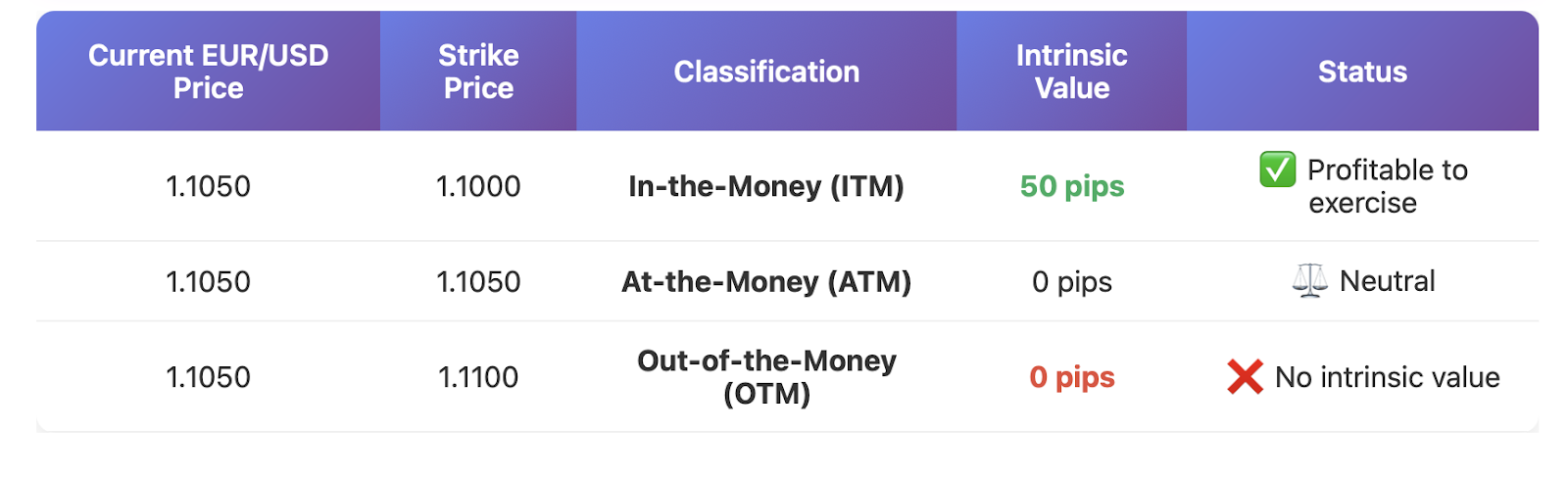
For example, if EUR/USD is trading at 1.1050, then a call option at 1.1000 strike is ITM, at 1.1050 strike is ATM, and at a 1.1100 strike is OTM.
The wonderful thing about call options is that they have an asymmetric risk profile. As the buyer, you have unlimited profit potential if the currency moves in your favor, but your loss is limited to the premium you paid. You have the right to exercise the option, but you are never obligated to do so.
Call Option Trading Strategies
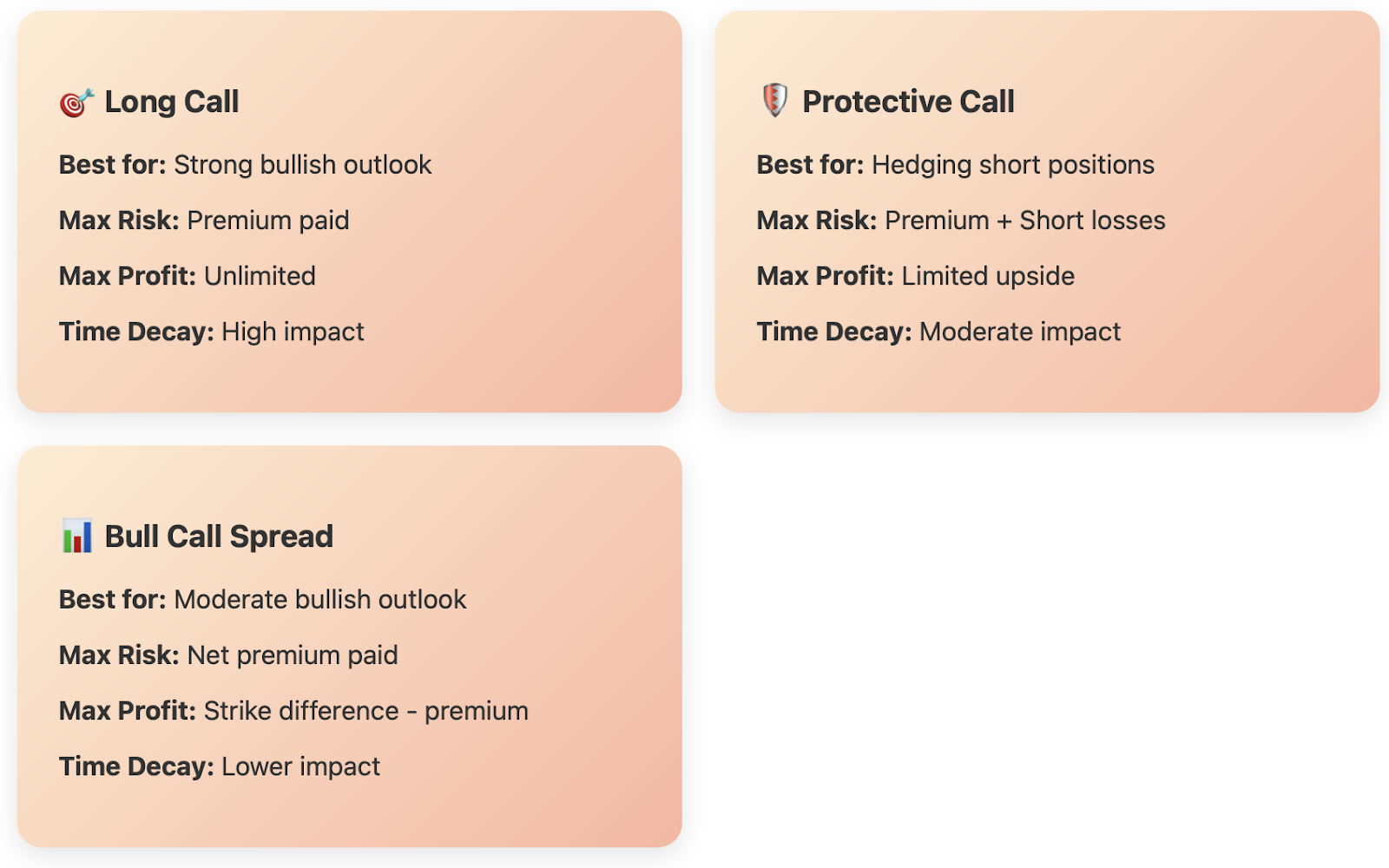
The most basic strategy is buying a call option when you expect a currency to rise. This can work well in a bullish market, and while you are exposing yourself to the upside movement, you are only risking the premium you paid in the beginning.
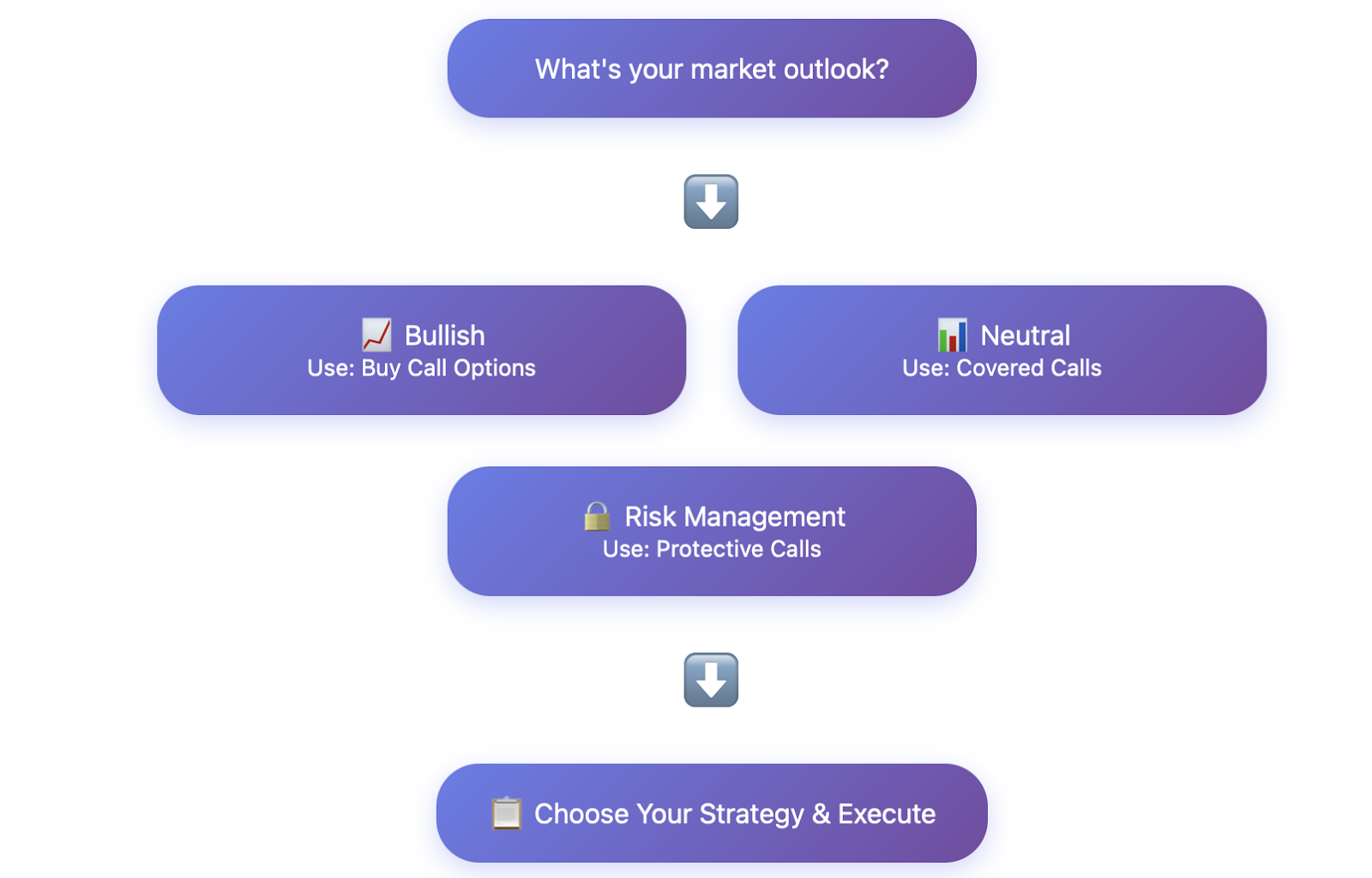
However, more complicated combinations of strategies for call options include:
- Protective Call strategy - An approach if you are short a currency pair. If you are short a position, buying a call option gives you protection against adverse moves. Essentially this acts as insurance to your position. The call option will gain value with the market goes against your short position, thus offsetting some of your losses.
- Covered call strategy - If you are long a currency pair, you can sell call options on your position to obtain premium income. This strategy is best suited when the market is sideways and no immediate move is expected, but you can generate income (option premium) from your position.
- Bull call spread - This trade entails buying a call option on a lower strike and simultaneously selling a call option on a higher strike. With this strategy, you are only lowering your cost basis as your max profit on this strategy is capped as well. This strategy works very well when you are moderately bullish, but also want to lower your upfront exposure.
Market activity determines which strategies will be advantageous. In trending markets, buying outright calls usually is advantageous. During periods of range, income strategies (like covered calls) usually are advantageous. During periods of high volatility, spreads are often used to accommodate the initially inflated premiums.
Here’s a practical example: A European bank expects that EUR/USD could increase given the improving economic data from the eurozone. The bank initially buys calls instead of going to a bigger spot position because of the risk, but it does allow for upside exposure. If the forecast is wrong, the call options will be lost, but only the premium paid. But if the forecast is correct and EUR strengthens, the trader gets to profit from the currency risk for less capital than it would incur if it used a spot position.
Essentially, you have to align your strategy based on your outlook of the market and risk tolerance. Traders that are more aggressive may want to take outright positions to maximize their leverage while more conservative investors will want to employ protective strategies to limit the downside risk.
Factors that Influence Call Option Prices
Knowing what affects call option prices will allow you to exit and enter at the right time. There are different factors that affect how much you will pay for an option, and how it's value changes over time.
Underlying Price Movement: This is the obvious one. As the currency pair moves above your strike price, the value of you call option goes up. The growth in value is not linear; we are getting to the Greeks.
Delta explains how much your call option price will change for every pip movement in the underlying currency. If you have an option with a delta of 0.5, it will gain roughly a half a pip for every pip the underlying currency rises. Deep ITM (in the money) options have greater deltas than OTM (out of the money) options.
Gamma is how fast delta changes in the value of the underlying currency. Options that are ATM (at the money) have the most gamma; therefore delta ramps up quickly once they move OTM or ITM.
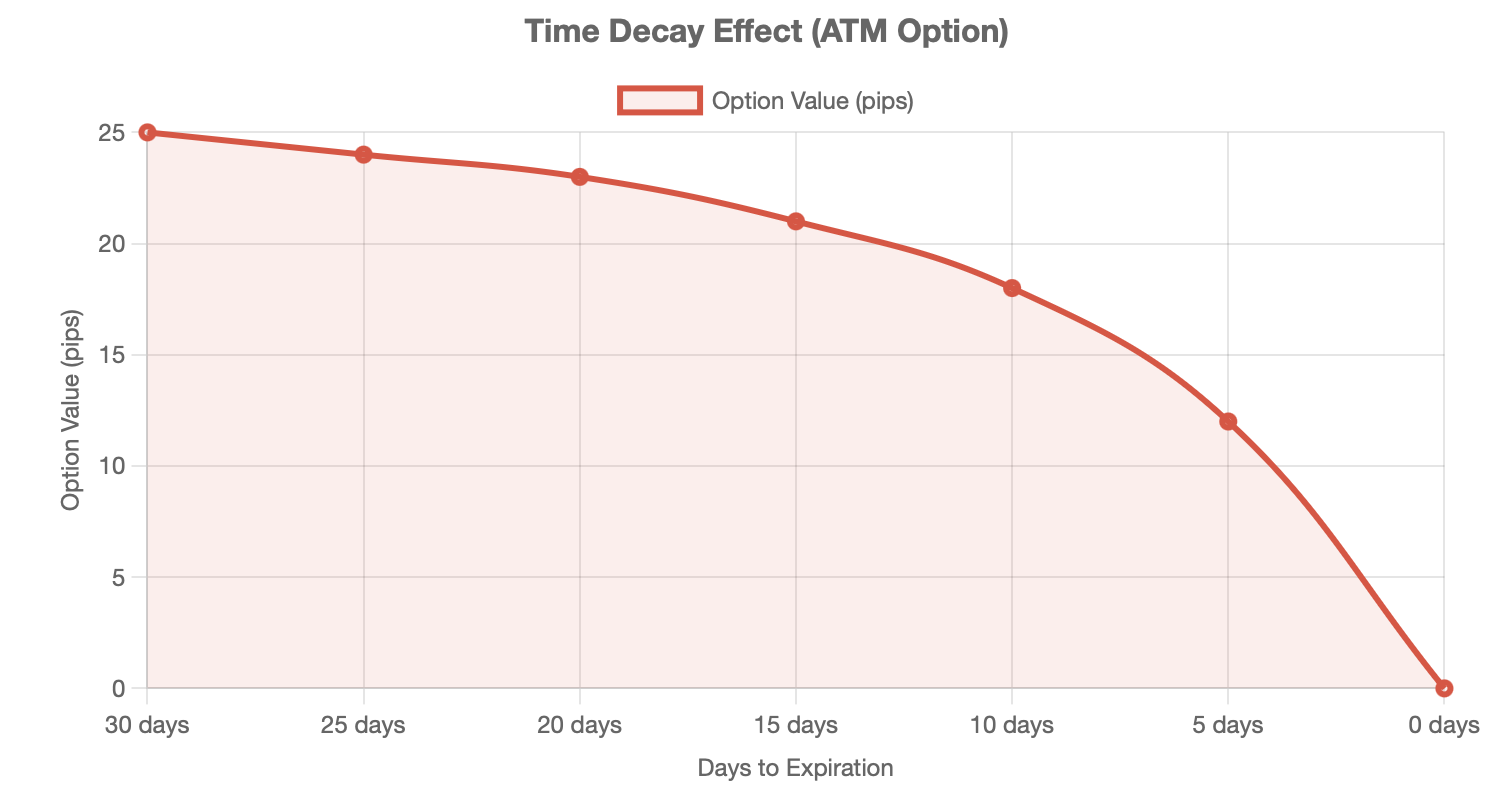
Theta measures time decay; how much value you lose each day as your option price approaches expiration. This is why when you buy an option far from expiration, it allows you more time for your trades to work out but costs more on the front end.
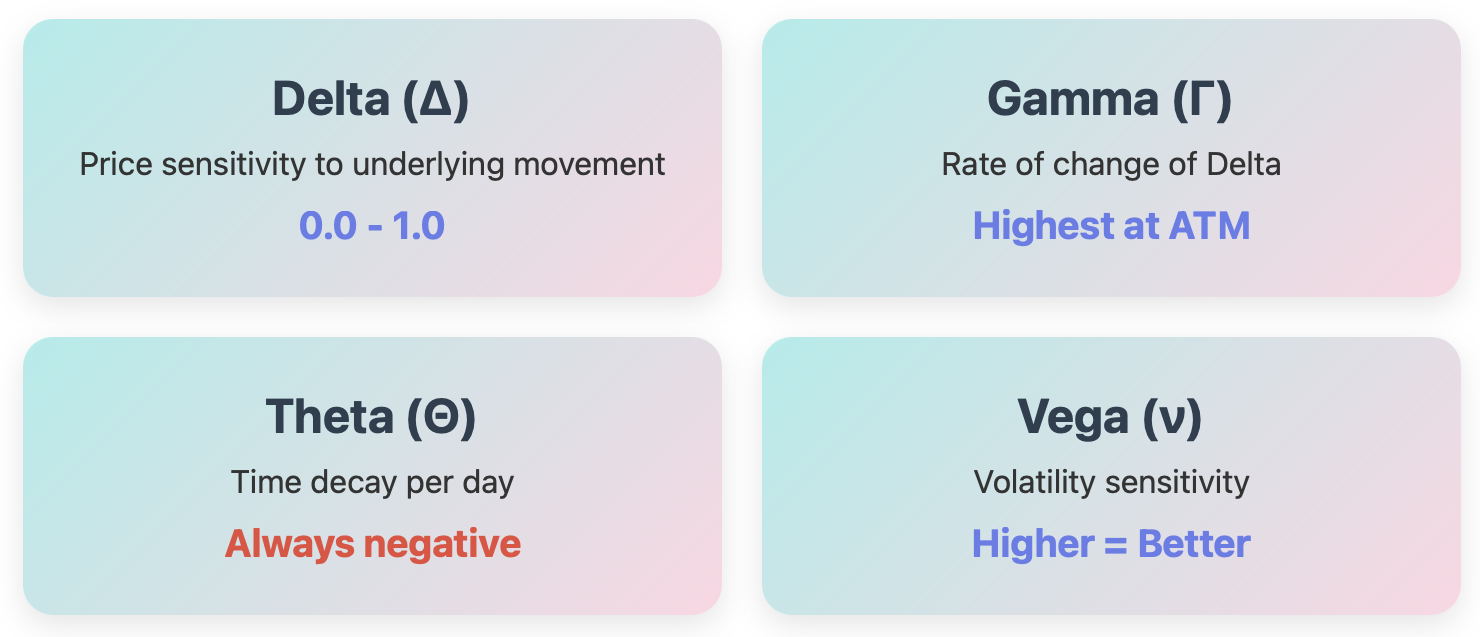
Vega quantifies an option's sensitivity to changes in volatility. As volatility approaches an increase, the option's value increases, as there is a greater likelihood of large price movements. When the market calms after a volatile period, option values often decline, because the underlying currency has not moved as much.
Interest Rate Differentials: In forex, difference in interest rates between base and quote currency can change option pricing. If the base currency has a higher interest rate, the call option value will generally increase.
Time to Expiration: More time until expiration generally increases the value of the option, although the increase is not linear as time to expiration approaches, sometimes referred to as time value. Options lose value slowly at first, and then rapidly as expiration occurs. The process creates the time decay curve that all options traders must understand.
A real example is the following: you purchase a 1-month EUR/USD call option when the implied volatility is 12%. The European Central Bank gives hints at changes in policy, causing volatility for EUR/USD to spike to 18%. The underlying currency might not have changed prices for any substantial amount, but the value of your option increased because of the expected higher volatility of EUR/USD.
Each of these factors interacts with the market and creates total pricing dynamics that are very complex. A particular currency example might move in your favor, but if the volatility were to decrease substantially, your option could lose its value. Professional traders do not simply look at whether the underlying currency is to move positively or negatively. They monitor all different factors.
Risk Management and Trading Psychology
Options Trading magnifies opportunity and risk, hence, it is important to have risk management plans in place. The leverage associated with options can change small movements in currency prices into large gains or losses compared to your premium investment.
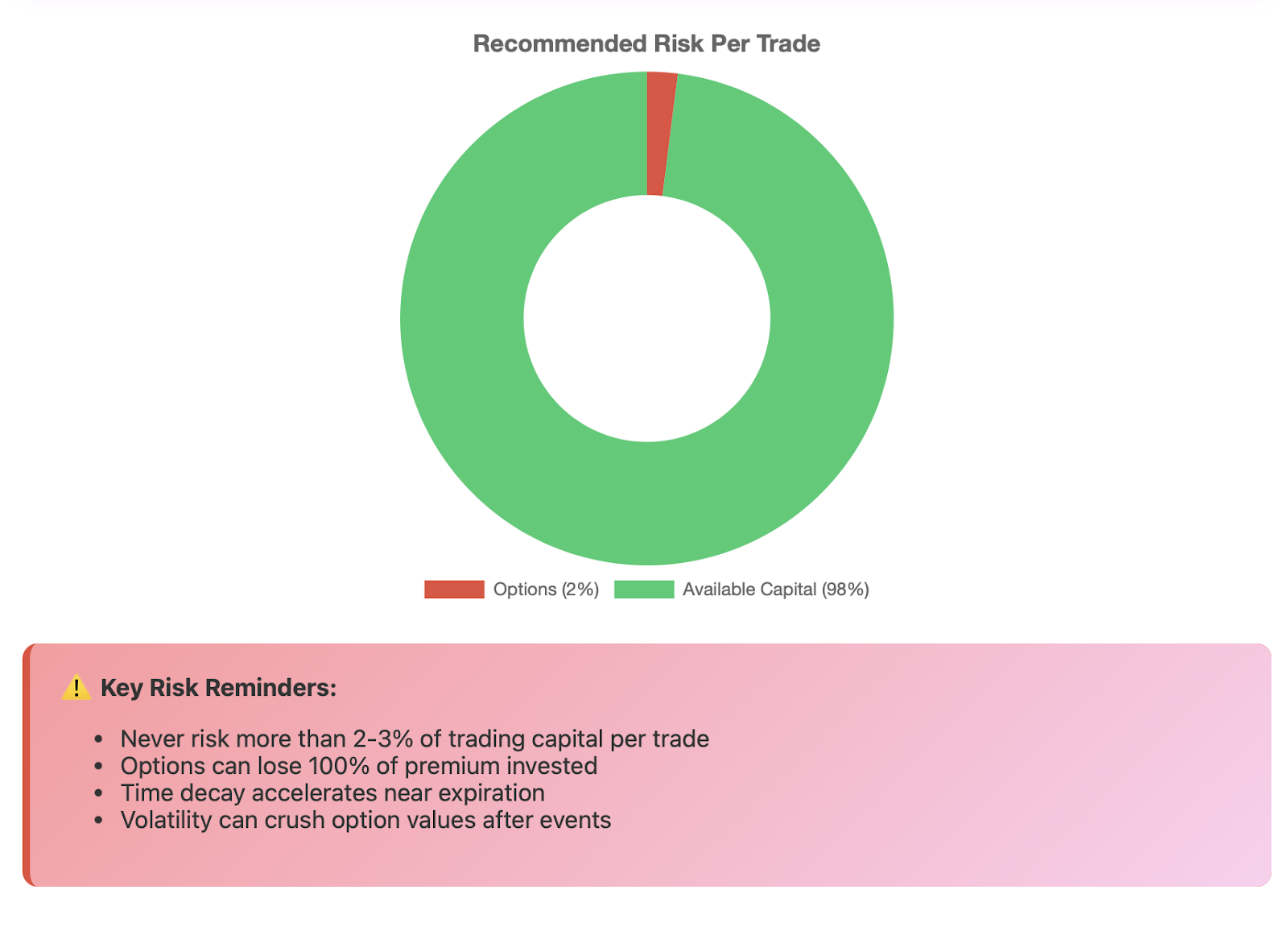
Time Decay Risk: Each day that passes, the value of your option decreases even if the underlying currency never moves against you. This pressure creates a sense of urgency that does not exist in spot trading. You need the currency to move quickly in your favour before time decay eats into your potential profit.
Volatility Crush: After key events such as central bank meetings or economic releases, the implied volatility for that currency will usually drop sharply. There is the potential for the currency to move as you expected, but there is also the potential for your option price to trade down because the anticipated volatility has dissipated.
Over-Leveraging: Since traders invest less in options than they would for an equivalent position in the spot market, they often have larger positions than they otherwise should. Keep in mind that you could lose as much as 100% of your premium so size your positions accordingly.
Managing risk effectively begins with position sizing. Always limit your risk to a total loss you can afford, and that is precisely what can happen with options. Many options traders who are successful will never risk more than 2-3% of total trading capital on a single trade.
Stop-Loss Strategies: In contrast to spot trading, stop-losses may be more problematic with options trades. Premium prices can only be highly volatile, and you may be stopped out on a temporary dip in price when your directional view is absolutely correct. Some traders use time constraints as defined stop-losses by closing their option position if it hasn’t moved positively after a defined period.
Take-Profit Planning: Options can gain value very rapidly when the currency movement aligns with volatility. Planning to take profits when they are available can avoid the scenario of holding too long only to see your gains evaporate through time decay or volatility declines.
Psychological Challenges: Options trading tests your discipline in a different way, unlike spot trading. The ticking clock of an expiration can create alternatively new pressures which in turn create the possibility of premature decisions. The potential for 100% loss can create fear while the leverage creates greed.
Below are the characteristics of a systematic risk management process available to successful options traders. Successful options traders understand their maximum risk ahead of their entry, establish their profit taking parameters ahead of time, and decide an amount to trade that will be the same even with a high amount of confidence on individual trades.
Think how a fund manager acts with options before big events. In front of the Federal reserve meeting they may buy a short amount of USD call options as a hedge against existing positions. They understand their maximum risk and predetermined exit strategies whether they win or not. Using a systematic approach limits the amount of discretionary mistakes leaning on emotion as volatility spikes.
Historical Case Studies
The following case studies show real examples of how call options work during major events and will help you understand how to apply this with your conditions wiser.
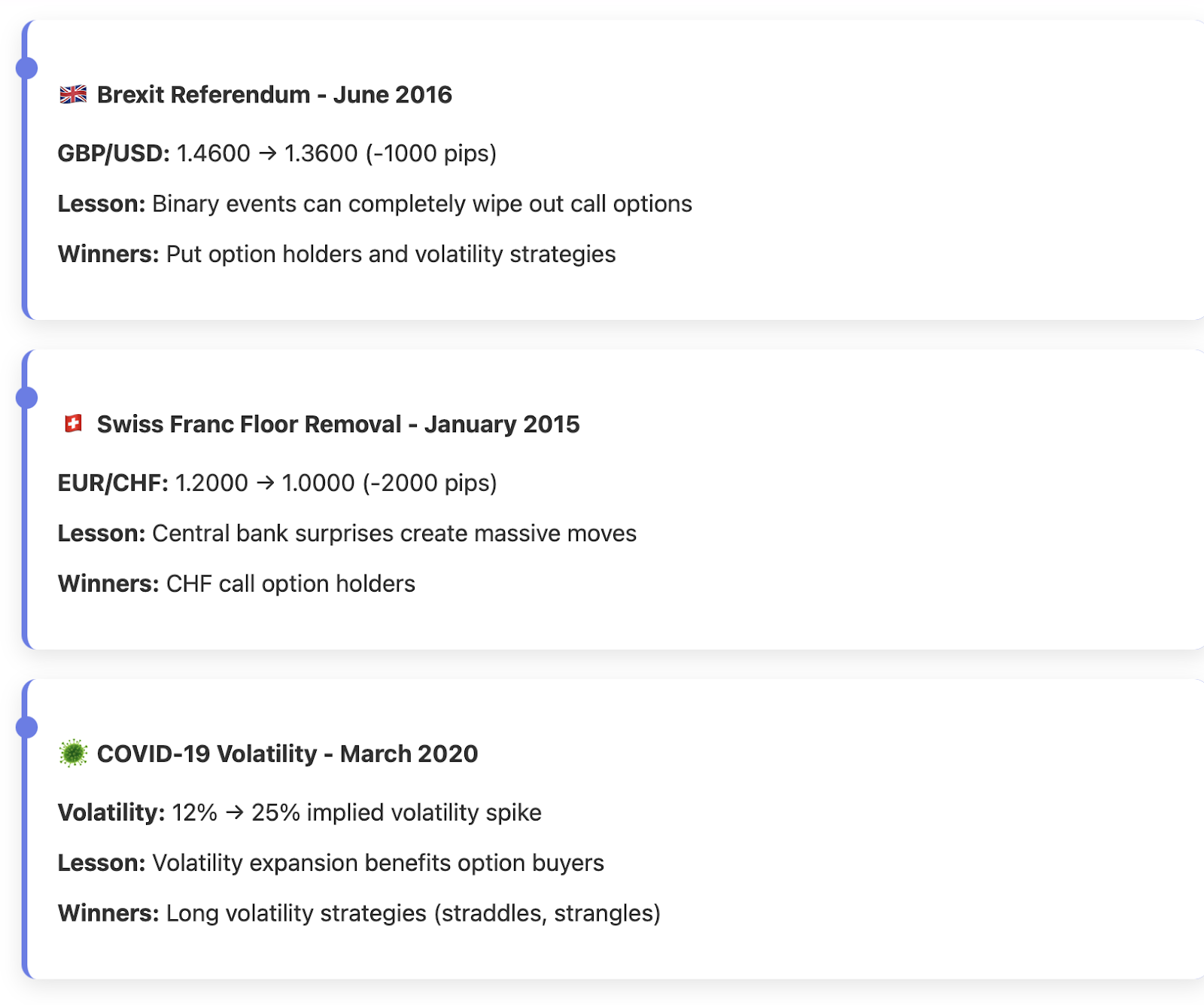
Case Study 1 - Brexit Referendum Impact on GBP/USD
In June 2016, before Brexit was voted on GBP/USD was trading fairly consistently around 1.4600. Although traders understood there would likely be volatility around the vote, they were arguing about the direction as usual. Those that bought GBP/USD call options with a strike of 1.4700 expiring after the referendum learned a harsh and costly lesson on risk management.
After the “Leave” vote won, GBP/USD tanked over 1000 pips in a matter of hours: The call options expired worthless. This is an example of how binary events can completely wipe out option premiums even when traders arrive at the correct trades based on due diligence and analysis. Traders who profited were those who bought puts or used volatility strategies that profited no matter how far it moved or in which direction.
Case Study 2: Swiss National Bank Franc Floor Removal
In January 2015, the Swiss National Bank unexpectedly removed the EUR/CHF floor at 1.2000. EUR/CHF crashed nearly 2000 pips in one trade. Traders holding CHF call options (EUR/CHF puts) profited enormously as options instantly dropped deep ITM.
This situation resulted in several important conclusions. First, the ability of central bank interventions to create large, instantaneous moves and create favorable opportunities for profit from option holders on the right side of the trade. Second, the leverage present in options can lead to profits that can be life changing from relatively small premiums when extreme events like the SNB cancellation of the lower-bound EUR/CHF.
Case Study 3: Currency Volatility during COVID-19
In March of 2020, currency volatility exploded as markets were seeking to price in pandemic uncertainty. While most traders suffered from market direction loss, traders who had positioned themselves with long volatility strategies, (long straddles, strangles) profited on both the long and short side as currency pairs moved aggressively.
Call options on EUR/USD that were bought shortly before the volatility increase increased in value from not only the movement of the currency, but due to a significant increase in implied volatility. Options that had a premium of 50 pips had a value of several hundred pips due to the heightened expectations of volatility.
Key Takeaways from Historical Case Events
Major events don’t just create volatility; they often create volatility expansions that benefit option buyers, but the timing of when you buy is crucial. Buying options just before a volatility spike is lucrative, but buying post-volatility spike is often a loser as the market tames bit.
Political events and central bank surprises create significant option moves. Currency pegging and intervention levels give clear targets for options strategies, but can easily turn into a binary variety where options pay you large or go completely worthless.
These case examples highlight the importance of understanding what you are really betting on. Are you betting direction, volatility or events? Each of them requires distinct option strategies and risk management approaches.
Practical Exercises and Skill Development
Theory is nothing without action - below are some practical exercises that will help you build your call option trading skills by using realistic scenarios. For more practice and current case studies, keep track of the EUR/USD prices on your preferred platform and follow any of the trade scenarios below.
Exercise 1: Simple Profit/Loss Calculation
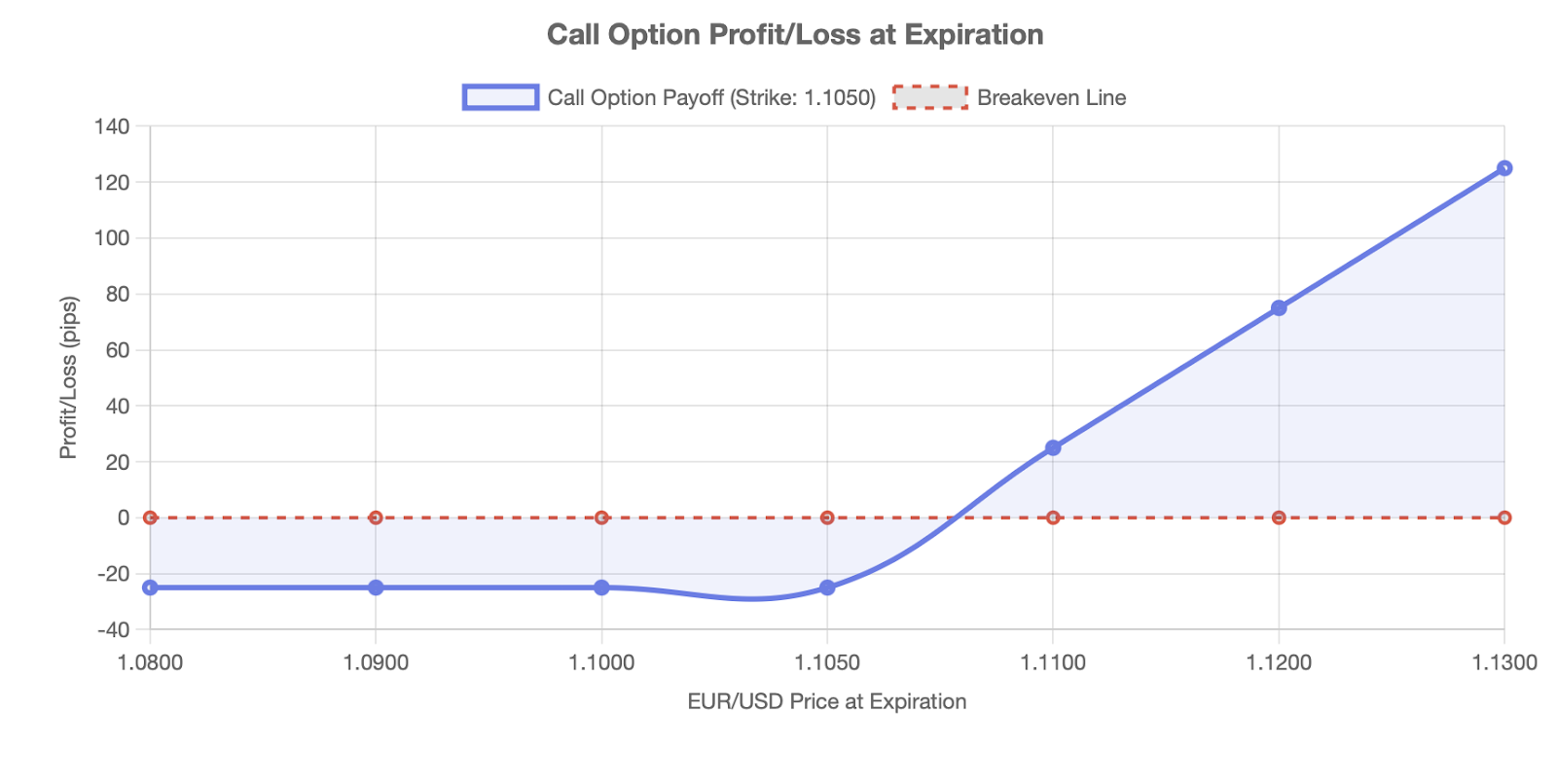
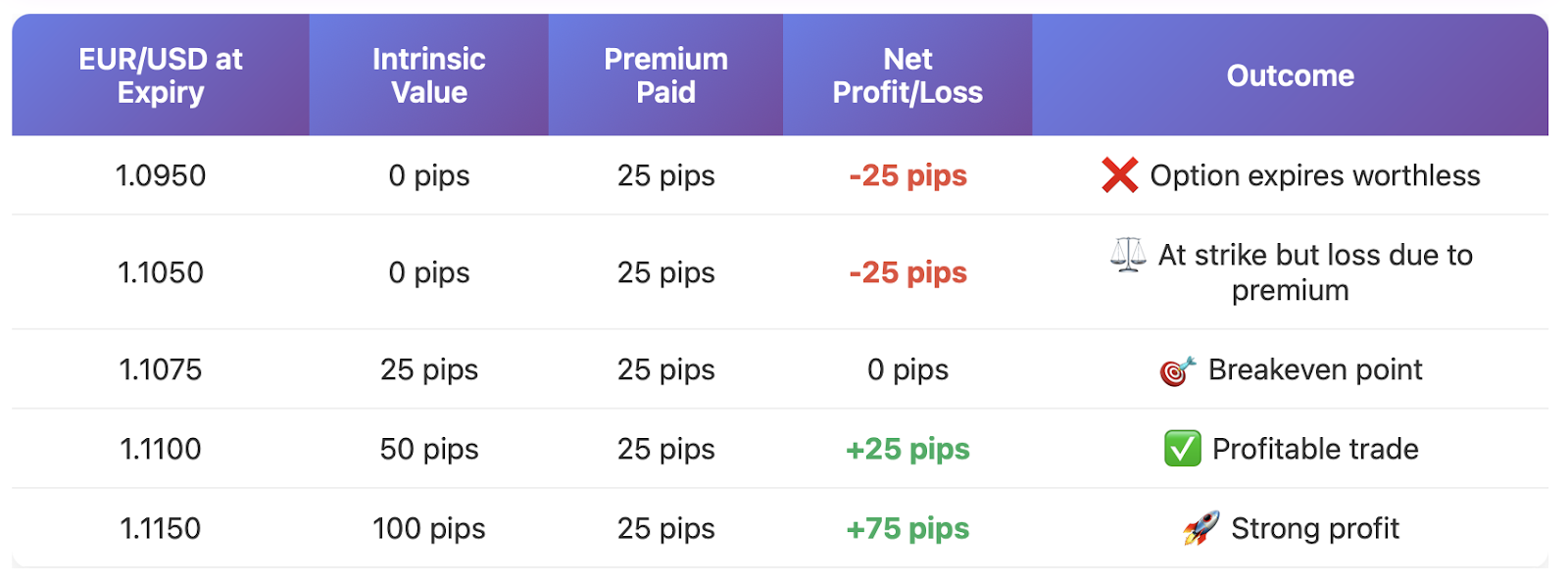
The EUR/USD currently spots 1.1000. You buy a call option with a 1.1050 strike price, 30 days to expiry, for a premium of 25 pips. Calculate your profit/loss if at expiry EUR/USD spots the following:
- 1.0950 (Loss = -25 pips - option expires worthless)
- 1.1050 (Loss = -25 pips - at breakeven at strike, however you paid a premium)
- 1.1075 (Breakeven = 25 pips intrinsic - 25 pip premium)
- 1.1100 (Profit - 50 pips intrinsic - 25 pip premium = +25 pips)
- 1.1150 (Profit - 100 pips intrinsic - 25 pip premium = +75 pips)
Exercise 2: Compare Strategies
You may be bullish EUR/USD and want to explore the following strategies:
- Buy EUR/USD spot at 1.1000 with a 50 pip stop-loss
- Buy a 1.1000 strike call option for a 30 pip premium
If the EUR/USD rises to 1.1100, the spot trade results in a 100 pip profit while the corresponding option produces a profit of 70 pips (100 intrinsic value - 30 premium). If the EUR/USD drops to 1.0950, the spot trade results in a 50 pip loss while the call option only results in a 30 pip loss.
This exercise demonstrates that for smaller sized positions, the benefit of using options to manage risk outweighs any potential profit sacrifice from option premium (less than 1 pip).
Exercise 3: Time Decay Simulation
Monitor a hypothetical call option each day leading up the expiration date:
We will start with the following: a 1.1050 strike EUR/USD call, 30 days until expiration, and a 25 pips premium.
- Assume that the EUR/USD will remain fixed at 1.1000 (no movement).
- You will be able to track how time decay decreases the value of the option each day leading up to expiry.
- This exercise will illustrate how time value affects option values regardless of price movement.
Exercise 4: Volatility Sensitivity Exercise
With the assumption of the same variables as the first two exercises, you can see how changes in volatility affect option price:
- Low Volatility environment (10% implied vol): premium around 20 pips.
- High Volatility environment (18% implied vol): premium around 35 pips.
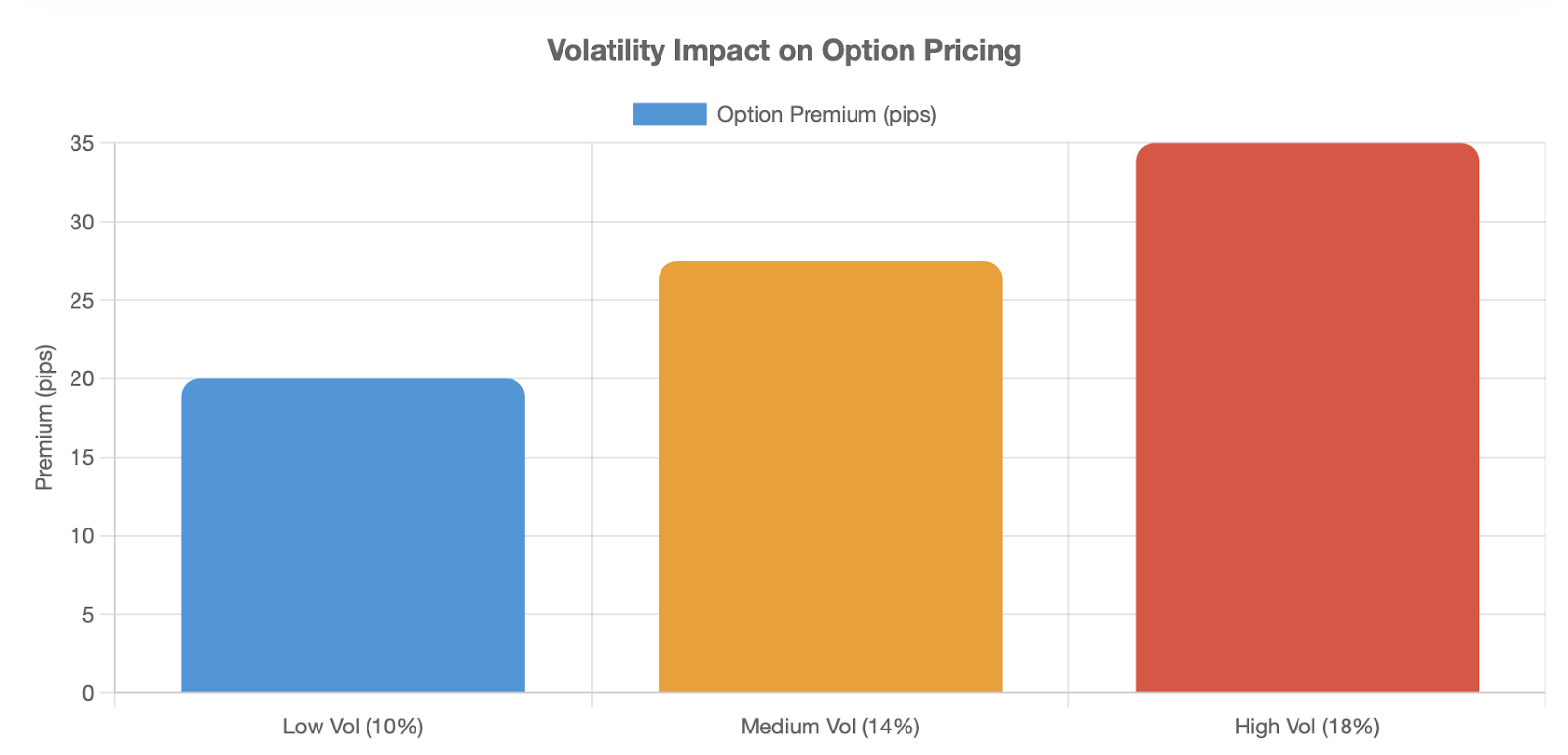
This demonstrates why you can purchase options prior to volatile times and sell them prior to quiet times to profit. Practice these situations with small amounts or paper trading until you intellectually understand how options behave. Most profitable options traders will spend months in simulation before risking any material capital.
Build a trading diary to document your hypothetical trades, why you made the decisions you did, and what the market conditions were when you traded. Read through it regularly to see if there are patterns in your decision-making and to help you make better decisions regarding timing.
Conclusion
In conclusion, call options are perhaps one of the most flexible instruments in the forex market, allowing for creative ways of leveraging profit while managing risk that can't be found in normal cash currency trading. You understand the ways in which these instruments work from basic mechanics to derivatives strategies that are consistently used by professional traders.
The three lesson reminders to take away from this course: call options give you the right (but not obligation) to purchase a currency at a fixed price; their value is based on both intrinsic value and amount of time remaining; and their pricing is affected by many variables including volatility and interest rates. How you ultimately use call options, to speculate, hedge, to maintain a natural position, or to generate income, depends upon your projections for the market and your willingness to carry risk.
Above all, successful options trading requires disciplined risk management and realistic goals. The leverage that makes options appealing also means they can be very dangerous if not used in a disciplined, risk-aware manner. Take small positions to start, trade a lot, and do not risk any money that you cannot afford to potentially lose in its entirety.
The strategies covered in this article (straight call purchase, protective calls, bull spreads, etc.) provide a basic foundation to build from. But the work is really in the use of the strategies through trading experience, observing options behavior in different environments, and learning from the winning trades and losing trades.
Don't rush to real trading - use simulation platforms and paper trading for a little while to watch how your theoretical positions would have performed. Study the Greeks as they are in action, and intuitively develop your bases for trading options behavior. The market will be there for you when you are confident in your skills, and your education through thorough practice will pay off, no matter your strategy throughout your trading future.
Ready to put your call options knowledge into practice? Start with our risk-free demo account and master these strategies before trading with real money.
Join thousands of traders who've transformed their forex approach with options – sign up today and get our exclusive options trading starter guide free.
Disclaimer: The content of the blog does not represent any position of Trade W, does not serve as any trading-related decision advice, and does not endorse any third-party.