

 Trade W
Introduction to Forex Derivatives: Understanding Risk & Opportunity
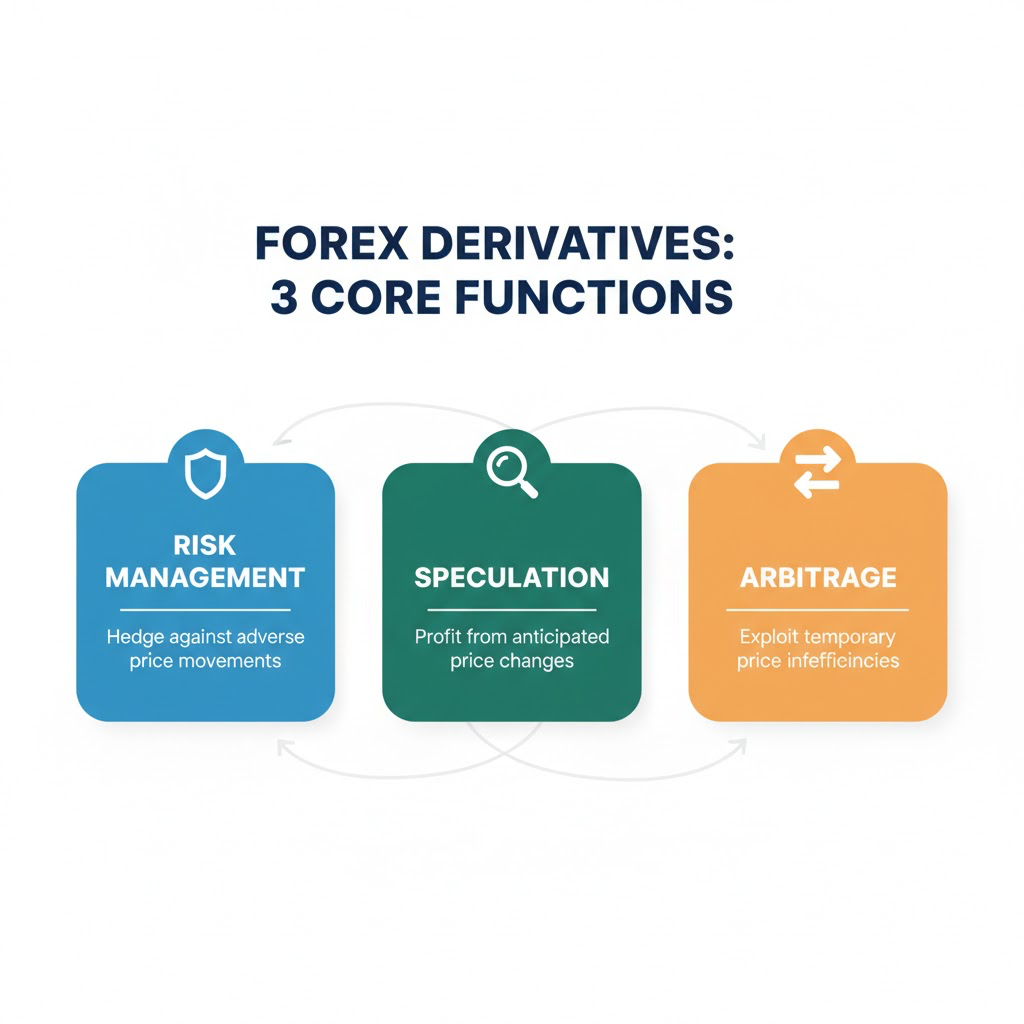
In global finance, including the foreign exchange market, derivatives are among the most powerful tools created utilizing currency pairs, stocks, commodities, and indices. There are three main functions for derivatives: to manage risk, speculate on price movements, and take advantage of arbitrage opportunities.
Derivatives dictate how traders and institutions manage market volatility, whether a trader is on Wall Street or a crypto exchange.
Imagine a multinational corporation that is concerned about the varying exchange rate. It would be able to lock in today’s exchange rate related to a transaction that will take place six months from today, by utilizing EUR/USD futures contracts. This protects the firm from facing currency volatility after they price their product through the EUR/USD exchange rate. Businesses also turned to futures hedging strategies during the year 2023, as the U.S. Federal Reserve raised interest rates, further shielding themselves from dollar volatility.
Understanding derivatives doesn't simply relate to learning complicated formulas. It is understanding how derivatives create opportunity and confidence in managing risk in all of the major financial market sectors. Whether it be trading CFDs from your laptop or analyzing commodity futures, the value of the derivatives acts on the underlying asset.
This guide will educate you about everything you need to know regarding derivatives trading from the basics to the advanced methodologies utilized by professional traders across the globe.
Types of Derivatives: Futures, Options, Swaps & CFDs Explained
The derivatives market provides different, and sometimes distinctly different, instruments available for trading that are suited for specific trading scenarios. Understanding the distinctions between the instruments allows you to use the correct applicable tool in your trading plan.
Futures: The Price You Lock in Today for Tomorrow
Futures are standardized contracts that create an obligation to buy or sell an asset for delivery at a predetermined price on a set date in the future. One can think of it like pre-ordering Christmas gifts in July. You place a "reservation" on an asset to buy it at a price that does not reflect the future demand during the last-minute shopping periods, which price is likely to be higher than if purchased early.
For our professional trader example, a Japanese consumer electronics manufacturer may utilize futures contracts in USD/JPY to hedge against adverse currency movements in the procurement of American components. Globally, the Chicago Mercantile Exchange (CME) and NYMEX handle billions of dollars a day of transactions in futures contracts in everything from currencies to crude oil futures.
Options: You Have the Option to Choose
Options give you the right, but not an obligation, to buy or sell an asset at a predetermined price before the expiration of the option period. Options are like holding a cinema ticket that gives you the right to see the film, or not to see it at all.
Professional traders utilize EUR/USD call options, which entails paying a premium for the optionality itself in order to execute the option only if the market favors an execution. The Chicago Board Options Exchange (CBOE) regularly facilitates an immense quantity of foreign exchange (forex) options trades, giving traders strategic flexibility with their position and exposure to currency markets without commitment to a full position.
Swaps: Exchanging Cash Flows
Swaps are defined contracts that two parties enter into, whereby they exchange cash flows based on underlying variables (e.g. currencies, interest rates). One can imagine a scenario where two friends swap lunches each week in order to eat something different without incurring any additional cost by purchasing lunch.
These swaps are often used by multinational corporations to manage interest payments in different currencies across different countries. For example, if a European multinationals borrows in dollars but earns Euros, a simple interest rate swap contract tied to an interest rate benchmark (e.g. LIBOR or SONIA), helps them manage their exposure.
CFDs: Speculating Without Ownership
Contracts for Difference (CFD) allow a trader to speculate on price movement without owning the underlying asset. You can think of a situation when one bets with his friends whether the price of apples will go up or down at the grocery store, with the resolution of the event being settled in cash based on the difference in the price.
Many traders use CFDs on BTC/USD, allowing them to get cryptocurrency price exposure without worrying about the digital marketplaces security or whether a digital wallet is correct or secure. CFD brokers, such as IG Market and Plus500, let traders trade CFDs on instruments worldwide markets, with leverage and flexibility, but with a shorter term strategy.
Different derivative types have different purposes in the ecosystem of trading. Futures are meant for standardized hedging, options provide strategic flexibility, swaps can be used to manage exposures in the long-term, and CFDs allow for speculation with very little capital.
How Are Derivatives Priced: Basics Principles and Market Dynamics
By understanding how derivatives are priced, you will understand why values are fluctuating, and you can make informed decisions while trading. The math can become complicated, but at the core, the principles are quite simple.
Fundamentals of Futures Pricing
The price of futures builds off of the spot price, but factored in are the time and the associated carrying costs. The basic formula loosely follows spot price + interest rate + time until expiration.
If Brent crude oil is trading at $80 per barrel today, the six month futures contract could be priced at $82 per barrel, inclusive of carrying costs and interest rate.
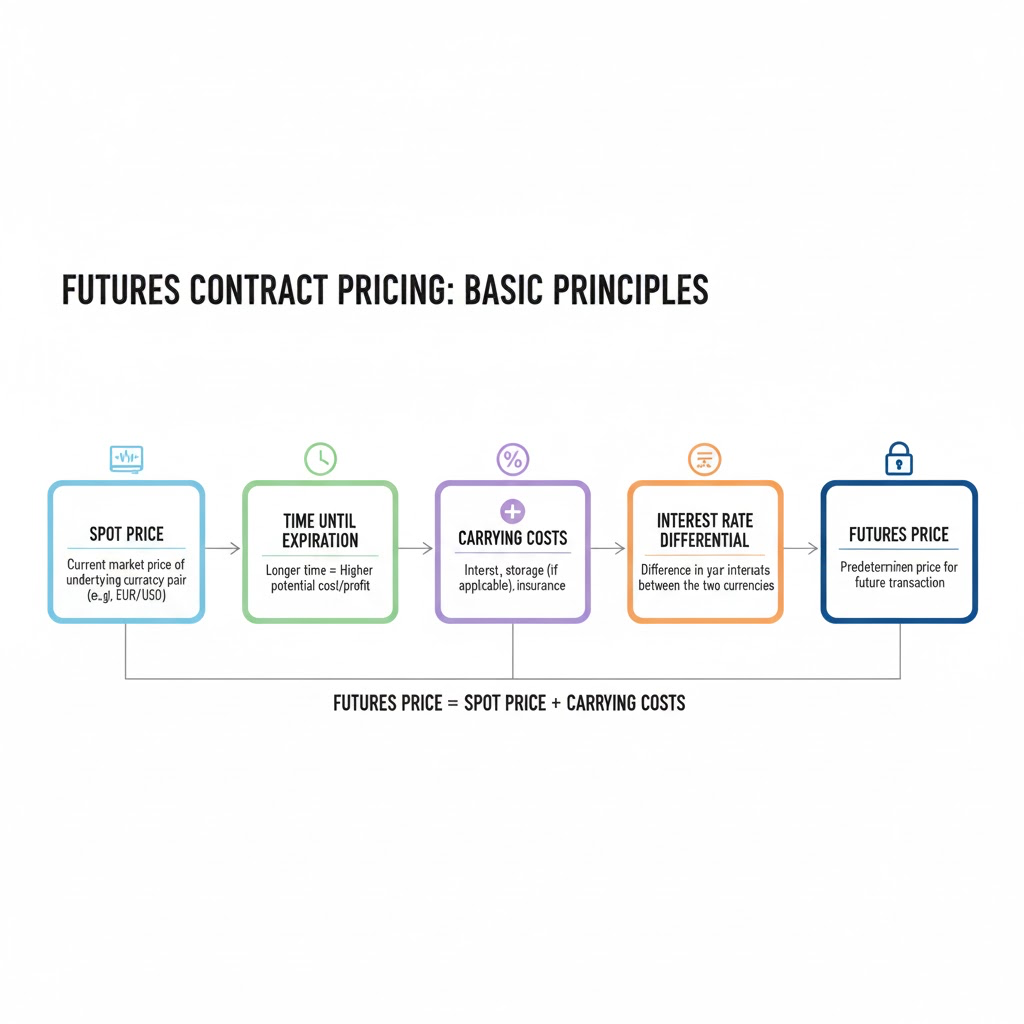
The differential between futures and spot prices create a trading opportunity. When futures prices diverge significantly from their theoretical values, arbitrageurs will do the heavy lifting by buying the instrument at one price and simultaneously selling it at another price until the market returns to equilibrium.
Options Pricing: More Than Simple Math
Pricing options adds a layer of difficulty as they are priced via models, such as Black-Scholes. Several variables determine an option's premium. The current market price of the underlying asset is the most important factor, but volatility is equally important. When the EUR/USD is fluctuating wildly, the premiums for both call and put options increase because uncertainty is valuable in regards to an option's right to choose.
Time decay is continuously eroding the value of options, analogous to how an early bird movie ticket costs less than a ticket purchased on the day of the film; because theaters want to reward you if you are planning ahead. In the same regard, options that have a long time remaining until expiration are typically more expensive than options that expire soon. That value diminishes as the expiration draws near, and it accelerates in the last weeks.
Market Forces Activate
Aside from formulas, actual derivative prices respond to market forces related to supply and demand. If Bitcoin is highly volatile, the premiums for BTC options skyrocket as traders look for protection, or consider speculating with potential volatility. Increased interest rates affect not only the carrying margin of futures price, but could also negatively affect even pricing assumptions.
Having an understanding of how pricing affects derivatives can help you determine if a derivative is valued. An option that is deeply discounted may be signaling low expectations for volatility in the market, while an expensive futures price could reflect supply issues for the underlying commodity.
The interaction between theory-based pricing models and market valuations opens up points of trade for knowledgeable traders that understand the disconnect between derivatives and fair value. This recognition changes derivatives from obscure products into elaborate mathematical instruments for smooth trading.
Role of Derivatives in Forex Trading: Risk, Speculation & Arbitrage
Derivatives fulfill three primary roles in the forex markets, each appealing to different trader requirements and market dynamics.
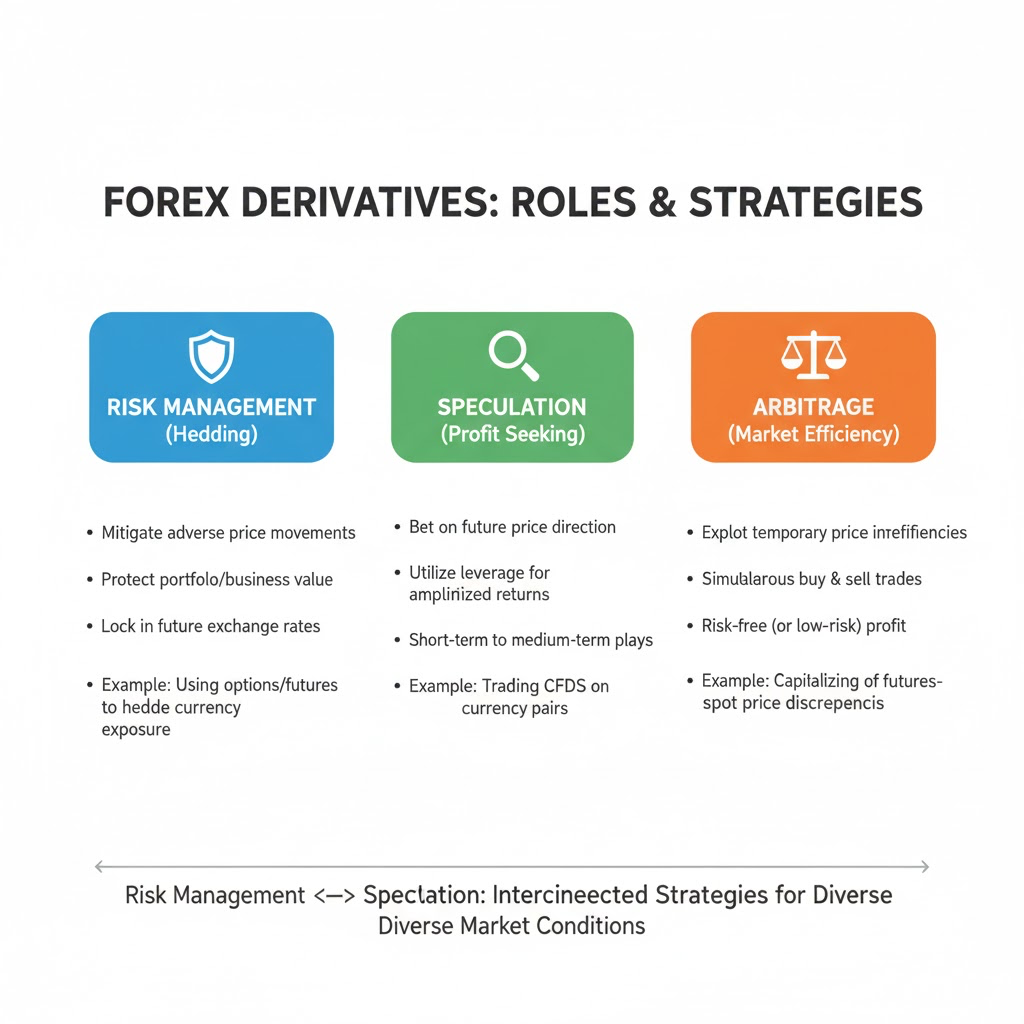
Risk Management: Your Financial Protection
Currency valuations can be devastating for international businesses, changing overnight. A European exporter that sells to American clients has an ongoing USD/EUR risk as it awaits payment for exported goods. If the dollar weakens before the payment is finalized, the exporter will receive less profit on its sale. A EUR/USD option will effectively insure against this risk, allowing the exporter to initiate a transaction in the aftermarket in the event of a loss, while also maintaining the upside potential should the currency move in the happy direction.
Derivative products serve as the primary vehicle for banks and corporations to hedge against currency volatility. In times of geopolitical uncertainty or government shifts in policy, hedging activity on behalf of institutions, which are often carrying currency volatility, typically has an uptick because volatility is unpredictable and security is sought after.
Speculation: Enhancing Market Procedure
Traders use derivatives contrarily to take advantage of currency directional movement, while utilizing leverage in the derivative to multiply their currency exposure. Instead of actually buying 100,000 euro to manipulate, a CFD might require as little as $1,000 to act as margin, while providing equivalent profit potential to the actual transaction. This is an efficient use of capital, calling traders to speculate from all over the world.
Leverage of the sort acts as a double edged sword. If a trader employs leverage in a bet on a currency's strength or weakness, the effect magnifies along the same scale as the margin, putting many accounts back to seasonal close. An example of this would be, when the euro strengthens against the dollar, a leveraged futures will generate returns on relatively small movement or reach with or without a profit margin. Conversely, if selling euros, the market would produce a loss quickly as opposed to the adjustment to profit. Professional speculators would utilize a combination of research and technical analysis in the use of derivatives with full margin and controlled use of risk management.
Arbitrage: Profiting from Market Inefficiencies
Price differentials in different price markets based on a relationship can lead to an arbitrage opportunity. When the futures price for the EUR/USD is trading at a premium to the theoretical fair value based on spot prices and the forward pricing formula using the interest rate differentials between the US and Eurozone, we can expect arbitrageurs to purchase spot euros and simultaneously sell futures contracts. This episodic profit opportunity disappears quickly as arbitrageurs bring prices back into alignment.
Global funds exist to look for arbitrage opportunities across markets globally 24/7 using complex algorithms and software. Although the actual dollar profit per arbitrage opportunity or leg may only be a small amount per transaction, utilizing high levels of frequency of execution creates a consistency of returns for the fund. All participants benefit from arbitrage as it creates more pricing efficiency and liquidity.
By recognizing these roles, you can understand that derivatives are more than just gambling speculation trades. They are part of the overall infrastructure that supports global commerce and allows businesses to focus on their businesses instead of worrying about currency risk and provides liquidity in the markets for pricing to discover itself.
Advantages and Risks of Derivative Trading: What You Must Know
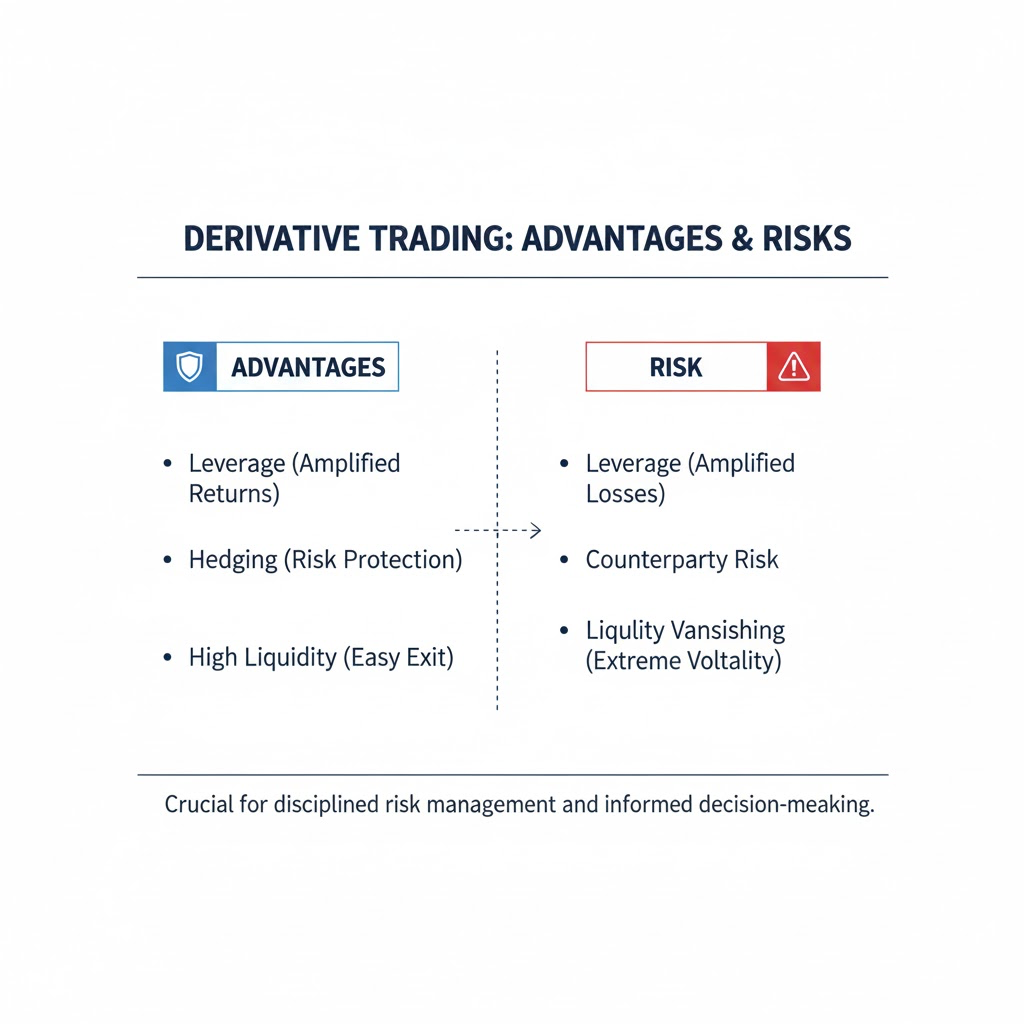
Derivatives provide incredible advantages but entail risks that are significant enough to warrant serious consideration and management.
The Power of Leverage
The most appealing and dangerous feature of derivatives is leverage. With $1,000, an investor might control $50,000 in forex exposure using CFDs. A market move in the right direction translates into exponential profits. A 2% move in the currency pocketed 100% returns on your margin.
That same leverage works exactly the same if the market moves against you. A 2% move against you, and all $1,000 invested is gone. The excessive use of leverage in derivative positions created havoc during the 2008 financial crisis, impacting even institutions viewed as indestructible through cascading margin calls and liquidations.
Hedging: Protection is Worth the Cost
Derivatives are excellent because they can help an investor manage or reduce risk. Traders and companies across the globe are willing to pay money to hedge currency exposure so they can sleep well knowing that exchange rate movements will not destroy their quarterly earnings. Hedging through derivatives will not be cheap in terms of premiums or spreads, but risk taw is worthwhile to protect your business and the investment of long-term holders.
Liquidity: Easy In and Out
Major derivative markets excel in their liquidity. EUR/USD futures and options have great liquidity with tight spreads and order book depth, putting you in a position to easily enter and exit your position with minimal transaction costs, and fair price execution. Liquidity is especially useful when markets are volatile and adjusting a position is needed.
Nonetheless, liquidity can vanish during times of extreme stress. Flash crashes and crisis events can leave you unable to exit losing positions at prices that make sense, obfuscating paper losses into materially damaging realized losses through slippage.
Credit and Counterparty Risk
When you trade derivatives, you are essentially making a bet with someone on the other side. If they are unable to perform on the contract, then your winning trade is rendered worthless. Regulated exchanges or clearinghouses have the potential to reduce that risk, however there is a real counterparty risk with over-the-counter derivatives markets.
Handling the Double-Edged Sword of Derivatives
Trading derivatives successfully requires disciplined risk management. You should not risk more than you can afford to lose entirely. You should always use stop-loss orders on trades in the market to limit downside risk for any position. You should also appropriately size each position taken so that risk per trade is only between 1-2% of total capital. You should avoid concentration risk by diversifying these trades across not only different strategies, but also across different currency pairs.
Traders who make it and survive in derivatives markets work risk management into their trading like it’s their main job. When you can manage losses, profits take care of themselves. Those traders that decide to neglect any risk controls above might find themselves at margin calling or losing accounts without regard to how well informed they are or what strong analytical skills they bring to the market.
Trading Strategies with Derivatives: Practical Examples & Tips
Transitioning from theoretical concepts to implementation, let's review three essential strategies used by professional traders with derivatives across global markets.
Hedging strategies: Protection over profit
Hedging involves the use of derivatives to mitigate risk in a position that is exposed. For example, assume you hold a sizable EUR position from a trade you've made today, and the European Central Bank is scheduled to announce their monetary policy tomorrow. You would not close your position because you risk losing on potential upside. Instead, you would buy EUR/USD put options or sell EUR futures to offset the downside risk on your position.
Example: A European company expects to receive a payment of $1 million in three months. They would be concerned about the depreciation of the dollar, and they can use a derivative to mitigate the currency exposure. They buy USD/EUR futures to lock in the current exchange rate. If the dollar depreciates the profits from the futures contract would offset any loss on the $1 million receivable. If the dollar appreciates the company loses value on the futures contract but is compensated as their payment has now increased. Hedging gives the company a fixed outcome.
Essentially the cost of a hedge is the amount of the insurance premium. There is a tradeoff of making a perfect hedge, as it eliminates risk, it also caps the upside since the hedge is locking you in at a specific price. A smart hedger evaluates the cost of protection relative to their risk tolerance and may initiate a partial hedge, which reduces risk but does not eliminate it entirely.
Speculation Strategies: Calculated Risk-Taking
Speculative strategies focus solely on the profit potential of expected price change. When a technical analyst identifies a breakout chart pattern, as with GBP/USD, they might use leveraged CFDs to increase returns from the anticipated price action. To put this into perspective, a position that requires $2,000 in margin could give the trader exposure to $100,000 in currency.
Trading Bitcoin often involves the use of BTC/USD CFDs, particularly since these traders are typically looking for short-term plays due to volatility. When traders are certain in advance a strong price move will be imminent based on technical signals, they can use leveraged CFDs to gain exposure without the hassle of using a cryptocurrency wallet or worrying about security issues with a cryptocurrency exchange.
Contracts for difference are executed in seconds and traders are in and out of positions just as rapidly, which is a requirement due to the fast-moving nature of the market. The main ingredients for speculation with CFDs are identifying an edge, position sizing and discipline to exit. Without a clearly defined trading edge the only trading proposition becomes gambling. If an edge is identified, then proper position sizing avoids an upset to the trading account for one trade.
Arbitrage Strategies: Risk-Free Profits from Inefficiency
Arbitrage involves taking advantage of temporary price differences among related instruments. For instance, when the futures for EUR/USD trade above fair value in relation to the spot prices and prevailing interest rate differentials, arbitrageurs will buy spot EUR and sell futures simultaneously. As the two prices converge at expiration, the arbitrageur locks in a riskless profit.
Cross-border arbitrage works in much the same manner. If the futures for gold, for example, trade at different prices on COMEX compared to London exchanges, after adjusting for shipping and insurance costs, then traders will buy the lower priced contract and sell the higher priced contract. These opportunities tend to be arbitraged out of existence fairly quickly as fast action from arbitrageurs force prices back into alignment.
Modern arbitrage requires a high degree of technology and a very fast execution speed. Most is performed by high-frequency trading firms, with some small occasional opportunities for retail traders at times of heightened volatility when market makers are having a hard time keeping up with pricing efficiency.
Combining Strategies for Robust Trading
Professional traders seldom employ a single method in their trading approach. A portfolio may consist of established hedging positions to help protect business operations, tactical speculation which rates the anticipated returns on an economic basis, and automated trading systems which scan markets for opportunities to arbitrage away the cost of capital. The careful and thoughtful application of diverse strategies helps to smooth the return distribution and reduces reliance on any one strategy to work perfectly.
The most important aspect of derivative trading is aligning your best trading propositions to fit with your objectives, risk tolerance, and market conditions. A conservative trader will emphasize the efforts toward hedging and arbitraging the position, whereas an aggressive speculator will trade with a higher risk:reward ratio. Knowing your objectives will frame how you choose trades and position size.
Derivative Market Regulation & Global Compliance Examples
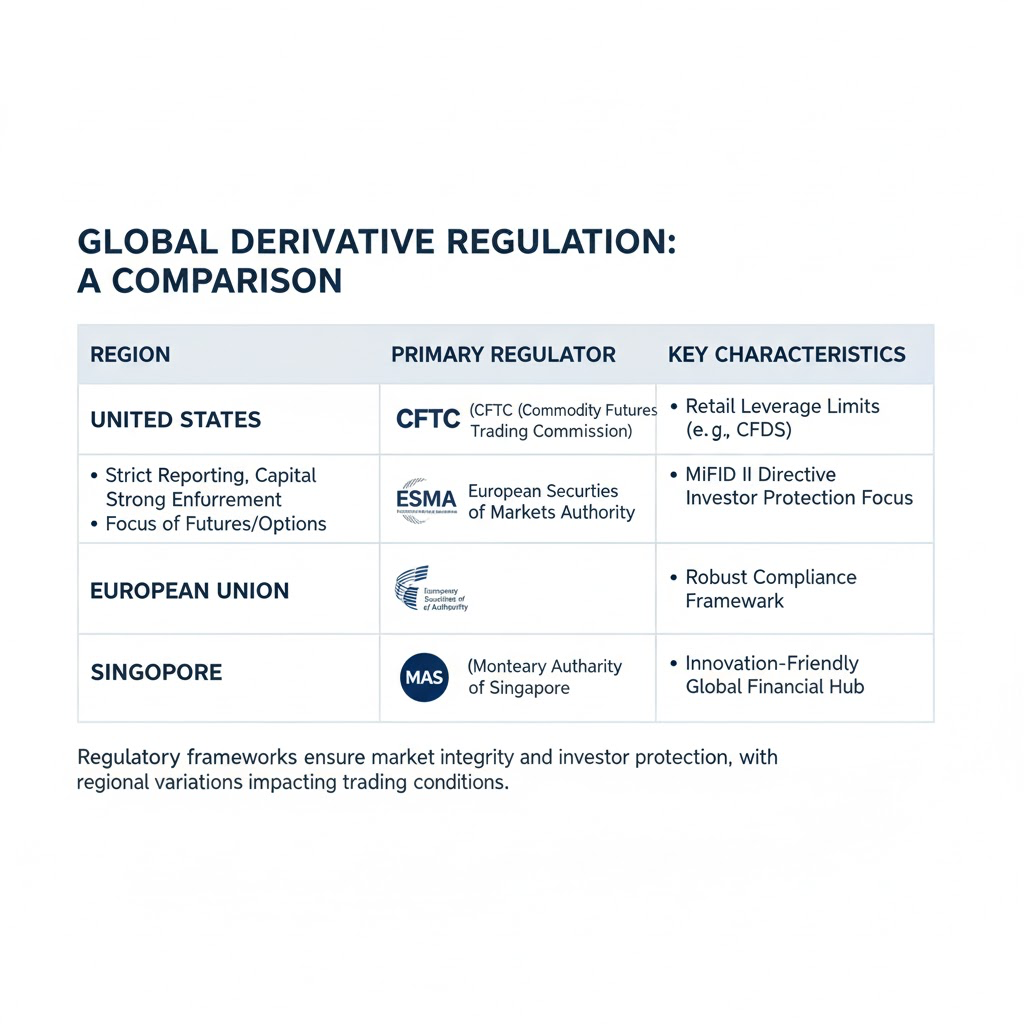
Regulatory frameworks define the global derivatives landscape by providing protections for market integrity while permitting legitimate trading to occur.
The Global Regulatory Environment
In the United States, the Commodity Futures Trading Commission (CFTC) regulates derivatives markets and has strict reporting requirements and capital requirements for brokers and exchanges. In Europe, the derivatives market is regulated by the European Securities and Markets Authority (ESMA), which put leverage limits on retail forex and contract for difference (CFD) trading to enhance protections for unsophisticated traders. Singapore's regulatory approach is somewhat in between the US and EU models, having a strong compliance-based framework, but also allowing room for innovation in derivative products and businesses. Different regulatory approaches affect the trading environment depending on jurisdiction, which can impact leverage available, available products, and taxation rules.
Why Compliance is Important
When trading with a regulated entity, you protect your capital. Licensed brokers require that clients' funds be found in segregated accounts, meaning that other client accounts cannot be impacted by a broker's financial challenges. Regulators monitor reporting as well to ensure fair pricing and trade execution, minimizing the chance of price manipulation or fraud.
The impact of regulation can be illustrated through the LIBOR scandal in 2012. The banks involved were manipulating a benchmark interest rate that was used for trillions of dollars in derivative contracts, which led to major fines and compliance changes for all banks involved. The modern regulatory framework means benchmarks are more likely to be transparent and have audit trails that make it harder to similarly abuse.
Tax Implications Across Borders
Tax regulations differ wildly depending on where you reside. In the U.S., different rules exist regarding wash sales and any trades made must be reported to the IRS. In the U.K., you can profit through spread betting without taxes, though you're subject to leverage rules. In Singapore, tax treatment tends to be friendly for many profits through derivatives, but you must closely monitor the profits for tax reporting.
It is important to know the tax rules for the jurisdiction you reside in order to avoid expensive errors. If you are a derivative trader, you will want to work with a tax professional who understands the rules applicable to derivative trading therefore allowing you to remain compliant while legally minimizing your tax position.
Selecting Regulated Brokers
It is critical to verify that your broker is regulated and complies to your selected entity, prior to signing up for the platform and depositing funds. Verify that your broker is registered with the respective compliance regulations and has adequate capital reserves to meet its responsibilities to their customers. While many of the unregulated offshore brokers look appealing with detailed leverage and or bonuses, if you run into issues - you likely have no recourse.
What does compliance mean to regulated trading? It is not bureaucratic red tape. Regulated practices are a foundation for safe and sustainable markets. Markets are efficient based upon the belief that their regulations provide integrity and fairness. By using regulated brokers, and complying with registered regulations, you protect your capital, and maintain a healthy market ecosystem.
Master Derivatives Trading: Your Path Forward
Derivatives are complex products that fuel the global financial system, important for risk management, speculation and arbitrage respectively. By understanding the various types of derivatives, how they are priced, and how they are used in strategic ways, derivatives become less of an enigma and more of a trading tool.
Moving from a novice to a steward of derivatives as a trading product takes practice, and time. An important first stage is getting the derivatives down pat. What is the key difference between options and futures? What is behind the pricing of derivatives? Why should one understand leverage? Applying your learning with live examples in the market. Understanding how discretionary traders utilise hedging or arbitrage scenarios.
Risk management is what separates the profitable trader and the cautionary tale. Regardless of how attractive the trade may appear, position sizing and stop-losses are needed to protect your trading capital for opportunities in the future. The best traders will not be those who never make losing trades, but those who manage losses and let gains run.
Brokerage and regulatory are also two areas that can be important as a trader. Using a regulated brokerage with eyes on your trading capital offers a level of protection, in addition to ensuring you are treated fairly. Knowing the repercussions of your tax situation allows you to lay out additional options, instead of surprises, ensuring you are maximising you net returns.
Having a theory alone is not going to make you a competent trader. Real-world trading enhances theory to discover certain nuances that textbooks may not reveal. It is always best practice to begin with a demo account to test live markets and strategies without financial risk. When moving to live trading, take positions that are small enough that they won't cause financial or emotional trauma if they fail.
Are you ready to apply what you have learned? Open a Tradewill account today and see how to use derivatives to enhance your trading strategy while managing risk, in real market conditions.
Disclaimer: The content of the blog does not represent any position of Trade W, does not serve as any trading-related decision advice, and does not endorse any third-party.