

 Trade W
Introduction: Why Floating Rates Matter in Forex Trading
Have you ever asked yourself why your favorite currency pair moves 200 pips up or down directly after a Fed announcement? Or why that student loan payment is different every month? The answer can be found in the magic of floating rates - one of the most important yet least understood concepts in forex and personal finance.
A floating rate is simply a rate that will go up and down based on the market conditions, unlike a fixed rate, which stays locked in place. It’s similar to the price of gasoline at your local gas station. The price of gasoline moves regularly based on supply, demand, as well as more broad economic conditions.
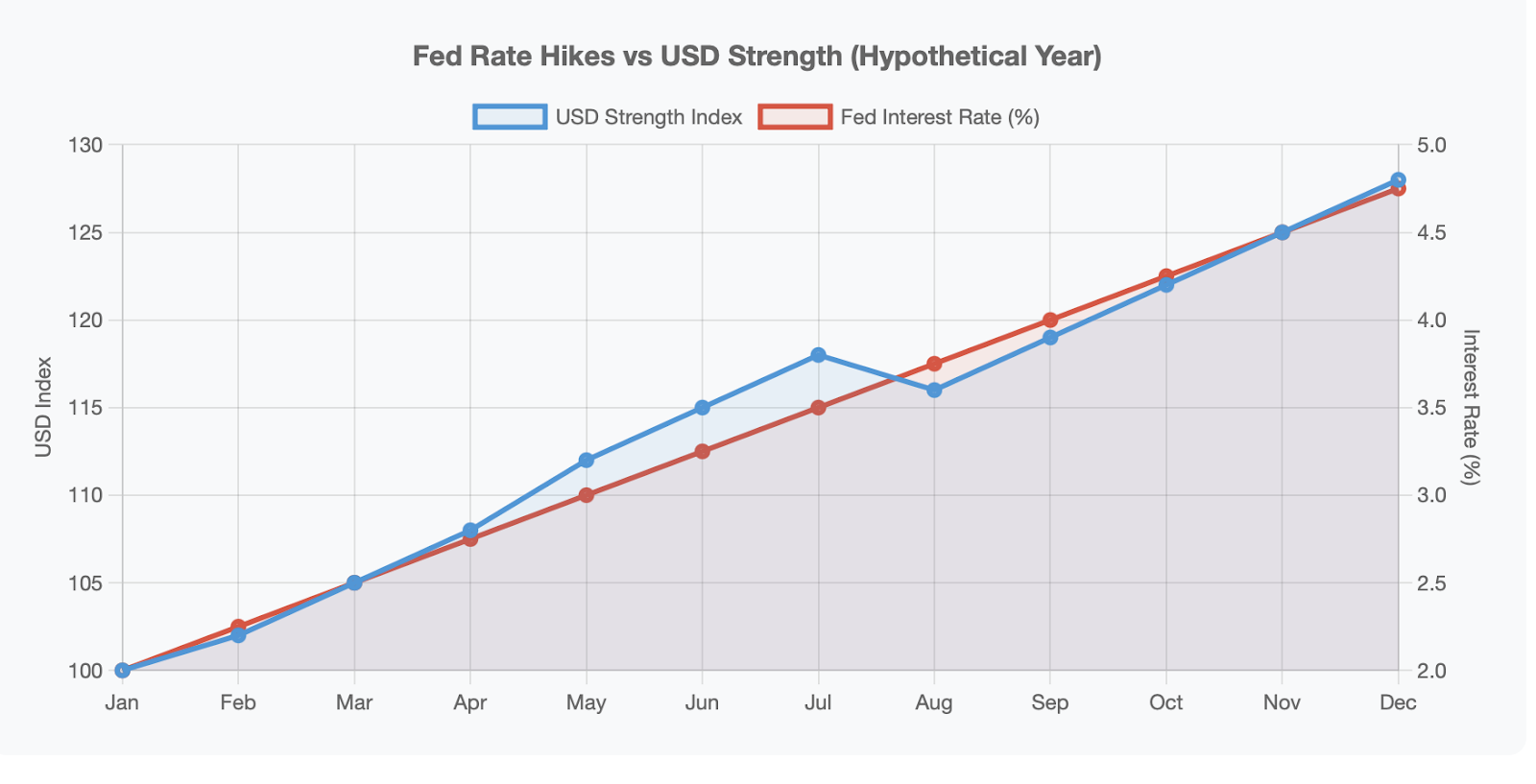
Floating rates are everywhere in forex. When the Federal Reserve raises interest rates, the USD usually strengthens against all other currencies. When any central bank cuts interest rates, the currency usually decreases in value. These movements are not random; they are the effects of floating rate mechanics.
However, what is powerful about this concept is that floating rates don’t only affect professional traders who are managing millions of dollars. They also affect decisions you make on a daily basis. Is it better to lock in a fixed-rate student loan versus a floating-rate student loan? It all depends on your expectations regarding where interest rates will be moving as is the case with fx traders regularly.
By knowing more about floating rates will help you in your trading and by extension, your life as a whole. It connects the gaps we experience in making sense of macroeconomic theory and profit opportunities in the real world.
Floating Rate Definition & Key Concepts: a beginner's guide.
Let us be precise with the language. A floating rate is any interest rate or an exchange rate that changes consistently and regularly for the profit of the market based on the market at that time. A fixed rate is any fixed interest rate that remains fixed for that period and then could be floated or lifted by the market.
The math behind the floating rate in its most basic form is as follows:
Floating Rate = Reference Rate (such as LIBOR or SOFR) + Spread.
Once again for your reference, here is an example from a bank: Your bank is offering a business loan "SOFR + 2%". If SOFR is 3%, your loan rate is 5% with the addition of the 2%. If SOFR goes to 4%. your loan is now 6%, -, the math is simple, but the result has consequences.
For beginners, think of it in terms of your school cafeteria policy on labour prices on buying your lunch. If vegetables become more expensive then lunch is more expensive, if the vegetables become cheaper, then so does lunch. This is exactly how floating rates work - they are floating to the conditions at that time and the market price.
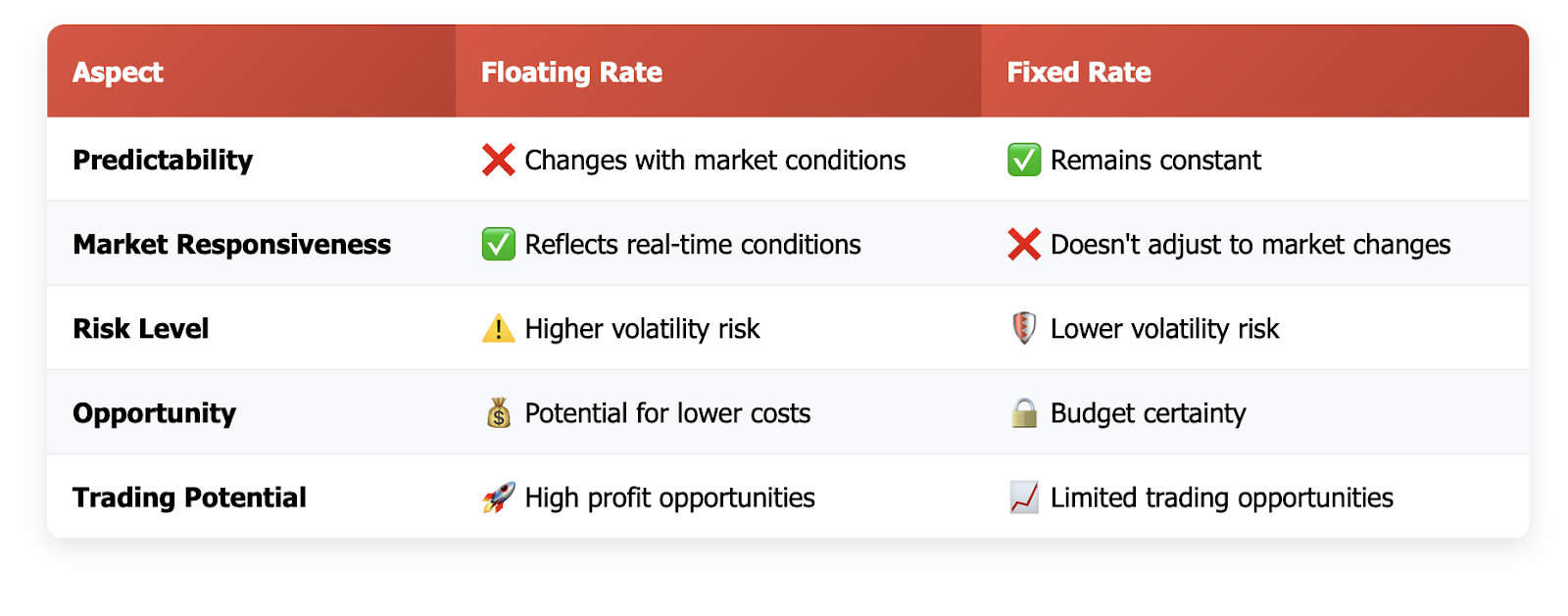
The primary distinction between floating and fixed rates is predictability and flexibility. Fixed rates provide certainty - you know exactly how much you'll pay. Floating rates provide responsiveness to the market - they fall when the market falls, and they rise when it rises.
In forex trading, floating exchange rates mean currency value moves continuously with economic data, political happenings, and market sentiment - giving forex traders opportunities (and risks) creating a thrilling and potentially profitable trading market.
Professional traders relish floating exchange rates because volatility creates trading opportunities. Intelligent retail traders will learn to identify signals that create those fluctuations in rate.
The History of Floating Rates: From a Fixed Exchange System to Forex
The modern forex market derives from one monumental event in 1971 when President Nixon announced the end of the Bretton Woods agreement to allow the dollar to "float" against other currencies.
Prior to 1971, most of the world currencies were pegged to the US dollar, which was directly redeemable for gold. It was a fixed exchange rate system with dollar values set to a ratio. For example, $35 always equated to an ounce of gold, and all currencies maintained set ratios to dollar values. It was like having a rate card for the world that rarely changed.
However, this arrangement was unable to endure the economic pressures of the 1960s. The United States was spending substantial amounts of money on the Vietnam War and social programs, which caused inflation to rise. Countries holding dollars began to ask for actual gold, which was draining US gold reserves. It was clear that something needed to change.
Nixon's answer was controversial: he would sever the dollar's ties to gold and permit the market to manage exchange rates. The values of currencies could apparently float freely determined only by supply and demand. It was like going from a school cafeteria, in which meal prices were fixed, to one where the prices changed daily based on food costs and student demand.
This new arrangement would also generate the foreign exchange market as we know it today. Without fixed exchange rates restricting currency's movements, traders were able to introduce profit from those differences between currencies. The daily volume went from virtually nothing to over $7 trillion today.
The move to floating exchange rates also fixed the dollar's status as the world reserve currency. Because most international trade and commodities prices are based in dollars, it became imperative for traders to monitor dollar fluctuations around the globe.
This historical background is hardly academic - it lays the groundwork for understanding how central bank decisions and US economic data move markets so decisively today.
Global Market Impact: How Floating Rates Shape Forex, Commodities, and Trade
Floating rates don't operate in a vacuum - they're the unseen force moving on the global markets every day. When the Federal Reserve raises rates, a chain reaction gets started that will impact pretty much everything, including everything from emerging market currencies to the price of your morning coffee.
Here is how that works: Higher US rates mean dollar-denominated investments become increasingly attractive to global investors. In turn, these global investors will sell their own currencies in exchange for US dollars, which strengthens the USD. This creates further effects and impact across global markets.
Emerging market currencies tend to take the greatest hit. When countries like Turkey, Argentina, or South Africa begin to see a depreciation of their currencies because investors are chasing yield in the US, their central banks are left with a choice to raise rates to defend their currency (and slow domestic growth), or they will have to let their currency depreciate further (which will make imports more expensive).
The same experiences happens in commodities as well. As all gold, oil, and most raw materials are priced in USD, a stronger dollar means these commodities become increasingly expensive to buyers using foreign currencies. Therefore, demand declines, and price goes lower. Such are the effects of floating rates in action across global markets.
Suppose your school cafeteria decides to only take the most valuable of all possible campus currency? The students scramble to obtain the currency causing it to become more valuable, while other "currencies", decrease in value, making the meals less expensive for those that hold the "most valuable currency", while making meals more expensive to everyone else.
The 2015 China "8·11 Exchange Reform" is a perfect example of this dynamic. An example of international market consequences occurred when China allowed the yuan to weaken against the dollar, which caused global market disruption as investors worried about competitive devaluations and impact on trade.
For forex traders, these interconnections produce opportunities. Knowing how floating rates affect the price of an asset class creates the opportunity to understand how to anticipate the direction of specific currencies and to find profitable trades.
Advantages & Disadvantages of Floating Rates: What Traders Need to Know
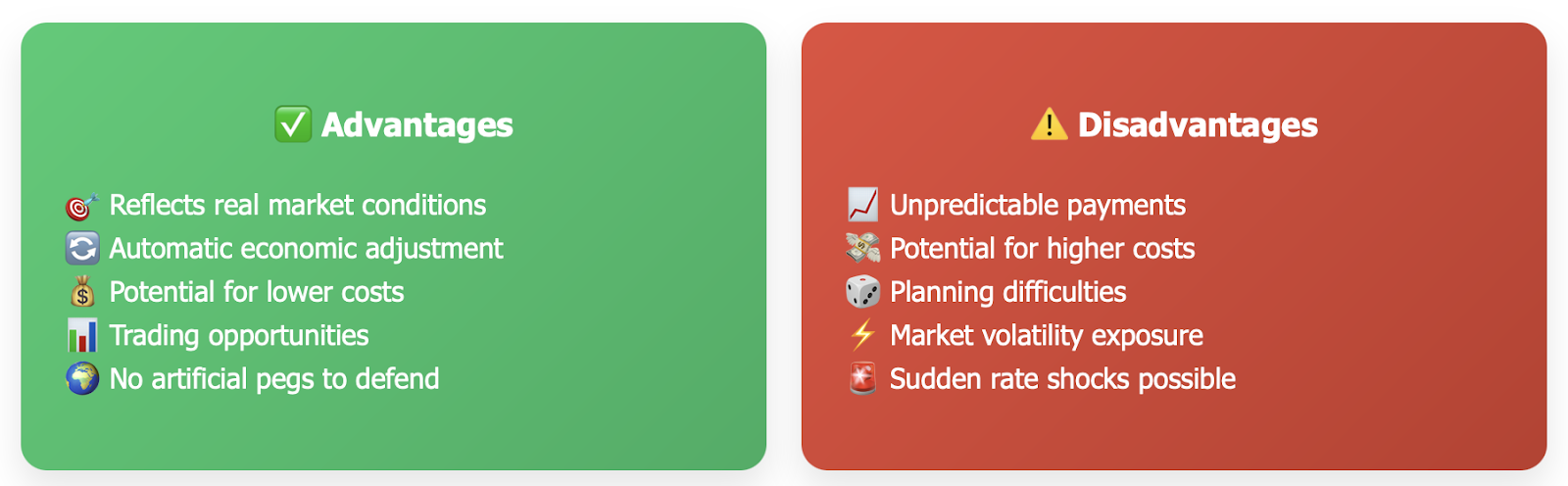
Variable rates can act as a two-edged sword - they offer flexibility and opportunity but are potentially unpredictable and risky. Understanding both the upside and downside of variable rates can help you trade more effectively and have more realistic expectations in your trading activities.
The Good News: First, variable rates accurately reflect actual world market conditions. When the economy of a country gets stronger, its currency appreciates all by itself. This totally natural appreciation of currency mitigates trade and currency distortions that fixed-rate systems often create. For traders, this creates real opportunities based on the economic fundamentals of the country.
Another big plus is the flexibility that variable rates provide. Countries are able to adjust their monetary policy much more easily and with less concern than if they had to defend an artificial exchange rate. Central banks can lower rates to spur growth or raise rates to fight inflation without the burden of defending an exchange rate peg.
The Challenges: Unpredictability is the most difficult aspect of variable exchange rates. Your loan payment's price, returns from investments, or profits from trading will all vary based on the movements of rates. All of this unpredictability complicates planning for businesses and people's personal lives.
For example, in emerging markets, floating rates can be particularly savage. Your currency can collapse overnight when global investors lose confidence. Imagine having your monthly student loan payment pop up by 30% with rates jacked up high - that is the world of many borrowers with a floating rate.
Volatility also raises transaction costs and concerns. Companies conducting international business need sophisticated strategies to hedge their currency risk.
Bottom line: Floating rates aren't in and of themselves bad or good - they're a tool - good in some situations, bad in others. The critical point is understanding the proper circumstances to use them. Smart traders learn to profit from that volatility; smart borrowers and businesses learn how to hedge those risks.
Success comes from recognizing both the opportunity and the danger that floating rates pose.
Floating Rates in Risk Management: Understanding Hedging Strategies
Smart money does not just accept floating rate risk, it manages that risk strategically. Whether you are a multinational corporation or an individual trader, knowing how to hedge can keep you from any nasty surprises.
The most common tool is the interest rate swap. The simplest form works like this - Company A has floating-rate debt but wants to have predictability of payments. Company B has fixed-rate debt but wants to be able to benefit from rates potentially falling. They swap payment obligations where Company A pays Company B's fixed rate while Company B pays Company A's floating rate.
You have a meal plan for the cafeteria where pricing is on a daily basis, and your friend has a plan in which the price is fixed. You are concerned about rising prices, while your friend wants to see if falling prices can benefit them. So you suggest that they pay their fixed amount plus you will pay your fixed amount for variable pricing, and it works out for both of you.
For Forex traders, if you were to hedge floating rate exposure, you consider either a currency forward or currency option. Imagine you are long EUR / USD, and you are concerned the Fed may hike rates, which ultimately strengthens the USD, you could consider buying USD call options or selling out on EUR futures in order to fix your losses.
Multinational companies may have an even more sophisticated structure of costs. Imagine a US company with European operations, who might consider cross currency swaps to hedge both interest rate and exchange risk, in order to hedge their costs of both the domestic and foreign operations.
The principle is balanced hedging. Speculation without hedging, means willingly bearing all risk in order to capture all reward. Hedging also means you can retain some upside, while capping the downside. Most traders who are consistently profitable, will use partial hedges, to the extent possible, that reduces the overall risk of significant moves in either direction of their trades, while also retaining some exposure for favorable moves.
Risk managers in the professional realm utilize flight risk in a diversification manner, as opposed to placing all their eggs in one basket (if looking in the one direction of one currency or rate direction) they will spread possible flight risk over positions and time frames.
Floating Rate Math & Calculations - Simplified
Let me start by saying floating rate calculation is not rocket science; if you can understand the basic formula, you can calculate floation rates like a pro.
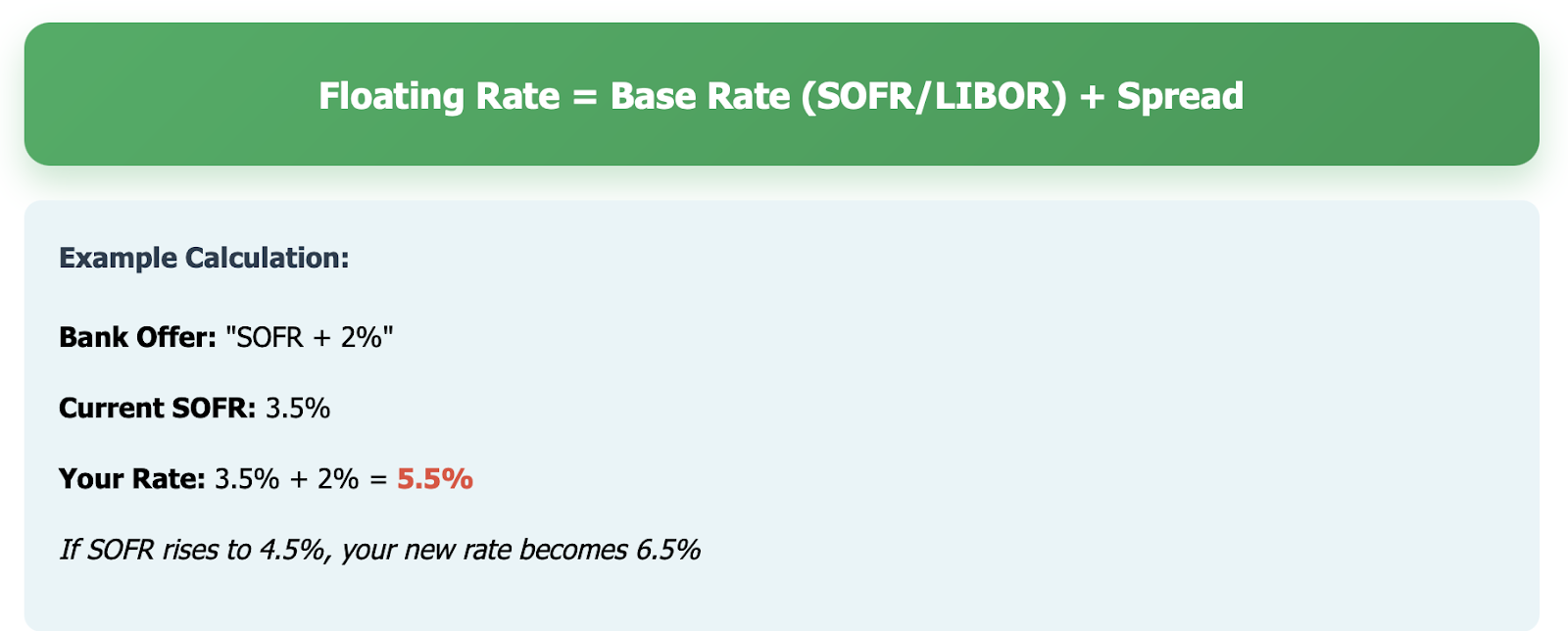
For the novice reader - think if you had a test score you wanted to calculate - final score = base score + bonus points
- Base score = 50 points (like SOFR)
- Bonus = 5 points (like spread)
- Final Score = 55 points
So, if the base changes to 60 - your final score is 65
In forex terms - central bank rate effect (most cases) how strong a currency will be.
When you see "Fed Funds Rate + Risk Premium", that would be centralized on the cost of having that currency, higher rates would mean a stronger currency price (more demand for currency from yield seekers).
The Calculation of the Compound Effect - For loans compounding monthly: Monthly Rate = (Annual Rate ÷ 12) If the floating rate is 6% per year: Monthly rate = 6% ÷ 12 = 0.5%
A trading note - This concept is more nuanced in practice. The spread component is usually fixed, while the base rate is floating. In practical terms, you can predict the changes relatively, but not absolutely. For example, if SOFR rises by 0.5%, all rates associated with SOFR will also rise by 0.5%.
It's useful to understand these methods so you can react quickly to see how the change in rates may affect your position, loan, or return on investments Bookkeeping will help you react in this way without an official call to notify you.
Case Studies: Real Life Examples of Floating Rates in Action
There is no better way to understand how floating rates work than with some real examples. Here are two case studies that demonstrate both the upside and downside of the floating rates.
Case Study 1: The Asian Financial Crisis of 1997: Thai baht to US dollar was pegged at about 25 to 1. As the Thai economy was weak, and the US dollar was stronger across the board, the central bank of Thailand was unable to keep that peg. The Thai central bank had a difficult time maintaining the value of the baht and burnt through foreign reserves to defend the rate.
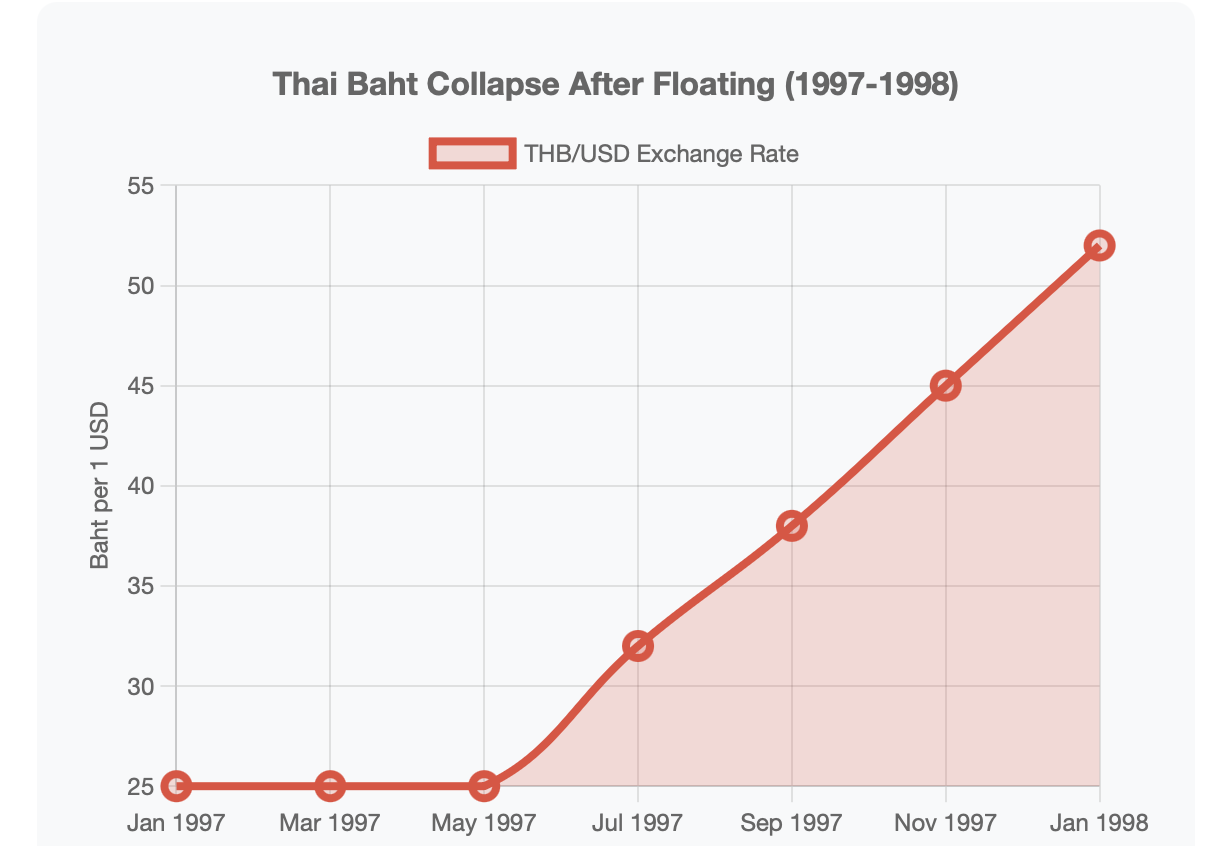
When they finally gave up and let the baht float, it collapsed to over 50 baht per dollar within months. Companies with dollar-denominated debt saw their repayment costs double overnight. The crisis spread to other Asian currencies as investors lost confidence in pegged systems.
The lesson? Fixed rates can create dangerous imbalances. If Thailand had used a floating rate system from the start, the adjustment would have been gradual rather than catastrophic.
Case Study 2: Evaluating Student Loan Expense Comparison Sarah signed up for a floating-rate student loan at Prime - 0.5% when Prime was 3.5%, which resulted in an effective interest rate of 3%. Her friend Mike chose a fixed-rate loan at 5%.
During the first two years, Sarah saved on payments, as interest rates remained low in that environment. Mike, with a fixed rate, did not benefit from the low interest rates. However, when the Fed commenced aggressive rate hikes, the Prime rate rose to 6%.
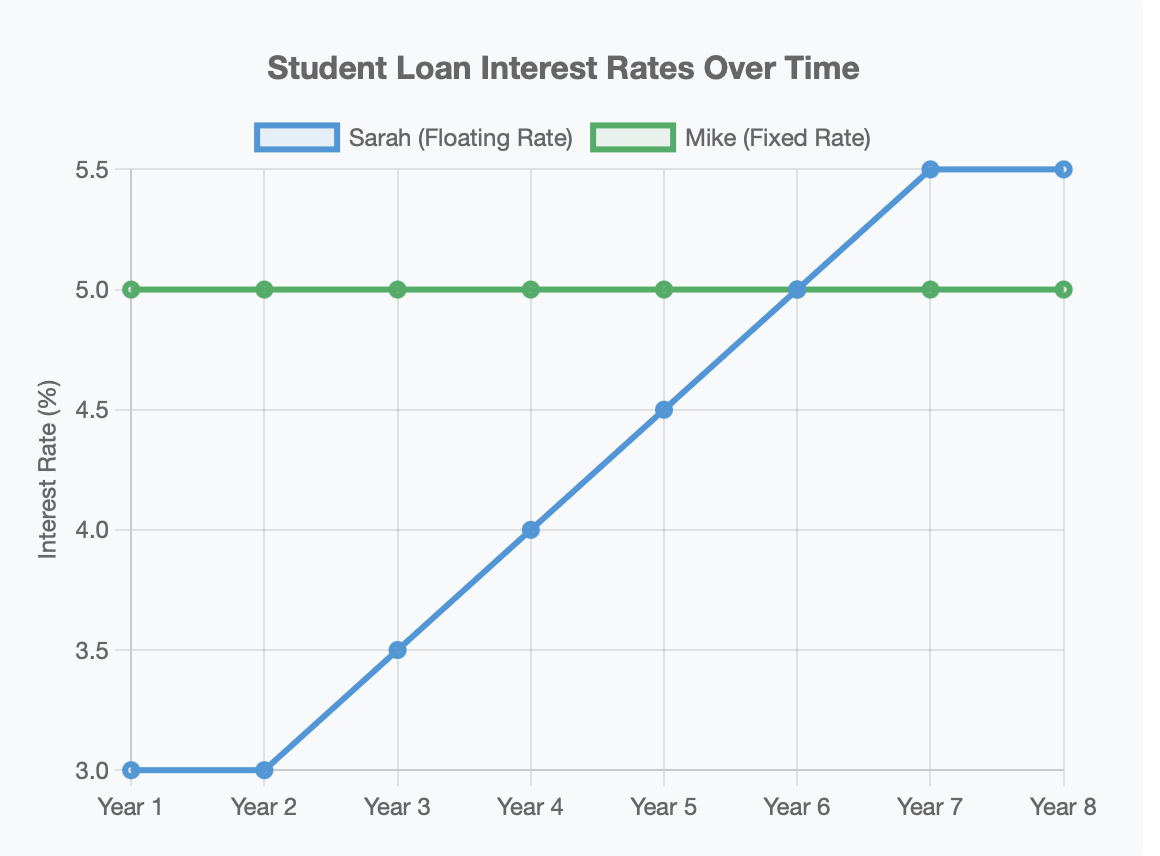
Therefore, Sarah's effective interest rate was 5.5%, while Mike continued to pay 5%. Therefore, over the period of ten years, Sarah experienced lower cumulative interest expense despite rising rates, because she benefitted from the earlier low interest rates. However, she faced consistent monthly variance in payments, which made calculating monthly payments more difficult.
Key Takeaways:
- Floating rates can provide opportunities and crises.
- Timing can matter greatly.
- Risk management will often determine survival during periods of volatility.
- Gradual adjustment is generally preferable to sudden shock.
Profound and real-world examples demonstrate the importance of understanding floating rates for trading purposes and personal finance decision-making.
Common Myths & FAQs about Floating Rates
Let's dispel some myths and address some of the most frequently asked questions about floating rates that traders regularly ask.
Myth 1: "Floating rates always result in losses." Reality: Floating rates create uncertainty and dynamism, meaning opportunities and risks; If you understand rates and how they move, many traders profit consistently. It's skill and risk management, not the rate structure, that makes the difference.
Myth 2: "Only professionals can understand floating rates." Reality: The simple concept of floating rates is one that simply reflects prices that adjust with changing markets. Advanced strategies take time and experience, but understanding how to basic idea can be learned quickly and most people can implement it profitably.
Myth 3: "Fixed rates are always safer." Reality: Fixed rates let you know exactly how much you will pay, but if market rates fall, your fixed rate loan can become expensive; it does not protect you against inflation or opportunity costs.
FAQ: "Should I get a floating or fixed rate loan?"
Answer: This is a function of your risk tolerance and expectations. If you believe rates will fall or stay low, floating rates will typically cost less than fixed rates. If you prefer known monthly payments or expect rates to increase significantly, fixed may be the better option.
FAQ: "How do floating rates of exchange impact forex trading?"
Answer: The price adjustments create the volatility that makes forex trading profitable; without floating exchange rates prices of currencies would hardly change, such that you would not be able to trade.
FAQ: "Can I have some success predicting floating rates?"
Answer: Certainly not, though you can certainly develop skills that may allow you to predict, in which likely direction, they may move. Economic indicators, communications from central banks, and technical analysis help traders make educated predictions.
FAQ: "What do you consider the biggest risks with floating rates?"
Answer: Sudden larger swings that are potentially beyond your risk tolerances. This reinforces the need for position sizing and stop losses when trading in floating rate instruments.
The truth about floating rates lies in the middle extremes - they are neither a panacea and totally bad, rather, powerful tools with great reward for preparing and understanding them.
Practical Guidelines: Using Floating Rates in Forex
Ready to put floating rates into action? Here's your plan of action to take this knowledge of rates into analytical use for profitable trading.
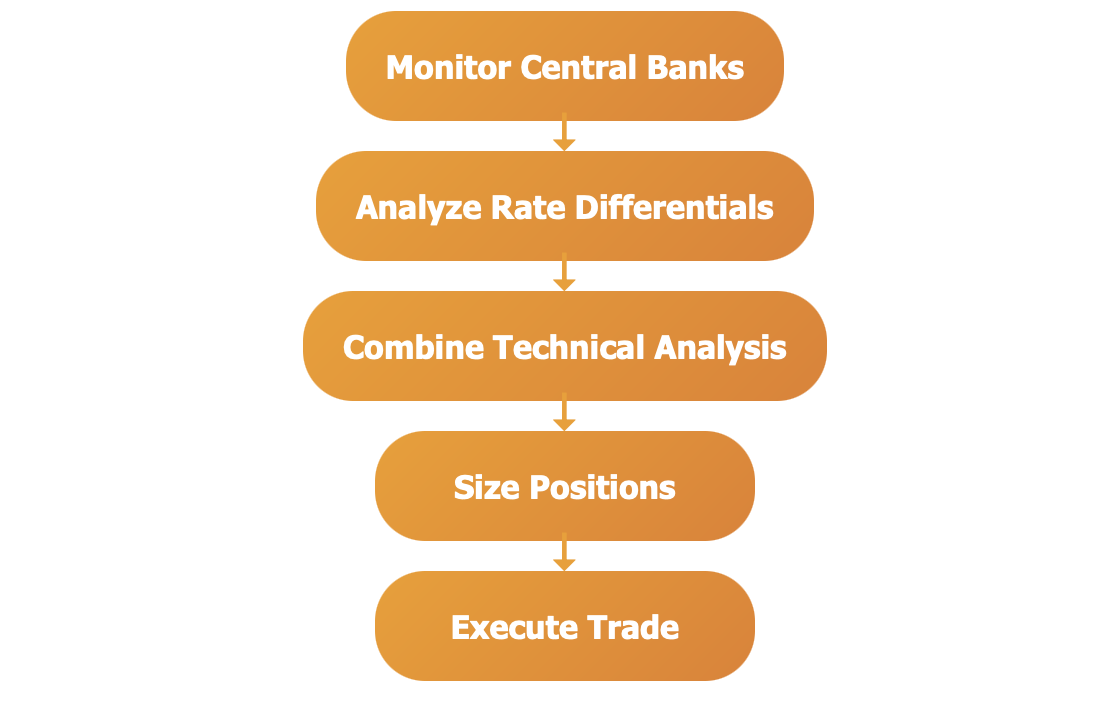
Step 1: Track Central Bank Calendars : Make note of the Fed's meetings, ECB interest rate decisions, and major announcements from other central banks. These events generally precede significant movement in rates. Monitor the economic calendar for other significant releases before or following these events.
Step 2: Know Where You Find Floating Spreads on Your Platform: Most brokers offer floating spreads that widely fluctuate based on volatility. Become familiar with your brokers spreads at times of announcements. This is good information to help figure out when to enter or exit a trade.
Step 3: Monitor Interest Rate Differentials: The difference between the interest rates between countries is an important driver of currency value. Every time the U.S. rates outpace Europe in the rate cycle, expect the price of USD/EUR to strengthen. Track these differentials to glean valuable trading insights.
Step 4: Use both Technical and Fundamental Analysis: Is your opinion of rates giving you confidence in a technical setup? If your charts are suggesting strength in the USD and the rate differential supports your opinion, you have an idea to build further confidence in a trade thesis than you'd have with just a technical analysis.
Step 5: Practice Position Sizing with Rate Volatility: Moving with the rate is one of the most volatile movements a trader can experience. Be cautious and adjust your position sizes to smaller sizes coming into significant rate decisions. Missing out on some profit is better than taking a large loss.
Step 6: Use Rate Selection Based Entry: Triggers Watch for rate surprises that happen when the actual announcement is created outside of your expectations (wider than forecasts). When channels or ranges are formed based off of rate moves, it often creates immediate trading opportunities as the market prices in the rate change impulse.
Professional Tip: When trading the actual rate decision, it is best to not only understand what the central bank's decision was based off of but also what the forward guidance (hints at the possible future direction of rates) is during the press conference or speech. More than the current rate handle, the market gets to pricing levels usually in the future.
Consider how much of your case in trading is dependent on interest rates. Trading interest rate levels as only one factor is a more successful strategy than blindly following interest rates as your trading signal.
Master Floating Rates for Forex Success
Floating rates are not merely an economic concept they're the primary drivers of daily profit opportunities in the world of forex. From the Fed's next rate hike to the swing in an emerging market currency, understanding the reason behind these movements can provide the trader with a significant advantage over those who trade without an understanding of the fundamentals.
We've covered the groundwork: what floating rates are, how they have evolved out of the Bretton Woods collapse, how they impact the global capital markets, and how they can be applied in trading. The math is easy; however, the implications can be very significant. Whether you are trying to understand your personal loans or you are trying to trade the EUR/USD exchange rate, floating rates will impact your bottom line.
The advantages are apparent flexibility in loans, responsiveness to the market, and trading opportunities. The disadvantages are also real unpredictability, volatility, and risk. Ultimately, being advantageous means that the trader must respect both sides and apply an appropriate risk management strategy.
Keep in mind the takeaways: floating rates create the volatility which makes trading forex a profitable endeavor, central bank decisions regarding rates drive movements in major currencies, and combining an assessment of floating to trading via technical and fundamental analysis provides the trader a more stronger trade set up to execute out of.
Are you ready to take the information you've gained and put it to work? Join thousands of successful traders as part of the advanced and easy to use forex trading platform on Tradewill.
Begin your journey trading using your floating rates processing to turn market volatility into a consistent profit today!
Sign up now and get access to real-time rate data, professional analysis tools, and live market opportunities.
Disclaimer: The content of the blog does not represent any position of Trade W, does not serve as any trading-related decision advice, and does not endorse any third-party.