

 Trade W
Introduction: Why Follow Through is Crucial in Forex Trading
Follow Through occurs when the price continues in the same direction after a breakout. It indicates that the initial breakout is not just a false move. An analogy would be a basketball player who takes a great shot and continues to score – the consecutive makes prove the player is hot, not just lucky.
In forex trading, Think of Follow Thru as your trend confirmation. When a currency pair sustains a breakout above significant resistance and continues thereafter to move higher for several days while gaining momentum – that is Follow Through. This validates the breakout and gives traders confidence that the trend will continue higher.
We have seen examples of this recently. When EUR/USD finally broke above 1.1000 in late 2023, it didn't just break and retreat. It provided Follow Through and loaned to an extended move upward over the multiple sessions, and it encouraged traders around 1.1000 to establish longer positions.
Between profitable and losing traders is often the question of patience. Those who sit through the Follow Through process are avoiding a myriad of false breakouts, while the traders that don't wait for Follow Through will likely become trapped in failed moves. The lesson from this information is that following the Follow Through concept is tremendously valuable to helping improving a trader's consistency.
Definition & Core Concepts of Follow Through – Understanding the True Signal
Follow Through refers to the persistent price motion that takes place after the preliminary breakout, corroborating the breakout's validity and suggesting the possibility of further continuation.
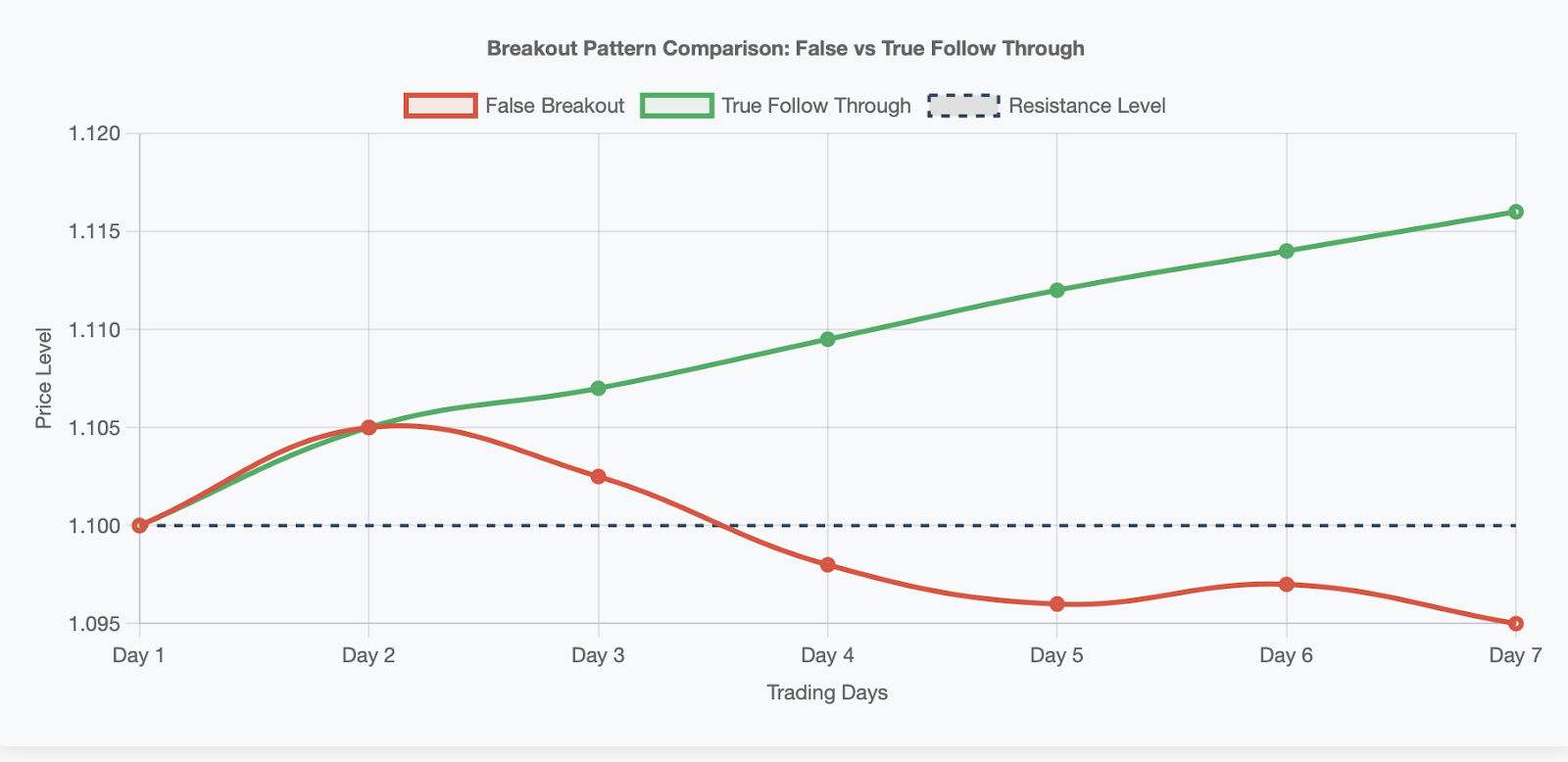
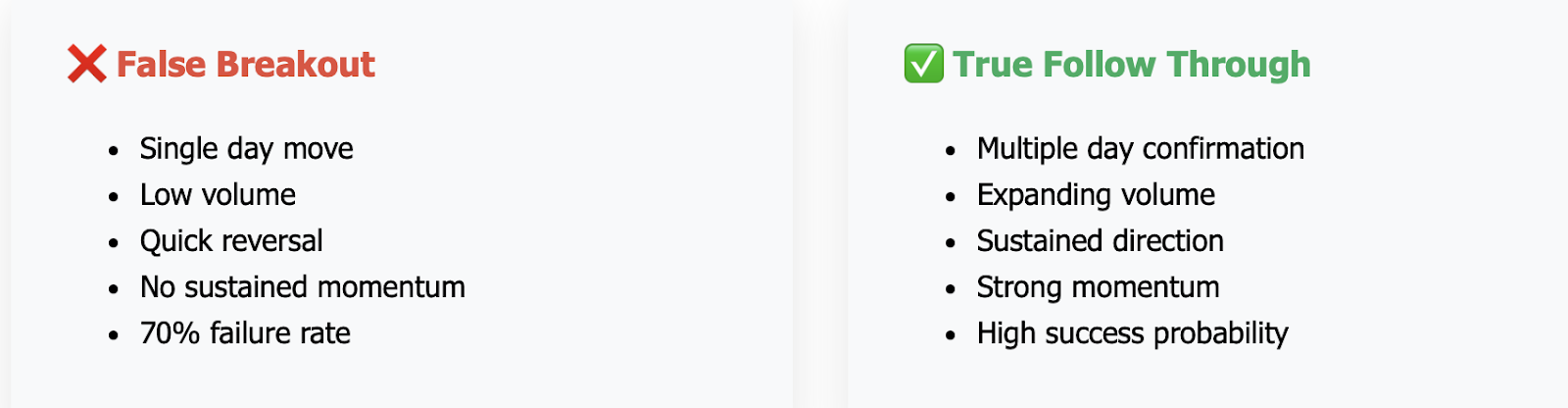
A breakout just means the price moved above or below a key level, but Follow Through demonstrates the movement has substance. One way to visualize this is in a classroom vote for which lunch option to have. Some students raise their hands initially for pizza when it is only the three of us. Then, once they see more of their peers raise their hands, the number of hands goes up again. The Follow Through (the additional votes) establishes that this was not just a random spike of students raising their hands for pizza, but there is a consensus of students who really want pizza.
The difference is in the extent and conviction. A breakout can happen over minutes, while Follow Through usually takes days or weeks. For example, when USD/JPY broke above 105.50 resistance, the initial breakout was only the first move.
Following price action reached to 106.00, and then to 106.50 after what was probably a couple of days, as evidenced that price closed above 105.50 two days after the breakout. There are a few variables to consider when observing Follow Through strength:
Trading Volume: More volume during the continuation phase imply strength in conviction. Professional traders and institutions are likely at play and not only retail traders.
Market Sentiment: Economic reports, news from central banking authorities, changes in interest rates, and geopolitical issues can enhance or dampen Follow Through. A rate hike announcement could provide a fundamental reason for price movement to follow through.
Technical Structure: Especially when they are well-established support/resistance levels, disruptions of those, instead of those more minor levels tend to create stronger Follow Through.
Follow Through is most trustworthy when the price does not just barely rupture the breakout level, but pushes beyond it. When prices merely marginally breach breakout levels, they fail most often because this marginal move does not have conviction from the larger players in the market.
Follow Through requires your patience and verification. The price movement beyond a key level one day doesn't equal Follow Through; This takes movement over multiple days to be a sustainable trend that is actually confirmed.
History & Theoretical Basis – The Roots of Follow Through in Markets
The concept of Follow Through originates with Charles Dow's observations in the early 1900s. He noted that markets tend to follow trends and once the trend gets started that trend is more likely to continue in that same direction than it is to turn back in the opposite direction. Follow Through became one of the foundations of modern technical analysis.
In the 1920s, Richard Wyckoff expanded the concept of these phases to identify specific market phases. Wyckoff laid out that the market exhibited phases of accumulation, markup, distribution, and markdown. Wyckoff identified Follow Through as a recurring phenomenon at the phases of markup and markdown, in which smart money made a directional commitment first and the retail trader followed the smart money.
The nature of Follow Through rests on aspects of herd mentality and momentum. When traders observe a breakout followed by further movement, fear of missing out (FOMO) kicks in and those who did not participate in the breakout now chase price. This effectively instantiates Follow Through.
The classic Wall Street example from the 1920s bull market comes to mind. When stocks had breakthroughs above key resistance, the stock did not immediately reverse. Instead, the stock continued upward movement as more and more traders took a position, which creates self-reinforcing trends that can last for months or longer.
There are classic biases that modern behavioral finance can explain, including.
- Anchoring: Traders anchor to the breakthrough price level as a new reference point of support/resistance
- Confirmation Bias: Once stacked too far in one direction, traders look for evidence to further support their position
- Momentum Effect: Winning breeds winning, therefore traders take larger positions will conscious effort to win within the position
The theoretical basis is built on supply and demand. When price moves through a resistance level, it indicates that demand has exceeded supply at that price level. Follow Through verifies that this is not just a brief spike in demand, but follows through and changes the underlying structure of the market.
This is not merely a theoretical concept. Algorithmic trading environments utilize programmed trading systems designed to identify Follow Through with each purchase and sale.
Behavior with an order of this magnitude is encouraging itself in that the selling is just as intense as the buying and so we see the institutional money instinctively take new positions for whichever side is being bought and sold.
The Importance of Follow Through in Forex Trading – Significance to Traders
Follow Through acts as your shield against one of the largest perilous pitfalls of forex trading: false breakouts. Most times, traders don't wait for Follow Through execution and they enter a trade on the initial breakout only for price to quickly reverse, triggering stop losses, and slowly dwindling account equity.
Follow Through execution is a good analogy to cramming for a final examination versus studying for the duration of a semester. Cramming and remembering for the exam is not sustainable, however, studying as a method creates permanence associated with retention.
Research tells us that approximately seventy percent of the initial breakouts retrace in the first series of trading sessions. Traders that await Follow Through execution experience an improved win percentage and better risk-adjusted returns.
Integration with Risk Management: Follow Through assists you with stop loss placement. Instead of putting stops a few ticks below the breakout (which they are likely to hit, due to normal market volatility), use Follow Through to find the more rational areas for stop placement.
Position sizing advantage: Instead of risking full position size on an uncertain breakout, professionals start with a smaller position size and add to the winners once Follow Through has given confirmation. The pyramiding process enables the expertise of traders to maximize profits with winners and control losses with failed positions.
Take for example the recent dollar breakout above $2000 in gold. Traders who immediately jumped on the breakout faced immediate volatility, and unattractive drawdowns with their positions. However, the traders who waited for Follow Through (multiple closing prices/confidence above $2000 for several days), entered the trade with a greater degree of confidence and better risk management.
Trend recognition: Follow Through recognizes the difference between a trend change versus market noise. Currency markets often experience false moves, particularly at major economic announcements. Follow Through can often help you filter out market noise as well as recognize genuine signal.
Psychology: Waiting for Follow Through can improve the emotional aspects of trading. In the case of seeing a breakout, rather than getting sucked into an immediate dilemma, you're forced to wait to see if the breakout sustains – this allows for more efficient and disciplined trading behavior.
The compound effect is significant. It's no problem if Follow Through confirmation means missing the first 20-30% of a move; any time we can catch the rest of the move (70%) with the highest probability tells us it's better than taking numerous small losses on invalid breakouts.
How to Recognize Follow Through - Identifying Reliable Signals
Recognizing real Follow Through requires more than a single price action level; you are looking to have multiple indicators confirming one another. Just like a detective finds a couple clues that seem to indicate the same conclusion, as a trader you'll want a couple clues confirming that the price action indicator is meaningful.
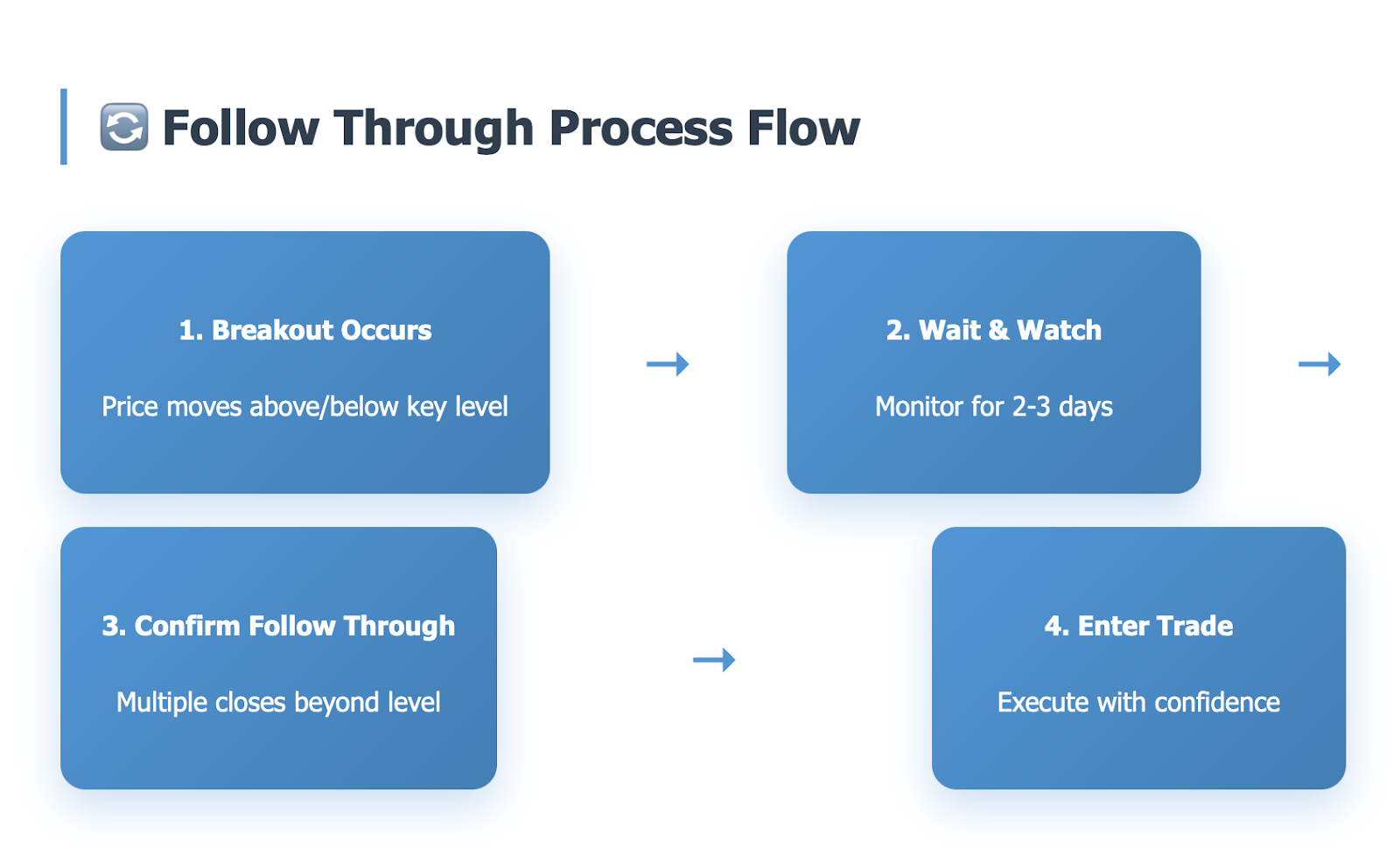
Price Structure Confirmation: Just like we want price confirmation before we buy a breakout or cash, we want to see consecutive closes above the breakout level. So if GBP/USD breaks above 1.2500 and closed above 1.2500 for three days, that is much better than GBP/USD making a breakout on a day closure. The fact that the market closed above the level three days suggests confidence that the move above will hold, and may very well continue further. The more closes above, the more confidence we have about follow through to the same level.
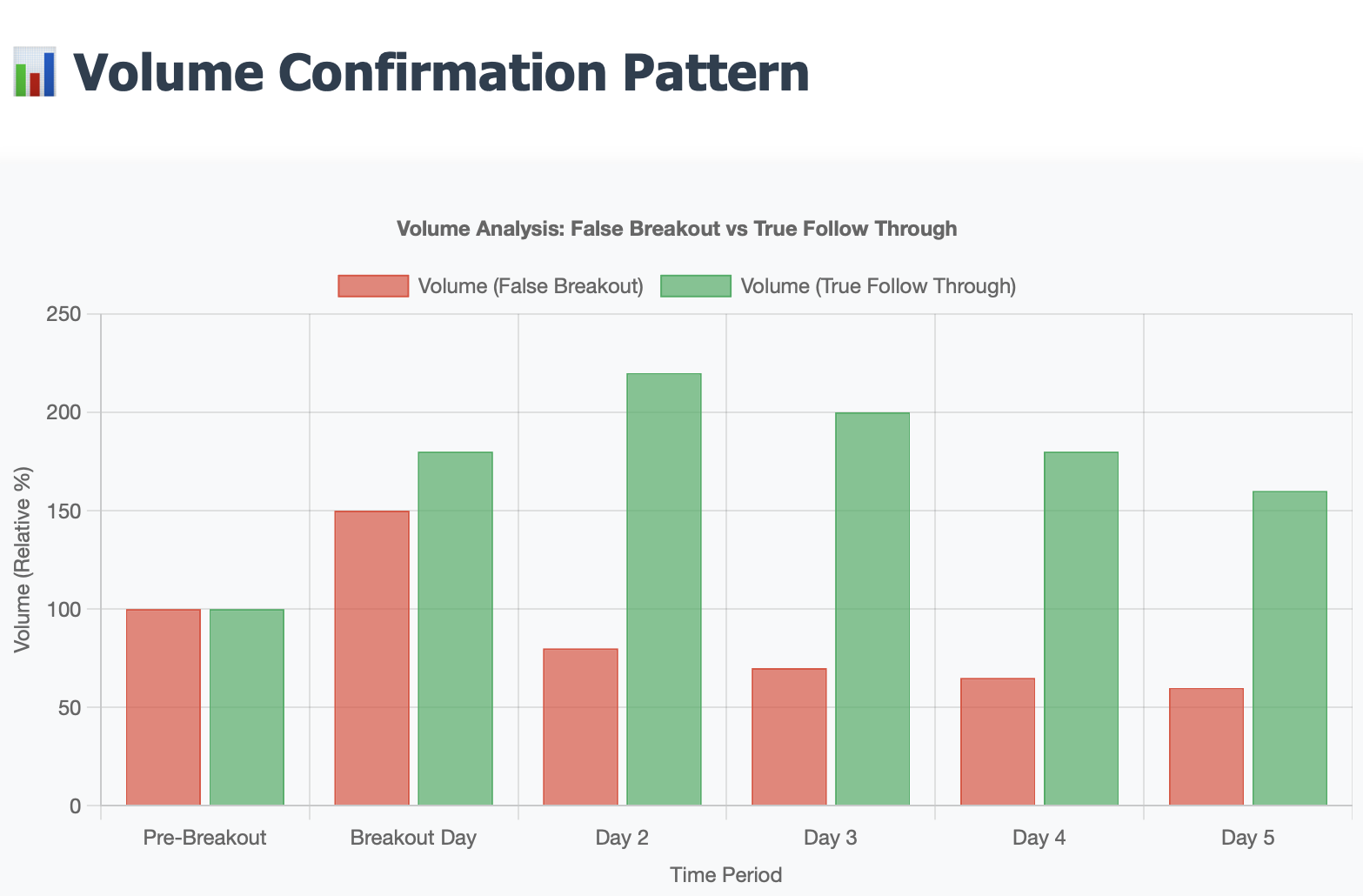
Volume Analysis: Volume will expand during the Follow Through Phase. In effect we are looking for tick volume if trading forex, or volume indicators across larger trading platforms. Higher volume during Follow Through phase should suggest that institutional traders were involved and not just retail traders.
Candlestick Patterns: The Follow Through will most of the time provide decisive candle formations. Look for large body candles with small wicks facing the breakout. Dojis or candles with larger upper and lower wicks indicate uncertainty or potential reversal.
Time Frame Alignment: Verify that Follow Through is present across a range of time frames. If the 4-hour time frame shows Follow Through and the daily time frame shows little to no strength, be careful. Multi-time frame confirmation strengthens the signal.
Think of a skateboarder trying a new trick. If they land a cleanly once, it may be a fluke, but if they cleaned it three times in a row, it's safe to say they've mastered the trick. The same concept applies to a move closing above a breakout level over a number of periods; it creates conviction in the move.
Support/Resistance Flip: In genuine Follow Through, resistance to the upside becomes support on the downside. If EUR/USD breaks above the 1.1000 level and then comes back down to test that support from above, if it holds above 1.1000, there is evidence to support the Follow Through.
Moving Averages: The price should remain above key moving averages during bullish Follow Through and below key moving averages during bearish Follow Through. When BTC/USD broke above the 200-day moving average and it continued higher, the fact that price continued to stay above that key level confirmed the Follow Through signal.
Momentum Signals: Indicators such as RSI and MACD should correspond in the direction of the Follow Through. That being said, in trending moves do not solely rely on oscillators as they can present false signals.
The key is to remain patient. Avoid the temptation to jump in just because there is a breakout. Instead, wait for a minimum of 2-3 confirmation signals before deciding to deploy capital. Exercising this form of discipline will help to eliminate many false signals and greatly improve your overall trading outcomes.
Quantitative Indicators for Follow through - Using Numbers to Confirm Trends
In the discipline of trading, numbers do not lie, and quantitative indicators help to eliminate emotion from the process of identifying Follow Through. By using previously defined and specific criteria, you can develop a framework for trade decisions that do not require gut feelings.
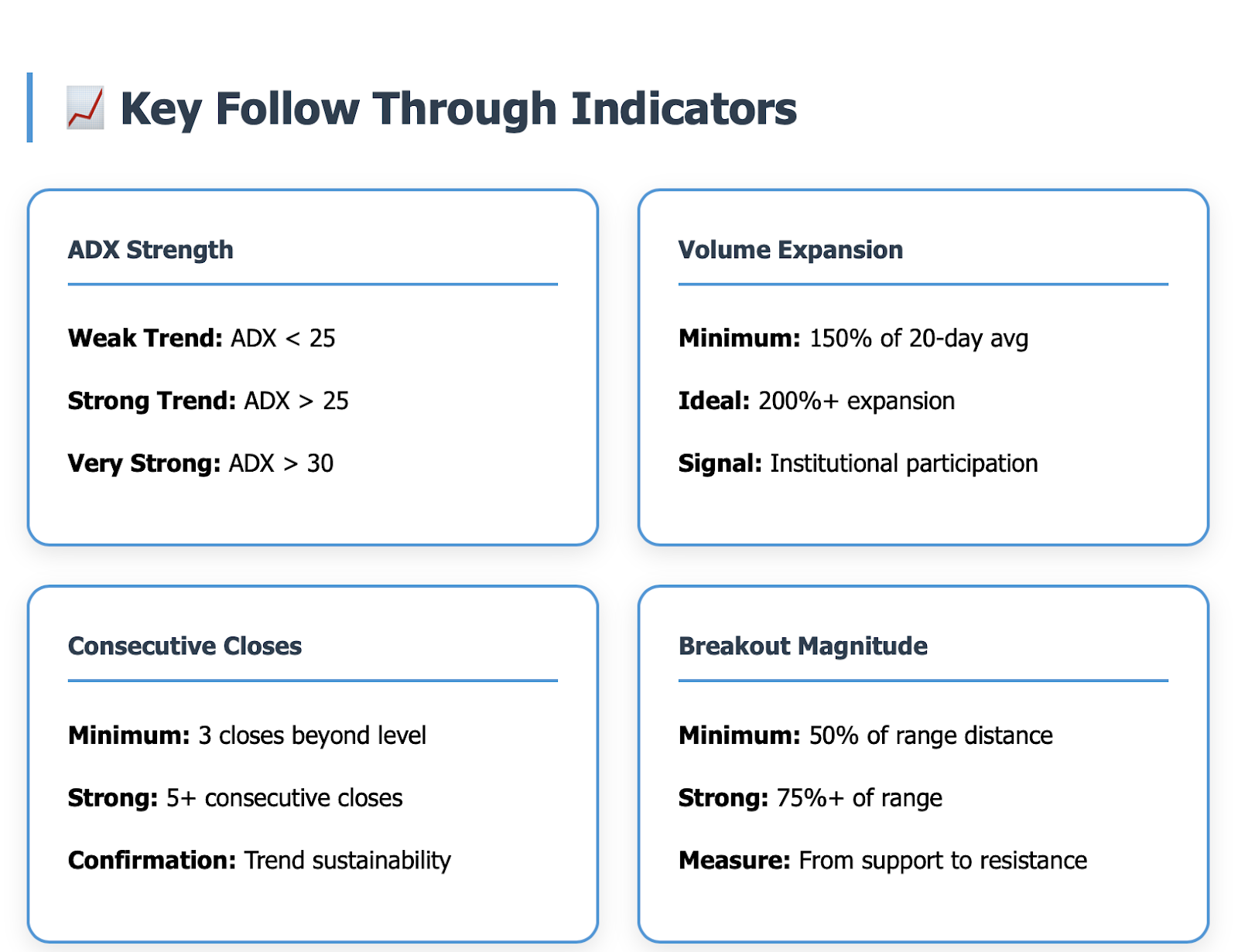
Average Directional Index (ADX): When ADX is positioned above 25, it indicates the existence of strong trending conditions that are ideal for Follow Through trades. ADX rising above 25 is interpreted to mean that the breakout is exhibiting some momentum. Values above 30 signify very strong trends with a high probability of Follow Through taking place.
Volume Confirmation: For volume, you should look for an expansion of a minimum of 150% above the 20-day average. Higher levels of volume often signify institutional participation and eliminate some false moves.
Consecutive Close Criteria: A simple rule to develop would be to wait for a minimum of three consecutive closes beyond a breakout level. While reader may find this innocuous, it eliminates many false breakouts while keeping you in most legitimate trends.
Breakout Magnitude: Assess the distance from the breakout point to the closest meaningful support/resistance level. A minimum 50% of this distance during Follow Through generally indicates more continuation in price.
Think of it like tracking your improving test scores; if you see a student who went from a 70% to a 75% to an 80% on three successive tests, that's check and confirm a series of higher outcomes. One good test could have been luck; two could suggest goodness, but three good tests strongly suggests a trend.
Moving Average Slope: Slope of a 20-period moving average should be calculated, as moving average slope should reveal whether there is consistent higher Follow Through in the direction of the breakout. If the slope becomes flat, that may suggest slowing momentum.
Price Momentum Score: A simple score can be created by assessing how far price has moved from breakout levels against recent volatility. If price moves 2x the average daily range above breakout levels over a 3-day period, this would be as strong Follow Through.
RSI Behavior: In bull Follow Through the RSI should stay greater than 50, and preferably 60. In bear Follow Through RSI should remain below 50. This will help you decipher a trending price behavior from sideways price action.
Percentage Above/Below Moving Averages: In bullish conditions, a good Follow Through keeps price at least 2% above the 50-day moving average. Conversely, when bearish, a good Follow Through keeps price at least 2% below the 50-day moving average. This buffer keeps you out of 'whipsaw' type trades around the moving average.
When you assign parameters to these criteria, you take out the guesswork of recognizing Follow Through. You can create your own checklist for buying and/or selling when multiple criteria show up with a numerical threshold. Enumerating your checklist helps immensely with consistency and your results in trading.
Risk Management - Using Follow Through to Protect Your Trades
A good Follow Through pattern can do more than tell you that you have identified a good trade. It can also protect capital and manage risk. Good traders can use Follow Through patterns to formalize their risk management plans for the trade and at the same time, maximize the probability of being profitable.
Dynamic Stop Loss Placement: Instead of placing your stop execution to protect your trade with a stop loss just below the breakout level, where you can be taken out from normal market volatility, allow Follow Through to find more logical stop levels. Instead of placing a stop to protect your trade just below the breakout, consider placing your stop just below the low of the Follow Through. Alternatively, you can us the 50-day moving average and place a stop just below that level.
Position Sizing Strategy: Begin with a smaller size on the initial Follow Through confirmation and add to positions that are winners while the pattern is developing. This pyramiding style allows you to try to maximize profits on trades that are working for you while minimizing your loss if a trade is unsuccessful. Think of it as trying a new restaurant; you don't order a full meal until you've sampled the food with an appetizer first.
The 2% Rule with Follow Through: While you have up to 2% of your account at risk on the trade, you will make position size adjustments in two different situations, based on the Follow Through strength. For example, a trade with Follow Through confirmation may allow you to risk the 2% based on the strength of the Follow Through (i.e. they indicate more and more support/confirmation), while another possible great trade may only support risking 1%.
Trailing Stops During Follow Through: As you experience Follow Through, you should trail your stops to lock in profits, but allow the trade to breathe. If you experience bullish Follow Through, use the previous day's low as your trailing stop level; if you experience bearish Follow Through, you can use the previous day's high.
"Professional institutional fund traders often get in batches at a time instead of loading all at once" (Nicholas, pg165). In the case of a position of 1000 shares, they may enter at 250 shares after confirming Follow Through into the 5 factors above and then on the follow-up confirmation add another 250 shares to bring them to 500 shares.
Then they may take their time and wait for the confirmation to their next level of risk (up to the 2%), and all they have at this point is on the first 500 shares. This way of approaching position sizes is a much more optimized way of managing money (and bettering odds) than simply loading up as soon as we see Follow Through confirmation from a bull or a bear.
Time-Based Risk Management: Place maximum holding periods on Follow Through trades. If a Follow Through trade doesn't move significantly in your favor within 5-10 trading days after confirming Follow Through, you may want to reduce your position size or exit the trade altogether. Time decay can be as dangerous as price movement in the opposite direction.
Volatility Adjustment: Adjust your distance for stops according to the volatility of the currency pair. Pairs such as GBP/JPY require much wider stops than EUR/USD due to their higher volatility. Consider using Average True Range (ATR) to determine an appropriate distance for your stop. This distance is generally 2-3x ATR from your entry price.
Correlation Risk: Please do not take multiple Follow Through trades in highly correlated pairs at the same time. In the previous example, if you took a long position in Both EUR/USD and GBP/USD based on Follow Through signals, you would be essentially doubling your exposure to the USD weakness.
The goal is not to eliminate every losing trade, rather to minimize losses while permitting winners to run. Follow Through patterns help achieve this by clearly defining when to add to a position, and when to cut losses short.
Common Mistakes & How to Avoid Them – Avoiding Follow Through Pitfalls
Even professional traders can make expensive mistakes relating to Follow Through signals. Knowing these common mistakes will save you major losses, and will subsequently increase your performance in trading.
Mistake 1: Pursuing prices following an extended move. Many traders view strong Follow Through and feel they can simply jump in at any time. This is the same as boarding a moving train – dangerous and usually unsuccessful. In all probability, you will be chasing extended move prices, which typically leads to buying tops or selling bottoms.
Solution: Wait for pullbacks into key levels before any entries. If you missed the original Follow Through, simply be patient and wait for the next opportunity to present itself and do not chase the prevailing price.
Mistake 2: Getting Long/Short on a one-day breakout. Novice traders will mistake a one day move as Follow Through. They see the price break the key level, and with no further confirmation, go long or short only to watch the price revert back on them the next day.
Solution: Set minimum criteria such as three consecutive closes beyond the breakout level, and then look to enter. This simple filter gets rid of 95% of false breakouts.
Mistake 3:Not paying attention to volume signals. The price can move beyond a key level on low volume which can make it feel like Follow Through is in progress, when in reality, the institution did not play a role in the price movement. Low volume moves tend to revert quickly.
Solution: Always check your volume indicators along with the price action. Look for expanding volume during Follow Through scenarios to confirm institutions are buying/selling.
Mistake 4: Succumbing to Crowd Psychology When social media is buzzing about a breakout, it’s likely too late to safely get in. It’s like watching people at a popular sale and joining them in giving your money to the competitors – you’ll typically end up overpaying.
Solution: Develop your own Follow Through criteria and follow it, irrespective of the noise of the general market. The best opportunities develop quietly before people catch on.
Mistake 5: Overcomplicating the Analysis Some traders employ such a large number of indicators to substantiate the Follow Through that they're "frozen" by the analysis. As soon as they find a confirmation from all their indicators, the move is finished.
Solution: Keep your Follow Through criteria simple and effective. Use only 3 to 4 indicators max., and practice acting when those indicators align rather than seeking confirmation all are aligned.
Mistake 6: Inadequate Risk Management Traders often risk too much on Follow Through trades, believing that they're "can't misses". When these trades reverse or otherwise don’t work, the over-sized position wreaks havoc on their account.
Solution: Take Follow Through trades just like any other trade for risk management. Never risk more than the preset maximum you agree to risk per trade.
Mistake 7: Ignoring Context in the Market Taking Follow Through signals during important news events or during low-liquidity times will generally result in false signals and erratic price action.
Approach: Always be cautious of Follow Through signals around major economic announcements or during holiday trading periods, when there is less liquidity.
The way to minimize these mistakes is to have a systematic method for Follow Through identification, and stick to your rules, no matter how excited or fearful the market may be.
Practical Strategies & Real World Examples
Theory does not mean anything unless you have an example you can apply it to. Let's take a look at some examples of real strategies that incorporate Follow Through principles, and see how this works in real world conditions.
The Moving Average Follow Through Strategy
In this example, we will focus on a Moving Average break along with a Follow Through confirmation for an example of how to build a trend-following trade.
Here is how we take the trade:
- Wait for price to break above/below a key Moving Average (20 or 50-period MA)
- Wait for price to confirms after it breaks in either direction, closing two or three consecutive times beyond the Moving Average
- If the Follow Through criteria have been met, you will take the trades on the fourth day after the break
- Place your stops below the Moving Average with a buffer for volatility
- Trailing your stops as the trend continues
Real Example: The EUR/USD broke above its 50-day moving average at 21.0850 back in early March of 2024. Again, instead of buying it immediately, the disciplined trader waited for the price to close three consecutive days above 1.0880. Follow Through occurred the next week as the price traveled to 1.0920 and therefore produced a clean trend-following trade.
- The Follow Through Method Utilizing Support and Resistance
- This technique relies on breaks of established horizontal levels.
- Identify solid support or resistance levels that have been tested multiple times
- Wait for price to break with volume
- Once the break occurs, wait for Follow Through by requiring multiple closes beyond the level
- Enter on pullback tests of the level that was broken
- Use the opposite side of the range as profit target
Real Life Example: Gold struggled for months at the resistance of $2000. When it finally broke higher, with volume, Follow Through occurred and the price went to $2050 without looking back. Those traders who waited for the pull back in price attempted to get in on $2000 as support again for excellent risk and reward.
The Follow Through System Intraday
If you are a shorter-term trader, the principles of Follow Through can apply to shorter time frames as well.
- Identify key levels on the 4-hour charts
- Wait for the break to happen in a high-volume trading session
- Confirm Follow Through on the 1-hour charts
- Enter on pull backs on the 15-min. charts
- Target previous swing high or lows
Real Life Example: GBP/USD broke the resistance of 1.2500 in the opening of the London session. A clean breakout above resistance can be enticing to try and chase, but smart traders waited for the 4-hour Follow Through confirmation then entered after the 15-minute pullbacks of this in order to quickly scalp profits.
Position Management After Follow Through:
When your trade is confirmed, you can enter a maximum of 25% of your intended position size for your initial trade. After that, once you see another confirming signal with the Follow Through you observed, you can then add another 25% position. After you establish the trend and have multi-time frame confirmation, you can completely fill in your position size.
Stop Loss Management:
You're going to want to establish your stops below the Follow Through pattern low. As your position and trend develop, you'll first trail your stops to breakeven. After that, you can then trail to the previous day's lows as the trend develops and positive price movement occurs for you. The key is to never turn winning Follow Through trades into losers.
Taking Profits:
You'll first want to realize a partial position profit at the measured move targets (which is the distance of the previous range projected from the breakout level). After booking partial profits, hold the remaining position for continued trend duration with trailing stops in place.
The critical piece is treating Follow Through as part of a process and not a single event. Then you can slowly build your position once you see the evidence coming together, and manage your risk dynamically as your stop and profit targets are identified.
Conclusion & Call to Action:
Follow Through takes Forex trading from gambling to being a systematic, probabilities based approach to confidence. With a follow through confirmation method to trend confirmations instead of jumping on every breakout idea and method, your winning rate will almost certainly improve to safer and risk adjusted profitability.
The essential ideas behind Follow Through are quite straightforward yet potent: price pause after breakouts indicates trend strength, price movement with volume expansion confirms institutional involvement, and sustained closes will determine if the move has staying power.
These principles are applicable to all timeframes and all currency pairs because they respond to underlying market psychology and the dynamics of supply and demand.
Keep in mind that Follow Through is not about capturing every pip of a move - it is about being part of the high-probability trends, while at the same time, buddying up with anticipated false breakouts that could cost you dearly in pips, dollars, and confidence.
The element of patience that waiting for verification takes is certainly worth it, as the trade-off of lower losses and increased confidence in trade decisions adds significant value to your trading experience.
Risk management continues to be just as critical as verification. While using Follow Through patterns to enhance stop placement and maximization of position size, the fundamentals of risk management must always remain in place. The best Follow Through signal does not amount to anything if poor risk management wipes out your account.
Are you ready to put Follow Through principles to use in your trading? Start with a Tradewill demo account to seek out these concepts without putting your real money on the line.
Disclaimer: The content of the blog does not represent any position of Trade W, does not serve as any trading-related decision advice, and does not endorse any third-party.