

 Trade W
In the swiftly evolving world of foreign currency trading, every trader must have a grasp on what margin means to be successful. That holds whether you're an enthusiastic high schooler wanting to know what makes financial markets sway or an Ivy League university student delving into real-world investment prospects. The fast and sometimes loose world of forex trading has plenty of gotchas, and understanding margin and leverage in both the right and wrong contexts can keep you on the straight and narrow in the sometimes shady landscape of forex trading.
What is Margin Trading?
Margin trading is one of the strongest tools a forex trader possesses. It enables a trader to control a position much larger than his or her actual investment. Although forex is already a highly leveraged investment (1:100 on average), margin trading allows investors to control even larger positions. Imagine being able to buy not just 100 units of something but 1,000 or even 10,000, using the same amount of money and the same technology (i.e., the same trading platform). The basic idea is that forex traders are using 1:10, 1:100, or even greater leverage when they trade. How else could a retail trader control such large sums of money?
To better grasp the concept of margin trading in forex, we can connect it to a common situation most people go through: buying a house. When you make the purchase, you rarely pay the full amount of money up front. Instead, you make a down payment, let's say, 20% of the home's value, and the bank holds the mortgage for the other 80% of the price. That down payment is kind of like the margin in forex trading. You're using a small amount of your own money to control a gigantic asset. And, of course, if you make the right trade, you can pay back the bank and live in your house, where you won't be paying rent.
In the foreign exchange market, if you want to trade a currency worth $10,000 and have only $100 in your account, you can use margin trading to make it happen. Your brokerage sets aside $100 as margin (your "down payment") and lets you control a $10,000 position (a currency trade worth $10,000). That means you have 100:1 leverage, or the ability to act like you're using 100 times more money than you actually have.
The capital efficiency of margin trading is what makes it so beautiful. You can make a $10,000 trade without having $10,000 to put up. You only need $100, in fact. This stunning leverage not only allows you to put your capital to work far more efficiently than you could otherwise; it also allows you to work with far more opportunities and far more potential profit.
Naturally, the same leverage can also magnify your losses. Yet, it is crucial to remember that trading on margin is a double-edged sword. While it can significantly amplify your profits, it can equally swell your losses. If the market goes south against your position, you could find yourself down not just the amount you invested but also the amounts of any gains you stacked up before the trade went against you. So understanding margin is critical if you plan to trade on margin—with or without leverage.
What is Margin in Forex?
Forex margin is not what many people first think. It is not a fee or cost; what many trading accounts call margin is actually a security deposit that the broker holds temporarily. You have to "pay" it in order to open leveraged positions. Think of it as a good faith deposit that illustrates your ability to cover potential losses.
This idea can be explained well with the following hotel analogy. When you check into a hotel, they often place a temporary hold on your credit card for incidentals, perhaps $200 per night. This isn't money you're spending; it's a security deposit. If you don't damage anything or use room service, you get that money back when you check out. Forex margin works the same way.
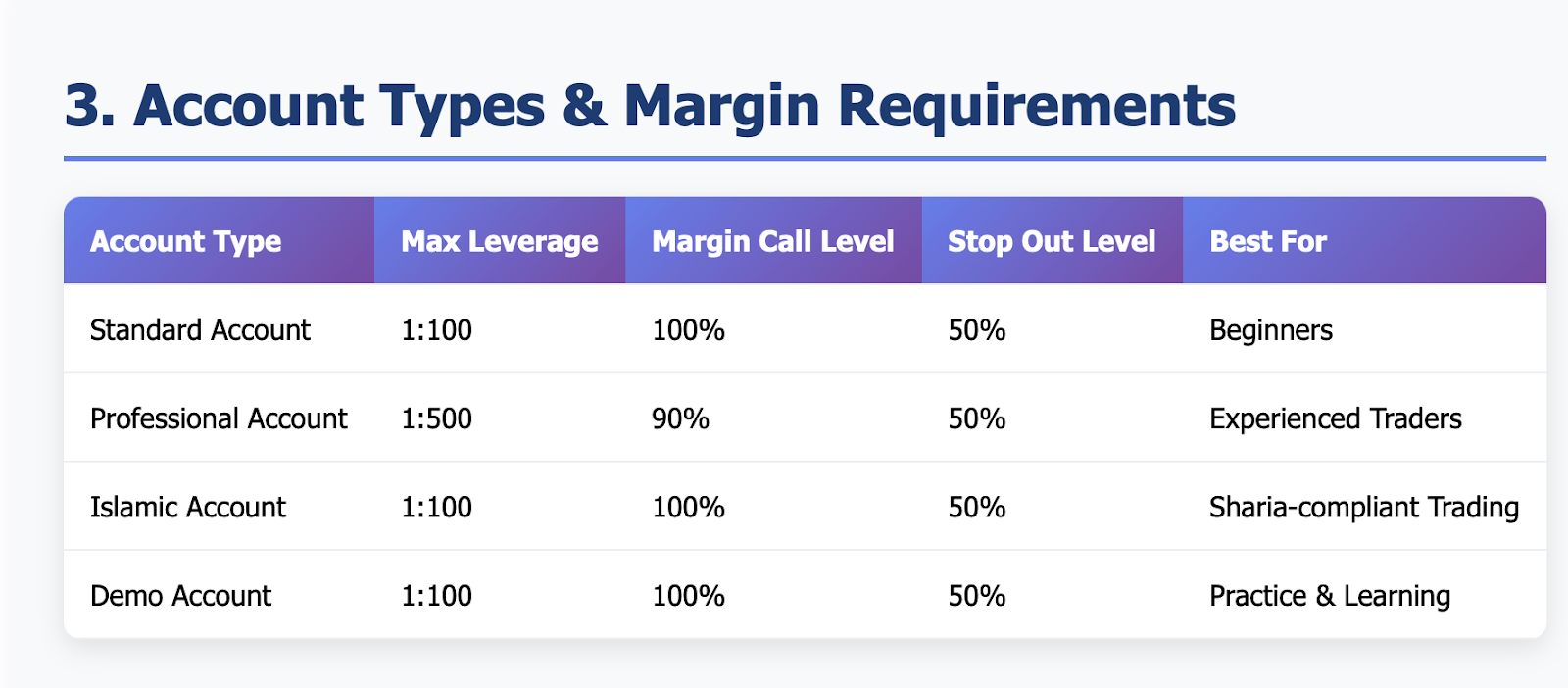
To open a leveraged position treats you to a position that must first be determined by your broker. Your broker bases this calculation on two aspects of your trading: trade size and leverage ratio. For the most popular major currency pairs (like the EUR/USD, the USD/CAD, and the USD/JPY), margin requirements are almost always between 2% to 5% of the notional value of the underlying base currency. So, if you were trading a notational amount of $10,000 worth of EUR/USD with a 3% margin requirement, you're literally Lynching for that position with a mere $300.
Two primary types of margins require your attention.
Initial Margin:
The absolute minimum necessary to establish an entirely new trade position. It is figured as a fraction of the overall trade and differs with such variables as the pair of currencies being traded and the broker's individual prerequisites.
Maintenance Margin:
You must have at least this much capital in your account to maintain your positions. If your capital drops below this level, you'll either have to add funds or reduce positions.
The most important thing to know about margin is that it works like a deposit and is returned to your usable balance when you close your position, provided that you haven't lost more than the margin amount. This means that trading on margin is an incredibly efficient way of accessing even larger amounts of money in the market, for the same amount of your money.
Margin vs. Leverage: Understanding the Relationship
How margin and leverage are related relates mathematically.
Two sides of the same equation, they are. Yet they have different purposes within your trading strategy, and understanding their connection is key to managing your risk.
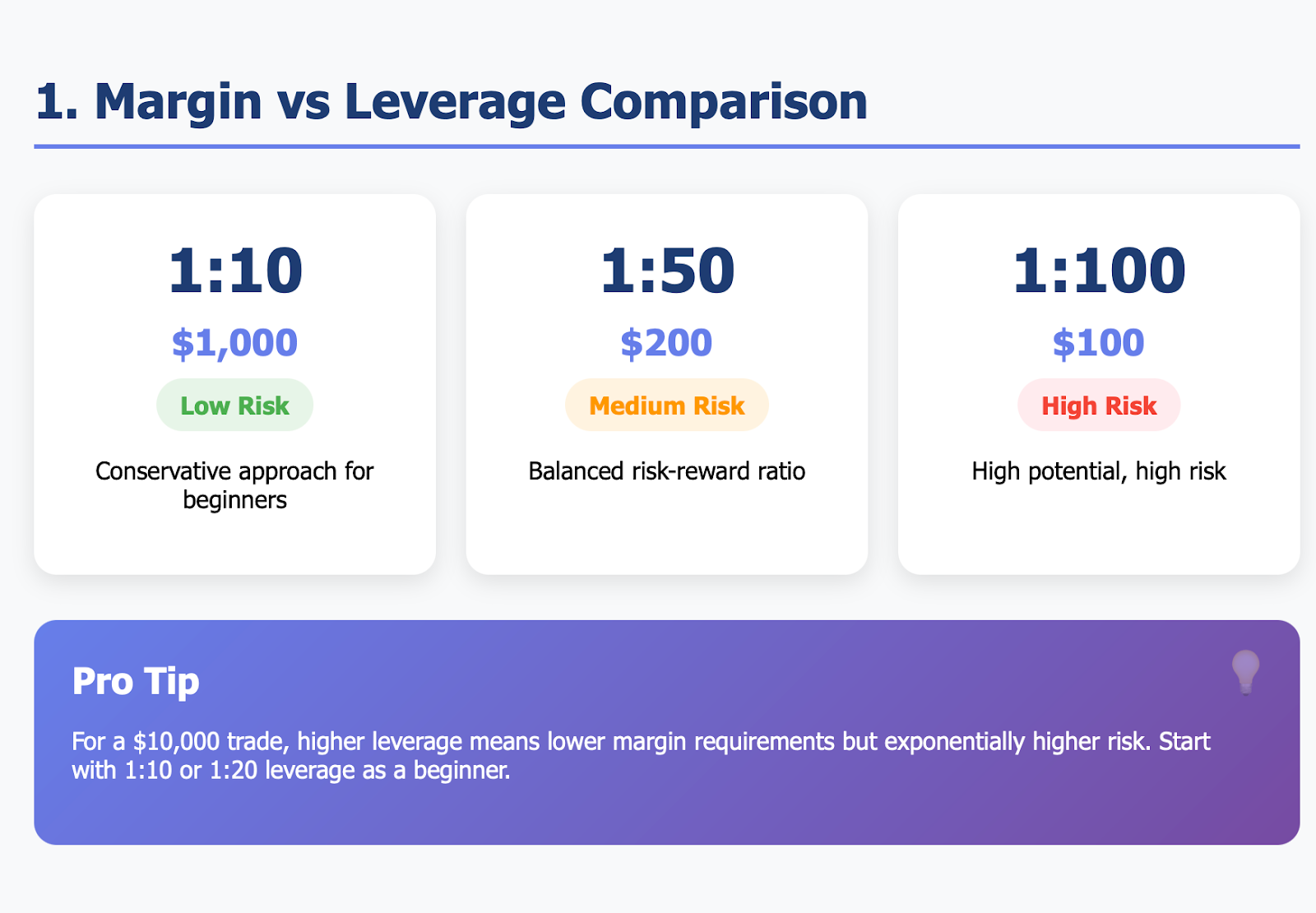
A ratio (1:10, 1:50, 1:100, etc.) expresses how much you can control in relation to your margin when using leverage. With 1:100 leverage, you control $100 for every $1 of margin you put up. The higher the leverage, the lower the margin requirement, and the higher the risk.
This is a fundamental equation that connects these factors. Required Margin = Trade Size ÷ Leverage.
Think about a particular situation: Trade Size: $10,000 Leverage 1:10: Required Margin = $10,000 ÷ 10 = $1,000 Leverage 1:50: Required Margin = $10,000 ÷ 50 = $200 Leverage 1:100: Required Margin = $10,000 ÷ 100 = $100
Think of leverage as a seesaw. When you are far from the centre (where momentum is low), it is easy to keep something heavy on the other side: You can let it stay there while you keep it at a nice angle and level with you. But when you are close to the centre (where momentum is high), the other side has a hard time keeping anything near you unless it is clearly going past you and on its way down. And if you happen to push something on the other side back up and past you, it has a nasty way of coming back down after you with a force that is directly opposite to the way you pushed.
For example, consider a requirement of 3% margin for trading the forex pair EUR/USD. This situation accords you with a phenomenal 33:1 leverage effect. With this trade, you only need to put up 3% of the full position size as margin, and you control 100% of the position value.
It is recommended that beginners work with lower leverage ratios. Good starting points are 1:10 or 1:20 ratios. These will allow new traders to become more comfortable with the concept of margin and how it influences their trading performance. When these individuals have obtained a sufficient level of experience and have developed adequate skills in managing risks, they can start to consider using higher leverage ratios when and if these align with their trading strategies.
The essential point is that greater leverage is not always a good thing. Even though it demands less margin and allows traders to take on larger positions, it corresponds with a much higher risk factor. Many successful traders use low- to moderate-leverage strategies combined with excellent risk management to obtain a much better reward/risk profile than high-leverage strategies that are more likely to blow up.
Margin Requirements by Account Types
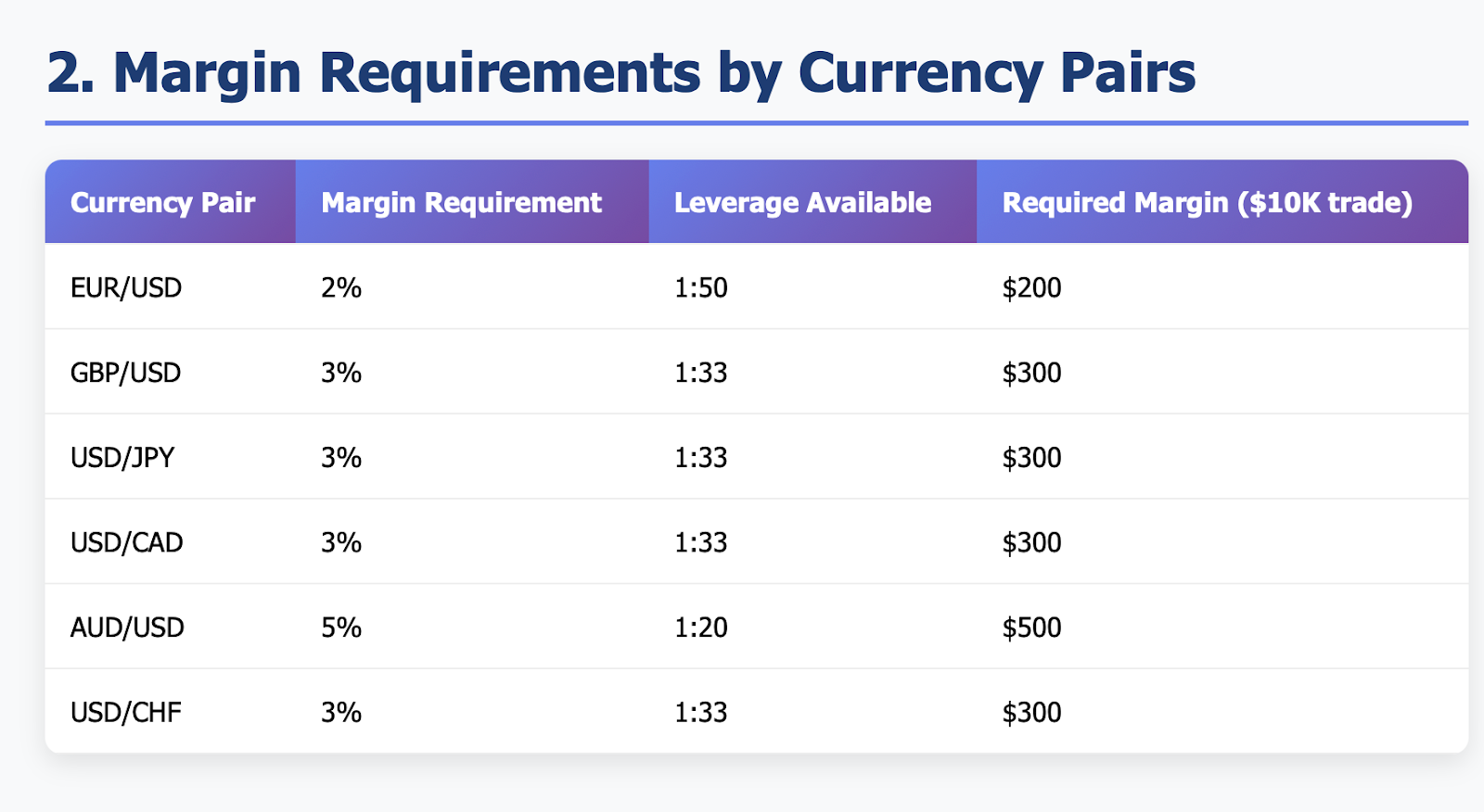
Various forex account types have different margin and leverage requirements. No account works for every trader. To select the right forex account, one must first understand one's trading style and risk tolerance. margin means one thing and leverage means another. Knowing what these terms mean not only helps one choose the right account but also helps one trade better. A trading account is like the plan one has when using a phone. Plans offer different levels of service. Accounts offer different levels of margin and leverage.
Standard Accounts
Moderate leverage options are typically offered by standard accounts. These range from 1:50 to 1:100, as a rule, for the major currency pairs. Standard accounts are set up for retail traders, who are the only folks I can reasonably see causing trouble using leverage. That said, margin calls can and do happen, so obey the rules and don't go nuts with the leverage. Obey these orders and keep your leverage low, your stops in, and your market orders at reasonable prices and you should be okay.
Professional Accounts
Many times, accounts providing a higher ratio of leverage are what we term as "professional accounts." These sometimes go as high as providing ratio after leverage ratio of 1:500 or more. What these accounts do is allow experienced traders who can demonstrate a proficient knowledge of trading and, more importantly, risk management to enjoy an experience where their money goes much farther (i.e., allows for much larger positions to be taken) than it would otherwise in the normal retail trading account scene.
Here's a practical comparison:
-
Standard account: 1:100 leverage, requires $1,000 to margin a $100,000 trade.
-
Professional Account: 1:500 leverage, requires a $200 margin for a $100,000 trade.
A professional account might require a little less margin, but it carries a lot more risk. If the market moves even a little against the position, the relative losses could be huge.
When choosing an account type, consider these factors:
-
Your experience level in trading
-
Your tolerance level for risk
-
Your capital that's available
-
Your trading approach and average trade dimensions
Keep in mind that leverage can also be a disadvantage. Plenty of accomplished traders value accounts that offer moderate leverage coupled with effective risk management over those that have high leverage but few safeguards. It obviously isn't wise to blow through your trading account in a matter of minutes when you can just as easily stretch it out over weeks or months.
Margin Call & Stop Out Explained
It is very important to comprehend margin calls and stop out levels if one is to protect trading capital. These devices are constructed to prevent you from losing more money than you have in your account, but they can result in quite substantial losses if you do not manage them well.
A margin call takes place when the equity in your account drops beneath a threshold amount. Brokerage firms typically set that threshold at a percentage above the required minimum necessary to keep a position open—often at 20% or so. If your account balances drop to anywhere near this level, your broker will send you a very unambiguous message: you need to add cash to your account pronto, or they're going to start liquidating your positions to get your equity balance back up to the minimum required level.
Consider a margin call to be the same as a credit card customer warning that they are close to their limit. When it looks like you are going to hit your maximum allowable balance, the bank or card company sends you a notice urging you to stop spending. A margin call is your broker's way of doing the same thing with buying power. If you keep it up, you'll get cut off.
Stop out is the automatic closure of your positions when your account equity goes below the stop out level. For the MT4/5 platforms a margin call occurs when equity on the account goes below 90% of the margin required for maintaining your positions and an automatic stop out will occur when account equity goes below 50% of the margin required for the trades.
Let us proceed with a real-world instance:
The position is worth 10,000 x 1.20 = 12,000 USD. The required margin is 12,000 x 0.02 = 240 USD. The actual margin given is only 200 USD. Therefore, the margin is insufficient.
1. Position size = 10,000 (in worth 12,000 USD)
2. Required margin = 240 USD
3. Actual margin = 200 USD
4. Verdict: Insufficient margin.
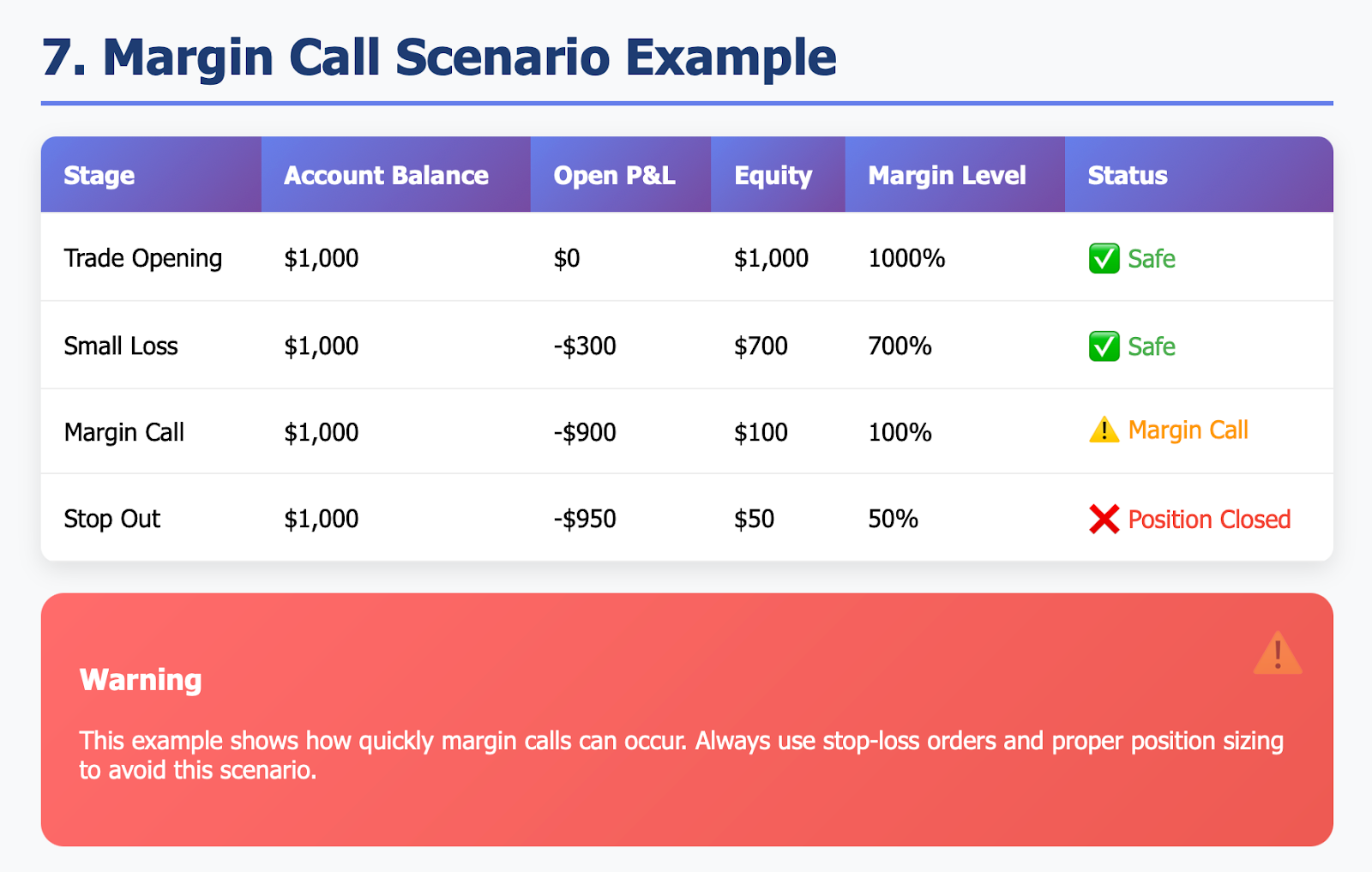
Account balance: $1,000.
Margin call level: 100% (equity equals margin requirement)
Stop out level: 50% (when equity is 50% of the margin requirement)
If the trade goes against Jane and her losses hit $800, her leftover equity would be $200 (that is, equal to her margin requirement). That would immediately kick off a margin call. If the trade keeps going against her, and her equity drops to $100 (which is 50% of her margin requirement), her position would then be automatically closed.
A margin call is an alert that your account equity is close to the stop-out level. If you want to avoid having your positions forcefully liquidated, you can either put in more money or take some of your positions down.
-
Avoiding margin calls and stop outs comes down to one thing: proactive risk management.
-
Regularly check your margin level.
-
Use stop-loss orders on every position.
-
Do not take chances with amounts you cannot replace.
-
Maintain sufficient money in your account as a cushion.
How to Manage Margin Risk
Effective margin risk management is the difference between successful long-term trading and quick account depletion.
Just like wearing a seatbelt while driving, good risk management keeps you safe when things go wrong.
Maintain a Safety Buffer: Do not use all of your available margin. Traders who make money over time use just 20-30% of their available margin and leave a lot of room for the market to wiggle around. If you have a trading account with $1,000, make it a practice to use only $200-300 for your margin accounts.
Use Stop-Loss Orders: Every position should have a previously determined exit point. A stop-loss order automatically closes your position when it reaches a certain loss level, protecting you from unlimited losses. Think of it as an automatic safety net that activates when your trade goes wrong.
Practice with Demo Accounts: Prior to putting actual funds on the line, devote time to practicing on simulated accounts. This lets you comprehend how leverage influences your trading decisions without incurring real-world costs. The majority of brokerage firms make available to prospective clients simulated accounts loaded with play money.
Start with Lower Leverage: Select leverage with care. Leverage magnifies both profits and losses. The potential payout is great, yet leverage cuts important factors down to size, keeping margins slender and forbidding size. Traders, especially beginners, should keep their unleveraged risk to 1% or 2% of the trading account. Whatever risk is taken in the unleveraged position should also dictate the size of the leveraged position.
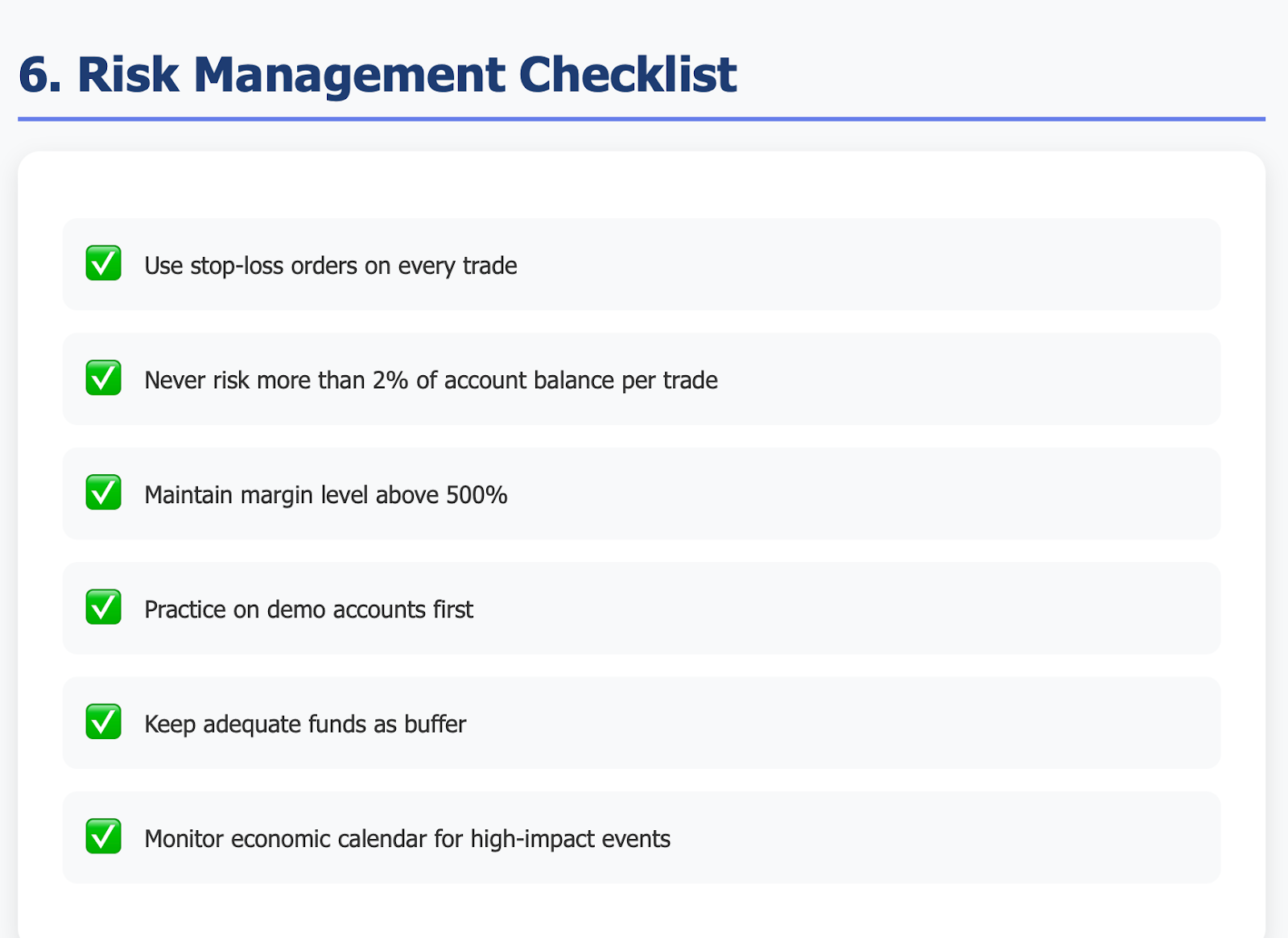
Monitor Margin Levels: Do not allow the "Margin Level" in the terminal to fall below 500%. This allows a substantial safety buffer and keeps unexpected margin calls at bay.
Diversify Your Trades: Distribute your margin across several positions. Place your trades in different currency pairs and reduce the risk of losing all your margin in one trade.
Position Sizing: Your position size should reflect your risk tolerance, not the maximum margin available to you. A good way to size trades is to risk 1-2% of your total account balance on any single trade. If you can't use 1-2% of your account as the basis for sizing a trade, then either: 1) the setup is not high enough quality to justify a trade, or 2) you are overly margined.
Stay Informed: Stay informed about economic developments and market happenings that could spark sudden volatility. Big news can produce fast price changes that impact your margin requirements.
Here's a practical risk management checklist:
Always use stop-loss orders on every trade. Risk no more than 2% of your account balance on a single trade. Ensure a margin level above 500% at all times. Begin trading on demo accounts until confident enough to trade live. Maintain a sufficient account balance that acts as a buffer. Stay attentive to the economic calendar for high-impact events.
Remember, making the most money in a single trade isn't what successful trading is about—it's consistently profitable trading over time. And the long-term foundation for that is proper margin risk management.
Common Margin Trading Mistakes to Avoid
Traders frequently make expensive mistakes with margin—even those with a solid understanding of it. Learn from these common errors and avoid them to save yourself significant losses. Developing better trading habits is a surefire way to achieve that.
Over-leveraging is perhaps the most dangerous mistake.
Maximum leverage does not equal maximum profit potential. That might be an unpleasant surprise for new traders, who often think of it that way. Using 1:500 leverage can command attention and sound like a great empowerment tool for profits. Just be aware, it can wipe out your account in an hour, too, if the market doesn't go your way.
Ignoring Margin Calls is another critical error.
A margin call is not just a suggestion—it's a warning that your account is in danger. Some traders get these warnings and hope that the market will turn back around and come in their favor again. They hang on, hoping against hope, and sometimes they do get lucky. But more frequently, what happens is they have the market up against them too long and they get margined out. Liquidation.
Not Using Stop-Loss Orders leaves you vulnerable to unlimited losses.
Every pro trader uses stop-losses, and this is a habit that beginners should cultivate right away. Without stop-losses, it's all too easy for a small loss to snowball into a catastrophic one.
Emotional Trading often leads to poor margin management.
Traders can be driven by fear and greed to increase position sizes (that is, to use more of their capital or margin) in markets that are moving against them (or to use less of their capital in markets that are moving in their favor).
Inadequate Account Funding is a setup for failure.
Beginning with inadequate funds in comparison to your trading aims compels you to rely on high leverage, constituting an almost certain route to a blown trading account.
Margin Trading Psychology and Discipline
More than just technical know-how, successful margin trading requires the kind of psychological discipline and emotional control that allows you to use—without undue risk—the leverage that margin provides. If you don't have what it takes to hold your trades both in a win and a loss, this will be a trap in which you become emotionally involved. And this is not just true for you as an individual—it's true for the whole margin trading community emotionally trapped as well.
Overconfidence: A common psychological pitfall is overconfidence. After a series of successful trades, particularly those that have been leveraged, a trader may become overconfident and increase not just his or her positions but also the leverage involved, all of which exceeds prudent levels. Always remember that what has happened in the past is no indicator of what will happen in the future.
FOMO: FOMO can cause hasty and ill-thought-out choices. You might be tempted to increase your leverage immediately and with little thought when you see other traders making high-dollar profits with high leverage and think they are doing it right. But, of course, your trades should be done according to your plan and with your risk factors in mind.
Loss aversion: Traders can hold on to losing positions for an excessive amount of time due to a psychological phenomenon known as loss aversion. They hope that they will not have to realize a loss and that the market will turn around. This can be a dangerous thing to do, especially in a margin account, because your losses can exceed your initial investment.
Acquiring the optimal mental attitude requires:
-
Establishing tangible anticipations regarding gains and deficits.
-
Keeping a trading diary to maintain a record of your chosen paths and the reasons behind them.
-
Concentrating on procedure more than solely on results
Advanced Margin Concepts
Once you have the basic margin concepts down, it's easy to move on to advanced margin topics. Understanding these can help you not only optimize your trading strategy but also give you the confidence to place larger trades.
Margin Efficiency: Margin efficiency means making effective use of your capital across various positions. Advanced traders compute the correlation between their positions to ensure they don't use excessive margin on trades that are too similar (i.e., trades that have nearly the same expected outcome).
Dynamic Margin Requirements: Dynamic Margin Requirements mean that margin requirements can change based on market volatility, time of day, and economic events. Brokers may increase margin requirements during high-volatility periods to guard both against losses incurred in trading as well as in margin calls.
Cross-Currency Margin: When trading currency pairs where neither currency is your account's base currency, calculating cross-currency margin can get complex. It's important to grasp these calculations so that you can more accurately predict your margin requirements.
Margin Hedging: Strategies for margin hedging involve employing margin in an efficient manner to hedge current positions, which has the potential to reduce overall risk and maintain exposure to market movements.
The Role of Regulation in Margin Trading
Understanding regulatory frameworks is essential for selecting reputable brokers and knowing one's rights as a trader. The different regulatory jurisdictions can have widely varying effects on the experience of being a trader. For instance, rules about maximum leverage and margin requirements can drastically change the way trading feels and the way in which it is (or isn't) profitable.
Under European regulations (ESMA), retail traders can access a maximum leverage of 1:30 for trading in the major currency pairs. This access to leverage is, however, coupled with an equally stringent access to margin. The retail trader wishing to trade at that maximum leverage must therefore be willing to put up a not-so-insignificant amount of money. Coupled with the leverage and margin combinations necessary to access the forex market is the very real risk of the retail trader losing all of that money and then some.
U.S. regulators, like the CFTC, allow a leverage limit of 1:50, even for the most popular currency pairs. When they specify the amount of margin needed, they do so in great detail and with numbers that leave no room for interpretation.
Higher leverage levels might be available in other regions, but it is crucial to ensure that your broker is not only well-regulated but also offers client protections that are substantial and meaningful.
Technology and Margin Trading
Today's trading platforms are equipped with powerful tools to assist you with efficient margin management. These tools can help you understand the implications of your trading decisions on your account balance, even when you're using a lot of leverage. But for all their power, these tools won't foil your plans if you have your heart set on blowing up your account.
Real-time Margin Monitoring
Tracking your margin usage and available margin is done real-time when margin monitoring is taking place. This allows you to make decisions on new positions with helpful, informed insight.
Margin Calculators
Margin calculators assist in finding the precise margin need before a position is opened. They enable better planning because you know exactly how much money is needed to trade.
Automated Risk Management
Tools for automated risk management can automatically close positions or decrease position sizes when margin levels start to look precarious.
Mobile Trading Apps
Mobile Trading Applications afford the opportunity to keep vigil over the trading account and perform basic portfolio upkeep when you are far from your computer. Whether you are on the road or on a coffee break, these apps allow you to perform bookkeeping functions in your trading account so that you have a semblance of order and the ability to reach for any available margin trade when the moment is right.
Conclusion
Grasping the concept of margin is essential for being a successful forex trader. Margin trading can give you greater returns—but also greater losses, if you're not careful. And understanding margin is step one in mastering the art of not getting too far over your head in your risk exposure.
Recall these crucial aspects:
Margin is what you put up when you want to trade but can't quite afford to—yet—in a way that's akin to renting instead of buying. It lets you control larger amounts of currency in your trades than you'd be able to if you only used your own money. But if your trades go against you, you're likely to lose more than the amount you had in your account when you started trading. And because you're controlling bigger amounts of currency, you're also more likely to move the market against you.
Increased leverage isn't always better; it increases the possibilities of profit as well as risk.
Managing risk is crucial—use stop-loss orders, maintain sufficient account capitalization, and never bet more than you can afford to lose.
Perfecting your skills requires practice—utilize demonstration accounts to comprehend the impacts of margin on your trading when you're not yet ready to stake real funds.
Remain knowledgeable—stay abreast of market conditions and regulatory changes that could influence margin requirements.
Regardless of whether you're at the beginning of your foray into forex or at a stage where you're attempting to hone a preexisting strategy, there's no denying that margin trading is an essential concept to understand if you wish to navigate the markets more effectively and protect your trading capital.
Prepared to initiate risk-free practical exercises in margin trading? There is no better way to learn than through direct experience in a safe environment. Find a trustworthy broker and open a demo account. There, you can practice all the risky concepts of margin trading in a controlled, real-time setting (trades and profits are simulated; your financial safety is guaranteed). When you feel confident with how margin works and have a risk management plan that allows you to sleep soundly at night, make the transition to live trading. At that point, you will have earned the right to call yourself a margin trader.
Start your forex trading journey today with a free demo account—experience margin trading safely and build your skills before committing real capital.
Disclaimer: The content of the blog does not represent any position of Trade W, does not serve as any trading-related decision advice, and does not endorse any third-party.