

 Trade W
Why Manual Calculations in Forex Can Destroy Your Profits
Forex mathematics can really be brutal to beginner traders. You open up a trade with confidence, do your mental math rather quickly regarding how much profit you would likely get, and then when you close your trade, the numbers look nothing like what you originally expected. This gap between your expectations and reality is frustrating as well as costly.
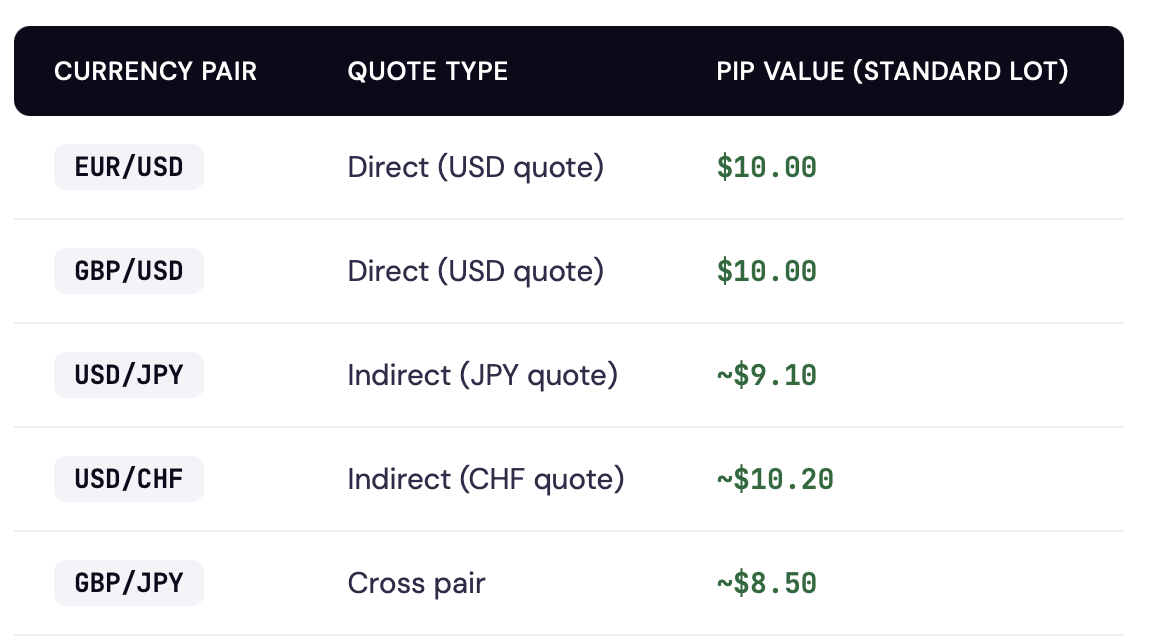
Mistakes in pip value are at the root of this problem. A pip, which is the smallest price movement in a currency pair, is equal to $10 for a standard lot on the EUR/USD currency pair.
This is pretty straightforward, but if you are trading the USD/JPY currency pair, where you are dealing with yen and pricing goes to two decimal places, you will see that your pip value is going to be quite different. As a result, many beginners do not make the distinction between the pip values of the two currency pairs and wind up with an unplanned loss.
This issue becomes even more pronounced with the use of leverage. For example, if you are using 1:100 leverage, you are controlling $100,000 worth of currency using only $1,000 in your account. While a 50-pip move in your favour is a good thing, if you then have a 50-pip move against you, you will likely suffer a substantial loss of capital in your account based on your mental math of feeling "safe".
Another issue with trading is the location of your account's base currency. If you have a GBP-based account and you want to trade EUR/USD, the pip value for that trade will not be quoted in the same currency as the base currency of your account. Therefore, the pip value must be converted, adding another layer of complication for many traders.
In addition to creating extra work through mental math, psychology creates added pressure for traders. When you are trying to calculate profit, manage an active live position and watch current price action all at once, there is a high potential for making mistakes simply because your brain is overworked.
To eliminate many of these issues, a forex profit calculator will allow you to input your trade details, and you will immediately be shown the exact amount of profit or loss that you are going to receive in the currency of your account, with no guesswork, no need to do conversion calculations and no pressure.
Mastering Forex Profit Calculations: Key Concepts Explained
Before you can use a forex profit calculator effectively, it helps to understand what it's actually doing for you under the hood.
The core formula is straightforward:
Profit = (Close Price – Open Price) × Trade Volume × Pip Value
To illustrate this point, let's use an example. You purchased 1 standard lot of EUR/USD at 1.1000 and closed out of that position at 1.1050 with 50 pips worth of an increase (profit). In this case, when the value of a pip for EUR/USD equals $10 in value, you will have made $500 worth of profit.
Now, if you want to use GBP/JPY instead, and use the same calculation without adjusting for the different pip value, you will get an entirely incorrect number, and you could size your trade improperly.
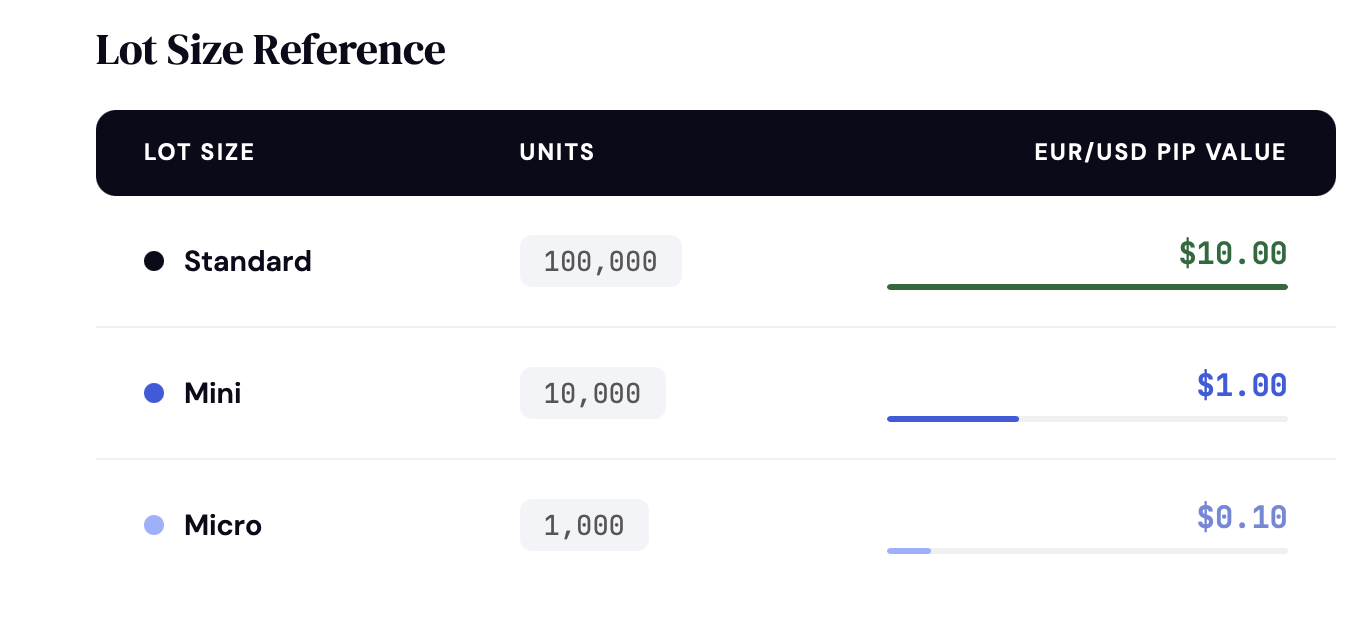
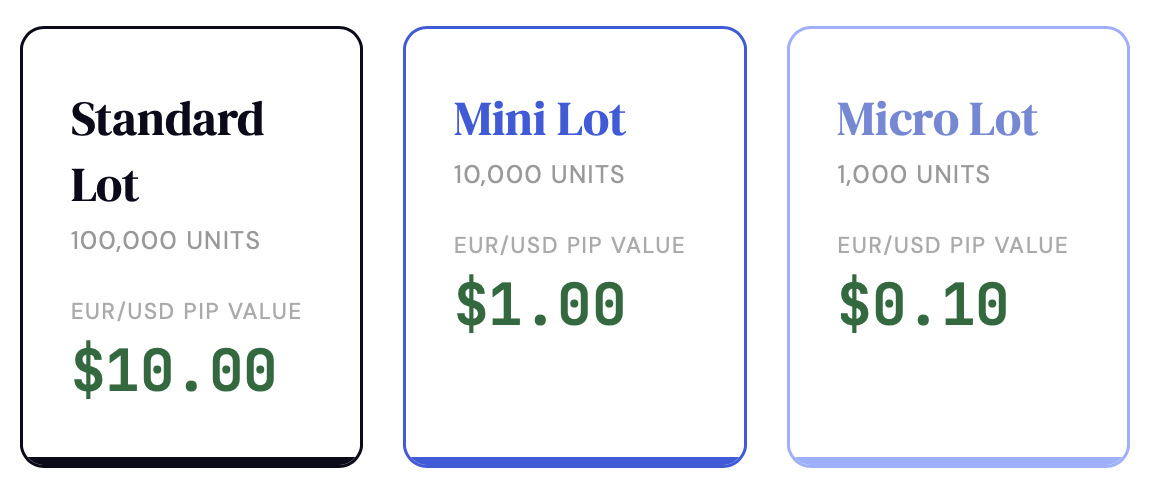
Trading is done in lots, which is how traders measure their trade volume. In Forex, a standard lot is equal to 100,000 units of the base currency, while a mini lot is equal to 10,000 units, and finally, a micro lot is equal to 1,000 units (with pip values scaling proportionately).The power of Forex leverage comes with great risk when trading. For example, with a retail trading account containing $500, the trader has the ability to use 1:100 leverage, thus granting the trader $50,000 purchasing power based on their deposited dollar amount. Because currency pairing values can change by a minimum of 1.0% within a single period, the retail trader can see his or her account balance either double or become worthless, as both profits and losses will equal 100% of the initial margin amount ($500).
As a trader, you must first determine how much you could potentially lose before you execute a trade. Anything less than this constitutes gambling instead of risk management. The accurate use of a calculator to establish your potential profit/loss for each trade will enable you to effectively manage your risk each time you enter or exit the marketplace.
You can relate this to a loan situation in which you are lending money to various friends at different interest rates and different payment terms. Before every loan, you would first need to identify the amount you could lend to each friend.
Your success in managing your risk by calculating potential losses and gains for each currency pair you trade will go a long way toward determining whether you achieve the desired outcome. Additionally, if you used a margin account to determine how much your account was worth after each trade, you would gain an understanding of how much of your original funding is still available for future trades.
Step-by-Step Guide: How to Use a Forex Profit Calculator Like a Pro
Using a forex profit calculator isn't complicated. You need five pieces of information:
-
Currency pair (e.g., EUR/USD, GBP/JPY)
-
Open price (the price you entered the trade)
-
Close price (the price you're targeting or exiting at)
-
Trade size (lot size)
-
Leverage ratio (e.g., 1:50, 1:100, 1:200)
Plug those numbers in, and the calculator instantly returns your projected profit or loss in your account currency, along with margin requirements and risk exposure.
Example walkthrough:
You want to buy EUR/USD at 1.1000. Your target is 1.1050. You plan to trade 1 standard lot. Your account uses USD. Leverage is 1:100.
The calculator tells you: 50 pips × $10 per pip = $500 profit.
It also tells you your required margin ($1,000 at 1:100 leverage) and what a 50-pip loss would cost you instead. Now you're not guessing. You know exactly what's at stake before you hit the buy button.
What changes when you don't use a calculator:
You estimate how much profit you're making in your head, round some numbers up or down, forget to change the pip value into your account's currency, and enter the trade, thinking you are risking $300. In reality, you are risking $520.
The trade goes against you by 52 pips, so you are then down much more than you had originally planned. You become scared, close the position and ten minutes later the market reverses.
This happens to a lot of new traders, not because they did not mean to, but because they are making mental calculations while they trade under high pressure and quickly move.
The psychological benefit of using a calculator to get the worst-case number before you enter your trade is tremendous. If you have concrete numbers in front of you, the fear of actually having that negative outcome decreases dramatically. You will have made an educated decision based on actual numbers, and you can hold onto your position calmly rather than praying that every pip does not go against you.
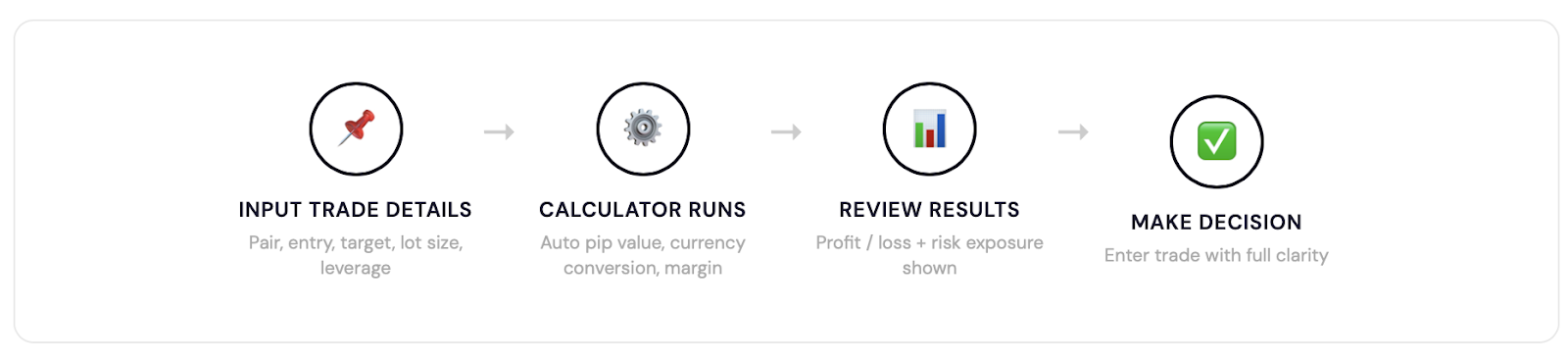
TradeWill's built-in profit calculator runs these calculations in real time, factoring in your account base currency and current market prices. The workflow looks like this:
Avoiding Beginner Traps: Common Mistakes in Forex Profit Calculation
Even experienced traders can make mistakes in the real world. Here are two of the most common mistakes made by new traders.
The first is not calculating the value of your currency pair correctly due to its different quote types. Direct quotes have USD as the quote currency while indirect quotes have USD as the base currency. The way in which you calculate the pip value differs based on the type of currency pair. Therefore, if you confuse the two types of quotes, your profit estimate will be dramatically incorrect.
Second, new traders often over-leverage their accounts based on the advertised leverage ratios. For instance, a trader who sees that the leverage on GBP/JPY is 1:200 may think they could make a significant amount of money; however, if they do not calculate the pip value properly and have their margin wiped out from a 20 pip move against them, then they are using too much leverage regardless of the leverage ratio provided.Trading without converting your account's base currency: If a trader has an account set up in euros and they execute a trade in USD/JPY, they must convert their profits and losses back into euros before calculating what they are actually making. If this conversion is skipped, then they will see the correct amount, but in the wrong currency.
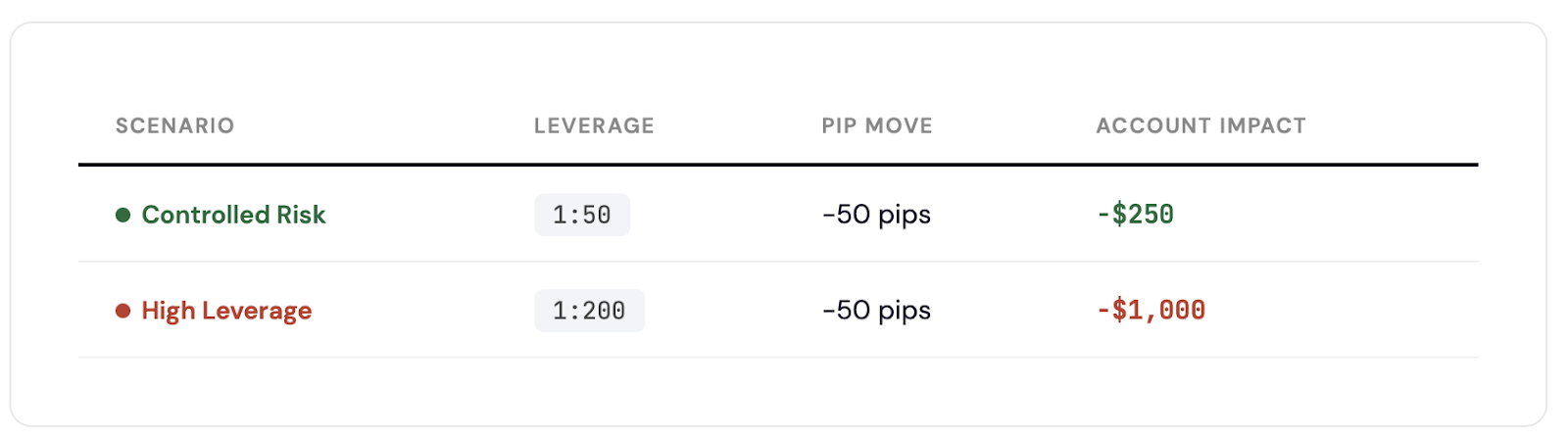
Incorrectly Matching Your Trade Size to Actual Risk Tolerance: For example, a new trader may say, "I am comfortable risking $200 on this trade." However, they may take a standard lot position on a volatile pair without first confirming that the size of that lot will allow them to only risk $200. New traders need to understand the difference between micro and mini lot sizes for the purpose of managing their risk appropriately.
A forex profit calculator does this work for you automatically. It recognises what the quote type is, applies the correct formula for valuing a pip based on the current exchange rate, converts to your account's base currency (i.e., euros) and provides you with exactly the number you need to assess how much profit you made or lost.
This is why calling it simply a profit calculator misrepresents its full functionality. The forex profit calculator is also a mistake prevention tool. This is one of the primary benefits of using a profit calculator for any trader, particularly beginning traders. Both of these tools have equal weight at the beginner level.
Psychological Edge: Trade with Confidence Using a Calculator
Trading psychology and risk management are both sides of the same coin.
When traders don't have a clear understanding of how much risk they will face when starting a new trade, they will experience generalised anxiety throughout the entirety of the trade. This anxiety will cause traders to exit trades prematurely that are actually turning out to be profitable, be fearful and hesitate to enter trades, and react emotionally to fluctuations in price that are typical. None of these behaviours contributes to the growth of your trading account.
By determining your worst-case scenario before placing a trade, you have converted an open-ended fear ("If I lose, I will lose a lot") into a definite number ("The maximum loss I will incur on this trade is $180"). A definable number enables you to manage this risk, while an open-ended fear cannot be managed.
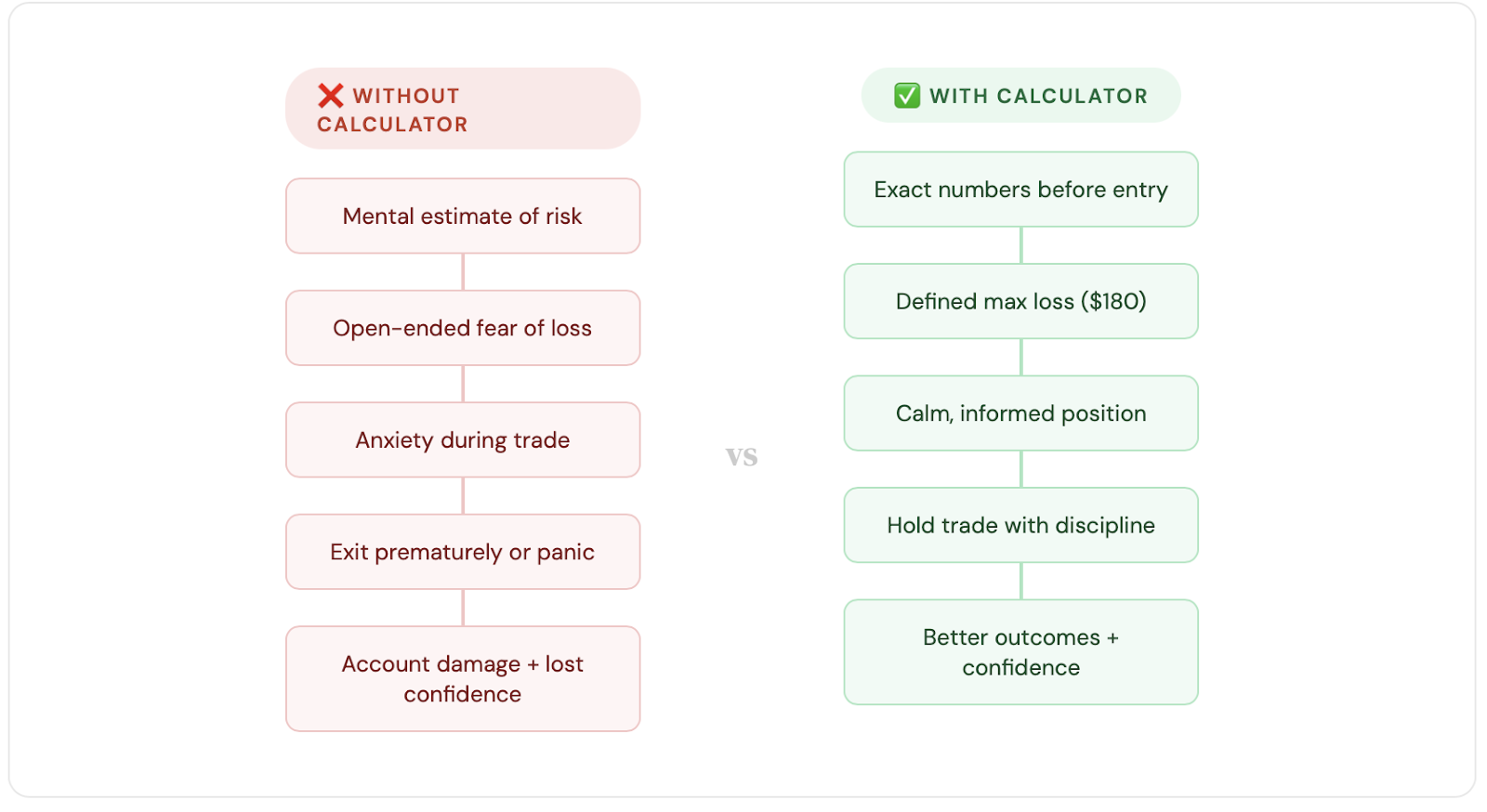
Traders who calculate their profit and loss from each trade consistently display greater discipline and self-control over their ability to execute trades correctly. This is not because they become better traders due to using a calculator, but because they become accustomed to planning for future trades before they take their first trade. The sequence is: Calculate the profit/loss you will incur on the trade, make a trading decision based on that calculation and execute the trade with clarity. Plan, Execute, Repeat.
If you are going to incorporate a calculator into your forex trading plan, it will not be complicated. You will ask yourself three questions before every trade: What is my entry price? What is my target price? What is my highest acceptable loss? The calculations will provide you with information about all three questions, and you will take less than 30 seconds to do so.
The TradeWill system offers you real-time alerts as well as a projection of your profit/loss at any given point in the trade, as well as notifications when your trading position is approaching a pre-determined risk point. With this setup, you will create your parameters, and you will be able to check on them without obsessing over your position (i.e. staring at your chart all day).
The traders who burn out in forex trading burn out the fastest, and they typically are the traders who do not separate "what I think will happen" from "what am I willing to lose if I am wrong." By using a calculator, you are forced to make that separation, which is no small thing.
Start Using Your Forex Profit Calculator Today
There are many disadvantages to manually calculating your forex trades. In fact, if you want to protect your trading account, then you will want to avoid manually calculating too many aspects of your trades.
Manual calculations can make it difficult to determine accurate pip value conversions, leverage and other factors involved in your trading account. The number of different variables you have to consider when trading live is simply too many to mentally keep track of. Small errors in these calculations not only result in loss of money, but also create a loss of confidence as well.
By using a forex calculator, you will have the opportunity to determine accurate calculations before placing a trade. You will not make the common mistakes new traders make, as you will have everything you need right in front of you, and you will be able to accurately size trades based on precise calculations instead of guesswork.
For anyone who is new to the forex or CFD trading environment, using a forex calculator is necessary as it is the starting point of every trade you will ever place.
Ready to stop guessing and start trading with real numbers?
TradeWill's forex profit calculator is built directly into the platform alongside live market data and risk management tools, so your calculations and your trades live in the same place. Try the calculator at TradeWill.com and run your first trade simulation before you risk a single dollar.
Disclaimer: The content of the blog does not represent any position of Trade W, does not serve as any trading-related decision advice, and does not endorse any third-party.