

 Trade W

Envision this: You've just made a forex trade on EUR/USD, and within minutes, you've gained a net $15. Your heart is pumping as you behold the green figures on your display. But then your mind meanders to the scary scenario of the market turning on you and your flipping those green numbers to red. So you make like a baby and walk away with your small win, your precious gain.
But then, in a nail-biting turn of events, you see the currency pair move in your favour for another 100 pips. What could have been a $150 profit is now a meagre $15 gain. Does this kind of close call with a substantial loss sound familiar?
You aren't by yourself. A recent talk in Reddit's trading community unveiled a bitter fact: "We all look like we're gambling from a short video like this." This feeling reverberates throughout the forex trading society, where often it's emotional decision-making that trumps strategic thinking.
The hard reality? One of the most profit-killing behaviours in forex trading is closing trades too early. It's not just about missing out on a few extra dollars. It's about systematically decimating your long-term profitability and turning strategies that could win into ones that don't. Closing trades too early is bad. Don't do it.
In this all-encompassing manual, we will expose the true expense of leaving too soon, dig into the deep-seated reasons for this harmful behaviour, and furnish you with five concrete, doable tactics that you can actually follow to let your profits run while controlling risk well enough that you sleep at night.
The Psychology Behind Premature Exits: Why Your Brain Works Against You
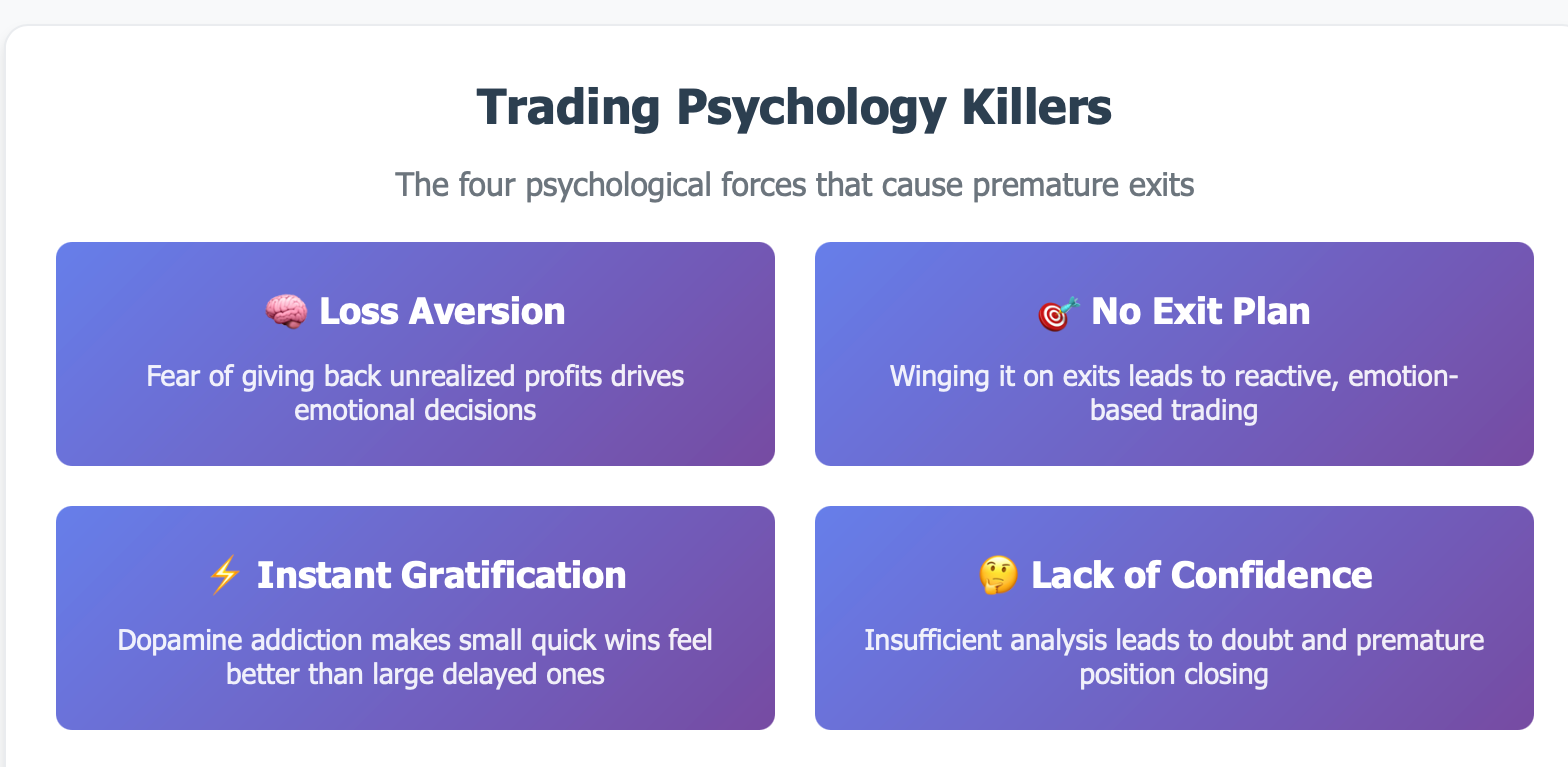
To grasp why traders invariably shut trades down too soon, one must look into the psychological forces that propel our decision-making. These aren't default features of our personalities—they're wired-in human responses that can be acknowledged and combated.
Fear of Giving Back Profits
As soon as you lay your eyes on the green on your screen, your brain treats those unrealized gains as cash in your possession. This phenomenon, identified by behavioral economist Daniel Kahneman as "loss aversion," is the intense fear of loss that leads people to hang onto stocks even when it seems foolish to do so. They would rather incur excessive trading costs, pay more taxes, and suffer substantial paper and real losses than sell at a loss and use the proceeds to buy more stimulating, fun-to-own stocks.
In short, when it comes to avoiding losses, we humans are pathetic. And when it comes to paper losses, we are really pathetic.
In the realm of psychology related to forex trading, this shows up as the seemingly irresistible desire to secure profits, even when your original analysis indicates to you that the trade has much more room to run. This sentiment was perfectly captured by one Reddit trader when he said, "We exit as soon as we see green. That's not a strategy—that's emotion."
Lack of Clear Exit Planning
The majority of traders devote ample time to scheming their entry points, yet they "wing it" when it comes to exits. Exiting a trade is often just as important (if not more so) than entering one. Without predetermining take-profit levels or a systematic approach to profit-taking, traders often allow emotions to dictate their actions in this regard. The result is a high percentage of traders making critical decisions on the very momentary feelings that many of us know (or should know) are prone to error.
Not having a plan means you've got a "style" of trading that is totally reactive. It amounts to having your every price movement provoke some kind of emotional reaction in you. Instead of following a forex exit strategy that's been planned and is therefore somewhat "set in stone," you're second-guessing yourself right to the point of decision-making that's not just inconsistent but almost guaranteed to be suboptimal.
Instant Gratification Addiction
Dopamine is released in response to visually rewarding images. Therefore, it is not too crass to think of trading as akin to a kind of striptease for the brain. But while the hormones and neurotransmitters that make trading and gambling feel good are doing their thing, there is something else to consider. Money can also buy happiness. Sheldon and his colleagues found that when people were given cash to spend, those who spent it on other people reported greater happiness than when they spent it on themselves. The reason, hypothesise the researchers, is that spending money on others satisfies the human social instinct.
Lack of Confidence in Analysis
When trust is lacking, traders tend to stumble or fall out. When understanding is incomplete, plans for the righting of the situation are improvised and put together on a partial basis. In both situations, the plans' performance is judged against the prior models' sorry lot, and the plans are rated low quality and unlucky. By contrast, plans made with understanding and trust tend to perform well, even when the traders have only a thin grasp of the situation.
The performance of plans tends to correlate with the level of understanding, trust, and emotional control the trader demonstrates. Having a trading plan that is understood and well-founded is clearly important for any trader. But it seems especially vital for the emotionally impaired trader. Most people are at some sort of handicap when it comes to trading and emotional control.
The True Cost of Premature Exits: What You're Really Missing
The impact of terminating trades prematurely extends well beyond the loss of specific profits. It gnaws at the very foundation of your trading performance, and what it is nibbling away at compounds and grows over time. It affects several different factors that we may not realize are connected.
Destroying Your Risk-Reward Ratio
Consider this scenario: You wager $50 for the chance to earn $15 on a trade. Your risk-reward ratio is 1:0.3. This means you have to win more than 75% of the time just to break even, and it is essentially impossible to do this in forex trades and almost any other kind of trading.
Take the same trade setup and let it run to +$150 instead of closing at +$15. Your risk-reward ratio is now 1:3, meaning you'd need to win just 25% of your trades to remain profitable. This one adjustment can turn a losing strategy into a winning one.
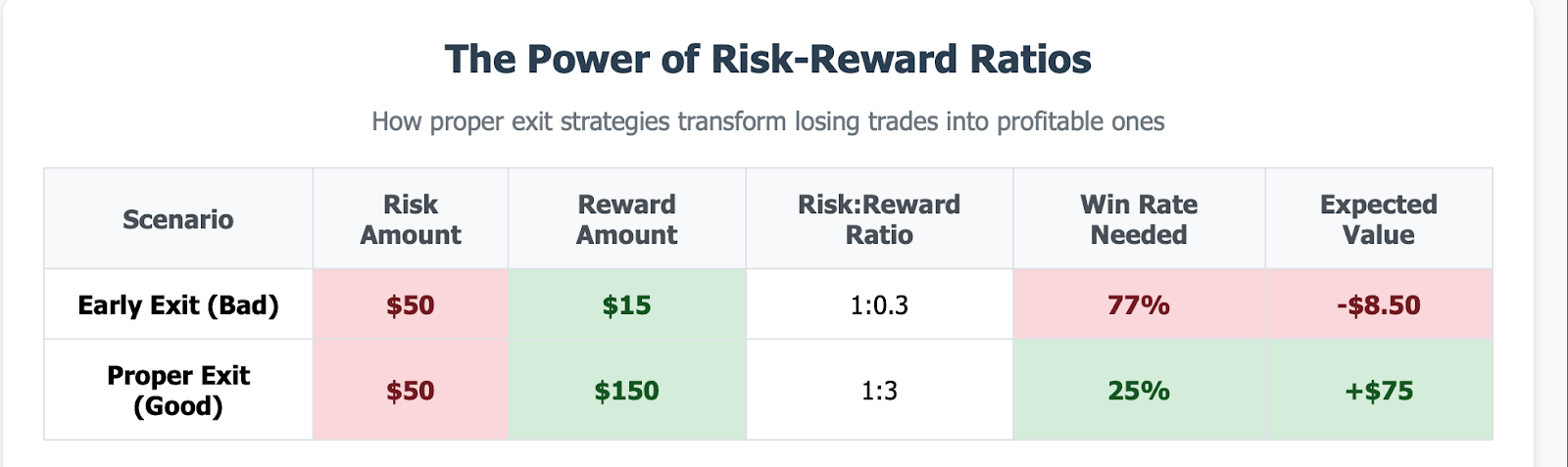
Forex trading can be profitable if it is not about counting the times when one is right or wrong but about counting the times one makes more money when one is right than when one is wrong. This simple truth puts us light-years ahead of most traders, who seem to not know this or not want to know this.
Missing Trend Profits
The forex market often trends for a long time, especially on high timeframes. When a trader closes a trade early, they are really quitting the most profitable part of a market move—the part where the trend keeps going.
A real, tangible case can tell us much more than theory. In 2023, the USD/JPY currency pair, for instance, was in a very lovely uptrend—moving in several months' time from 130 to 150.
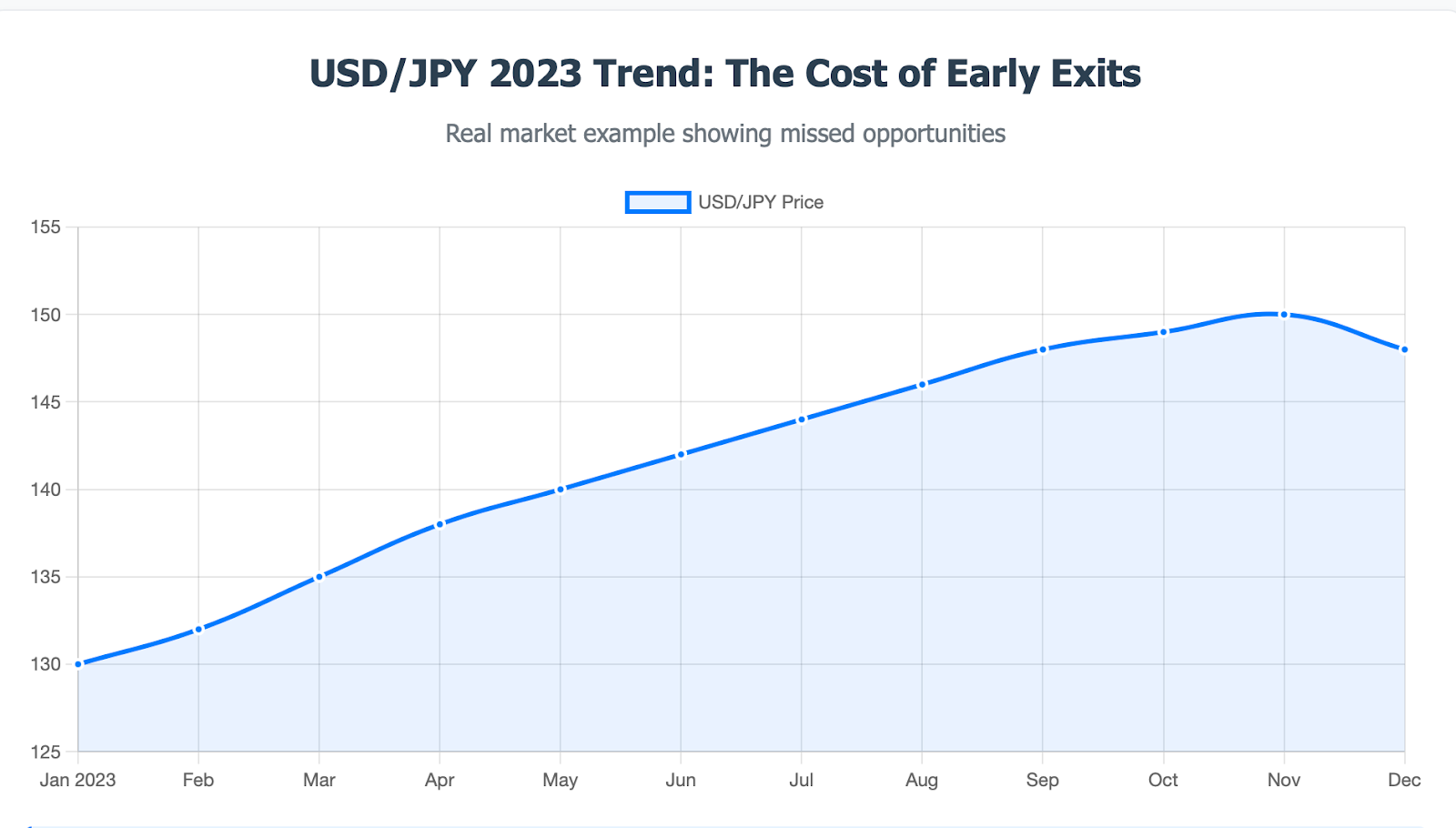
Traders who took their profits too early, in this instance, and exited with modest gains, obviously missed out on a potential profit of thousands of pips. Yet, we would venture to say that those who used trailing stops and good position management in the upside part of this move rode the majority of the wave.
Weakening Long-Term Strategy Performance
Any forex trading plan that nets both small and large wins and one that weakens the statistical advantage of the plan, when it results in an early exit, is not a plan at all. It's what we call a scattershot. Trading plans that work reliably over time result in netting both small and large wins, with the big wins more than offsetting the losses we know are part of trading.
If you always make a point of terminating your winning trades early, you are not allowing the most profitable portion of your trading system to function. This system component, your winning trades, is what confers overall profitability on your trading system. If you aren't making a point of letting your winning trades run, you might as well not have a system at all.
Creating Emotional Trading Patterns
Boosting emotional decision-making makes it likely you will choose emotion over reason in the future. If you close a trade because you are afraid, not because of some well-reasoned strategy, every time you do it, you're boosting emotional decision-making. So, if you want to make more rational decisions, steer clear of this. Alternatively, if you want to make emotional decisions more often, favor this. But do not favor this. Favor what helps.
A sinful circle arises here that makes your trading more of an emotional prison and less of a systematic, hard-decision, enter-exit-stay-in-trade kind of work. When your trading is influenced by emotion, it is almost certainly not systematic; when it is not systematic, it is almost certain that it is losing.
When losing, many traders tend to resort to the use of all kinds of harmful emotional crutches. This is obviously a very bad habit to get into.
Five Proven Strategies to Avoid Premature Exits
Getting the trades closed too early requires making systematic decisions instead of making emotional ones. Here are five ways that have withstood the test of time that will let you manage risk well and cause you to allow your profitable trades to run.
Strategy 1: Master the Trailing Stop
Your best buddy in letting profits run while protecting gains is a trailing stop. Unlike fixed stop-losses, a trailing stop moves with the price, allowing you to capture more of a trend while giving you downside protection.
Here's a guide for you to put into action trailing stops the right way:
-
Initial Setup: Trailing stops shouldn't be put in too close to the price action or too far away.
-
Adjustment Method: Only move your stop into profit.
-
Distance Calculation: Use ATR to determine stop placement and adjustments.
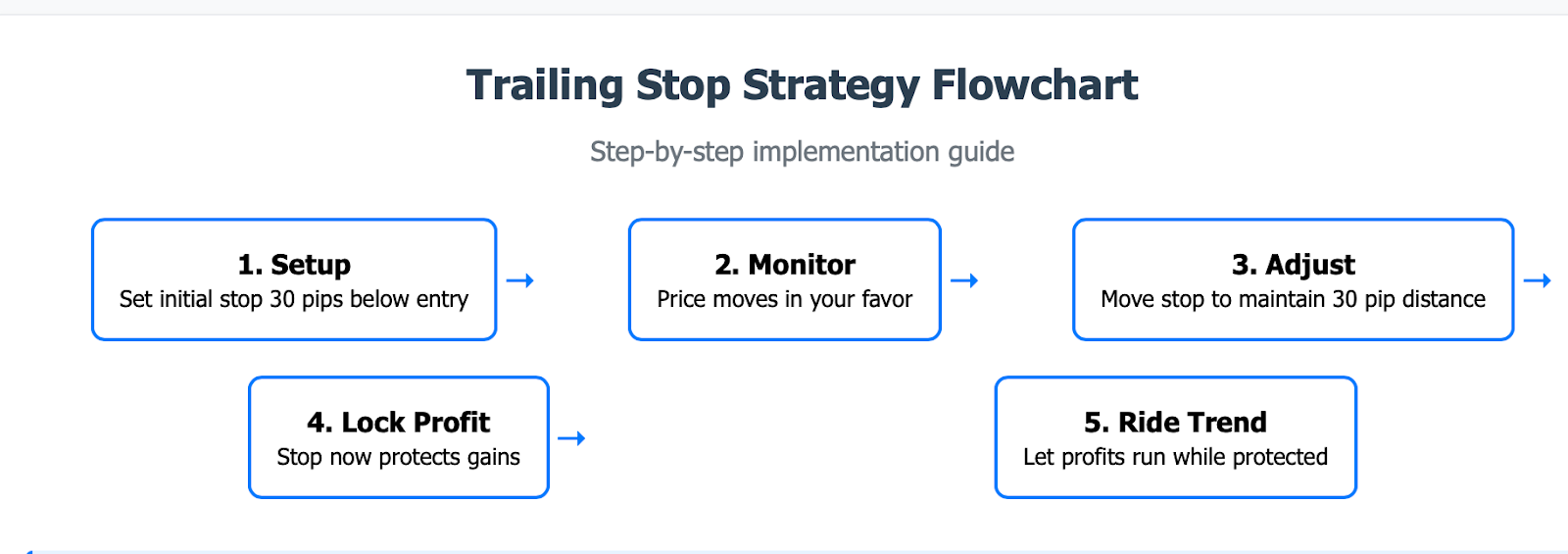
If you're long EUR/USD at 1.1000 with a trailing stop of 30 pips, your initial stop would be at 1.0970. But then, as the price moves up to 1.1050, your trailing stop moves to 1.1020, locking in 20 pips of profit and allowing for further upside capture.
Strategy 2: Implement Fixed Risk-Reward Ratios
Before you enter any trade, fix a minimum risk-reward ratio for the trade—typically 1:2 or 1:3. This means that for every dollar you're risking, you should be aiming to make at least two or three dollars in profit.
Steps for implementation:
-
Assess the amount of risk you will take prior to entering a trade.
-
Set your initial take-profit target according to the risk-reward ratio you desire.
-
Use partial position closing to allow the profits to run while also securing some profits.
-
Do not close any trade for a profit that is less than what you predetermined you would take.
The above rules are for implementation on a trailing stop-loss system. What you may need to adjust is whether to use the system at all and how to make it work best for you.
This method eliminates from the equation any decision-making that is influenced by emotions. You don't exit because you're frightened; you exit because you've hit your previously set target.
Strategy 3: Pre-Trade Exit Planning
Image result for Plan your trade and trade your plan. The time to formulate your exit strategy is not when you are observing minute-by-minute fluctuations in price but rather before you enter the trade. The potential for emotional decision-making is arguably at its maximum when you have money on the line. Your pre-trade checklist should include the following:
-
Entry price and reasoning
-
Initial stop loss level
-
Primary take-profit target
-
Secondary target or targets for partial closes
-
Conditions that would invalidate your trade thesis
-
Money management rules for position sizing
Write this plan down and follow it regardless of the semblance of right here, right now that the trade might have as you are approaching it.
Strategy 4: Trade Higher Timeframes
Trading for short periods, including scalping, naturally encourages traders to exit positions too early because of the market's noise and emotional intensity. Yet, guidelines exist that promote healthier trading habits that can lead to fewer mistakes.
One guideline, for example, urges traders not to use a time frame shorter than 30 minutes for charting and analysis. Charting at a higher time frame, such as 30 minutes, 1 hour, or 4 hours, makes several things happen that greatly benefit the trader:
-
Reduced noise: Higher time frames filter out much of the market's noise, which reveals in clearer terms whatever it is that the market is doing.
-
Better risk-reward opportunities: Longer-term moves typically offer bigger profit potential and much better risk-reward setups than those tight ones that are necessary to satisfy a scalper's need to be in and out of trades in less than a minute.
Strategy 5: Develop a Trading Journal Habit
The most powerful tool you can have for finding and fixing the reasons you exit trades too early is a journal kept for trading. You can't just track the trades you make and expect to see a clear picture of your trading. You also have to track the reasons you make the decisions you do—in both good trades and bad ones. Here are the contained elements you need to keep in mind when recording your trading experience:
-
Entry and exit prices, along with the reasons behind those decisions.
-
Emotional state during the trade.
-
Adherence to the trading plan or deviation from it.
-
Hypothetical performance of the trade had you held it longer.
-
Lessons learned and plans for next time.
For most traders, these components add up to a significant cost.
Building Discipline: The Path to Consistent Profitability
Traders who earn consistent profits have one thing in common: they utilise a system to trade. They do not allow their emotions to run rampant, nor do they permit their emotions to obfuscate their better judgment. When a trader uses a system, he or she is not being robotic in a step-by-step manner; rather, he or she is being orderly and methodical.
The Power of a Systematic Approach
Professional traders do not rely on willpower to remain in trades long enough. They use systems that make the automatic, right decisions in a trade. These systems include:
-
Automated tools: Using platform features like trailing stops and take profit orders.
-
Position sizing rules: Never risk more than a predetermined percentage per trade.
-
Review processes: Regularly analysing not just trading performance, but also the rightness and wrongness of decisions made during the trading process.
-
Continuous education: Staying current not just with the market's current dynamics, but also with trading psychology.
Mental Preparation Techniques
Make sure you are in a good mental place before each trading session:
-
Visualisation: Picture yourself adhering to your plan regardless of what the market does.
-
Affirmations: Remind yourself that your long-term goals are as steadfast as ever and that reaching them requires the kind of discipline that you are currently demonstrating.
-
Stress management: Practice your go-to techniques for maintaining calm during trading emergencies.
-
Perspective maintenance: Remind yourself that trading results are just data. With any single trade, you could win or lose, but what matters is how those results help or hinder your long-term success.
Building Confidence Through Education
The more you grasp the essentials of forex, the technical analysis, and the market's behavior, the more assured you will feel making decisions about your trade management. With this assurance comes an easing of the anxiety that sometimes propels one to exit a trade before its natural term has run.
Comprehend well:
-
The economic indicators that propel currency movements
-
The technical analysis that tells you when you're in a trend and when you're not
-
The market structure and the operation of the big players
-
The risk management that protects your capital.
From Short-Term Comfort to Long-Term Wealth
The decision to exit trades too soon or to allow winning trades to run is, at root, a decision between short-term emotional comfort and long-term financial growth. When we close trades early, we enjoy immediate emotional relief, but we sacrifice the compounding potential of our trading accounts.
The Compound Effect of Proper Exit Strategies
When you consistently allow your profits to run while you cut your losses short, you're harnessing the power of compound growth. A few big winners can offset a multitude of small losses and achieve a kind of exponential account growth that we all like to see.
Think about two traders who have the same entry strategies but different ways of getting out of a trade.
Trader A (Exits Too Soon):
Average profit: $25
Average loss: $50
Profit rate: 60%
Expected value: (0.6 × $25) + (0.4 × -$50) = -$5
Trader B (Systematic Exits):
Average win: $150
Average loss: $50
Win rate: 40%
Expected value per trade: (0.4 × $150) + (0.6 × -$50) = $30
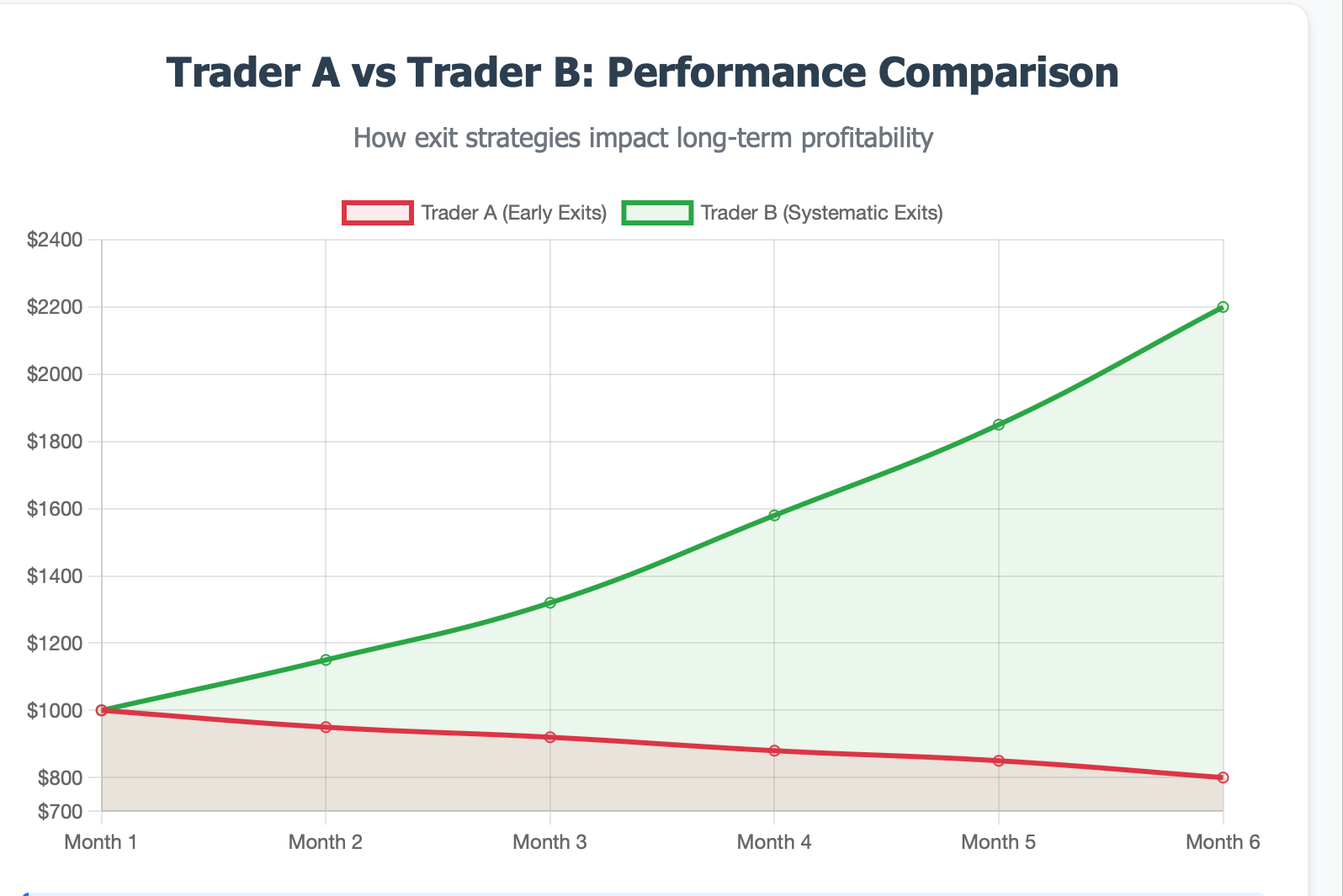
Even though Trader B has a lower win rate, they produce steadily profitable returns, while Trader A's account is slowly depleting.
The Professional Mindset Shift
Professional traders know that trading is a business, not a pastime or a way to make a lot of money in a short time. It's a mindset. I won't pretend it's easy to adopt, but this alone changes how you think about exit strategies.
-
Business mindset: Concentrate on the long-term successful operation of the business instead of getting bogged down in individual rulings
-
Statistical method: Rely on the law of large numbers and the systematic execution of your method
-
Risk management: Consider every possible outcome when you are managing a portfolio; protect capital as the most important asset you have
-
Continuous improvement: Breathe; always look for ways to do what you do better
Building Your Trading Business
Run your forex trading like a business by:
-
Setting reasonable objectives. You should be aiming for consistent returns on a monthly basis. Don't get caught up focusing on the daily moves and trying to trade for profits every single day.
-
Keeping detailed and correct records. There are two aspects to record keeping. One is for tax purposes. The IRS expects you to keep good records. The other is for performance analysis.
-
Using your trading profits as job number two. Forex compounding is basically reinvesting your profits so that, over time, you see your account grow at an increasing rate.
-
Making sure you are always learning and always improving. This is forex professional development.
Advanced Exit Strategies for Experienced Traders
Once you have conquered the fundamentals of allowing profits to run, you can delve into more advanced exit strategies that top off profitability and maintain risk control.
Partial Position Closing
Rather than shutting down whole positions, contemplate rewarding oneself with partial profits and allowing the rest to pursue larger ambitions. This method grants the emotional delight of securing profits while also keeping a hand in for bigger moves.
-
Close 25% of position at 1:1 risk-reward ratio
-
Close 50% at 1:2 risk-reward ratio
-
Let final 25% run with trailing stop.
Multiple Target Approach
Establish several profit objectives that reflect an analysis of different timeframes:
-
Target 1: Close-in resistance level (take profits quickly)
-
Target 2: Intermediate swing level (let trades marinate a bit)
-
Target 3: Long-term projection (see if this whipsaw will whip you good)
Even if you aren't sure how the near-term direction of the market will unfold, this way of managing profits allows for granularity. You can get profits at different levels while keeping the trade open and allowing for more potential profit.
Volatility-Based Exits
Modify your exit strategy according to the market's ups and downs:
-
High Market Activity: Make Your Stops Wider and Targets Further Away, to Avoid Premature Exits
-
Low Market Activity: Manage Your Profits Tighter, to Take What's Available
-
In Breakout Scenarios: Use Wider Targets, to Capture the Trades with the Most Momentum
-
In a Market That Trades in Ranges: Take Quicker Profits, to Get What's Available at the Levels You've Established
Start Your Journey to Better Trade Management Today
Overcoming the tendency to exit a trade too soon begins with one clear choice: discipline over emotion. Every trade managed systematically rather than with a knee-jerk emotional reaction makes it just a bit easier to allow a profit to run.
Your Action Plan
-
Examine your trading history: Pinpoint how much profit you have passed up by leaving trades too early.
-
Select your tools: Pick a forex trading platform that provides support for trailing stops and order management automation.
-
Establish your structure: Formulate rules in writing for managing trades and strategising exits.
-
Demonstration trading: Use this to practice your new strategy with no risk of losing real money.
-
Implement step by step: Begin with smaller position sizes and build up to larger ones as you gain confidence in the new approach.
The Competitive Edge
Reworded text
Keep in mind that the market rewards patience, discipline, and systematic thinking. Holding winning trades for longer than may feel comfortable is not a "natural" act—but it is a necessary step in the process toward becoming consistently profitable.
Take the First Step
-
Allowing another day to go by while leaving money on the table simply isn't an option. It is imperative to start implementing these strategies now.
-
Get our free Take Profit Strategy Template to systematically plan your exits.
-
Create a demonstration account to risklessly practice implementing new strategies for exiting trades.
-
Become a part of our trading community, where you can network with other well-mannered traders who take their craft as seriously as you do.
-
Access our Trading Journal PDF to monitor your evolution and to pinpoint areas that need enhancement.
It's your decision: stick with cosy, small profits, or cultivate the discipline to net the big, transformative gains that can turn your trading account around. Your future self will reward you for making the right decision today.
Prepared to revolutionise your trading outcomes?
Commence with our complimentary demo account and leverage these strategies designed to maximise profit, all the while working immediately. Keep in mind, the most opportune moment to sow the seeds of potential was 20 years past. The next best moment is today.
Disclaimer: The content of the blog does not represent any position of Trade W, does not serve as any trading-related decision advice, and does not endorse any third-party.