

 Trade W

Most forex traders lose money not due to an incorrect strategy, but rather due to a lack of proper risk management. A good entry can be ignored if one bad trade causes you to lose all of your profits for the month; therefore, it is critical to implement proper risk management techniques into your trading strategy.
Unfortunately, over 70% of retail forex traders consistently lose money because they fail to implement risk management practices when executing trades.
Professional traders do not view trading in the same manner as novice traders. When a hedge fund manager makes a trade, their first question will not be "what direction will the market go?" but rather "how much money do I want to risk on this trade?"
There is a significant shift in how professional traders view trading, with a focus on protecting their capital, and those who have had capital for years will have an entirely different view of trading than those who have only had it for a few months.
This guide will take you through all aspects of forex risk management, from beginner to advanced techniques on using volatility as a basis for your decision-making process when making a trade. It provides you with an action plan so that you can implement the concepts presented in this book immediately.
What Is Forex Risk Management?
Forex Risk Management involves controlling your potential losses with tools like Position Sizing, Leverage Limits, Stop Loss Orders, and Risk to Reward Ratios. The goal of Forex Risk Management isn't to remove your risks; all opportunities have a cost, and that cost is Risk. It is to ensure that no one trade, no one day, or even no one losing streak will inflict any long-term damage on your trading capital.
There are four types of risk every forex trader faces:
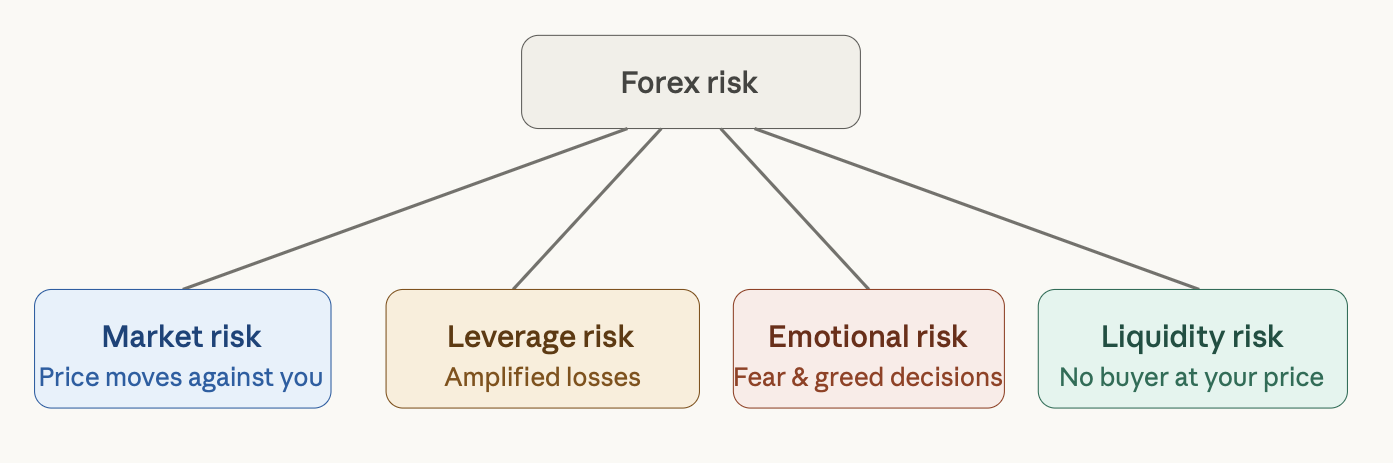
Understanding these four categories is the foundation. Once you know what can hurt you, you can build defences against each one.
The 1–2% Rule: How Much to Risk Per Trade
Setting a limit for potential losses before opening positions is the single most important habit in forex trading. Professionals use a cap of 1% to 2% of their entire account balance for each trade.
Mathematics is critical because if you start with a 10% loss on each trade, over a period of time you would have lost at least 50% of your total account if you experienced 5 consecutive losses; thus, to recoup what you lost, you would have to achieve a 100% return on the initial account balance and do so with greater risk to your trading capital.
On the other hand, using a 1% rule would reduce your total loss after 5 consecutive losses to 5% of the total account. This will hurt, but it is survivable.
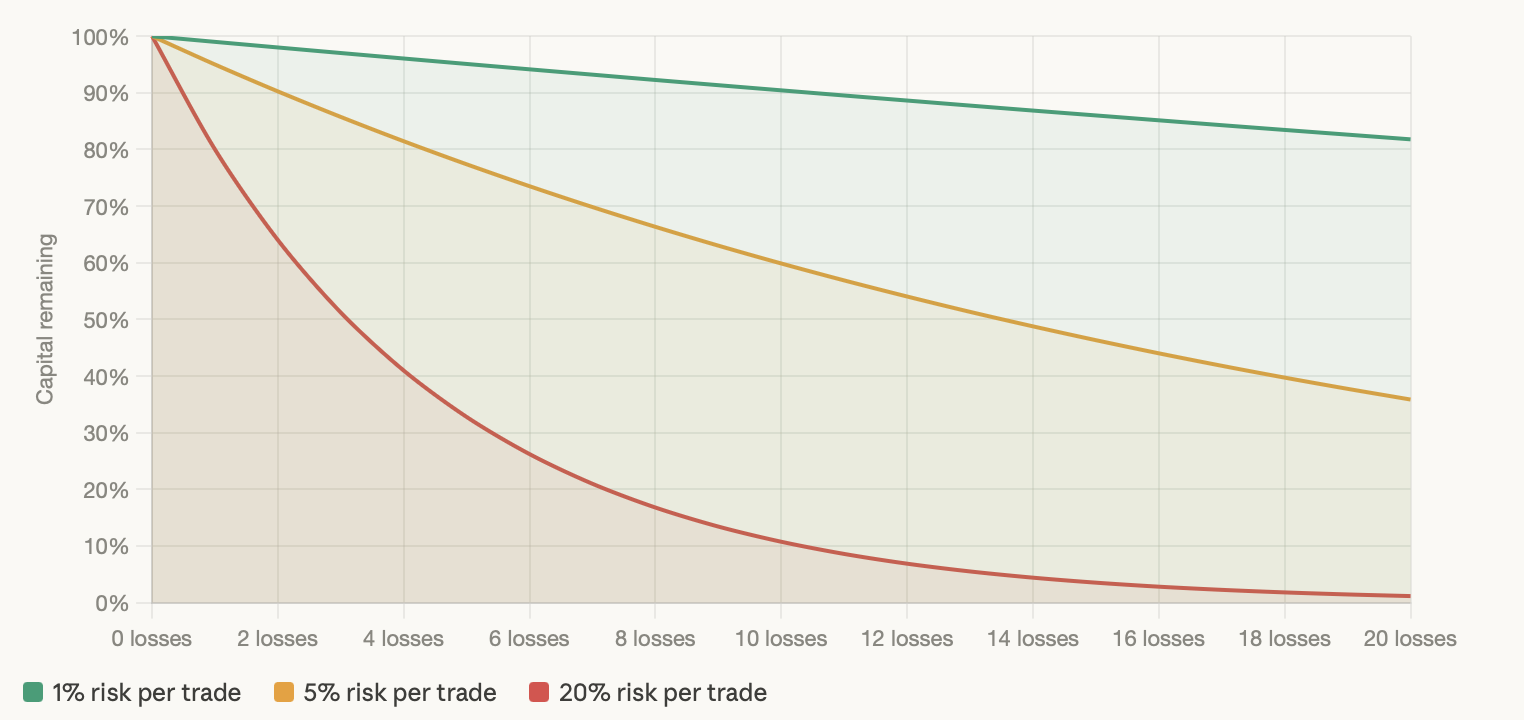
The gap between a 1% and 20% risk strategy becomes brutal after just five or six losing trades. The 1% trader still has over 95% of their capital. The 20% trader has barely a third left.
Practical calculation: If your account is $10,000 and you risk 1%, your maximum loss per trade is $100. Everything else, your lot size, your stop-loss distance, gets calculated backwards from that $100 figure.
Position Sizing: Calculating the Right Lot Size
Position sizing answers the question: how many units should I trade? Most beginners choose a random lot size, which is essentially gambling. Professionals calculate it precisely every single time.
The formula is straightforward:
Lot Size = (Account Risk $) ÷ (Stop-Loss in Pips × Pip Value)
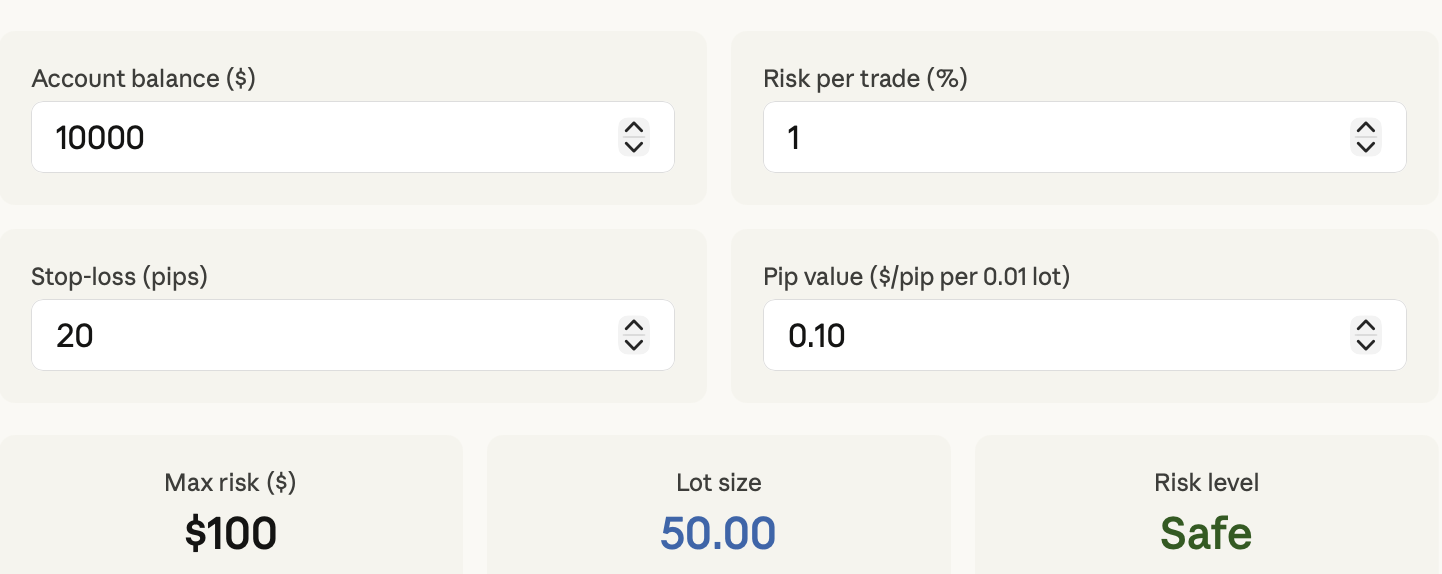
Use the calculator above to find the right lot size for any trade. The pip value varies by currency pair and account currency, so always verify it in your trading platform before entering a position.
Stop-Loss Strategy: Your Last Line of Defence
A stop-loss is a pre-defined exit strategy for closing out of an open position. You cannot afford to trade without a stop-loss because if there is any large, unexpected price movement in your account, you can potentially lose everything you have saved in collateral.
There are three different ways to create your stop-loss:
• Fixed Stop: Set your stop fixed at a specific number of pips or distance away from the entry point. It is easy to execute, but it does not account for changing volatility or price fluctuations on the Currency Pair being traded.
• Trailing Stop: Your stop-loss will follow the price as it increases in value to lock in the projected profit while leaving room for the overall price movement to continue. These are best used in trending markets.
• Volatility Stop (Based on ATR): This method utilises the Average True Range (ATR) indicator to calculate how much a currency pair typically moves during a Trading day and sets the stop-loss slightly outside this range. By doing so, the trader will avoid being taken out of a trade early due to regular market noise.
The biggest mistake traders make when using stop-losses is moving their stop-loss further away from a position when it goes against them, which causes a small pre-planned loss to turn into a much larger unexpected loss.
Risk-to-Reward Ratio: Why Most Traders Get This Wrong
A risk-to-reward ratio indicates the amount of anticipated profit in comparison to the amount being put on the line. With a ratio of 1:2, the potential loss would be $50 while the possible profit would be $100.
The problem that beginning traders face is that they concentrate entirely on win rates. For example, someone could trade with an 80% win rate but use a 1:0.5 trade size; they're likely going to lose regardless of how many times they win. The numbers do not lie.
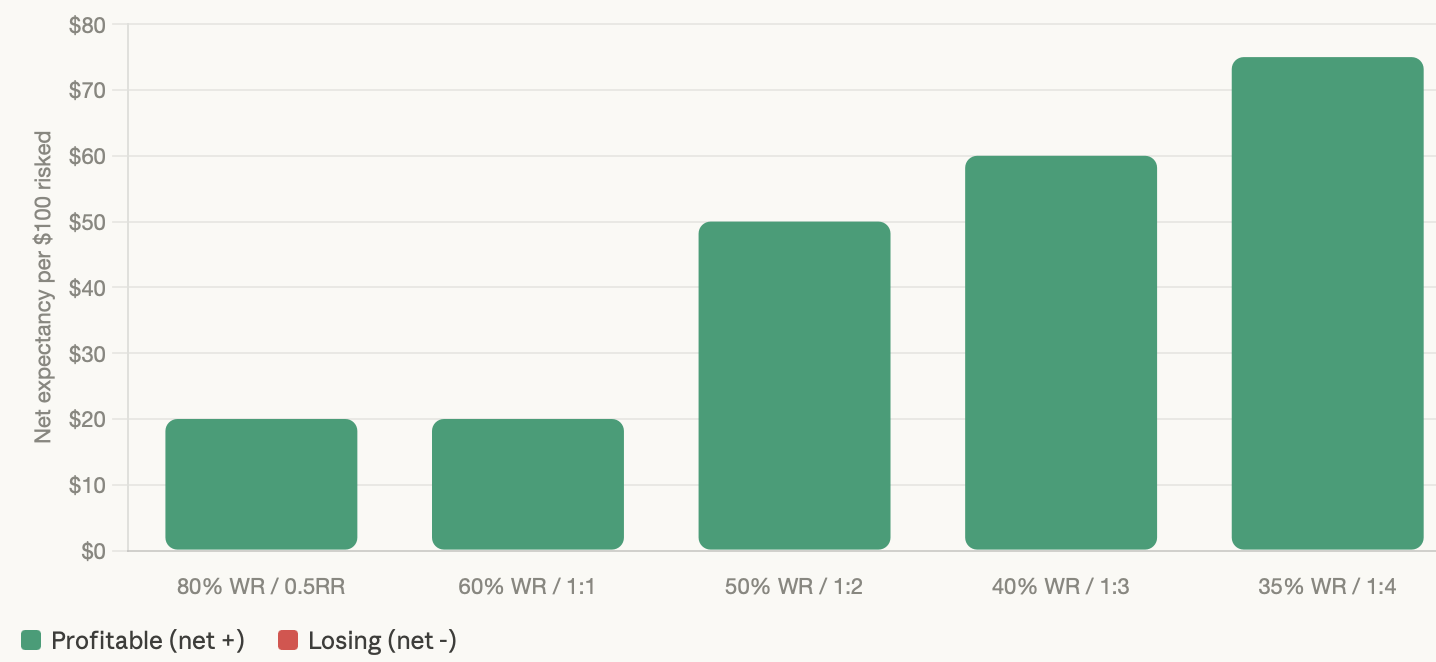
Take note that the trader winning 80%, with their 0.5 R: R, actually does not come out ahead overall, while the trader who only wins 40% of the time, but has an R: R of 1:3, is making a meaningful profit overall. Therefore, it is best to seek at least a 1:2 R: R on each trade you place.
Leverage Management: The Double-Edged Sword
By using leverage, it's possible to hold a substantial position while only injecting a small amount of money. For Example, with a leverage ratio of 1:10,0 you can control $100,000 in currency with only $1,000. Thus, this magnifies the profit or loss by the same factor.
Retail traders have a tendency to pursue high leverage because of the perceived potential of profit; whereas, professional traders utilise far less leverage than what their broker will permit because they realise that leverage will work both ways.
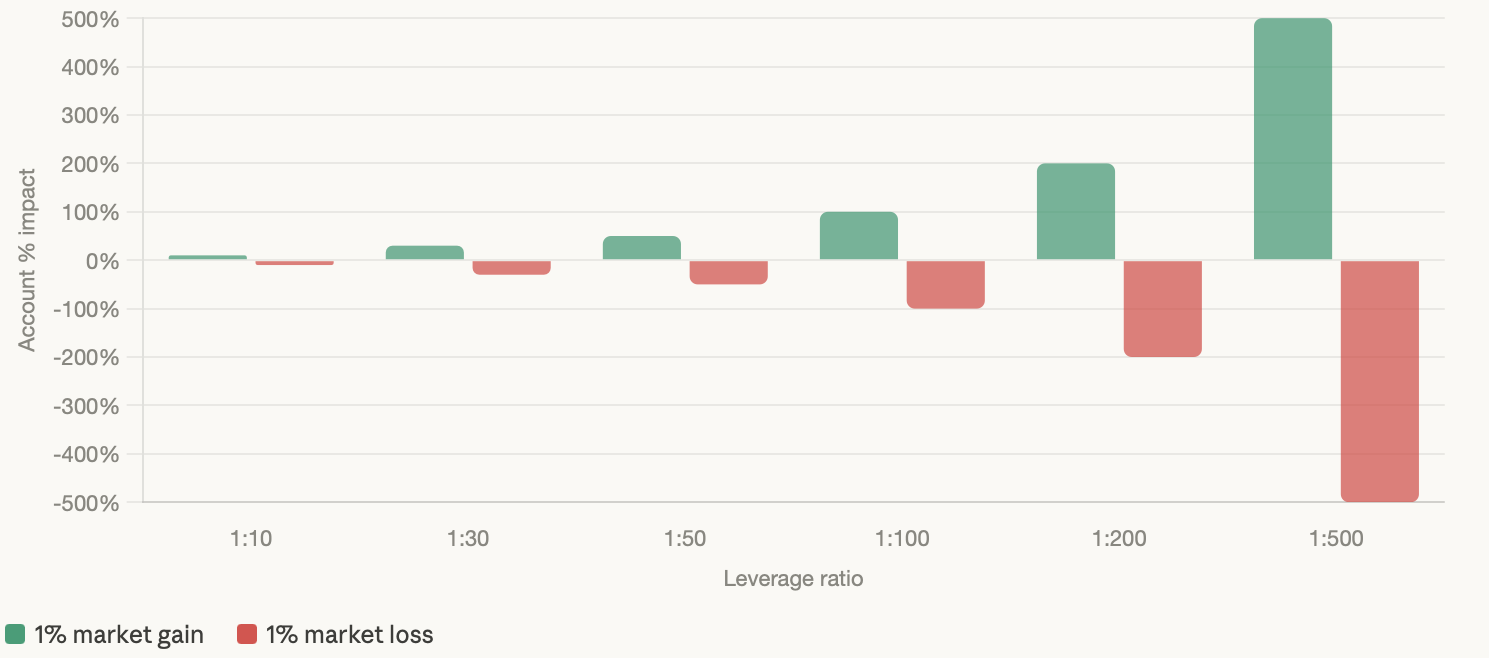
When a market moves by 1% using 1:500 leverage, this results in up to 500% volatility to your account balance. This isn't trading - this is gambling your retirement money away on the flip of a coin. Most professional traders trade with an effective leverage of 1:5 - 1:20, depending on what their broker offers them.
Emotional Risk: Where Most Accounts Actually Die
Whether you've memorised each rule from this guide or not, there's a good chance emotion will ruin your account if you don't learn to control it.
Revenge trading is the need to make back the money you lost after experiencing a loss. Instead of waiting for new trades to set up, you find yourself making larger and larger trades without your normal analysis. You take an even larger trade than before; that one doesn't make money either. In just hours, you may have gone from losing $100 to losing $1,000.
Overtrading is the urge you get after winning too many times. Confidence starts to turn into arrogance. Instead of waiting for quality setups, you take low-quality setups because you "feel" the market will go your way this time.
The solution to both situations is to create a written trading plan with strict guidelines. If the trade does not meet the specifics outlined in your plan, do not put in the trade; no exceptions! Professionals create and use their trading plans as rigorously as a pilot does his pre-flight checklist – without exception.
Daily and Weekly Risk Limits
Apart from managing your individual trades, you should definitely have limits on the amount of money you can lose each day or week. This will help keep a bad morning from destroying your entire month.
Many trade professionals use this practical system as a method of risk management.
-
Stop trading when you have lost 3% of your account in a day or
-
Place a limit at 6% of your total capital on weekly losses, and
-
When you hit these limits, exit and review your trades before returning.
Limits are not indicative of weak character. They are the same risk limits that institutional traders are subject to at every prominent financial institution.
Volatility-Based Risk: The ATR Method
Standard fixed stops do not account for the fact that the market will behave differently at different times. For example, 40 pips of movement could occur in a EUR/USD on a low volatility day, such as Tuesday, and 150 pips of movement could occur in the same currency pair on a US jobs report day.
However, the Average True Range (ATR) indicator can help you determine and measure your stop loss on a trade based on its recent volatility automatically. You will set your stop at a multiple of 1.5x to 2x of the ATR value for that time, which will give you more room on a trade on a volatile day by allowing you to have a tighter stop on a less volatile day.
Therefore, you will be less likely to get stopped out by the noise from the volatility in the market while still providing greater protection for your capital on a less volatile day.
Diversification and Correlation Risk
It's not true that if you treat a currency as a pairing, you’re spreading risk. For example, the Euro to US Dollar is highly correlated to the British Pound to US Dollar; this means that if one of them goes against you, the other will likely follow suit as well. You’re then adding more exposure instead of diversifying.
You should compare the correlations of all pairs you hold open at the same time. If your correlation is greater than 0.7, you should consider those positions the same for risk capital purposes. In order to achieve true diversification, you would want to be holding an inverse or negatively correlated pair of currencies (for example: Euro to US Dollar and US Dollar to Japanese Yen).
Common Mistakes Beginners Make
Your Step-by-Step Forex Risk Management Plan
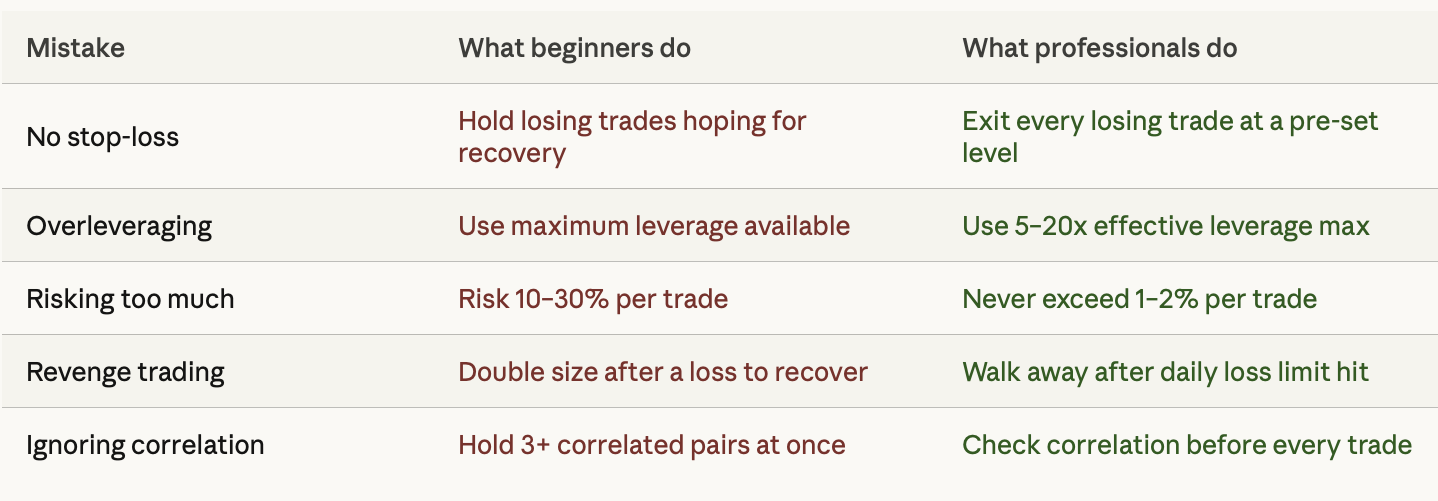
Here's a complete framework you can use before every single trade.
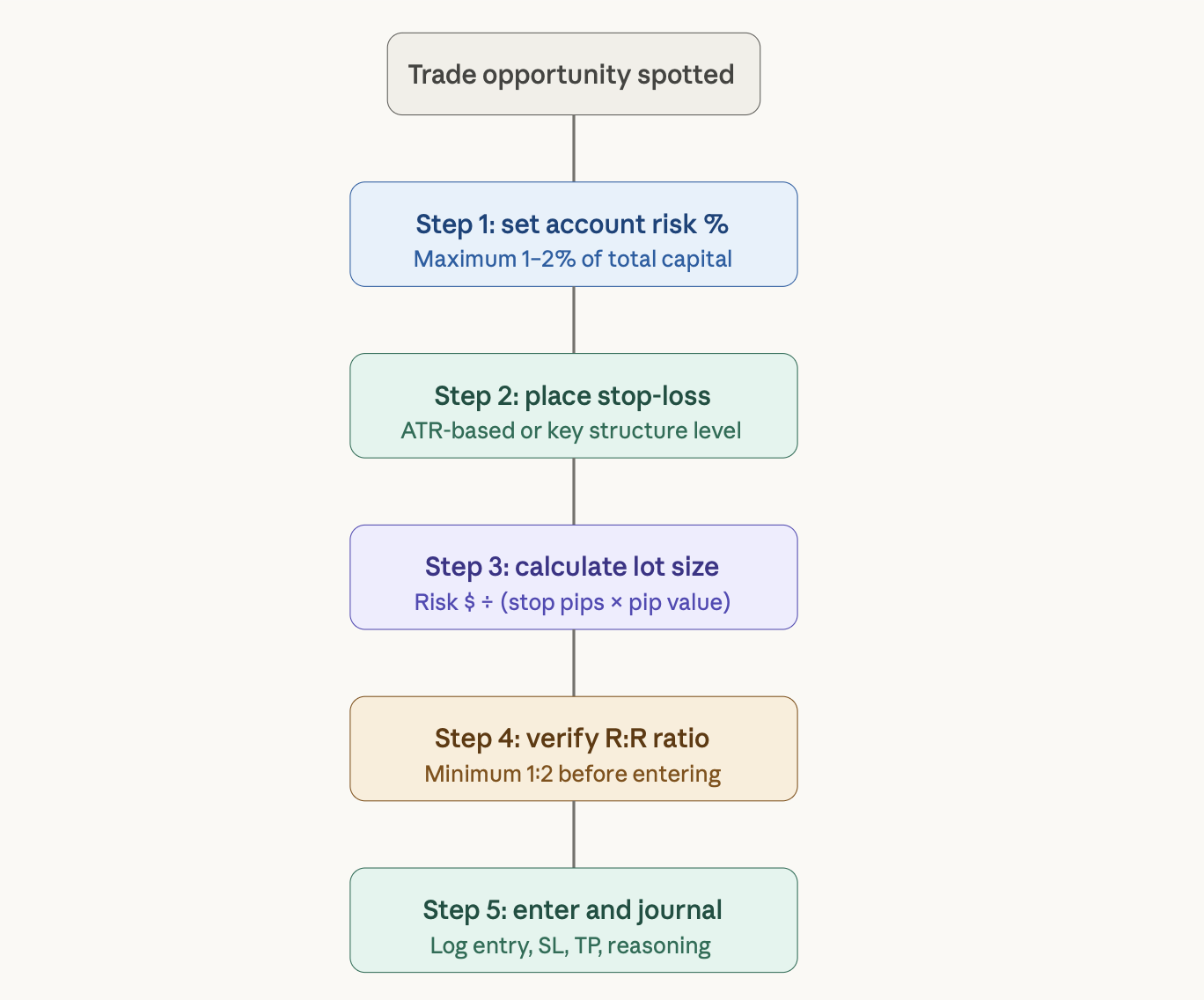
Run through these five steps before every trade. If any step fails (the R: R is below 1:2, or the setup doesn't let you place a logical stop-loss), skip the trade. There will always be another one.
FAQ
What is the best risk percentage per trade? Most professionals use 1% per trade. Beginners should start at 0.5% until they're consistently profitable.
Is the 1% rule suitable for beginners? Yes, especially for beginners. A smaller account might feel like the gains are too slow, but capital preservation at the start is far more important than fast growth.
How does leverage affect risk? Leverage multiplies both your gains and losses proportionally. A 1% adverse move with 1:100 leverage wipes your entire position. Effective leverage should stay well below the maximum your broker allows.
What is a good risk-to-reward ratio? A 1:2 ratio is the minimum worth trading. With 1:3, you can be profitable even if you only win 40% of your trades.
Why do most forex traders lose money? Poor risk management, not poor strategy, is the main cause. Overleveraging, no stop-loss, and revenge trading destroy accounts faster than any bad entry signal.
How does risk management improve profitability? By keeping losses small, you stay in the game long enough for your edge to play out. A strategy with a genuine edge only works if you survive the inevitable losing streaks.
Should I use a stop-loss on every trade? Yes, without exception. Even if you're confident in a trade, the market can move against you faster than you can react manually.
Is risk management different for CFD trading? The principles are identical. CFDs carry additional overnight financing charges and gap risk, so position sizes should be adjusted to account for those extra costs.
Start managing your trades the professional way. Open a Tradewill account today, where built-in risk tools, transparent leverage settings, and real-time analytics give you everything you need to trade with discipline from day one.
Disclaimer: The content of the blog does not represent any position of Trade W, does not serve as any trading-related decision advice, and does not endorse any third-party.