

 Trade W

1. Why Choosing the Right Forex Broker Actually Matters
Forex is the trading of currencies to make a return on investment based on fluctuations in the currency markets. With more than seven trillion dollars being conducted each day, it is the largest financial marketplace in the world.
However, many new traders miss crucial points about their broker being merely the "middleman" in a transaction. A good broker will provide the trader with quick trade execution times, reasonable per-trade costs, and security of the trader's funds.
To understand this point, let's say that two traders use the same method to trade the currency pair EUR/USD. One trader pays a 0.2 pip spread to buy/sell the EUR/USD currency pair, and the other pays a 1.8 pip spread to execute the same trade.
If both traders used the same method for executing their trades over an extended period, the difference in trading costs between the lower and higher spreads will allow one trader to become profitable over a period of time while the other trader loses money. While the execution methods used by both traders were identical, it was the broker that determined the amount of the difference in their execution costs.
For traders in Pakistan, choosing a broker has additional considerations. Many international brokers do not accept clients from Pakistan; the payment methods accepted by the broker may differ, the regulatory protections provided to the trader by the broker will differ, and the potential risks involved in using an unregulated broker are very real if the trader is unaware of the issues.
This is intended to act as a reference guide to help the investor identify what qualities will make a broker worthwhile to work with, which brokers actually provide services to traders in Pakistan, and how to become involved in Forex trading with limited risk of making the mistakes that most new traders make.
2. Is Forex Trading Legal in Pakistan?
Although trading Foreign Exchange is allowed, the State Bank of Pakistan regulates it under the Foreign Exchange Regulation Act.
Only an individual retail trader has the facilities under the SBP to carry out trades on this market at retail; institutions or large trades are subject to a much higher degree of regulation by various authorities such as the SECP and various banks et.
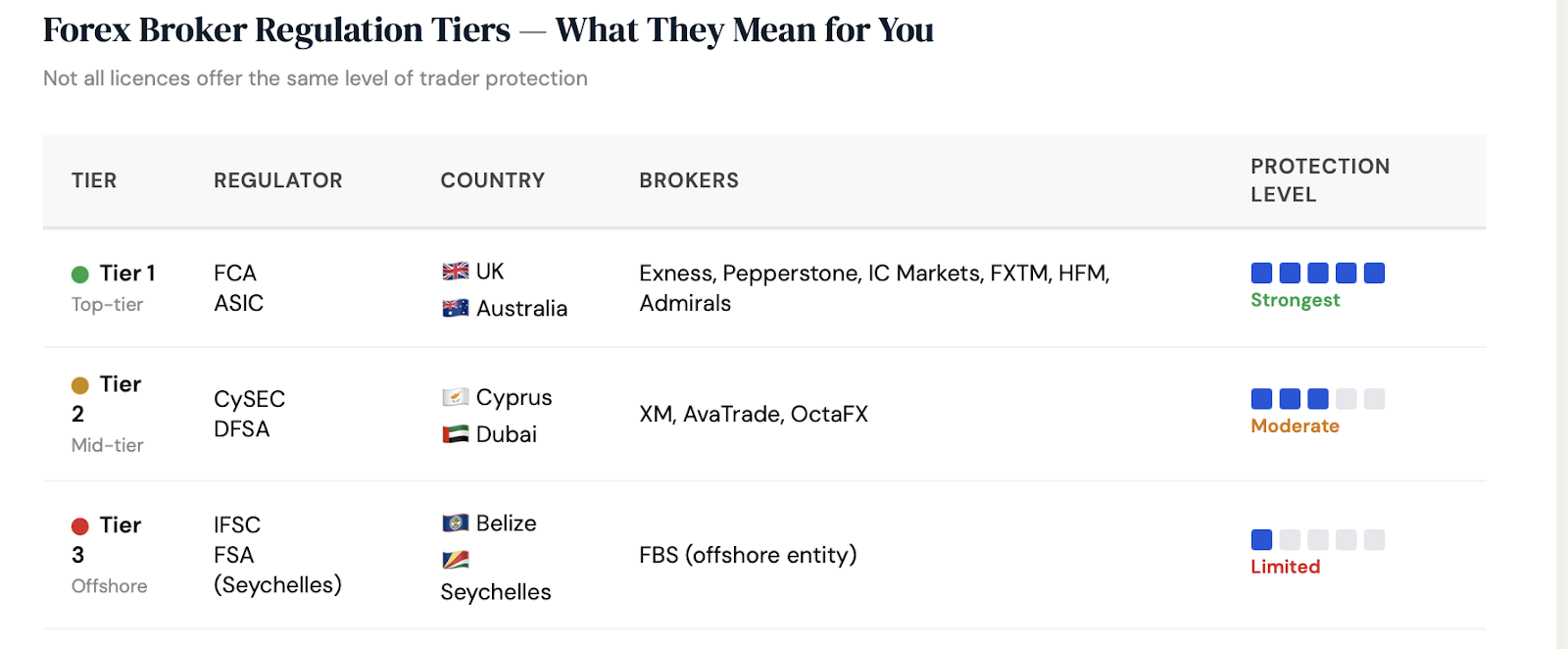
Most people in Pakistan use offshore regulated brokers for their Forex trading because Pakistan does not have an independent regulatory agency that regulates retail Forex like the Australian ASIC or UK FCA does; therefore, retail traders in Pakistan typically rely on having a brokerage with a good reputation and holding a reputable license from a regulated foreign authority.
It is important to note that it is legal and common to trade with offshore regulated brokers, whether they are FCA-regulated, ASIC-registered, or other CySec-registered. Alternatively, trading through either unregulated brokers or blacklisted brokers will put the trader at risk of losing their funds without the authority or independent agency to recover them.
You should check the regulatory authority's website where your broker is registered to verify their licensing and not rely solely on what is printed on their website.
3. How to Choose the Best Forex Broker in Pakistan
The first step in finding a suitable broker is knowing how to evaluate them. Here are the main criteria on which you should base your evaluation.
First of all, regulation. Brokers who are regulated by the FCA (UK), ASIC (Australia), or CySEC (Cyprus) must follow stringent financial regulations. Your money is generally kept in segregated accounts, so a broker cannot simply use your funds for their own expenses.
A broker’s spread and commissions will determine the cost of every trade. The spread is the difference between the buying and selling prices of a particular currency pair. The narrower the spread, the cheaper the trade. Many brokers have no spread and charge a set, flat-rate commission per lot traded instead. Neither of these two pricing models is better than the other; however, a scalper or a high-frequency trader will certainly notice the difference more quickly than others.
Leverage is a tool that increases both profits and losses. Although Pakistani traders ideally prefer higher leverage, this is a double-edged sword. There's not necessarily any advantage to choosing a broker who offers 1:500 leverage over one who offers 1:100 leverage; what is important is whether you have a solid understanding of how leverage works.
The trading platform is your work environment. The most widely used trading platforms today are MetaTrader4 (MT4) and MetaTrader5 (MT5). These platforms have the benefit of being very stable, supportive of high customisation options, and allow you to use automated trading via Expert Advisors (EA). Some brokers have their own proprietary trading platform, which may be very good; however, there may be a learning curve associated with it.
There may be several different deposit and withdrawal methods available in Pakistan, including local banking transfers, Skrill, Neteller, and, in some cases, JazzCash or Easypaisa through a third-party payment processor. You should be cautious when choosing a broker and make sure you check that they offer your preferred deposit and withdrawal methods prior to opening an account with them!
For a Muslim trader, another important criterion is whether the broker offers an Islamic account. Islamic accounts are swap-free accounts, which means they do not incur any overnight interest charges and thus comply with Shariah law. Almost every major and established broker will now offer this account type.
Customer service is not usually regarded as very important by most traders; therefore, there is no customer service evaluation criterion for many people. If you are having trouble withdrawing your money or if a trade is stuck in the system, you will need the ability to reach someone quickly. Checking the response time for customer service prior to depositing any funds may save you a great deal of headache later on!
4. Top 10 Forex Trading Brokers in Pakistan 2026
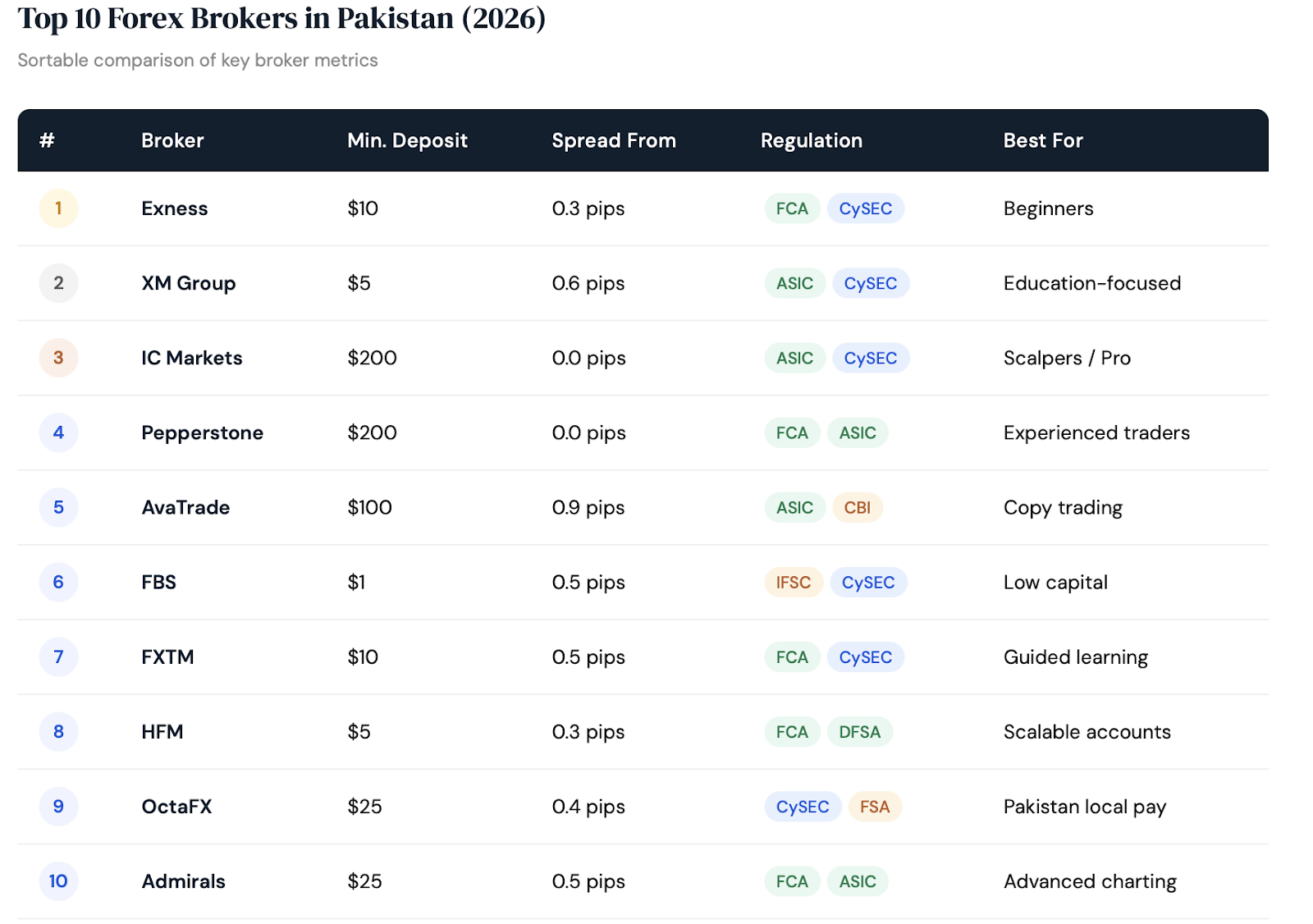
While there is no one "perfect" broker out there, there are brokers that will accommodate your individual needs based on your trading style, budget, and trading objectives. Here is a summary of the best brokers currently available to traders from Pakistan.
1. Exness
Regulation: FCA, CySEC, FSCA Minimum Deposit: $10 Platforms: MT4, MT5
Exness has become one of the most popular brokers in South Asia for good reason. Spreads on major pairs start from 0.3 pips on standard accounts, and withdrawals are fast, often processed within minutes. They offer Islamic accounts and multiple local payment options.
Pros: Low minimum deposit, instant withdrawals, strong regulation.
Cons: Fewer educational resources for beginners
Best for: Beginners and intermediate traders who want low-cost entry
2. XM Group
Regulation: ASIC, CySEC, IFSC Minimum Deposit: $5 Platforms: MT4, MT5
XM is beginner-friendly with a $5 minimum deposit and an extensive educational library. Their no-requote execution policy means the price you click is the price you get. They also run regular webinars in multiple languages.
Pros: Excellent education, low entry barrier, and good customer support. Cons: Spreads slightly wider on entry-level accounts
Best for: Complete beginners building foundational skills
3. IC Markets
Regulation: ASIC, CySEC, SCB Minimum Deposit: $200 Platforms: MT4, MT5, cTrader
IC Markets is the go-to broker for scalpers and algorithmic traders. Raw spreads from 0.0 pips with a small commission make it extremely competitive for high-volume trading. Their server infrastructure is fast, which matters when you're in and out of trades within seconds.
Pros: Ultra-low spreads, fast execution, supports EAs
Cons: Higher minimum deposit, less beginner-friendly
Best for: Professional traders and scalpers
4. Pepperstone
Regulation: FCA, ASIC, DFSA, CMA Minimum Deposit: $200 Platforms: MT4, MT5, cTrader, TradingView
Pepperstone consistently ranks among the top brokers globally for execution quality. They support TradingView integration, which is a big draw for traders who prefer charting outside MT4. Customer support is responsive and genuinely helpful.
Pros: Excellent execution, TradingView support, strong regulation.
Cons: No proprietary platform
Best for: Experienced traders who prioritise execution and charting tools
5. AvaTrade
Regulation: ASIC, FSCA, CBI, ADGM Minimum Deposit: $100 Platforms: MT4, MT5, AvaTradeGO, DupliTrade
AvaTrade is one of the few brokers with a truly global regulatory footprint. Their proprietary mobile app (AvaTradeGO) is well-designed, and the DupliTrade feature lets beginners copy professional traders automatically.
Pros: Multi-jurisdiction regulation, copy trading, and a good mobile app
Cons: Inactivity fee after 3 months
Best for: Beginners interested in copy trading
6. FBS
Regulation: IFSC, CySEC Minimum Deposit: $1 Platforms: MT4, MT5
FBS is popular in Asia and Africa for its ultra-low deposit requirement and high leverage options (up to 1:3000 on some account types). That level of leverage is dangerous in the wrong hands, but for experienced traders managing risk carefully, it offers flexibility.
Pros: Very low deposit, high leverage available, and bonus offers.
Cons: Weaker regulation compared to FCA/ASIC brokers
Best for: Traders with limited starting capital who understand leverage risk
7. FXTM (ForexTime)
Regulation: FCA, CySEC, FSCA Minimum Deposit: $10 Platforms: MT4, MT5
FXTM puts a strong emphasis on trader education. Their learning centre includes video courses, live webinars, and market analysis tools. They also support social trading, allowing beginners to follow experienced traders.
Pros: Strong educational content, good regulation, and Islamic accounts available.
Cons: Higher spreads on entry-level accounts
Best for: Beginners who want guided learning alongside live trading
8. HFM (HotForex)
Regulation: FCA, CySEC, FSCA, DFSA Minimum Deposit: $5 Platforms: MT4, MT5
HFM offers a wide range of account types from micro to premium, which makes it easy to scale as your experience grows. Their VPS hosting support is useful for traders running automated strategies.
Pros: Multiple account types, VPS support, and good regulation.
Cons: Platform design feels dated compared to newer brokers
Best for: Traders who want flexibility to grow within one broker
9. OctaFX
Regulation: CySEC, FSA (Seychelles) Minimum Deposit: $25 Platforms: MT4, MT5, OctaTrader
OctaFX has a strong user base in Pakistan and other South Asian markets. They offer competitive spreads, smooth deposits via local payment methods, and a decent mobile trading experience. Regulation is lighter than that of top-tier brokers, which is worth noting.
Pros: Popular in Pakistan, local payment options, and easy to use.
Cons: Not regulated by FCA or ASIC
Best for: Casual traders comfortable with mid-tier regulation
10. Admiral Markets (Admirals)
Regulation: FCA, ASIC, CySEC, JSC Minimum Deposit: $25 Platforms: MT4, MT5, MetaTrader Supreme Edition
Admirals stands out for its MetaTrader Supreme Edition plugin, which adds advanced charting and analysis tools directly into MT4/MT5. They also provide a detailed educational hub with courses suited to all levels.
Pros: Extended MT4/MT5 features, strong regulation, comprehensive education
Cons: Slightly higher spreads on standard accounts
Best for: Intermediate traders who want enhanced charting within MT4/MT5
5. Understanding Forex Trading Costs
The majority of traders put all their attention on potential profits, while ignoring all of the costs associated with placing a trade. This is a critical mistake.
Each trade includes three different types of costs. The first cost is the spread, which is the difference between the buying and selling price of a currency pair. For example, if you opened a standard lot of the EUR/USD at a spread of 1 pip, then you would immediately start this trade with a cost of $10.
The other model for paying costs is known as a commission-based model. Instead of charging a spread, the broker will charge you a fixed fee per lot, depending on the broker. Typically, these range from $3 to $7 per lot round-trip.
Another type of cost that you will incur with trading is the swap or rollover that you will pay for holding a currency overnight. Swaps are usually calculated based on the differential between the interest rates of the two currencies in the pair.
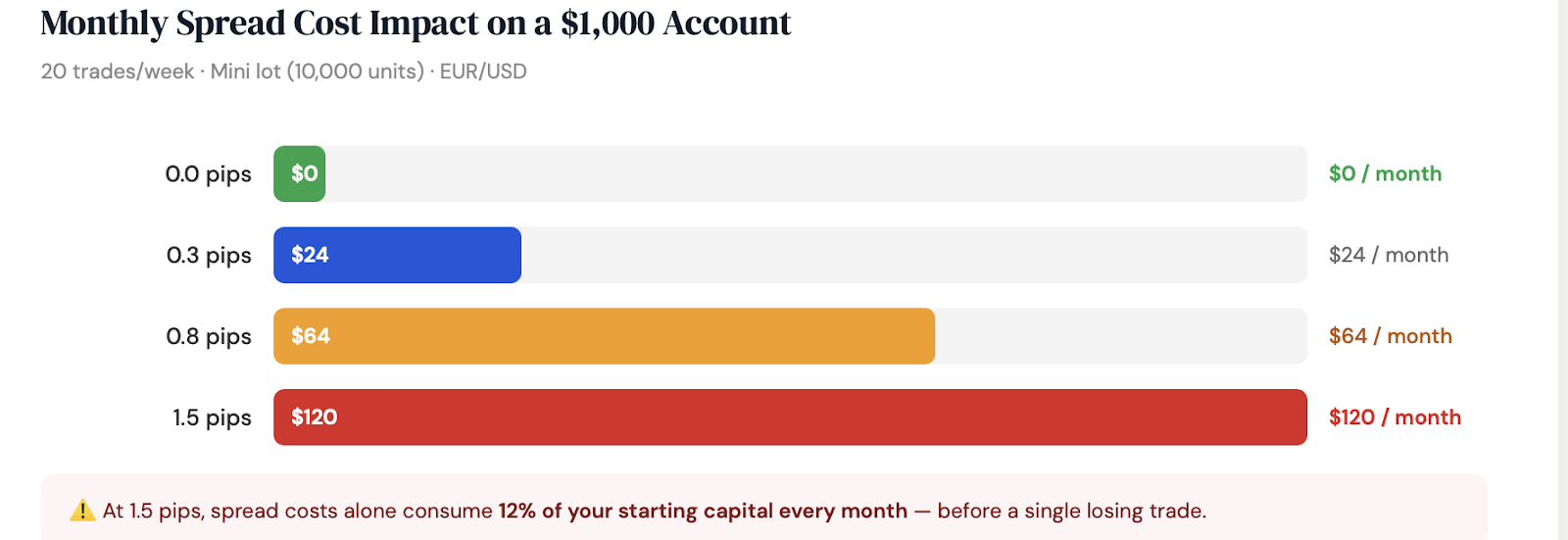
To give you a real-life example, assume you're opening a $1000 trade with an EUR/USD spread of 1.5 pips and doing so with a mini lot (10,000 units). The cost of the spread per trade would then be $1.50. If you were to make 20 trades per week, that would translate to $30 per week or $120 per month for the cost of the spread.
If you put that into perspective, $120 equates to 12% of your initial capital, and that is before considering any losses due to losing trades.
Therefore, you must choose a broker that has a very low spread, because this will have a significant impact on whether your trading strategy will yield a profit over the long term.
6. MT4 vs MT5: Which Platform Should You Use?
METATRADER 4 was first released in 2005, and it remains the most commonly used platform in the world. This means that a lot of brokers have made their tutorials and communities of traders based on MT4's build and available tools. Because it has many features and allows automated trading through Expert Advisors (EAs), there is a large number of users, and thus a large number of available resources.
METATRADER 5 is an upgrade to 4, with new features, including more timeframes, a wider range of order types, and the ability to trade equity and commodity markets alongside foreign exchange/forex. While MT5 is more advanced than MT4, the number of EAs available is less than that of MT4 and the learning curve is often perceived as steeper than with MT4.
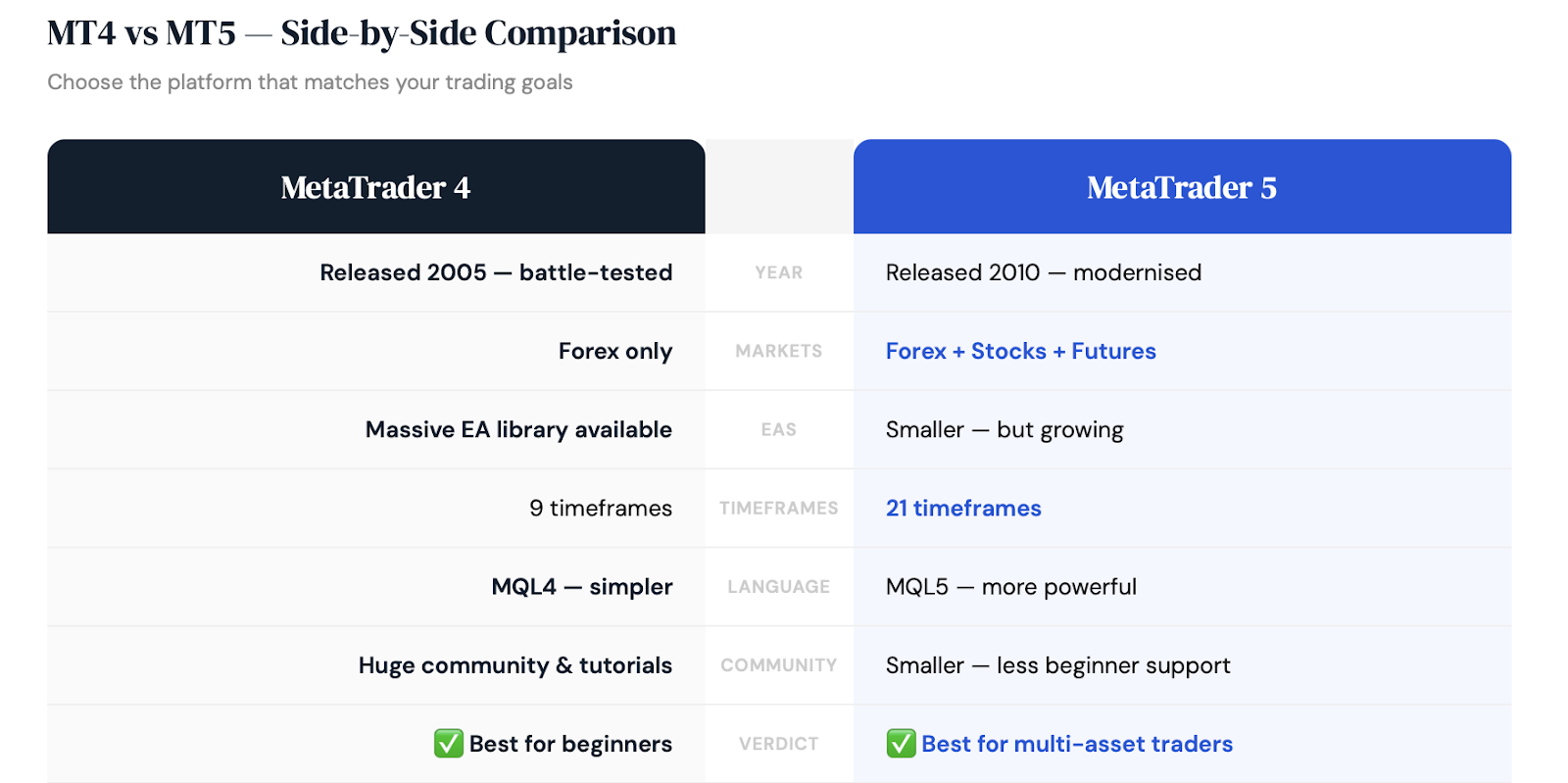
Beginners should consider that MT4 offers more educational materials and community support than MT5, and the user interface is much cleaner than MT5's. If someone is seeking access to trade across many asset classes, or if they want to utilise only tools available for or designed for use with MT5, it is logical to upgrade to MT5.
Both MT4 and MT5 have solid mobile apps and are supported on Android and iOS devices. Both platforms function well for mobile trading. However, the desktop versions have far more screen real estate, which is what the majority of professional traders tend to prefer for analysis.
8. Risks of Forex Trading You Should Know Before Starting
Forex trading is inherently risky and has real financial consequences, so be sure to understand the associated risks before opening an account. The biggest risk in forex for beginners is leverage.
Increased position size by leveraging borrowed capital will double or increase percentage losses or gains based on the change in market price. An account with a leverage ratio of 1:100 means that if the market price goes against you by one per cent, your entire account will be negative. Misuse of leverage has caused new traders to lose their entire trading account in a matter of hours.
Another major risk associated with forex trading is emotional trading. It is difficult to quantify the risk of emotional trading; however, the behaviour associated with trading emotionally, including revenge trading after losing money, holding onto losing trades for too long, and closing winning trades too early, can all erode your trading capital over an extended period of time.
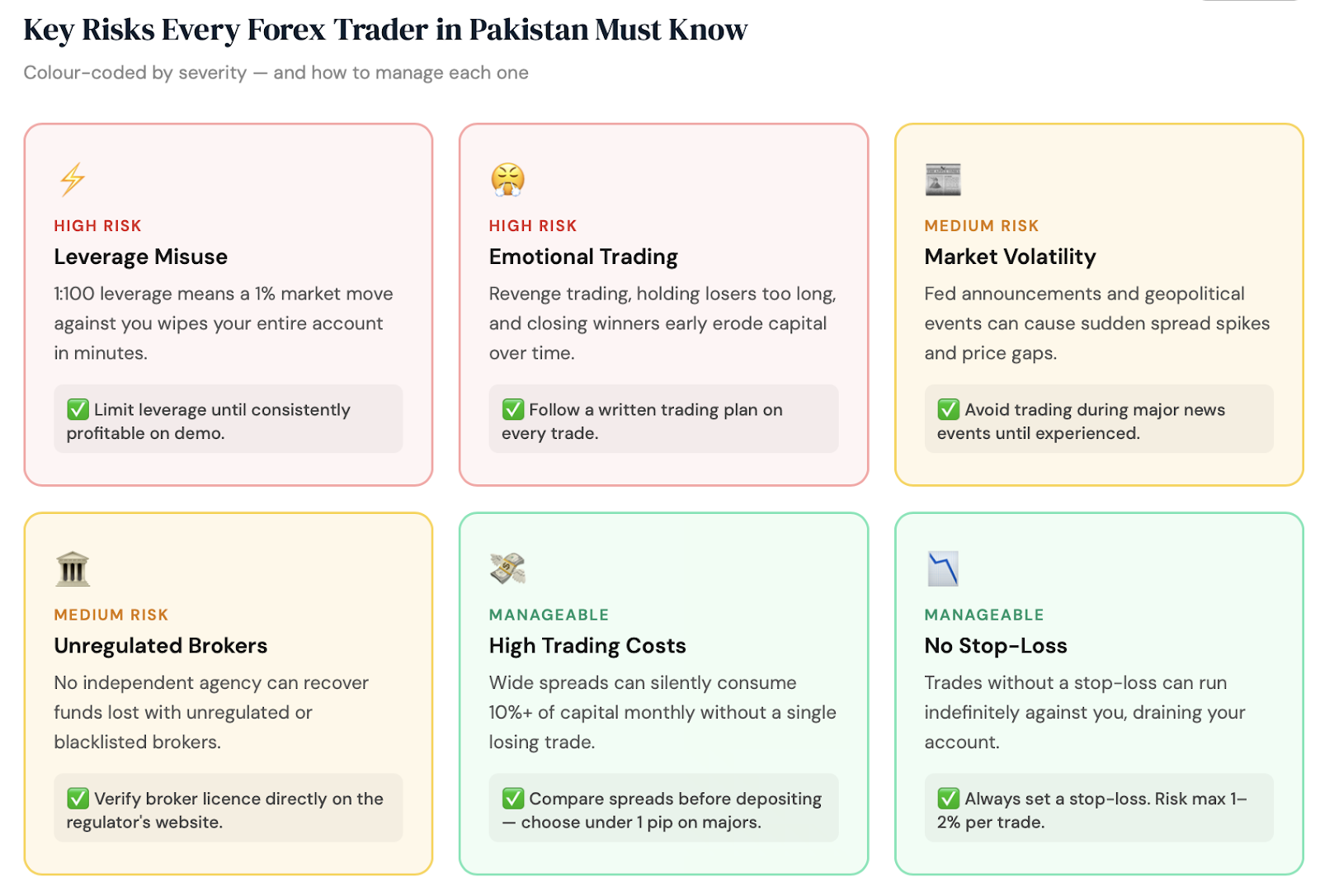
Major economic announcements, i.e. Federal Reserve announcements and geopolitical developments, can often cause volatility in the foreign exchange market, resulting in a large increase in spread and gapped pricing. Strategies that are effective in a stable market may not work under volatile market conditions.
You should try to manage each risk instead of fully avoiding that risk. This includes using a stop-loss on every trade; not risking more than 1% to 2% of your trading account on any given trade; while you do not have consistent profitable results from your demo account, you should continue to limit the amount of leverage you use.
9. How to Start Forex Trading in Pakistan
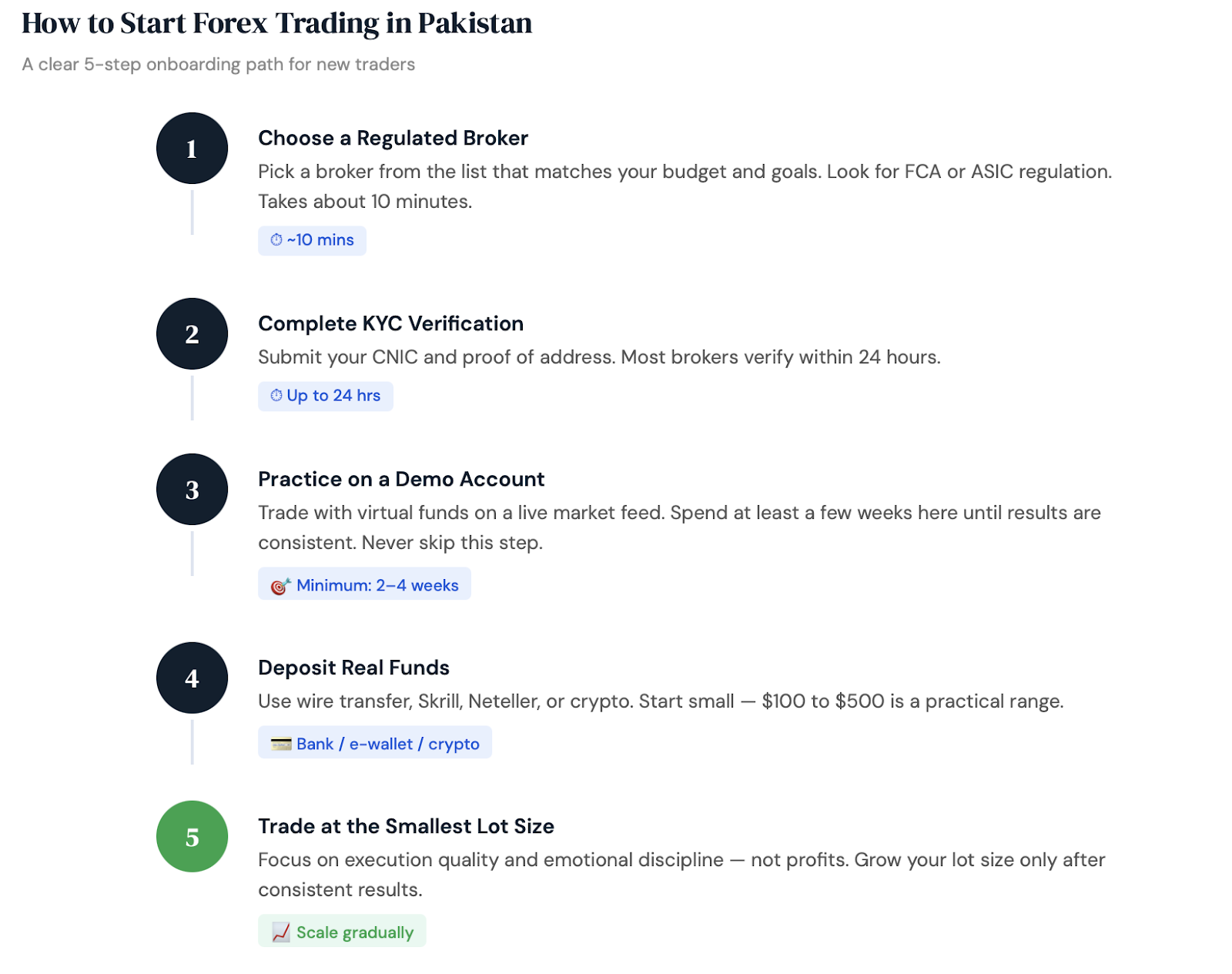
The getting-started process is easier than most people realise. Here is the actual process:
1. Choose a regulated brokerage from this list that meets your goals and budget, and then go to the broker's website and establish an account with that brokerage. This process will usually take about 10 minutes to complete.
2. Complete the KYC verification process by submitting your CNIC and proof of address. Most brokers will process your document submission and verify your account within 24 hours.
3. Open a demo account to test your skills to trade. You can use the demo account to practice trading with virtual funds on a live market feed without the risk associated with trading with real money. Spend at least a few weeks testing your skills on a demo account until you have consistent results.
4. When you are ready to deposit real funds into your live account, use your preferred deposit method to fund your account. Most brokers accept deposit methods such as wire transfer, Skrill, Neteller, or Cryptocurrency. Deposit your initial funds into your specified account, open up MT4 or MT5, and begin trading with the smallest available lot size.
5. Trade your initial trades at the smallest available lot size. Your goal at this stage is not to get rich overnight but rather to become comfortable executing your trading strategy under real market conditions without emotional impediments or self-restrictions.
10. Frequently Asked Questions
Is forex trading legal in Pakistan?
Yes. Individual retail traders can legally trade forex in Pakistan. Most traders use internationally regulated brokers since Pakistan doesn't have a dedicated retail forex regulator.
Which forex broker is safest for Pakistani traders?
Brokers regulated by the FCA (UK) or ASIC (Australia) offer the strongest protections. IC Markets, Pepperstone, and Exness all hold top-tier licenses.
What's the minimum deposit to start forex trading in Pakistan?
Some brokers, like XM and FBS, allow you to start with as little as $5. A more practical starting point for meaningful practice is $100 to $500.
Do forex brokers in Pakistan offer Islamic accounts?
Yes. Most reputable international brokers offer swap-free Islamic accounts. Exness, XM, FXTM, and others provide this as a standard option.
Should I start with a demo account?
Always. A demo account lets you test your strategy and learn the platform without risking real money. Skipping this step is one of the most common beginner mistakes.
11. Conclusion
Choosing a broker is not merely an administrative function; it ultimately shapes every one of your trades. Likewise, making the incorrect choice could result in higher costs to you than necessary and lead to less of a sense of security about your investments. Thus, before anything else, ensure that you select the proper broker.
TradeWill can help you find regulated brokers who have been vetted for you, matched to your intended style of trading, your initial capital, and your goals. Stop guessing and start trading with clarity at tradewill.com.
Disclaimer: The content of the blog does not represent any position of Trade W, does not serve as any trading-related decision advice, and does not endorse any third-party.