

 Trade W
Introduction to Dow Theory in Forex Trading

Introducing Dow Theory, the original technical analysis. It was originally developed in the late 1800s by Charles Dow while he was an editor at the Wall Street Journal and is not an ancient, outdated idea about trading. Dow Theory is simply the foundation for everything that modern day chart patterns, trend lines, and technical indicators are based on.
What makes Dow Theory essential, is that it doesn’t just work for stocks. Smart forex and CFD traders have been applying Dow Theory to read currency markets for decades. In fact, when a professional trader studies trends and makes analysis of EUR/USD pairs, they are quite often unconsciously relying on Dow’s 6 core principles of identifying the difference between a genuine and a false breakout.
Visually see it as equivalent to learning how to read. After you learn the fundamentals for reading, you can begin picking up books. Dow Theory gives you the reading fundamentals for the financial markets.
If you are a complete beginner to watching the prices fluctuate on what Treasury traders are buying and selling, it can be disorienting. It can feel like showing up to a high school basketball game and only seeing the score increase and decrease but not understanding what the coaches and players are doing, in what is often referred to as a game strategy. Dow Theory will teach you to recognize a “strategy” (not just the score).
The beauty of it all? This framework was the means through which traders navigated the financial crisis of 2008, facilitated significant forex reversals throughout the weeks of the Brexit turmoil, and continues to do so in the present, data science and global algorithms notwithstanding. The trading platforms have all changed in current times, but human psychology, human traders, and market dynamics have hardly evolved.
Thus, the understanding of Dow Theory is no longer just an academic pursuit, but applicable knowledge that fundamentally changes how you approach any forex or CFD trading strategy, analyzing 'majors', to highly correlated 'exotics'.
The 6 Core Principles of Dow Theory (For Forex Traders)
Let me take you through the 6 principles in Dow Theory. Don't let the principles trick you into thinking they are complex. I will take you through each one using trading examples.
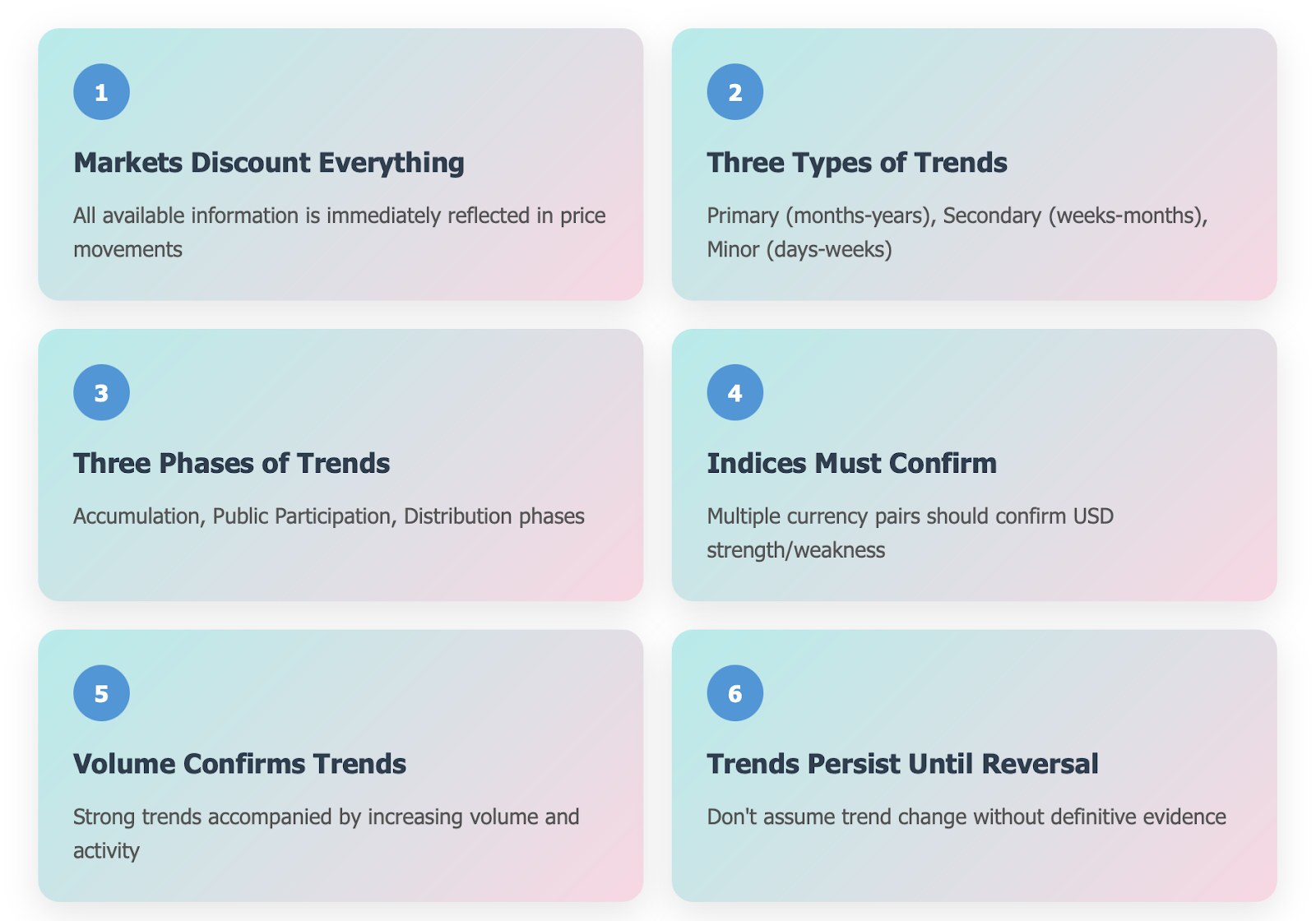
Markets Are Discounting Mechanisms
The first principle is that all available information is discounted into price immediately. It sounds fancy but it is quite simple.
The next time the European Central Bank (ECB) hints at an interest rate hike, you will often see significant movement in EUR/USD prior to the ECB actually announcing the interest rate hike and decision. The professional traders fully understand that the potential for the interest rate hike is already discounted into current EUR/USD prices.
Think of it like students knowing exam results will affect their weekend mood before grades are officially posted. The market's already adjusted to that information and moved accordingly.
Every currency pair operates on three time frames at the same time:
- Primary trends last for the long term (months to years)
- Secondary trends last for the intermediate (weeks to months, corrective)
- Minor trends last for the short term (days to weeks, noise)
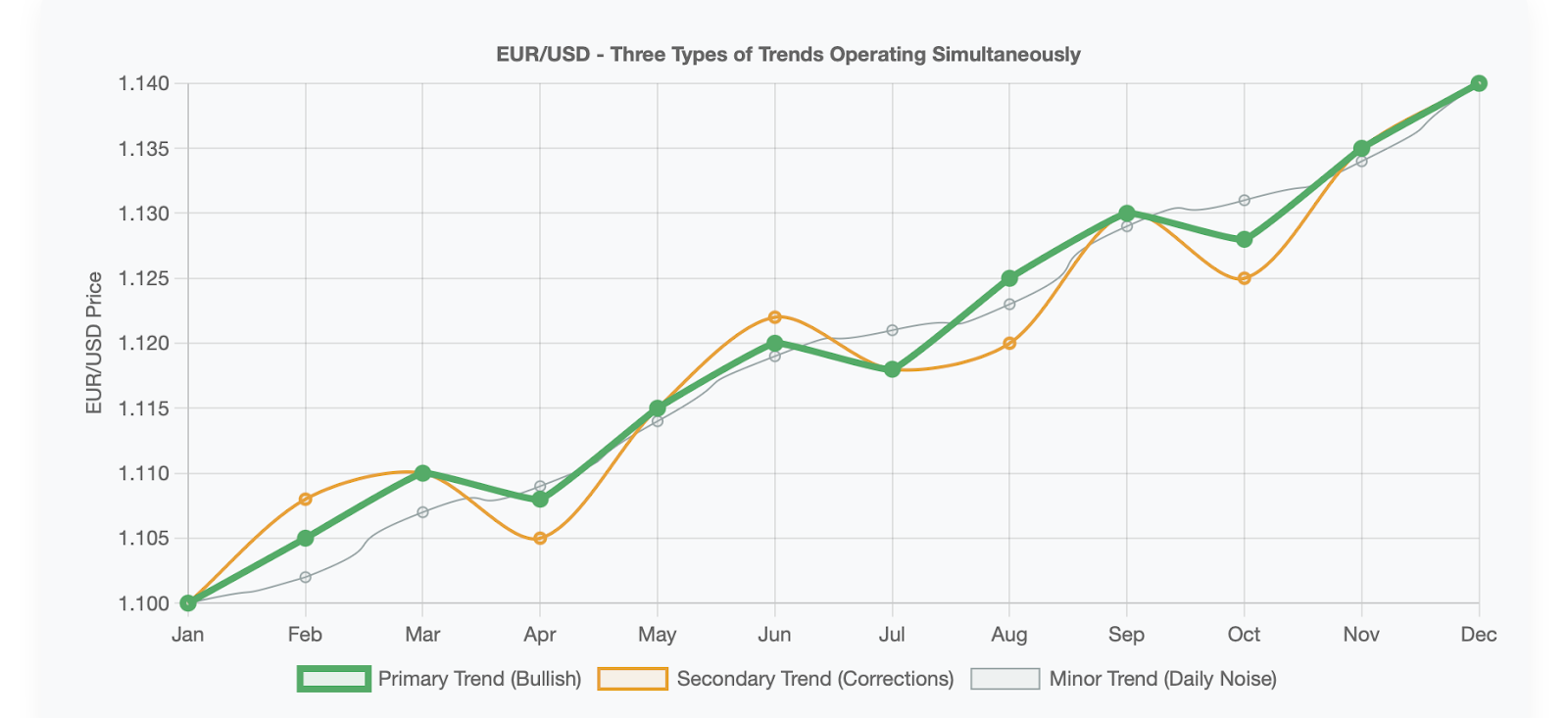
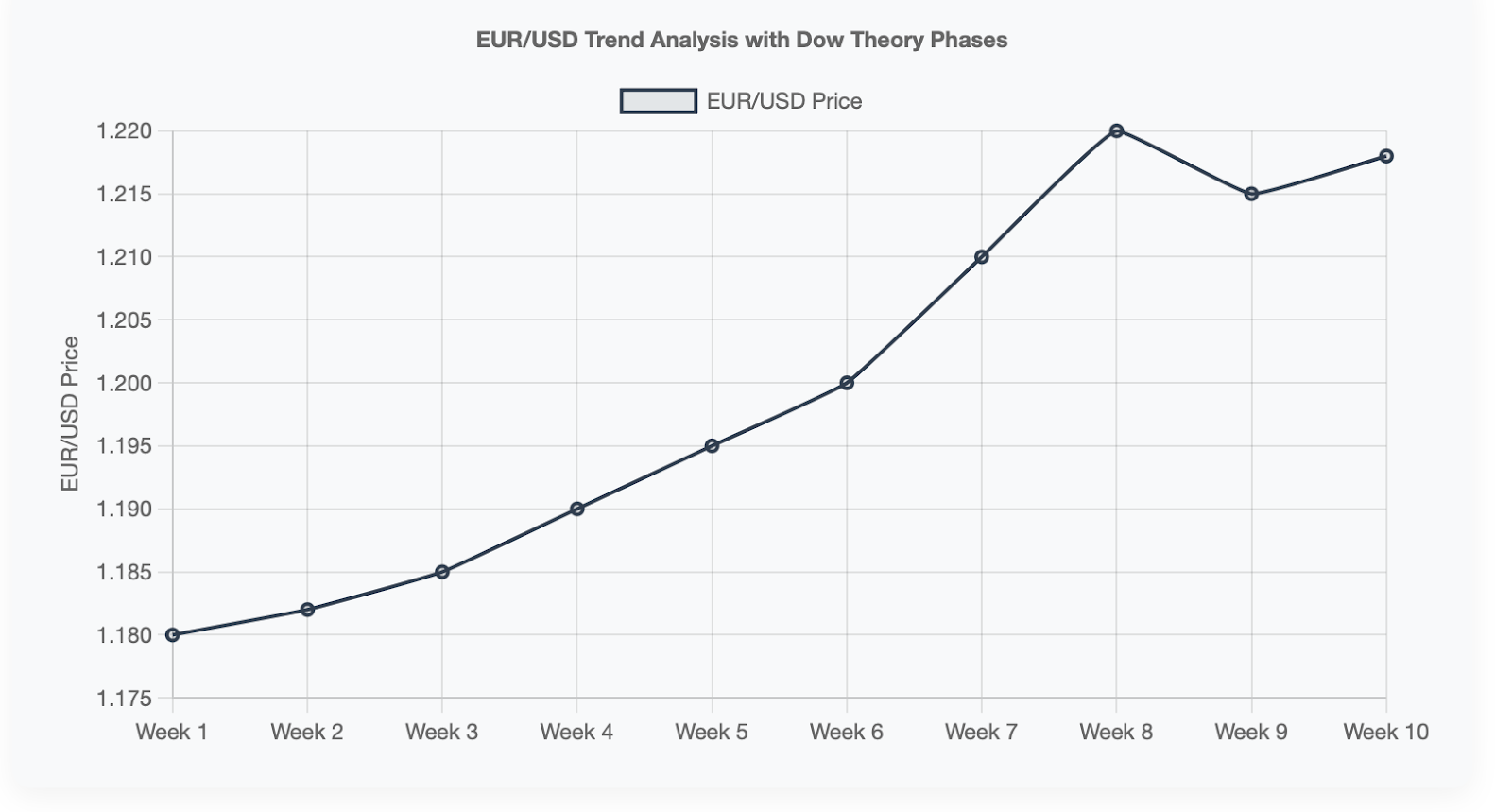
Let's say the EUR/USD is currently in a significant uptrend over the last six months but has experienced, along the way, a two-week pullback as well as seemingly random daily movements. The point is that all three of those trends are occurring simultaneously.
In essence, intelligent traders look to the primary trend for direction, while utilizing secondary trends for timing to enter trades with the direction of the primary trend.
Every major trend has three major phases in its own unique sequence:
Accumulation Phase - Smart money accumulates positions while the vast majority of traders are oblivious to what is going on. It is similar to early domineering fans who line up for a new iPhone release before any of the public figures out that a new model is to be released.
Public Participation Phase - The trend has become obvious to media and retail have jumped on board; this is where the big movement will occur.
Distribution Phase: Smart money starts taking profits while the public remains bullish. The trend is getting tired.
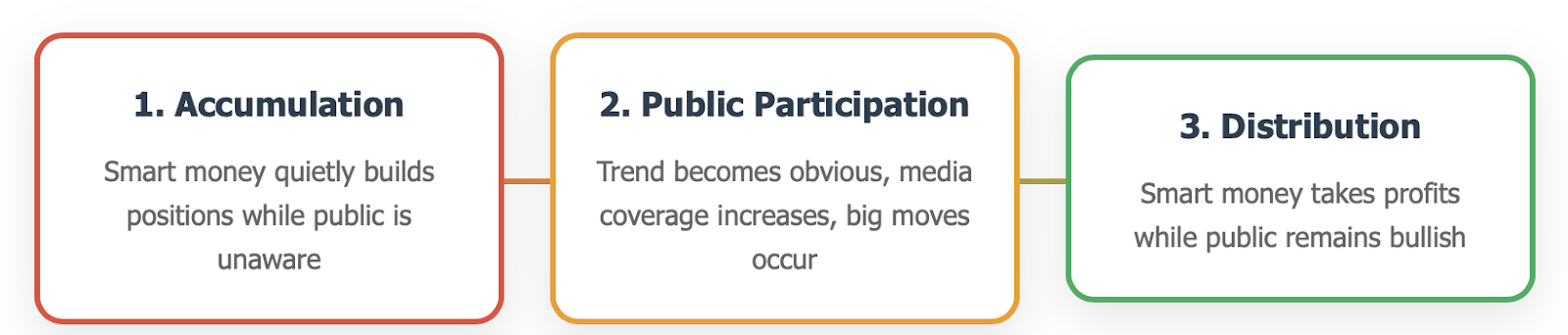
A perfect example? Gold's rally before major economic uncertainty. Professional traders accumulate positions early, the public joins during the explosive phase, then smart money distributes as enthusiasm peaks.
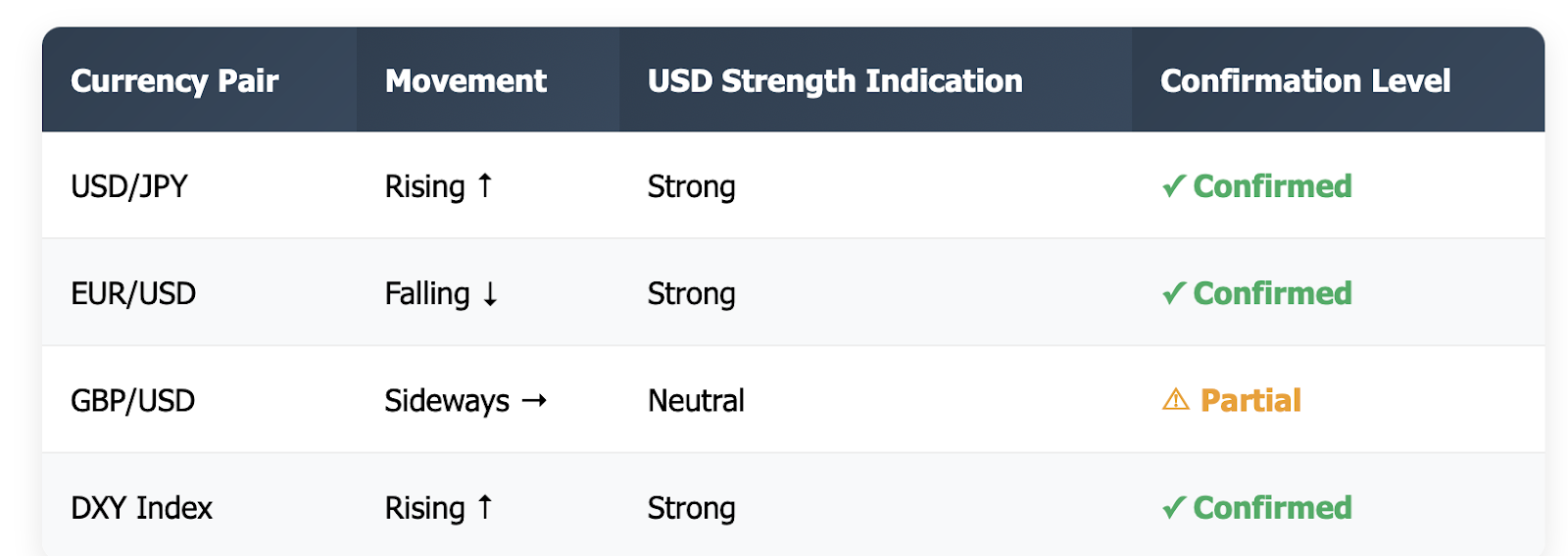
Indices Should Confirm Each Other
In the stock markets, the Dow looked for confirmation between the Industrial and Transportation averages. In the Forex market, we use this principle differently.
When considering USD strength, you should look at multiple pairs. If USD/JPY is moving up and EUR/USD is not falling back with the same magnitude, then dollar strength may only be strong in that particular region and not broad-based. In addition, you should often corroborate what you are seeing with the Dollar Index (DXY), as it can give confidence that you would feel comfortable acting on what is transpiring.
Volume Confirms the Trend
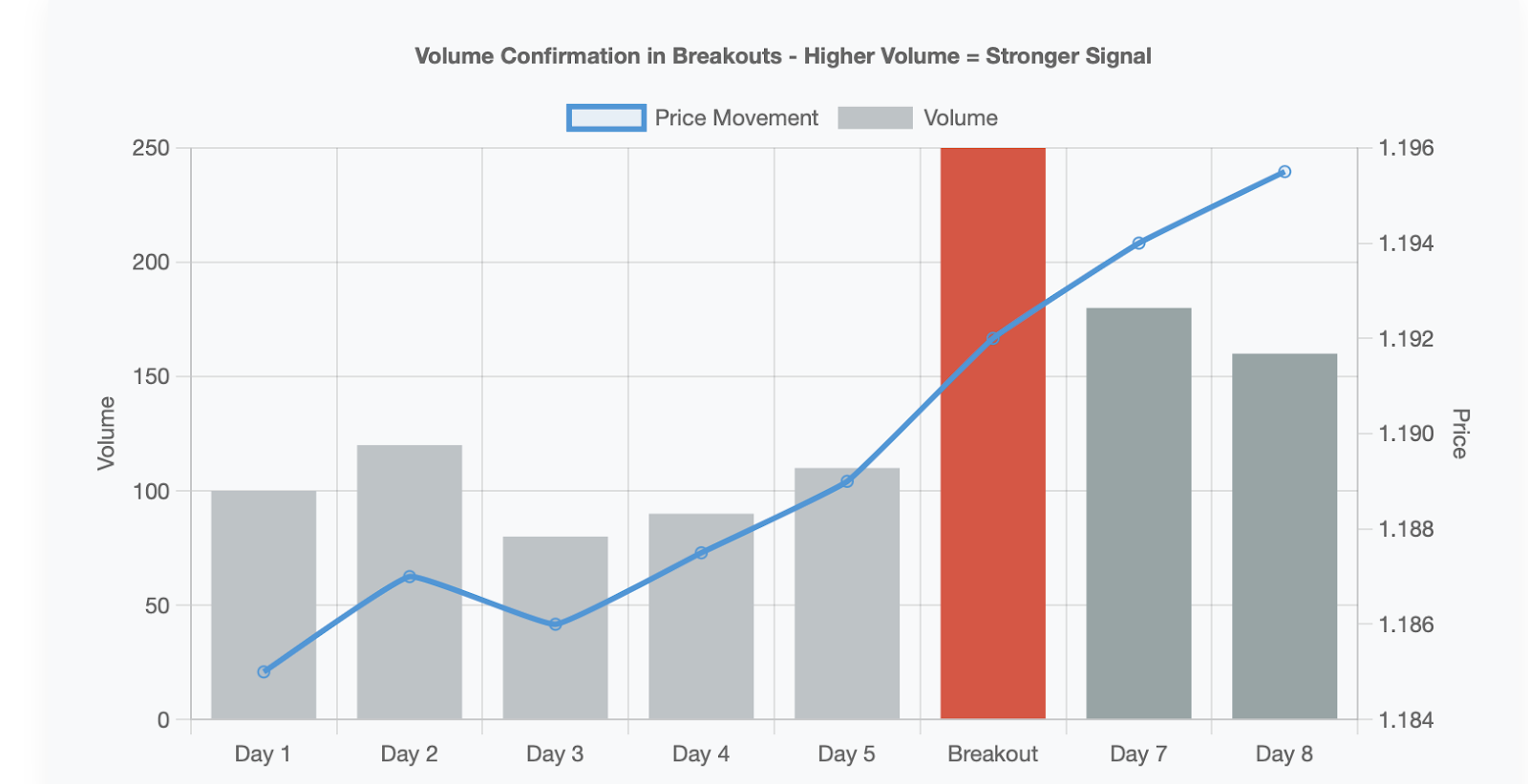
Strong trends should result in increasing volume. In the Forex market, this means higher activity and larger spreads during a real breakout event, versus a quiet, low-volume event when the market is consolidating an area, then the market pops or breaks out.
When considering a USD/JPY breakout of major resistance with heavy volume, that event should be more meaningful, versus an Asian session or an event with very low volume.
Trends Persist Until Reversal is Clear
Don't assume a trend has changed until you see definitive evidence. Minor pullbacks don't equal reversals.
This saves traders from jumping out of profitable positions too early. That two-day EUR/USD decline doesn't mean the month-long uptrend is over - it might just be normal retracement before continuation.
The key insight? These six principles work together as a complete system. You can't cherry-pick one or two and expect consistent results. Professional traders evaluate all six elements before making major position changes.
Applying Dow Theory to Forex and CFD Markets
Next, let's get to the practical part - how do you actually implement Dow Theory into your trading?
Let's explore an example of applying Dow Theory to GBP/USD. Suppose you are looking at the chart and you see:
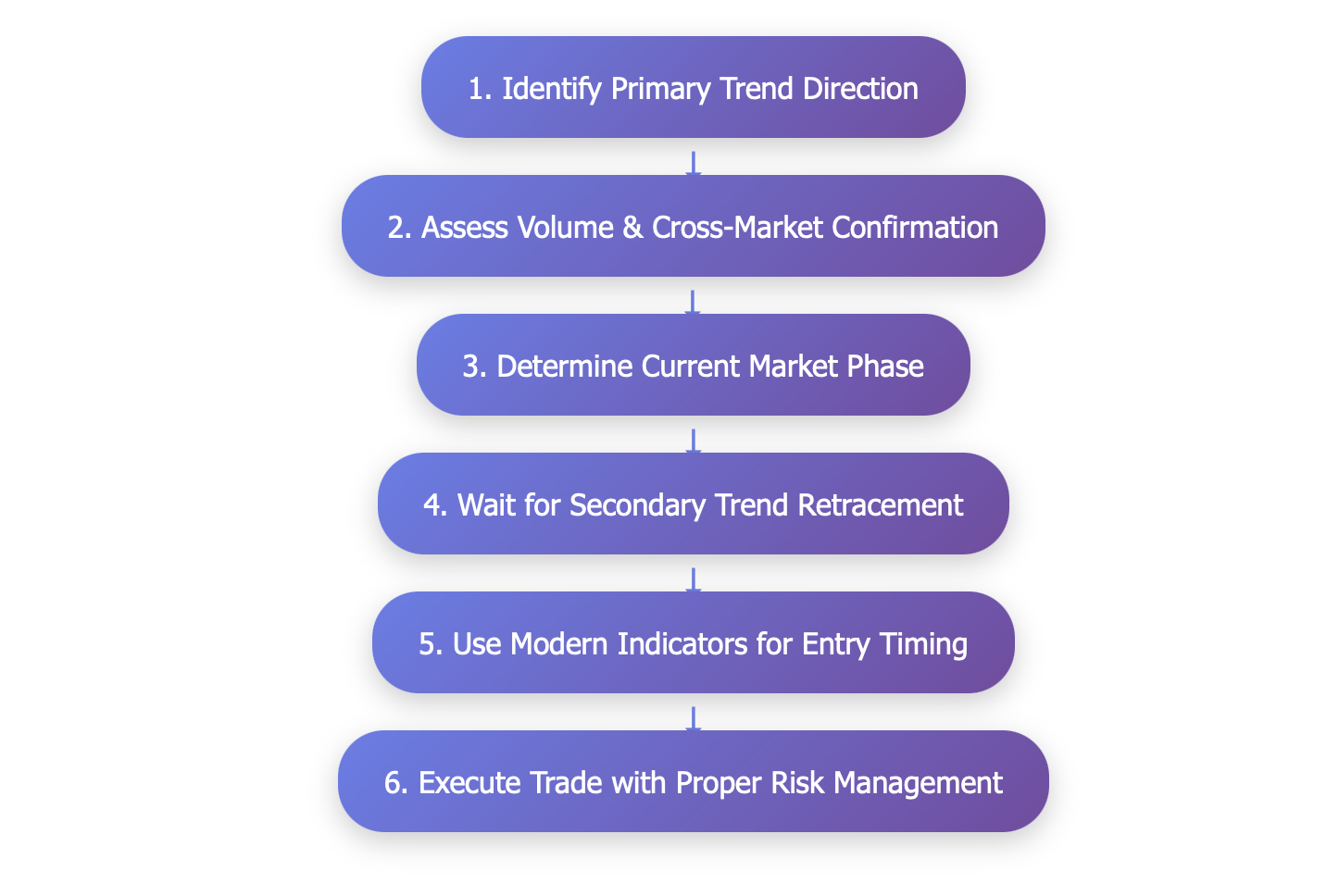
- Confirmation of the primary trend: GBP/USD is going down for three months (primary bearish trend)
- Volume assessment: There is increased selling in the last few days
- Phase of the market: We are probably in the public participation phase because Brexit is dominating the headlines
- Cross-pair confirmation: Weakness in EUR/GBP confirms the broader weakness in GBP
- Trend continuation: Despite minor rebounds, there are no clear signals of reversal
Your Dow Theory analysis suggests the bearish trend is likely continuing. Now here's the important part - you can't trade based on Dow Theory alone.
It's like checking the weather forecast and deciding whether to take an umbrella. The forecast (Dow Theory) provides a broader understanding, but you want to check the current conditions (i.e., technical indicators) before going out for the day.
- Pair your Dow Theory framework with:
- RSI to avoid an oversold bounce.
- MACD for extra confirmation of the momentum.
- Support and resistance level for specific entry.
This methodology works across all of the CFD markets. It can be utilized for oil futures, stock indices, or currency pairs; apply the same conceptual framework. Dow Theory is beneficial for discerning the primary directional bias, while the more modern technical indicators can be utilized for timing an entry or exit.
This should be done:
- Identify the primary trend using a Dow Theory principle
- Confirm with volume and analysis of other relevant related markets.
- Wait for a secondary trend retracement before getting involved in a desired trade on the primary trend direction
- Use more modern indicators for precise timing.
- Manage the exposure to risk, based on the primary trend direction
Take the Brexit volatility with GBP/USD for context. The traders working through analyzing using Dow Theory recognized the primary bearish trend early on, further, avoided getting shaken out by the daily volatility, and rode the major move while others got chopped up from news-driven chaos.
Keep in mind, Dow Theory is not a crystal ball (a tool /concept will never be).
It is a conceptual framework for organizing information on markets for informed decisions based on probabilities. The magic happens when you overlay century-old wisdom with today's trading snapshot.
Common Misunderstandings and Mistakes with Dow Theory
Even experienced traders make errors when it comes to utilizing Dow Theory. In this blog, let's discuss the biggest mistakes so you don't have to make them the hard way.
Mistake 1: Taking short-term noise as a change in trends
This is the big one. A trader sees EUR/USD drop 100 pips on the day and assumes the month-long up trend is over. Wrong.
This is similar to thinking a rainy Tuesday afternoon signifies the arrival of winter. One day of price action, even with significant moves, rarely impacts the primary trends that have developed over the past several months.
Professional traders misreading EUR/USD pullbacks as reversals will often exit profitable long positions too soon and potentially miss the follow-on continuation moves that generally happen after normal retracements.
Mistake 2: Relying on price movement without volume confirmation
Price movement without volume is little different than buying a rumor. Yes, it can generate excitement, but it is vulnerable and has little holding power.
If a currency pair breaks through resistance at 3 AM London time with little volume or participation, this tells a different story than the same currency pair breaking at 8:00 AM during the busy European session. Professional traders will wait for volume confirmation before treating breakouts as true trend changes.
Mistake 3: Misapplying Dow Theory
Although Dow Theory offers a framework, it should not be thought of as a firm set of rules. Markets do not always behave as expected or textbook especially when major news occurs or Central Banks remove or add liquidity to the market.
During the chaos of COVID-19, the traditional trend phases could be seen compressed into days instead of weeks, and traders that were rigid in their view of needing to see all three phases in order lost the opportunity to capitalize on large moves.
The preferred approach was to use Dow Theory as a compass, while remaining flexible to the route taken in arriving at your destination.
Mistake 4: Forgetting to Use Cross-Market Confirmation
Analyzing EUR/USD as a standalone analysis without referencing DXY, EUR/GBP, USD/JPY is still one level of information. There is a second layer here, because only hearing one part of a conversation would provide limited understanding.
In one recent example the strength of USD/CHF and weakness in all other dollar pairs suggested weakness in the Swiss Franc and not dollar strength, resulting in traders who did not recognize the distinction ending up with incorrect directional positions.
The Bottom Line
Managing Dow Theory well is about being flexible enough to recognize it is more of a guideline than it is of any "gospel." If you intend to be using Dow Theory in your analysis, use it to create structure around the overall assessment of the market, remembering that it should not override the sense of reasonable judgment or the ability to read and follow changing conditions in the markets.
The traders who successfully use Dow Theory are walking the fine line of balancing the timeless constructs of Dow Theory and its significance, with today's conditions wherever that rule applies. They do this while remaining flexible while being able to balance the discipline of convenience.
Dow Theory in Modern Forex: Is It Still Relevant?
Here's the million-dollar question: does a theory from the 1800's hold any meaning in today's hyper-speed, algorithm-driven forex markets?
The sceptics have a great argument. Today's markets move at speeds that Dow couldn't have imagined. Algorithmic trading creates price changes in micro-seconds that seem to insult the concept of trend analysis. Information is rapidly moving currencies before humans can rationally process the information.
What the critics overlook is the fact that human psychology remains unchanged. Emotion drives both modern and Dow's markets fear, greed, hope, panic.
Algorithmic trading (acting faster) hasn't removed the emotions of humans making decisions around rewards versus risk.
Hedge funds, institutional traders and individual traders don't abandon trend analysis due to speed, as they manage it, they view it as a part of the framework of how they work with modern tools for execution.
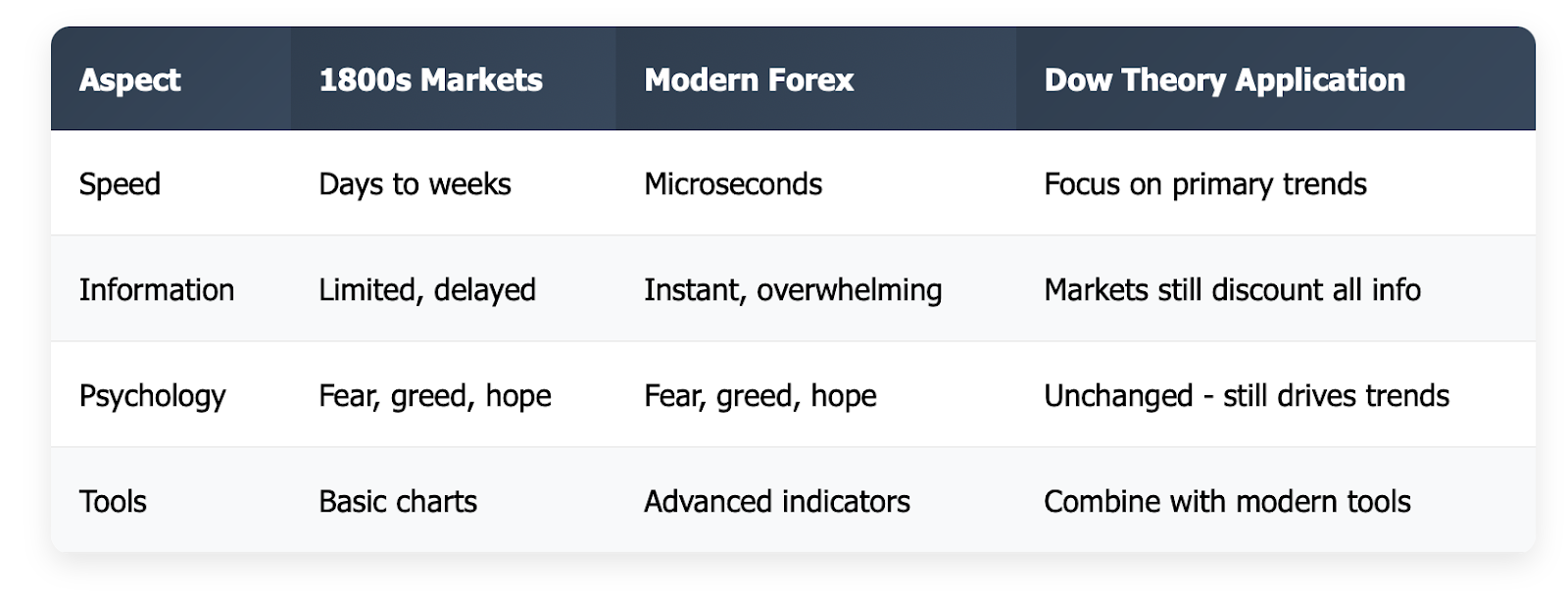
The best analogy is that old math formulas are still valid in the cutting edge of physics research; even if they are considered archaic their core ideas still have value while they are modernized and a more complicated form of a thought process.
The COVID-19 market crash stands as a clear demonstration of the preceding piece of advice. During the height of daily volatility, we were able to pull actionable signals off the charts using the principles of Dow Theory to correctly identify major price reversal points. We note again, traders who were focused on changes to the primary trend versus noise created from day-to-day price volatility were able to catch the major price moves in USD/JPY, EUR/USD, GBP/USD etc.
The real secret to smart trading is integration. Just using Dow Theory in today's markets is not enough, however, when combined with modern indicators, you have an excellent trading framework.
We also note what does work: Using Dow Theory to determine market direction, and modern indicators for timing of trades and associated risk.
And what does not work: Thinking that what worked back in the 1890s will produce results without relating to the realities we face in the 2020s.
Smart traders today think about Dow Theory similar to a GPS system all while using indicator systems (or market instruments) that give them real-time updates of the proper path. The Dow Theory shows the traders the overall route (primary direction of the market) while they get updates and adjust: the path of the trading direction they are considering changes in real-time based on market conditions (indicator systems).
The argument around algorithmic trading actually adds credibility to the application of Dow Theory. Any time machines are taking over short-term price action, human trading systems that adopt traditional frameworks like Dow Theory may become even more valuable for longer-term macro market analysis compared to machine-driven price action where humans have little if any impact.
Bottom line - Dow Theory is not only useful in today's modern forex market, but it's essential, but only if you relate the time-tested principles of Dow Theory to the modern realities of contemporary trading.
Conclusion & Call to Action: Master Dow Theory with Tradewill
Let's finish off with what is most important: converting knowledge into profits!
You now know the six fundamental principles of Dow Theory, how to implement them in the forex and CFD markets, and how to avoid the pitfalls that hold back traders. But knowledge and mastery are different things.
Here are your next steps:
First, keep in mind that Dow Theory is your framework, not your complete trading system. Use it to establish primary market direction, then incorporate modern indicators to add timing and confirmation to all your trades.
Second, practice identifying the three phases of trends in the real market. Start with the majors EUR/USD or GBP/USD where trends tend to be clearer and sustained.
Third, learn to think cross-market. Don't trade the EUR/USD without checking the DXY, don't think about trading gold without assessing dollar strength first.
And the most important thing is don't expect to become a master overnight. Professional traders take months to even begin seeing the market through Dow Theory. It is like learning a foreign language and it will take practice to become fluent, not just reading and studying.
This is where your practice will take place with Tradewill. Whether you are experimenting with and testing Dow Theory principles on live EUR/USD charts or testing your trend identification skills with a position in CFDs, you will be experiencing live market conditions, without any of the costs associated with learning time.
Start in demo accounts to practice trend recognition without risking your capital. Once you are confident that you can consistently identify primary trends and avoid false break signals, you can consider commencing live trading with a small position or two.
The beauty of Dow Theory is that it works in all of Tradewill's markets, whether you are in an EUR/USD forex major, or an exotic pair, or a commodity or a stock index. Master Dow Theory principles once and you have a framework to analyze any financial market from.
Reading this guide is not the only education in trading you will need. Taking these theories and concepts, and putting them into practice in the real market, with real capital or not, is the only education to be had. Fire up those charts, practice identifying trends, and remember, we all begin exactly where you are now.
Are you ready to take some action and put Dow Theory into practice? A Tradewill account is waiting for you.
Disclaimer: The content of the blog does not represent any position of Trade W, does not serve as any trading-related decision advice, and does not endorse any third-party.