

 Trade W
Introduction to Trading Signals: Your Forex Trading Compass
Trading signals in the forex and CFD markets are comparable to a GPS unit in your car. They tell you when you might consider a buy or sell in a currency pair, but you might run into unexpected traffic along the way, and therefore, not reach your destination.
At cool, trading signals can be defined as alerts or recommendations that indicate a possible trading opportunity based on some form of market analysis. They have been used in financial markets since the dawn of the trading era. What has changed over the years is the complexity of trading signals. They have evolved from very basic arrow pointing signals found on line charts to extremely sophisticated algorithmic signals that alert you via your phone, within seconds and in real-time.
Just thinking about it again as a car example: imagine you are a very busy high school students and before an important exam, a reminder buzzes your phone to study because you may have forgotten. That would be a very basic simile to how a 'trading signal' operates.
A trading signal indicates when market conditions may be suited for trading. For instance, a professional trader might receive a trading signal when RSI ever so slightly crosses one of the established thresholds, or might receive the signal when price action crosses or breaks through a popular moving average on EUR/USD.
But the thing is - signals are guidance aids, not crystal balls. Signals will help you make a decision, but signals will not help you predict what will happen next. The best traders use signals in conjunction with solid risk management. Treat it as one piece of a larger puzzle instead of a guaranteed winning ticket.
This is what a typical signal flow looks like:
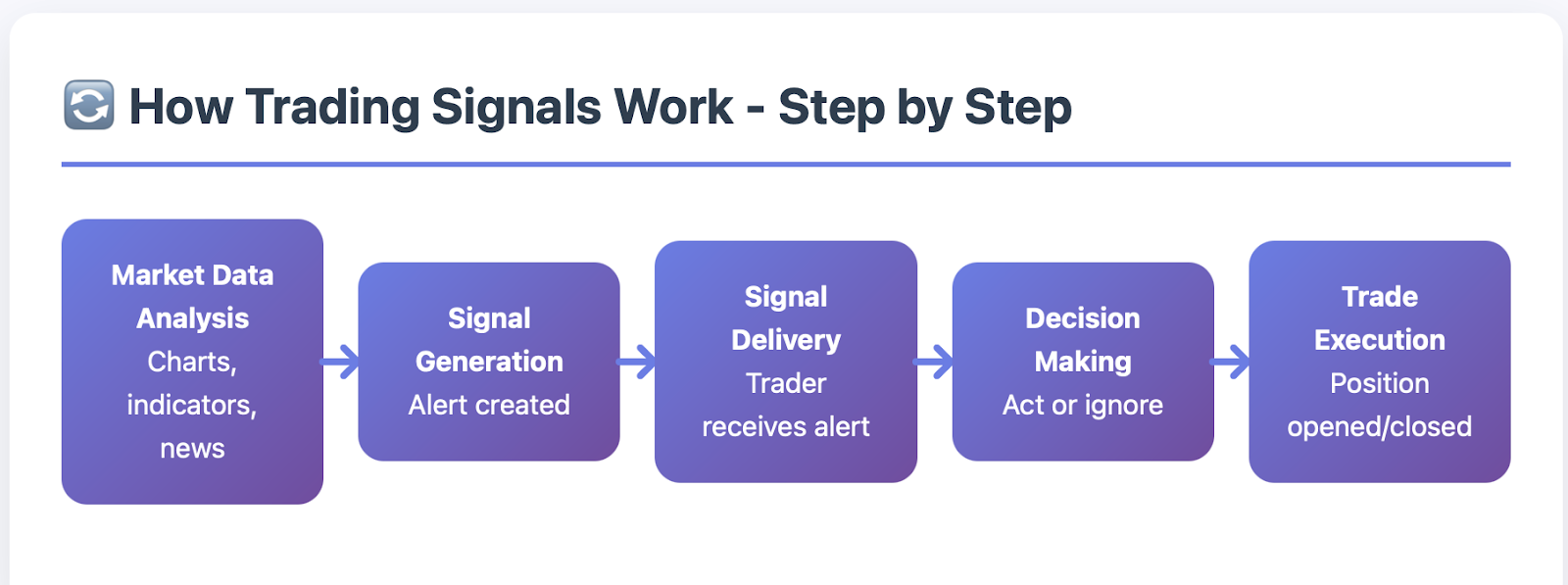
Now let's say you got a signal that stated EUR/USD would increase from 1.0850 to the next target of 1.0920. The signal played out and the trader made a profit! Awesome! Now what if an unexpected news item hit while you were collecting your profit and the pair instead dropped? This is why signals are used as a guide in decision making rather than as the decision maker for you in that process!
Three Types of Trading Signals - Manual, Automated, Social
Trading signals are usually categorized into three buckets and each has its own personality or use case.
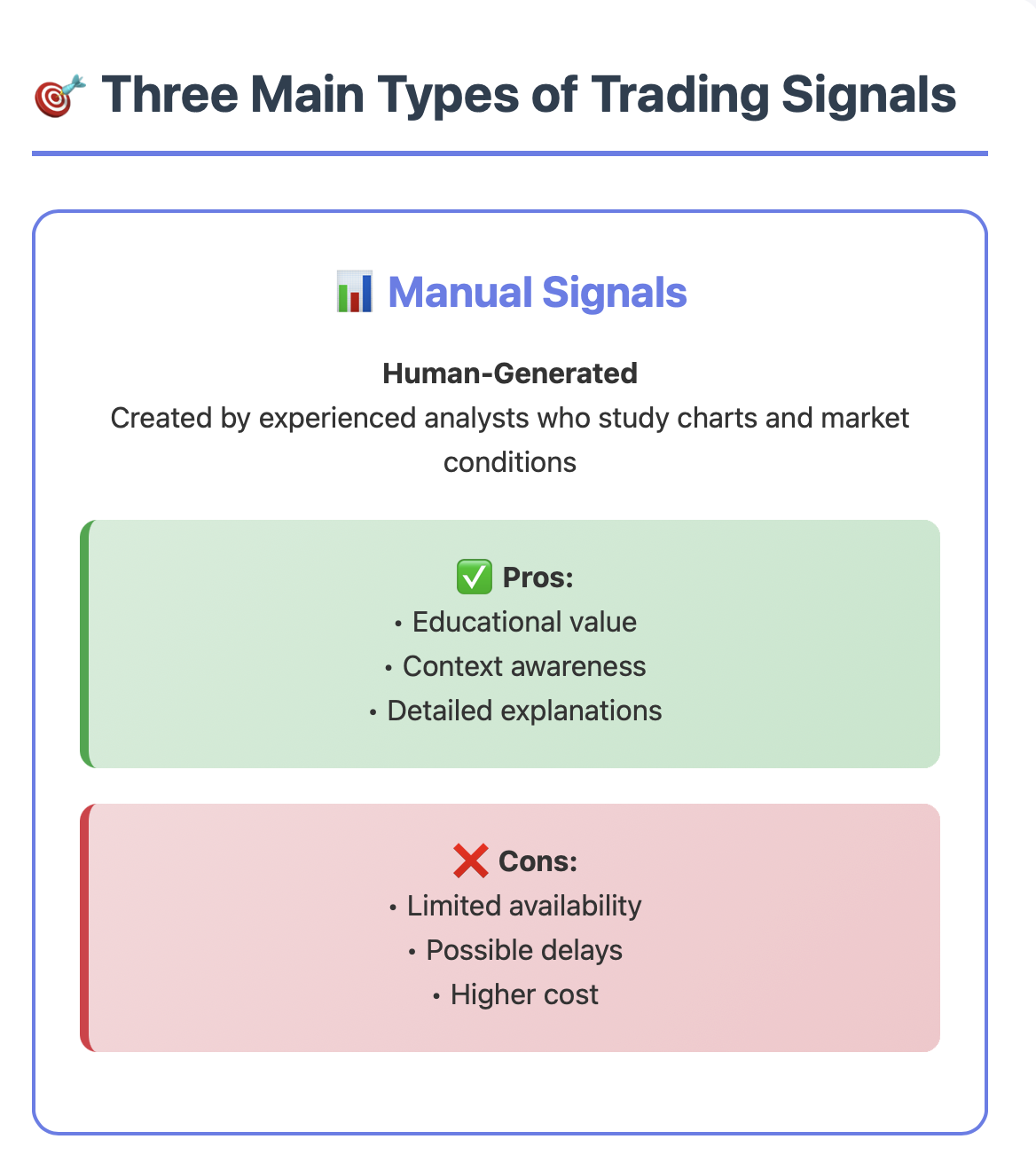
Manual signals are signals generated by human analysts or experienced traders who analyze charts, check news/market conditions, and, when comfortable, provide a recommendation. Manual signals might be considered like your experienced teacher providing individual advice.
They are great to read into, as they typically have paragraph-long explanation of the recommended trade, meaning the novice traders gain something educational too. The downside to manual signals is limited human availability, and the possible delay during fast price action.
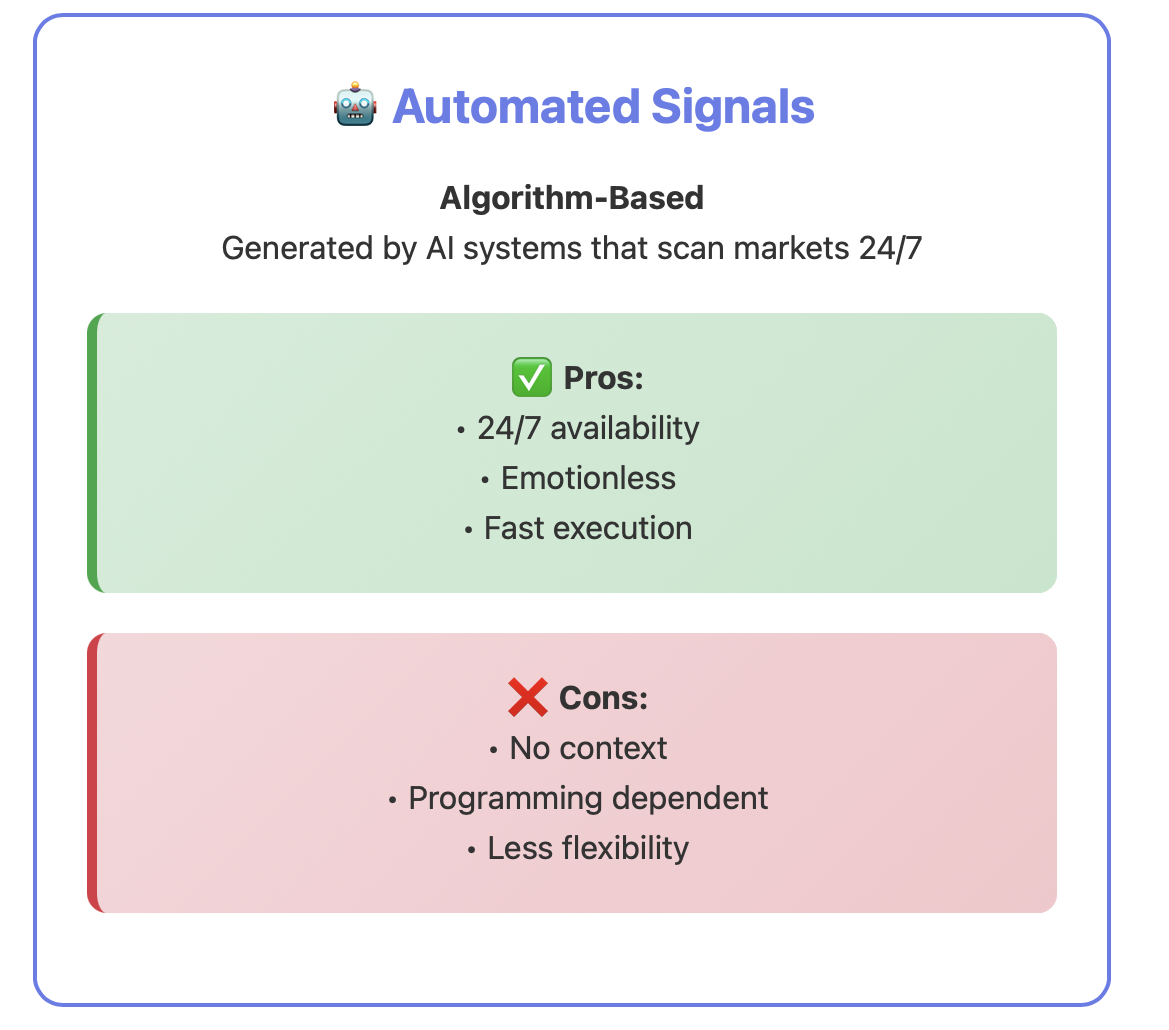
Automated signals are the "calculators" of trading. They are signals generated by algorithms or AI systems that can scan the markets 24-7, and process price data much faster than any human being. Many popular trading platforms (like MT4, MT5, etc.) offer auto-generated bots which offer signals. Automated signals are reliable and are emotionless in their generation. However, they will not pick-up context in the market that a human could interpret. And ultimately, they will be as good as their programming.
Social signals, also, work like a group chat to people you are connected with in your trading community. They might come from a copy trading platform, or simply from someone you follow on social networks, who may or may not be "successful" in trading, and are simply sharing their moves with people following them.
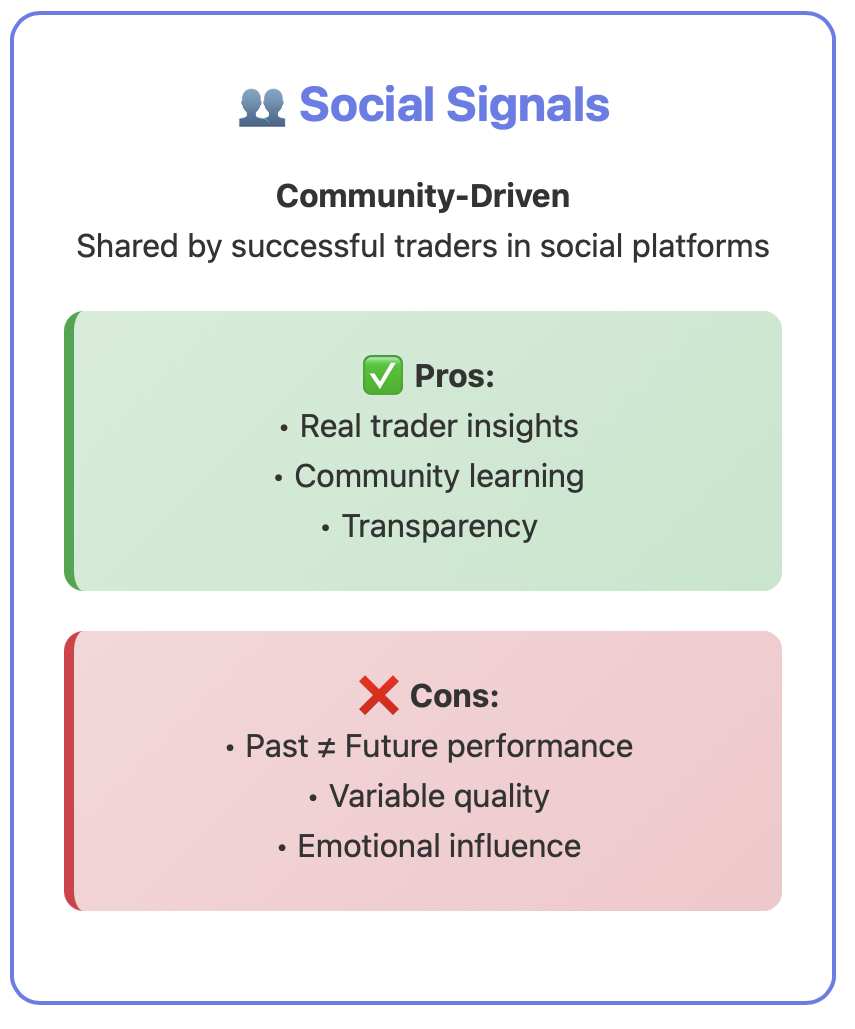
If you are following someone, with history of being successful, you would receive an alert when they enter a position, for example, if they had an open position, you would see the notifications about all the trades they opened, and closed. It's like a door into who is succeeding and what their portfolio looks like. But past performance is nothing more than clinical in association with future performance.
Here's a quick comparison:Telegram and WhatsApp forex signal groups have risen to tremendous popularity, especially among beginners. Some groups have great content, and others are scams that promote ridiculous unrealistic returns.
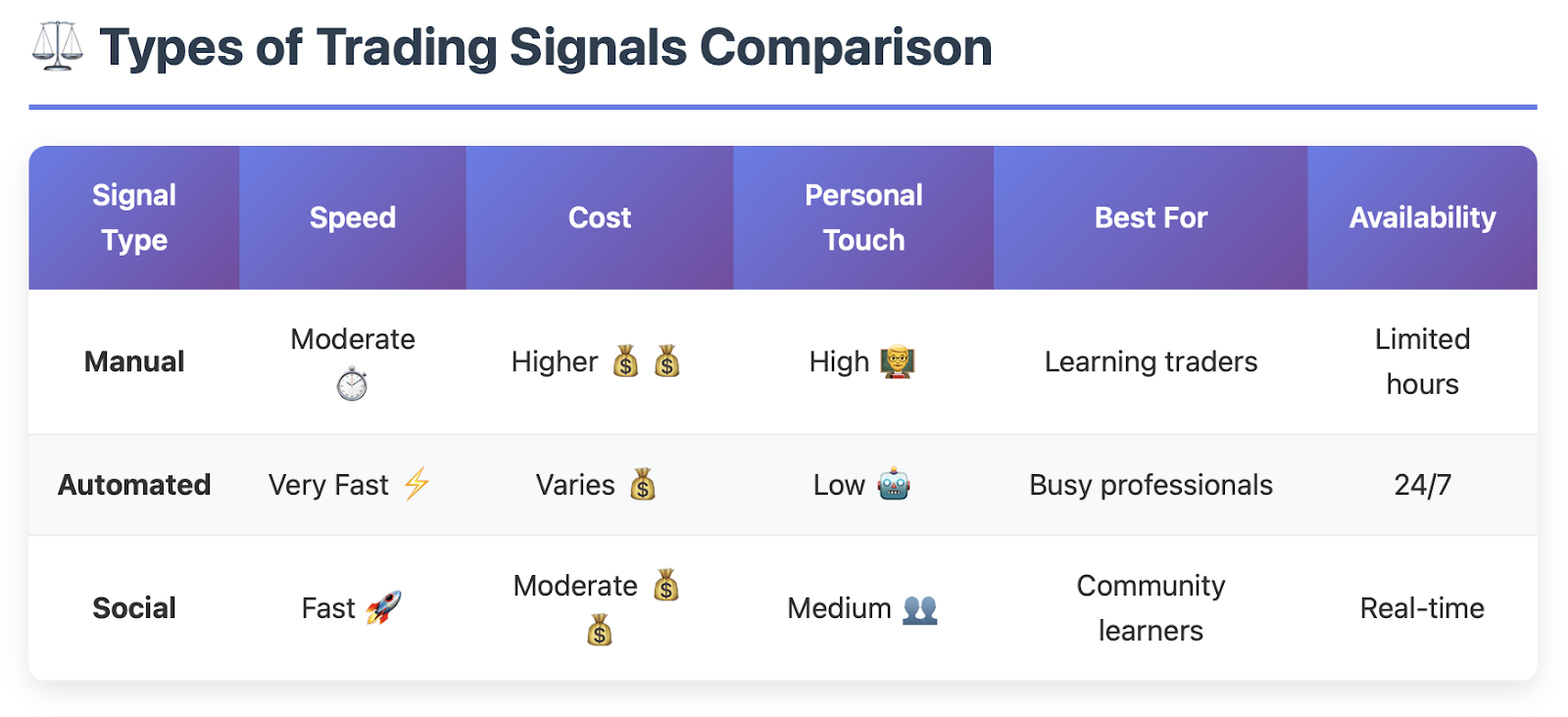
The right choice for you comes down to anything from your experience level, your available time to trade, your trading style, or all combined. Some traders may even take a mix from each to receive a full perspective of market opportunities.
How Signals are generated (Technical signal/ Market sentiment)
Understanding how signals are born provides you with patently ability to evaluate quality and reliability.
A technical analysis signal is math representation, as it applies to a forex market, to evaluation. Technical signals are based on price charts and potential price patterns associated with the bounce using mathematical indicators. Example price crossing above the EUR/USD 50-day moving average may dictate a bullish signal.
However, other popular Technical triggers may include the RSI has crossed above 70 (potentially overbought) or below 30 (potentially oversold), the MACD line has crossed above its signal line, or the price has bounced off the lower Bollinger band to the upside.
These signals signal per the theory that a general that what has happened in the past conditionally will repeat itself. If a particular market condition has caused positive price increases 70% of the time, traders will be less than human to pay attention.
Fundamental analysis signals are analogous to composing a history paper. They are based on having a grasp of the bigger economic picture. These can come from events, whether planned or otherwise, such as central bank interest rate decisions, economic data releases (like U.S. Non-Farm Payrolls), or inflation data (Consumer Price Index).
If the Federal Reserve surprises markets with a more aggressive interest rate stance than markets are expecting, then they will likely strengthen the U.S. dollar vs other currencies. Cognizant signal providers carefully monitor the economic calendar and produce alerts before the data is released and after it has been released.
Sentiment signals represent the market's group mood. In this way, sentiment signals are similar to checking in on the student's vibe before an important exam. If everyone is panicking and worried about the upcoming exam, there is an important data point. Sentiment signals are often based on such information as Commitment of Traders (COT) reports, which show you how various trader groups are positioned, or retail sentiment indicators that show you whether the small trader group is mostly long or short.
Interestingly, retail sentiment is a common contrarian indicator. When 80% of all retail traders are long EUR/USD and the rest are short, that is often a signal to sell the EUR/USD, presuming the majority of retail traders will likely be wrong.
Let’s look at an example of a real signal generation: Suppose the ECB announces an unexpected interest rate hike. In the following minutes, the algorithmic trading systems pick up large volume and volatility in the EUR pairs. Technicians see buy signals popping up as the EUR/USD trades above resistance levels. Sentiment has shifted dramatically as traders rush to buy euros. All three analysis types converge to develop strong bullish EUR signals.
The quality of a signal is significantly dependent upon the data sources and the analyst’s interpretation of the data. Garbage in, garbage out, as they say in programming.
How to Read and Interpret Trading Signals: A Beginner's Guide
Learning how to read a trading signal is like learning how to follow a recipe. Each component serves a certain purpose and, by learning them all, you become a better trader.
Most forex signals have a standard format that includes the following three important elements:
Entry Price: This tells you exactly where to enter the trade. For example, if the signal reads “Buy EUR/USD at 1.0850,” this means to place your buy order when the price hits 1.0850. Occasionally signals presents a price range: “Buy between 1.0845-1.0855,”, which accounts for normal market fluctuations.
Stop Loss (SL): This acts as your safety net - it indicates the price level at which you will exit a trade in case the price moves against you. For instance, in our example "SL: 1.0800", if the EUR/USD goes to 1.0800, you will close the position, and accept a small loss. We can think of this as your trading insurance policy.
Take Profit (TP): This is your target for profit - it is the level that you will close the trade if it moves in your favor. If you see "TP: 1.0920", the signal means you will close the position when the EUR/USD increases to 1.0920 to lock in profits after a favorable price move in your direction.
Now let’s break down a full signal: "Buy EUR/USD at 1.0850, SL: 1.0800, TP: 1.0920".
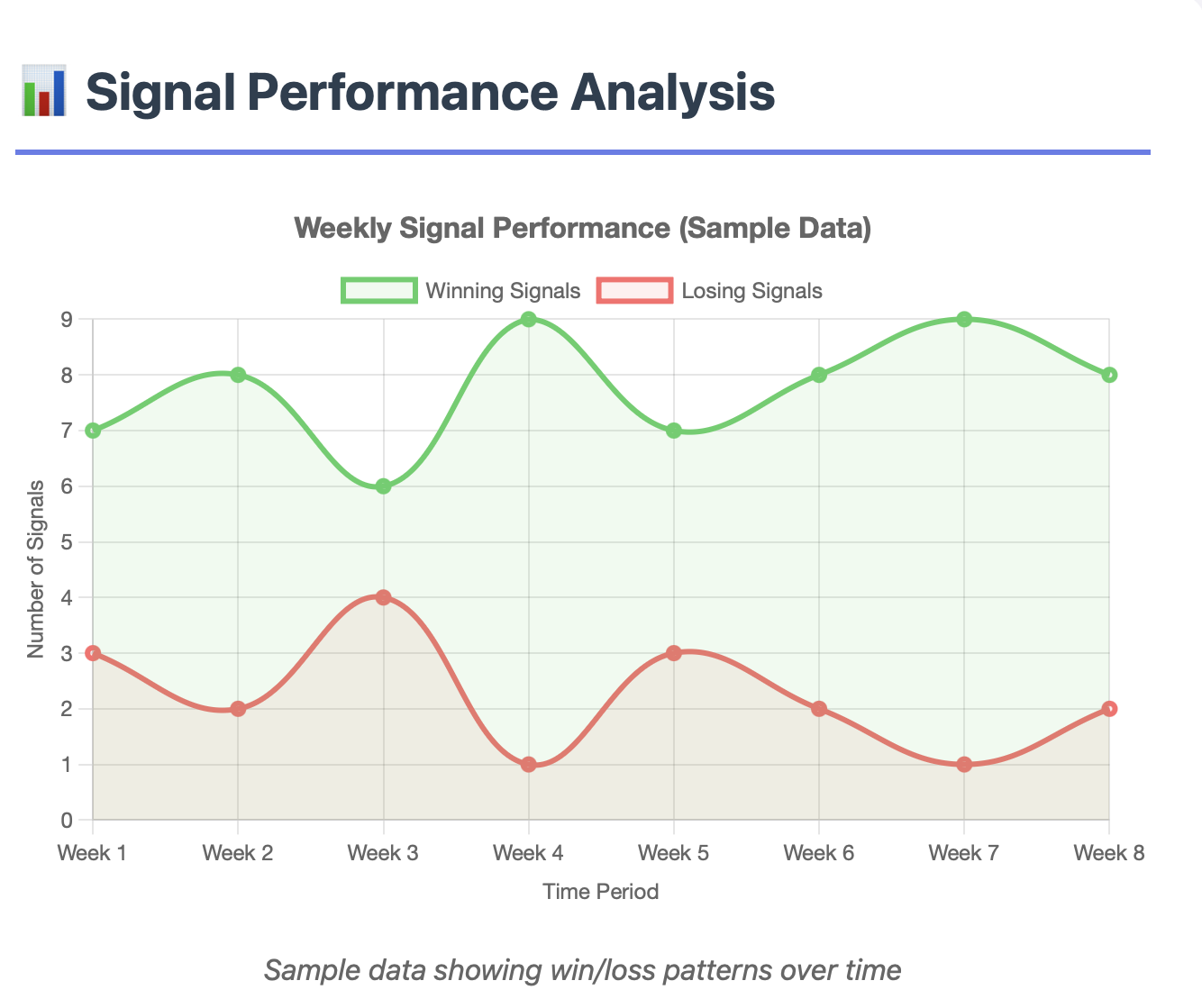
This signal indicates to "buy the euros against the dollar at 1.0850" and based on the stop loss and take profit given, you are risking 50 pips (the difference between where you enter the market and the stop loss) in hopes of making 70 pips (the difference between where you enter the trade and the take profit). In terms of risk-to-reward ratio, you are risking 50 pips for a potential gain of 70 pips, which is a risk-to-reward ratio of 1:1.4, many traders will accept this type of risk.
Some signals include additional information, such as:
-
Confidence level: How confident the signal provider is about the trade signal (for example: “high confidence” or “70% probability”)
-
Timeframe: How long the trade might take to achieve the target (for example: “1-4 hours” or “swing trade”)
-
Reasoning: A short explanation of the reason for the trade signal being generated.
The most common mistake a beginner can make in trading is taking a signal and blindly following it without knowing the reasoning behind it. This is the same as following a recipe and adding ingredients to your meal without realizing why you were doing so. You may be fortunate at times, but you won't actually learn how to cook.
Before you take any trade based on a signal, consider the following: Does this make sense based on present market conditions? If I happen to lose and violate my stop loss, do I have money out here to pay for the loss? Would I feel confident holding this signal for # trades or hours?
Understand that just like everything, there will be signals that will not work, even the best signals. The market environment changes relatively quickly, news comes out irregularly, and technical levels that are support or resistance can break in a flash holding for months. Your goal isn't to find the perfect signals all the time, your goal is to achieve risk before going capitalizing on trades that provide you a good possibility of a winning setup at the same time when you're managing your risk.
Benefits and Risks of Trading Signals
Trading signals can be one of the best, and helpful tools for trading, but every trader should understand there will be benefits and risks.
Trading signals save you a lot of time. Instead of chart staring for hours, you will get trade ideas from analysts that have experience, or algorithms that have time put into them. This becomes even more valuable to professionals who can't be in front of the market all day.
They are effective methods of learning as well. Good quality signals often accompany a description of the setup in the market so that newer traders can learn why certain trades make sense. It's quite similar to having a coaching and having someone show you the steps and not pay to get into expensive one-on-one coaching.
Signals can provide psychological support. The trading worlds can seem overwhelming and random when you are a new trader. Signals provide a degree of framework to designs and builds your sense of confidence and helps to develop a systematic approach to the trading world.
Signals are part of any professional hedge fund and/or institutional trader, combine with risk management structures and portfolio optimization into their own algorithm. If signals are good enough and worthy for billion-dollar hedge funds to use, they can be beneficial for all individual traders to consider.
Real risks: The biggest risk is over-dependence. There are traders that become addicted to signals, and they cannot make trading decisions without getting confirmation or validation from a signal. This is similar to copying homework and you pass the homework and or a quiz or even a test, but you struggle when you are presented with a new challenge.
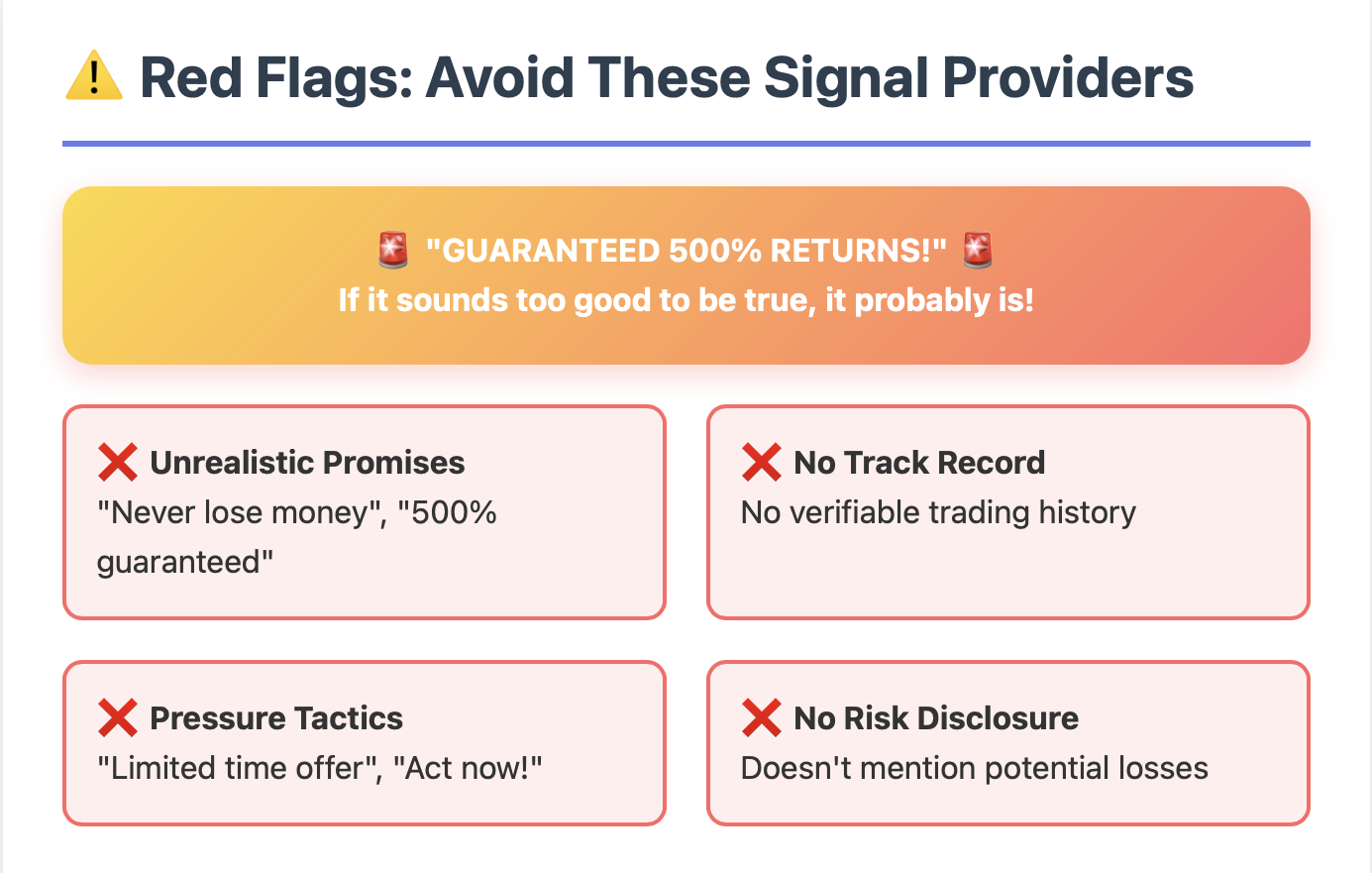
Scams involving signals are a major issue in the forex market. There are countless Telegram channels and websites that promise "guaranteed profit" or "90% winning percentage" knowingly for a monthly subscription. This should raise red flags. Legitimate signal provider would never guarantee profit since it is a market and cannot be predicted with any certainty.
Signal provider can provide legit signals but a trader can come to poor results if they do not incorporate proper risk management. The signal might be accurate 70% of the time, but if the trader risks too much on each trade, then bad trades in a row can wipe out their account.
Emotional trading is another trap. When signals go as planned, the trader can display over confidence and start disregarding the risk management rules they had for when trading signals do not work out. Now the trader either revenge trades or doubles down on their losing position
Finding the Balance
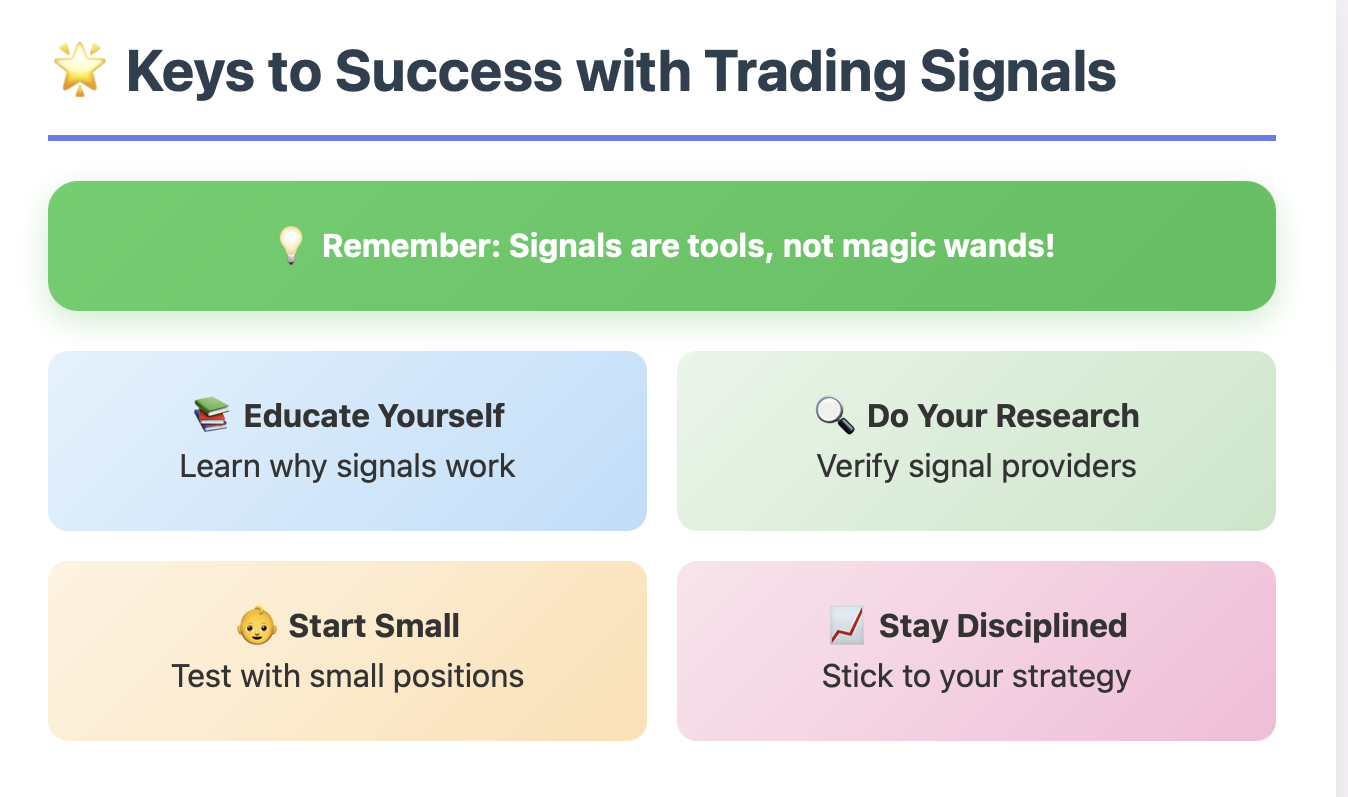
The goal is to treat signals like tools, not magic - or, to think of it more like a weather forecast; for example, it is great for planning purposes but is not 100% accurate. The trader would not walk out of their house with no umbrella just because the forecast says it is sunny; that trader should not risk money because a signal can be promising.
Intelligent traders consider signals a jumping-off point for their analysis. A trader could receive a buy signal for GBP/USD and then check news stories, look at the market more generally and then determine if the trade fits in with their portfolio and risk tolerance.
They will use thoughtful position size. Never risk more than 1-2% of your trading account at any one time for any one signal, regardless of how confident the signal provider seems to be. This way, you could lose five trades in a row, and your capital base remains intact.
Some Practical Strategies: Using Forex Signals Efficaciously
Extracting value from trading signals involves more than just blindly hitting enter and copying trade ideas. Here is how to set up your own systematic trading approach that will work properly.
Select Your Sources Diligently
Not all signal providers are the same. You want transparency in their trading history - full signal providers will openly report their win rates, average returns, and maximum drawdowns. Additionally, they should be regulated by a recognized financial regulatory authority or, at the very least, have a verifiable record that you can check.
Watch out for providers who make promises that seem unrealistic. If you ever see a claim like "guaranteed 500% returns" or "you will never lose money," those are immediate warning signs. Professional traders understand that losses are part of trading, and a reputable signal provider is aware of this fact.
Test any signal service with a small position size prior to entering into any serious money. Many providers offer free trials or low-cost trial periods to allow you to test any signals first. This way you can look at the signal quality, frequency of signals received, observed them fit your time availability and risk temperament on your submitted signals.
Combine signals with your own analysis
Think of signals like Google Maps directions - they are helpful directions but you should always confirm with your observations. If you receive a signal to buy EUR/USD, take a quick look at the economic calendar. Are there any major announcements that could impact your trade? Lastly, watch the news for any possible developments that could impact the euro and/or the dollar due to geopolitical tensions..
Look at the larger time frame too. A 1-hour chart may show a bullish setup, but the daily chart shows a solid downtrend, I may be a little more cautious in taking a long position.
Organize Signals to Your Timing
Day trading signals take a lot of focus and effort to execute quickly. If you have a job, day trading signals may not work well for you. Swing trading signals can play out in a few days or weeks and better match part-time traders.
Providers oftentimes specialize in certain time frames. For example, scalping signals may provide you 10-15 trade ideas in one day with small profit targets, whereas position trading signals typically provide 2-3 trade ideas in a month with larger gains.
Utilize Strict Risk Management
This cannot be overstated - risk management is more important than signal accuracy. Even signals with a 70% win rate can wipe out trading accounts if risk management is neglected.
You need to establish maximum risk per trade (1-2% of your account size is pretty standard) and follow it religiously. If a stop-loss on a signal would cause you to risk more than you're willing to lose, you need to skip that trading signal or simply take smaller position size.
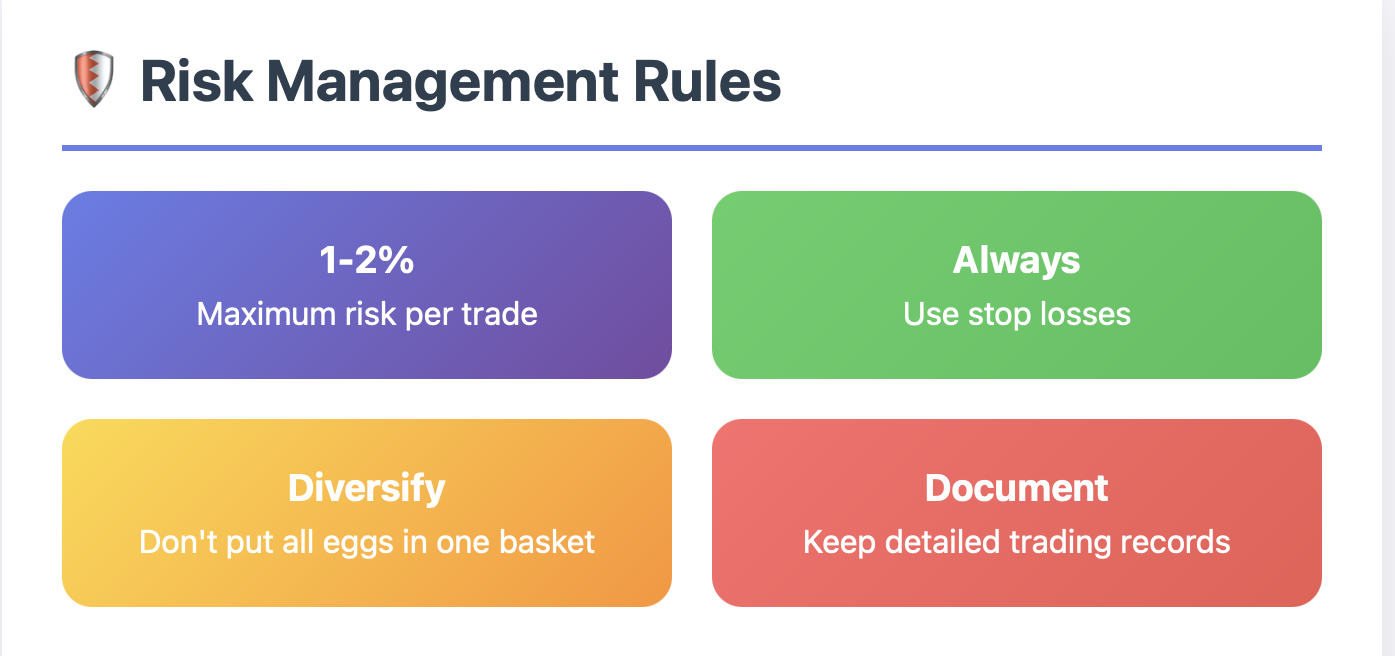
In addition, don't ignore correlated trades. It would not be wise to take multiple signals on highly correlated pairs (i.e., EUR/USD and GBP/USD) at the same time. If you are wrong about the dollar's direction, both trades would move against you.
Maintain Thorough Records
Document every signal you take, including your entry price, exit price, and profit or loss, as well as the rationale for accepting the trade. These records can be invaluable in your evaluation of signal providers and may prove beneficial in mapping out your own decision-making process.
Review your trading log periodically. What types of signals did you have success with? Are you more successful trading technical signals, or fundamental signals? Did some market conditions lead you to avoid trading altogether?
A Practical Process
Below is a step-by-step guide that a number of successful traders participate in to collect trades:
-
Receive signal alert
-
Check current market conditions and news
-
Check that the proposed trade fits your risk management rules
-
Calculate position size you can trade
-
Open the trade with a stop loss and take profit pre-defined
-
Simply observe the trade unfold and do not intervene because of emotions
-
Document results for lessons learned later
While this procedure may differ slightly for you, using a formalized and structured process to teach your trading decision ultimately removes emotion from trading decisions and helps you operationalize your decisions, making them habitual over time.
Examples in Practice: When Trading Signal Work and When They Do Not
Nothing works better to teach as an example. Below I will review two different examples of the signal performance process.
Example 1: Trading Successful Trigger - EUR/USD Technical Signal
In March 2024, a reputable signal provider made this trade signal: "Buy EUR/USD at 1.0880, SL: 1.0840, TP: 1.0950".
The reasoning was solid: the EUR/USD had been consolidating in a range for two weeks, forming a support base around 1.0850. The RSI showed bullish divergence, a pull was made against the upper boundary of a symmetrical triangle pattern, and meanwhile, European data was improving while U.S. data was showing signs of cooling.
Traders who took the signal bought long at 1.0880, as suggested. Immediately, the trade went against them briefly - down to 1.0865 - but the support level held, and over the next 48 hours, positive eurozone inflation data came out along with a dovish statement from a Fed official that led to a move up in EUR/USD.
The profit target at 1.0950 was hit in just under three days, resulting in a 70-pip profit and risking 40 pips. The risk-to-reward ratio of 1:1.75 worked quite well, bringing followers of the signal a good profit.
What Worked:
-
Clear technical setup with multiple confirming factors.
-
Reasonable risk to reward ratio achieved.
-
Timing was good with a favorable fundamental backdrop.
-
Position size recommendations used appropriately.
Case Study 2: The GBP/USD Failed Fundamental Play.
Two months later, the same signal generator delivered a different trade: "Buy GBP/USD at 1.2650, SL: 1.2590, TP: 1.2750."
The rationale appeared valid: the UK inflation dataset was due to come in above expectations, perhaps forcing the Bank of England to leave interest rates higher. Alongside that, technical indicators showed the pair bouncing off a significant support level.
Traders got in at 1.2650 as suggested. The initial UK inflation release came in above expectations, and GBP/USD quickly rallied to the 1.2680 area. Things seemed to be going well.
Then the unexpected happened. During the London session, an announcement followed that the UK Chancellor was thinking about emergency tax measures regarding the budget. Political uncertainty caused the pound to tumble. Within hours, GBP/USD crashed through the stop loss at 1.2590 and fell further to 1.2520.
Traders who took the signal lost 60 pips and according to their risk management strategy. Those who panicked, adjusted their stops, or held on in hope lost much more.
Reasons why this signal failed:
-
Unexpected political news trumped both technical and fundamental analysis
-
High-impact events can nullify a signal instantly
-
Even good analysis can't predict black swan events
The Key Lessons
Both cases illustrate important principles:
First, signals are probability-based tools, not guarantees. The first signal had everything going for it but could have easily failed if different news had emerged. The second signal's analysis was reasonable, but unexpected events changed the game entirely.
Second, proper risk management saved traders in the losing case. By sticking to predetermined stop losses, they contained their damage to acceptable levels. This is why position sizing and stop losses are non-negotiable.
Third, market context matters enormously. The same technical setup might work beautifully in trending markets but fail during high-volatility news periods. Good signal providers acknowledge these limitations and adjust their approach accordingly.
Finally, you can learn as much from failed signals as successful ones. The GBP/USD loss taught traders about political risk and the importance of staying informed about broader events that could impact their positions.
Building Resilience
Professional traders acknowledge that they will lose money on about 30-50% of trades, even with a good signal. They focus on managing risk and ensuring their wins are large enough to offset the losses. This approach - conceptualizing individual signals as merely one trade in the context of a larger statistical game, not one that makes or breaks a strategy - is what separates successful traders from gamblers seeking a quick result.
Weather forecasts often aren't completely correct, but we still find them useful for our planning of activities for the day. Forex signals and trade references are a similar analogy of improvement of your decision-making process but contained within imperfect tools.
Are Forex Trading Signals Worth It? The Final Answer
Now that we have prodded every angle we can around forex trading signals, let's address the ultimate question: should you use them?
The answer is not a yes or no. It is entirely dependent upon your perspective towards signals and what the role signals play in your overall forex trading plan.
Signals are more effective when you treat them as the basis of knowledge to be learned rather than a means to easy money. The most successful traders tend to utilize signals as a way to facilitate their own analysis to make successors decisions, rather than the last persuasion to open or close their position. They couple what the indicator produces with their own experience on market conditions and risk management principles of trading goals.
Consider signals like a knowledgeable friend who shares interesting investment ideas at a party. Assuming that it is the friend who might be unusual but with no idea of their ideas, you would logically hear your friend out, do your own investigation and consider your own decisions. You would never invest your life savings on just overhead conversation.
For beginners, good signals can potentially expedite their learning experience. Instead of spending months of research and analysis trying to figure out what makes for a good trade setup, they can examine logical signals, and eventually develop their own market gut instinct. Of course, this can only happen if they show initiative and learning rather than just copying the trades of others.
The biggest benefit of signals is the ability to access diverse signals. Multiple signals provide the trader a more complete picture of the market's conditioned. Just as doctors seek second (and third) opinions for serious diagnostic purposes, savvy traders seek out multiple opinions before they make any significant trading decision.
At the same time, you must remember the rule of rules; signals guide, but discipline is what enables success. You cannot rely on good signals, if you are terrible on risk management, emotional, or have unrealistic expectations.
The practical bottom line: Use free or low-cost signals from trusted service. Start small as you transition. Focus on more than just making money or losing it and think more about why signals make money or lose money. Learn to transition to your own analytical skillset so you are less reliant on other people's signals.
Now, signals can be very good tools in your toolbox for trading, but they are still just tools and your success will be defined by how well you construct signals with solid risk management principles with an analytical skill set while learning to simply trade with only realistic expectations of markets.
Are you ready to begin your journey into forex trading with confidence? At Tradewill, explore our extensive trading guides and educational materials to build the knowledge and skillset you will need for a profitable journey over a sustained duration.
Disclaimer: The content of the blog does not represent any position of Trade W, does not serve as any trading-related decision advice, and does not endorse any third-party.