
 Trade W

Forex and gold trading are not inherently more or less profitable than one another. Many people who argue that one market is superior have already decided which market they prefer and then work backward to justify that conclusion. As a result, their opinions often reflect personal preference rather than objective analysis.
The forex market generally offers lower spreads, deeper liquidity, and a broader range of trading opportunities across multiple currency pairs. Gold, on the other hand, typically produces fewer trading setups but often experiences larger price movements, displays clearer trending behaviour, and is frequently favoured by swing traders and longer-term systematic traders because of its strong macroeconomic drivers.
Your long-term success or failure as a trader depends far more on the following four factors than on the specific market or instrument you choose to trade:
-
A proven trading system with clearly defined entry signals, stop-loss placement, and profit targets.
-
Effective risk management and appropriate position sizing on every trade.
-
Total trading costs relative to the profits you are attempting to achieve, rather than focusing solely on advertised spreads.
-
Your ability to manage the psychological demands of market volatility without second-guessing your trading decisions.
Regardless of whether you choose forex or gold, only a small percentage of retail CFD traders become consistently profitable. The market itself is simply the environment in which trading takes place. Your trading plan, risk management, and discipline are the factors that ultimately determine your long-term performance.
The Real Question Behind "Which Is More Profitable?"
When someone searches for "forex vs gold how much profit," they are usually trying to solve a practical problem: where to invest their capital, where to devote their time, and which market is worth learning. These are reasonable questions. However, before comparing the profit potential of forex and gold, it is important to recognize that the question itself is based on an assumption that needs to be examined.
Markets do not have profit ratings attached to them. Instead, each market has its own characteristics, such as average daily range, liquidity, trading costs, fundamental drivers, and the frequency with which new trading opportunities develop. Whether those characteristics translate into profits depends on whether your trading strategy is suited to the market and whether your trading style aligns with its behavior over time.
There is another important reality that should also be considered. Across the retail leveraged trading industry, brokers consistently disclose that approximately 70% to 80% of retail trading accounts lose money. This statistic is not an argument against trading itself, but it is a strong argument against choosing a market based solely on excitement or because another trader achieved impressive returns in that market. Long-term success is far more likely to come from developing a well-tested trading strategy, applying disciplined risk management, and executing trades consistently than from choosing one instrument over another. With that in mind, we can now examine the key differences between forex and gold and consider the implications of each.
Forex and Gold Trading: A Quick Grounding
In forex trading, you buy one currency while simultaneously selling another in a currency pair such as EUR/USD, GBP/USD, or USD/JPY. According to the Bank for International Settlements Triennial Central Bank Survey, the global forex market records approximately $7.5 trillion in average daily trading volume, making it the largest and most liquid financial market in the world. The forex market operates nearly 24 hours a day during the trading week, with four major trading sessions centered on London, New York, Tokyo, and Sydney. Market participants include central banks, commercial banks, hedge funds, institutional investors, and retail traders around the world.
In retail CFD trading, gold is primarily traded as XAU/USD, which represents the price of one troy ounce of gold quoted in U.S. dollars. When trading gold CFDs, you speculate on whether the price of gold will rise or fall without taking delivery of the physical metal. Like the forex market, gold can be traded nearly 24 hours a day during weekdays. Traders can take both long and short positions, and leverage allows them to control larger positions with a relatively small margin deposit, increasing both the potential for profits and the potential for losses. Understanding how forex derivatives and CFDs actually work before comparing the two markets will save you from surprises that catch many beginners off guard.
Head-to-Head: The Factors That Actually Shape Profit
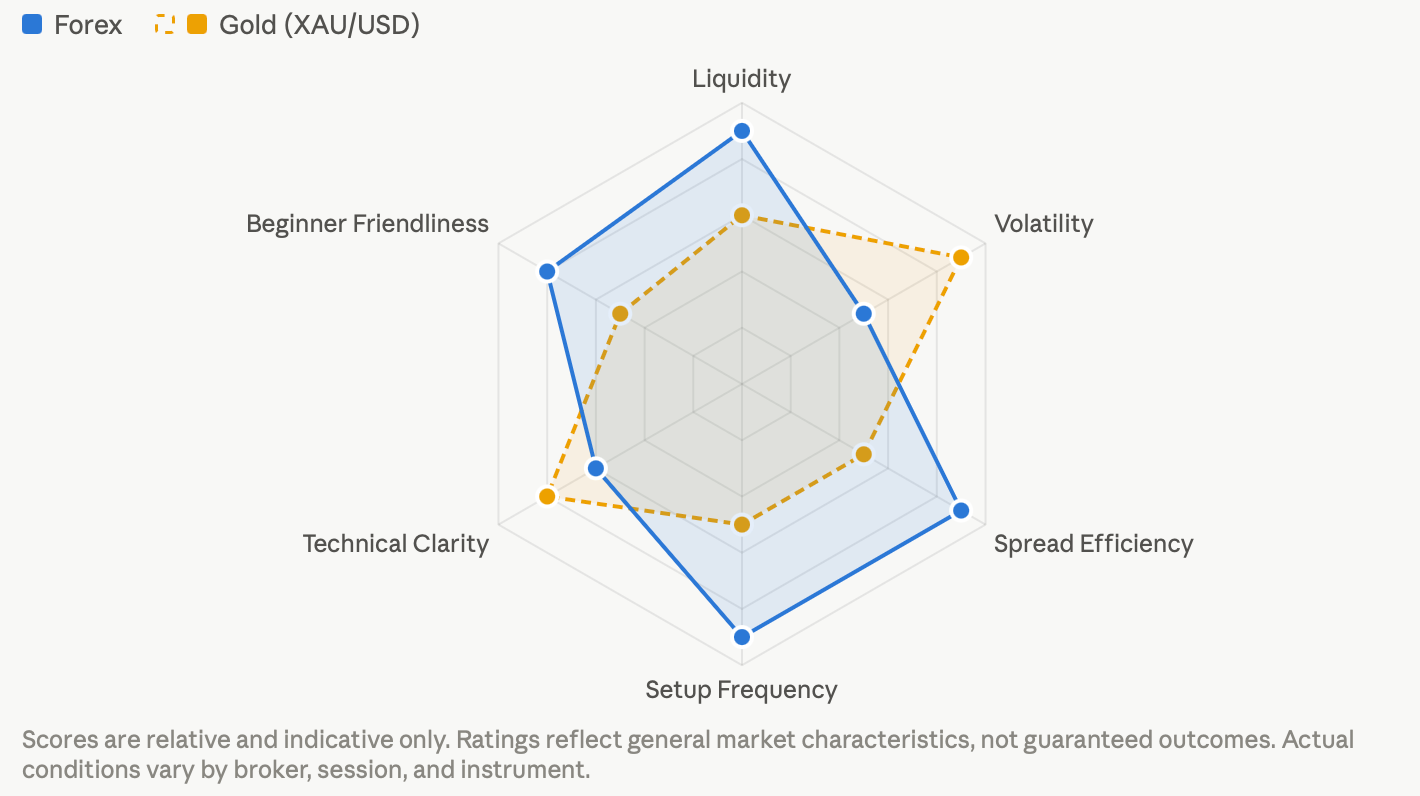
Rather than reaching an early conclusion, a more effective approach is to evaluate the factors that influence profitability individually and draw an objective conclusion for each one. The chart below compares the forex and gold markets across six key categories that traders consistently identify as the most important factors affecting long-term trading performance.
Volatility
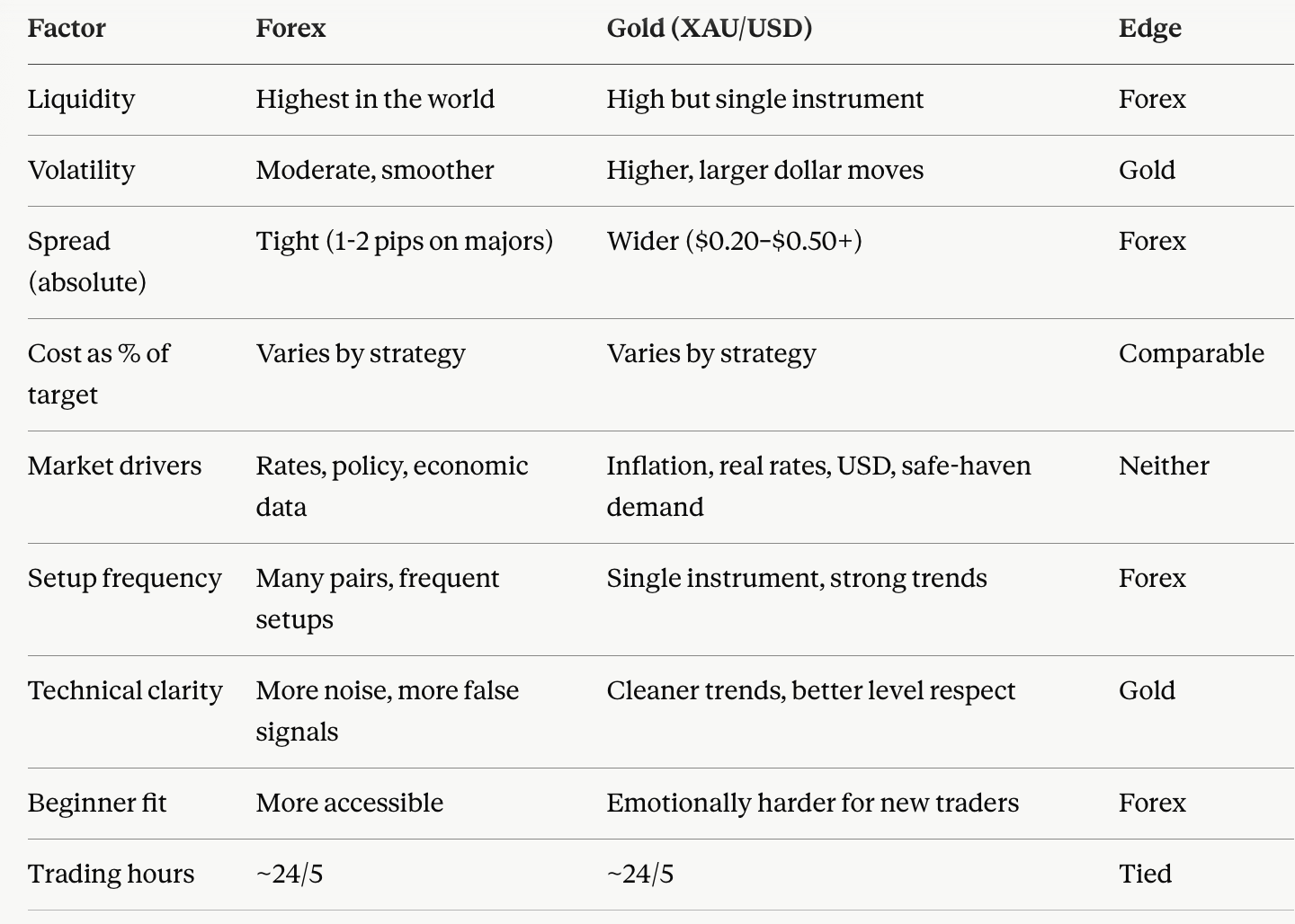
Gold typically experiences larger daily price movements than most major forex currency pairs. Under normal market conditions, XAU/USD often moves between $25 and $50 per trading day, although the range can expand significantly during periods of heightened macroeconomic or geopolitical uncertainty. By comparison, most major currency pairs typically move between 60 and 100 pips per day. Gold's daily trading range also tends to increase during periods of financial stress, geopolitical instability, or major economic events.
Conclusion on volatility: Gold is generally more volatile than most major forex currency pairs, creating the potential for both larger profits and larger losses on each trade. Higher volatility does not make trading easier. When combined with leverage, it significantly increases trading risk.
Liquidity
The forex market is the most liquid financial market in the world, supported by the enormous trading volume of major currency pairs. As a result, execution is typically very efficient, spreads remain extremely tight during active trading hours, and slippage is generally limited under normal market conditions. Large trade sizes also have relatively little market impact compared with many other asset classes.
Although gold is also highly liquid compared with most commodities, it remains a single trading instrument. Liquidity can decline during quieter trading sessions or immediately before major economic announcements, increasing the likelihood of wider spreads and slippage.
Conclusion on liquidity: Forex offers a clear liquidity advantage over gold. This advantage is most valuable for scalpers, high-frequency traders, and traders executing large position sizes who depend on fast execution and minimal slippage.
Trading Costs and Spreads
Major forex currency pairs often trade with spreads of one to two pips during active market hours, making them among the lowest-cost financial instruments on an absolute basis. Gold generally trades with wider spreads, commonly ranging between $0.20 and $0.50, although spreads vary depending on the broker, market conditions, and time of day.
While forex generally has lower absolute trading costs, this comparison can be misleading when viewed in isolation. Because gold often experiences larger price movements than forex pairs, the spread may represent a smaller percentage of the total price movement that a trader is attempting to capture. As a result, the relative cost of trading gold may be more competitive than the absolute spread alone suggests.
Conclusion on costs: Forex is generally less expensive than gold on an absolute basis. However, the more meaningful comparison is the total trading cost relative to your expected profit target. Before choosing either market, compare spreads, commissions, and other trading fees over the number of trades you expect to execute.
Market Drivers
Forex prices are primarily influenced by interest rate differentials, central bank monetary policy, inflation data, employment reports, trade balances, and geopolitical developments that affect confidence in a country's economy. The carry trade strategy exists because of the historically consistent relationship between interest rates and currency valuations. As central banks adjust monetary policy, currency pairs often respond in predictable ways, creating recurring macroeconomic trading themes.
Gold is influenced by a different set of macroeconomic factors. The primary drivers include real interest rates, the strength of the U.S. dollar, inflation expectations, demand for safe-haven assets during periods of uncertainty, and central bank purchases of gold. In recent years, central bank demand from emerging market economies has become an increasingly important influence on gold prices. Many investors also view gold as a portfolio hedge against inflation and broader financial uncertainty.
Conclusion on market drivers: Neither market is fundamentally more complex than the other. However, each requires a different analytical approach. Traders who focus on macroeconomic developments often prefer forex, while traders seeking longer-term macro themes and safe-haven opportunities are frequently drawn to gold.
Technical Behavior
Many experienced traders believe that gold tends to produce cleaner trends and respects technical levels more consistently than many forex currency pairs. Forex markets often experience increased price noise around economic news releases, trading session transitions, and periods of shifting liquidity. As a result, forex price action can appear less consistent over shorter timeframes.
Gold generally exhibits stronger directional trends, making it well-suited to swing traders and traders who rely primarily on price action over higher timeframes. Forex, however, provides a much larger universe of tradable instruments, resulting in more potential trading setups. The trade-off is that forex also generates more false signals and market noise, requiring traders to apply stronger filtering techniques before entering trades.
Conclusion on technical behaviour: Gold generally produces cleaner and more sustained trends than forex. Forex offers a greater number of potential trading opportunities but also generates considerably more market noise, requiring greater selectivity and discipline when identifying high-quality setups.
Which Is Actually More Profitable? A Framework
The question this article seeks to answer is the profit potential of forex and gold trading, and how each market fits within the following framework:
Profitability = Edge × Frequency × Risk/Reward Ratio - Costs × Discipline
Each component of this formula is important, but each behaves differently in the forex and gold markets. Without a genuine trading edge, there is little chance of achieving consistent success in either market. Adding leverage without an edge simply increases the speed at which losses can accumulate while following an unprofitable trading strategy.
One of the key differences between forex and gold is trading frequency. Forex traders can often find trading opportunities across multiple currency pairs and trading sessions, resulting in a higher number of potential setups. Gold, by comparison, is a single instrument and generally produces fewer trading opportunities. However, when high-quality gold setups do occur, they often provide larger potential price movements and may offer more favourable risk-to-reward ratios.
Trading more frequently is not necessarily an advantage. A higher number of trading opportunities only improves profitability if you can consistently execute the same trading edge, maintain the same risk-to-reward standards, and apply the same level of discipline across every trade.
The relationship between risk, reward, and trading costs is where the comparison becomes more interesting. The graphic below illustrates why the common statement that forex is always cheaper to trade than gold requires additional context and should be evaluated in relation to the size of the expected price movement rather than the spread alone.
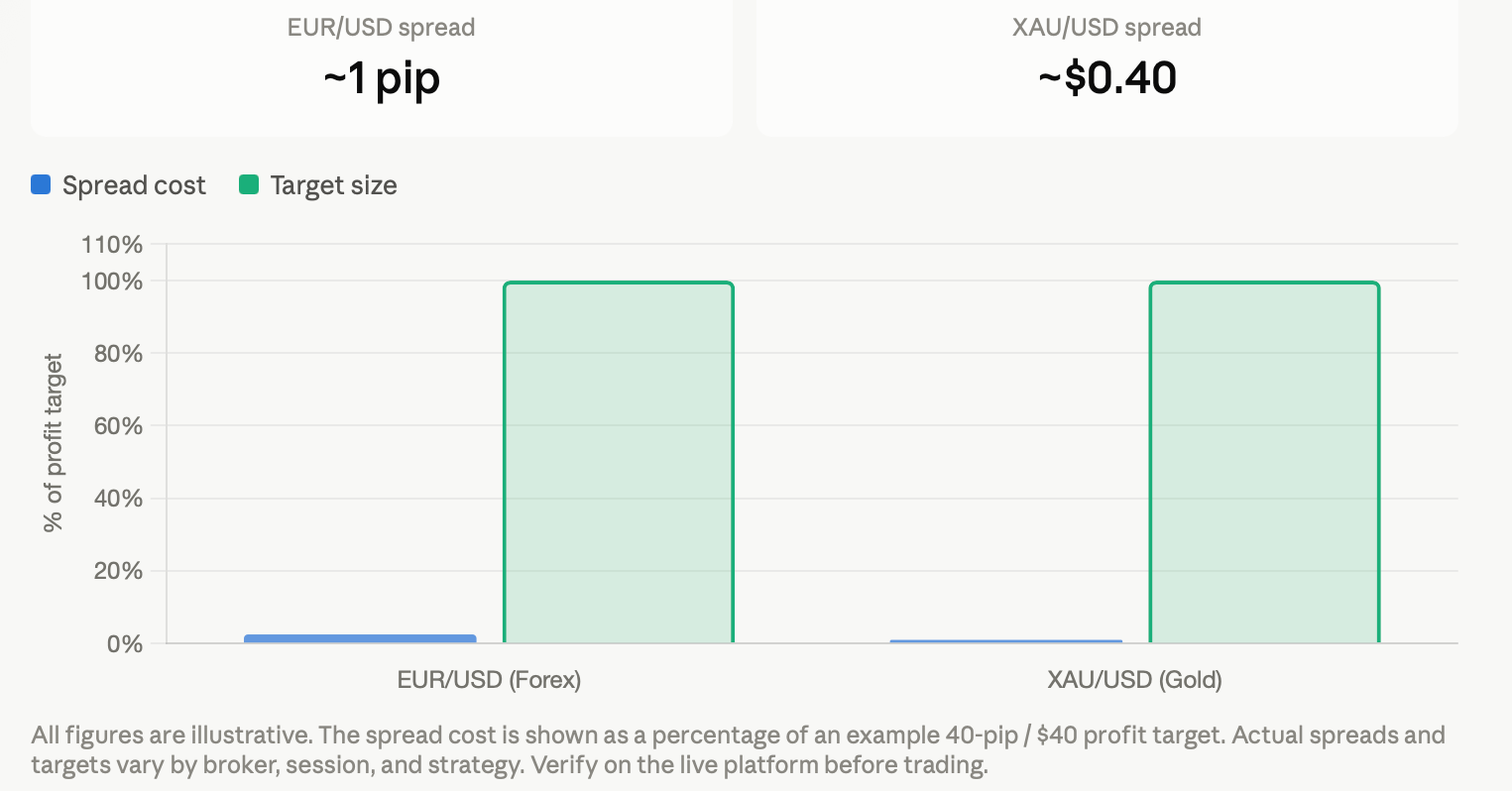
Due to the frequent occurrence of larger gold targets relative to their size as a percentage of the target, the cost associated with trading gold as a percentage could potentially be lower than that of other Forex pairs, even though there may actually be a larger dollar amount spread between them. For example, a trader following a Forex strategy that targets 40 pips above the current price of the EUR/USD pair would incur a trading cost of approximately 2.50% of the overall target based on a trading spread of 1 pip. On the other hand, a trader following a gold trading strategy that targets a $40 price increase with only a $0.40 trading spread would experience a trading cost equal to 1.0% of the overall target in comparison to the trading cost for the Forex trader. The purpose of the above figures is purely to serve as an example of the principle being discussed (the principle of trading). Therefore, you should not evaluate a trading instrument solely by its bid/ask spread when determining which market to trade using the strategies mentioned above. Instead, consider the size of your actual target and the respective trading costs.
It is important to note that discipline is what separates traders who successfully apply a trading system from those who make errors during periods of pressure or trade too frequently as a result of trades that did not perform as expected. The difference between successful traders and unsuccessful traders can be attributed to their respective levels of discipline, regardless of the market they are trading. Moreover, successful traders possess certain trading habits and rules, along with a specific mental attitude while trading, which assists in their success.
As such, neither Forex nor gold has an inherent advantage in achieving profitability. However, based on the differences between your trading strategies, the frequency at which you are able to trade, as well as your ability to manage the volatility associated with the specific markets, profitability can be achieved when trading either market.
Which Should You Trade? A Decision Guide
Rather than a one-size-fits-all recommendation, a more honest answer takes the form of a self-assessment. Your trading style, available time, emotional wiring, and capital base all influence which market gives you the best chance of building a genuine edge. Understanding what professional forex day trading looks like structurally and reviewing day trading strategies built for 2026 market conditions will help you see where your natural approach fits before you commit.
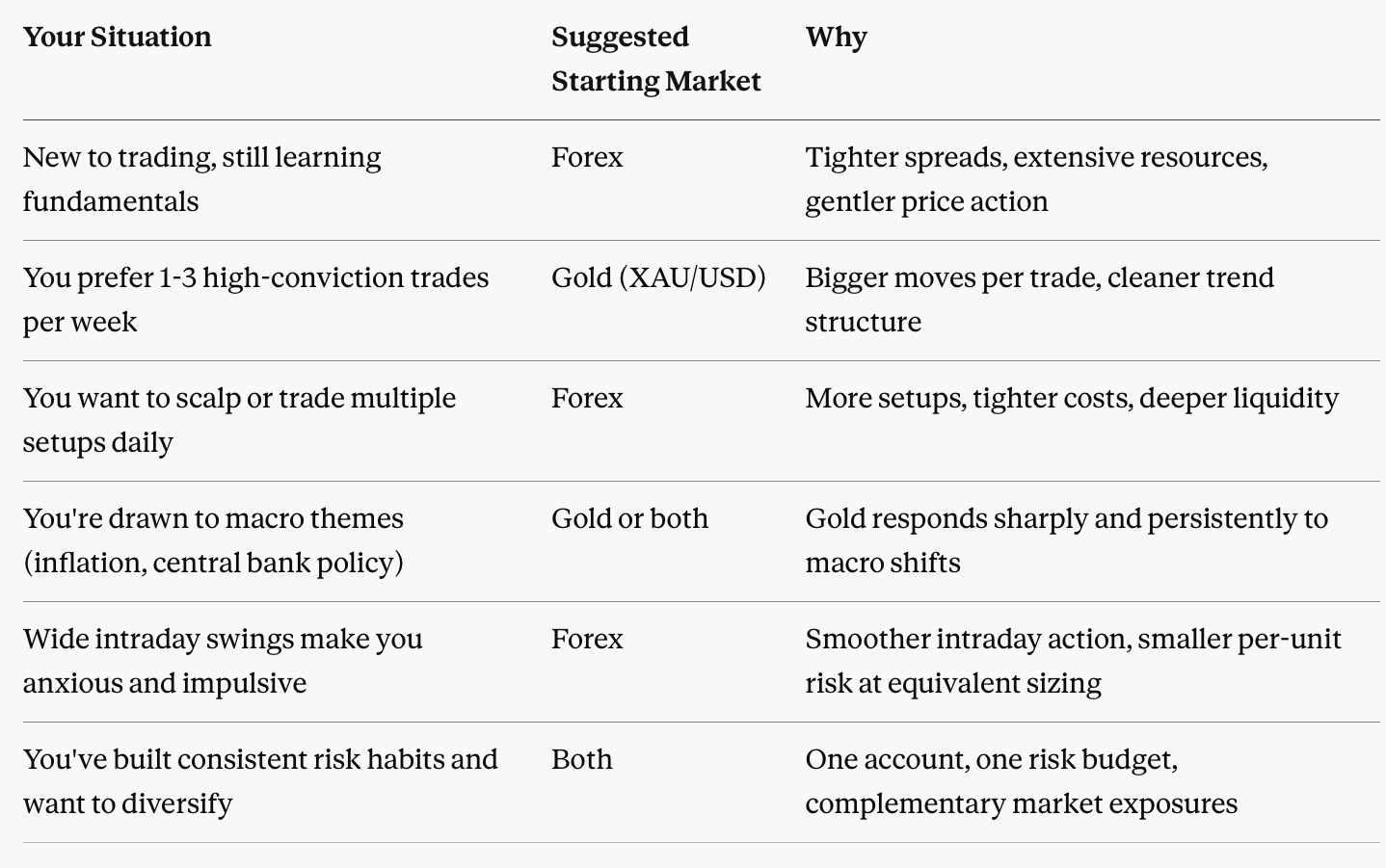
This matrix presents some general suggestions for trading. You must weigh your unique circumstances against your overall capital and risk tolerance, as they all differ dramatically.
If you like having numerous options and shorter trades, enjoy watching a variety of currency pairs throughout an entire trading session, and are still developing a solid understanding of how to manage the risk of each trade, then you will benefit from trading in the Forex market.
However, if you prefer to take longer-term trades with fewer overall positions based on large price movements with conviction, or if you are disciplined enough to remain in a trade through periods of normal volatility without exiting prematurely, and you enjoy using macroeconomic analysis as the basis for determining price direction, then you will benefit from trading gold.
Why Not Both? Trading Forex and Gold Together
For traders who have already gone through the early learning stage of their trading career, generally speaking, the answer to the question of which is the more profitable trading market usually comes down to neither market exclusively, because trading both markets together under an overall risk management plan results in a smoother equity curve more consistently than trading only one instrument.
Gold and Forex do not always trend together, nor do they behave the same way during every event. For example, when there are risk-off conditions due to geopolitical uncertainty and/or economic stress, gold may show a steady uptrend, while some currency pairs may be stuck in a consolidation pattern or moving in a direction that is difficult to predict. On the other hand, during high-volatility news events, Forex may provide cleaner, more well-defined setups than gold due to its lower spread.
By trading both markets through a single trading account that has a total risk budget across separate markets, you can allocate your total risk capital to whichever market is presenting a clearer and more favorable risk-to-reward opportunity during that week.
Before you mix markets, it is wise to understand how currency correlations affect your overall portfolio. The USD contributes to two separate asset classes: USD-based currencies and gold. If you do not consider your combined exposure to the USD, then you may inadvertently place too much emphasis or concentration on one position by viewing each trade separately. The main risk of trading both markets at the same time is becoming overextended on margin to the point where you could lose more than you have available to lose because you have a lower-than-expected account balance supporting two or more Forex positions in addition to a gold position.
A trader can quickly reach his or her risk exposure and margin limits by implementing a single risk budget or position sizing methodology across one common trading strategy with a guaranteed daily loss limit. This provides a structured and sustainable multi-market trading approach rather than one that is unfocused and unstructured.
Tradewill allows trading Forex and gold (XAU/USD) contracts for difference (CFDs) on both MT4 and its proprietary app with TradingView charting services from a single account. You can see how both markets operate before risking any of your own money by using the free demo accounts to trade both markets with no financial risk. Instead, you trade with virtual funds under actual live market conditions to determine which trading method best fits your own schedule and trading style.
FAQ
Is forex trading more profitable than gold trading?
Neither is more profitable by nature. Forex offers tighter spreads and a higher volume of setups across many currency pairs, while gold offers bigger moves per trade and cleaner trend structure. Profitability depends far more on your strategy, risk management, and trading discipline than on the market you choose, and most retail traders lose money in both.
Should beginners trade forex or gold?
Beginners generally find forex more manageable as a starting point because the major pairs have tighter spreads, smoother price action, and far more educational resources available. Gold's wider daily swings can be emotionally difficult to navigate before a trader has developed solid risk management habits. Building your foundation in forex and then adding gold after gaining consistent experience is a common and sensible progression.
Which market is more volatile, forex or gold?
Gold is generally more volatile than major forex pairs, often moving several times further in dollar terms on a typical trading day. That higher volatility means larger potential gains per trade but also larger potential losses, and it requires wider stop placement, which in turn demands proportionally smaller position sizes to keep per-trade risk at an acceptable level.
Can I trade both forex and gold on the same account?
Yes, and many experienced traders do. Most regulated CFD brokers offer forex pairs and gold (XAU/USD) on the same platform, making it straightforward to manage both from a single account with one unified risk framework. Beginners should master one market before adding the other, and the two positions should never be treated as separate risk budgets running independently.
What drives gold prices compared to forex prices?
Gold is primarily driven by real interest rates, US dollar strength, inflation expectations, safe-haven demand during risk-off periods, and central-bank gold buying at the sovereign level. Forex is driven by interest rate differentials between economies, central bank policy decisions, economic data releases like inflation and employment figures, and geopolitical developments. Understanding these distinct driver sets helps you read each market with context rather than just reacting to price movement.
Which market is better for day trading?
Both support day trading, but they suit different approaches. Forex is popular for scalping and news-driven trading because of its tight spreads and the volume of setups that appear across sessions. Gold is often preferred by intraday swing traders who want fewer, larger moves with clean technical structure and a macro underpinning. Which suits you better depends on your preferred pace, your typical trade target size, and the sessions you're available to trade consistently.
Does gold's higher volatility automatically translate to higher profits?
It does not. Higher volatility raises the potential size of both winning and losing trades proportionally, and it requires wider stops and smaller position sizes to manage risk correctly. A trader who treats gold's larger daily range as a profit guarantee without adjusting their sizing for the volatility will find that losses grow exactly as fast as wins, and often faster during the emotional strain of a drawdown.
Which has lower trading costs overall, forex or gold?
Major forex pairs have tighter absolute spreads, making them cheaper per unit of movement. Gold's spread is wider but its typical profit target is also larger, so the cost expressed as a percentage of the target can actually be lower for gold depending on your strategy's typical trade target. Always calculate cost-to-target for your specific approach rather than comparing instruments on the spread headline alone.
Conclusion: The Honest Verdict
Before you mix markets, it is wise to understand how currency correlations affect your overall portfolio. The USD contributes to two separate asset classes: USD-based currencies and gold. If you do not consider your combined exposure to the USD, then you may inadvertently place too much emphasis or concentration on one position by viewing each trade separately. The main risk of trading both markets at the same time is becoming overextended on margin to the point where you could lose more than you have available to lose because you have a lower-than-expected account balance supporting two or more Forex positions in addition to a gold position.
A trader can quickly reach his or her risk exposure and margin limits by implementing a single risk budget or position sizing methodology across one common trading strategy with a guaranteed daily loss limit. This provides a structured and sustainable multi-market trading approach rather than one that is unfocused and unstructured.
Ready to go live? Tradewill lets you fund your account from a low minimum deposit and start trading both markets with leverage up to 1:500 on MT4 or the proprietary app with TradingView charts, all from a single regulated account.
Disclaimer: The content of the blog does not represent any position of Trade W, does not serve as any trading-related decision advice, and does not endorse any third-party.