

 Trade W
Introduction: Why VWAP Matters in Forex Trading
If you have ever questioned how professional traders are able to make consistent decisions to be profitable, despite your challenges with timing your entries, you're not alone. The secret ingredient many institutional traders use is VWAP - or the Volume Weighted Average Price.
VWAP is simply a reference price, but arrives at that price using a fairly simple formula: price multiplied by volume, divided by total volume. To clarify, for example, if you are buying groceries and you want to know the actual average price you paid for a item that you bought different quantities of, you would not calculate that by taking the average price. You would weight each price based on how many you bought of each. VWAP does the same thing for currency prices.
Large institutions use VWAP as their benchmark, after the market opens. They utilize it as a comparison to see if they are getting fair value on their trades. For the retail trader, VWAP becomes the tool to gauge the strength of that trend, and enter at appropriate points.
The key attraction of VWAP in forex is its ability to filter out market noise. In other words, a simple moving average provides equal weight to all price movements, but VWAP gives more weight to periods with higher trading volume. VWAP tells you where the real money is moving, not just where prices happen to be.
The value of VWAP is in its simplicity and effectiveness. It's not another convoluted indicator with misleading signals. VWAP provides a clean, volume-based reference that allows you to align your trades with the flow of institutional money.
VWAP History: Origins and Development
VWAP did not originate in the forex world. VWAP originated in the traditional stock markets, where institutional traders needed a way to measure how well they traded against a fair benchmark. Before VWAP, trader were hard-pressed to figure out whether they were over or under paying for a large block of shares traded!
The idea developed due to a practical necessity. Let’s say that you are a fund manager, purchasing, throughout the day, 100,000 shares of stock at varying prices. How can you know if you got a good price? Simple price averaging will not work; after all, you bought many more shares at some prices than at others. The solution? VWAP, or a volume-weighted price benchmark.
As electronic trading began delivering real-time pricing, VWAP calculations began being generated quickly, and what began as a tool to measure performance at the end of the day took on a life of its own as an indicator for live trading. Traders began to use VWAP not only to evaluate a stock purchase in the past but to define their future trades. The evolution from stocks to forex was seamless.
Currency markets not only had enormous volume but also included institutional interest which made it a perfect use of VWAP analysis. Now, major banks and hedge funds use the VWAP algorithm to facilitate large currency trades, without the concern of having the trade move the market against them.
This again is a reflection of a transition in trading. Markets became increasingly data-dependent, and successful traders learned to follow the institutional money, not fight it. VWAP also became the first opportunity for retail traders to peek behind the curtain to see where the smart money wanted to be in the market.
VWAP Basics: Understanding the Concept
Let's make VWAP straightforward to understand. The formula simply reads: (Price × Volume) ÷ Total Volume. But the real benefit is recognizing what this indicates.
For example, you buy coffee throughout the day. You get one cup for $3 am, you get three cups for $2.50 lunch, and you get two cups for $2.75 in the afternoon.
Thus, the VWAP is: ((1x3)+(3x2.50)+(2x2.75))/(1+3+2) = $2.67. This is far more representative of what you paid than just averaging the prices of $2.75.
In the forex world this has some power because volume is real commitment to money. If the EUR/USD is moving associated with high volume, large players are putting money to work. If the EUR/USD is moving associated with low volume, it could be market random noise or small retail orders.
Typically VWAP is calculated out at the beginning of each trading session so now you have a new reference point to consider. There are traders that use a VWAP for a week or a month, and longer time frame, but plan intraday VWAP is the most common for intraday active trading.
The key point to take away is that VWAP is reflexive. VWAP gives more weight for prices over time during periods of high activity, and slows down during quiet periods. This means you can think of VWAP as a dynamic benchmark of trade participation in the market, rather than price movement over time.
Professional traders often use EUR/USD as an example to illustrate the point, because EUR/USD is very liquid. When EUR/USD trades above the intraday VWAP and continues to increase in volume, it indicates institutional buying pressure. Likewise, when EUR/USD trades below VWAP, you may indicate an institutional selling pressure.
VWAP Math: Step By Step Calculation
Don't worry about needing to calculate VWAP yourself! Your trading platform does the math. Still, the awareness of how it is calculated certainly helps with interpreting the signals VWAP gives.
For example, let's work through a step-by-step example using simplified data:
- Time 1 - Price = 1.1200, Volume = 1000
- Time 2 - Price = 1.1250, Volume = 1500
- Time 3 - Price = 1.1180, Volume = 800
The calculation for VWAP is:
Total value = (1.1200 × 1000) + (1.1250 × 1500) + (1.1180 × 800) = 3829
Total volume = 1000 + 1500 + 800 = 3300
VWAP = 3829 ÷ 3300 = 1.1603
Let's compare with the easy way: (1.1200 + 1.1250 + 1.1180) ÷ 3 = 1.1210. The VWAP is expressing that 1.1250 level is more weighted because more volume traded there. The mathematical accuracy of the VWAP is what makes it better than simple moving averages, when developing institutional-level analytics. A 20 period moving average takes each period close, as an equal event, but the VWAP sees that some periods matter more based on the volume of participation.
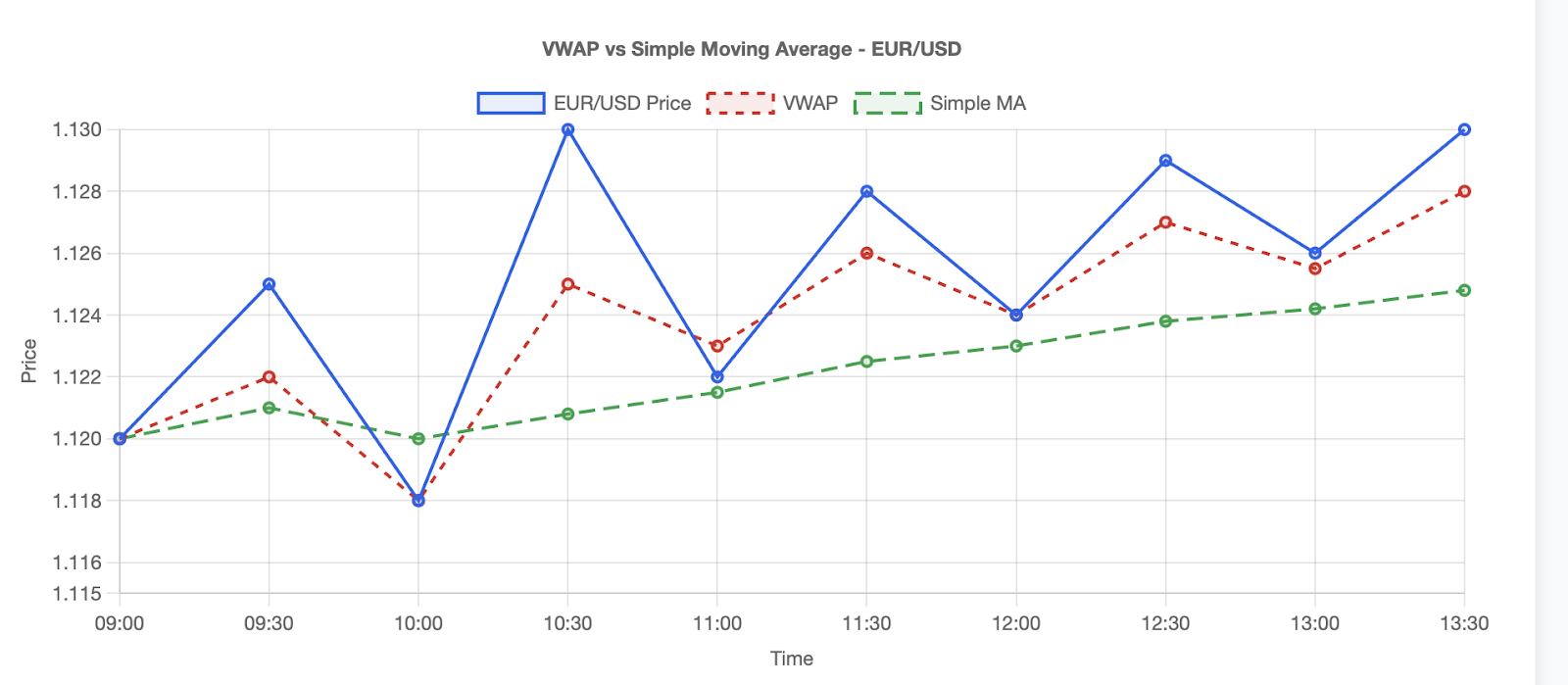
The beauty about this simple calculation is that it can be tracked cumulatively. With every new period the next number we are adding to either the price × volume in the numerator and volume in the denominator; it is like a running weighted average, just like we discussed above, that becomes increasingly stable.
If you think about this like calculating your semester GPA. If you take a 3-credit course it will affect your average more than a 1-credit course, same concept with VWAP; they both share the course load of participation. Participation has to be the key here. It is the very key component making VWAP truly valuable to a more serious trader.
VWAP for Trend Confirmation
This is where one of the main situational advantages of VWAP enters the "fray" on behalf of the trader as it gives insight into market sentiment as well as strength of trend in relation to the price compared to VWAP.
If price persists above VWAP, buyers are exhibiting bullish behavior. If the market currently values the asset above the average price based on volume spent, buyers want to pay more than what sells for most of the volume weighed in the session. On the other hand, if price persists below VWAP, sellers are exhibiting bearish pressure - sellers have already accepted pricing below the average price based on volume in the session.
But here is the kicker: you need volume. A high price breakout above VWAP with a high level of volume is much more important than a breakout above VWAP with low volume. High volume is paramount for price confirmation to help indicate supply/demand.
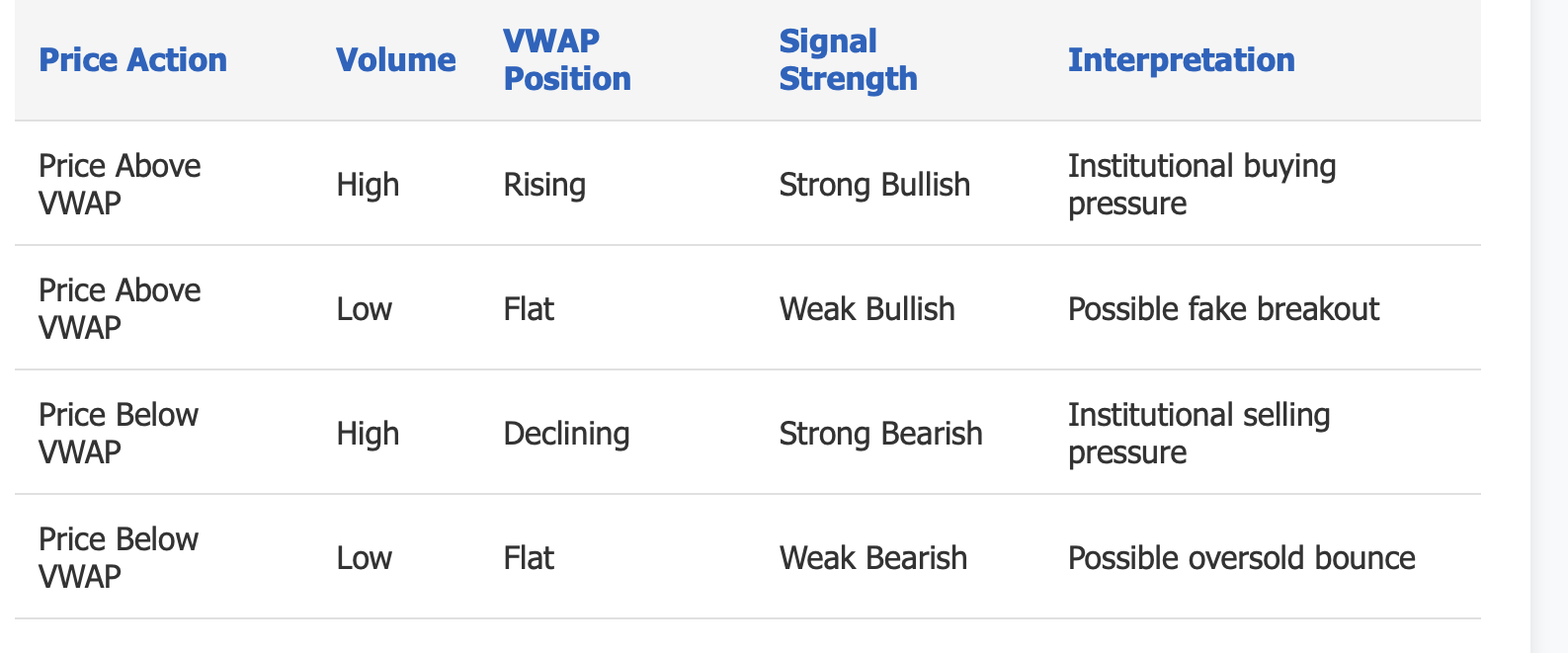
Similar to the public acknowledgement difference between hearing a few people clapping versus the entire audience giving a standing ovation, volume causes the price to continue.
For example, GBP/USD has traded below the volume weighted price all morning and it spikes above VWAP in price with heavy volume. The price is not arbitrarily spiking. The price they most likely marginally paid through, was institutional money coming in to create upward volatility. Intelligent traders see this as confirmation that bearish pressure could be abated.
The main reason VWAP is such an amazing trend filter is because it is dynamic. Unlike fixed support and resistance levels, VWAP continually adjusts itself throughout the session based on actual trading activity. This is particularly useful for day traders who are looking for feedback from the market when entering trades.
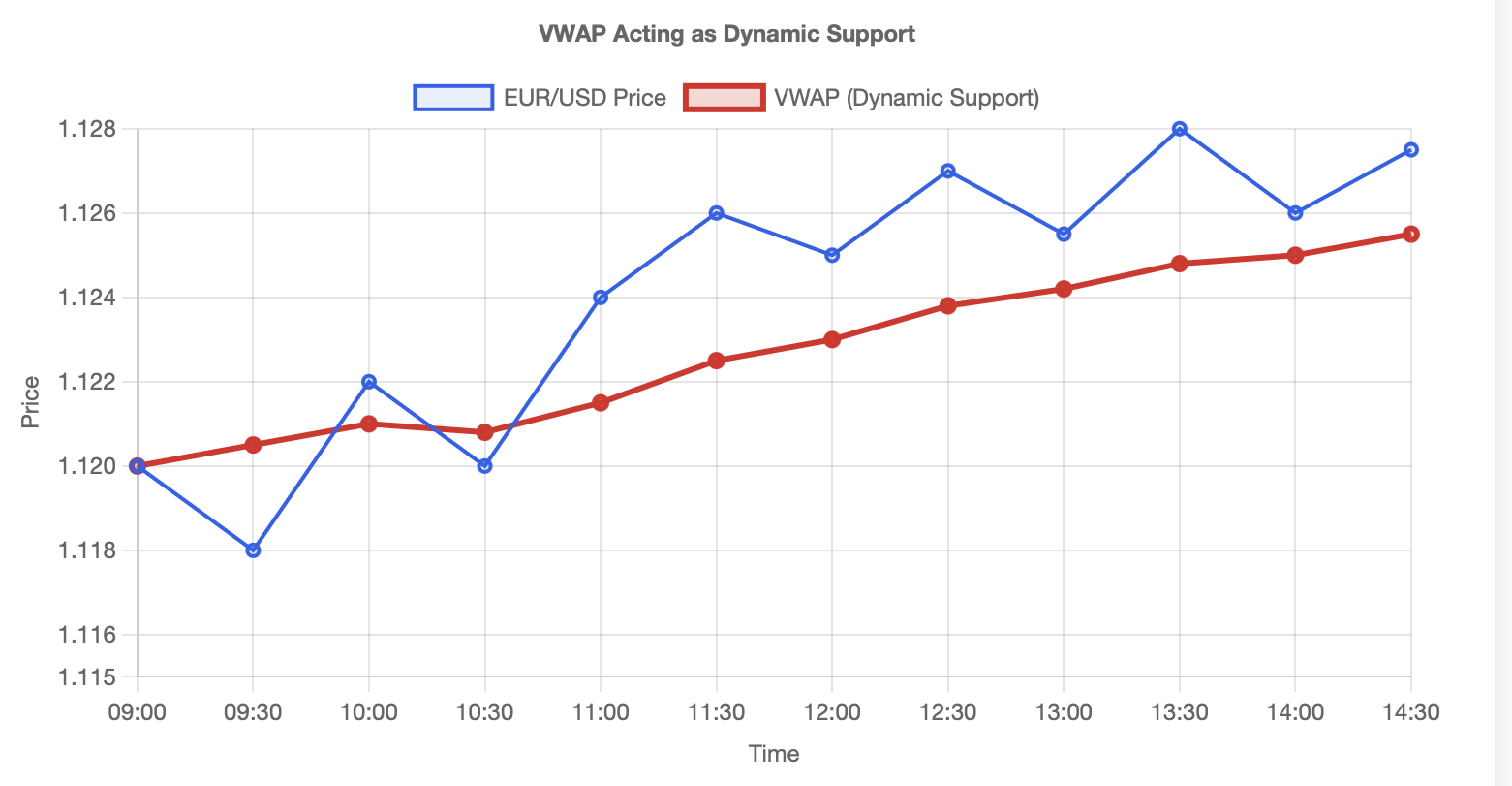
Keep in mind that VWAP is not a magic indicator. VWAP is a reference point which is utilized to align with the current trend rather than fighting it. Think of it as a weather vane signifying the directional feel of the institutional wind.
A professional trader may wait for pull backs into VWAP in a trending market. If, for example, the USD/JPY is in a strong uptrend and pulled back to test VWAP support, they may see that as a logical entry to join the trend instead of trying to "catch a knife falling."
VWAP Across Timeframes
VWAP is not just for day trading. Different time frames offer different perspectives and, at times, using more than one, creates a more complete understanding of market dynamics.
Intraday VWAP (daily reset) works perfectly for scalping and short-term momentum trades. It provides immediate feedback as to the attractiveness of current prices relevant to daily activity. Many professional traders use this as a primary reference when it comes to entries and exits.
A weekly VWAP provides a broader perspective of the trend. Once daily price action stays consistently above the VWAP levels for the week, you can assume a more sustained bias to the upside. This can help the swing trader align their position to institutional sentiment based on the larger timeframe.
The monthly VWAP serves as a longer-term filter still. Position traders utilize the monthly VWAP as a means to see deep movements in the market and to avoid going against the primary direction of the market. When price has traded above the monthly VWAP for an extended up move and then price trades below the monthly VWAP, the price directional movement could be a major shift in market structure.
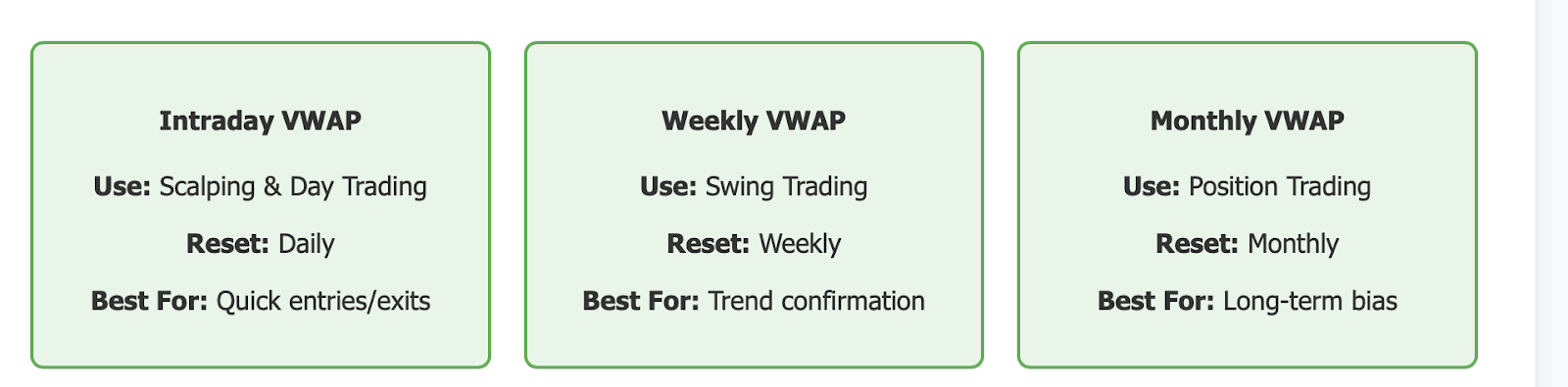
The real strength in this operation is the combination of the time frames. To illustrate: More specifically, if the EUR/USD is trading above the weekly VWAP (bullish longer term) while also trading below the daily VWAP (short-term weakness), this combination indicates a buying opportunity. The monthly trend has remained intact and that will usually create an area for better probability of trade.
This time-frame combination can be viewed like a map where the monthly VWAP represents the interstate highway direction, the weekly the local roads and the daily VWAP the immediate traffic conditions. All 3 elements matter depending on the length of your route.
The savvy trader will ultimately build a multi-frame filtering framework to identify trade durations. The trader may take long trade decisions once the price crosses above the weekly VWAP, and then apply daily VWAP for entry and exit timing. This process provides a structured options beyond initial trading planning including the use of price action within trend direction, while maintaining the trader's ability to optimize their timing on the short timeframe.
VWAP as Dynamic Support and Resistance
Forget about resistance and support lines that are static from old swings highs or lows. VWAP creates dynamic levels that change in real time based on actual market activity. Which makes it a highly valuable intraday decision-making tool.
When markets trend higher or lower, VWAP often acts as a relatively moving support or resistance level. In higher trends, price tends to find support at VWAP on pullbacks. In downtrends, VWAP often acts as resistance on price rallies. It's like having a dynamic floor or ceiling that shifts with the true center of gravity of market price.
The important part of this tool, is understanding the context. In strong trends where VWAP is acting as support or resistance, the price is more likely to hold, as institutional players are most likely in the market defending these levels. In weaker and sideways markets, price may slice through VWAP repeatedly, without basis for a price level changes.
As an example, the EUR/GBP is trending to higher price levels, and the price pulls back to test VWAP support. If the price holds, and VWAP support holds with more volume coming into the market , this is typically a good entry point for continuation trades. It is probable that institutions are stepping in here, at fair value, to defend the trend.
The advantage of the fluidity of dynamic support and resistance is that it evolves. Static levels may become irrelevant as underlying market dynamics shift, but VWAP recalibrates itself and evolves based on recent trades. It is similar to having a GPS model constantly updating your means of transportation given real-time traffic conditions.
VWAP bounces are one of the low-risk entry criteria that may be used by both professional traders and other veteran traders alike. The logic is straightforward: if price has a difficult time breaking a volume weighted average level, then there is an indication that the trend in the opposite direction has strength. This is a set up with a high probability of safety and decisiveness with risk management levels.
Consider VWAP in terms of the center line of a basketball court. In a game, players are naturally drawn to the center line and it is on the center line that we determine which team gains positional advantage. In trading terms, being on the right side of VWAP simply means you are trading with institutional positioning.
VWAP Trade Strategies
Now, we get to the items that are practical. Here are real drop usings VWAP strategies used by professional traders who continue to profit consistently from diminished trading.
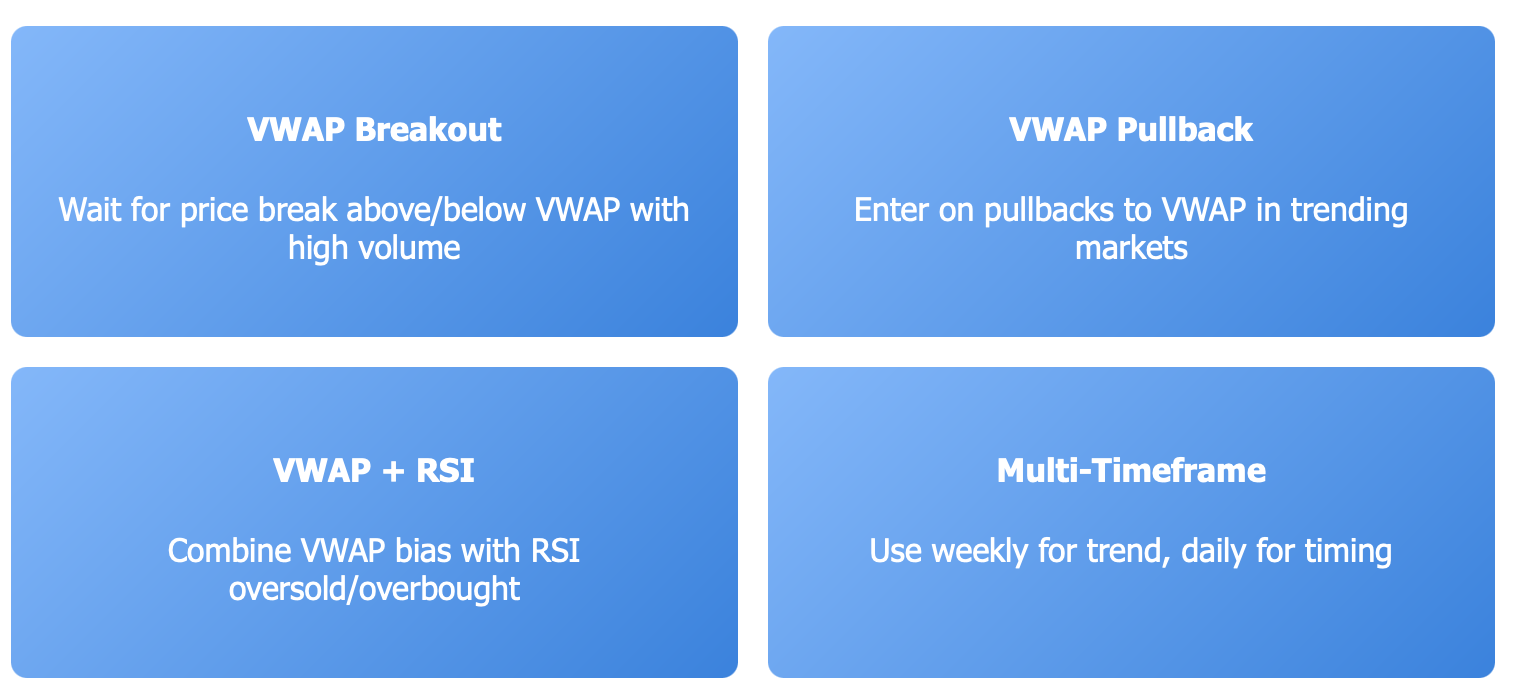
Strategy 1: The VWAP Breakout Wait for a significant price break above or below the VWAP that shows heavy volume, this would indicate that institutions are entering the trade for a potential move. Trade with the breakout and use the VWAP as your first stop-loss level. Remember, it is the volume that confirms the breakout as a valid breakout and not a false breakout.
Strategy 2: The VWAP Pullback In a trending market, it is common to use VWAP to enter as a dynamic support or resistance level. For example, what if EUR/USD is heading to the upside? If price were to pull back to the VWAP level then wait for a bullish reversal signal in order to enter back into the market. Such a sign could be a hammer candlestick or the RSI diverging from the price action. The reason this strategy works is that price is often pulled back towards the VWAP level at fair value where institutions will typically buy the dips.
Strategy 3: VWAP + RSI Combination Also, the VWAP pairs well with the RSI for higher-probability setups. When the price is above the VWAP (bullish bias) while agreeing with the RSI being in the oversold zone (below 30), it often results in excellent buying opportunities. The opposite is true for selling opportunities.
Strategy 4: Multiple Timeframe VWAP Using the VWAP on a weekly timeframe helps with the trend direction while the VWAP on the daily timeframe is used to time the entry. Generally, only take the trade if the trade is showing the same bias as the weekly VWAP while the daily VWAP would give you the best level of the entry/exit. This helps you stay in alignment with institutional flow but gives you better timing.
The foundation of effective VWAP trading revolves around patience and context. You should choose not to chase every VWAP engagement and pick your approaches that offer higher probabilities where volume, trend, and price action align. VWAP signals are similar to dating; when seeking the right opportunity, focus on quality vs now many options; it will significantly improve your outcome.
Risk management is one of the most critical components, as it is through position sizing that you can remain in trade while the price fluctuates normally along the VWAP levels. The professional trader standard for risk management is to risk 1-2% of their account balance, regardless of how "obvious" setup might look.
Advanced VWAP Techniques
Advanced techniques may give you an edge over many retail traders once you understand some of the simple VWAP concepts or principles.
VWAP Deviation Analysis: Look at how far price deviates from VWAP; extreme deviations will generally lead to mean reversion moves. For example, when price becomes too stretched from VWAP, typically 2-3 standard deviations of range from VWAP. It typically snaps back to VWAP creating excellent scalping opportunities to profit from in a timely manner.
VWAP Anchoring: Instead of simply using the VWAP from the standard day to calculate your VWAP, anchor your calculation to events. These may include major news, market open, and/or keen technical levels. This will provide you, as a trader, more relevant reference points than standardized time-driven reference points.
Volume Profile + VWAP: By utilizing VWAP in conjunction with volume profile analysis, you can notice where the greatest volume of trading actually happened at specific price levels. When VWAP is aligned with nodes of high volume, it can create especially important areas of support or resistance.
Multi-Asset VWAP Correlation
Track VWAP relationships between correlated currency pairs. For example, when EUR/USD and GBP/USD both break above their respective VWAPs at the same time, it signals weakness in the dollar rather than strength in either currency pair.
These approaches are more challenging and require more sophisticated analysis, but at the same time give you an additional edge in competitive markets. Experienced traders utilize these methods to find opportunities that newer traders miss.
You are well equipped to start gradually implementing these concepts. First, practice your basic use of VWAP, and then begin adding more advanced techniques. If you try to do it all at once, you wind up not deciding on a course of action in the first place - this is what is known as sifting through trades forever leading to paralysis analysis, which is often poor decision making.
VWAP and Market Psychology
VWAP is not a series of numbers and movements, it is a glimpse into market psychology and institutional activity. Knowing that there is a psychology piece to these movements can greatly improve your trade outcome.
When the price trades above VWAP it indicates that recent buyers are willing to pay above-average prices. A positive sign that they have confidence and are willing to chase momentum. When the price trades below VWAP, it is asserted that recent sellers are willing to sell at below-average prices and a negative sign that indicates urgency or pessimism on their part.
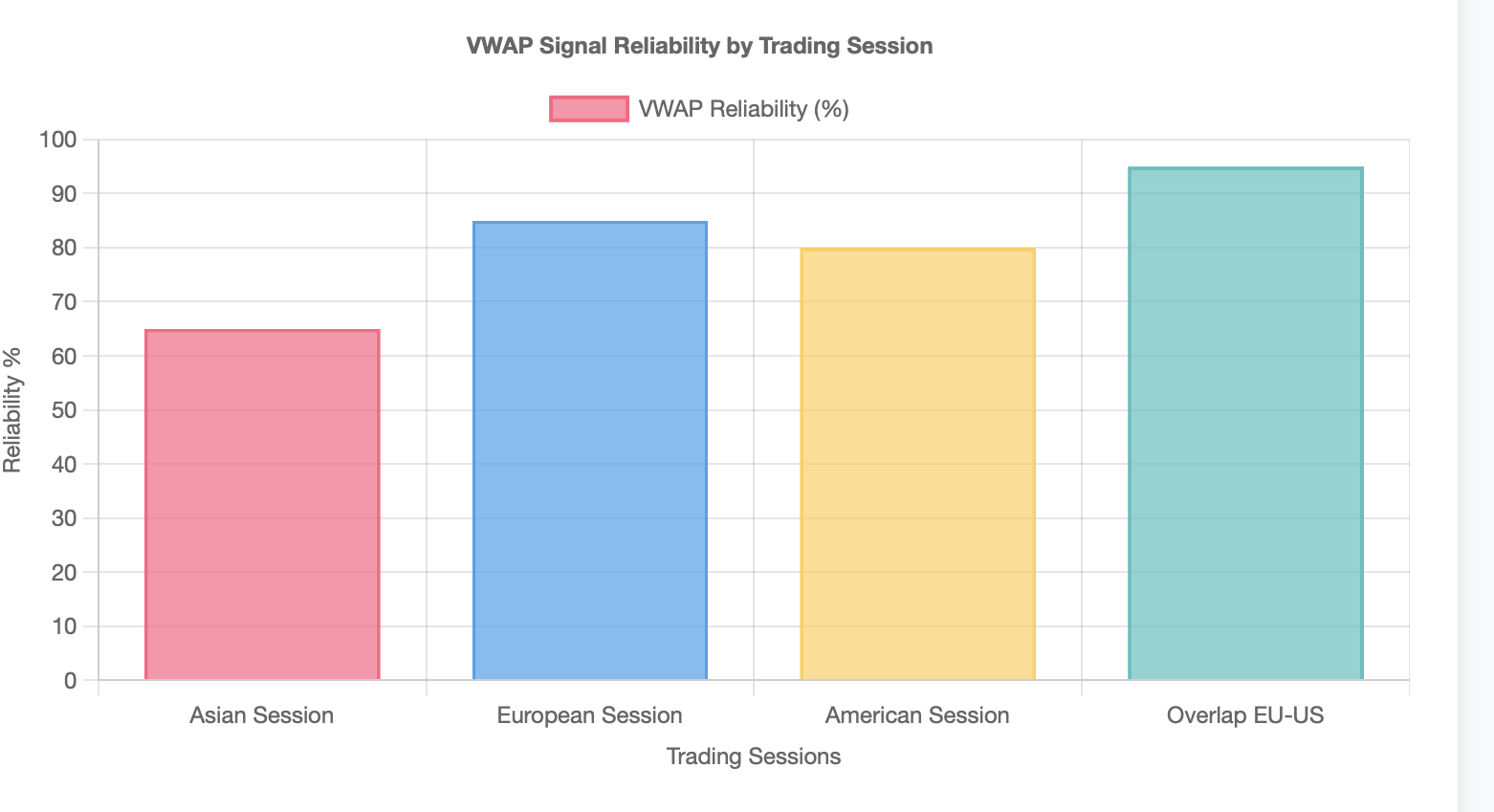
The battle of psychology surrounding send follows VWAP levels is particularly interesting in key market hours. In the European session, for instance, there may be VWAP levels established by traders that traders in the American session either respect or challenge. Ultimately, these interactions showcase the continuing battle between various institutional groups.
The viewpoint of retail traders is also relevant to consider. When the price is traveling to VWAP or approaching VWAP (e.g. from above) retail traders often sell in anticipation that the price reverses. If there are institutional buyers defending VWAP as support, however, the stop-loss of retail traders will aid prices to go even higher. This awareness of the dialogue helps you position alongside the smart-money as opposed to against it.
There are also times the herd mentality comes into play at VWAP levels. The more traders that adopt VWAP as an analytical tool, the more these levels become self-fulfilling prophecies. When all traders are looking at the same level it inevitably becomes important because everyone is looking to the same level as important.
The main reason VWAP functions best in liquid markets with widely diverse engagements is because the key psychological element is present. In unliquid markets (thin markets), large orders can knock the VWAP off a screwy/track and generate false signals. The VWAP relationship should always be interpreted in the context of the market.
VWAP Limitations and Suggestions
As with any trading tool, VWAP does have limitations you should be aware of in order to use it effectively, and to do that there are a few qualifiers.
Liquidity Issues: In illiquid currency pairs or during low activity hours, VWAP signals are not as reliable. Orders on both sides can knock the VWAP off track and generate false signals. Stick with the majors during active trading hours.
Nature of the Lagging: VWAP is a lagging indicator based on actual price and volume previously traded in a specific timeframe or over a rolling period of time. In a rapidly changing market, the VWAP might not be suitable for ascertaining current sentiment in the near-term moments. You cannot use the VWAP purely as your basis for entries, instead combine VWAP with leading indicators or simply price action signal confirmations.
Quality of Volume Data: VWAP is not as reliable for forex volume data as it is for an equity market exchange simply for the reason that there's no centralized exchange. You will observe that different brokers will display different volume numbers, or at least have a different and often incomplete set of calculations to come up with VWAP involving volume. You will have to treat VWAP as more of a generalization tool than a precise calculation.
False Breakouts: Not every VWAP breakout will lead to an explosive price movement. There are times when market makers or algorithmic traders will push price through the VWAP levels to squeeze out stops and then revert the price movement shortly after. Always wait for confirmation with volume and keep the bigger picture in mind.
Overreliance on VWAP It is a tool. It is not a secret X-factor that will produce winning trades easily for you. Some traders become so fixated on the VWAP levels that they forget about other relevant market data or news events or economic releases or even major technical levels. So be sure to keep a balanced approach.
The best VWAP traders will look at VWAP as just one piece of a larger puzzle! VWAP works well in conjunction with trend analysis, support and resistance, momentum indicators and fundamental analysis that will help them define a complete trading decision.
As always, practice with demo accounts to develop your skills before placing real money on the line. Trading with VWAP takes practice and experience to identify the high-probability setups from the false moves. When trading with VWAP I always recommend starting with small position sizes and increasing as you grow comfortable and proficient.
Conclusion & Practical Advice
VWAP makes the difference between guessing and making a strategic decision in forex trading. Its great benefit is that it shows you where the institutional money is being positioned in the market on the VWAP plot. It create a roadmap to trade with the smart money and not against it.
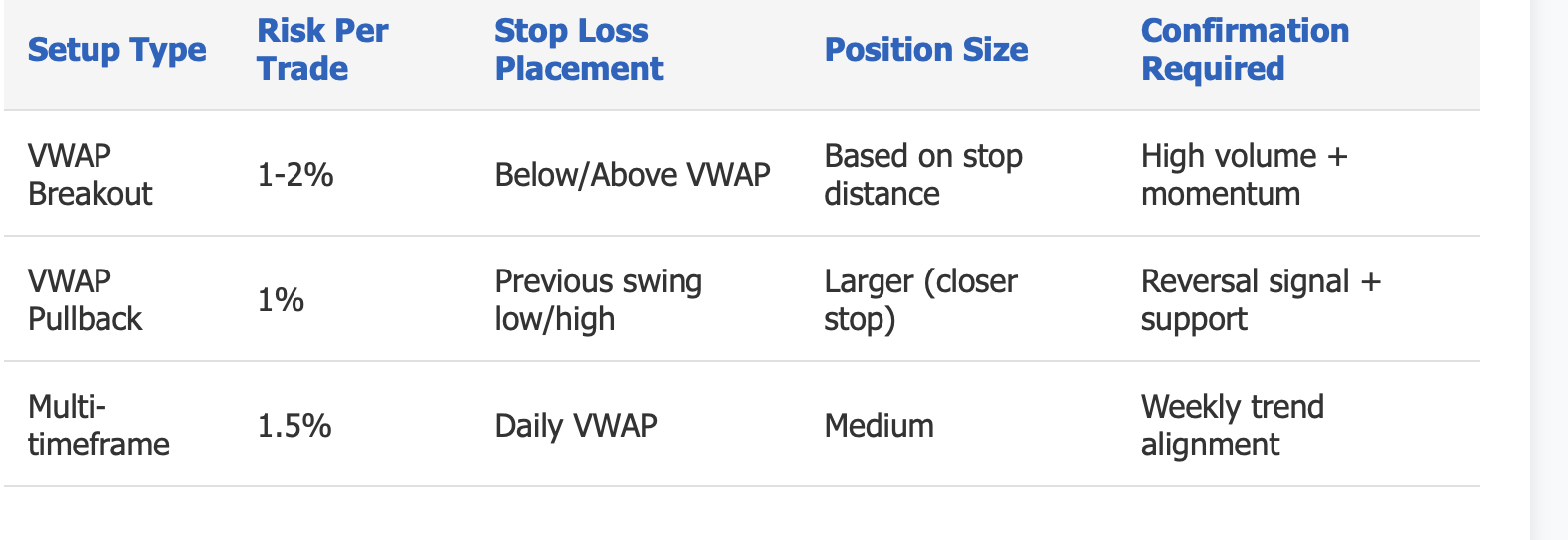
Start with major currency pairs during liquid trading sessions. Use daily VWAP for intraday decisions and weekly VWAP for the overall context of trend. Don't act on any of the VWAP signals unless you get volume confirmation and incorporate proper risk management along with VWAP analysis.
The best VWAP traders develop patience and discipline. They do not act on every trade signal they see. They wait and only trade their higher probability set-ups, where several aspects align. They know that VWAP is not meant to be a signal for inevitable profit; it is used to improve the odds.
As you will learn, markets change and so will your evolving methodology. What can work with trending markets may not work with range markets. Be fluid and continue to learn from trading and each trade irrespective of the profit and loss association.
Practice makes permanent, not perfect. And while I don't usually encourage demo accounts, I do recommend practicing and honing your VWAP skills so you know what to expect while establishing your expectations using uncomfortable capital. Track your outcomes and find the best VWAP strategy to match your style and risk tolerance.
Finally, VWAP should be a tool to enhance your current trading methodology, not a treatment for poor trading methodology. So continue to focus on your proper position size, risk management, etc, emotional discipline, while utilizing VWAP analysis to improve market timing and identify trends.
Are You Prepared to Elevate Your Trading Game?
Don't allow another profitable VWAP setup to pass while you are still resolving the fundamentals. Join thousands of successful traders who have improved their trading results by learning how to quickly and easily use professional indicators like VWAP.
Disclaimer: The content of the blog does not represent any position of Trade W, does not serve as any trading-related decision advice, and does not endorse any third-party.